
- Home
- »
- Advanced Interior Materials
- »
-
Raman Spectroscopy Market Size, Share Report, 2026-2033GVR Report cover
![Raman Spectroscopy Market (2026 - 2033)Report]()
Raman Spectroscopy Market (2026 - 2033)
Size, Share & Trends Analysis Report By Sampling Technique (Tip-enhanced Raman Scattering, Surface-enhanced Raman Scattering), By Instrument Type, By End-use, By Region, And Segment Forecasts
Market Size, 2025
$1.2BMarket Estimate, 2026
$1.3BMarket Forecast, 2033
$1.8BCAGR, 2026–2033
5.1%Raman Spectroscopy Market Summary
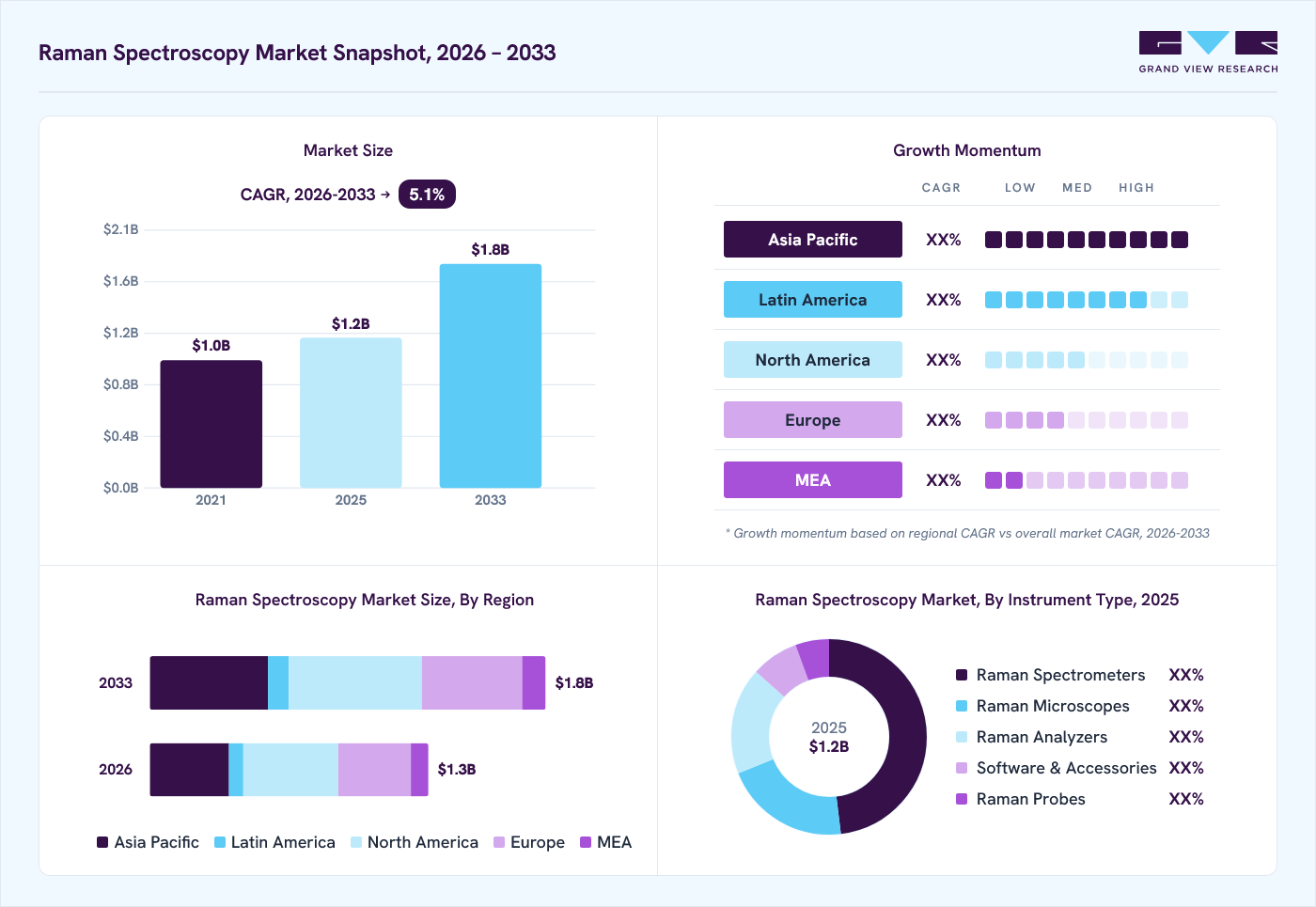
The global Raman spectroscopy market size was valued at USD 1.2 billion in 2025 and is projected to grow from USD 1.3 billion in 2026 to USD 1.8 billion by 2033, at a CAGR of 5.1% from 2026 to 2033. North America dominated the market, accounting for the largest revenue share of 34.1% in 2025. The market is being driven by the growing need for rapid, accurate, and non-destructive material identification and analysis across pharmaceutical, life sciences, food & beverage, chemical, semiconductor, and materials industries.
Key Market Trends & Insights
- By sampling technique: Surface-enhanced Raman scattering segment held the largest market share of 79.2% in 2025.
- By instrument type: Raman spectrometers segment held the largest market share of 48.0% in 2025.
- By end-use: Pharmaceutical segment held the largest market share of 20.9% in 2025.
Regional Highlights
- Largest regional market: North America (34.1% revenue share, 2025)
- Fastest-growing regional market: Asia Pacific (highest CAGR, 2026-2033)
- By country: The U.S. held the largest share of North America in 2025.
Market Size & Forecast
- Market size in 2025: USD 1.2 Billion
- Estimated market size in 2026: USD 1.3 Billion
- Projected market size by 2033: USD 1.8 Billion
- CAGR (2026-2033): 5.1%
Manufacturers and research organizations increasingly require analytical techniques that can provide molecular information with limited sample preparation and minimal sample damage. Technological advancements are also expanding the use of Raman spectroscopy beyond conventional laboratory testing. Portable and handheld Raman analyzers, Raman microscopy, improved detectors, compact laser systems, and advanced spectral-analysis software are making the technology more practical for field and on-site applications.
At the same time, specialized techniques such as surface-enhanced Raman scattering (SERS) are improving sensitivity for trace-level detection, while Raman probes enable analysis directly within manufacturing processes. These developments are increasing the range of applications for Raman systems and encouraging adoption in areas such as semiconductor manufacturing, mineral identification, nanomaterial research, and real-time process analysis.
Market Dynamics
The Raman spectroscopy industry is shaped by the increasing demand for rapid, non-destructive material analysis across pharmaceuticals, life sciences, food & beverage, chemicals, semiconductors, mining, and advanced materials. Growing adoption of portable and handheld systems, Raman microscopy, process monitoring solutions, and enhanced Raman techniques is expanding the application base. At the same time, high equipment costs, technical complexity, and the need for skilled personnel can limit adoption, particularly among smaller laboratories and price-sensitive end users.
The increasing need to identify and characterize materials without significantly altering or damaging samples is driving the adoption of Raman spectroscopy. Unlike many conventional analytical techniques, Raman systems can provide molecular and chemical information with minimal sample preparation, making them useful for quality control, raw material verification, contamination detection, and research. This is particularly valuable in the pharmaceutical, chemical, food, and materials industries, where rapid analysis can improve testing efficiency and reduce delays.
Growing requirements for faster testing are also encouraging the use of Raman systems outside conventional laboratories. Portable and handheld Raman analyzers enable material identification directly at manufacturing sites, warehouses, mining locations, and other field environments. Raman probes further support real-time analysis within production processes, while Raman microscopes enable characterization of very small areas in semiconductor, electronics, and advanced-material applications. These capabilities are broadening the addressable market and supporting continued adoption.
The relatively high cost of advanced Raman instruments, particularly Raman microscopes, specialized systems, and enhanced Raman solutions, can restrict adoption among smaller laboratories and organizations with limited analytical budgets. In addition, system selection, calibration, spectral interpretation, and integration with existing laboratory or production workflows may require specialized technical expertise. These factors can increase the overall investment required and encourage some users to continue relying on conventional analytical techniques.
The growing availability of compact, handheld, and portable Raman systems presents a significant opportunity for market expansion. These systems allow users to perform material identification and analysis directly at the point of use, reducing the need to transport samples to centralized laboratories. Applications in pharmaceutical raw-material verification, chemical identification, food testing, mining, environmental analysis, and forensic investigation can benefit from this flexibility.
Further opportunities are emerging from in-line and real-time Raman monitoring, where probes can continuously analyze materials during manufacturing. Integration with automation, advanced data analytics, and AI-based spectral interpretation can improve process control and reduce reliance on manual testing. This is expected to create additional demand for Raman systems in pharmaceutical manufacturing, chemicals, semiconductor production, and other industries requiring continuous quality monitoring.
Market Concentration & Characteristics
The Raman spectroscopy industry is concentrated, with a limited number of established players holding a significant share of the market across Raman spectrometers, microscopes, analyzers, probes, and related software. However, the presence of specialized manufacturers and emerging technology providers offering portable systems, advanced microscopy, enhanced Raman techniques, and application-specific solutions creates a competitive environment. The market therefore, reflects a moderately concentrated structure, combining established global suppliers with smaller specialized participants.
The Raman spectroscopy industry is highly innovative, supported by continuous improvements in laser sources, detectors, optics, signal processing, miniaturization, and spectral analysis software. The development of portable and handheld systems, Raman microscopy, SERS, TERS, and AI-assisted spectral interpretation is expanding the technology's reach into new applications. These innovations are improving sensitivity, speed, portability, and the ability to analyze smaller samples.
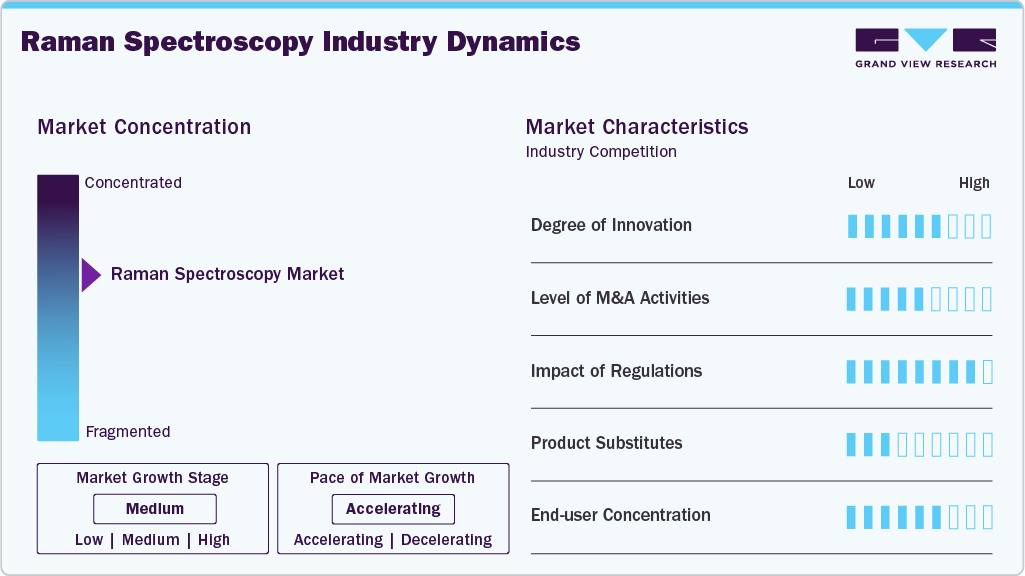
The Raman spectroscopy industry experiences a moderate impact from regulations. Raman systems are generally analytical tools and are not directly subject to extensive product-specific regulation. However, regulatory requirements in industries such as pharmaceuticals, food & beverage, healthcare, chemicals, and environmental testing influence how the technology is used for quality control, material verification, process monitoring, and compliance testing. Requirements for data accuracy, traceability, validation, and laboratory standards can therefore support demand for reliable Raman systems.
The market has a moderate level of end-user concentration, as demand comes from a broad range of industries rather than a single application sector. Pharmaceuticals, life sciences, chemicals, food & beverage, semiconductor & electronics, mining, and materials research all use Raman spectroscopy for different analytical requirements. However, pharmaceutical, semiconductor, and research applications drive significant demand for advanced, high-value systems, giving these end-user groups greater influence over technology adoption and product development.
Analyst Perspective
The Raman spectroscopy market is positioned for steady expansion as industries increasingly seek rapid, non-destructive, and highly specific methods for material identification and process analysis. Pharmaceutical applications remain a key demand driver, while semiconductor, life sciences, chemical, food & beverage, and advanced materials applications are broadening the market base. Technological developments in portable systems, Raman microscopy, probes, SERS, and data analytics are also expanding the range of applications beyond conventional laboratory testing. Going forward, greater integration of Raman systems with real-time process monitoring, automation, and advanced data analysis is expected to create additional opportunities, although equipment costs and technical requirements may continue to limit adoption among smaller users.
Sampling Technique Insights
The surface-enhanced Raman scattering (SERS) segment led the market with the largest revenue share of 79.2% in 2025, supported by its ability to significantly enhance Raman signals and enable the detection of very low concentrations of target substances. Its strong sensitivity makes it valuable across pharmaceutical, life sciences, food & beverage, chemical, and environmental applications, particularly where trace-level identification is required. The increasing demand for rapid and sensitive analytical techniques is further driving the adoption of SERS.
The tip-enhanced Raman scattering (TERS) segment is expected to grow at the fastest CAGR of 5.4% during the forecast period, driven by its ability to provide highly localized chemical and structural information at the nanoscale. Growing research in nanomaterials, semiconductors, graphene, and advanced materials is increasing demand for high-resolution characterization techniques. Continued improvements in Raman microscopy and nanoscale measurement capabilities are expected to further expand TERS applications.
Instrument Type Insights
The Raman spectrometers segment led the market with the largest revenue share of 48.0% in 2025, owing to their broad use across pharmaceutical, chemical, food & beverage, life sciences, and materials characterization applications. These systems provide rapid and non-destructive chemical identification and material analysis, making them widely used for research, quality control, and laboratory testing. Their availability across different configurations, from laboratory systems to compact instruments, further supports their adoption.
The software & accessories segment is expected to grow at the fastest CAGR of 6.2% during the forecast period, supported by increasing demand for advanced spectral analysis, automation, data management, and improved instrument performance. Growing adoption of AI-assisted analysis, specialized software, improved detectors, lasers, sampling components, and other accessories is enhancing the capabilities of Raman systems. The increasing integration of Raman instruments with digital laboratory and process-monitoring workflows is also creating additional demand for supporting software and components.
End-use Insights
The pharmaceutical segment led the market with the largest revenue share of 20.9% in 2025, driven by the growing use of Raman spectroscopy for raw-material identification, drug formulation analysis, quality control, and process monitoring. The technology enables rapid, non-destructive analysis with minimal sample preparation, making it suitable for pharmaceutical manufacturing and research. Increasing focus on product quality, process consistency, and efficient analytical testing is further supporting adoption across the pharmaceutical industry.
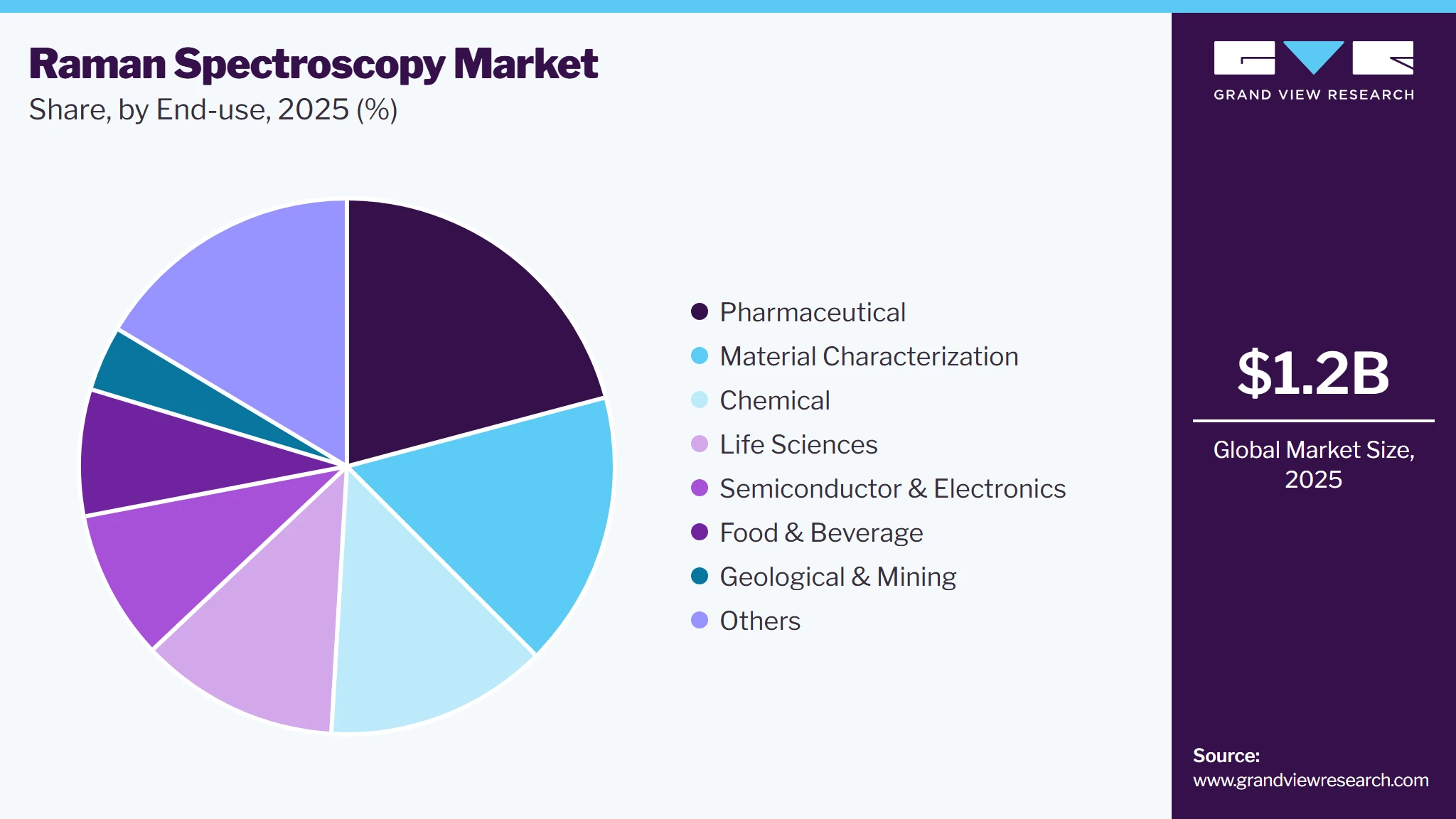
The chemical segment is expected to grow at the fastest CAGR of 5.7% during the forecast period, supported by increasing demand for rapid chemical identification, composition analysis, and real-time process monitoring. Raman spectroscopy can analyze materials directly during production, reducing the need for frequent sample collection and laboratory testing. Growing investments in chemical manufacturing and the adoption of Raman probes for in-line monitoring are expected to further increase its use across chemical processing applications.
Regional Insights
North America dominated the global Raman spectroscopy market with the largest revenue share of 34.1% in 2025, supported by the strong presence of pharmaceutical, biotechnology, semiconductor, chemical, and advanced materials industries. The region also benefits from extensive research and development activities and widespread adoption of advanced analytical technologies across industrial and academic laboratories. Increasing investments in pharmaceutical manufacturing, semiconductor research, and life sciences are sustaining demand for high-performance Raman spectroscopy systems.

U.S. Raman Spectroscopy Market Trends
The Raman spectroscopy market in the U.S. accounted for the largest market revenue share in North America in 2025, supported by its strong semiconductor, pharmaceutical, life sciences, and advanced materials industries, as well as extensive research and development activities. According to the Semiconductor Industry Association (SIA), U.S.-headquartered companies generated USD 425 billion in semiconductor sales in 2025, representing 53.4% of global semiconductor sales. The report also noted that U.S. semiconductor companies invested a record USD 76.8 billion in R&D in 2025, highlighting the country’s strong focus on advanced technology and material research. These developments support demand for Raman spectroscopy for material characterization, semiconductor research, quality analysis, and process development.
Europe Raman Spectroscopy Market Trends
The Raman spectroscopy market in Europe is expected to grow steadily, supported by established pharmaceutical, chemical, food processing, and research industries. Increasing emphasis on product quality, advanced manufacturing, and process efficiency is encouraging the use of Raman spectroscopy for material verification and process analysis. Growing research in biotechnology, nanomaterials, and sustainable materials is also creating opportunities for Raman microscopy and other advanced systems.
The Germany Raman spectroscopy market held a significant share in Europe in 2025, supported by its strong chemical, pharmaceutical, manufacturing, and research base. The country has a highly R&D-intensive industrial ecosystem, creating sustained demand for advanced analytical and materials characterization technologies.
The Raman spectroscopy market in France is expected to grow rapidly, supported by its established pharmaceutical, chemical, biotechnology, food, and research sectors. The country’s pharmaceutical industry provides a particularly relevant application base, with Raman spectroscopy used for raw material verification, quality control, formulation analysis, and process monitoring. France is also strengthening its focus on pharmaceutical research, innovation, and domestic production, creating opportunities for advanced analytical technologies.
Asia Pacific Raman Spectroscopy Market Trends
The Raman spectroscopy market in the Asia Pacific is expected to grow at the fastest CAGR during the forecast period, driven by expanding pharmaceutical manufacturing, electronics and semiconductor production, chemical processing, and research activities. Countries such as China, Japan, South Korea, and India are increasing investments in advanced manufacturing and laboratory infrastructure, creating greater demand for rapid material identification and quality analysis. Growing adoption of portable and automated Raman systems is also supporting market expansion.
The China Raman spectroscopy market is supported by its large-scale manufacturing base in pharmaceuticals, chemicals, electronics, semiconductors, and advanced materials. The country’s expanding research infrastructure and continued investment in high-technology manufacturing are increasing the need for material identification, quality control, and advanced characterization. The growing adoption of Raman microscopy and spectroscopy in semiconductor, nanomaterial, pharmaceutical, and industrial research is further strengthening China’s position in the regional market.
The Raman spectroscopy market in India is expected to grow strongly, supported by the expansion of pharmaceutical manufacturing, biotechnology, chemicals, electronics, and advanced research activities. According to IBEF, India’s pharmaceutical industry recorded a turnover of INR 2.25 trillion (USD 26.3 billion) in FY2025, while pharmaceutical exports reached USD 30.5 billion. The country’s growing high-technology manufacturing base also supports demand for advanced material characterization and quality-control technologies. In addition, the expansion of semiconductor and electronics manufacturing is creating opportunities for Raman spectroscopy in material analysis, process development, and quality testing, further supporting market growth.
Middle East & Africa Raman Spectroscopy Market Trends
The Raman spectroscopy market in the Middle East & Africa is projected to grow steadily, with demand supported by expanding activities in the chemical, pharmaceutical, food processing, mining, and research sectors. Mining and mineral exploration create opportunities for portable Raman analyzers, while chemical and pharmaceutical facilities can benefit from Raman-based material verification and process monitoring. Increasing investment in industrial diversification and laboratory infrastructure is expected to support adoption over the forecast period.
The Saudi Arabia Raman spectroscopy market is expected to grow at a significant CAGR during the forecast period, supported by the expansion of pharmaceutical, biotechnology, chemical, food, and advanced manufacturing activities under Vision 2030. The country’s focus on localizing pharmaceutical and biomanufacturing capabilities, strengthening research infrastructure, and developing biotechnology is driving greater demand for analytical technologies for material identification, quality control, pharmaceutical analysis, and process monitoring. The National Biotechnology Strategy is also encouraging investment in biomanufacturing, genomics, vaccines, and related research, creating additional opportunities for Raman spectroscopy across life sciences and industrial applications.
Latin America Raman Spectroscopy Market Trends
The Raman spectroscopy market in Latin America is expected to experience gradual market growth, supported by increasing pharmaceutical production, food processing, mining, and chemical activities. Raman spectroscopy is gaining relevance for mineral identification, quality control, ingredient verification, and laboratory analysis. Improvements in industrial testing capabilities and increasing adoption of modern analytical equipment are expected to gradually expand the regional customer base.
The Brazil Raman spectroscopy market is expected to maintain its leading position in the Latin America market, supported by its established pharmaceutical, chemical, food & beverage, mining, and research sectors. Expanding industrial activity is increasing the need for material identification, chemical analysis, quality control, and process monitoring. The country’s strong mining and agricultural base also creates opportunities for Raman spectroscopy in mineral identification, food testing, and material characterization, while growing investments in pharmaceutical and chemical research are supporting wider adoption of advanced analytical technologies.
Key Raman Spectroscopy Company Insights
Some of the key players operating in the market include Thermo Fisher Scientific, Mettler Toledo, and Renishaw plc.
-
Thermo Fisher Scientific Inc. is a global provider of scientific and analytical technologies, serving life sciences research, pharmaceutical development and manufacturing, laboratory testing, and other industrial applications. The company offers Raman spectroscopy solutions under its Thermo Scientific portfolio, including Raman microscopes, spectrometers, process Raman analyzers, and related sampling and probe solutions. These systems are used for chemical identification, material characterization, quality control, pharmaceutical analysis, semiconductor research, and process monitoring across academic and industrial settings.
-
Mettler Toledo is a global supplier of precision instruments and analytical solutions, serving industries such as life sciences, food, chemicals, and manufacturing. Its portfolio covers laboratory weighing, analytical instruments, automated reactors, in-situ analysis, and process analytics, supporting applications across research and development, quality control, scale-up, and production. The company’s solutions combine precision measurement, automation, and software to improve analytical accuracy, process optimization, and quality management.
Key Raman Spectroscopy Companies
The following key companies have been profiled for this study on the raman spectroscopy market.
-
Thermo Fisher Scientific
-
Mettler Toledo
-
Renishaw plc.
-
Bruker
-
HORIBA
-
Agilent Technologies
-
Oxford Instruments
-
Rigaku Holdings Corporation
-
Metrohm
-
JASCO Global
-
PerkinElmer
-
Shimadzu Corporation
-
Edinburgh Instruments
-
Wasatch Photonics
-
Ocean Insight
Competitive Benchmarking
Category
Operating Strategies
Competitive Edge
Weakness
Established Players (e.g., Thermo Fisher Scientific; Mettler Toledo; Renishaw plc.; Bruker; HORIBA; Agilent Technologies)
- Expand product portfolios across spectrometers, microscopes, analyzers, probes, and software.
- Invest continuously in R&D, product launches, and advanced Raman technologies.
- Strengthen global distribution and application coverage across pharmaceutical, life sciences, materials, and semiconductor industries.
- Strong brand recognition and established relationships with large industrial and research customers.
- Broad technology portfolios covering multiple Raman applications and instrument configurations.
- Strong R&D capabilities and global sales networks.
- Advanced systems generally involve higher acquisition costs.
- Broad product portfolios can result in greater system complexity for smaller end users.
- Large global organizations may have less flexibility than specialized vendors in addressing highly niche requirements.
Emerging & Regional Players (e.g., Oxford Instruments; Rigaku Holdings Corporation; Metrohm; JASCO Global; PerkinElmer; Shimadzu Corporation)
- Focus on specialized Raman applications, portable systems, and application-specific solutions.
- Develop differentiated technologies for areas such as process monitoring, microscopy, and advanced material analysis.
- Expand through targeted partnerships and regional market penetration.
- Greater flexibility in developing customized and application-focused solutions.
- Ability to compete in niche markets where specialized technical capabilities are important.
- Portable and compact solutions can address field-based and cost-sensitive applications.
- Relatively smaller global distribution and application-support networks.
- Lower brand visibility compared with major multinational suppliers.
- More limited resources for large-scale R&D and global expansion.
Recent Developments
-
In January 2026, Renishaw launched Time-resolved Raman Spectroscopy (TRRS) integration for its inVia confocal Raman microscopes. The technology helps overcome sample fluorescence, enabling Raman analysis of samples that were previously difficult to measure. It uses a SPAD array detector with 50-picosecond temporal precision to distinguish Raman signals from fluorescence.
-
In June 2025,Thermo Fisher Scientific launched the Thermo Scientific MarqMetrix All-In-One X Process Raman Analyzer for real-time, in-line chemical analysis in hazardous environments. The analyzer is designed for applications across oil & gas, chemical, polymer, and pharmaceutical industries.
Global Raman Spectroscopy Market Report Scope
Report Attribute
Details
Market size in 2025
USD 1.2 billion
Estimated market size in 2026
USD 1.3 billion
Projected market size by 2033
USD 1.8 billion
Growth rate
CAGR of 5.1% from 2026 to 2033
Base year for estimation
2025
Historical data
2021 - 2024
Forecast period
2026 - 2033
Quantitative units
Revenue in USD million/billion, and CAGR from 2026 to 2033
Report coverage
Revenue forecast, company ranking, competitive landscape, growth factors, and trends
Segments covered
Sampling technique, instrument type, end-use, region
Regional scope
North America; Europe; Asia Pacific; Latin America; Middle East & Africa
Country scope
U.S.; Canada; Mexico; UK; Germany; France; Spain; Italy; China; Japan; India; Australia; South Korea; Brazil; Argentina; Saudi Arabia; UAE; South Africa
Key companies profiled
Thermo Fisher Scientific; Mettler Toledo; Renishaw plc.; Bruker; HORIBA; Agilent Technologies; Oxford Instruments; Rigaku Holdings Corporation; Metrohm; JASCO Global; PerkinElmer; Shimadzu Corporation; Edinburgh Instruments; Wasatch Photonics; Ocean Insight.
Customization scope
Free report customization (equivalent up to 8 analysts working days) with purchase. Addition or alteration to country, regional & segment scope.
Pricing and purchase options
Avail customized purchase options to meet your exact research needs. Explore purchase options
Global Raman Spectroscopy Market Report Segmentation
This report forecasts revenue growth at global, regional, and country levels and provides an analysis of the latest industry trends in each of the sub-segments from 2021 to 2033. For this study, Grand View Research has segmented the global Raman spectroscopy market report based on sampling technique, instrument type, end-use, and region.

-
Sampling Technique Outlook (Revenue, USD Billion, 2021 - 2033)
-
Surface-enhanced Raman Scattering
-
Tip-enhanced Raman Scattering
-
-
Instrument Type Outlook (Revenue, USD Billion, 2021 - 2033)
-
Raman Spectrometers
-
Raman Microscopes
-
Raman Analyzers
-
Raman Probes
-
Software & Accessories
-
-
End-use Outlook (Revenue, USD Billion, 2021 - 2033)
-
Life Sciences
-
Food & Beverage
-
Pharmaceutical
-
Material Characterization
-
Chemical
-
Semiconductor & Electronics
-
Geological & Mining
-
Others
-
-
Regional Outlook (Revenue, USD Billion, 2021 - 2033)
-
North America
-
U.S.
-
Canada
-
Mexico
-
-
Europe
-
Germany
-
France
-
Italy
-
Spain
-
UK
-
-
Asia Pacific
-
China
-
India
-
Japan
-
South Korea
-
Australia
-
-
Latin America
-
Brazil
-
Argentina
-
-
Middle East & Africa
-
Saudi Arabia
-
UAE
-
South Africa
-
-
Research Methodology
The Raman spectroscopy marketfigures in this report are based on a proven research process that combines executive interviews with secondary research from proprietary databases, company filings, and recognized regulatory and institutional sources. Market size is built through value-chain sizing-reconciling supply-side and demand-side estimates-and triangulated with bottom-up and top-down approaches. Every estimate passes multiple levels of expert validation before publication, with eachRaman spectroscopy segment quantified using the revenue-capture definitions in the table below.
Segment Definition
Sampling Technique
Revenue Capture Definition
Surface-enhanced Raman Scattering
Revenue generated from the sale of Raman spectroscopy systems, analyzers, substrates, and related equipment specifically incorporating surface-enhanced Raman scattering technology for enhanced and trace-level chemical detection.
Tip-enhanced Raman Scattering
Revenue generated from the sale of Raman spectroscopy systems, microscopes, probes, tips, and related equipment incorporating tip-enhanced Raman scattering technology for nanoscale chemical and material analysis.
Instrument Type
Revenue Capture Definition
Raman Spectrometers
Revenue generated from the sale of laboratory, benchtop, portable, and handheld Raman spectrometers used for chemical identification, material analysis, and quality testing.
Raman Microscopes
Revenue generated from the sale of Raman microscope systems, combining Raman spectroscopy with microscopy for high-resolution chemical, structural, and spatial analysis of small or microscopic samples.
Raman Analyzers
Revenue generated from the sale of Raman analyzer systems designed for rapid material identification, chemical analysis, and laboratory or in-line process measurements.
Raman Probes
Revenue generated from the sale of Raman probes and probe assemblies used to collect Raman signals from samples for direct, in-situ, or process-based analysis.
Software & Accessories
Revenue generated from the sale of Raman analysis software, spectral libraries, sampling accessories, attachments, optical components, and other supporting products used with Raman spectroscopy systems.
End Use
Revenue Capture Definition
Life Sciences
Revenue generated from the sale of Raman spectroscopy instruments and related products used for biological, biomolecular, cellular, and tissue analysis in life sciences research and testing.
Food & Beverage
Revenue generated from the sale of Raman spectroscopy systems and related products used for food composition analysis, quality control, ingredient identification, and contaminant detection.
Pharmaceutical
Revenue generated from the sale of Raman spectroscopy instruments and related products used for pharmaceutical raw-material identification, formulation analysis, quality control, and process monitoring.
Material Characterization
Revenue generated from the sale of Raman spectroscopy systems and related products used to identify, characterize, and analyze the chemical, structural, and physical properties of materials.
Chemical
Revenue generated from the sale of Raman spectroscopy instruments, analyzers, probes, and related products used for chemical identification, composition analysis, reaction monitoring, and process control.
Semiconductor & Electronics
Revenue generated from the sale of Raman spectroscopy systems and related products used for semiconductor and electronic material characterization, defect analysis, stress measurement, and research.
Geological & Mining
Revenue generated from the sale of Raman spectroscopy instruments and related products used for mineral identification, geological analysis, ore characterization, and field material testing.
Others
Revenue generated from the sale of Raman spectroscopy instruments and related products used in other applications, including forensic analysis, environmental testing, art conservation, and security-related material identification.
Estimation Model
Layer Name
Key Question
Description
Market Scope & Segmentation
What products and applications are included in the market?
Define the Raman Spectroscopy Market scope across sampling techniques, instrument types, and end-use industries, while excluding unrelated spectroscopy products and services.
Supply & Demand Assessment
Who supplies Raman systems, and where is the demand coming from?
Assess the product revenues of manufacturers and demand across pharmaceutical, life sciences, chemical, food & beverage, semiconductor & electronics, material characterization, geological & mining, and other end-use sectors.
Geographic & Competitive Assessment
Where is the market generated, and how is it distributed?
Estimate market contribution across major regions and countries by evaluating industrial activity, research infrastructure, technology adoption, import activity, and the presence of key Raman spectroscopy suppliers.
Revenue Estimation
What is the total market revenue?
Calculate total market revenue based on sales of Raman spectrometers, Raman microscopes, Raman analyzers, Raman probes, software & accessories, and related Raman systems, followed by segmentation and geographic allocation.
Delivered Customizations
This report has been delivered with the following In-depth customizations
Client Request
Customization Delivered
Value Adds
Regional Segmentation
Delivered detailed regional and country-level analysis covering North America, Europe, Asia Pacific, Latin America, and the Middle East & Africa, with country-level insights for the U.S., Germany, France, China, India, Brazil, and Saudi Arabia.
Identifies regional market leaders and high-growth countries, while linking market development to pharmaceutical, semiconductor, chemical, research, and other relevant end-use activities.
Competitive Benchmarking
Delivered a competitive assessment of key Raman spectroscopy companies, including product portfolios, company descriptions, recent developments, market positioning, operating strategies, competitive advantages, and weaknesses.
Provides a clear view of the competitive structure and helps identify established versus specialized players, their technology focus, and areas of differentiation.
Opportunity Assessment
Delivered an assessment of opportunities across sampling techniques, instrument types, end-use industries, and regional markets, with emphasis on portable systems, advanced Raman techniques, process monitoring, and emerging applications.
Highlights attractive growth areas and supports strategic identification of high-potential segments, technologies, applications, and geographies.
Frequently Asked Questions About This Report
The global Raman spectroscopy market size was valued at USD 1.2 billion in 2025 and is estimated at USD 1.3 billion in 2026.
The global Raman spectroscopy market, in terms of revenue, is expected to grow at a compound annual growth rate of 5.1% from 2026 to 2033 to reach USD 1.8 billion by 2033.
Asia Pacific is expected to be the fastest-growing region during the forecast period, supported by expanding pharmaceutical and chemical manufacturing, semiconductor and electronics production, and research and development activities.
North America held the largest regional share, accounting for 34.1% of the global Raman Spectroscopy Market in 2025, supported by established pharmaceutical, life sciences, semiconductor, chemical, and research sectors and strong adoption of advanced analytical technologies.
Surface-enhanced Raman Scattering (SERS) dominated the sampling technique segment, accounting for 79.2% of global revenue in 2025, supported by its ability to enhance weak Raman signals and enable sensitive detection of low-concentration substances.
Raman spectrometers led the instrument type segment, accounting for 48.0% of revenue in 2025, due to their broad use in laboratory analysis, material identification, pharmaceutical testing, chemical analysis, and research applications.
The pharmaceutical segment dominated the end-use market with a 20.9% revenue share in 2025, driven by the use of Raman spectroscopy for raw-material identification, quality control, formulation analysis, and process monitoring.
Some of the key players operating in the global Raman spectroscopy market include Thermo Fisher Scientific; Mettler Toledo; Renishaw plc.; Bruker; HORIBA; Agilent Technologies; Oxford Instruments; Rigaku Holdings Corporation; Metrohm; JASCO Global; PerkinElmer; Shimadzu Corporation; Edinburgh Instruments; Wasatch Photonics; Ocean Insight.
The global Raman spectroscopy market is driven by rising demand for rapid, non-destructive material analysis across pharmaceutical, life sciences, chemical, semiconductor, and food industries. Growing adoption of portable systems, improved sensitivity, and real-time analysis is further expanding applications.
About the Author(s)
Advanced Interior Materials Research Team
Advanced Materials · Advanced Interior MaterialsThis report was authored by the advanced interior materials research team at Grand View Research - comprising two research analysts, one senior research analyst, and one industry expert - with specialized expertise in the advanced interior materials segment of the advanced materials industry. All findings are based on proprietary advanced materials databases, executive interviews, and regulatory analysis, subject to internal peer review prior to publication.
Last Updated:
Speak to Analyst


Customize this report to your needs — add regions, segments, or data points, with 20% free customization.
Or view our licence options:


ISO 9001:2015 & 27001:2022 Certified
We are GDPR and CCPA compliant! Your transaction & personal information is safe and secure. For more details, please read our privacy policy.


