
- Home
- »
- Plastics, Polymers & Resins
- »
-
Recycled Plastics In Green Building Materials Market Report, 2025-2033GVR Report cover

Recycled Plastics In Green Building Materials Market (2025 - 2033)
Size, Share & Trends Analysis Report By Product Type (rPET, rPVC, rPP, rHDPE, rLDPE, rPS), By Application (Insulation Materials, Roofing Tiles, Wall Panels, Flooring), By End Use, By Region, And Segment Forecasts
Market Size, 2024
$5.3BMarket Estimate, 2026
$6.1BMarket Forecast, 2033
$11.0BCAGR, 2025–2033
8.7%Recycled Plastics in Green Building Materials Market Summary
The global recycled plastics in green building materials market size was valued at USD 5.3 billion in 2024 and is projected to grow from USD 6.1 billion in 2026 to USD 11.0 billion by 2033, at a CAGR of 8.7% from 2025 to 2033. Asia Pacific dominated the market, accounting for a revenue share of 47.8% in 2024. Recycled plastic composites benefit from growing green financing programs that offer lower interest rates or grants for projects using sustainable materials.
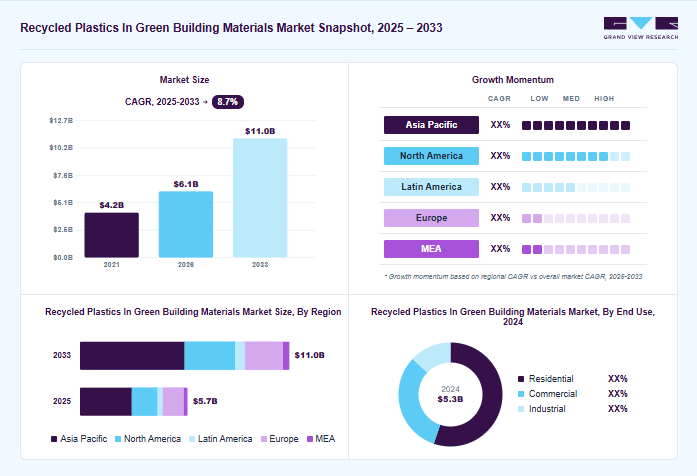 Source: Grand View Research, IR Documents, Primary Interviews, Paid DatabasesTo learn more about this report,
 Download Free Sample Report
Key Market Trends & Insights
- The recycled plastics in green building materials market in India is expected to grow at a substantial CAGR of 9.88% from 2025 to 2033.
- By product type, the rPET segment is expected to grow at a considerable CAGR of 10.01% from 2025 to 2033 in terms of revenue.
- By application, the insulation materials segment is expected to grow at a considerable CAGR of 9.51% from 2025 to 2033 in terms of revenue.
- By end use, the residential segment is expected to grow at a considerable CAGR of 9.33% from 2025 to 2033 in terms of revenue.
Market Size & Forecast
- Market size in 2024: USD 5.3 Billion
- Projected market size by 2033: USD 11.0 Billion
- CAGR (2025 - 2033): 8.7%
- Asia Pacific: Largest market in 2024
Prism AI by Grand View Research Free to tryAsk a question about the recycled plastics in green building materials marketTry asking✓Every figure cited from GVR research Prefer the report? Download free sample →
These incentives make it financially easier for developers to specify recycled plastics, driving broader adoption in construction. The recycled plastics segment within green building materials is witnessing accelerated integration of advanced composite solutions, driven by the adoption of prefabricated panels and modular construction techniques. Manufacturers are leveraging high-density polyethylene (HDPE) and polypropylene blends to produce lightweight, moisture-resistant boards that streamline installation timelines and reduce on-site waste. This shift toward off-site fabrication aligns with broader industry efforts to optimize supply chains and minimize project lead times, reinforcing the role of recycled polymers in modern construction ecosystems.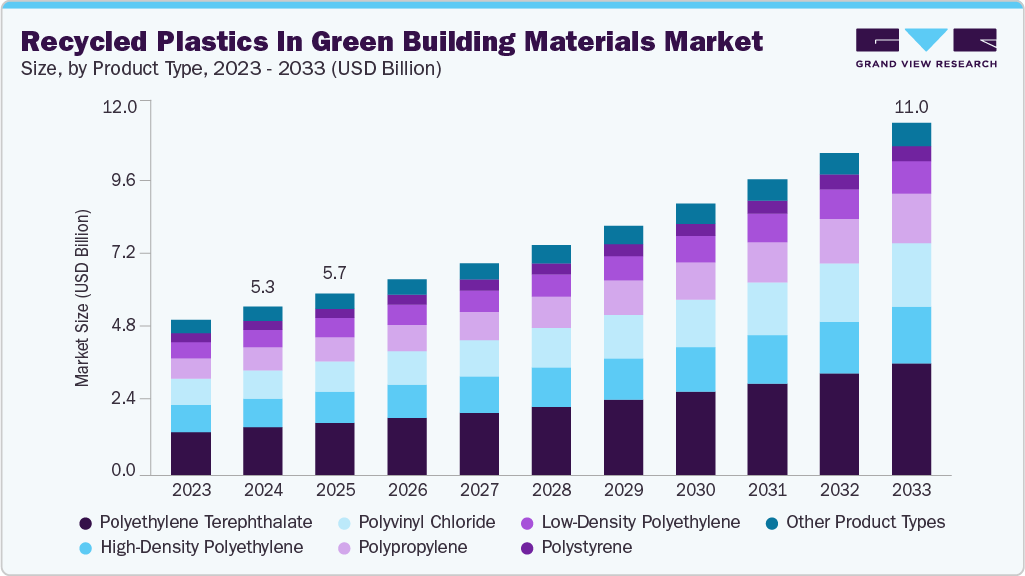 To learn more about this report, Download Free Sample Report
Drivers, Opportunities & Restraints
Stringent environmental regulations and increasingly aggressive carbon-neutral targets are compelling stakeholders across the built environment to seek low-carbon material alternatives. Governments and rating bodies such as LEED and BREEAM now award significant credits for post-consumer recycled content, making recycled plastic composites economically attractive despite modest price premiums. This regulatory momentum, combined with corporate sustainability mandates, is driving demand for green-grade plastic supplies from waste management streams.
Innovation in polymer modification and additive technologies offers a significant growth frontier, enabling the development of high-performance, fire-retardant, and UV-stable plastic composites for both interior and exterior applications. Strategic partnerships between resin recyclers, chemical formulators, and construction firms can unlock customized solutions, such as sound-dampening panels and load-bearing decking boards that achieve premium margins.
Persistent inconsistencies in recycled plastic feedstock quality continue to hinder large-scale adoption, as variations in contaminant levels and polymer degradation can undermine mechanical strength and finish aesthetics. Additionally, limited end-of-life recapture mechanisms for composite materials create challenges to genuine circularity, potentially deterring specifiers concerned with cradle-to-cradle accountability. These technical and logistical obstacles, combined with relatively higher upfront costs compared to traditional virgin materials, remain major barriers to broader market penetration.
Market Concentration & Characteristics
The growth stage of recycled plastics in green building materials market is medium, and the pace is accelerating. The market exhibits slight market concentration, with key players dominating the industry landscape. Major companies like Trex Company, Inc.; Fiberon; AZEK Company Inc.; Envirodeck; Composite Decking SA; Ecodek Outdoor Living; and Terafest play a significant role in shaping the market dynamics. These leading players often drive innovation within the market, introducing new products, technologies, and end uses to meet evolving industry demands.
In green building applications, recycled plastic composites compete directly with traditional materials such as treated lumber, aluminum extrusions, and fiber-cement boards. While wood offers natural aesthetics and aluminum provides high strength-to-weight ratios, recycled plastics stand out due to their superior moisture resistance and longer service life. As developers weigh lifecycle costs, recycled-plastic solutions typically require less maintenance and offer enhanced durability, making them a compelling alternative for both interior and exterior uses.
 To learn more about this report, Download Free Sample Report
Evolving building codes and sustainability standards are mandating higher percentages of post-consumer content, driving specifiers toward recycled-plastic materials that can satisfy these thresholds. In regions like the EU, the Construction Products Regulation now requires clear documentation of embodied carbon, favoring low-carbon feedstocks such as recycled polymers. Meanwhile, U.S. green-building programs are tightening criteria around waste diversion and recycled content, effectively elevating recycled-plastic composites from niche options to mainstream compliance solutions.
Product Type Insights
Polyethylene terephthalate (rPET) dominated the recycled plastics in green building materials industry with a revenue share of 28.41% in 2024. Growing consumer demand for transparency in material sourcing has elevated rPET’s appeal, as its traceable post-consumer origin aligns with green building certifications. Manufacturers are capitalizing on robust recycling infrastructures, especially in urban centers, to secure consistent supplies of food-grade PET feedstock, enabling them to formulate high-strength panels and cladding systems at competitive costs.
The polyvinyl chloride (rPVC) form segment is anticipated to grow at a significant CAGR of 9.61% through the forecast period. Advances in decontamination and sorting technologies have significantly improved rPVC purity, making it a cost-effective substitute for virgin PVC in window frames and piping. As plumbing codes tighten around lead and phthalate content, recycled PVC compounds that meet stringent health standards are gaining preference among specifiers looking to balance performance with sustainability mandates.
Application Insights
Insulation materials led the recycled plastics in green building materials market with a revenue share of 35.14% in 2024. Stringent energy-efficiency regulations, such as the International Energy Conservation Code (IECC) updates, are driving installers toward recycled-plastic-based insulations that deliver high R-values with minimal thickness. These products not only help meet thermal performance targets but also reduce embodied carbon, offering builders a dual compliance solution that streamlines project approvals under evolving green building guidelines.
The roofing tiles segment is expected to expand at a substantial CAGR of 9.22% through the forecast period. Heightened focus on storm resilience and urban heat island mitigation has spurred interest in recycled-plastic roofing tiles engineered for superior impact resistance and thermal reflectivity. By integrating UV-stabilized polymers with local recycled streams, manufacturers can offer longer-lasting, lighter-weight roofing options that simplify logistics and reduce structural load requirements.
End Use Insights
Residential dominated the recycled plastics in green building materials industry, accounting for a share of 55.22% in 2024. Homeowners’ growing willingness to invest in sustainable upgrades, supported by green mortgage incentives and property tax rebates, has driven the uptake of recycled plastic products in decks, fencing, and façade applications. These materials’ low maintenance profile and resistance to moisture appeal to DIY markets and specifiers alike, translating into higher per-unit selling prices and expanded retail distribution.
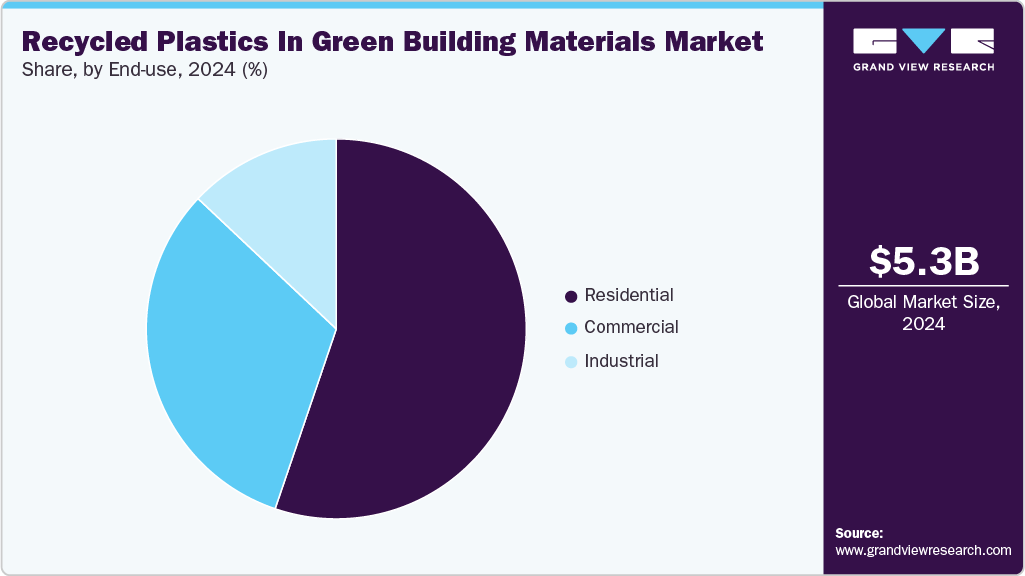 To learn more about this report, Download Free Sample Report
The commercial segment is projected to witness a substantial CAGR of 8.22% over the forecast period. Corporate tenants and facility managers, under increasing pressure from investors and regulators to meet Environmental, Social, and Governance (ESG) criteria, are specifying recycled-plastic interior finishes and exterior cladding to substantiate carbon footprint reductions. This trend is reinforced by large-scale office and retail developers who bundle recycled-content thresholds into procurement policies, creating sizable, predictable demand pipelines
Regional Insights
Asia Pacific led the recycled plastics in green building materials market, with a revenue share of 47.8% in 2024. Rapid urbanization and rising sustainability mandates across Asia Pacific are underpinning the growth of recycled plastic building components. Governments in Australia, Japan, and Southeast Asian economies are rolling out comprehensive plastic-waste reduction policies, ranging from single-use bans to deposit-return schemes that bolster feedstock availability for manufacturing. Heightened public awareness of eco-friendly building practices, coupled with subsidies for green construction, is driving developers to integrate recycled-plastic cladding and roofing solutions into large-scale residential and infrastructure projects.
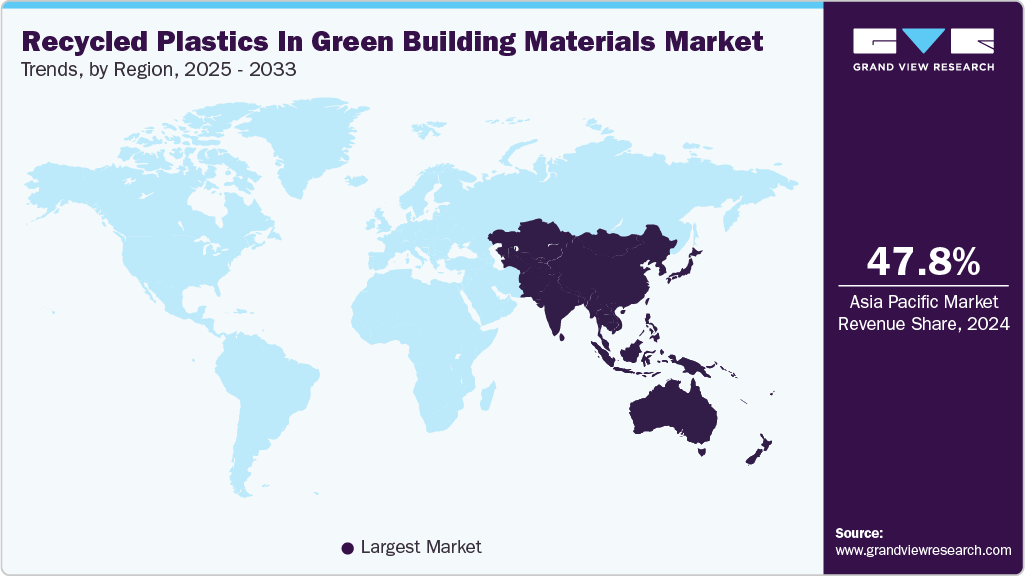 To learn more about this report, Download Free Sample Report
China Recycled Plastics in Green Building Materials Market Trends
The China recycled plastics in green building materials market is expected to grow over the forecast period. China’s ambitious circular-economy targets are fueling demand for recycled-plastic construction materials, supported by the National Development and Reform Commission’s push to establish a state-backed recycling group. This initiative aims to upgrade recycling equipment and develop new trade-in models, boosting the country’s commodity-waste recycling rate and securing steady volumes of high-quality polymer feedstock. As local authorities enforce extended producer responsibility schemes, recycled PVC and PET composites are rapidly displacing virgin materials in window frames and interior panels.
North America Recycled Plastics in Green Building Materials Market Trends
Stringent environmental mandates and widespread adoption of green building certifications propel the North America recycled plastics in green building materials industry. Mandatory green construction codes in major cities and financial incentives for projects achieving LEED and ENERGY STAR ratings are incentivizing developers to specify recycled-plastic insulation and façade panels. Additionally, a mature recycling infrastructure ensures reliable feedstock streams, enabling manufacturers to scale production of high-performance recycled composites.
In the U.S., landmark federal initiatives, most notably the Inflation Reduction Act’s allocation of more than USD 5 billion in green building incentives, are catalyzing the uptake of recycled-plastic materials in public and private construction projects. State-level embodied-carbon procurement laws, such as “Buy Clean” policies in California and Colorado, further reinforce demand by favoring low-carbon, recycled polymer products. Coupled with robust consumer preference for sustainable homes, these policies are driving substantial capital flows toward recycled-content boards and decking solutions.
Europe Recycled Plastics in Green Building Materials Market Trends
Europe’s recycled plastics sector gains momentum from the Circular Plastics Alliance, a multi-stakeholder forum committed to doubling recycled-content usage by 2025 and harmonizing quality standards across the value chain. Backed by the EU’s Plastics Strategy, which mandates minimum recycled content levels in building materials, manufacturers are investing heavily in chemical and advanced mechanical recycling to meet new quotas. This regulatory rigor not only enhances material traceability but also positions recycled polymers as cost-competitive alternatives to virgin feedstocks.
Key Recycled Plastics in Green Building Materials Company Insights
The Recycled Plastics in Green Building Materials Market is highly competitive, with several key players dominating the landscape. Major companies include Trex Company, Inc., Fiberon, AZEK Company Inc., Envirodeck, Composite Decking SA, Ecodek Outdoor Living, and Terafest. The market is characterized by a competitive landscape with several key players driving innovation and market growth. Major companies in this sector are investing heavily in research and development to enhance the performance, cost-effectiveness, and sustainability of their types.
Key Recycled Plastics in Green Building Materials Companies:
The following are the leading companies in the recycled plastics in green building materials market. These companies collectively hold the largest market share and dictate industry trends.
- Trex Company, Inc.
- Fiberon
- AZEK Company Inc.
- Envirodeck
- Composite Decking SA
- Ecodek Outdoor Living
- Terafest
Recent Developments
-
In May 2025, Talasey launched Pioneer, an advanced composite decking range featuring 4K high-definition wood imaging that captures every grain and texture with ultra-precision. Pioneer uses aerospace-grade PMMA coating technology, adapted from applications like airplane windows, to provide exceptional durability, color clarity, and fade resistance even after prolonged UV exposure. The decking boards have a strong core made from woven fiberglass, bamboo, and foamed PVC, offering resistance to warping, impact, and allergens. Pioneer is sustainable, using recycled plastics and bamboo, and is FSC 100% certified.
-
In February 2025, Trex Company expanded its mid-tier Trex Select line by introducing three new colors with enhanced aesthetics and performance, including the industry's first mid-priced board with heat-mitigating technology. These additions include Trex’s SunComfortable IR technology, making them cooler than other composite decking options, and they are fully rated for W.U.I. (Wild Urban Interface) compliance, increasing their fire resistance. Select boards are made from 95% recycled material, including plastics.
Recycled Plastics in Green Building Materials Market Report Scope
Report Attribute
Details
Market size in 2024
USD 5.3 billion
Estimated market size in 2026
USD 6.1 billion
Projected market size by 2033
USD 11.0 billion
Growth rate
CAGR of 8.7% from 2025 to 2033
Historical data
2021 - 2023
Forecast period
2025 - 2033
Quantitative units
Revenue in USD million/billion, volume in kilotons, and CAGR from 2025 to 2033
Report coverage
Revenue forecast, volume forecast, competitive landscape, growth factors, and trends
Segments covered
Product type, application, end use, region
Regional scope
North America; Europe; Asia Pacific; Latin America; Middle East & Africa
Country Scope
U.S., Canada; Mexico; Germany; UK; France; Italy; Spain, China; India; Japan; South Korea; Australia; Brazil; Argentina; Saudi Arabia; South Africa; UAE
Key companies profiled
Trex Company, Inc.; Fiberon; AZEK Company Inc.; Envirodeck; Composite Decking SA; Ecodek Outdoor Living; Terafest
Customization scope
Free report customization (equivalent up to 8 analyst’s working days) with purchase. Addition or alteration to country, regional & segment scope
Pricing and purchase options
Avail customized purchase options to meet your exact research needs. Explore purchase options
Global Recycled Plastics in Green Building Materials Market Report Segmentation
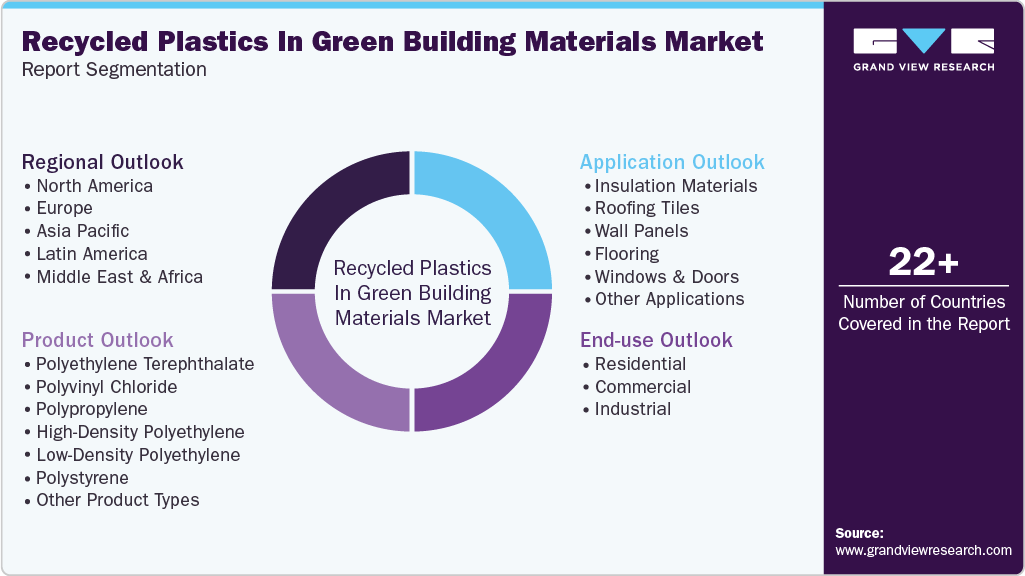
This report forecasts volume & revenue growth at the global, regional, and country levels and provides an analysis of the latest industry trends in each of the sub-segments from 2021 to 2033. For this study, Grand View Research has segmented the Recycled Plastics in Green Building Materials Market report on the basis of product type, application, end use, and region:
 To learn more about this report, Download Free Sample Report
-
Product Type Outlook (Volume, Kilotons; Revenue, USD Million, 2021 - 2033)
-
Polyethylene Terephthalate (rPET)
-
Polyvinyl Chloride (rPVC)
-
Polypropylene (rPP)
-
High-Density Polyethylene (rHDPE)
-
Low-Density Polyethylene (rLDPE)
-
Polystyrene (rPS)
-
Other Product Types
-
-
Application Outlook (Volume, Kilotons; Revenue, USD Million, 2021 - 2033)
-
Insulation Materials
-
Roofing Tiles
-
Wall Panels
-
Flooring
-
Windows & Doors
-
Other Applications
-
-
End Use Outlook (Volume, Kilotons; Revenue, USD Million, 2021 - 2033)
-
Residential
-
Commercial
-
Industrial
-
-
Regional Outlook (Volume, Kilotons; Revenue, USD Million, 2021 - 2033)
-
North America
-
U.S.
-
Canada
-
Mexico
-
-
Europe
-
Germany
-
UK
-
France
-
Italy
-
Spain
-
-
Asia Pacific
-
China
-
India
-
Japan
-
South Korea
-
Australia
-
-
Latin America
-
Brazil
-
Argentina
-
-
Middle East & Africa
-
Saudi Arabia
-
South Africa
-
UAE
-
-
Frequently Asked Questions About This Report
The global recycled plastics in green building materials market size was valued at USD 5.3 billion in 2024 and is estimated at USD 6.1 billion for 2026.
Some key players operating in the recycled plastics in green building materials market include Trex Company, Inc., Fiberon, AZEK Company Inc., Envirodeck, Composite Decking SA, Ecodek Outdoor Living, and Terafest
Recycled plastic composites benefit from growing green financing programs that offer lower interest rates or grants for projects using sustainable materials. These incentives make it financially easier for developers to specify recycled plastics, driving broader adoption in construction.
The global recycled plastics in green building materials market is expected to grow at a CAGR of 8.7% from 2025 to 2033, reaching USD 11.0 billion by 2033.
Polyethylene terephthalate (rPET) dominated the recycled plastics in green building materials market across the product type segmentation in terms of revenue, accounting for a market share of 28.4% in 2024. Growing consumer demand for transparency in material sourcing has elevated rPET’s appeal, as its traceable post-consumer origin aligns with green building certifications.
About the Author(s)
Plastics, Polymers & Resins Research Team
Bulk Chemicals · Plastics, Polymers & ResinsThis report was authored by the plastics, polymers & resins research team at Grand View Research - comprising two research analysts, one senior research analyst, and one industry expert - with specialized expertise in the plastics, polymers & resins segment of the bulk chemicals industry. All findings are based on proprietary bulk chemicals databases, executive interviews, and regulatory analysis, subject to internal peer review prior to publication.
Last Updated:
Speak to Analyst

Customize this report to your needs - add regions, segments, or data points, with 20% free customization.
Or view our licence options:


ISO 9001:2015 & 27001:2022 Certified
We are GDPR and CCPA compliant! Your transaction & personal information is safe and secure. For more details, please read our privacy policy.


