
- Home
- »
- Advanced Interior Materials
- »
-
Recycled Steel Construction Materials Market Report, 2033GVR Report cover
![Recycled Steel Construction Materials Market Size, Share & Trends Report]()
Recycled Steel Construction Materials Market (2025 - 2033) Size, Share & Trends Analysis Report By Product (Recycled Structural Steel, Recycled Steel Sheets & Plates, Recycled Steel Pipes & Tubes), By End Use (Residential Construction, Commercial Construction), By Region, And Segment Forecasts
- Report ID: GVR-4-68040-818-9
- Number of Report Pages: 107
- Format: PDF
- Historical Range: 2021 - 2024
- Forecast Period: 2025 - 2033
- Industry: Advanced Materials
- Report Summary
- Table of Contents
- Segmentation
- Methodology
- Download FREE Sample
-
 Download Sample Report
Recycled Steel Construction Materials Market Summary
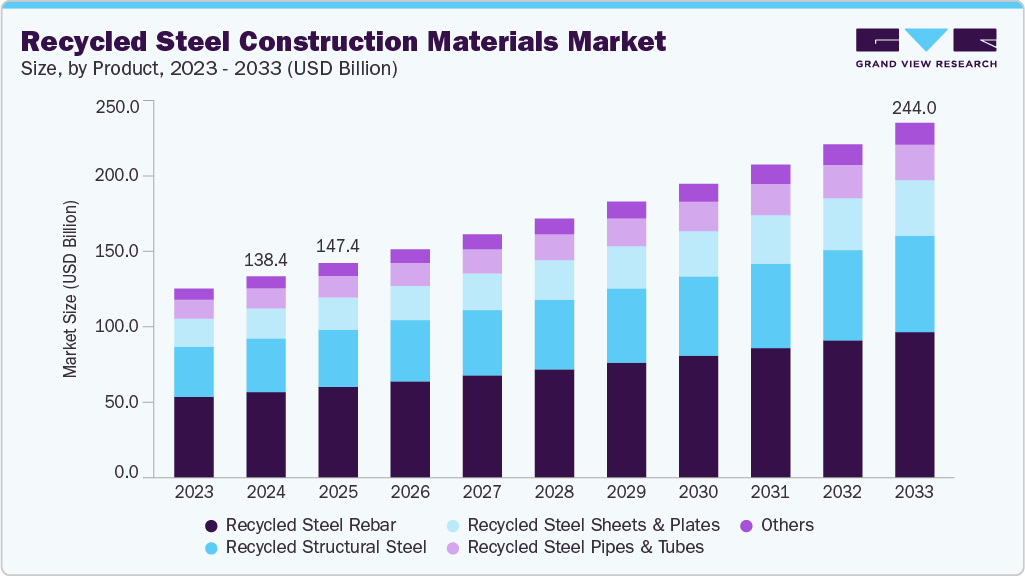
The global recycled steel construction materials market size was estimated at USD 138.45 billion in 2024 and is expected to reach USD 244.03 billion by 2033, registering a CAGR of 6.5% from 2025 to 2033. The demand for recycled steel in construction is rising as builders shift toward materials that reduce environmental impact and conserve natural resources.
Key Market Trends & Insights
- Asia Pacific dominated the recycled steel construction materials market with the largest revenue share of 38.6% in 2024.
- By product, the recycled steel sheets & plates segment is expected to grow at the fastest CAGR of 7.1% over the forecast period.
- By end use, the infrastructural segment is expected to grow at the fastest CAGR of 6.9% over the forecast period.
Market Size & Forecast
- 2024 Market Size: USD 138.45 Billion
- 2033 Projected Market Size: USD 244.03 Billion
- CAGR (2025-2033): 6.5%
- Asia Pacific: Largest market in 2024
Urban expansion and rapid infrastructure upgrades are pushing developers to use cost-effective, durable steel made from scrap. Green building certifications are also encouraging contractors to prefer recycled inputs over virgin metals. Many companies are choosing recycled steel because it lowers lifecycle emissions without compromising structural strength. Renovation and demolition activities are adding more scrap availability, further supporting supply. Growing awareness among architects about circular construction practices is also boosting adoption.Builders see recycled steel as a reliable material because it offers consistent strength and flexibility. Its ability to be reused repeatedly without quality loss makes it attractive in high-volume construction. Cost savings from reduced energy use during production are another major driver. Green procurement policies by private and public developers encourage the use of recycled products. Faster fabrication and on-site assembly are also improving the material’s popularity in large-scale structures. The global shift toward low-carbon construction is further pushing its adoption. These drivers collectively position recycled steel as a preferred choice for sustainable building.
Advanced sorting technologies are improving the purity and consistency of recycled steel. Digital tracking systems are emerging to trace material origin and recycled content. New electric arc furnace processes are helping manufacturers reduce energy use and emissions. Fabricators are adopting modular steel systems that fit well with recycled inputs. Automation in scrap processing yards enables higher efficiency and better material recovery. Lightweight and customizable recycled steel products are gaining acceptance in commercial and residential projects. These innovations are shaping a more efficient and sustainable recycled steel industry.
Market Concentration & Characteristics
The industry is moderately concentrated, with established steel producers and integrated recyclers holding significant influence due to their extensive processing networks and advanced manufacturing capabilities. These players benefit from strong supply chains, access to large scrap volumes, and the ability to meet construction-grade specifications. Regional mid-sized recyclers also contribute meaningfully, particularly in urban centers with consistent demolition activity. Competitive differentiation is shaped by production efficiency, energy performance, and material quality assurance. Entry barriers stem from high capital requirements and strict certifications. Consolidation trends are gradually emerging as firms seek scale advantages. Despite this, localized players retain relevance in scrap sourcing and distribution.
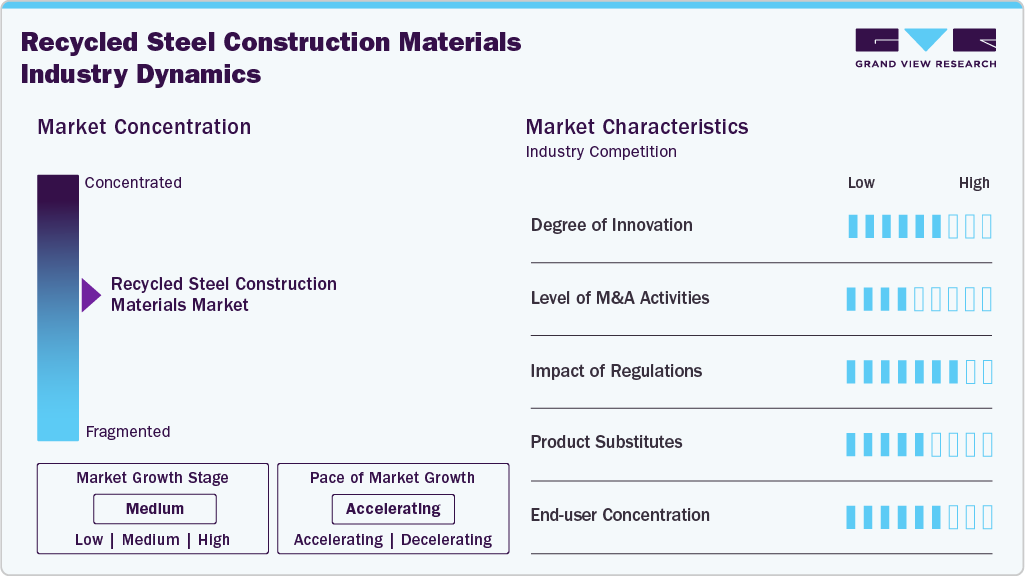
Alternative materials include virgin structural steel, engineered timber, composites, and aluminum, each with specific constraints. Virgin steel competes strongly but carries a higher environmental footprint, reducing its appeal for sustainable projects. Engineered timber is suitable for selected applications but cannot match steel’s structural capacity in large projects. Aluminum offers corrosion resistance but is costlier for heavy-duty construction. Composite materials present potential but require further standardization before broad adoption. Recycled aggregates and concrete serve complementary, rather than substitutive, roles. Overall, substitute pressure is moderate due to recycled steel’s balance of performance, availability, and sustainability.
Product Insights
The recycled steel rebar segment held the highest revenue share of 42.6% in 2024, as infrastructure developers, contractors, and civil engineering firms increasingly adopt recycled material to meet sustainability targets without compromising structural strength. Rebar offers reliable load-bearing performance in foundations, bridges, industrial facilities, and transportation networks, making it a widely used material in both public and private projects. The segment benefits from strong availability of scrap feedstock, stable pricing, and compliance with emerging green-building guidelines that encourage recycled input utilization. Its use also aligns with lifecycle efficiency goals, which further reinforces its leadership position in the market.
The recycled steel sheets & plates segment is expected to grow at a significant CAGR of 7.1% over the forecast period, as demand increases from contractors seeking durable, corrosion-resistant, and cost-effective materials for roofing, paneling, fabrication, and industrial construction. Advancements in scrap processing and EAF steelmaking are improving product consistency, enabling these materials to compete directly with primary steel across commercial and manufacturing applications. Growing adoption in green-certified projects and prefabricated structures, along with rising emphasis on transparency and traceable supply chains, further supports the segment’s expansion outlook over the forecast period.
End Use Insights
The infrastructural segment held the highest revenue share of 47.1% in 2024, as governments and investors continue to expand large transportation corridors, utility networks, public facilities, and industrial corridors. Recycled steel fits well into these developments due to its strength, long service life, and ability to meet evolving environmental specifications without increasing project costs. Infrastructure developers increasingly prioritize materials that lower embodied carbon footprints, support circular-economy principles, and enable long-term structural reliability. The segment also benefits from large-scale procurement policies that encourage the use of recycled materials in public works.
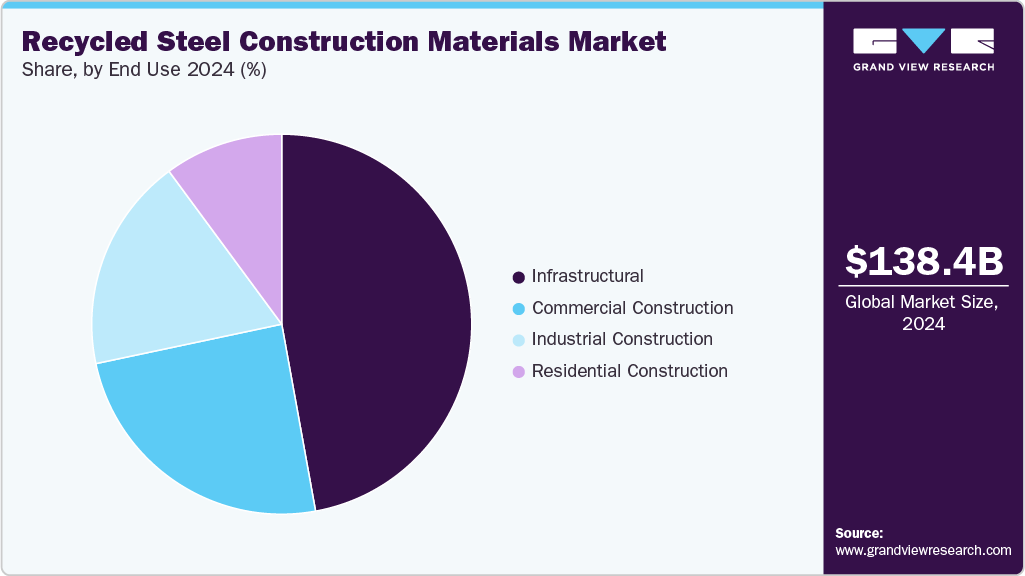
The commercial construction segment is expected to grow at a significant CAGR of 6.4% over the forecast period, as developers, architects, and contractors adopt recycled steel in office parks, retail complexes, mixed-use developments, and institutional buildings. The sector increasingly values materials that offer rapid assembly, design flexibility, and compliance with sustainability frameworks such as green-rating certifications. Rising investment in new commercial spaces, renovation programs, and adaptive reuse projects further supports the expansion of recycled steel adoption. Strong focus on environmental reporting, reduced operational impact, and resilient building performance strengthen the segment’s growth prospects going forward.
Regional Insights
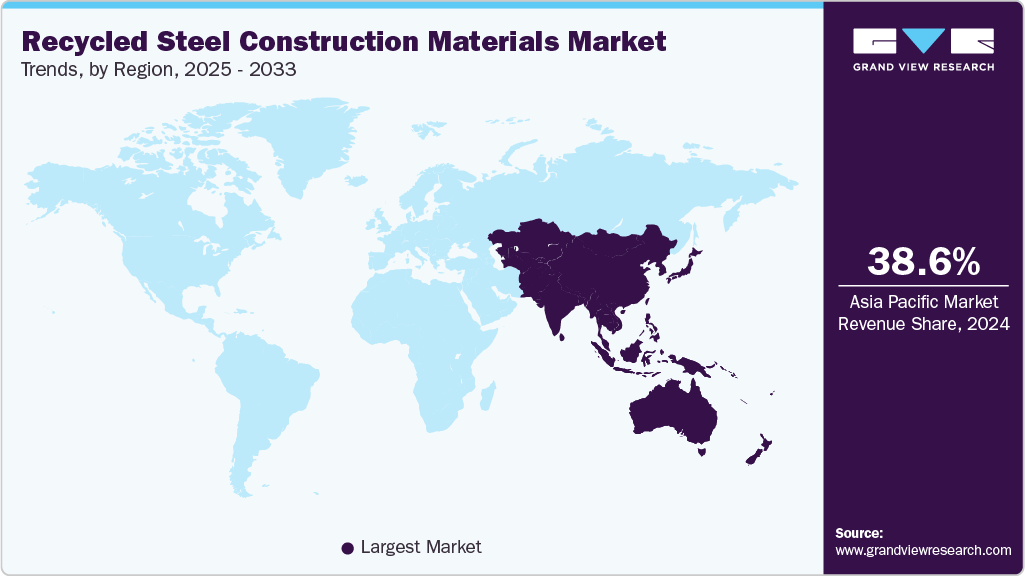
Asia Pacific dominated the global recycled steel construction materials market and accounted for the largest revenue share of 38.6% in 2024, supported by expanding urban development and strong demand for cost-efficient, environmentally aligned building materials. Countries such as China and India generate substantial volumes of scrap and continue to advance large-scale construction programs that actively integrate recycled steel. Governments across the region are promoting circular-economy frameworks, which encourage developers to incorporate recycled inputs into public and private projects. Increasing investment in infrastructure, industrial facilities, and high-density housing provides a large and consistent consumption base. The region’s rapid population growth further strengthens the need for durable, scalable construction solutions. However, uneven recycling standards and capacity gaps in emerging economies limit uniform adoption.
China held a significant share of the regional market as it continued to enhance recycled steel production through large-scale scrap availability and targeted decarbonization strategies. Strong policy enforcement around waste management and stricter emissions regulations pushed manufacturers to increase the use of recycled inputs. Urban redevelopment projects generated considerable scrap inflows, allowing steelmakers to maintain stable supply chains. The country’s extensive infrastructure pipeline continued to drive consistent consumption across residential, commercial, and industrial segments. Growing adoption of electric-arc furnace technologies further accelerated the shift toward recycled steel.
North America Recycled Steel Construction Materials Market Trends
The recycled steel construction materials market in North America accounted for a notable share of the global market, driven by mature recycling systems and increased adoption of low-carbon construction materials. The U.S. and Canada benefited from well-established scrap collection networks and strong industry alignment with sustainability targets. Renovation activity across aging metropolitan areas generated consistent scrap volumes, supporting stable production. Green building standards and ESG-driven procurement practices encouraged construction firms to incorporate recycled steel into large commercial and institutional projects. Investments in automation and advanced sorting technologies improved product quality and processing throughput.
U.S. Recycled Steel Construction Materials Market Trends
The recycled steel construction materials market in the U.S. represented one of the most influential markets in the region, backed by a strong recycling ecosystem, policy support, and ongoing infrastructure renewal. Federal and state-level sustainability mandates encouraged the integration of recycled steel into public construction contracts. Scrap availability remained high due to extensive demolition and redevelopment activity in urban centers. Producers continued to upgrade their facilities with cleaner technologies that improved recycled content and overall efficiency. Construction firms adopted recycled steel across large-scale projects to align with embodied-carbon reduction goals.
Europe Recycled Steel Construction Materials Market Trends
The recycled steel construction materials market in Europe remained a leading adopter of recycled steel due to its stringent environmental policies, advanced recycling infrastructure, and strong commitment to circular manufacturing. Countries across Western and Northern Europe maintained high recycling rates, ensuring a reliable supply of scrap for construction-grade steel production. Green building directives promoted the use of low-impact materials, strengthening the position of recycled steel across residential, commercial, and public projects. Large renovation programs, especially in aging building stock, supported steady demand. Manufacturers expanded digital traceability systems to meet regulatory compliance and certification requirements. Despite strong institutional support, rising operational costs and labor shortages influence production efficiency.
Germany captured a strong share of the European market, supported by advanced steelmaking capabilities, high recycling efficiency, and strict sustainability requirements across the construction sector. The country’s dense urban centers generated consistent scrap volumes, which enabled steel producers to maintain stable input flows. Industrial clusters in manufacturing regions facilitated streamlined logistics and high-quality processing. Builders and developers incorporated recycled steel to meet rigorous environmental certifications and building-performance standards. Public procurement frameworks further reinforced demand by prioritizing recycled materials in infrastructure projects. Despite these strengths, rising energy costs and regulatory compliance pressures created operational constraints. Continued technological upgrades and industrial coordination are expected to strengthen Germany’s long-term position.
Central & South America Recycled Steel Construction Materials Market Trends
The recycled steel construction materials market in Central & South America exhibited steady growth potential as construction markets in Brazil, Mexico, Colombia, and Chile expanded their focus on sustainable and resource-efficient materials. Increasing urbanization and rising investment in commercial and industrial projects supported greater interest in recycled steel. Recycling networks continued to evolve, improving scrap collection and processing consistency across major metropolitan regions. Governments introduced policies encouraging greener material choices, gradually influencing procurement practices in public works. However, operational gaps in recycling infrastructure and limited awareness among smaller builders restrained adoption. Ongoing technological improvements and partnerships with global steel producers are expected to enhance regional competitiveness.
Middle East & Africa Recycled Steel Construction Materials Market Trends
The recycled steel construction materials market in the Middle East & Africa region demonstrated increasing adoption as developers and governments sought to align large infrastructure and real-estate projects with long-term sustainability goals. Investments in steel recycling facilities expanded local capacity and strengthened supply chains. Major economies such as the UAE, Saudi Arabia, and South Africa promoted circular-economy principles, which supported greater integration of recycled inputs into new construction. Growing waste management reforms improved scrap availability and processing efficiency. However, limited standardization and uneven recycling participation across markets posed challenges. International collaborations, regulatory development, and ongoing industrial diversification initiatives are expected to accelerate regional adoption.
Key Recycled Steel Construction Materials Companies Insights
Key players operating in the recycled steel construction materials market are undertaking various initiatives to strengthen their presence and increase the reach of their products and services. Strategies such as expansion activities and partnerships are key in propelling the market growth. Some of the key players operating in the market include Totten Tubes, Ovako AB.
-
Totten Tubes operates as a key supplier of structural steel tubing widely used in construction, offering products sourced from mills with high recycled-steel content. The company supports circular construction practices by distributing hollow structural sections (HSS) that meet sustainability-focused project requirements.
-
Ovako AB positions itself as a major European producer of high-quality engineering steel manufactured almost entirely from recycled scrap through electric arc furnace technology. The company serves construction, heavy machinery, and infrastructure segments with low-carbon steel bars and tubes tailored for high-strength applications.
CMC and Steel Dynamics are some of the emerging market participants in the recycled steel construction materials market.
-
Commercial Metals Company (CMC) plays a central role in the recycled steel construction materials landscape through its extensive network of scrap recycling facilities and EAF-based steel mills. The company manufactures rebar, merchant bar products, and structural steel widely used in residential, commercial, and infrastructure projects. With vertically integrated recycling and steelmaking operations, CMC consistently strengthens its position in circular construction value chains.
-
Steel Dynamics, Inc. is one of the largest U.S. producers of recycled steel, operating electric arc furnace mills that convert ferrous scrap into high-quality construction-grade steel. Its portfolio includes rebar, structural shapes, and sheet steel used across major building and infrastructure projects. The company’s focus on low-carbon steelmaking and closed-loop scrap systems positions strongly within markets prioritizing sustainable and resource-efficient construction materials.
Key Recycled Steel Construction Materials Companies:
The following are the leading companies in the recycled steel construction materials market. These companies collectively hold the largest Market share and dictate industry trends.
- RAMA TMT Pvt Ltd.
- Sree Metaliks Ltd.
- CMC
- Ovako AB
- Nucor Corporation
- Gerdau S.A.
- Steel Dynamics
- Radius Recycling
- Totten Tubes
- Tata Steel
Recent Developments
-
In October 2024, Sree Metaliks announced that it has adopted Ladle Refining Furnace (LRF) technology in its TMT bar production, improving steel purity, strength, and weldability.
-
In October 2025, Gerdau announced that it will expand capacity at its recycled-content EAF mill in Midlothian, Texas, while suspending certain Brazilian investments.
Recycled Steel Construction Materials Market Report Scope
Report Attribute
Details
Market size value in 2025
USD 147.45 billion
Revenue forecast in 2033
USD 244.03 billion
Growth rate
CAGR of 6.5% from 2025 to 2033
Base year for estimation
2023
Actual estimates/historical data
2021 - 2024
Forecast period
2025 - 2033
Quantitative units
Revenue in USD million/billion and CAGR from 2025 to 2033
Report coverage
Revenue forecast, company ranking, competitive landscape, growth factors, and trends
Segments covered
Product, end use, region
Regional scope
North America; Europe; Asia Pacific; Central & South America; Middle East & Africa
Country scope
U.S.; Canada; Mexico; Germany; UK; France; Spain; China; Japan; India; South Korea; Saudi Arabia; UAE; Egypt; Kuwait; Qatar
Key companies profiled
RAMA TMT Pvt Ltd.; Sree Metaliks Ltd.; CMC; Ovako AB; Nucor Corporation; Gerdau S.A.; Steel Dynamics; Radius Recycling; Totten Tubes; Tata Steel
Customization scope
Free report customization (equivalent up to 8 analysts working days) with purchase. Addition or alteration to country, regional & segment scope.
Pricing and purchase options
Avail customized purchase options to meet your exact research needs. Explore purchase options
Recycled Steel Construction Materials Market Report Segmentation
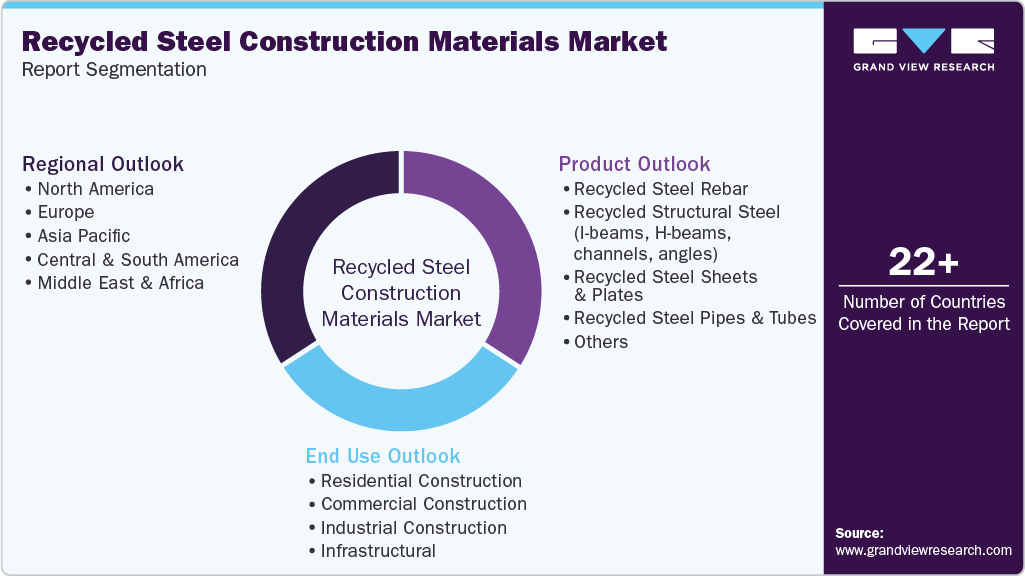
This report forecasts revenue growth at the global, regional & country levels and provides an analysis of the industry trends in each of the sub-segments from 2021 to 2033. For this study, Grand View Research has segmented the global recycled steel construction materials market report on the basis of product, end use, and region:
-
Product Outlook (Revenue, USD Billion, 2021 - 2033)
-
Recycled Steel Rebar
-
Recycled Structural Steel (I-beams, H-beams, channels, angles)
-
Recycled Steel Sheets & Plates
-
Recycled Steel Pipes & Tubes
-
Others
-
-
End Use Outlook (Revenue, USD Billion, 2021 - 2033)
-
Residential Construction
-
Commercial Construction
-
Industrial Construction
-
Infrastructural
-
-
Regional Outlook (Revenue, USD Billion, 2021 - 2033)
-
North America
-
U.S.
-
Canada
-
Mexico
-
-
Europe
-
UK
-
Germany
-
France
-
Spain
-
-
Asia Pacific
-
China
-
Japan
-
India
-
South Korea
-
-
Central & South America
-
Middle East & Africa
-
Saudi Arabia
-
UAE
-
Egypt
-
Qatar
-
Kuwait
-
-
Frequently Asked Questions About This Report
b. The global recycled steel construction materials market size was estimated at USD 138.45 billion in 2024 and is expected to reach USD 147.45 billion in 2025.
b. The global recycled steel construction materials market is expected to grow at a compound annual growth rate of 6.5% from 2025 to 2033 to reach USD 244.03 billion by 2033.
b. The recycled steel rebar segment held the highest revenue market share of 42.6% in 2024, as infrastructure developers, contractors, and civil engineering firms increasingly adopt recycled material to meet sustainability targets without compromising structural strength.
b. Some of the key players operating in the recycled steel construction materials market include RAMA TMT Pvt Ltd., Sree Metaliks Ltd., CMC, Ovako AB, Nucor Corporation, Gerdau S.A., Steel Dynamics, Radius Recycling, Tata Steel, and Totten Tubes.
b. Rising sustainability mandates, increasing scrap availability, and the growing push for cost-efficient, low-carbon construction are key factors driving the recycled steel construction materials market.


Share this report with your colleague or friend.
Need a Tailored Report?
Customize this report to your needs — add regions, segments, or data points, with 20% free customization.


ISO 9001:2015 & 27001:2022 Certified
We are GDPR and CCPA compliant! Your transaction & personal information is safe and secure. For more details, please read our privacy policy.
Trusted market insights - try a free sample
See how our reports are structured and why industry leaders rely on Grand View Research. Get a free sample or ask us to tailor this report to your needs.













