
- Home
- »
- Biotechnology
- »
-
Reusable Bioreactors Market Size And Share Report, 2033GVR Report cover
![Reusable Bioreactors Market (2026 - 2033)Report]()
Reusable Bioreactors Market (2026 - 2033)
Size, Share & Trends Analysis Report By Product (Reusable Bioreactor Systems, Reusable Bioreactor Accessories & Components), By Bioreactor Type, By Application, By End Use, By Region, And Segment Forecasts
Market Size, 2025
$8.2BMarket Estimate, 2026
$9.3BMarket Forecast, 2033
$30.9BCAGR, 2026–2033
18.7%Reusable Bioreactors Market Summary
The global reusable bioreactors market size was valued at USD 8.2 billion in 2025 and is projected to grow from USD 9.3 billion in 2026 to USD 30.9 billion by 2033, at a CAGR of 18.7% from 2026 to 2033. North America dominated the market, accounting for the largest revenue share of 34.6% in 2025. The growth is driven by the rising adoption of reusable bioreactors for cost-effective, scalable, and sustainable biopharmaceutical manufacturing processes globally.

Key Market Trends & Insights
- By product: Reusable bioreactor systems segment held the highest market share of 42.4% in 2025.
- Based on bioreactor type: Stirred-tank bioreactors segment held the highest market share of 24.7% in 2025.
- Based on application: Monoclonal antibodies segment held the highest market share of 19.5% in 2025.
- By end use: Pharmaceutical & biopharmaceutical companies segment held the highest revenue share of 31.8% in 2025.
Regional Highlights
- Largest regional market: North America (34.6% revenue share, 2025)
- Fastest-growing regional market: Asia Pacific (highest CAGR, 2026-2035)
- By country: The U.S. held the largest revenue share in 2025.
Market Size & Forecast
- Market Size in 2025: USD 8.2 Billion
- Estimated Market Size in 2026: USD 9.3 Billion
- Projected Market Size in 2033: USD 30.9 Billion
- CAGR (2026-2033): 18.7%
The industry is witnessing significant growth, driven by increasing demand for scalable and cost-efficient bioprocessing across pharmaceutical, biotechnology, food, and industrial applications. The ability of reusable bioreactors to support repeated production cycles and large-scale operations is encouraging manufacturers to adopt these systems for greater equipment utilization and lower long-term operating costs.

Market Dynamics
The growing focus on sustainable bioprocessing and reducing waste from disposable systems is supporting market expansion. Moreover, advances in bioreactor design, automation, process monitoring, and reusable materials are improving operational flexibility and process efficiency, further supporting market growth over the forecast period.
The increasing adoption of cost-effective reusable bioreactor systems is supporting the growth of the industry, as these systems can lower capital and operating costs while enabling scalable production. Their ability to withstand repeated production cycles also makes them suitable for economical large-scale bioprocessing. For instance, in March 2026, California Cultured completed its first successful production run in a reusable 2,000-L plastic bioreactor. The company stated that the reactors can be reused thousands of times and are designed to reduce production costs compared with conventional systems.
Higher cleaning and sterilization requirements remain a key restraint for the market, as reusable systems need to be thoroughly cleaned and sterilized between production batches. This increases the need for water, steam, cleaning infrastructure, and validation, while also extending turnaround time between production cycles. In addition, the risk of cross-contamination requires effective cleaning and validation to prevent product carryover between batches, particularly when the same bioreactor is used for different products.
The development of sustainable reusable bioreactors presents an opportunity for the industry by combining repeated use with reduced material waste and greater flexibility in bioprocessing. Advances in 3D printing and bio-based materials are supporting the development of bioreactor components that can withstand high-temperature sterilization and be reused across production cycles. For instance, in March 2025, Imperial College London announced Project Nexus, a funded collaboration valued at approximately USD 2.5 million, focused on developing sustainable bioprocessing materials and bioreactors using 3D printing and bio-based resins that can be autoclaved for reuse.
Market Concentration & Characteristics
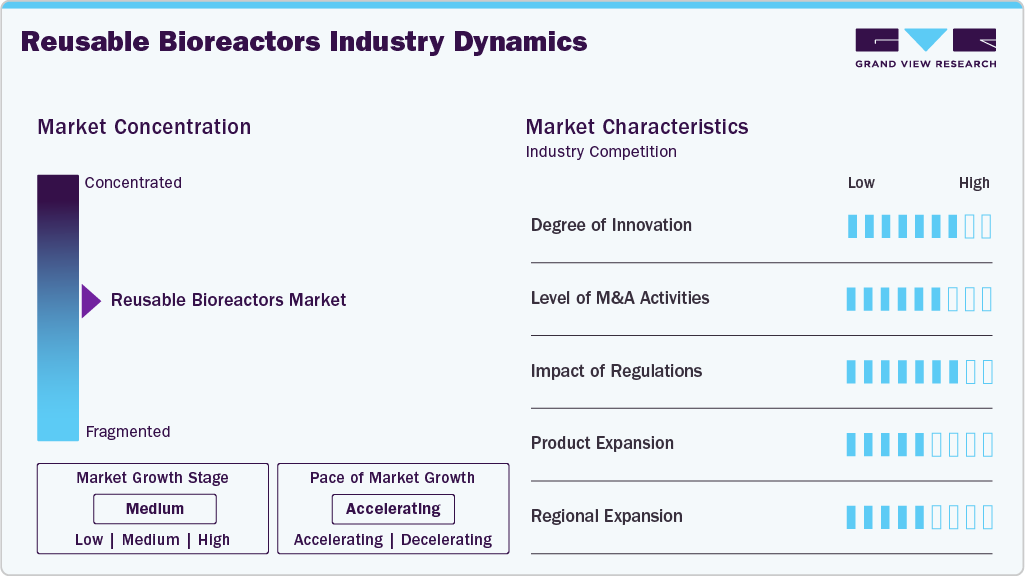
The industry is witnessing ongoing innovation, with manufacturers focusing on improvements in reactor design, process control, automation, mixing, aeration, and monitoring. Stainless-steel and glass bioreactor systems are being enhanced to improve scalability, reproducibility, and operational efficiency, while sensor integration and automated controls enable more precise monitoring of cultivation conditions. These developments are focused on enhancing the performance, reliability, flexibility, and consistency of reusable bioreactor systems across research, process development, and commercial bioprocessing applications.
The industry is seeing M&A activity as companies strengthen their bioreactor design, fermentation, and bioprocessing capabilities. For instance, in December 2025, Tetra Pak acquired Bioreactors.net, a company specializing in the design and manufacture of bioreactor systems for biomass and precision fermentation. The acquisition added bioreactor design and upstream fermentation expertise to Tetra Pak’s portfolio, strengthening its ability to provide integrated bioreactor and fermentation solutions across different production scales.
“The addition of Bioreactors.net complements our existing upstream and downstream processing portfolio with fermentation capabilities. Together, we will deploy their full portfolio of bioreactor solutions under the Tetra Pak brand, offering advanced food production systems. This acquisition will enable us to accelerate the development of next-generation bioreactors, empowering both emerging innovators and established producers to scale sustainably.”
- Rafael Barros, Director of the New Food Business Stream at Tetra Pak.
Regulations affect the industry through GMP requirements for equipment qualification, cleaning, sterilization, contamination control, and process validation. These requirements are important for stainless steel and glass bioreactors, which are cleaned and sterilized between production batches. Manufacturers, therefore, need effective CIP/SIP procedures, process monitoring, automation, and proper documentation to maintain consistent operating conditions and meet quality standards in biopharmaceutical manufacturing.
The industry is witnessing developments in large-scale stainless-steel systems to support higher-volume biopharmaceutical production. For instance, in December 2024, Boston Institute of Biotechnology and BiBo Pharma announced an expansion including 30,000-L, 15,000-L, and 5,000-L stainless-steel bioreactors, adding more than 150,000 L of mammalian cell-culture working volume. The expansion increases large-scale manufacturing capacity and supports the growing need for high-capacity reusable bioreactor systems in biologics production.
The industry is witnessing regional development as biopharmaceutical manufacturing capacity grows across different markets. Stainless-steel bioreactors continue to support large-scale production due to their durability and suitability for repeated use. Moreover, companies are strengthening manufacturing, engineering, and service capabilities, supporting wider adoption of reusable bioreactor systems in commercial bioprocessing.
Analyst Perspective
The industry is driven by increasing demand for scalable, cost-effective, and sustainable bioprocessing solutions across biopharmaceutical manufacturing. Rising adoption of reusable systems for repeated production cycles, particularly in large-scale biologics manufacturing, is supporting market expansion. Advancements in bioreactor design, automation, process monitoring, and reusable materials are further improving operational efficiency, flexibility, and process consistency. Market participants are focusing on large-scale stainless-steel systems, advanced process-control technologies, sustainable materials, and customized bioreactor solutions to address the growing requirements of pharmaceutical and biopharmaceutical manufacturers, CROs, and CDMOs.
Product Insights
The reusable bioreactor systems segment accounted for the largest revenue share of 42.4% in 2025. The growth is supported by the established use of stainless-steel systems in large-scale biopharmaceutical manufacturing. These systems offer durability, scalability, and repeated use, making them suitable for commercial cell culture and production. For instance, in December 2025, HOLVES launched the Omini Cell510 stainless-steel bioreactor for process development, scale-up, and GMP clinical sample production. The use of reusable systems in large-scale biopharmaceutical manufacturing is helping to maintain the segment’s leading position.
The reusable bioreactor accessories & components segment is expected to grow at a significant CAGR during 2026-2033, supported by the continued use of reusable systems in biopharmaceutical manufacturing and research. Demand for sensors, probes, impellers, valves, fittings, headplates, and other components is increasing with system installation, maintenance, and replacement requirements. The need for reliable process monitoring and regular replacement of components used in reusable systems is expected to support segment growth over the forecast period.
Bioreactor Type Insights
The stirred-tank bioreactors segment dominated the market with a share of 24.7% in 2025, supported by its established use in reusable systems for cell culture and biopharmaceutical manufacturing. These systems provide controlled agitation, oxygen transfer, pH, and temperature, making them suitable for process development and large-scale production. Moreover, their scalability and established use across biopharmaceutical manufacturing processes are expected to drive segment growth during the forecast period.
The packed-bed bioreactors segment is expected to register a significant CAGR during 2026-2033, driven by its use in high-density adherent-cell culture for biopharmaceutical and cell therapy applications. These systems provide a large surface area for cell attachment and facilitate nutrient and oxygen transfer, enabling efficient cell expansion. Growing demand for adherent-cell manufacturing is likely to strengthen the adoption of packed-bed systems.
Application Insights
The monoclonal antibodies segment accounted for 19.5% of the total revenue in 2025, making it the leading segment, mainly due to rising demand for antibody-based therapies across oncology, immunology, and other therapeutic areas. The increasing use of monoclonal antibodies is creating demand for additional manufacturing capacity, including reusable bioreactor systems used for large-scale production. According to an article published in mAbs in February 2025, rising demand for antibody therapeutics was reported to increase the need for additional biomanufacturing capacity, particularly for large-scale mAb production. This increase in mAb manufacturing demand supports the segment growth during the forecast period.
The microbial products segment is projected to grow with a significant CAGR during 2026-2033, driven by increasing production of vaccines, enzymes, antibiotics, recombinant proteins, and other microbial-derived products. Reusable bioreactors provide controlled fermentation conditions and support repeated production runs across different scales. Growing demand for microbial-based products and expansion of biopharmaceutical manufacturing are supporting the use of reusable bioreactors in this application.
End Use Insights
The pharmaceutical & biopharmaceutical companies segment accounted for 31.8% of the global revenue in 2025, driven by the expansion of biopharmaceutical manufacturing and increasing demand for scalable production capacity. Reusable bioreactors are used in large-scale cell culture and microbial processes, particularly where repeated production, established cleaning procedures, and long-term equipment use are required. Growing biopharmaceutical manufacturing capacity is anticipated to drive the use of reusable bioreactor systems across pharmaceutical companies.

The CROs & CDMOs segment is projected to witness significant growth during 2026-2033, driven by increasing outsourcing of biopharmaceutical development and manufacturing. Growing demand for process development, scale-up, and commercial production services is expanding the role of CROs and CDMOs in biopharmaceutical manufacturing. Rising outsourcing by pharmaceutical companies is expected to increase demand for reusable bioreactor systems.
Regional Insights
The North America reusable bioreactors market accounted for the largest revenue share of 34.6% in 2025, driven by the region’s well-established biopharmaceutical manufacturing infrastructure, widespread adoption of large-scale stainless-steel bioreactor systems, and the presence of major biologics manufacturers with established production facilities. Reusable bioreactors remain particularly relevant for high-volume and repeated manufacturing campaigns because of their durability, established scale-up processes, cleanability, and compatibility with CIP/SIP operations.

U.S. Reusable Bioreactors Market Trends
The reusable bioreactors market in the U.S. is expected to grow significantly over the forecast period, supported by a large-scale biopharmaceutical manufacturing base and continued use of stainless-steel systems for commercial production. In addition, the expansion of cell-culture manufacturing capacity is creating demand for high-capacity reusable bioreactors, particularly for processes requiring established cleaning and sterilization infrastructure. The availability of large-scale stainless-steel systems is further supporting their use in commercial biologics manufacturing.
Europe Reusable Bioreactors Market Trends
The reusable bioreactors market in Europe is supported by an established biopharmaceutical manufacturing base and continued use of stainless-steel systems for large-scale production. In addition, well-developed GMP infrastructure and established bioprocessing facilities support the demand for durable and repeatedly sterilizable bioreactors, particularly for high-volume manufacturing processes.
The UK reusable bioreactors market is supported by the availability of multi-use systems across laboratories, scale-up, and production applications. For instance, in May 2024, TECNIC appointed Biopharma Group as its exclusive distributor for the UK and Ireland, making its bioreactor systems available in stainless-steel multi-use and single-use formats from benchtop to production scale. The partnership expands access to stainless-steel multi-use bioreactors across different bioprocessing requirements, supporting market development in the UK.
The reusable bioreactors market in Germany is anticipated to grow significantly over the forecast period, supported by its established biopharmaceutical manufacturing base and expertise in bioprocess engineering. In addition, the continued use of stainless-steel systems for large-scale cell and microbial cultivation is supporting demand for reusable equipment, while established bioprocessing facilities are strengthening their use across development and production applications.
Asia Pacific Reusable Bioreactors Market Trends
The reusable bioreactors market in Asia Pacific is expected to grow at the fastest CAGR of 20.2% during the forecast period, by expanding biopharmaceutical manufacturing capacity, increasing investments in biologics production facilities, and rising demand for large-scale bioprocessing equipment. Moreover, the expansion of domestic pharmaceutical manufacturing and production capacity is increasing the need for scalable production systems, supporting the use of reusable bioreactors for commercial-scale and repeated biopharmaceutical manufacturing.
The China reusable bioreactors industry is witnessing strong growth, supported by the expansion of large-scale biologics manufacturing and increasing adoption of stainless-steel production systems. For instance, in June 2025, two 10,000-L stainless-steel bioreactor production lines for trastuzumab and bevacizumab biosimilars were approved for use in China. The production lines had completed more than 50 drug-substance batches and over 120 drug-product batches, supporting the use of large-scale reusable bioreactors in commercial biologics manufacturing.
The reusable bioreactors market in Japan is witnessing rapid growth driven by the country’s established pharmaceutical manufacturing base and focus on process development. Moreover, demand for controlled and reproducible cultivation systems is supporting the use of multi-use bioreactors across research and production. Established bioprocessing capabilities are further supporting demand for reusable systems in scale-up and commercial manufacturing.
Latin America Reusable Bioreactors Market Trends
The reusable bioreactors industry in Latin America is growing steadily, supported by the expansion of biopharmaceutical manufacturing and increasing local production of biological medicines. In addition, investments in manufacturing facilities are creating demand for bioprocessing equipment, including reusable systems used for repeated production and established GMP processes. The expansion of biological manufacturing capacity is expected to support the adoption of reusable bioreactors for commercial-scale production.
MEA Reusable Bioreactors Market Trends
The reusable bioreactors industry in the Middle East & Africa is expected to grow gradually, driven by the expansion of local biopharmaceutical manufacturing, increasing investments in biologics production infrastructure, and efforts to strengthen regional pharmaceutical self-sufficiency. For instance, in May 2025, Saudi Arabia inaugurated MS Pharma’s biologics manufacturing plant in Riyadh, the country’s first facility for producing fully formulated biologic drugs, supporting the localization of pharmaceutical manufacturing. The expansion of regional biologics manufacturing capacity is helping to create opportunities for bioprocessing equipment suppliers.
Key Reusable Bioreactors Companies Insights
The reusable bioreactors market includes established companies offering bioreactor systems, stainless-steel vessels, and specialized equipment for cell culture, microbial fermentation, and large-scale bioprocessing. Key players, including Eppendorf SE, Pierre Guérin (a subsidiary of Equans), GEA Group, ZETA, ABEC, Inc., Infors AG, Solaris Biotech, bbi-biotech, Getinge AB, and Actini Group strengthen their market positions through product development, customized bioreactor solutions, expanded production capabilities, advanced process control, and continued investment in bioprocessing technologies.
Key Reusable Bioreactors Companies
The following key companies have been profiled for this study on the reusable bioreactors market.
-
Eppendorf SE
-
Pierre Guérin (a subsidiary of Equans)
-
GEA Group
-
ZETA
-
ABEC, Inc.
-
Infors AG
-
Solaris Biotech
-
bbi-biotech
-
Getinge AB
-
Actini Group
Competitive Benchmarking
Category
Operating Strategies
Competitive Edge
Weakness
Established Players (Eppendorf SE; Pierre Guérin, a subsidiary of Equans}; GEA Group; ZETA; ABEC, Inc.; Getinge AB; Actini Group, etc.)
Expanding reusable bioreactor portfolios, developing stainless-steel systems across scales, offering customized solutions, and integrating automation technologies.
Broad portfolios, large-scale manufacturing capabilities, customized designs, established bioprocessing expertise, and global service networks.
High equipment and installation costs, complex cleaning and sterilization, longer installation cycles, and competition from single-use systems.
Emerging Players (Infors AG; Solaris Biotech; bbi-biotech, etc.)
Focusing on specialized bioreactor systems, modular configurations, process development, and flexible laboratory and pilot-scale solutions.
Specialized technologies, flexible configurations, application-specific solutions, and alignment with process-development requirements.
Smaller portfolios, limited large-scale capabilities, and greater dependence on specific applications and customer segments.
Recent Developments
-
In March 2024, ZETA Group acquired SIGMA Process & Automation GmbH to strengthen its pharmaceutical process automation and digitalization capabilities, supporting advanced automation and control of biopharmaceutical manufacturing processes, including applications relevant to bioreactor operations.
"The joining of our resources ensures that our customers benefit from the highest possible value of expertise and experience from our two companies. Together, we offer a perfect network and comprehensive services that are close to our customers"
- Andreas Marchler, CEO of ZETA Group
Reusable Bioreactors Market Report Scope
Report Attribute
Details
Market size value in 2025
USD 8.2 billion
Estimated market size in 2026
USD 9.3 billion
Projected market size by 2033
USD 30.9 billion
Growth rate
CAGR of 18.7% from 2026 to 2033
Historical data
2021 - 2025
Forecast period
2026 - 2033
Quantitative units
Revenue in USD billion, and CAGR from 2026 to 2033
Report coverage
Revenue forecast, company ranking, competitive landscape, growth factors, and trends
Segments covered
Product, bioreactor type, application, end use, region
Regional scope
North America; Europe; Asia Pacific; Latin America; Middle East & Africa
Country scope
U.S.; Canada; Mexico; UK; Germany; France; Italy; Spain; Norway; Denmark; Sweden; China; Japan; India; South Korea; Australia; Thailand; Brazil; Argentina; Saudi Arabia; South Africa; UAE; Kuwait
Key companies profiled
Eppendorf SE; Pierre Guérin (a subsidiary of Equans); GEA Group; ZETA; ABEC, Inc.; Infors AG; Solaris Biotech; bbi-biotech; Getinge AB; Actini Group
Customization scope
Free report customization (equivalent up to 8 analysts' working days) with purchase. Addition or alteration to country, regional & segment scope.
Pricing and purchase options
Avail customized purchase options to meet your exact research needs. Explore purchase options
Global Reusable Bioreactors Market Report Segmentation
This report forecasts revenue growth at the global, regional, and country levels and provides an analysis of the latest trends in each of the sub-segments from 2021 to 2033. For this study, Grand View Research has segmented the global reusable bioreactors market report on the basis of product, bioreactor type, application, end use, and region:
-
Product Outlook (Revenue, USD Billion, 2021 - 2033)
-
Reusable Bioreactor Systems
-
Up to 10 L
-
11-100 L
-
101-500 L
-
501-1,500 L
-
Above 1,500 L
-
-
Reusable Bioreactor Accessories & Components
-
Others
-
-
Bioreactor Type Outlook (Revenue, USD Billion, 2021 - 2033)
-
Stirred-tank Bioreactors
-
Air-lift Bioreactors
-
Bubble-column Bioreactors
-
Packed-bed Bioreactors
-
Other Bioreactors
-
-
Application Outlook (Revenue, USD Billion, 2021 - 2033)
-
Monoclonal Antibodies
-
Vaccines
-
Recombinant Proteins
-
Cell & Gene Therapies
-
Microbial Products
-
Other Applications
-
-
End Use Outlook (Revenue, USD Billion, 2021 - 2033)
-
Pharmaceutical & Biopharmaceutical Companies
-
CROs & CDMOs
-
Academic & Research Institutes
-
Other End Users
-
-
Regional Outlook (Revenue, USD Billion, 2021 - 2033)
-
North America
-
U.S.
-
Canada
-
Mexico
-
-
Europe
-
UK
-
Germany
-
France
-
Italy
-
Spain
-
Denmark
-
Sweden
-
Norway
-
-
Asia Pacific
-
Japan
-
China
-
India
-
Australia
-
Thailand
-
South Korea
-
-
Latin America
-
Brazil
-
Argentina
-
-
Middle East and Africa (MEA)
-
South Africa
-
Saudi Arabia
-
UAE
-
Kuwait
-
-
Research Methodology
The reusable bioreactors market figures in this report are based on a proven research process that combines executive interviews with secondary research from proprietary databases, company filings, and recognized regulatory and institutional sources. Market size is built through value-chain sizing-reconciling supply-side and demand-side estimates-and triangulated with bottom-up and top-down approaches. Every estimate passes multiple levels of expert validation before publication, with each reusable bioreactors segment quantified using the revenue-capture definitions in the table below.
Segment Definition
Segment- Product
Revenue Capture Definition
Reusable Bioreactor Systems
Revenue generated from reusable bioreactor systems, including systems with capacities of up to 10 L, 11-100 L, 101-500 L, 501-1,500 L, and above 1,500 L, used for cell culture, microbial fermentation, process development, scale-up, and biopharmaceutical manufacturing.
Reusable Bioreactor Accessories & Components
This segment captures income from reusable accessories and components used with bioreactor systems, including reusable probes, sensors, agitators, impellers, spargers, sampling assemblies, vessel fittings, control modules, and fluid-handling components supporting repeated processing cycles.
Others
Market value in this category stems from other reusable bioreactor-related products and equipment, including specialized reusable culture vessels, cultivation chambers, containment assemblies, and supporting bioprocessing equipment not classified under systems or accessories and components.
Segment- Bioreactor Type
Revenue Capture Definition
Stirred-tank Bioreactors
Revenue generated from reusable stirred-tank bioreactors using mechanical agitation, including impellers, agitators, and integrated mixing systems, to provide controlled mixing, oxygen transfer, nutrient distribution, and uniform culture conditions during biological production.
Air-lift Bioreactors
This segment captures income from reusable air-lift bioreactors that use gas-driven circulation and internal flow to provide mixing, aeration, and mass transfer without conventional mechanical agitation during cell culture and microbial processes.
Bubble-column Bioreactors
Market value in this category stems from reusable bubble-column bioreactors that introduce gases through the culture medium, supporting aeration, mixing, oxygen transfer, and mass transfer during biological and fermentation processes.
Packed-bed Bioreactors
Revenue generated from reusable packed-bed bioreactors containing fixed support matrices for cell retention or immobilization, enabling cell cultivation and biological product production through controlled medium circulation.
Other Bioreactors
This segment captures income from reusable bioreactor configurations other than stirred-tank, airlift, bubble-column, and packed-bed systems, including specialized reactor designs used for specific cell culture, fermentation, or bioprocessing applications.
Segment- Application
Revenue Capture Definition
Monoclonal Antibodies
Market value in this category stems from reusable bioreactor systems used for cell cultivation and monoclonal antibody production, including research, process development, scale-up, and manufacturing of antibody-based therapeutics.
Vaccines
Market value in this category stems from reusable bioreactor systems used for cell cultivation and monoclonal antibody production, including research, process development, scale-up, and manufacturing of antibody-based therapeutics.
Recombinant Proteins
This segment captures income from reusable bioreactor systems used to cultivate microbial or mammalian expression systems for recombinant protein production, including therapeutic proteins, enzymes, hormones, and other biologic products.
Cell & Gene Therapies
Market value in this category stems from reusable bioreactor systems used for cell expansion, cultivation, processing, and production activities supporting cell and gene therapy development and manufacturing.
Microbial Products
Revenue generated from reusable bioreactor systems used for microbial cultivation and fermentation, including the production of enzymes, metabolites, organic compounds, biomass, and other microbial-derived products.
Other Applications
This segment captures income from reusable bioreactor applications outside monoclonal antibodies, vaccines, recombinant proteins, cell and gene therapies, and microbial products, including specialized biological and fermentation processes.
Segment- End Use
Revenue Capture Definition
Pharmaceutical & Biopharmaceutical Companies
Market value in this category stems from reusable bioreactor systems and related products used by pharmaceutical and biopharmaceutical companies for research, process development, scale-up, clinical manufacturing, and commercial production of biologics.
CROs & CDMOs
Revenue generated from reusable bioreactor systems and related equipment utilized by CROs and CDMOs for outsourced research, process development, analytical activities, scale-up, clinical manufacturing, and commercial bioprocessing services.
Academic & Research Institutes
This segment captures income from reusable bioreactor products used by universities, research institutes, government laboratories, and other scientific organizations for cell culture research, microbial studies, process development, and bioprocess experimentation.
Other End Users
Market value in this category stems from reusable bioreactor systems and related products used by end users outside pharmaceutical and biopharmaceutical companies, CROs & CDMOs, and academic and research institutes.
Delivered Customizations
This report has been delivered with the following In-depth customizations
Client Request
Customization Delivered
Value Adds
Reusable Bioreactor Cost & Economics Assessment
Assessment of purchase costs, operating expenses, maintenance costs, and potential cost differences between reusable and single-use bioreactor systems for selected applications and production scales.
Helps clients understand cost drivers, evaluate economic benefits, and support pricing and product-positioning strategies across different end-user requirements.
Reusable Bioreactor Workflow & Adoption Assessment
Assessment of reusable bioreactor adoption across key manufacturing workflows, including process integration, operating practices, user preferences, and implementation considerations across selected facilities.
Help clients understand adoption drivers, workflow requirements, implementation challenges, and areas for product improvement and differentiation.
Reusable Bioreactor Procurement Assessment
Assessment of key purchasing criteria, including lifecycle, maintenance, process compatibility, automation, supplier selection factors, and technical requirements across selected end users.
Helps clients understand purchasing priorities, evaluate supplier requirements, and refine product positioning according to specific customer needs.
Frequently Asked Questions About This Report
The global reusable bioreactors market size was valued at USD 8.2 billion in 2025 and is estimated at USD 9.3 billion for 2026.
The global reusable bioreactors market is expected to grow at a CAGR of 18.7% from 2026 to 2033, reaching USD 30.9 billion by 2033.
The market growth is driven by rising adoption of reusable bioreactors for cost-effective, scalable, and sustainable biopharmaceutical manufacturing processes globally.
North America dominated with a 34.6% revenue share in 2025.
Asia Pacific is the fastest-growing region over the forecast period.
The reusable bioreactor systems segment led with a 42.4% revenue share in 2025.
The stirred-tank bioreactors segment led with a 24.7% revenue share in 2025.
The monoclonal antibodies segment led with a 19.5% revenue share in 2025.
Key players includes Eppendorf SE, Pierre Guérin (a subsidiary of Equans), GEA Group, ZETA, ABEC, Inc., Infors AG, Solaris Biotech, bbi-biotech, Getinge AB, and Actini Group
About the Author(s)
Biotechnology Research Team
Healthcare · BiotechnologyThis report was authored by the biotechnology research team at Grand View Research - comprising two research analysts, one senior research analyst, and one industry expert - with specialized expertise in the biotechnology segment of the healthcare industry. All findings are based on proprietary healthcare databases, executive interviews, and regulatory analysis, subject to internal peer review prior to publication.
Last Updated:
Speak to Analyst


Customize this report to your needs — add regions, segments, or data points, with 20% free customization.
Or view our licence options:


ISO 9001:2015 & 27001:2022 Certified
We are GDPR and CCPA compliant! Your transaction & personal information is safe and secure. For more details, please read our privacy policy.


