
- Home
- »
- Next Generation Technologies
- »
-
Role-based Access Control Market Size Report 2026-2033GVR Report cover

Role-based Access Control Market (2026 - 2033)
Size, Share & Trends Analysis Report By Component (Solution, Services), By Model Type (Core RBAC, Hierarchical RBAC), By Enterprise Size, By End-use, By Region, And Segment Forecasts
Market Size, 2025
$11.9BMarket Estimate, 2026
$13.4BMarket Forecast, 2033
$30.4BCAGR, 2026–2033
12.5%Role-based Access Control Market Summary
The global role-based access control market size was valued at USD 11.9 billion in 2025 and is projected to grow from USD 13.4 billion in 2026 to USD 30.4 billion by 2033, at a CAGR of 12.5% from 2026 to 2033. North America dominated the market, accounting for a revenue share of 32.0% in 2025. There is a growing inclination toward adopting role-based access control (RBAC) solutions explicitly designed for DevOps settings.
Key Market Trends & Insights
- By end use: The BFSI segment led the market with the largest revenue share of over 24.0% in 2025.
- By component: The solution segment led the market with the largest revenue share of over 59.5% in 2025.
- By model type: The core RBAC segment led the market with the largest revenue share of over 51.0% in 2025.
- By enterprise size: The large enterprises segment led the market with the largest revenue share of over 61.0% in 2025.
Regional Highlights
- Largest regional market: North America (32.0% revenue share, 2025)
- Fastest-growing regional market: Asia Pacific (highest CAGR, 2026-2033)
Market Size & Forecast
- Market size in 2025: USD 11.9 Billion
- Estimated market size in 2026: USD 13.4 Billion
- Projected market size by 2033: USD 30.4 Billion
- CAGR (2026-2033): 12.5%
Three ways to get this report
Buy it, customize it, or ask a question.Ask an Analyst
Analyst response in 1 business day
- AccessReport author, directly
- Reply timeWithin 1 working day
- No sales callDirect answer only
- FormatEmail reply
- CostFree, no cost
Get the Full Report
What the study covers
- FormatsPDF · Excel · Dashboard
- Timeline2026–2033 annual, 2025 base
- Coverage20+ countries, 5 regions
- Companies10+ key players profiled
Customize the Report
20% free customization
- IncludeCountries, segments, points
- TailorTo your product definition
- ExtendDeeper competitor detail
- OrA fully bespoke study
- Turnaround5–10 working days
These RBAC systems are customized to meet the ever-changing requirements of DevOps teams by offering detailed access controls that match the continuous integration/continuous deployment (CI/CD) pipeline. The goal of RBAC in DevOps is to simplify access administration for developers, ensuring the required permissions for projects while maintaining robust security.
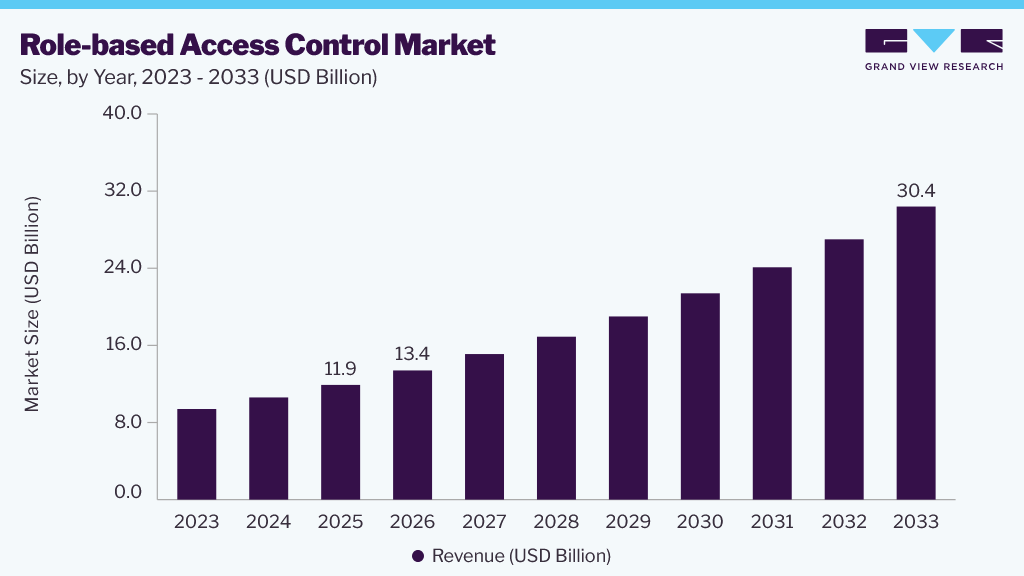 Source: Grand View Research, IR Documents, Primary Interviews, Paid DatabasesTo learn more about this report,
 Download Free Sample Report
 The growing acceptance of Bring-Your-Own-Device (BYOD) practices in workplaces is driving market expansion. As employees increasingly use personal devices to reach corporate assets, RBAC has emerged as a vital tool for regulating access to these resources. RBAC systems empower organizations to govern user access based on job roles and duties, regardless of the device they use. This ensures that employees are granted access only to the resources necessary for their roles, thereby reducing the risk of data breaches from unauthorized access. Consequently, RBAC has become an indispensable element of numerous companies' security strategies tailored for BYOD implementations.
One of the key trends in the role-based access control industry is adapting access control solutions to the evolving dynamics of hybrid work environments. As remote work and hybrid work models, combining both remote and office work, become more prevalent, RBAC systems are being optimized to oversee access permissions across varied environments. This trend focuses on ensuring that employees, regardless of their work location (be it home or office), maintain regulated access to organizational resources in line with their designated roles. This approach ensures that security measures are upheld while fostering smooth teamwork and efficiency in hybrid work arrangements.
Analyst Perspective
The market is becoming increasingly important as organizations seek to manage user permissions across expanding digital environments while reducing security risks. Growth is being driven by the rising adoption of cloud platforms, hybrid work models, and stricter regulatory requirements related to data protection and identity governance. Organizations are prioritizing access management solutions that improve operational efficiency, support compliance, and minimize unauthorized access. Future market development is expected to focus on integrating RBAC with identity and access management (IAM), zero-trust security frameworks, and automated provisioning technologies to address evolving cybersecurity and enterprise governance requirements.
End Use Insights
The BFSI segment dominated the market, with a share of over 24.0% in 2025, and is expected to grow at the fastest CAGR over the forecast period. The growing need to secure sensitive financial information, manage privileged access, and comply with stringent regulatory requirements is driving growth in this segment. Financial institutions increasingly deploy role-based access control solutions to strengthen identity governance, reduce insider threats, and improve access visibility across complex digital environments. The growing adoption of digital banking, cloud-based financial platforms, and cybersecurity frameworks continues to accelerate demand for advanced access management solutions across the BFSI sector.
The government and defense segment is expected to witness substantial growth during the forecast period. Government agencies are increasingly adopting standardized and interoperable access control frameworks to support secure information sharing across departments while maintaining strict authorization controls. Growing investments in digital government initiatives, cybersecurity modernization programs, and critical infrastructure protection are driving the implementation of RBAC solutions. These platforms help public-sector organizations improve governance, strengthen data security, support regulatory compliance, and manage user access across large and complex administrative environments.
Components Insights
The solution segment dominated the market, accounting for over 59.5% in 2025. A prominent trend observed in RBAC solutions involves the fusion of Identity Governance and Administration (IGA) platforms. This integration aims to deliver comprehensive access control by combining RBAC's role-based methodology with IGA's capabilities for managing identities, access requests, certifications, and policy enforcement. This unified solution streamlines governance, risk management, and compliance (GRC) efforts, ensuring stronger access controls and improved visibility into user entitlements across the organization.
The service segment is expected to grow rapidly over the forecast period. Driven by the growing need for consulting and advisory services specializing in RBAC strategy development. Organizations sought expert guidance to craft comprehensive access control strategies that align with their business goals and security requirements. These services encompassed evaluating existing access control mechanisms, identifying gaps, and devising tailored RBAC frameworks to strengthen the security posture and compliance.
Model Type Insights
The Core RBAC segment dominated the market, accounting for over 51.0% of revenue in 2025. The segment's dominance stems from its widespread adoption across enterprises as a foundational access control framework for managing user permissions based on predefined organizational roles. Core RBAC enables organizations to simplify access administration, reduce the risk of unauthorized access, and support regulatory compliance across complex IT environments. Its ease of implementation and compatibility with identity and access management systems have contributed to broad adoption across industries, particularly among organizations seeking centralized and scalable access governance solutions.
The hierarchical RBAC segment is expected to grow at a notable rate during the forecast period. Growth is driven by the increasing demand for scalable access management frameworks that support complex organizational structures and expand digital ecosystems. Hierarchical RBAC enables inheritance of permissions across multiple role levels, reducing administrative complexity and improving policy consistency. The growing adoption of cloud computing, hybrid work environments, Internet of Things (IoT) deployments, and edge computing architectures is further accelerating demand for hierarchical access models that can efficiently manage authorization across large numbers of users, devices, applications, and interconnected systems.
Enterprise Size Insights
The large enterprises segment dominated the market, accounting for over 61.0% of market share in 2025. The ongoing integration of RBAC solutions customized for large enterprises operating in multi-cloud environments. As organizations increasingly embrace a variety of cloud services and platforms, RBAC systems are being developed to provide centralized access management across multiple clouds. This trend aims to ensure consistent policy enforcement, govern access, and facilitate user provisioning, thereby enabling secure, streamlined operations within intricate multi-cloud infrastructures.
The small and medium-sized enterprises (SMEs) segment is expected to grow at the fastest CAGR during the forecast period. The increasing need for streamlined access control solutions in SMEs has sparked a trend. This trend involves the emergence of simplified RBAC solutions specially designed to facilitate easier implementation and management within SME environments. These solutions feature user-friendly interfaces, pre-configured templates, and intuitive setups tailored to address the limited resources and expertise commonly found in SME settings. As a result, this trend enables SMEs to adopt RBAC without requiring extensive technical knowledge, thereby streamlining access control processes and improving operational efficiency.
Regional Insights
The North America region dominated the market, accounting for approximately 32.0% of revenue in 2025. One of the key trends observed in North America is the adoption of cloud-native RBAC solutions tailored to meet organizations' growing requirements for scalability, adaptability, and remote access. These solutions, specifically designed for cloud setups, address the region's rising need for scalable access management tools. Cloud-native RBAC allows smooth integration with diverse cloud services, catering to the dynamic infrastructure needs of enterprises in North America and enabling secure remote access for dispersed work teams.
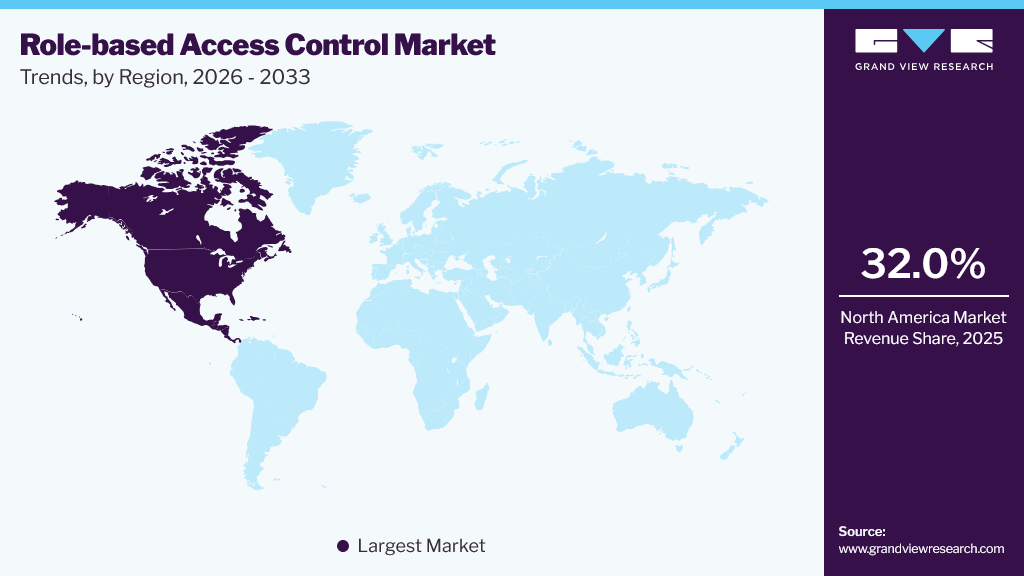 To learn more about this report, Download Free Sample Report
 In June 2025, Okta, Inc. introduced Cross App Access, a cloud-native identity and access management platform that offers centralized, policy-based authorization across enterprise applications and AI agents. It allows enterprises to manage access permissions through a cloud-based platform that offers scalability and secure access. This product development demonstrates growing demand in North American enterprises for cloud-native RBAC.
Asia Pacific Role-based Access Control Market Trends
The role-based access control market in the Asia Pacific is the fastest-growing market worldwide, encompassing burgeoning economies such as India, Japan, China, and Australia, all of which host numerous SMEs. Amid escalating cybersecurity threats, expanded use of online services, and mounting expectations from citizens and the workforce, it is imperative for governments and agencies across this region to modernize digital identities to deliver superior digital experiences. The surge in digitization efforts, notably in online banking and UPI payments, is revolutionizing the financial services sector across the Asia-Pacific and globally. However, this transformation also opens pathways to cyber threats such as ransomware and to risks associated with third-party involvement. Consequently, the financial services sector in the Asia Pacific faces a pressing need to reassess its cybersecurity framework to adapt to the evolving technological landscape, seize business opportunities, and mitigate associated risks.
Key Role-based Access Control Company Insights
The key players in the market are established cybersecurity, identity management, and cloud infrastructure providers that offer solutions for user authorization, identity governance, and access policy enforcement across enterprise environments. Market participants are expanding their capabilities through acquisitions, platform integration, and product enhancements focused on identity security, privileged access management, and zero-trust architecture.
Key Role-based Access Control Companies
The following key companies have been profiled for this study on the role-based access control market:
-
Amazon Web Services, Inc.
-
Broadcom Inc.
-
CyberArk Software Ltd.
-
Dell Technologies Inc.
-
International Business Machines Corporation
-
JumpCloud Inc.
-
Microsoft Corporation
-
Okta, Inc.
-
Oracle Corporation
-
RSA Security LLC
-
SolarWinds Worldwide, LLC
-
Thales S.A.
-
Open Text Corporation
Recent Developments
-
In February 2025, Amazon Web Services Inc. announced the general availability of enhanced AWS Verified Access. The solution enables organizations to centrally define and enforce access policies across applications and cloud resources, supporting secure access management and strengthening policy-based authorization capabilities within enterprise environments.
-
In February 2025, CyberArk acquired Zilla Security, an identity governance and administration (IGA) provider. Zilla's AI-powered provisioning, role management, and access governance capabilities strengthen CyberArk's identity security platform and improve management of role-based access policies across enterprise environments.
Role-based Access Control Market Report Scope
Report Attribute
Details
Market size in 2025
USD 11.9 billion
Estimated market size in 2026
USD 13.4 billion
Projected market size by 2033
USD 30.4 billion
Growth rate
CAGR of 12.5% from 2026 to 2033
Actual data
2021 – 2025
Forecast period
2026 – 2033
Quantitative units
Revenue in USD billion, and CAGR from 2026 to 2033
Report coverage
Revenue forecast, company ranking, competitive landscape, growth factors, and trends
Segments covered
Component, model type, enterprise size, end use, region
Regional scope
North America; Europe; Asia Pacific; Latin America; MEA
Country scope
U.S.; Canada; Mexico; UK; Germany; France; Italy; Spain; China; India; Japan; Australia & New Zealand; South Korea; Brazil; Argentina; South Africa; UAE
Key companies profiled
Amazon Web Services, Inc.; Broadcom Inc.; CyberArk Software Ltd.; Dell Technologies Inc.; International Business Machines Corporation; JumpCloud Inc.; Microsoft Corporation; Okta, Inc.; Oracle Corporation; RSA Security LLC; SolarWinds Worldwide, LLC; Thales S.A.; Open Text Corporation
Customization scope
Free report customization (equivalent up to 8 analysts working days) with purchase. Addition or alteration to country, regional & segment scope.
Pricing and purchase options
Avail of customized purchase options to meet your exact research needs. Explore purchase options
Global Role-based Access Control Market Report Segmentation
This report forecasts revenue growth at the global, regional, and country levels and provides an analysis of the latest industry trends and opportunities in each sub-segment from 2021 to 2033. For this study, Grand View Research has segmented the global role-based access control market report based on component, model type, enterprise size, end use, and region:
-
Components Outlook (Revenue, USD Billion, 2021 - 2033)
-
Solution
-
Services
-
-
Model Type Outlook (Revenue, USD Billion, 2021 - 2033)
-
Core RBAC
-
Hierarchical RBAC
-
Constrained RBAC
-
-
Enterprise Size Outlook (Revenue, USD Billion, 2021 - 2033)
-
Large Enterprises
-
Small & Medium-sized Enterprises (SMEs)
-
-
End Use Outlook (Revenue, USD Billion, 2021 - 2033)
-
BFSI
-
IT & Telecom
-
Government & Defense
-
Retail & Consumer Goods
-
Education
-
Healthcare
-
Energy & Utilities
-
Others
-
-
Regional Outlook (Revenue, USD Billion, 2021 - 2033)
-
North America
-
U.S.
-
Canada
-
-
Europe
-
UK
-
Germany
-
France
-
-
Asia Pacific
-
China
-
India
-
Japan
-
South Korea
-
Australia & New Zealand
-
-
Latin America
-
Brazil
-
Mexico
-
-
Middle East and Africa
-
KSA
-
UAE
-
South Africa
-
-
Frequently Asked Questions About This Report
Some key players operating in the role-based access control market include Amazon Web Services, Inc., Broadcom Inc., CyberArk Software Ltd., Dell EMC, IBM Corporation, JumpCloud Inc., Micro Focus International plc, Microsoft Corporation, Okta, Inc., Oracle Corporation, RSA Security LLC, SolarWinds, and Thales Group.
The global role-based access control market size was valued at USD 11.9 billion in 2025 and is estimated at USD 13.4 billion for 2026.
The global role-based access control market is expected to grow at a CAGR of 12.5% from 2026 to 2033, reaching USD 30.4 billion by 2033.
North America dominated with a revenue share of 32.0% in 2025.
Solution segment dominated the role-based access control market with a share of 59.5% in 2025.
About the Author(s)
Next Generation Technologies Research Team
Technology · Next Generation TechnologiesThis report was authored by the next generation technologies research team at Grand View Research - comprising two research analysts, one senior research analyst, and one industry expert - with specialized expertise in the next generation technologies segment of the technology industry. All findings are based on proprietary technology databases, executive interviews, and regulatory analysis, subject to internal peer review prior to publication.
Last Updated:
Speak to Analyst

Customize this report to your needs - add regions, segments, or data points, with 20% free customization.
Or view our licence options:


ISO 9001:2015 & 27001:2022 Certified
We are GDPR and CCPA compliant! Your transaction & personal information is safe and secure. For more details, please read our privacy policy.


