
- Home
- »
- Renewable Energy
- »
-
Rooftop Solar PV Market Size And Share Report, 2026-2033GVR Report cover

Rooftop Solar PV Market (2026 - 2033)
Size, Share & Trends Analysis Report By Technology (Thin Film, Crystalline Silicon), By Grid Type (On Grid, Off Grid), By Application (Industrial, Residential), By Region, And Segment Forecasts
Market Size, 2025
$184.1BMarket Estimate, 2026
$200.9BMarket Forecast, 2033
$389.0BCAGR, 2026–2033
9.9%Rooftop Solar PV Market Summary
The global rooftop solar PV market size was valued at USD 184.1 billion in 2025 and is projected to grow from USD 200.9 billion in 2026 to USD 389.0 billion by 2033, at a CAGR of 9.9% from 2026 to 2033. The market in Asia Pacific dominated with a revenue share of 31.0% in 2025. The growing demand for clean energy drives the market growth.
 Source: Grand View Research, IR Documents, Primary Interviews, Paid DatabasesTo learn more about this report,
 Download Free Sample Report
Key Market Trends & Insights
- By technology: Crystalline silicon segment held the largest market share of 95.3% in 2025.
- By grid type: On-grid segment held the largest market share of 84.6% in 2025.
- By application: Industrial segment held the largest market share of 40.1% in 2025.
Regional Highlights
- Largest regional market: Asia Pacific (31.0% revenue share, 2025)
- Fastest-growing regional market: Middle East & Africa (highest CAGR, 2026-2033)
- By country: China held the largest market share in 2025
Market Size & Forecast
- Market size in 2025: USD 184.1 Billion
- Estimated market size in 2026: USD 200.9 Billion
- Projected market size by 2033: USD 389.0 Billion
- CAGR (2026-2033): 9.9%
Three ways to get this report
Buy it, customize it, or ask a question.Ask an Analyst
Analyst response in 1 business day
- AccessReport author, directly
- Reply timeWithin 1 working day
- No sales callDirect answer only
- FormatEmail reply
- CostFree, no cost
Get the Full Report
What the study covers
- FormatsPDF · Excel · Dashboard
- Timeline2026–2033 annual, 2025 base
- Coverage20+ countries, 5 regions
- Companies10+ key players profiled
Customize the Report
20% free customization
- IncludeCountries, segments, points
- TailorTo your product definition
- ExtendDeeper competitor detail
- OrA fully bespoke study
- Turnaround5–10 working days
This system uses solar panels mounted on a building’s roof to convert solar energy into electricity. In addition, the rising population and rapid industrialization in certain countries are major factors in the growing market. The demand for renewable energy and government initiatives and investments are major factors in the growth of the rooftop solar PV market. Multiple countries offer subsidies, tax credits, and feed-in tariffs to promote solar adoption. Rooftop solar PV offers a sustainable solution for generating electricity while reducing carbon emissions, thereby driving the government to prioritize renewable energy to prevent climate change.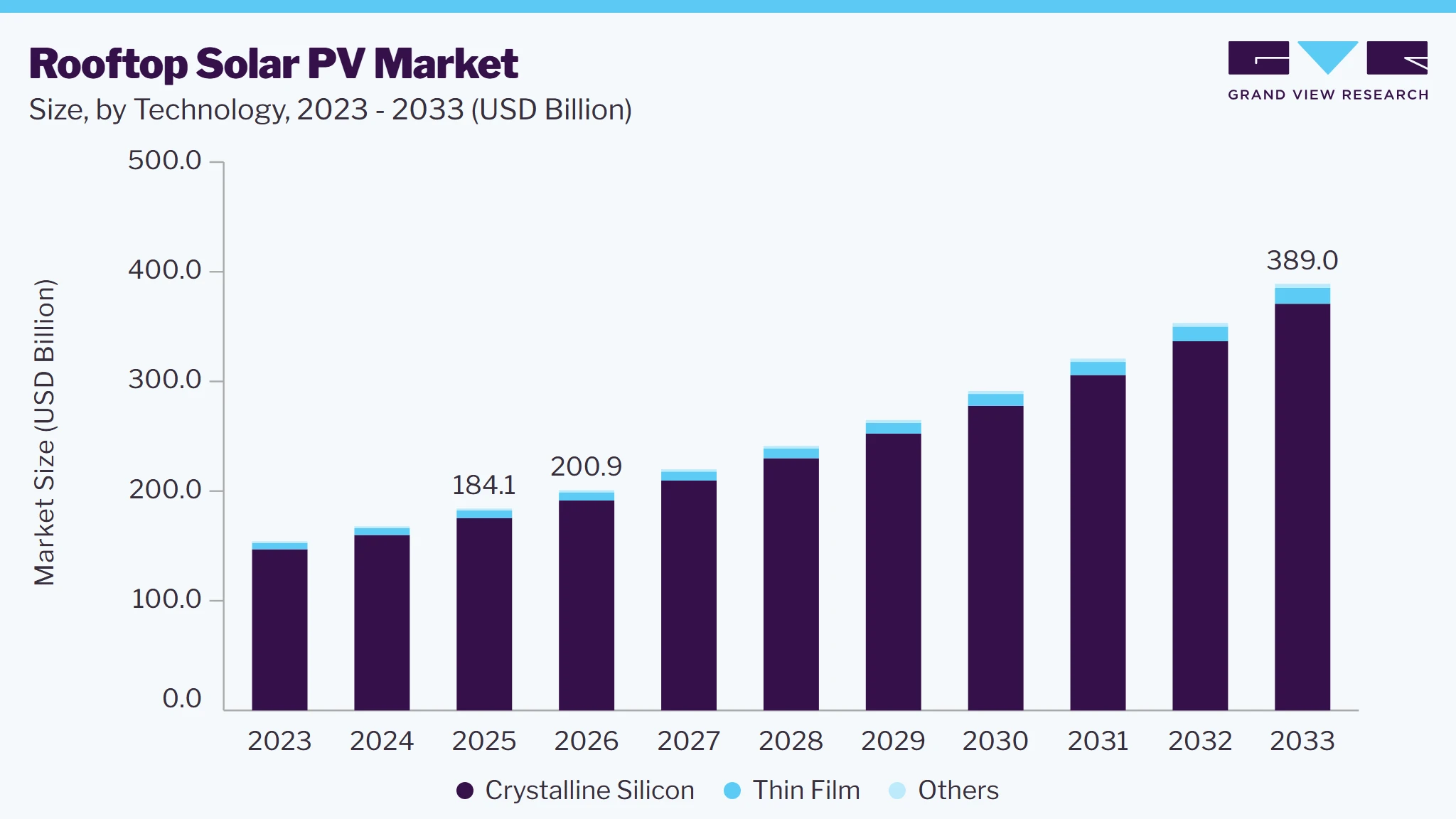 To learn more about this report, Download Free Sample Report
In addition, the reduced costs of solar PV systems and installations over the years due to technological advancements have made them affordable to a larger part of the population. Rooftop solar PV systems are a great cost-effective alternative for increasing conventional energy costs, thereby offering long-term savings on electricity bills. In addition, rooftop solar PV reduces dependency on the grid, mostly in the areas with unreliable electricity supply, along with net metering policies, which improve financial viability, allowing consumers to sell excess solar electricity back to the grid.
Furthermore, the rising environmental awareness, such as the impact on fossil fuels and economic benefits among businesses and residential consumers, is a driving factor for the growth of the rooftop solar PV market. In addition, rapid urbanization has increased energy consumption, which is why measures are being taken by the government, such as energy transition goals, including global commitments to transition to net-zero emissions by 2050, thereby accelerating the growth of the rooftop solar PV industry.
Market Dynamics
The rooftop solar PV market is driven by increasing electricity costs, growing adoption of distributed energy generation, supportive government incentives, and rising demand for energy independence across residential, commercial, and industrial sectors. Advancements in solar module efficiency, battery storage integration, and smart energy management systems are improving system performance and accelerating adoption. However, challenges such as high upfront installation costs, grid integration complexities, and regulatory variations across regions influence market growth. Increasing corporate sustainability commitments and net-zero targets are creating new opportunities for rooftop solar deployment, particularly in commercial and industrial applications.
The rooftop solar PV market is primarily driven by rising electricity prices and the growing need for consumers to reduce dependence on conventional power sources. Residential, commercial, and industrial users are increasingly adopting rooftop solar systems to lower electricity bills, improve energy security, and achieve long-term cost savings. The availability of government incentives, net metering policies, and declining solar installation costs is further encouraging the adoption of rooftop solar solutions across various end-use sectors.
The increasing focus on energy cost reduction has accelerated rooftop solar adoption worldwide. In 2025, global solar PV additions exceeded 600 GW, with distributed solar, including rooftop systems, accounting for a significant share of new capacity growth. China remained the largest rooftop solar market, adding more than 70 GW of distributed PV capacity in 2025, supported by high electricity demand and favorable distributed energy policies. In Europe, rooftop solar deployment continued to expand, with the European Union surpassing 400 GW of cumulative solar PV capacity in 2025, driven by residential and commercial installations aimed at reducing energy costs and improving energy security. These developments highlight the growing role of rooftop solar PV as a cost-effective alternative to conventional electricity sources.
The rooftop solar PV market faces challenges due to the high upfront investment required for system installation, including solar panels, inverters, mounting structures, and installation services. Although rooftop solar systems provide long-term electricity cost savings, the initial capital requirement can limit adoption among residential users and small businesses, especially in price-sensitive markets. Limited access to financing options, complex loan processes, and uncertainty around incentive programs can further slow installation rates. The International Energy Agency highlighted that high financing costs and limited access to affordable capital continue to restrict distributed solar growth in developing economies, where the cost of borrowing can significantly increase project payback periods.
The rooftop solar PV market is gaining opportunities through the integration of battery storage, smart inverters, and energy management systems. Solar-plus-storage solutions help users store excess power, improve energy reliability, reduce grid dependence, and optimize electricity usage. Increasing adoption of smart grids, electric vehicles, and decentralized energy systems is further supporting demand for advanced rooftop solar solutions. In 2025, the European Union added significant solar capacity, with rooftop installations accounting for a major share of new PV deployments, supported by rising electricity prices, favorable policies, and incentives for self-consumption.
Analyst Perspective
The rooftop solar PV market is shifting from a subsidy-driven adoption model toward a more commercially viable energy solution, supported by rising electricity costs, energy independence goals, and corporate sustainability targets. The market is witnessing increased demand for high-efficiency modules, smart inverters, and integrated solar-plus-storage systems that improve performance and reliability. Residential and commercial users are increasingly adopting digital monitoring platforms and AI-enabled energy management solutions to optimize power generation. A key emerging trend is the growth of virtual power plants (VPPs) and distributed energy resource management, enabling multiple rooftop systems to operate as connected energy networks. However, market growth remains influenced by installation costs, grid integration challenges, and varying regulatory support across regions.
Technology Insights
Based on technology, the crystalline silicon segment led the market with the largest revenue share of 95.3% in 2025, due to its high efficiency and long-lasting application, with up to 30 years of guarantee. In addition, their resistance to breakages and prevention from debris accommodation due to their tempered glass shields is a major factor for the growing crystalline silicon rooftop solar PV industry.
Thin film rooftop solar PV market is expected to grow at a significant CAGR over the forecast period, primarily driven by growing investments in renewable energy. Thin film solar cells are cost-effective as they use less semiconductor material and are more efficient in diffused sunlight than conventional silicon solar cells. Furthermore, thin-film solar panels are lighter and more flexible, ideal for weight constraints and weaker buildings.
Grid Type Insights
Based on grid type, the on-grid segment led the market with the largest revenue share of 84.6% in 2025, primarily driven by cost savings and net metering, as it allows consumers to feed back the excess electricity produced by the solar panels back to the grid for financial credits and incentives. In addition, larger businesses are adopting on-grid solar systems for sustainability, reduction of operational charges, and less dependency on fossil fuels. Furthermore, on-grid solar systems provide high returns on investments due to their low maintenance and operational costs, making them a major factor in the growing rooftop solar PV industry.
The off-grid rooftop solar PV market is expected to grow at the fastest compound annual growth rate (CAGR) of 12.9% over the forecast period from 2026 to 2033 due to rising energy demand in remote areas where the grid infrastructure is limited or non-existent. Electricity is important for economic development and essential services such as healthcare and educational institutions. In addition, its cost-effectiveness compared to traditional energy sources, reduction of greenhouse gas emissions, and environmental footprints are not major factors for the growing industry.
Application Insights
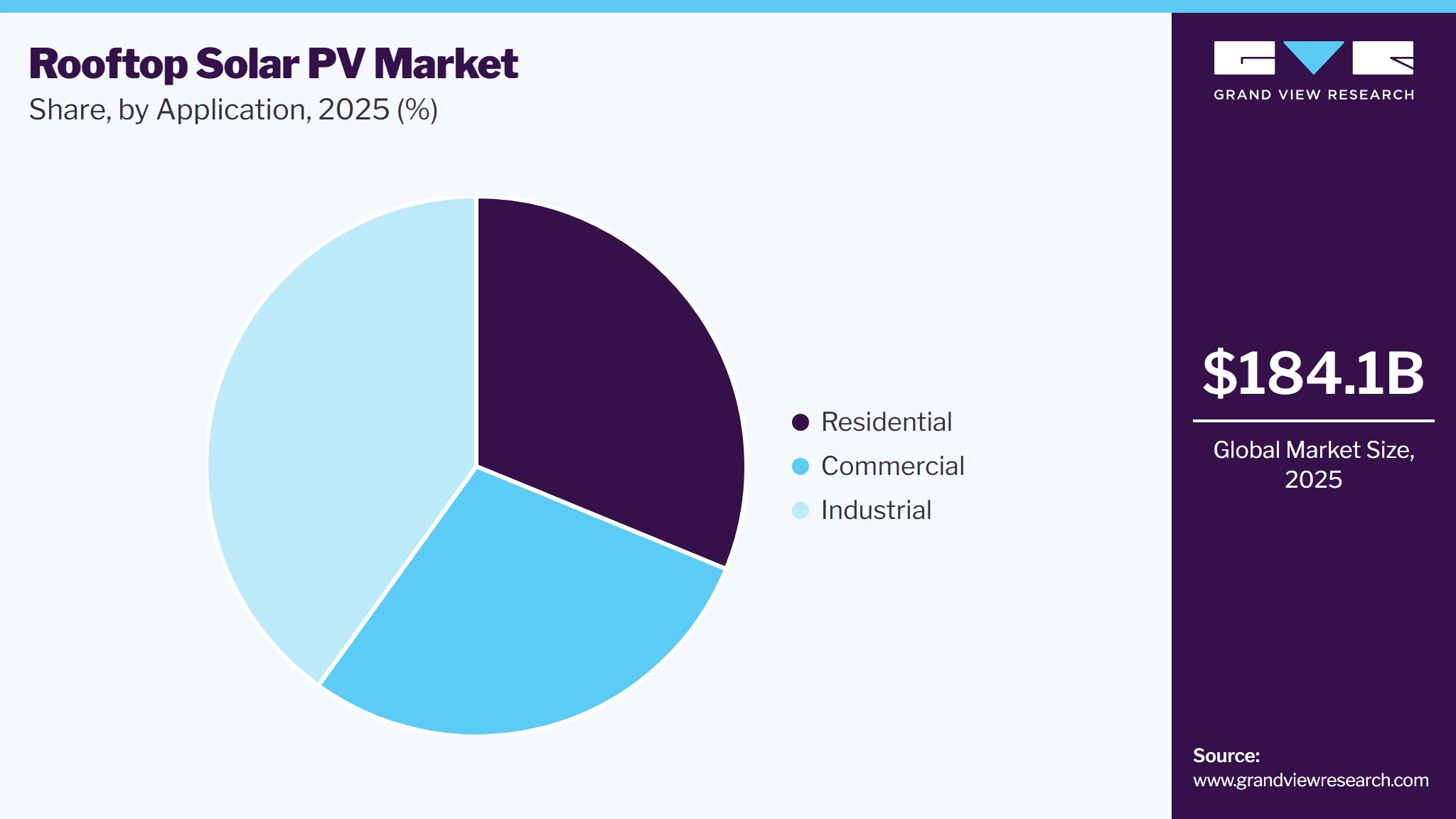
Based on application, the industrial segment led the market with the largest revenue share of 40.1% in 2025, primarily driven by the reduced cost of solar panel systems, installations, and management, making it efficient for businesses and industries to invest on them. Growing environmental awareness prompts industries to use renewable energy solutions such as rooftop solar systems. Government incentives, such as the Investment Tax Credit (ITC) in multiple countries, have made solar investments more appealing for businesses, thereby enhancing market dynamics of the industrial rooftop solar PV market.
 To learn more about this report, Download Free Sample Report
The residential rooftop solar PV market is expected to grow at the fastest compound annual growth rate (CAGR) of 10.8% over the forecast period from 2026 to 2033 due to government initiatives such as the Ministry of New and Renewable Energy (MNRE) in India offer subsidies for solar systems in houses. In addition, houses are opting for solar systems due to net metering policies, which allow homeowners to feed excess electricity back to the grid, reducing their electricity bill. Furthermore, the desire for energy independence and increased property value is a driving factor for the rise of the residential rooftop solar PV market.
Regional Insights
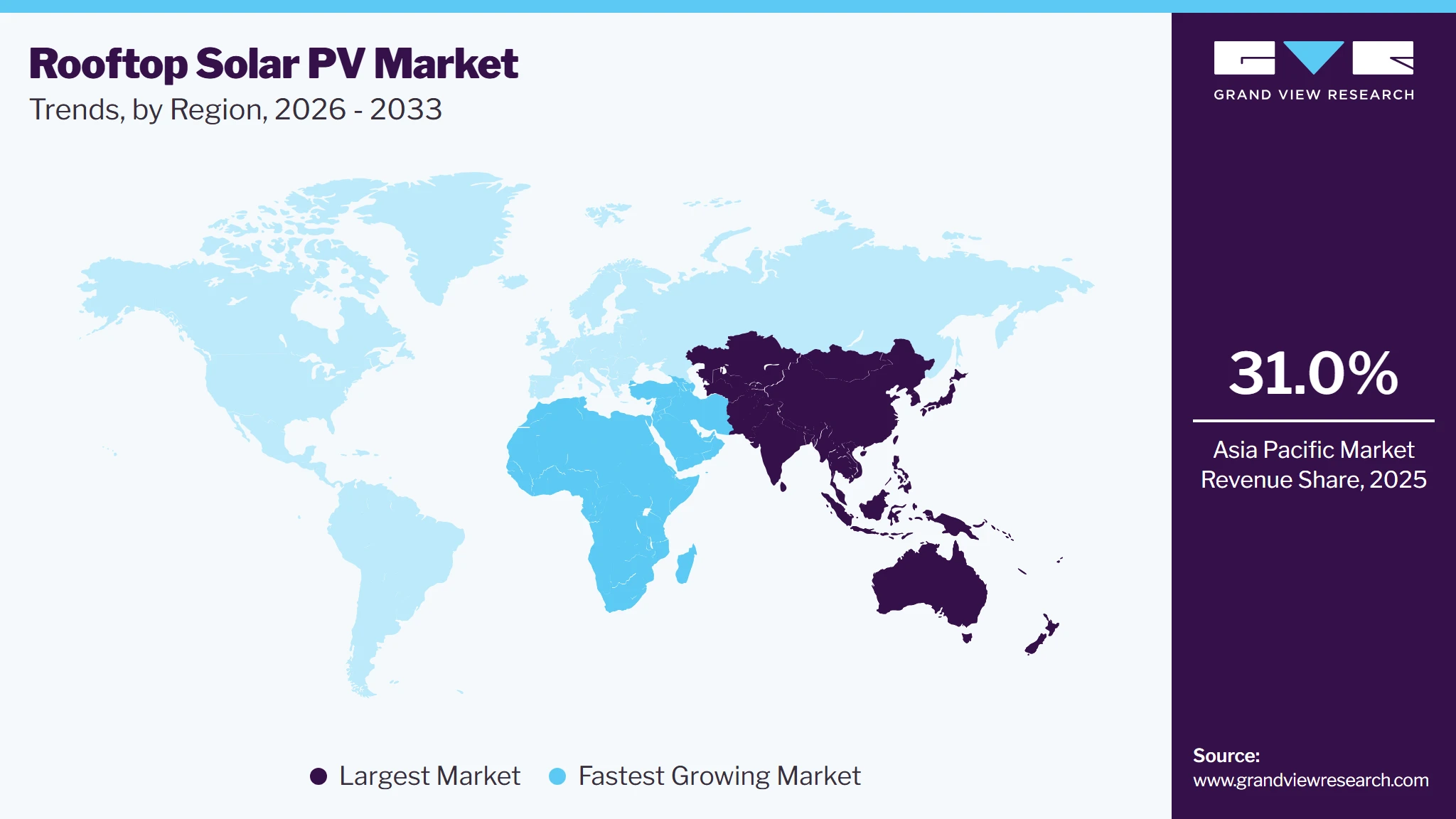
Asia Pacific dominated the rooftop solar PV market with the largest revenue share of 31.0% in 2025. This growth is attributed to favorable government initiatives and the rising focus on saving energy. In addition, the countries in this area are experiencing rapid development, leading to a surge in energy demand by the commercial and industrial segment. Furthermore, the declining cost of solar panels and installations, technological advancements, and their environmental benefits are driving the growth of the Asia Pacific rooftop solar PV market.
 To learn more about this report, Download Free Sample Report
China Rooftop Solar PV Market Trends
The rooftop solar PV market in China held the largest share in the Asia Pacific region in 2025. This was primarily driven by rapid urbanization and industrialization and the shift towards distributed energy generation, which reduces reliance on traditional energy sources. In addition, China’s commitment to reducing carbon footprints and achieving climate goals is driving market growth. Furthermore, the country stated that new public buildings and factories had to be covered at 50% by solar panels by 2025, changing the rooftop solar PV industry dynamics.
Middle East & Africa Rooftop Solar PV Market Trends
Middle East & Africa rooftop solar PV market is expected to grow at the fastest compound annual growth rate (CAGR) of 12.7% over the forecast period from 2026 to 2033. The driving factor for the market is the rising focus of certain countries on solar energy, as most parts of the region are blessed with sunlight for most of the year. In addition, major regional renewable energy targets to prevent carbon emissions from fossil fuels are a driving factor for the market growth. Furthermore, a single solar installation can suffice power demands for a huge part of the population and reduce the electricity bill per unit, making it a major factor in market growth.
The rooftop solar PV market in UAE dominated the Middle East & Africa market and accounted for the largest revenue share in 2025, driven by multiple government initiatives to reach environmental goals. According to the small-scale solar PV Energy netting Regulation, owners of solar PV panels are to be credited for any surplus electricity production within their premises. Furthermore, the rising population of solar canopies in parking areas in UAE for clean energy generation and protection of vehicles from the shed makes it beneficial for both the consumer and the rooftop solar PV industry.
North America Rooftop Solar PV Market Trends
North America rooftop solar PV market is expected to grow significantly over the forecast period from 2026 to 2033 due to the increasing awareness of climate change and reduction of carbon footprints among consumers and businesses. In addition, with the rising electricity prices, homeowners are seeking an alternative energy solution, which makes the residential sector the fastest-growing segment in the rooftop solar PV market, aligning with solar energy benefits. Furthermore, the market is expected to grow significantly with technological advancements, such as solar-powered appliances and energy storage solutions.
The rooftop solar PV market in the U.S. dominated the North America market and accounted for the largest revenue share in 2025, driven by government initiatives to reduce the use of fossil fuels and encouragement towards photovoltaic energies. The Investment Tax Credit (ITC) benefits homeowners by deducting a large percentage of the cost of solar energy system installations from their taxes. In addition, environmental campaigns about climate change and carbon emissions have motivated consumers to adopt renewable energy solutions, hence becoming a major factor in the rise of the rooftop solar PV market.
Key Rooftop Solar PV Company Insights
Key global rooftop solar PV market players include 3M, Koninklijke Philips N.V., Pentair PLC, Panasonic, and others. These companies contribute through innovative technologies, market presence, customer service, and sustainability. These companies invest in high-efficiency panels and hybrid systems for enhanced energy independence. In addition, they have collaborations with multiple local distributors, EPC, contractors and others. Furthermore, their high investment on R&D and focus on cost-effectiveness and durability makes them stand out in the global market.
-
3M is a company that manufactures solar original equipment, installs solar systems, and provides materials such as solar tapes, solar films, and solar coatings for the solar industry. The company participates in global initiatives like RE100, which brings together companies that aim to achieve renewable power by 2050.
-
Panasonic offers a variety of high-efficiency solar panels, including the EverVolt series, which is mainly known for its performance and durability. The company stopped manufacturing solar panels and shifted to outsourcing production to focus more on design, thereby collectively focusing on high-quality products.
Key Rooftop Solar PV Companies:
The following key companies have been profiled for this study on the rooftop solar PV market.
-
3M
-
Koninklijke Philips N.V.
-
Pentair PLC
-
Panasonic
-
Unilever PLC
-
LG Electronics
-
EcoWater Systems
-
A.O. Smith
-
Cilligan International
-
Kinetico Incorporated
Competitive Benchmarking
Category
Operating Strategies
Competitive Edge
Weakness
Established Players (LONGi, Jinko Solar, Trinasolar, JA Technology Co.,Ltd., SUNGROW, Risen Energy Co., Ltd., Qcells)
- Focus on large-scale manufacturing expansion, vertical integration, and cost optimization to maintain leadership in the solar PV value chain.
- Continuously invest in R&D to improve module efficiency, reliability, power output, and next-generation technologies such as n-type TOPCon and heterojunction (HJT).
- Strengthen global market presence through regional manufacturing facilities, strategic partnerships, and utility-scale solar project participation.
- Strong brand recognition, global customer base, and proven track record across utility, commercial, and residential solar markets.
- Large manufacturing capacities enable cost advantages and consistent supply availability.
- Advanced technology capabilities supported by extensive R&D investments and patent portfolios.
- High dependence on large-scale manufacturing creates exposure to module oversupply and price declines.
- Significant capital requirements for capacity expansion and technology upgrades.
- Heavy reliance on Asian supply chains creates vulnerability to trade restrictions, tariffs, and geopolitical risks.
Emerging Players (AIKO, Chint New Energy Technology Co., Ltd., Tata Power)
- Focus on differentiated technologies, specialized product offerings, and targeted regional expansion to compete with established manufacturers.
- Invest in high-efficiency cell technologies and advanced PV solutions to capture premium market segments.
- Build market presence through strategic partnerships, local manufacturing initiatives, and government-supported renewable energy programs.
- Greater agility in adopting new technologies and responding quickly to emerging solar market trends.
- Ability to compete through differentiated products, such as high-efficiency modules and advanced cell architectures.
- Strong regional positioning and local market knowledge, particularly in high-growth solar markets.
- Lower global brand recognition and customer trust compared with established Tier-1 players.
- Smaller manufacturing scale results in limited cost advantages and pricing competitiveness.
- Less extensive international distribution networks and project references.
Recent Developments
-
In January 2025, LG Energy Solutions announced its partnership with Aptera Motors to supply 2170 cylindrical batteries that advance solar EV innovation and sustainable mobility to promote solar-powered transportation in the U.S.
-
In January 2025, A.O. Smith announced that they had scheduled a conference call for the release of the fourth quarter 2024 financial results on 30th January 2025.
-
In March 2024, an agreement was made with PowerChina Huadong Engineering Corporation Limited by JA Solar, which stated that JA Solar needs to provide 480 MW PV Modules to the CEME1 480MW Project, which is the largest photovoltaic (PV) installation in Chile.
-
In January 2024, a leading solar panel manufacturing company, Emmvee Photovoltaic Power Pvt. Ltd., stated that they made a supply agreement with KPI Green Energy Ltd to deliver 300MWp of Bifacial MonoPERC Solar panels for the 240 MW solar plant in Gujarat.
Rooftop Solar PV Market Report Scope
Report Attribute
Details
Market Definition
The rooftop solar PV market is defined as the revenue generated from the sales of rooftop solar photovoltaic systems based on technology, grid type, and application across residential, commercial, and industrial sectors.
Market size in 2025
USD 184.1 billion
Estimated market size in 2026
USD 200.9 billion
Projected market size by 2033
USD 389.0 billion
Growth rate
CAGR of 9.9% from 2026 to 2033
Base year for estimation
2025
Historical data
2021 - 2024
Forecast period
2026 - 2033
Quantitative units
Revenue in USD Million and CAGR from 2026 to 2033
Report coverage
Revenue forecast, company ranking, competitive landscape, growth factors, and trends
Segments covered
Technology, Grid Type, Application, Region
Regional scope
North America, Europe, Asia Pacific, Latin America, Middle East & Africa
Country scope
U.S., Canada, Mexico, North America, Germany, Russia, UK, Spain, Italy, France, China, Japan, South Korea, India, Australia, Brazil, Colombia, Paraguay, Saudi Arabia, UAE, South Africa, and Egypt
Key companies profiled
LONGi, Jinko Solar, Trinasolar, JA Technology Co.,Ltd., Chint New Energy Technology Co., Ltd., SUNGROW, Risen Energy Co., Ltd., AIKO, Qcells, Tata Power
Customization scope
Free report customization (equivalent up to 8 analysts' working days) with purchase. Addition or alteration to country, regional & segment scope.
Pricing and purchase options
Avail customized purchase options to meet your exact research needs. Explore purchase options
Global Rooftop Solar PV Market Report Segmentation
This report forecasts revenue growth at global, regional, and country levels and analyzes the latest industry trends in each sub-segment from 2021 to 2033. For this study, Grand View Research has segmented the global Rooftop Solar PV market report based on technology, grid type, application and region.
 To learn more about this report, Download Free Sample Report
-
Technology Outlook (Revenue, USD Million, 2021 - 2033)
-
Thin Film
-
Crystalline Silicon
-
Others
-
-
Grid Type Outlook (Revenue, USD Million, 2021 - 2033)
-
On Grid
-
Off Grid
-
-
Application Outlook (Revenue, USD Million, 2021 - 2033)
-
Residential
-
Commercial
-
Industrial
-
-
Regional Outlook (Revenue, USD Million, 2021 - 2033)
-
North America
-
U.S.
-
Canada
-
Mexico
-
-
Europe
-
Germany
-
Russia
-
UK
-
Spain
-
Italy
-
France
-
-
Asia Pacific
-
China
-
Japan
-
South Korea
-
India
-
Australia
-
-
Latin America
-
Brazil
-
Colombia
-
Paraguay
-
-
Middle East and Africa
-
Saudi Arabia
-
UAE
-
South Africa
-
Egypt
-
-
Research Methodology
The rooftop solar PV market figures in this report are based on a proven research process that combines executive interviews with secondary research from proprietary databases, company filings, and recognized regulatory and institutional sources. Market size is built through value-chain sizing - reconciling supply-side and demand-side estimates - and triangulated with bottom-up and top-down approaches. Every estimate passes multiple levels of expert validation before publication, with each rooftop solar PV segment quantified using the revenue-capture definitions in the table below.
Segment Definition
Segment - Technology
Revenue capture definition
Thin Film
Thin-film rooftop solar PV systems include lightweight and flexible photovoltaic modules designed for rooftop installations with specific space, weight, and design requirements. Revenue is generated from the sales of thin-film solar PV modules used across residential, commercial, and industrial rooftop applications.
Crystalline Silicon
Crystalline silicon rooftop solar PV systems include mono-crystalline and polycrystalline photovoltaic modules widely used for rooftop energy generation. Revenue is generated from the sales of crystalline silicon solar PV modules deployed across residential, commercial, and industrial rooftop solar installations.
Others
Other rooftop solar PV technologies include emerging and alternative photovoltaic solutions used for specialized rooftop energy applications. Revenue is generated from the sales of non-crystalline and advanced solar PV modules installed across niche rooftop projects.
Segment - Grid Type
Revenue capture definition
On-grid
On-grid rooftop solar PV systems include installations connected to the utility grid for electricity generation, self-consumption, and excess power export. Revenue is generated from the sales of grid-connected rooftop solar PV systems used across residential, commercial, and industrial applications.
Off-grid
Off-grid rooftop solar PV systems include standalone installations integrated with batteries or backup solutions for independent power generation. Revenue is generated from the sales of off-grid rooftop solar PV systems used in remote locations and areas with limited grid connectivity.
Segment - Application
Revenue capture definition
Residential
Residential rooftop solar PV systems include solar installations deployed on homes, apartments, and residential buildings for household electricity generation and energy cost reduction. Revenue is generated from the sales of rooftop solar PV systems installed across residential properties.
Commercial
Commercial rooftop solar PV systems include solar installations deployed across offices, retail buildings, educational facilities, and other commercial establishments. Revenue is generated from the sales of rooftop solar PV systems used for commercial electricity generation and sustainability initiatives.
Industrial
Industrial rooftop solar PV systems include solar installations deployed across factories, warehouses, and manufacturing facilities to meet high electricity demand and support renewable energy adoption. Revenue is generated from the sales of rooftop solar PV systems used in industrial energy applications.
Estimation Model
Layer Name
Key Question
Description
Rooftop Solar PV Demand Layer
What drives the demand for rooftop solar PV systems?
Identify key demand drivers for rooftop solar PV, including rising electricity costs, renewable energy adoption, government incentives, energy independence goals, declining solar module costs, and increasing demand for distributed energy generation. Assess factors such as sustainability targets, net metering policies, and grid reliability requirements influencing market growth.
Rooftop Solar PV Technology & Grid Type Layer
What technologies and system configurations are used?
Analyze adoption of rooftop solar PV systems based on technology (thin film, crystalline silicon, and others) and grid type (on-grid and off-grid). Assess preferences based on efficiency, installation flexibility, cost competitiveness, energy storage integration, and electricity access requirements.
Rooftop Solar PV Application Layer
Where are rooftop solar PV systems deployed?
Evaluate rooftop solar PV installations across residential, commercial, and industrial applications. Assess demand based on electricity consumption patterns, rooftop availability, energy cost reduction goals, sustainability initiatives, and adoption of self-generation solutions.
Revenue Layer
How is market revenue generated?
Market revenue is quantified through the sales of rooftop solar PV modules across different technologies, grid types, and applications. The overall market value is determined by revenue generated from the sale of photovoltaic modules supplied for residential, commercial, and industrial rooftop solar applications.
Delivered Customizations
This report has been delivered with the following In-depth customizations
Client Request
Customization Delivered
Value Adds
Regional Opportunity Assessment
A detailed country- and region-level assessment was conducted to evaluate rooftop solar PV market potential by analyzing solar resource availability, electricity tariff trends, renewable energy policies, incentive programs, net metering regulations, grid modernization initiatives, distributed energy adoption, and residential, commercial, and industrial installation growth.
Identified high-potential regions and emerging markets with favorable policy support, strong solar adoption outlook, and attractive investment opportunities for rooftop solar PV deployment.
Competitive Benchmarking
Prominent rooftop solar PV players were benchmarked based on module and system offerings, technology capabilities, installation and EPC expertise, solar-plus-storage integration, digital monitoring solutions, financing models, geographical presence, customer segments served, partnerships, and recent strategic developments.
Provided insights into competitive positioning, key differentiation factors, technology leadership, expansion strategies, and opportunities for market entry or partnerships.
Thin-Film Rooftop Solar PV Across Applications
Thin-film rooftop solar PV adoption was analyzed across residential, commercial, and industrial applications based on technology capabilities, efficiency performance, installation flexibility, roof structure suitability, weight constraints, cost considerations, regional adoption trends, and application-specific deployment opportunities.
Provided insights into high-potential application areas for thin-film rooftop solar PV, technology adoption patterns, competitive advantages over conventional modules, and emerging opportunities across different end-use segments.
Frequently Asked Questions About This Report
China dominated the Asia Pacific region market with a revenue share of 25.0% in 2025.
The Middle East & Africa region is anticipated to register the fastest CAGR of 12.7% over the forecast period.
Based on technology, the crystalline silicon segment accounted for the largest revenue share of 95.3% in 2025.
Based on application, the industrial segment accounted for the largest revenue share of 40.1% in 2025.
The global rooftop solar PV market size was valued at USD 184.1 billion in 2025 and is estimated at USD 200.9 billion for 2026.
The global rooftop solar PV market is expected to grow at a CAGR of 9.9% from 2026 to 2033, reaching USD 389.0 billion by 2033.
The Asia Pacific region dominated the rooftop solar PV market with a revenue share of 31.0% in 2025.
The key players operating in the rooftop solar PV market are LONGi, Jinko Solar, Trinasolar, JA Technology Co., Ltd., Chint New Energy Technology Co., Ltd., SUNGROW, Risen Energy Co., Ltd., AIKO, Qcells, Tata Power, and others.
The key factors driving the rooftop solar PV market include rising electricity costs, supportive government incentives, increasing demand for energy independence, declining solar installation costs, corporate sustainability goals, and growing adoption of distributed renewable energy solutions.
About the Author(s)
Renewable Energy Research Team
Energy & Power · Renewable EnergyThis report was authored by the renewable energy research team at Grand View Research - comprising two research analysts, one senior research analyst, and one industry expert - with specialized expertise in the renewable energy segment of the energy & power industry. All findings are based on proprietary energy & power databases, executive interviews, and regulatory analysis, subject to internal peer review prior to publication.
Last Updated:
Speak to Analyst

Customize this report to your needs - add regions, segments, or data points, with 20% free customization.
Or view our licence options:


ISO 9001:2015 & 27001:2022 Certified
We are GDPR and CCPA compliant! Your transaction & personal information is safe and secure. For more details, please read our privacy policy.


