
- Home
- »
- Advanced Interior Materials
- »
-
Rotary Air Compressor Market Size And Share Report, 2026-2033GVR Report cover

Rotary Air Compressor Market (2026 - 2033)
Size, Share & Trends Analysis Report By Lubrication (Oil-free, Oil-filled), By Type (Stationary, Portable), By Application, By Region (North America, Europe, Asia Pacific, Latin America, MEA), And Segment Forecasts
Market Size, 2025
$13.1BMarket Estimate, 2026
$13.7BMarket Forecast, 2033
$18.7BCAGR, 2026–2033
4.6%Rotary Air Compressor Market Summary
The global rotary air compressor market size was valued at USD 13.1 billion in 2025 and is projected to grow from USD 13.7 billion in 2026 to USD 18.7 billion by 2033, at a CAGR of 4.6% from 2026 to 2033. The Asia Pacific market held the largest share of 43.7% of the global market in 2025. The market growth is primarily driven by increasing industrialization and automation across key sectors such as manufacturing, oil & gas, and energy.
 Source: Grand View Research, IR Documents, Primary Interviews, Paid DatabasesTo learn more about this report,
 Download Free Sample Report
 Key Market Trends & Insights
- By type: The Stationary rotary/screw air compressors dominated the market in 2025.
- By lubrication: The Oil-filled rotary/screw air compressors dominated the market in 2025 and accounted for 61.7% share.
- By application: The manufacturing segment dominated the market and accounted for 37.3% share in 2025.
Regional Highlights
- Largest regional market: Asia Pacific (43.7% revenue share, 2025)
- By country: The China held the largest market share in 2025.
Market Size & Forecast
- Market size in 2025: USD 13.1 Billion
- Estimated market size in 2026: USD 13.7 Billion
- Projected market size by 2033: USD 18.7 Billion
- CAGR (2026-2033): 4.6%
Three ways to get this report
Buy it, customize it, or ask a question.Ask an Analyst
Analyst response in 1 business day
- AccessReport author, directly
- Reply timeWithin 1 working day
- No sales callDirect answer only
- FormatEmail reply
- CostFree, no cost
Get the Full Report
What the study covers
- FormatsPDF · Excel · Dashboard
- Timeline2026–2033 annual, 2025 base
- Coverage20+ countries, 5 regions
- Companies10+ key players profiled
Customize the Report
20% free customization
- IncludeCountries, segments, points
- TailorTo your product definition
- ExtendDeeper competitor detail
- OrA fully bespoke study
- Turnaround5–10 working days
As industries adopt advanced production systems and pneumatic tools, the demand for reliable and continuous compressed air solutions has significantly increased. Rotary air compressors, particularly screw compressors, are preferred due to their high efficiency, durability, and ability to operate continuously with minimal downtime. To learn more about this report, Download Free Sample Report
 Rotary air compressors are gaining strong traction due to their ability to deliver a smooth and continuous airflow compared to reciprocating compressors, which often produce pulsation and pressure fluctuations. Their design minimizes heat generation during compression, which in turn reduces moisture formation and improves overall system efficiency. This leads to better air quality and lowers the risk of water entering downstream equipment, making them highly suitable for industrial applications that require a consistent and reliable air supply.
Market Concentration & Characteristics
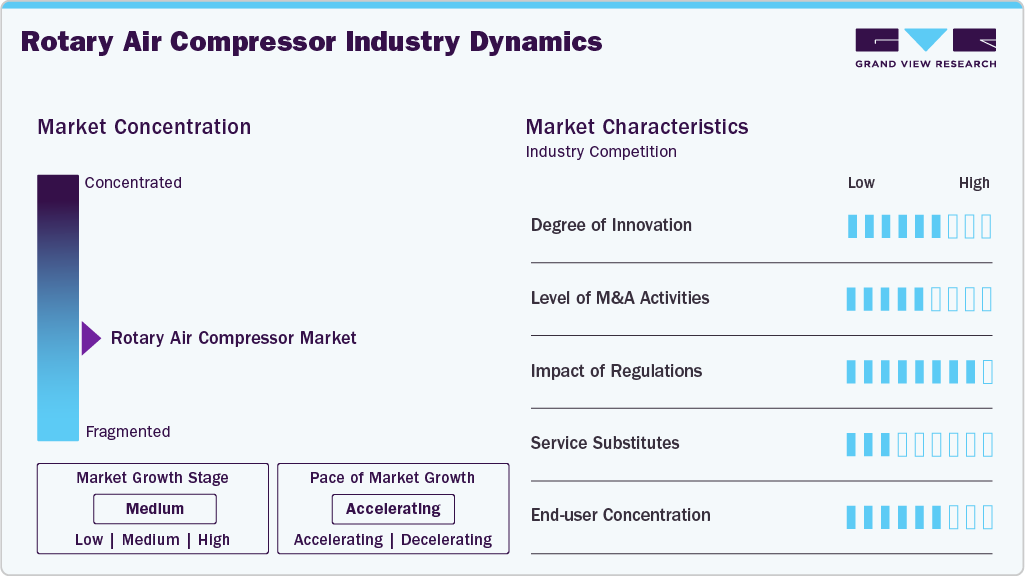
The rotary air compressor industry is fragmented, with the presence of several global and regional players competing across different product segments and end-use industries. While a few established companies, such as Atlas Copco, Ingersoll Rand, and KAESER KOMPRESSOREN, hold significant market shares due to their strong distribution networks, technological capabilities, and brand recognition, a large number of regional and local manufacturers contribute to competitive intensity.
The rotary air compressor industry is seeing steady innovation, mainly focused on improving efficiency, reliability, and system intelligence. Companies are introducing features like variable speed drives, remote monitoring, and predictive maintenance to optimize performance and reduce operating costs. For instance, in February 2025, development by ELGi Equipment introduced its “STABILISOR” technology. This solution helps balance air supply with demand, reduces unnecessary load cycles, and improves energy efficiency while extending equipment life. Such advancements reflect a broader industry shift toward smarter and more energy-conscious compressor systems.
 To learn more about this report, Download Free Sample Report
 Regulatory requirements have a strong influence on product design and adoption in this market. Industries such as food processing, healthcare, and pharmaceuticals require clean, oil-free compressed air to meet strict safety and quality standards. At the same time, energy efficiency regulations and environmental policies are pushing manufacturers to develop systems that consume less power and reduce emissions. These compliance requirements are encouraging the adoption of advanced, eco-friendly compressor technologies across regions.
The demand for rotary/screw air compressors is spread across a wide range of industries, making the market diversified. Manufacturing continues to lead due to its extensive use of compressed air in production and automation processes. Other important sectors include oil & gas, energy, healthcare, food & beverage, and electronics. In addition to large industrial users, small and medium enterprises are also increasingly adopting these systems, especially in developing regions. This balanced demand across multiple industries supports stable and consistent market growth.
Drivers, Opportunities & Restraints
The market is mainly driven by growing industrialization and the increasing use of automation across sectors such as manufacturing, oil & gas, and energy. These compressors are preferred for their ability to deliver continuous and reliable compressed air, which is essential for running pneumatic tools and production systems. Rising demand for energy-efficient equipment is also pushing adoption, as modern rotary compressors help reduce power consumption and operating costs.
There is a strong opportunity in the development of energy-efficient and smart compressor systems. The integration of digital technologies such as IoT-based monitoring and predictive maintenance is allowing users to optimize performance and reduce downtime. Emerging markets, particularly in Asia-Pacific and Latin America, are creating new growth avenues due to rapid industrial expansion and infrastructure development. In addition, increasing focus on sustainability and carbon reduction is encouraging the adoption of advanced compressors with lower emissions and improved efficiency, opening doors for innovation and product differentiation.
Despite steady growth, the market faces certain challenges. High initial investment costs, especially for advanced oil-free and energy-efficient compressors, can limit adoption among small and medium enterprises. Maintenance and operational costs can also be significant if systems are not properly managed. Moreover, fluctuations in raw material prices and economic uncertainties in key industries such as oil & gas can impact overall demand.
Type Insights
Stationary rotary/screw air compressors dominated the market in 2025, mainly due to their widespread use in large-scale industrial operations requiring continuous and high-capacity compressed air supply. Industries such as manufacturing, oil & gas, and energy relied heavily on these systems for running automated processes, heavy machinery, and production lines. Their ability to operate efficiently over long durations, along with higher output capacity and reliability, made them the preferred choice for fixed installations. In addition, centralized compressed air systems in industrial facilities further supported the dominance of stationary compressors.
Portable rotary/screw air compressors were the fastest-growing segment at a CAGR of 5.0%, driven by increasing demand for flexible and mobile compressed air solutions. These compressors gained traction across construction sites, automotive services, and field operations where ease of transport and on-site usability are critical. Their compact design, ease of handling, and ability to power various pneumatic tools contributed to their rising adoption. Growth in infrastructure development, maintenance activities, and small-scale industrial applications further accelerated demand for portable compressors during the year.
Lubrication Insights
Oil-filled rotary/screw air compressors dominated the market in 2025 and accounted for 61.7% share, primarily due to their cost-effectiveness, durability, and suitability for heavy-duty industrial operations. These compressors were widely adopted across manufacturing, oil & gas, and energy sectors where continuous operation and high efficiency are required. The presence of lubricating oil helps in cooling, sealing, and reducing wear and tear, which enhances equipment lifespan and reliability. In addition, their lower initial cost compared to oil-free systems made them a preferred choice, particularly in price-sensitive markets and large-scale industrial applications.
Oil-free compressors are witnessing the fastest growth, driven by increasing demand for clean and contamination-free compressed air. Industries such as food & beverage, healthcare, pharmaceuticals, and electronics require high air purity to meet strict quality and safety standards. Regulatory pressures and growing awareness around product integrity are accelerating the shift toward oil-free technologies. Although these systems involve a higher initial investment, their ability to eliminate contamination risks and reduce downstream filtration requirements is boosting their adoption across sensitive applications.
Application Insights
The manufacturing segment dominated the market and accounted for 37.3% share in 2025, driven by the extensive use of compressed air across production lines and industrial processes. Rotary air compressors were widely used to power pneumatic tools, operate automation systems, and support material handling and assembly operations. Their ability to deliver continuous, stable airflow made them essential in high-volume manufacturing environments. In addition, the ongoing shift toward industrial automation and smart factories further strengthened demand for reliable and energy-efficient compressor systems in this segment.
 To learn more about this report, Download Free Sample Report
 The food & beverage segment was the fastest-growing application in 2025, mainly due to increasing emphasis on hygiene, product safety, and regulatory compliance. The industry showed a strong preference for oil-free compressors to eliminate the risk of contamination during processing, packaging, and bottling operations. Rising demand for packaged and processed food, along with stricter quality standards, significantly contributed to segment growth. Moreover, advancements in clean air technologies and increasing investments in modern food processing facilities further supported the adoption of rotary air compressors in this sector.
Regional Insights
North America experienced steady growth at a CAGR of 3.4%, driven by the modernization of industrial infrastructure and increasing focus on energy efficiency. Industries in the region emphasized the adoption of advanced compressor systems with improved performance and reduced operational costs. Demand was further supported by the need for reliable compressed air in sectors such as healthcare, food processing, and high-precision manufacturing. The growing integration of smart technologies and predictive maintenance solutions also contributed to sustained market expansion.
U.S. Rotary Air Compressor Market Trends
The rotary air compressor market in the U.S. was supported by strong growth in manufacturing activity and industrial output. According to the National Association of Manufacturers (NAM), manufacturing value-added output increased from USD 2.860 trillion in Q2 2025 to USD 2.951 trillion in Q3 2025. This growth was observed across both durable goods, which rose from USD 1.534 trillion to USD 1.576 trillion, and nondurable goods, which increased from USD 1.325 trillion to USD 1.375 trillion. The expansion in production activity drove higher demand for reliable and continuous compressed air systems, particularly in automated and high-volume manufacturing environments. As industries continued to scale operations and improve efficiency, the adoption of advanced rotary air compressors remained strong across key industrial applications.
Europe Rotary Air Compressor Market Trends
The rotary air compressor market in Europe is supported by strict environmental regulations and a strong emphasis on sustainability. Industries increasingly adopted energy-efficient and oil-free compressor systems to comply with regulatory standards and reduce carbon emissions. The region also witnessed rising demand for technologically advanced equipment, particularly in sectors requiring high-quality compressed air. Continuous upgrades of existing industrial systems further supported the adoption of modern rotary compressors.
Germany rotary air compressor market dominated Europe, supported by its strong industrial base and advanced manufacturing ecosystem. The country’s well-established sectors, including automotive, engineering, and healthcare, continued to generate steady demand for efficient and reliable compressed air systems. According to the International Trade Administration, the healthcare industry recorded a gross value added of USD 496 billion (EUR 435 billion) in 2024, accounting for 11.5% of the overall economy. This significant contribution highlights the scale of operations requiring clean and high-quality compressed air, particularly in medical and pharmaceutical applications.
The rotary air compressor market in France witnessed notable growth, driven by increasing industrial modernization and rising demand from sectors such as food processing, healthcare, and general manufacturing. The country’s emphasis on improving production efficiency and adopting sustainable technologies encouraged the use of advanced and energy-efficient compressor systems. Growing investments in automation and infrastructure development also contributed to the expanding adoption of rotary air compressors. In addition, the rising need for high-quality and contamination-free compressed air in regulated industries supported steady market growth.
Asia Pacific Rotary Air Compressor Market Trends
The rotary air compressor market in the Asia Pacific in 2025 and also emerged as the fastest-growing region, supported by rapid industrial expansion and strong manufacturing activity. The region benefited from increasing investments in infrastructure, electronics production, and energy projects, which drove consistent demand for compressed air systems. Rising adoption of automation and the presence of a large base of small and medium industries further contributed to market growth. In addition, growing awareness of energy-efficient technologies accelerated the uptake of advanced rotary compressors across various sectors.
 To learn more about this report, Download Free Sample Report
 China rotary air compressor market remained a key growth in the Asia Pacific, supported by its large-scale industrial base and continuous expansion of manufacturing activities. Strong demand from sectors such as electronics, automotive, and heavy industries drove the adoption of high-capacity and energy-efficient compressor systems. Increasing automation across production facilities and ongoing infrastructure development further contributed to market growth.
The rotary air compressor market in India witnessed strong growth, driven by rapid industrialization and expanding manufacturing capabilities. According to the India Brand Equity Foundation, the country’s manufacturing sector is gaining momentum, with rising exports and key industries such as electronics, pharmaceuticals, automobiles, and textiles positioning it to reach approximately USD 1 trillion in output by FY26. This growth trajectory is strengthening its role as a global manufacturing hub and driving demand for reliable and energy-efficient compressed air systems.
Latin America Rotary Air Compressor Market Trends
The rotary air compressor market in Latin America witnessed moderate growth in 2025, driven by gradual industrial development and expanding construction and energy sectors. The demand for rotary air compressors increased due to rising infrastructure projects and the need for efficient equipment in industrial operations. Cost-effective solutions remained a key preference in the region, encouraging the adoption of durable and reliable compressor systems. Improving industrial activities and investments in key sectors supported steady market growth.
Brazil rotary air compressor market showed steady growth, supported by expanding industrial and infrastructure activities. Demand was driven by sectors such as manufacturing, construction, energy, and mining, where reliable compressed air systems are essential for daily operations. Increasing investments in industrial modernization and equipment upgrades further contributed to market expansion. In addition, the need for cost-efficient and durable compressor solutions remained strong, encouraging the adoption of rotary air compressors across both large-scale industries and smaller enterprises.
Middle East & Africa Rotary Air Compressor Market Trends
The rotary air compressor market in the Middle East & Africa is experiencing growing demand, largely supported by developments in energy, construction, and industrial sectors. The need for robust and high-performance equipment capable of operating in challenging environments contributed to the adoption of rotary compressors. Increasing focus on infrastructure development and diversification of industrial activities further supported market expansion.
Saudi Arabia rotary air compressor market experienced notable growth, driven by expanding industrial diversification and large-scale infrastructure development. Strong demand from sectors such as energy, petrochemicals, and construction supported the adoption of high-performance and durable compressor systems. Ongoing investments in industrial projects and modernization initiatives increased the need for reliable and continuous compressed air solutions.
Key Rotary Air Compressor Company Insights
Some of the key players operating in the market include Atlas Copco, Ingersoll Rand, and KAESER KOMPRESSOREN.
-
Atlas Copco’s compressor operations in the U.S. focus on delivering integrated compressed air and gas solutions through a wide portfolio that includes compressors, blowers, air treatment systems, and related equipment. The company supports these offerings with a strong service network, spare parts availability, and system optimization capabilities tailored to industrial needs. Its approach emphasizes ensuring consistent performance, maintaining air quality standards, and providing reliable after-sales support to enhance overall operational efficiency across applications.
-
Ingersoll Rand provides a wide portfolio of compressed air, vacuum, and fluid handling solutions designed for industrial and commercial use. Its offerings include both oil-free and oil-lubricated compressors, along with air treatment equipment and system accessories. The company also delivers end-to-end support through installation, maintenance, and optimization services, along with digital tools for monitoring system performance. This approach helps improve operational efficiency, reliability, and overall system management across various applications.
Key Rotary Air Compressor Companies:
The following key companies have been profiled for this study on the rotary air compressor market.
- Atlas Copco
- CompAir
- HPC Compressed Air Systems
- United Air Power Ltd.
- KAESER KOMPRESSOREN
- ELGi
- Kaishan USA
- Ingersoll Rand
- GE Appliances
- Gardner Denver
- Hitachi Ltd.
- Kobe Steel Ltd.
- BAUER COMP Holding GmbH
- BelAire
- Frank Compressors
- Sollant Group
Recent Developments
-
In February 2026, Atlas Copco launched the X-Air Plus 800-20 portable compressor under its DrillAir range, offering high airflow capacity in a compact and easy-to-transport design. The model delivers improved fuel efficiency, reducing operating costs compared to earlier versions. It is suitable for demanding applications such as drilling and pipeline work. The system also includes advanced controls to enhance performance and operational efficiency.
-
In January 2026, Ingersoll Rand introduced the RSbn Nirvana Series screw air compressors in India, designed to improve energy efficiency and reduce operating costs. The range includes capacities from 7 kW to 250 kW and features a Variable Frequency Drive with a high-efficiency permanent magnet motor. These compressors adjust output based on demand, helping minimize energy wastage. They are well-suited for industries with variable load requirements, offering better performance and lower power consumption.
Rotary Air Compressor Market Report Scope
Report Attribute
Details
Market size in 2025
USD 13.1 Billion
Estimated market size in 2026
USD 13.7 billion
Projected market size by 2033
USD 18.7 billion
Growth rate
CAGR of 4.6% from 2026 to 2033
Historical data
2021 - 2025
Forecast period
2026 - 2033
Quantitative units
Revenue in USD million/billion and CAGR from 2026 to 2033
Report coverage
Revenue forecast, company market position analysis, competitive landscape, growth factors, and trends
Segments covered
Lubrication, type, application, region
Regional scope
North America; Europe; Asia Pacific; Latin America; MEA
Country Scope
U.S.; Canada; Mexico; Spain; France; Germany; Italy; UK; China; India; Japan; Australia; South Korea; Brazil; Argentina; Saudi Arabia; South Africa
Key companies profiled
Atlas Copco; CompAir; HPC Compressed Air Systems; United Air Power Ltd.; KAESER KOMPRESSOREN; ELGi; Kaishan USA; Ingersoll Rand; GE Appliances; Gardner Denver; Hitachi Ltd.; Kobe Steel Ltd.; BAUER COMP Holding GmbH; BelAire; Frank Compressors; Sollant Group
Customization scope
Free report customization (equivalent up to 8 analysts working days) with purchase. Addition or alteration to country, regional & segment scope.
Pricing and purchase options
Avail customized purchase options to meet your exact research needs. Explore purchase options
Global Rotary Air Compressor Market Report Segmentation
This report forecasts revenue growth at global, regional & country levels, and provides an analysis on the latest trends and opportunities in each of the sub-segments from 2021 to 2033. For this study, Grand View Research has segmented the global rotary air compressor market based on lubrication, type, application, and region:
 To learn more about this report, Download Free Sample Report
 -
Lubrication Outlook (Revenue, USD Billion, 2021 - 2033)
-
Oil-free
-
Oil-filled
-
-
Type Outlook (Revenue, USD Billion, 2021 - 2033)
-
Stationary
-
Portable
-
-
Application Outlook (Revenue, USD Billion, 2021 - 2033)
-
Manufacturing
-
Semiconductor & Electronics
-
Food & Beverage
-
Healthcare/Medical
-
Oil & Gas
-
Home Appliances
-
Energy
-
Others
-
-
Regional Outlook (Revenue, USD Billion, 2021 - 2033)
-
North America
-
U.S.
-
Canada
-
Mexico
-
-
Europe
-
Spain
-
Germany
-
Italy
-
France
-
UK
-
-
Asia Pacific
-
China
-
India
-
Japan
-
Australia
-
South Korea
-
-
Latin America
-
Brazil
-
Argentina
-
-
Middle East & Africa
-
Saudi Arabia
-
South Africa
-
-
Frequently Asked Questions About This Report
The stationary segment held the largest revenue share in 2025, while the portable segment is the fastest-growing.
The oil-filled rotary/screw air compressors segment led with a 61.7% revenue share in 2025, while the oil-free compressors segment is the fastest-growing.
The manufacturing segment led with a 37.3% revenue share in 2025, while the food & beverage segment is the fastest-growing.
The global rotary air compressor market size was estimated at USD 13.1 billion in 2025 and is expected to reach USD 13.7 billion in 2026
The global rotary air compressor market is expected to grow at a compound annual growth rate of 4.6% from 2026 to 2033 to reach USD 18.7 billion by 2033
Asia Pacific dominated the rotary air compressor market in 2025 with 43.7% share, supported by rapid industrial expansion and strong manufacturing activity. The region benefited from increasing investments in infrastructure, electronics production, and energy projects, which drove consistent demand for compressed air systems
Some of the key players operating in the rotary air compressor market include Atlas Copco; CompAir; HPC Compressed Air Systems; United Air Power Ltd.; KAESER KOMPRESSOREN; ELGi; Kaishan USA; Ingersoll Rand; GE Appliances; Gardner Denver; Hitachi Ltd.; Kobe Steel Ltd.; BAUER COMP Holding GmbH; BelAire; Frank Compressors; Sollant Group
The rotary air compressor market is driven by rising industrial automation and the growing need for continuous, reliable compressed air across manufacturing and energy sectors. Increasing focus on energy efficiency and demand for oil-free air in regulated industries further supports market growth
About the Author(s)
Advanced Interior Materials Research Team
Advanced Materials · Advanced Interior MaterialsThis report was authored by the advanced interior materials research team at Grand View Research - comprising two research analysts, one senior research analyst, and one industry expert - with specialized expertise in the advanced interior materials segment of the advanced materials industry. All findings are based on proprietary advanced materials databases, executive interviews, and regulatory analysis, subject to internal peer review prior to publication.
Last Updated:
Speak to Analyst

Customize this report to your needs - add regions, segments, or data points, with 20% free customization.
Or view our licence options:


ISO 9001:2015 & 27001:2022 Certified
We are GDPR and CCPA compliant! Your transaction & personal information is safe and secure. For more details, please read our privacy policy.


