
- Home
- »
- Communications Infrastructure
- »
-
Routing Market Size, Share & Trends Report, 2026-2035GVR Report cover

Routing Market (2026 - 2035)
Size, Share & Trends Analysis Report By Type (Core Routers, Edge Routers, Wireless Routers, Virtual Routers), By Application (Data Centers, Enterprise Networking, Home Networking), By End User, By Region, And Segment Forecasts
Market Size, 2025
$20.4BMarket Estimate, 2026
$22.0BMarket Forecast, 2035
$43.2BCAGR, 2026–2035
7.8%Routing Market Summary
The global routing market was valued at USD 20.4 billion in 2025 and is projected to grow from USD 22.0 billion in 2026 to USD 43.2 billion in 2035, at a CAGR of 7.8% from 2026 to 2035. North America dominated the market, accounting for a revenue share in 2025. The market is witnessing increasing adoption, driven by the rapid growth in data traffic, expansion of cloud computing and data center infrastructure, increasing deployment of 5G networks, and growing demand for high-performance, scalable network connectivity among enterprises and service providers.
Key Market Trends & Insights
- By type: The core routers segment held the largest market share in 2025
- By application: The data centers accounted for the largest market share in 2025
- By end user: The service providers segment dominated with the largest market share in 2025
Regional Highlights
- Largest regional market: North America (largest revenue share, 2025)
- Fastest-growing regional market: Asia Pacific (highest CAGR, 2026-2035)
Market Size & Forecast
- Market size in 2025: USD 20.4 Billion
- Estimated market size in 2026: USD 22.0 Billion
- Projected market size by 2035: USD 43.2 Billion
- CAGR (2026-2035): 7.8%
Prism AI by Grand View Research Free to tryAsk a question about the routing marketTry asking✓Every figure cited from GVR research Prefer the report? Download free sample →
The routing market is mainly driven by ever-growing internet traffic, proliferating growth of hyper-scale data centers and cloud computing, and increasing demand for high-speed and reliable network connectivity. However, the demand for routing solutions is expected to surge with rising adoption of 5G networks, edge computing, software-defined networking (SDN), and cloud-based enterprise infrastructure. Moreover, the current trend toward network modernization by enterprise and communication service providers to optimize scalability, performance, security, and operational efficiency is expected to further propel the need for high-density routing capacity during the forecast period. Growing adoption of applications enabled with AI and data-heavy workloads is also anticipated to accelerate the demand for high-capacity routing infrastructure.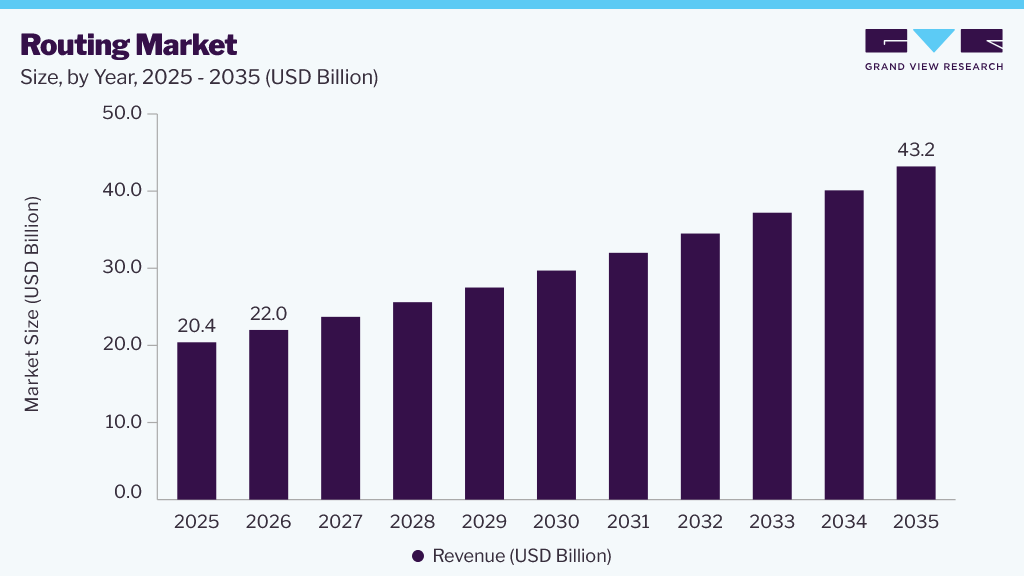 Source: Grand View Research, IR Documents, Primary Interviews, Paid DatabasesTo learn more about this report,
 Download Free Sample Report
Analyst Perspective
This market is transitioning from traditional hardware-centric networking toward next-generation smarter, programmable, software-defined network infrastructure. The rapid growth in data traffic, distributed cloud environments, 5G deployment, edge computing, and AI-driven workloads is expected to drive enterprises and service providers to scale their routing infrastructure with greater capacity, automation, and network control. While core routers will continue to play a critical role in large-scale backbone connectivity, edge and virtual routing solutions are gaining importance as network architectures become increasingly distributed. The expansion of data centers and ongoing modernization of telecommunications infrastructure are also expected to support market growth. Going forward, vendors that combine high-performance, high-capacity routing hardware with automation, SDN, security, and cloud-native technologies are likely to be well positioned for sustained growth.
Type Insights
The core routers segment dominated the routing market and accounted for the largest revenue share in 2025. Core routers lie at the heart of large telecommunications and enterprise networks, where they are deployed across key data center interconnects, service-provider networks, and other primary network nodes to handle growing traffic volumes and increasing cloud computing requirements. For instance, in October 2025, Cisco introduced its 8223 routing system, a 51.2 Tbps Ethernet fixed router designed to connect AI clusters across multiple data centers, highlighting continued investment in high-capacity core routing infrastructure to support data-intensive and distributed AI workloads.
The edge routers segment is anticipated to record a notable CAGR over the forecast period. Growth of this segment is driven by increasing network infrastructure density, edge computing, 5G deployment, adoption of SD-WAN, and rising demand for low-latency connectivity closer to end users and distributed data centers. Edge routers serve as critical network components that manage traffic at the network access point, enabling connectivity, traffic control, automation, and high-speed data transmission across distributed network environments. For instance, in February 2025, Juniper Networks introduced the ACX7020 Access Edge Router as part of an expansion of its AI-native routing portfolio, extending automation and routing capabilities to metro networks and customer premises. The platform is designed for cloud metro applications and supports 4G/5G mobile network deployments, reinforcing the growing role of edge routing in distributed and next-generation network architectures.
Application Insights
The data centers segment dominated the routing market in 2025 with the largest revenue share. Increasing deployment of hyper scale and cloud data centers, rising AI workloads, growing east-west traffic, and the need for high-bandwidth connectivity between data center facilities are driving demand for advanced routing infrastructure. Data center operators are increasingly deploying high-capacity routers capable of supporting AI and cloud workloads while maintaining network security and low latency. For example, in October 2025, Arista Networks introduced its R4 Series platforms for AI, data center, and routed backbone deployments, including 800GbE capabilities and high-capacity routing platforms designed for distributed AI and data center environments.
The industrial networking segment is anticipated to witness a significant CAGR during the forecast period. The growth of this segment is led by advancements in industrial automation, connected manufacturing plants, industrial IoT deployments, and the implementation of private 5G and edge computing in factory floors and offshore industrial sites that require highly reliable routing infrastructure connecting thousands of machines, sensors, control systems, and enterprise networks with assured low latency and network security. For instance, in February 2025, Ericsson launched the Cradlepoint X20 5G Router, providing enterprise-class fixed wireless access (FWA) connectivity with network slicing, security, routing, switching, and Wi-Fi 7 capabilities for businesses and distributed locations.
End User Insights
The service providers segment dominated the routing market in 2025. Telecommunication operators, internet service providers, and other communications service providers, need high capacity routing infrastructure to cope with increasing internet traffic, 5G availability and broadband as well as cloud based applications. Growing amount of AI-generated traffic and aging telecommunications networks are also motivating the service providers to modernize the infrastructure. For instance, in February 2025, Cisco announced its Agile Services Networking solutions for service providers, combining Silicon One routing platforms, software enhancements, and optical technologies to help operators modernize their networks and support increasing AI-related traffic.
The enterprises segment is anticipated to witness the fastest CAGR during the forecast period. Demand from enterprises is expected to grow as they migrate its branch and campus networks to the latest technology, deploy cloud and hybrid IT architecture, ramp up SDWAN deployments, and need more secured connectivity with its spread-out business operations. Deployment of AI-powered network management and automation is also making enterprise routing infrastructure more scalable and operationally efficient. For instance, in November 2025, Cisco introduced new 8200 and 8400 Series Secure Routers designed for branch and campus deployments, combining high-performance routing with integrated security and automated connectivity capabilities.
Regional Insights
North America routing market held the largest revenue share in 2025, driven by high enterprise technology investments, the proliferation of hyperscale data center operators, swelling cloud infrastructure deployment and deep penetration of sophisticated networking architecture in the region. Mature telecommunications infrastructure and investments into high capacity data center interconnect were also driving factors. For instance, in May 2025, Nokia announced that CoreSite selected its IP routing portfolio for deployment across 30 data centers in 11 U.S. markets, supporting increasing AI, cloud, and high-performance computing connectivity requirements.
The routing market in North America is dominating on account of the ongoing data center construction, enterprise network upgrades, adoption of AI applications, and bandwidth hungry applications. In May 2025, AT&T announced an agreement to acquire Lumen Technologies' Mass Markets fiber business, with plans to expand its fiber network to approximately 60 million locations by the end of 2030. The expansion is expected to increase requirements for network infrastructure capable of supporting high-speed broadband and growing data traffic across the U.S.
Asia Pacific Routing Market Trends
Asia Pacific is anticipated to witness the fastest CAGR during the forecast period. Growth is of the regional market is supported by rapid digitalization, increasing internet and mobile data consumption, expansion of cloud and data center infrastructure, 5G network deployment, and growing investments in enterprise and telecommunications networks across China, India, Japan, South Korea, and countries in Southeast Asia.
The region is also witnessing significant investments in high-capacity IP networking infrastructure as internet traffic and digital services expand. For instance, in January 2025, Nokia announced that BBIX had selected its IP routing technology to upgrade its network to 400GE, with deployment beginning in Japan and planned expansion to other markets including Singapore. The upgrade is intended to increase network capacity, stability, flexibility, and reliability in response to growing data traffic.
Key Routing Company Insights
Leading vendors in the routing market are focusing on developing AI-enabled, high-capacity routing solutions and expanding their networking infrastructure offerings for cloud and data center environments. Moreover, vendors are broadening their portfolios to include advanced routing solutions, 5G, cloud and enterprise connectivity, automation, and other networking technologies to address growing data traffic and the increasing performance, scalability, and connectivity requirements of enterprises and service providers.
Key Routing Companies
The following key companies have been profiled for this study on the routing market:
-
Cisco Systems, Inc.
-
Huawei Technologies Co., Ltd.
-
Nokia Corporation
-
Hewlett Packard Enterprise (HPE)
-
Arista Networks, Inc.
-
ZTE Corporation
-
Extreme Networks, Inc.
-
Ciena Corporation
-
MikroTik (SIA Mikrotīkls)
-
Dell Technologies Inc.
Recent Developments
-
In March 2025, Huawei Technologies Co., Ltd. unveiled its AI WAN Solution at MWC Barcelona 2025, introducing a three-layer AI-centric architecture comprising AI routers, AI connectivity, and AI-based network intelligence. The solution was designed to help carriers improve network performance, enhance operational efficiency, and accelerate the transition toward intelligent Net5.5G networks.
-
In June 2025, Nokia Corporation expanded its IP routing portfolio for utility networks by enhancing its 7705 Service Aggregation Router and 7250 Interconnect Router platforms with capabilities including quantum-safe security, advanced synchronization, and automation. The solutions were designed to support utilities in modernizing their communications infrastructure for smart-grid applications.
Routing Market Report Scope
Report Attribute
Details
Market size in 2025
USD 20.4 billion
Estimated market size in 2026
USD 22.0 billion
Projected market size by 2035
USD 43.2 billion
Growth rate
CAGR of 7.8% from 2026 to 2035
Base year for estimation
2025
Historical data
2021 – 2024
Forecast period
2026 – 2035
Quantitative units
Revenue in USD billion, and CAGR from 2026 to 2035
Report coverage
Revenue forecast, company ranking, competitive landscape, growth factors, and trends
Segments covered
Type, application, end user, region
Regional scope
North America; Europe; Asia Pacific; Central & South America; Middle East & Africa
Country scope
U.S.; Canada; Mexico; UK; Germany; France; Italy; Spain; China; Japan; India; Australia; South Korea; Brazil; Argentina; South Africa; Saudi Arabia; UAE
Key companies profiled
Cisco Systems, Inc.; Huawei Technologies Co., Ltd.; Nokia Corporation; Hewlett Packard Enterprise (HPE); Arista Networks, Inc.; ZTE Corporation; Extreme Networks, Inc.; Ciena Corporation; MikroTik (SIA Mikrotīkls); Dell Technologies Inc.
Customization scope
Free report customization (equivalent to 8 analyst working days) with purchase. Addition or alteration to country, regional & segment scope.
Pricing and purchase options
Avail of customized purchase options to meet your exact research needs. Explore purchase options
Global Routing Market Report Segmentation
This report forecasts revenue growth at the global, regional, and country levels and provides an analysis of the latest industry trends and opportunities across each sub-segment from 2021 to 2035. For the purpose of this study, Grand View Research has segmented the global routing market report based on type, application, end user, and region:
-
Type Outlook (Revenue, USD Billion, 2021 - 2035)
-
Core Routers
-
Edge Routers
-
Wireless Routers
-
Virtual Routers
-
Others
-
-
Application Outlook (Revenue, USD Billion, 2021 - 2035)
-
Data Centers
-
Enterprise Networking
-
Home Networking
-
Industrial Networking
-
Others
-
-
End User Outlook (Revenue, USD Billion, 2021 - 2035)
-
Service Providers
-
Enterprises
-
Government
-
Others
-
-
Regional Outlook (Revenue, USD Billion, 2021 - 2035)
-
North America
-
U.S.
-
Canada
-
Mexico
-
-
Europe
-
UK
-
Germany
-
France
-
Italy
-
Spain
-
-
Asia Pacific
-
China
-
Japan
-
India
-
Australia
-
South Korea
-
-
Central & South America
-
Brazil
-
Argentina
-
-
Middle East and Africa (MEA)
-
South Africa
-
Saudi Arabia
-
UAE
-
-
Frequently Asked Questions About This Report
The global routing market is expected to grow at a CAGR of 7.8% from 2026 to 2035, reaching USD 43.2 billion.
The global routing market size was valued at USD 20.4 billion in 2025 and is estimated at USD 22.0 billion for 2026.
The core routers segment accounted for the largest revenue share in 2025.
North America dominated with the largest revenue share in 2025.
Key players in the market include Cisco Systems, Inc.; Huawei Technologies Co., Ltd.; Nokia Corporation; Hewlett Packard Enterprise (HPE); Arista Networks, Inc.; ZTE Corporation; Extreme Networks, Inc.; Ciena Corporation; MikroTik (SIA Mikrotīkls); Dell Technologies Inc.
About the Author(s)
Communications Infrastructure Research Team
Technology · Communications InfrastructureThis report was authored by the communications infrastructure research team at Grand View Research - comprising two research analysts, one senior research analyst, and one industry expert - with specialized expertise in the communications infrastructure segment of the technology industry. All findings are based on proprietary technology databases, executive interviews, and regulatory analysis, subject to internal peer review prior to publication.
Last Updated:
Speak to Analyst

Customize this report to your needs - add regions, segments, or data points, with 20% free customization.
Or view our licence options:


ISO 9001:2015 & 27001:2022 Certified
We are GDPR and CCPA compliant! Your transaction & personal information is safe and secure. For more details, please read our privacy policy.


