
- Home
- »
- Next Generation Technologies
- »
-
SalesOps Market Size, Share And Growth Report, 2025-2033GVR Report cover
![SalesOps Market (2025 - 2033)Report]()
SalesOps Market (2025 - 2033)
Size, Share & Trends Analysis Report By Offering (Software, Services), By Deployment Mode (Cloud & On-Premises), By Enterprise Size, By Application, By End Use, By Region, And Segment Forecasts
Market Size, 2024
$3.3BMarket Estimate, 2026
$4.1BMarket Forecast, 2033
$11.1BCAGR, 2025–2033
14.8%SalesOps Market Summary
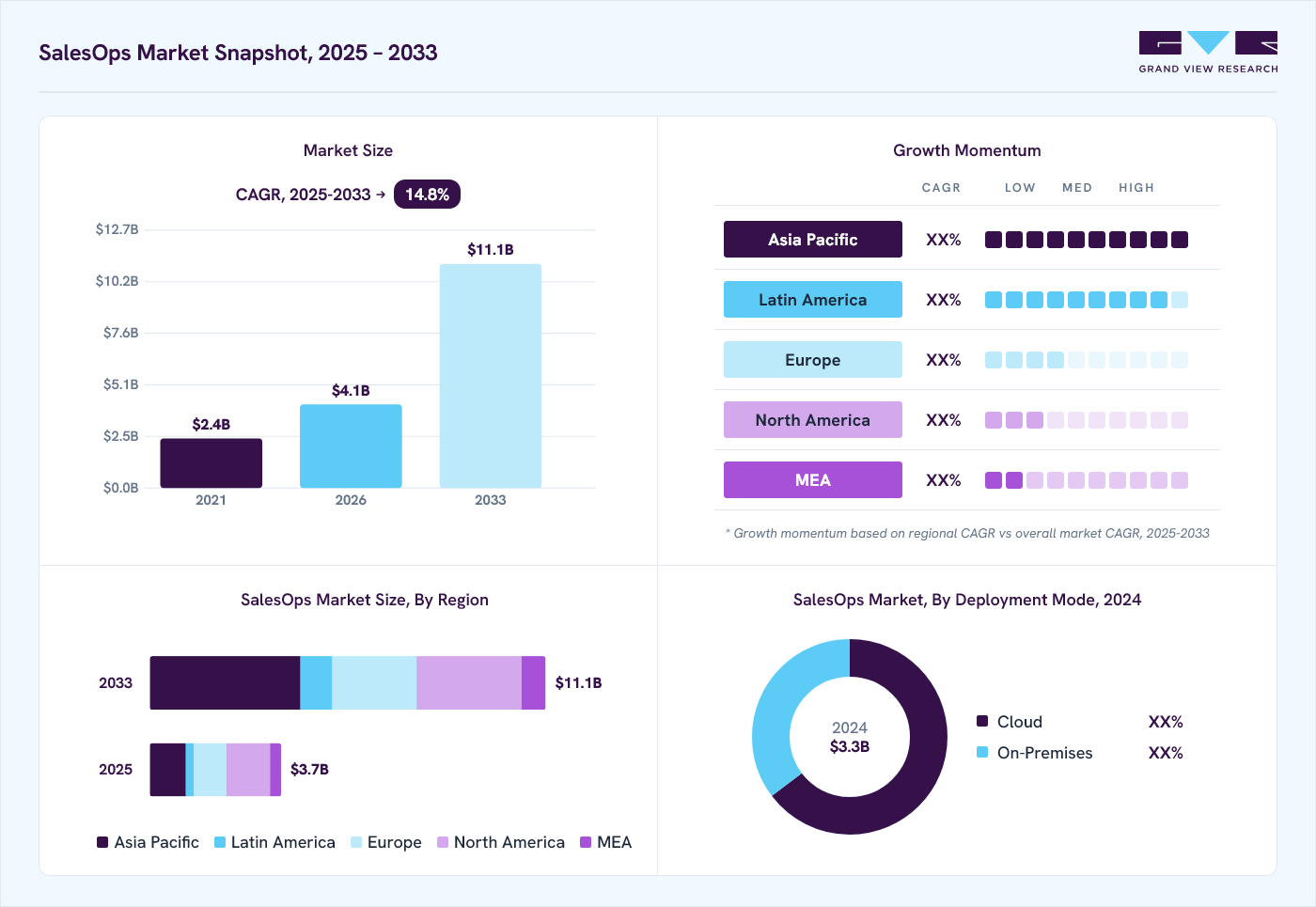
The global SalesOps market size was valued at USD 3.3 billion in 2024 and is projected to grow from USD 4.1 billion in 2026 to USD 11.1 billion by 2033, at a CAGR of 14.8% from 2025 to 2033. North America dominated the market, accounting for a revenue share of 34.2% in 2024. The market is primarily driven by the rising need for data-driven decision-making, the automation of sales processes, and the integration of AI and analytics for accurate forecasting and performance management.
Key Market Trends & Insights
- The SalesOps market in the U.S. led the North America market and held the largest revenue share in 2024.
- By offering, the software segment led the market, holding the largest revenue share of 56.7% in 2024.
- By deployment mode, the cloud segment held the dominant position in the market.
- By enterprise size, the large enterprises segment held the dominant position in the market.
Market Size & Forecast
- Market size in 2024: USD 3.3 Billion
- Projected market size by 2033: USD 11.1 Billion
- CAGR (2025-2033): 14.8%
- North America: Largest market in 2024
- Asia Pacific: Fastest growing market
Growing adoption of cloud-based CRM and revenue intelligence platforms, focus on improving sales productivity, and demand for real-time visibility into pipelines and customer behavior further accelerate market growth across enterprises of all sizes.The increasing emphasis on data-driven sales strategies is a major factor propelling the SalesOps (sales operations) industry growth. Organizations are leveraging advanced analytics, AI, and machine learning to generate actionable insights, improve forecasting accuracy, and optimize sales performance. SalesOps tools enable companies to centralize customer and pipeline data, helping identify high-value opportunities and enhance decision-making. This shift from intuition-based to data-backed selling is driving significant investments in SalesOps platforms, among enterprises focused on achieving greater revenue predictability, operational transparency, and alignment between sales, marketing, and finance functions.
The widespread adoption of cloud and automation technologies is transforming sales teams' operations, fueling demand for SalesOps solutions. Cloud-based SalesOps platforms offer scalability, real-time collaboration, and seamless integration with CRM, ERP, and marketing systems, enhancing agility and minimizing manual inefficiencies. Automation of key functions such as lead management, pipeline tracking, and incentive management enables faster sales cycles and higher productivity. Moreover, subscription-based cloud models are increasingly preferred by SMEs for their cost efficiency and flexibility, which further contributes to the global growth of the SalesOps market.
Enterprises are increasingly focusing on improving sales efficiency, productivity, and alignment across business units, which is fueling the growth of the industry. SalesOps platforms streamline administrative tasks, improve quota management, and enhance performance tracking, allowing sales teams to focus on customer engagement and revenue generation. Besides, companies are adopting SalesOps tools to establish consistent performance metrics, ensure accurate territory planning, and enhance cross-departmental visibility. The growing demand for continuous sales process improvement, combined with the rise of hybrid and digital selling models, is strengthening the global adoption of SalesOps solutions across industries.
Offering Insights
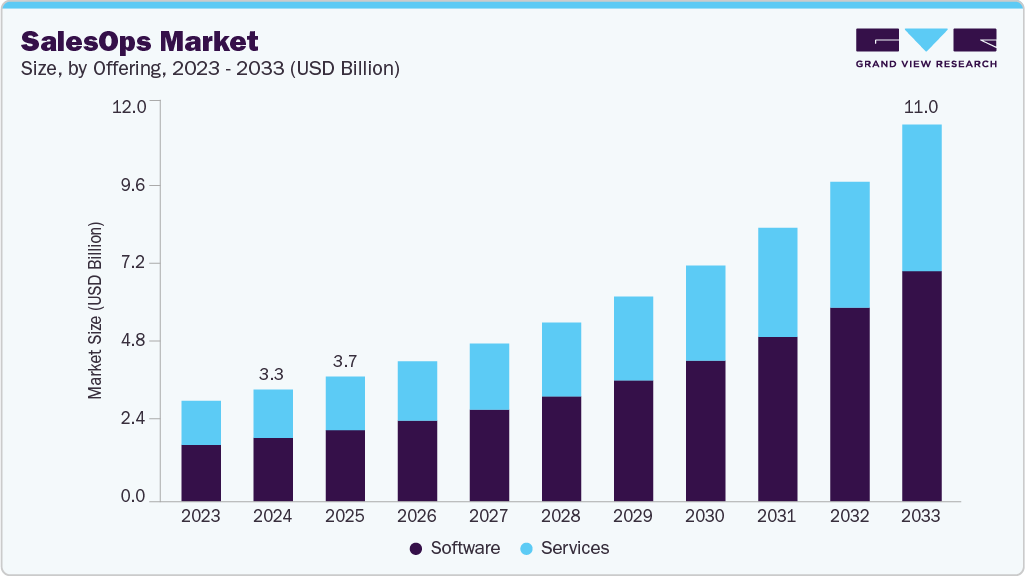
The software segment dominated the market with a share of over 56.0% in 2024, driven by the growing adoption of AI-driven analytics, automation tools, and predictive sales forecasting platforms that enhance decision-making and revenue optimization. The increasing demand for integrated CRM, CPQ, and performance management solutions is driving investments in cloud-based SalesOps software. Businesses are leveraging these platforms to streamline complex sales cycles, improve collaboration between sales and marketing teams, and gain real-time insights into customer data. In addition, the shift toward digital transformation and subscription-based revenue models continues to propel software-driven innovation and scalability across global enterprises.
The services segment is expected to register a significant CAGR over the forecast period, fueled by the increasing demand for consulting, implementation, integration, and managed services to optimize complex sales processes. As enterprises adopt advanced SalesOps platforms, they require expert support to align technology with business objectives, improve sales data quality, and streamline workflows. The growing emphasis on revenue intelligence, AI-driven forecasting, and performance analytics has further heightened the need for professional services that ensure seamless deployment, effective user training, and customized system integration. Furthermore, the rising adoption of cloud-based and hybrid sales solutions drives continuous service engagement and long-term vendor partnerships.
Deployment Mode Insights
The cloud segment dominated the market in 2024 in the wake of the increasing shift toward digital and remote sales environments, enabling organizations to access scalable, secure, and cost-efficient platforms for managing sales data and performance. Cloud-based SalesOps solutions offer real-time analytics, seamless CRM integration, and AI-driven insights that enhance forecasting accuracy and sales productivity. Besides, rising adoption among SMEs and mid-market enterprises due to low upfront costs and flexibility, along with continuous innovations in SaaS-based sales enablement and revenue intelligence tools, further propel the segment’s growth globally.
The on-premises segment is expected to register a significant CAGR over the forecast period, driven by enterprises seeking greater control, security, and customization over their sales data and infrastructure. Organizations operating in highly regulated industries such as banking, defense, and healthcare continue to prefer on-premises solutions to meet compliance standards and data residency requirements. In addition, the need for seamless integration with existing enterprise resource planning (ERP) and customer relationship management (CRM) systems supports adoption. Despite the rise of cloud-based platforms, companies with established IT frameworks and privacy-sensitive operations maintain steady demand for on-premises SalesOps solutions.
Enterprise Size Insights
The large enterprises segment dominated the market in 2024, driven by the growing need to streamline complex sales processes, enhance forecasting accuracy, and improve revenue visibility across global operations. These organizations increasingly adopt AI-driven SalesOps platforms to automate workflows, manage large sales teams, and integrate data across CRM, ERP, and marketing systems. Moreover, rising focus on performance optimization, quota management, and compliance tracking fuels technology investments. Additionally, large enterprises leverage predictive analytics and cloud-based SalesOps solutions to enhance collaboration, scalability, and real-time decision-making across diversified business units and international markets.
The SMEs segment is expected to register the fastest CAGR over the forecast period. Small and Medium Enterprises (SMEs) are increasingly driving demand in the salesops industry due to their growing focus on sales process automation, cost optimization, and data-driven revenue management. As SMEs expand digitally, they adopt cloud-based SalesOps solutions to streamline workflows, enhance pipeline visibility, and improve forecasting accuracy without large IT investments. The rising accessibility of affordable SaaS platforms, integration with CRM tools, and the need to boost sales team productivity amid competitive markets further fuel adoption. Additionally, SMEs are leveraging AI-enabled SalesOps tools to enhance customer engagement and optimize go-to-market strategies efficiently.
Application Insights
The sales analytics & forecasting segment dominated the market in 2024, propelled by the growing demand for real-time insights, data accuracy, and predictive intelligence to enhance revenue visibility and decision-making. Organizations are increasingly relying on AI- and ML-powered analytics tools to identify sales trends, optimize pipeline management, and enhance forecasting precision. The integration of advanced analytics with CRM and ERP systems enables proactive sales strategies, better quota planning, and risk mitigation. Additionally, the surge in data availability and the adoption of cloud-based analytics platforms are fueling this segment’s rapid expansion across industries.
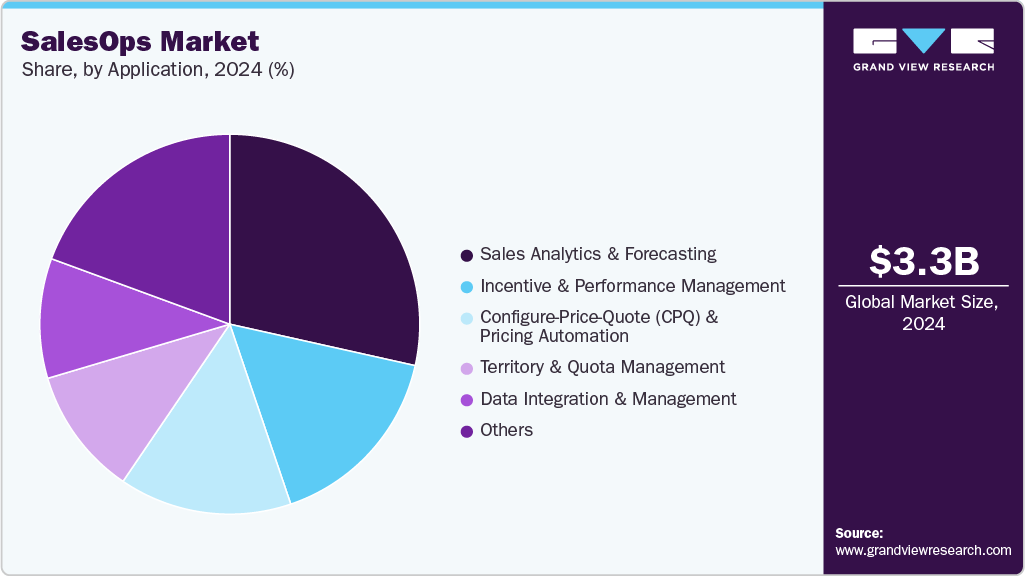
The Configure-Price-Quote (CPQ) & pricing automation segment is expected to register a significant CAGR over the forecast period, primarily driven by the growing need to streamline complex sales cycles, reduce pricing errors, and accelerate deal closures. Enterprises are increasingly adopting CPQ tools to automate quote generation, ensure pricing consistency, and enhance customer experience through real-time, data-backed pricing strategies. The integration of AI and machine learning enables further dynamic pricing optimization and personalized offers, thereby improving sales efficiency and profitability. Besides, the shift toward digital selling, subscription-based models, and omnichannel commerce is fueling strong demand for advanced CPQ and pricing automation solutions.
End Use Insights
The IT & Telecom segment dominated the market in 2024, propelled by the rapid digital transformation of sales processes, the rising adoption of subscription-based and cloud service models, and the growing complexity of pricing and quoting structures. Companies in this sector rely heavily on SalesOps platforms to enhance pipeline visibility, automate forecasting, and manage global sales teams efficiently. The increasing integration of AI-driven analytics, CRM systems, and revenue intelligence tools further enables telecom and IT enterprises to optimize customer acquisition, improve deal conversion rates, and streamline data-driven sales planning for competitive advantage.
The BFSI segment is expected to register the fastest CAGR over the forecast period, propelled by the increasing demand for streamlined sales processes, enhanced customer relationship management, and improved revenue forecasting. Financial institutions are adopting SalesOps solutions to optimize their sales workflows, reduce operational inefficiencies, and ensure regulatory compliance. The integration of advanced analytics and AI-powered tools enables better decision-making, personalized customer engagement, and real-time performance monitoring. Additionally, rising competition and the need for digital transformation across the banking and insurance sectors are further accelerating the adoption of SalesOps solutions in the BFSI segment.
Regional Insights
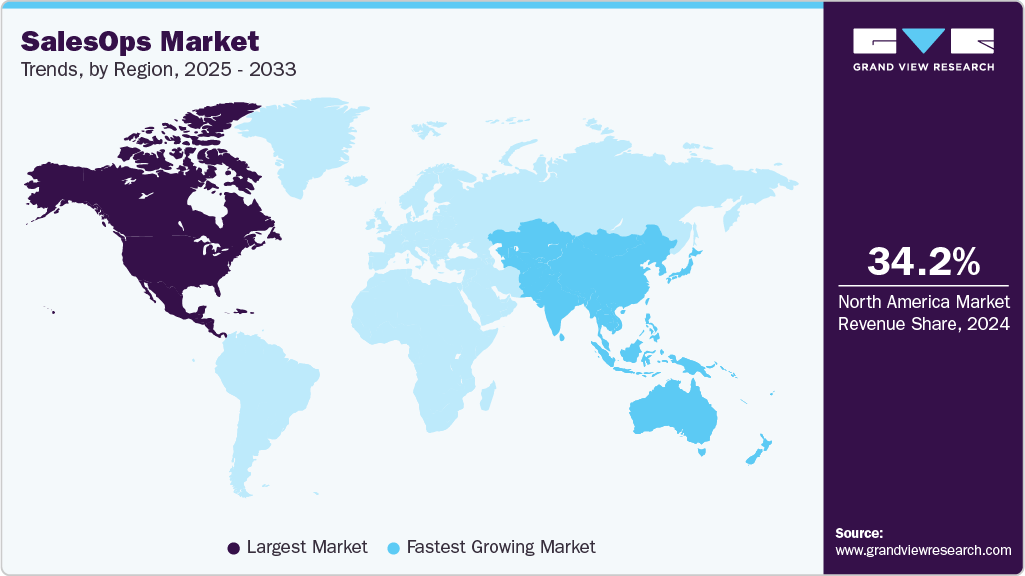
The North America SalesOps industry dominated with a revenue share of over 34.0% in 2024, driven by the increasing adoption of data-driven sales strategies and digital transformation initiatives across enterprises. Organizations are focusing on streamlining sales processes, improving revenue forecasting accuracy, and enhancing sales team efficiency through the use of automation tools and CRM integration. The growing demand for predictive analytics, performance management solutions, and AI-powered sales enablement platforms further fuels market expansion. Besides, the rise of cloud-based solutions, increased investment in customer-centric strategies, and the need for seamless collaboration among sales, marketing, and finance functions are key factors propelling sales operations in the region.
U.S. SalesOps Market Trends
The U.S. SalesOps industry is expected to grow significantly in 2024, driven by the growing demand for integrated revenue management solutions that align sales, marketing, and customer success teams. The increasing adoption of automation, analytics, and AI-powered tools among U.S. enterprises is enhancing operational visibility and improving the accuracy of revenue forecasting. The strong presence of numerous CRM and analytics providers, coupled with a digital infrastructure, supports widespread deployment of SalesOps platforms. Moreover, the rising focus on customer retention, data-driven decision-making, and cross-functional collaboration is propelling market expansion. Continuous investments in cloud-based technologies and advanced sales intelligence tools further accelerate the growth of the U.S. market.
Europe SalesOps Market Trends
The SalesOps industry in Europe is expected to grow significantly over the forecast period, driven by the increasing adoption of data-driven sales strategies and advanced analytics to optimize sales performance and streamline operations. Growing demand for automation tools, CRM integration, and AI-enabled sales forecasting is enhancing efficiency and reducing operational costs across organizations. Furthermore, the shift toward omnichannel sales models and the need for real-time performance insights are accelerating investments in SalesOps solutions. Regulatory compliance requirements and competitive pressures further compel companies to adopt structured sales operations frameworks, fostering consistent growth and innovation in the European market.
Asia Pacific SalesOps Market Trends
The SalesOps industry in the Asia Pacific region is anticipated to witness the fastest CAGR over the forecast period. The regional market is driven by the rapid digital transformation across industries and the increasing adoption of data-driven sales strategies. Organizations are focusing on enhancing sales efficiency, improving forecasting accuracy, and optimizing revenue through advanced analytics, CRM integration, and automation tools. The growing presence of cloud-based solutions, coupled with rising demand for streamlined sales processes and performance management, further fuels market expansion. Additionally, the proliferation of SMEs and enterprises seeking competitive advantage through operational excellence is propelling investments in SalesOps solutions across key APAC economies.
Key SalesOps Company Insights
Some key companies in the SalesOps industry are Salesforce, Inc. and Clari, among others.
-
Salesforce, Inc. is a key player in the market. It offers end-to-end solutions, including pipeline management, forecasting, analytics, and AI-driven insights. Its strong ecosystem, extensive integrations, and continuous innovation position as the preferred choice for enterprises seeking to streamline and optimize sales operations worldwide.
-
Microsoft is a major player in the SalesOps market. Microsoft Dynamics 365 Sales enables comprehensive sales operations through automation, forecasting, analytics, and quota management. Its seamless integration with Microsoft Office, Power Platform, and Azure enhances productivity and adoption, making Microsoft a leading player` by combining robust SalesOps functionality with a widely adopted enterprise technology ecosystem.
Key SalesOps Companies:
The following are the leading companies in the salesops market. These companies collectively hold the largest market share and dictate industry trends.
- Salesforce, Inc.
- Microsoft
- SAP SE
- Oracle Corporation
- HubSpot, Inc.
- Zoho Corporation Pvt. Ltd.
- ZoomInfo Technologies LLC
- Demandbase
- Xactly Corporation
- Anaplan, Inc.
Recent Developments
-
In May 2025, Salesforce, Inc. acquired Informatica LLC, an enterprise cloud data management company, to enhance sales‑operations data & AI stack. Salesforce, Inc. announced it would acquire Informatica LLC in a transaction of approximately USD 8 billion, aimed at integrating Informatica LLC’s data‑cataloguing, integration, governance and privacy capabilities into Salesforce, Inc.’s ecosystem.
-
In March 2025, Microsoft Corporation launched “AI Accelerator for Sales” and new Sales‑agent capabilities, aimed at accelerating customer adoption of its Dynamics 365 Sales product with Microsoft 365 Copilot‑powered agents. The update includes two new AI sales agents, such as Sales Agent and Sales Chat that automate lead nurturing, meeting scheduling, research, and action‑recommendation tasks. This initiative reflects a strategic push to shift sales operations from manual CRM‑driven workflows to AI‑enabled workflow orchestration, targeting sales organizations seeking productivity gains.
-
n February 2025, Salesforce, Inc. expanded its strategic partnership with Google LLC to embed Google LLC’s Gemini AI models into its Agentforce platform, enabling multimodal capabilities, such as images, audio, video, and two‑million‑token context windows. This enhancement integrates Agentforce with Google Cloud infrastructure and the Google Cloud Marketplace, offering customers flexible, AI‑powered sales‑operations and service‑agent workflows across platforms.
SalesOps Market Report Scope
Report Attribute
Details
Market size in 2024
USD 3.3 billion
Estimated market size in 2026
USD 4.1 billion
Projected market size by 2033
USD 11.1 billion
Growth rate
CAGR of 14.8% from 2025 to 2033
Actual data
2021 - 2023
Forecast period
2025 - 2033
Quantitative units
Revenue in USD million/billion and CAGR from 2025 to 2033
Report coverage
Revenue forecast, company ranking, competitive landscape, growth factors, and trends
Segments covered
Offering, deployment mode, enterprise size, application, end use, region
Regional scope
North America; Europe; Asia Pacific; Latin America; Middle East & Africa
Country scope
U.S.; Canada; Mexico; Germany; UK; France; China; India; Japan; Australia; South Korea; Brazil; UAE; South Africa; KSA
Key companies profiled
Salesforce, Inc.; Microsoft; SAP SE; Oracle Corporation; HubSpot, Inc.; Zoho Corporation Pvt. Ltd.; ZoomInfo Technologies LLC; Demandbase; Xactly Corporation; Anaplan, Inc.
Customization scope
Free report customization (equivalent up to 8 analysts working days) with purchase. Addition or alteration to country, regional & segment scope.
Pricing and purchase options
Avail customized purchase options to meet your exact research needs. Explore purchase options
Global SalesOps Market Report Segmentation
This report forecasts revenue growth at global, regional, and country levels and provides an analysis of the latest industry trends in each of the sub-segments from 2021 to 2033. For this study, Grand View Research has segmented the global SalesOps market report based on offering, deployment mode, enterprise size, application, end use, and region.
-
Offering Outlook (Revenue, USD Billion, 2021 - 2033)
-
Software
-
Services
-
-
Deployment Mode Outlook (Revenue, USD Billion, 2021 - 2033)
-
Cloud
-
On-Premises
-
-
Enterprise Size Outlook (Revenue, USD Billion, 2021 - 2033)
-
Large Enterprises
-
SMEs
-
-
Application Outlook (Revenue, USD Billion, 2021 - 2033)
-
Sales Analytics & Forecasting
-
Incentive & Performance Management
-
Configure-Price-Quote (CPQ) & Pricing Automation
-
Territory & Quota Management
-
Data Integration & Management
-
Others
-
-
End Use Outlook (Revenue, USD Billion, 2021 - 2033)
-
BFSI
-
IT & Telecom
-
Healthcare & Life Sciences
-
Retail & E-commerce
-
Manufacturing
-
Others
-
-
Regional Outlook (Revenue, USD Billion, 2021 - 2033)
-
North America
-
U.S.
-
Canada
-
Mexico
-
-
Europe
-
Germany
-
UK
-
France
-
-
Asia Pacific
-
China
-
Japan
-
India
-
South Korea
-
Australia
-
-
Latin America
-
Brazil
-
-
Middle East and Africa (MEA)
-
UAE
-
KSA
-
South Africa
-
-
Frequently Asked Questions About This Report
The global SalesOps market size was valued at USD 3.3 billion in 2024 and is estimated at USD 4.1 billion for 2026.
The global SalesOps market is expected to grow at a CAGR of 14.8% from 2025 to 2033, reaching USD 11.1 billion by 2033.
North America dominated the SalesOps market with a share of 34.2% in 2024. This is attributable to the increasing adoption of data-driven sales strategies and digital transformation initiatives across enterprises. Organizations are focusing on streamlining sales processes, improving revenue forecasting accuracy, and enhancing sales team efficiency through automation tools and CRM integration.
Some key players operating in the SalesOps market include Salesforce, Inc.; Microsoft; SAP SE; Oracle Corporation; HubSpot, Inc.; Zoho Corporation Pvt. Ltd.; ZoomInfo Technologies LLC; Demandbase; Xactly Corporation; and Anaplan, Inc.
Key factors that are driving the SalesOps market growth include the rising need for data-driven decision-making, automation of sales processes, and integration of AI and analytics for accurate forecasting and performance management. Growing adoption of cloud-based CRM and revenue intelligence platforms, focus on improving sales productivity, and demand for real-time visibility into pipelines and customer behavior further accelerate market growth across enterprises of all sizes.
About the Author(s)
Next Generation Technologies Research Team
Technology · Next Generation TechnologiesThis report was authored by the next generation technologies research team at Grand View Research - comprising two research analysts, one senior research analyst, and one industry expert - with specialized expertise in the next generation technologies segment of the technology industry. All findings are based on proprietary technology databases, executive interviews, and regulatory analysis, subject to internal peer review prior to publication.
Last Updated:
Speak to Analyst

Need a Tailored Report?
Customize this report to your needs — add regions, segments, or data points, with 20% free customization.
Or view our licence options:


ISO 9001:2015 & 27001:2022 Certified
We are GDPR and CCPA compliant! Your transaction & personal information is safe and secure. For more details, please read our privacy policy.












