
- Home
- »
- Next Generation Technologies
- »
-
Satellite Edge Computing Market Size Report, 2026-2033GVR Report cover

Satellite Edge Computing Market (2026 - 2033)
Size, Share & Trends Analysis Report By Type (Hardware, Software, Services), By Deployment Mode (Onboard, Ground-Based, Hybrid), By Application (Satellite Communication), By End Use, By Region, And Segment Forecasts
Market Size, 2025
$3.8BMarket Estimate, 2026
$4.5BMarket Forecast, 2033
$17.1BCAGR, 2026–2033
20.9%Satellite Edge Computing Market Summary
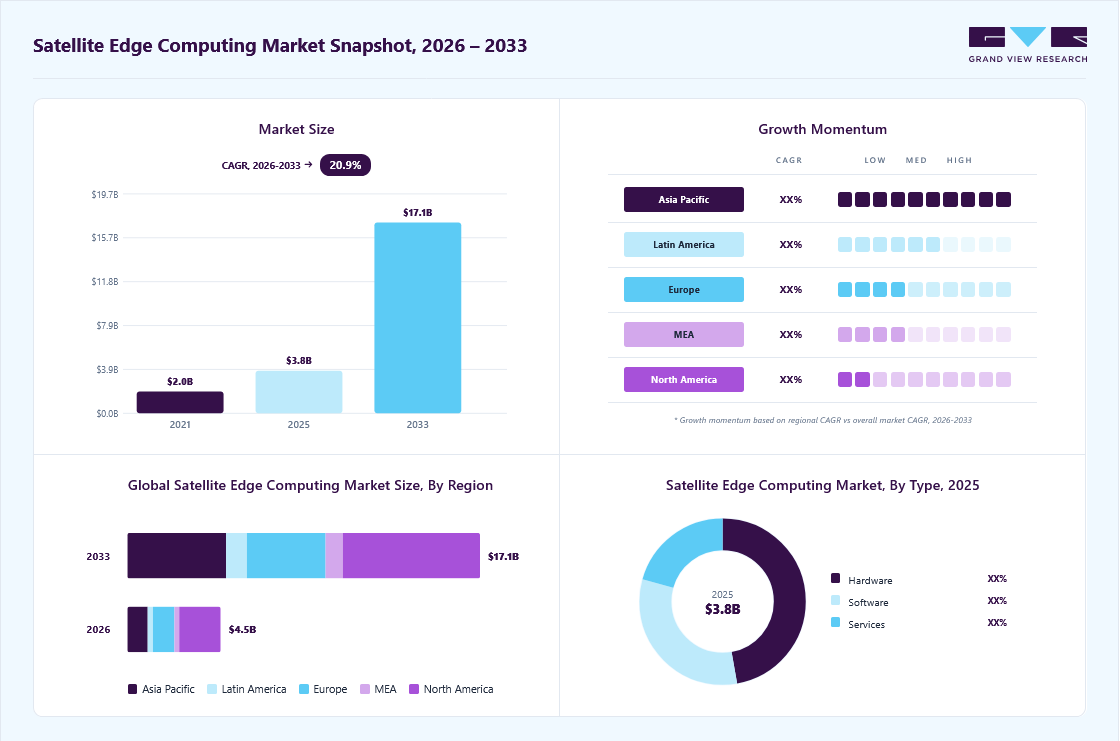
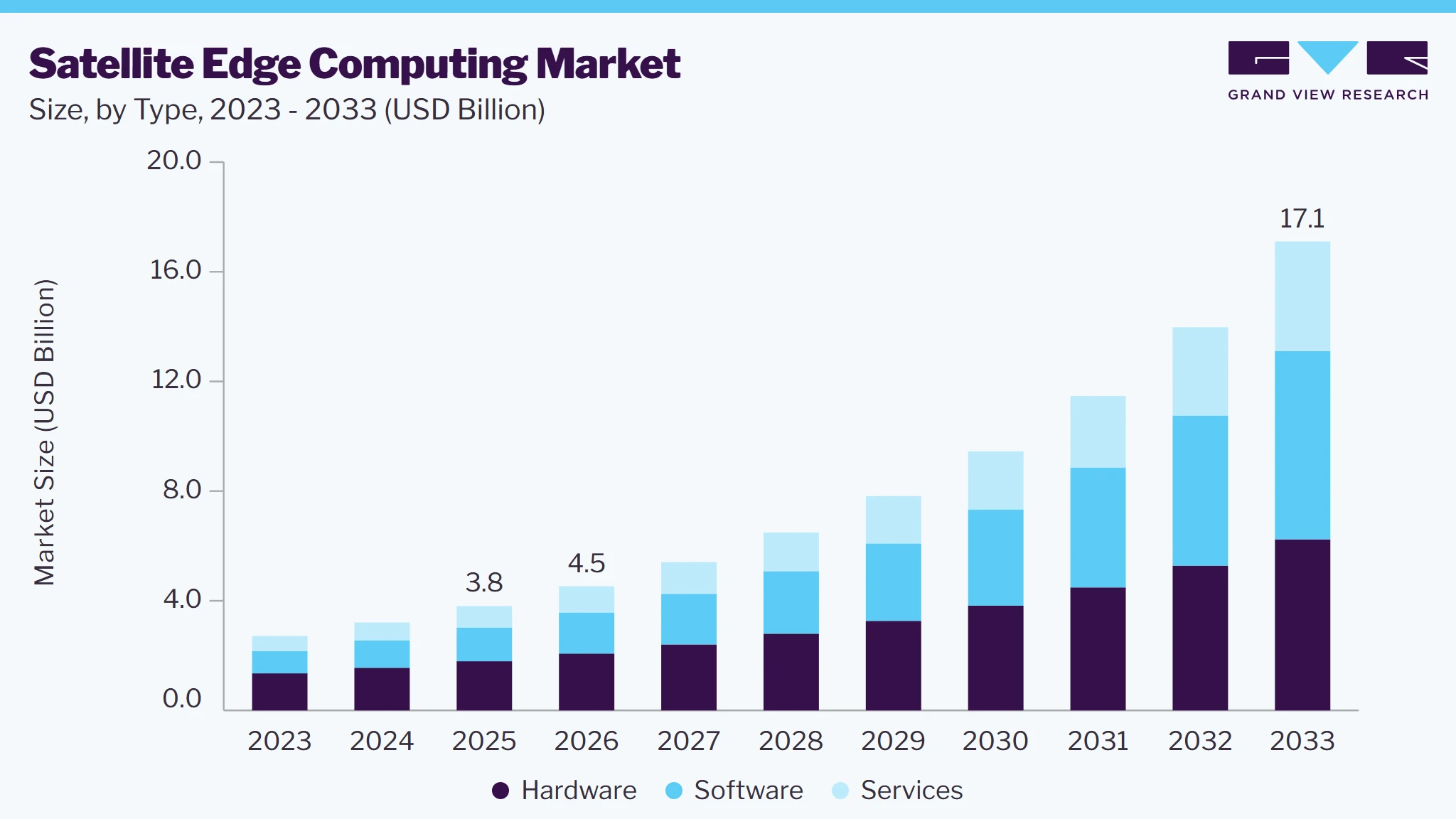
The global satellite edge computing market size was valued at USD 3.8 billion in 2025 and is projected to grow from USD 4.5 billion in 2026 to USD 17.1 billion by 2033, at a CAGR of 20.9% from 2026 to 2033. North America dominated the market, accounting for the largest revenue share of 45.2% in 2025. The market growth is driven by the rising volume of satellite-generated data, increasing deployment of AI-enabled onboard processing, and growing demand for low-latency satellite intelligence.
 Source: Grand View Research, IR Documents, Primary Interviews, Paid DatabasesTo learn more about this report,
 Download Free Sample Report
Key Market Trends & Insights
- By type: Hardware segment held the dominant position and accounted for the highest revenue share of 47.1% in 2025.
- By deployment mode: Onboard segment accounted for the largest revenue share of 60.1% in 2025.
- By application: Satellite communication segment dominated the market in 2025.
- By end use: Government & defense segment accounted for the largest revenue share in 2025.
Regional Highlights
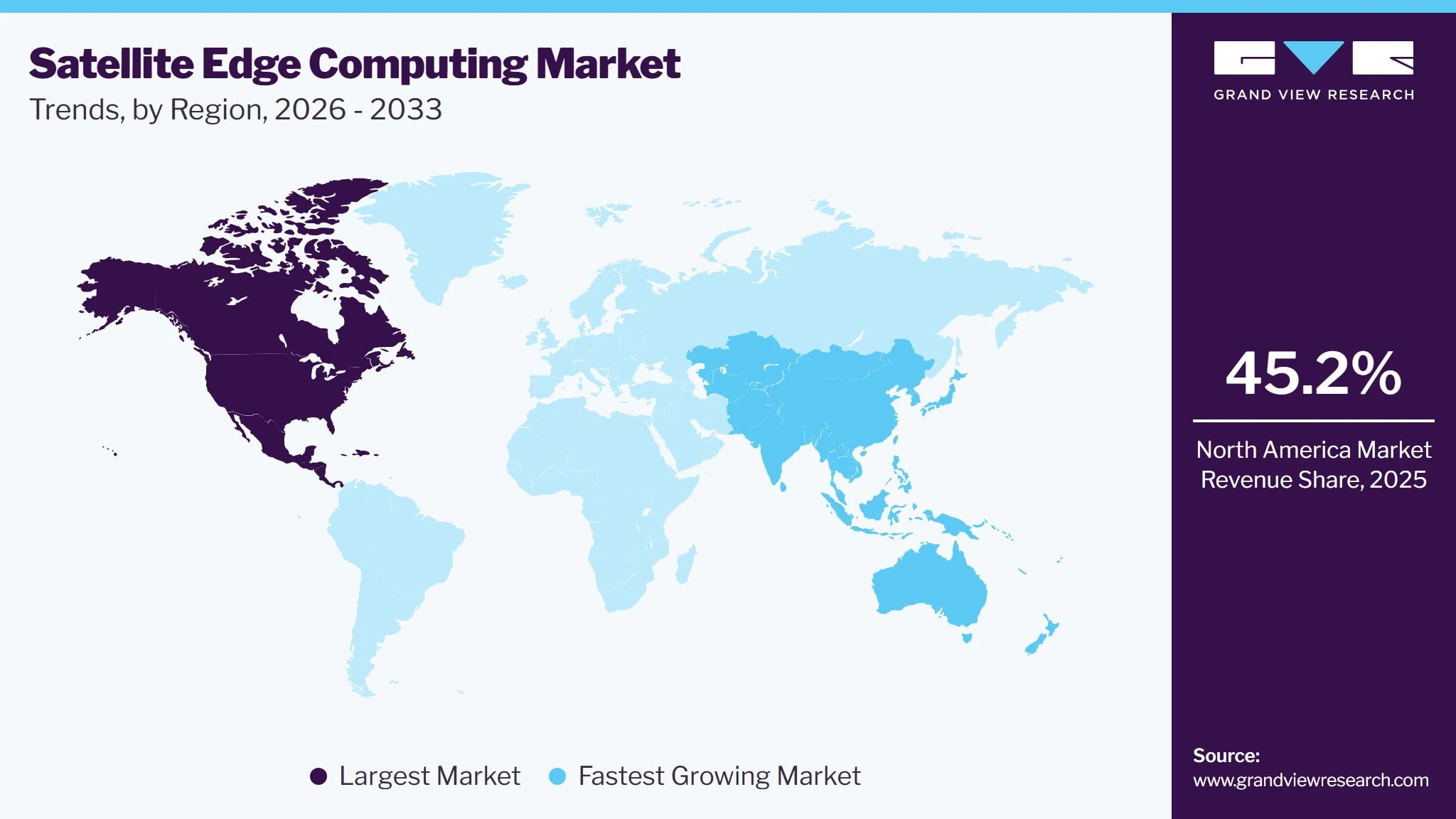
- Largest regional market: North America (45.2% revenue share in 2025)
- Fastest growing regional market: Asia Pacific (highest CAGR, 2026-2033)
- By Country: The U.S. held the largest market share in 2025.
Market Size & Forecast
- Market size in 2025: USD 3.8 Billion
- Estimated market size in 2026: USD 4.5 Billion
- Projected market size by 2033: USD 17.1 Billion
- CAGR (2026-2033): 20.9%
Three ways to get this report
Buy it, customize it, or ask a question.Ask an Analyst
Analyst response in 1 business day
- AccessReport author, directly
- Reply timeWithin 1 working day
- No sales callDirect answer only
- FormatEmail reply
- CostFree, no cost
Get the Full Report
What the study covers
- FormatsPDF · Excel · Dashboard
- Timeline2026–2033 annual, 2025 base
- Coverage20+ countries, 5 regions
- Companies10+ key players profiled
Customize the Report
20% free customization
- IncludeCountries, segments, points
- TailorTo your product definition
- ExtendDeeper competitor detail
- OrA fully bespoke study
- Turnaround5–10 working days
The expansion of Earth observation and LEO satellite constellations, combined with the need to reduce downlink bandwidth requirements by filtering, compressing, and analyzing data directly onboard, is accelerating the adoption of satellite edge computing.The growth of the satellite edge computing market is driven by the increasing deployment of software-defined satellites, autonomous satellite constellations, and inter-satellite communication networks, which require greater computing capacity directly within space-based infrastructure. The shift toward reconfigurable payloads, distributed computing across satellite fleets, autonomous resource allocation, and in-orbit software updates is encouraging satellite operators to integrate high-performance processors and flexible edge-computing platforms into next-generation spacecraft. ESA is actively developing intelligent constellation architectures that use distributed data processing, AI computing modules, autonomous reconfiguration, and inter-satellite links to improve constellation operations.
 To learn more about this report, Download Free Sample Report
The increasing deployment of direct-to-device satellite connectivity, non-terrestrial networks (NTNs), and integrated satellite-terrestrial communication architectures is strengthening demand for the satellite edge computing industry. Satellite operators are increasingly developing networks that connect satellites with smartphones, IoT devices, and cellular infrastructure, creating requirements for localized traffic processing, network optimization, and dynamic resource management. The continued development of 3GPP-based satellite connectivity is increasing the importance of edge-computing capabilities that can support efficient integration between space and terrestrial communication networks. This trend is creating opportunities for edge processors, network virtualization software, and distributed computing platforms designed for next-generation satellite communication infrastructure.
Additionally, the growing emphasis on cybersecurity, data sovereignty, and resilient space infrastructure is supporting the adoption of satellite edge computing solutions. Government, defense, telecommunications, and critical-infrastructure users increasingly require satellite systems capable of securely processing sensitive information while limiting unnecessary movement of mission-critical data across networks. Increasing concerns regarding satellite-network disruption, cyberattacks, communication outages, and infrastructure resilience are therefore encouraging investment in secure, radiation-tolerant computing hardware and trusted software environments capable of maintaining critical processing functions across distributed space and ground infrastructure.
Moreover, advancements in space-qualified semiconductor technologies, radiation-tolerant processors, FPGAs, AI accelerators, and high-capacity onboard storage are expanding the technical and commercial feasibility of satellite edge computing. Spacecraft computing capabilities were constrained by power consumption, radiation exposure, thermal management requirements, and the limited performance of space-qualified electronics. These developments are lowering technical barriers to deploying sophisticated computing workloads in orbit and creating opportunities for hardware manufacturers, semiconductor suppliers, edge software developers, and satellite integrators to introduce higher-performance satellite edge computing platforms.
Market Dynamics
The satellite edge computing market is experiencing significant growth, driven by the increasing deployment of advanced satellite constellations and growing demand for real-time data processing directly in space. Satellite operators are increasingly adopting onboard computing solutions that can process, analyze, and prioritize data before transmission to ground infrastructure. The ability of satellite edge computing to reduce communication delays, optimize bandwidth utilization, accelerate mission-critical decision-making, and improve operational efficiency is encouraging satellite manufacturers and operators to integrate high-performance edge processors and intelligent computing platforms into next-generation satellite systems.
The increasing deployment of onboard artificial intelligence is strengthening demand for satellite edge computing as operators seek to process information closer to where it is generated. Advanced processors enable satellites to analyze imagery, classify objects, detect anomalies, filter unusable observations, compress data, and prioritize critical information before transmission. These capabilities reduce dependence on continuous ground processing while improving response times for Earth observation, communications, surveillance, disaster management, and scientific missions.
Increasing computational requirements across modern satellite missions are also encouraging manufacturers to integrate radiation-tolerant processors, AI accelerators, FPGAs, high-capacity storage, and specialized edge software into spacecraft. Greater onboard processing allows satellites to execute increasingly complex workloads within limited communication windows while using available downlink capacity more efficiently. As satellite payloads become more sophisticated, edge computing is an important architectural component that enables intelligent processing, faster information delivery, mission flexibility, and improved utilization of satellite resources.
The high cost of developing, testing, qualifying, and deploying space-grade computing systems remains a significant barrier to the adoption of satellite edge computing. Processors, memory systems, accelerators, and associated electronics must withstand radiation exposure, extreme temperature variations, vibration, power limitations, and prolonged operation without physical maintenance. These requirements increase engineering complexity compared with terrestrial computing infrastructure, resulting in lengthy qualification cycles, specialized component requirements, higher development expenditure, and limited availability of suitable high-performance computing hardware.
Cost challenges become particularly important for small satellite operators, research organizations, and emerging commercial missions operating under constrained budgets. Integrating advanced computing capabilities can also increase spacecraft power consumption, thermal management requirements, payload weight, and system design complexity. Furthermore, hardware deployed in orbit cannot be easily repaired or replaced following component failure. Operators must therefore balance processing performance against reliability, power, mass, mission duration, and overall spacecraft economics, potentially limiting adoption of highly sophisticated edge-computing configurations.
The transition toward software-defined satellite architectures presents a significant opportunity for satellite edge computing providers by enabling computing functionality to be modified after spacecraft deployment. Reconfigurable processors, containerized applications, virtualized workloads, and remotely deployable software can allow operators to introduce new processing functions without replacing physical satellite infrastructure. This creates opportunities for edge-platform developers to provide application management, workload orchestration, onboard analytics, cybersecurity, mission optimization, and AI inference capabilities throughout the satellite operational lifecycle.
Software-defined computing can support more flexible business models by enabling satellite operators to offer computing capacity to multiple applications or customers from a common orbital infrastructure. New algorithms could be uploaded for Earth observation analytics, communications optimization, environmental monitoring, security applications, or scientific processing as mission requirements evolve. This transition creates opportunities for computing-as-a-service models, third-party satellite applications, edge-software marketplaces, subscription-based platforms, and remotely upgradeable computing environments across future satellite constellations.
Market Concentration & Characteristics
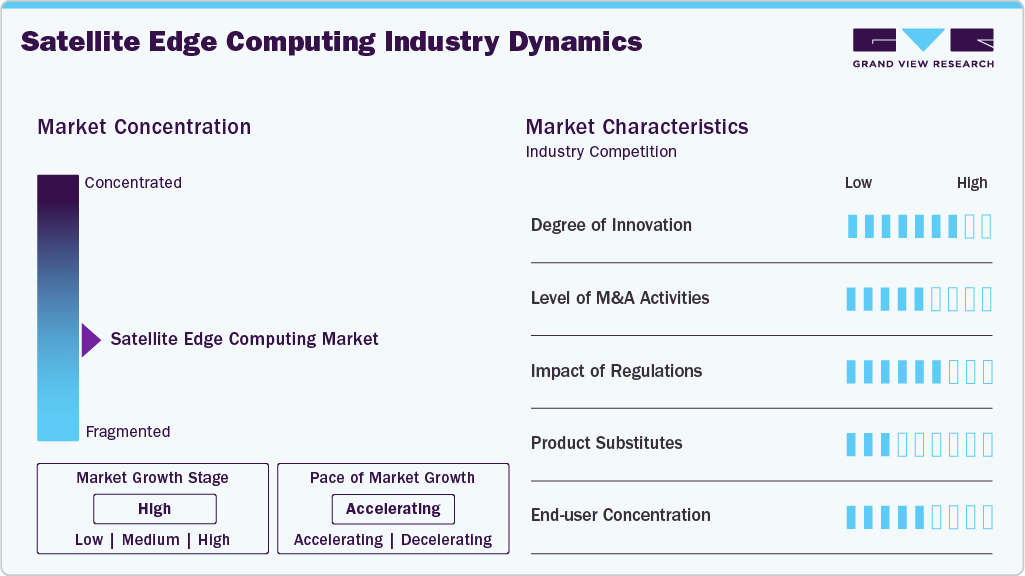
The satellite edge computing market is moderately fragmented, comprising major aerospace companies, satellite manufacturers, cloud computing providers, semiconductor companies, onboard computing specialists, edge software developers, and satellite data processing providers that compete across satellite communications, Earth observation, space exploration, space situational awareness, government, and defense applications. The market is shaped by increasing deployment of onboard processing, AI-enabled satellite payloads, software-defined spacecraft, hybrid space-ground architectures, and advanced satellite constellations. Long-term space programs, mission-specific qualification, technology partnerships, government contracts, proprietary computing platforms, and established relationships with satellite operators enable leading companies to strengthen their positions across global space programs.
 To learn more about this report, Download Free Sample Report
The market is characterized by a high level of innovation, supported by advancements in radiation-tolerant processors, AI accelerators, reconfigurable computing, onboard analytics, edge software, high-capacity storage, and autonomous processing capabilities. The market witnesses a moderate level of merger and acquisition activity, while companies also expand capabilities through strategic partnerships, technology integration, joint development programs, and internal R&D. Competition from ground-based cloud processing and conventional satellite-to-ground processing remains moderate, as onboard edge systems provide specialized low-latency and autonomous processing capabilities. The increasing demand for real-time satellite intelligence, efficient bandwidth utilization, resilient computing, in-orbit processing, and flexible software-defined architectures continues to drive competitive development.
Analyst Perspective
The satellite edge computing industry is advancing through the increasing commercialization of in-orbit computing infrastructure, expansion of distributed satellite networks, and rising demand for computing resources that can be dynamically allocated across space-based missions. Technology providers are strengthening their portfolios through radiation-hardened multicore processors, reconfigurable computing modules, containerized software environments, high-speed inter-satellite data exchange, and remotely upgradeable computing platforms. The emergence of space-based data centers, multi-tenant computing payloads, and computing-as-a-service models is encouraging satellite operators to move beyond mission-specific processing toward shared orbital computing infrastructure that supports multiple customers, applications, and workloads throughout a satellite’s operational life.
Type Insights
The hardware segment accounted for the largest market share of 47.1% in 2025, propelled by increasing integration of high-performance computing components into satellites, communication payloads, Earth observation platforms, and other space-based systems. The growing deployment of radiation-tolerant processors, FPGAs, AI accelerators, high-capacity memory, onboard storage, and specialized computing modules is increasing hardware requirements. The expansion of LEO constellations and the development of space-qualified semiconductor technologies are further strengthening demand for the hardware segment in the Satellite Edge computing industry.
The software segment is expected to witness the highest CAGR of over 24% from 2026 to 2033. The segment is driven by the increasing adoption of remotely configurable satellite applications, edge orchestration platforms, AI inference frameworks, and virtualized computing environments. Software enables operators to modify processing functions, deploy new algorithms, manage workloads, and update satellite capabilities. Increasing adoption of software-defined payloads, containerized applications, automated workload management, cybersecurity solutions, and application-based satellite computing is expected to accelerate software demand as operators seek greater mission flexibility and longer-term utilization of orbital computing infrastructure.
Deployment Mode Insights
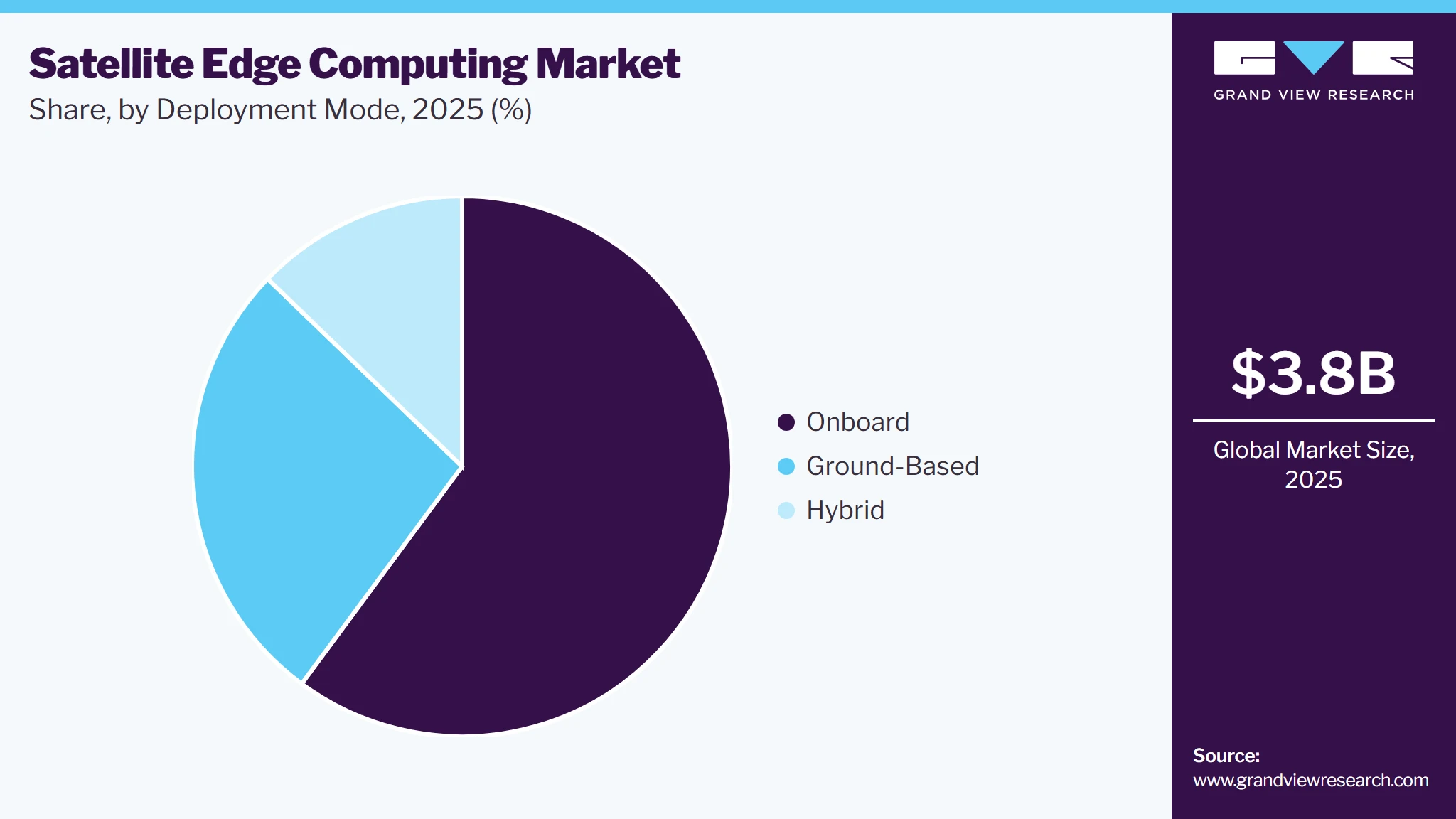
The onboard segment accounted for the largest market share of 60.1% in 2025, driven by increasing requirements for immediate data processing, autonomous decision-making, and efficient utilization of satellite downlink capacity. Satellite operators are increasingly integrating computing resources directly into spacecraft to process imagery, communications data, and sensor information before transmission to ground infrastructure. Growing deployment of intelligent communication payloads, AI-enabled spacecraft, and autonomous missions is strengthening demand for onboard processors, high-capacity storage, and edge software capable of performing mission-critical computing functions directly in orbit.
 To learn more about this report, Download Free Sample Report
The hybrid segment is expected to witness the highest CAGR from 2026 to 2033, driven by increasing adoption of architectures that distribute computing workloads between satellites and terrestrial edge infrastructure. Hybrid deployments allow time-sensitive filtering, compression, and preliminary analytics to occur onboard while computationally intensive workloads are transferred to ground-edge or cloud environments. Expanding satellite constellations, growing integration of space and terrestrial networks, and demand for scalable computing resources are expected to accelerate hybrid deployment across the satellite edge computing industry.
Application Insights
The satellite communication segment accounted for the largest market share of 31.0% in 2025, driven by the increasing deployment of high-throughput satellites, LEO communication constellations, software-defined payloads, and interconnected satellite networks requiring faster processing of communication data. Edge computing enables satellites to perform traffic routing, signal processing, data prioritization, network optimization, and interference management closer to the source, reducing dependence on terrestrial infrastructure. Rising demand for broadband connectivity, direct-to-device communication, and dynamic allocation of satellite capacity continues to strengthen the adoption of edge computing across satellite communication systems.
The Earth observation segment is expected to witness the highest CAGR from 2026 to 2033, driven by increasing volumes of high-resolution imagery and growing demand for actionable intelligence with minimal processing delay. Onboard edge computing allows satellites to identify relevant images, detect objects or environmental changes, remove cloud-covered or unusable imagery, compress datasets, and transmit prioritized information instead of complete raw datasets. Expanding applications across disaster response, agriculture, climate monitoring, infrastructure assessment, and defense intelligence are accelerating demand for AI-enabled edge processing across Earth observation satellite constellations.
End Use Insights
The government & defense segment accounted for the largest market share of 47.5% in 2025, driven by increasing investments in defense satellite constellations, intelligence, surveillance and reconnaissance (ISR) systems, secure communications, missile-warning capabilities, and space situational awareness. Government agencies are increasingly integrating edge computing to process sensitive satellite data closer to its source, reduce communication latency, and limit dependence on continuous ground connectivity. Expanding military space programs, proliferated LEO constellations, and demand for rapid battlefield intelligence are strengthening the adoption of space-qualified computing platforms across government and defense missions.
The commercial segment is expected to witness the highest CAGR from 2026 to 2033, driven by expanding commercial satellite constellations, Earth observation services, satellite broadband networks, and emerging in-orbit computing services. Commercial operators are adopting edge computing to reduce the volume of data transmitted to ground stations, accelerate the delivery of processed satellite data, optimize network resources, and deploy new applications after launch. Increasing private investment in LEO networks, software-defined satellites, direct-to-device connectivity, onboard AI applications, and satellite data-as-a-service models is expected to accelerate adoption of the commercial segment in the satellite edge computing industry.
Regional Insights
North America satellite edge computing market held the largest share of 45.2% in 2025, driven by a mature commercial space ecosystem, large-scale government space programs, and early deployment of advanced onboard computing technologies. The region benefits from extensive development of proliferated LEO constellations, defense satellite networks, and satellite broadband infrastructure. The increasing deployment of AI-enabled payloads, the demand for real-time intelligence processing, and the growing integration of cloud infrastructure with satellite networks are accelerating the adoption of edge computing across commercial, civil, and defense space missions.
 To learn more about this report, Download Free Sample Report
U.S. Satellite Edge Computing Market Trends
The U.S. satellite edge computing market is dominated, with a share of 92.1% in 2025, driven by extensive investment in military space architectures, commercial satellite constellations, and advanced spaceborne computing platforms. The growing deployment of proliferated LEO systems for missile warning, tracking, secure communications, and intelligence applications is creating demand for autonomous onboard processing. Strong participation from cloud providers, semiconductor companies, satellite operators, and aerospace contractors is accelerating development of radiation-tolerant processors, onboard AI, software-defined payloads, and space-to-cloud computing architectures.
Europe Satellite Edge Computing Market Trends
Europe satellite edge computing market is expected to grow at a significant CAGR of 20.4% from 2026 to 2033. The market growth is driven by increasing investment in sovereign satellite infrastructure, secure connectivity, Earth observation, and independent space-data processing capabilities. European initiatives focused on multi-orbit secure communications and next-generation Earth observation systems are increasing the requirements for distributed computing closer to satellite data sources. Growing emphasis on data sovereignty, reduced dependence on non-European digital infrastructure, climate monitoring, border surveillance, and resilient satellite communications is encouraging the deployment of onboard analytics and hybrid space-ground computing architectures.
The UK satellite edge computing market is expected to grow significantly in the coming years, driven by the expansion of its small-satellite ecosystem, Earth observation capabilities, defense space programs, and commercial satellite communications activities. Growing use of satellites for maritime surveillance, climate intelligence, secure communications, and national security applications is increasing the requirements for faster processing of data before downlink. The country's established satellite manufacturing and downstream analytics ecosystem is supporting the development of onboard AI applications capable of filtering imagery and delivering actionable information with reduced dependence on continuous ground processing.
The Germany satellite edge computing market is supported by increasing investment in secure satellite communications, Earth observation, aerospace electronics, and European space programs. Germany's strong semiconductor, industrial computing, automotive, and aerospace technology base provides capabilities applicable to high-performance and energy-efficient space computing systems. Increasing requirements for environmental monitoring, infrastructure observation, secure government communications, and autonomous satellite operations are encouraging integration of advanced processors and software-defined computing platforms capable of processing complex workloads onboard spacecraft.
Asia Pacific Satellite Edge Computing Market Trends
The Asia Pacific satellite edge computing market is expected to grow at the highest CAGR of 25.3% from 2026 to 2033, driven by the rapid expansion of national satellite programs, commercial constellations, Earth observation networks, and indigenous space technologies. China, India, Japan, South Korea, and Australia are increasing investment in satellite communications, remote sensing, defense space systems, and resilient positioning infrastructure. Rising volumes of satellite-generated imagery, limited ground-station contact windows, and requirements for faster disaster, and security intelligence are accelerating the deployment of onboard AI and distributed space computing.
The Japan satellite edge computing market is gaining traction through increasing deployment of Earth observation satellites, disaster-monitoring systems, advanced communication satellites, and space-based scientific missions. Japan's exposure to earthquakes, tsunamis, typhoons, and other natural hazards creates strong requirements for rapidly processed satellite imagery and timely situational intelligence. The growing development of compact satellites and advanced electronics is encouraging onboard AI systems that can identify disaster-affected areas, reduce unnecessary downlink traffic, and improve the responsiveness of satellite-based monitoring services.
The China satellite edge computing industry is expanding through the rapid development of large-scale LEO communication constellations, remote-sensing satellites, navigation infrastructure, and increasingly autonomous spacecraft. Deployment of large satellite fleets is generating substantial volumes of data that require efficient onboard filtering, compression, routing, and analysis before transmission. China's focus on domestic semiconductor capabilities, integrated satellite networks, intelligent spacecraft, and space-based information infrastructure is further supporting development of indigenous processors, AI-enabled payloads, inter-satellite computing, and autonomous constellation-management technologies.
Key Satellite Edge Computing Company Insights
Some of the key players operating in the market are Amazon Web Services, Inc., and Microsoft Corporation, among others.
-
Amazon Web Services, Inc. has a strong position in the satellite-data infrastructure ecosystem through AWS Ground Station and its broader edge and cloud-computing portfolio. AWS Ground Station enables satellite operators to communicate with spacecraft and integrate satellite operations with AWS infrastructure, while AWS edge technologies support processing and analytics closer to data sources. Its cloud scale, satellite ground infrastructure, AI/ML ecosystem, and edge capabilities make AWS an important participant in ground-based and hybrid satellite edge computing.
-
Microsoft Corporation combines Azure cloud infrastructure with satellite and on-orbit computing capabilities. Its space initiatives have included reconfigurable onboard computing, AI processing, satellite-to-cloud integration, and partnerships for deploying software applications directly to spacecraft. Microsoft has worked with Thales Alenia Space and other space companies on on-orbit computing and Earth-observation processing, positioning it strongly across hybrid space-ground edge architectures.
RAMON.SPACE and Unibap Space Solutions AB are some of the emerging market participants in the satellite edge computing market.
-
RAMON.SPACE is a specialized space-computing company focused directly on onboard processing, making it particularly relevant to the core satellite edge computing market. Its portfolio includes NuPod edge computing systems, NuStream space storage, and NuComm communication processors, with support for AI/ML processing, autonomous operations, data compression, Earth observation, communication payloads, and orbital data-center applications. Its dedicated focus on space-resilient computing differentiates it from broader cloud providers. RAMON.SPAC.
-
Unibap Space Solutions AB specializes in space-qualified edge computing hardware and software through its SpaceCloud platform. SpaceCloud OS supports edge computing, autonomous operations, containerized applications, and AI/ML inference directly in space. The company is also expanding toward higher-performance in-orbit services; its 2026 collaboration with KSAT combines Unibap's iX20 platform with low-latency satellite connectivity to process and distribute information directly in orbit. Unibap Space Solutions.
Key Satellite Edge Computing Companies
The following key companies have been profiled for this study on the satellite edge computing market.
-
Amazon Web Services, Inc.
-
Microsoft Corporation
-
International Business Machines Corporation (IBM)
-
NVIDIA Corporation
-
Hewlett-Packard Enterprise Development LP
-
RAMON.SPACE
-
Unibap Space Solutions AB
-
Thales Alenia Space
-
Airbus
-
Lockheed Martin Corporation.
Competitive Benchmarking
Category
Operating Strategies
Competitive Edge
Weakness
Established Players (Amazon Web Services, Inc., Microsoft Corporation, International Business Machines Corporation (IBM))
- Focus on integrating satellite edge computing with cloud platforms, ground stations, and onboard processors.
- Invest heavily in space-qualified hardware, AI software, secure communications, and computing infrastructure.
- Strong aerospace partnerships, cloud capabilities, and technical expertise support complex satellite computing deployments.
- Ability to provide scalable, secure computing solutions across onboard, ground-based, and hybrid architectures.
- Complex organizational structures can slow the commercialization of rapidly evolving space-edge computing technologies.
- Higher development and qualification costs may limit flexibility compared with specialized space-computing companies.
Emerging Players (RAMON.SPACE, Unibap Space Solutions AB, Thales Alenia Space)
- Emerging players are focusing on specialized onboard computing platforms, space-qualified processors, and software-defined satellite architectures.
- Build strategic partnerships with satellite operators, manufacturers, and launch providers for commercial deployments.
- Specialized space-computing expertise enables rapid development of lightweight, high-performance onboard processing solutions.
- Agile development models support faster integration of AI, edge software, and reconfigurable computing.
- Limited financial resources can restrict large-scale R&D, manufacturing, and global market expansion.
- Smaller customer bases and limited mission heritage can constrain adoption among established satellite operators.
Recent Developments
-
In September 2026, Airbus received an order from Eutelsat for 229 additional OneWeb satellites incorporating advanced digital channelizers, strengthening onboard processing capabilities, payload flexibility, and efficient data management. The development highlights increasing integration of advanced onboard processing technologies across large-scale satellite constellations, supporting the satellite edge computing industry.
-
In March 2026, NVIDIA Corporation introduced its space computing portfolio, including the Space-1 Vera Rubin Module, targeting orbital data centers, autonomous space operations, geospatial intelligence, and AI inference workloads. The launch expands the availability of high-performance AI computing infrastructure designed for space environments, accelerating technological advancement in the satellite edge computing market.
-
In February 2026, Amazon Web Services, Inc. expanded its Ground Station as a Service Partner Program with KSAT, enhancing integration between satellite ground infrastructure and AWS cloud computing, storage, analytics, and AI/ML capabilities. The initiative enables satellite operators to process and manage space-generated data more efficiently while connecting ground stations with scalable cloud resources, supporting hybrid space-ground architectures and wider adoption across the satellite edge computing industry.
Satellite Edge Computing Market Report Scope
Report Attribute
Details
Market size in 2025
USD 3.8 billion
Estimated market size in 2026
USD 4.5 billion
Projected market size by 2033
USD 17.1 billion
Growth rate
CAGR of 20.9% from 2026 to 2033
Base year for estimation
2025
Historical data
2021 - 2024
Forecast period
2026- 2033
Quantitative units
Revenue in USD Million/Billion and CAGR from 2026 to 2033
Report product
Revenue forecast, company ranking, competitive landscape, growth factors, and trends
Segments covered
Type, Deployment Mode, Application, End Use, Region
Region scope
North America; Europe; Asia Pacific; Latin America; Middle East & Africa
Country scope
U.S.; Canada; Mexico; UK; Germany; France; China; Japan; India; South Korea; Australia; Brazil; Saudi Arabia; UAE; South Africa
Key companies profiled
Amazon Web Services, Inc.; Microsoft Corporation; International Business Machines Corporation (IBM); NVIDIA Corporation; Hewlett-Packard Enterprise Development LP; RAMON.SPACE; Unibap Space Solutions AB; Thales Alenia Space; Airbus; Lockheed Martin Corporation
Customization scope
Free report customization (equivalent to up to 8 analyst’s working days) with purchase. Addition or alteration to country, regional & segment scope.
Pricing and purchase options
Avail customized purchase options to meet you exact research needs. Explore purchase options
Global Satellite Edge Computing Market Report Segmentation
This report forecasts revenue growth at global, regional, and country levels and provides an analysis of the latest technological trends in each of the sub-segments from 2021 to 2033. For this study, Grand View Research has segmented the satellite edge computing market report based on type, deployment mode, application, end use, and region:
-
Type Outlook (Revenue, USD Million, 2021 - 2033)
-
Hardware
-
Software
-
Services
-
-
Deployment Mode Outlook (Revenue, USD Million, 2021 - 2033)
-
Onboard
-
Ground-Based
-
Hybrid
-
-
Application Outlook (Revenue, USD Million, 2021 - 2033)
-
Satellite Communication
-
Earth Observation
-
Space Exploration
-
Space Situational Awareness
-
Others
-
-
End Use Outlook (Revenue, USD Million, 2021 - 2033)
-
Commercial
-
Government & Defense
-
Others
-
-
Regional Outlook (Revenue, USD Million, 2021 - 2033)
-
North America
-
U.S.
-
Canada
-
Mexico
-
-
Europe
-
UK
-
Germany
-
France
-
-
Asia Pacific
-
China
-
Japan
-
India
-
South Korea
-
Australia
-
-
Latin America
-
Brazil
-
-
Middle East and Africa (MEA)
-
Saudi Arabia
-
UAE
-
South Africa
-
-
Research Methodology
The satellite edge computing market figures in this report are based on a proven research process that combines executive interviews with secondary research from proprietary databases, company filings, and recognized regulatory and institutional sources. Market size is built through value-chain sizing-reconciling supply-side and demand-side estimates-and triangulated with bottom-up and top-down approaches. Every estimate passes multiple levels of expert validation before publication, with each satellite edge computing segment quantified using the revenue-capture definitions in the table below.
Segment Definition
Segment - Type
Revenue capture definition
Hardware
Revenue is generated from physical computing components deployed across satellite edge computing systems, including space-qualified processors, AI accelerators, FPGAs, memory, onboard storage, computing modules, networking equipment, servers, and gateways used for processing satellite-generated data in orbit or at ground infrastructure.
Software
Revenue is generated from software enabling satellite data processing, analytics, and workload management across edge environments. These solutions include onboard operating systems, AI inference platforms, edge analytics, virtualization, cybersecurity software, orchestration tools, and applications supporting autonomous and software-defined satellite operations.
Services
Revenue is generated from professional and managed services supporting satellite edge computing deployment and operation. These include consulting, system integration, implementation, maintenance, technical support, platform management, and computing services provided to satellite operators, government agencies, defense organizations, and commercial space companies.
Segment - Deployment Mode
Revenue capture definition
Onboard
Revenue is generated from edge computing solutions deployed directly onboard satellites and spacecraft. These systems process data near its source, enabling AI inference, image analysis, filtering, compression, signal processing, and autonomous decision-making before selected information is transmitted to terrestrial infrastructure.
Ground-Based
Revenue is generated from edge computing infrastructure deployed at ground stations, gateways, and mission facilities near satellite data reception points. These systems process, analyze, store, and prioritize received information before transferring relevant data to centralized cloud platforms, data centers, or applications.
Hybrid
Revenue is generated from architectures distributing computing workloads between satellites and terrestrial infrastructure. These solutions combine time-sensitive onboard processing with ground-edge or cloud computing for intensive analytics, storage, and application workloads, enabling flexible and scalable processing across integrated space-ground environments.
Segment - Application
Revenue capture definition
Satellite Communication
Revenue is generated from edge computing solutions supporting satellite communication networks and connectivity services. Applications include signal processing, intelligent routing, traffic management, bandwidth optimization, interference management, and resource allocation across broadband satellites, LEO constellations, direct-to-device services, and other communication networks.
Earth Observation
Revenue is generated from edge computing solutions processing satellite imagery and sensor information for Earth observation applications. These systems support image filtering, object detection, change identification, compression, and data prioritization across agriculture, environmental monitoring, disaster response, mapping, surveillance, and defense intelligence.
Space Exploration
Revenue is generated from edge computing technologies supporting scientific and exploratory space missions. These solutions enable autonomous processing, navigation, scientific analysis, robotic operations, and mission decision-making across lunar missions, planetary exploration, deep-space spacecraft, space stations, and other exploration platforms.
Space Situational Awareness
Revenue is generated from edge computing solutions used to detect, track, and analyze satellites, orbital debris, and other space objects. Applications include collision assessment, orbital monitoring, threat identification, spacecraft protection, and rapid processing of observational data for space-domain operations.
Others
Revenue is generated from satellite edge computing applications outside the major categories, including weather monitoring, navigation support, scientific research, technology demonstrations, and specialized space missions requiring localized data processing, storage, analytics, or autonomous computing capabilities across satellite and spacecraft platforms.
Segment - End Use
Revenue capture definition
Commercial
Revenue is generated from satellite edge computing solutions deployed by commercial satellite operators, communication providers, Earth observation companies, cloud providers, and space-data businesses. Applications include connectivity, imagery processing, constellation management, onboard AI, data analytics, and emerging commercial in-orbit computing services.
Government & Defense
Revenue is generated from satellite edge computing solutions deployed by government, defense, intelligence, and civil space agencies. Applications include secure communications, surveillance, missile warning, Earth observation, space situational awareness, autonomous processing, disaster response, and other mission-critical public-sector space operations.
Others
Revenue is generated from satellite edge computing solutions used by universities, research institutions, nonprofit organizations, and other specialized users. Applications include scientific experiments, academic research, technology demonstrations, and specialized satellite data processing requiring localized or autonomous computing capabilities.
Estimation Model
Layer Name
Key Question
Description
Satellite Computing Demand Layer
Who are the potential end users?
Identifies commercial satellite operators, government space agencies, defense organizations, Earth observation companies, communication providers, research institutions, and other space organizations requiring edge computing for onboard processing, data analytics, communication optimization, and mission-critical decision-making.
Edge Computing Development Layer
Who can provide satellite edge computing solutions?
Satellite edge computing development involves aerospace companies, cloud providers, semiconductor manufacturers, satellite manufacturers, onboard computing specialists, software developers, and technology companies supporting space-qualified processors, edge analytics, workload orchestration, cybersecurity, and autonomous computing.
Deployment Infrastructure Layer
Where are satellite edge computing solutions deployed?
Satellite edge computing solutions are deployed across satellites, spacecraft, communication payloads, ground stations, satellite gateways, and hybrid space-ground networks requiring localized data processing, low-latency analytics, intelligent workload management, and autonomous computing capabilities.
Revenue Generation Layer
How is revenue generated?
Revenue is generated through computing hardware sales, software licenses, platform subscriptions, system integration, managed services, computing-as-a-service, cloud connectivity technology upgrades, and long-term contracts supporting onboard, ground-based, and hybrid satellite computing deployments.
Delivered Customizations
This report has been delivered with the following In-depth customizations
Client Request
Customization Delivered
Value Adds
Onboard Edge Computing Deployment & Processing Architecture Assessment
Assessed onboard computing architectures across communication, Earth observation, and defense satellites, covering space-qualified processors, AI accelerators, storage systems, data processing, and autonomous computing capabilities.
Supports architecture selection, improves processing efficiency, reduces latency, and optimizes satellite computing investments.
Space-Based AI Processing & Autonomous Mission Strategy
Evaluated deployment of onboard AI across satellite missions, covering image analytics, object detection, data prioritization, autonomous decision-making, reconfigurable computing, and intelligent workload execution in orbit.
Enables real-time intelligence, reduces downlink requirements, strengthens autonomy, and improves mission responsiveness significantly.
Hybrid Space-Ground Computing & Infrastructure Integration Strategy
Analyzed integration of onboard computing with ground stations and cloud infrastructure, assessing workload distribution, edge orchestration, satellite connectivity, data transfer, cybersecurity, and scalable hybrid architectures.
Optimizes workload distribution, strengthens space-ground connectivity, improves scalability, and enhances operational efficiency substantially.
About the Author(s)
Next Generation Technologies Research Team
Technology · Next Generation TechnologiesThis report was authored by the next generation technologies research team at Grand View Research - comprising two research analysts, one senior research analyst, and one industry expert - with specialized expertise in the next generation technologies segment of the technology industry. All findings are based on proprietary technology databases, executive interviews, and regulatory analysis, subject to internal peer review prior to publication.
Last Updated:
Speak to Analyst

Customize this report to your needs - add regions, segments, or data points, with 20% free customization.
Or view our licence options:


ISO 9001:2015 & 27001:2022 Certified
We are GDPR and CCPA compliant! Your transaction & personal information is safe and secure. For more details, please read our privacy policy.


