
- Home
- »
- Next Generation Technologies
- »
-
Satellite NTN Market Size, Share & Growth Report, 2033GVR Report cover

Satellite NTN Market (2026 - 2033)
Size, Share & Trends Analysis Report By Component (Hardware, Software), By Frequency (L-Band, Ka-Band), By Orbit (LEO, GEO, MEO), By End Use (Commercial, Government, Defence), By Region and Segment Forecasts
Market Size, 2025
$434.7MMarket Estimate, 2026
$639.2MMarket Forecast, 2033
$4,480.4MCAGR, 2026–2033
32.1%Satellite NTN Market Summary
The global satellite NTN market size was valued at USD 434.7 million in 2025 and is projected to grow from USD 639.2 million in 2026 to USD 4,480.4 million by 2033, at a CAGR of 32.1% from 2026 to 2033. The market in North America dominated with a revenue share of 40.7% in 2025. The satellite NTN market is driven by the increasing demand for ubiquitous connectivity, the growing deployment of Low Earth Orbit (LEO) satellite constellations, and the rising adoption of 3GPP-compliant non-terrestrial network technologies.
 Source: Grand View Research, IR Documents, Primary Interviews, Paid DatabasesTo learn more about this report,
 Download Free Sample Report
Key Market Trends & Insights
- By component: Hardware segment held the largest market share of 71.7% in 2025.
- By frequency: Ka-band segment held the largest market share of 25.9% in 2025.
- By orbit: LEO segment held the largest market share of 57.1% in 2025.
- By end use: Commercial segment held the largest market share of 45.6% in 2025.
Regional Highlights
- Largest regional market: North America (40.7% revenue share, 2025)
- Fastest-growing regional market: Asia Pacific (highest CAGR, 2026-2033)
- By country: The U.S. held the largest market share in 2025
Market Size & Forecast
- Market size in 2025: USD 434.7 Million
- Estimated market size in 2026: USD 639.2 Million
- Projected market size by 2033: USD 4,480.4 Million
- CAGR (2026-2033): 32.1%
Three ways to get this report
Buy it, customize it, or ask a question.Ask an Analyst
Analyst response in 1 business day
- AccessReport author, directly
- Reply timeWithin 1 working day
- No sales callDirect answer only
- FormatEmail reply
- CostFree, no cost
Get the Full Report
What the study covers
- FormatsPDF · Excel · Dashboard
- Timeline2026–2033 annual, 2025 base
- Coverage20+ countries, 5 regions
- Companies10+ key players profiled
Customize the Report
20% free customization
- IncludeCountries, segments, points
- TailorTo your product definition
- ExtendDeeper competitor detail
- OrA fully bespoke study
- Turnaround5–10 working days
The increasing use of regenerative payloads, software-defined satellites, advanced phased-array antennas, inter-satellite laser links, and AI-enabled network management is enhancing network performance, reducing latency, and enabling seamless global coverage, thereby creating growth opportunities in the market. The growing demand for seamless global connectivity is fueling innovation in the satellite NTN market. As terrestrial networks struggle to reach remote or oceanic regions, NTN systems are being increasingly adopted to bridge the coverage gap. Businesses and governments alike are investing in satellite-based solutions to ensure uninterrupted access to critical data and services. This shift is positioning satellite NTN as a core component of next-generation communication strategies. To learn more about this report, Download Free Sample Report
The growing demand for resilient and secure communications is driving the adoption of satellite NTNs in defense, emergency response, and critical infrastructure monitoring. Enterprises in remote industries such as oil & gas, mining, and maritime-are increasingly turning to NTN-as-a-Service models to enable real-time IoT and telemetry applications. Strategic collaborations between satellite operators and mobile network providers are accelerating the integration of NTN into 5G standards, improving global coverage and service continuity. Meanwhile, advancements in miniaturized satellite payloads and reusable launch systems are lowering deployment costs, making NTNs more commercially viable and scalable.
The rising interest in satellite-enabled 5G backhaul is accelerating infrastructure deployment within the satellite NTN industry. As telecom providers aim to extend 5G coverage to underserved and rural regions, satellite NTN systems offer a practical alternative to terrestrial fiber. Backhaul solutions are delivering high-speed, low-latency connectivity in challenging terrains. This expanding role in global 5G rollouts is strengthening the strategic value of the satellite NTN industry.
The satellite NTN industry is experiencing rapid growth driven by the rising demand for global connectivity in remote and underserved areas. Integration with 5G networks is a key trend, enabling seamless hybrid terrestrial-satellite communication for applications like IoT, autonomous transport, and emergency services. The market is also being shaped by advancements in LEO satellite constellations and high-throughput satellite technology, which enhance coverage and reduce latency. Additionally, public-private partnerships and regulatory support are accelerating commercialization and innovation in satellite-based NTN infrastructure.
The rising interest in high-throughput satellites (HTS) is enhancing performance benchmarks across the satellite NTN industry. Operating primarily in the Ka- and Ku-bands, HTS platforms offer significantly greater capacity and data speed, making them ideal for high-bandwidth applications. These satellites are increasingly integrated with NTN systems to support enterprise connectivity, inflight Wi-Fi, and maritime broadband. The adoption of HTS is pushing the satellite NTN industry toward more robust, scalable, and data-intensive service delivery.
Market Dynamics
The satellite NTN market is experiencing strong growth, driven by rising demand for ubiquitous global connectivity, increasing deployment of Low Earth Orbit (LEO) satellite constellations, and the rapid adoption of non-terrestrial networks across commercial, government, and defense sectors. The growing use of regenerative payloads, software-defined satellites, phased-array antennas, and inter-satellite optical communication links is enhancing network performance and operational efficiency. The integration of 3GPP Release 17/18 standards, edge computing, dynamic spectrum management, and cloud-native satellite core networks enables seamless terrestrial-satellite integration, reduced latency, improved service continuity, optimized network utilization, enhanced scalability, and greater connectivity reliability, creating significant long-term growth opportunities for the global satellite NTN market.
The rapid adoption of 3GPP Release 17 and subsequent NTN standards is accelerating the integration of satellite communications with terrestrial mobile networks. Mobile network operators, satellite service providers, and infrastructure vendors are collaborating to deliver seamless connectivity across remote, rural, maritime, aviation, and disaster-prone regions. Standardized network architectures are improving interoperability, enabling compatible devices to access satellite services without requiring specialized communication systems.
The increasing deployment of Low Earth Orbit satellite constellations is strengthening network coverage, reducing latency, and improving service continuity for broadband and IoT applications. Advancements in regenerative payloads, phased-array antennas, software-defined satellites, and intelligent network orchestration are enhancing communication efficiency while supporting direct-to-device services. These developments are enabling reliable connectivity for enterprises, governments, transportation operators, and emergency response organizations operating beyond terrestrial network coverage.
The deployment of satellite NTN infrastructure requires substantial capital investment across satellite manufacturing, launch services, gateway stations, spectrum licensing, and network integration. Building large satellite constellations and maintaining continuous global coverage involves significant operational expenditures, creating financial challenges for new market entrants and service providers seeking rapid network expansion.
Complex coordination between satellite operators, telecom providers, regulatory authorities, and equipment manufacturers further increases implementation costs and deployment timelines. Frequent satellite replacement cycles for Low Earth Orbit constellations, combined with launch scheduling uncertainties and evolving technical standards, add additional financial pressure. These factors can delay commercialization plans and limit service availability in cost-sensitive markets despite increasing demand for ubiquitous connectivity.
The commercialization of direct-to-device satellite connectivity is creating new opportunities for extending mobile coverage without relying solely on terrestrial infrastructure. Standard smartphones and IoT devices equipped with 3GPP-compliant technologies can increasingly communicate through satellite networks, enabling continuous connectivity across remote regions, transportation corridors, offshore operations, and emergency situations where conventional cellular coverage is unavailable.
Growing partnerships between satellite operators, mobile network providers, chipset manufacturers, and device manufacturers are accelerating the introduction of integrated satellite-enabled communication services. Advances in software-defined networking, spectrum sharing, cloud-native core networks, and intelligent traffic management are improving service quality while supporting messaging, voice, broadband, and IoT connectivity. These developments are expanding commercial use cases across consumer, enterprise, public safety, logistics, and defense applications.
Market Concentration & Characteristics
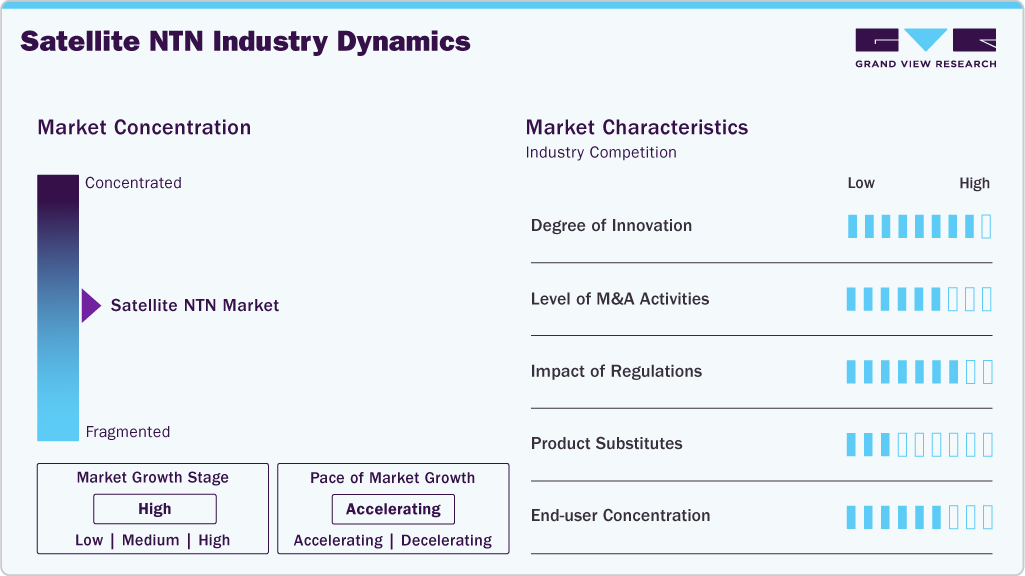
The satellite NTN market is moderately concentrated, with leading satellite operators, telecommunications equipment providers, network infrastructure companies, semiconductor manufacturers, and aerospace technology firms competing across broadband connectivity, direct-to-device services, IoT communications, aviation, maritime, public safety, and defense applications. Rising investments in Low Earth Orbit satellite constellations, increasing adoption of 3GPP-compliant non-terrestrial networks, and growing demand for seamless global connectivity are driving market expansion. Companies are strengthening their competitive positions through strategic partnerships, satellite constellation deployments, technology acquisitions, and continuous investments in software-defined satellites, regenerative payloads, phased-array antennas, and advanced satellite communication technologies.
 To learn more about this report, Download Free Sample Report
The market is characterized by a high degree of innovation, supported by rapid advancements in software-defined satellites, regenerative payload architectures, phased-array antennas, inter-satellite optical communication links, artificial intelligence-enabled network orchestration, and cloud-native satellite core networks. Merger and acquisition activity remains moderate as companies expand satellite communication capabilities and strengthen integrated connectivity portfolios. Regulatory impact is significant due to spectrum allocation policies, orbital coordination requirements, satellite licensing frameworks, space debris mitigation regulations, and 3GPP NTN compliance standards. The threat of substitutes remains low because terrestrial cellular networks cannot provide continuous, ubiquitous connectivity across remote, maritime, aviation, and disaster-affected environments where satellite NTN solutions are essential.
Analyst Perspective
The satellite NTN market is experiencing significant expansion, driven by rising investments in Low Earth Orbit satellite constellations, rapid advancements in 3GPP-compliant non-terrestrial network technologies, and the growing adoption of direct-to-device connectivity, broadband satellite services, and IoT communications across diverse end-use sectors. The expanding implementation of software-defined satellites, regenerative payloads, phased-array antennas, inter-satellite optical communication links, and AI-enabled network orchestration is improving network efficiency, service continuity, bandwidth utilization, and connectivity reliability. Organizations increasingly prioritize ubiquitous coverage, resilient communication infrastructure, and seamless terrestrial-satellite integration to meet evolving commercial, government, and defense requirements. Technology providers are positioned to capitalize on emerging opportunities, thereby reinforcing long-term market expansion and sustainable revenue generation across the global satellite connectivity ecosystem.
Component Insights
Based on component, the hardware segment led the market with the largest revenue share of 71.7% in 2025 and is expected to grow at a considerable CAGR over the forecast period. This segment is witnessing strong growth within the satellite NTN industry. Key components such as RF front ends, antennas, and onboard processing units are being continuously optimized to enhance performance, reduce latency, and support multi-band operations. The rapid deployment of LEO, MEO, and GEO satellite constellations is further fueling the need for compact, power-efficient, and high-capacity hardware solutions. This momentum is positioning the hardware segment as a foundational pillar in the satellite NTN industry’s advancement toward global, high-speed connectivity.
The software segment is expected to register the fastest CAGR of 34.8% from 2026 to 2033, owing to the increasing complexity of satellite networks and the need for seamless integration with terrestrial infrastructure. This segment is experiencing rapid growth within the satellite NTN industry. Software platforms are essential for managing satellite orchestration, real-time communication routing, and intelligent resource allocation across diverse frequency bands. The rise of AI, machine learning, and virtualization technologies is further enhancing software capabilities, enabling more adaptive and efficient network performance. As a result, the software segment is emerging as a critical driver of innovation and operational efficiency in the satellite NTN industry.
Frequency Insights
Based on frequency, the Ka-Band segment dominated the market with the largest revenue share of 25.9% in 2025, owing to its ability to support high-throughput data transmission and wide bandwidth. This segment is experiencing significant growth across satellite communication networks. Its higher frequency range enables faster internet speeds and greater capacity, making it ideal for applications such as broadband access, streaming, and enterprise connectivity. The segment is seeing increased adoption in LEO and GEO satellite deployments to meet the rising demand for data-intensive services. As the need for high-performance connectivity grows, the Ka-Band is becoming a preferred choice for advanced satellite systems.
The L-band segment is expected to grow at a significant CAGR in the coming years, primarily driven by its strong propagation characteristics and reliability in adverse weather conditions. The L-Band segment is gaining steady traction across satellite communication applications. It is particularly favored for aviation, maritime, and mobile satellite services due to its lower frequency range and resistance to signal degradation. The band’s suitability for narrowband applications like GPS, IoT, and safety-critical communications is further boosting its adoption. As demand for uninterrupted, mission-critical connectivity rises, the L-Band continues to play a vital role in enabling dependable communication links.
Orbit Insights
Based on orbit, the LEO segment accounted for the largest market share of 57.1% in 2025, owing to its low latency and proximity to Earth. This segment is experiencing rapid expansion in satellite communication networks. LEO satellites enable faster data transfer and reduced signal delay, making them ideal for real-time applications such as video conferencing, broadband internet, and mobile connectivity. The surge in global investments from both private and public sectors is accelerating large-scale LEO constellation deployments. As demand for seamless, high-speed global coverage intensifies, the LEO segment is emerging as a cornerstone of next-generation connectivity solutions.
The MEO segment is expected to grow at a significant CAGR in the coming years. The increasing demand for balanced performance between coverage, latency, and capacity is driving growth in the MEO segment of satellite communications. MEO satellites offer a middle ground between LEO and GEO, providing lower latency than GEO and broader coverage than LEO, making them suitable for navigation, data services, and enterprise connectivity. Their stable orbits and longer dwell times enhance signal consistency for applications like global positioning and high-capacity broadband. As organizations seek reliable and scalable connectivity solutions, MEO is gaining traction as a versatile and strategic orbital layer.
End Use Insights
Based on end use, the commercial segment dominated the market with a revenue share of 45.6% in 2025, primarily driven by the need for reliable, high-speed connectivity across diverse industries. This end use segment is experiencing robust growth in satellite communication deployments. Enterprises in aviation, maritime, logistics, and remote infrastructure are turning to satellite solutions for real-time data access and operational continuity. The increasing affordability and scalability of LEO constellations are further encouraging adoption among commercial users. As digital transformation accelerates across sectors, the commercial segment continues to play a pivotal role in expanding the reach and impact of satellite-based services.
 To learn more about this report, Download Free Sample Report
The government segment is expected to grow at a significant CAGR in the coming years. The demand for secure and resilient communication networks is propelling growth in the government segment of satellite communications. Governments are increasingly leveraging satellite technology for defense operations, disaster response, border surveillance, and public safety initiatives. These applications require uninterrupted, encrypted, and wide-area coverage that satellite systems are well-positioned to provide. As national security and emergency preparedness become top priorities, the government segment is seeing expanded investments in satellite infrastructure and services.
Regional Insights
North America dominated the satellite NTN market with the largest revenue share of 40.7% in 2025, driven by strong government funding, early adoption of LEO constellations, and widespread demand for rural broadband. The region continues to lead the global market. Private sector advancements from companies like SpaceX and AST SpaceMobile are further accelerating innovation and deployment. The region’s mature satellite infrastructure and robust defense sector reinforce its market dominance.
 To learn more about this report, Download Free Sample Report
U.S. Satellite NTN Market Trends
The satellite NTN market in the U.S. held the largest share in the North America region in 2025. primarily driven by federal initiatives for nationwide 5G and broadband expansion. The U.S. is heavily investing in next-generation satellite communication technologies. Major commercial deployments and defense-backed constellations are strengthening their leadership in non-terrestrial connectivity. Ongoing collaboration between public agencies and private space companies is a key enabler of sustained growth.
Europe Satellite NTN Market Trends
The Europe satellite NTN market is expected to grow at a significant rate in the coming years, owing to the rising need for secure and sovereign satellite communications. The European region is developing its own LEO and MEO constellations. EU space strategies and funding mechanisms are supporting both commercial and government-driven NTN deployments. Cross-border partnerships and innovation in green satellite technologies are adding momentum to Europe's NTN market expansion.
The Germany satellite NTN market is expected to grow at a significant rate in the coming years, fueled by the demand for industrial automation and secure enterprise connectivity. Germany is embracing satellite NTN to support its smart manufacturing and logistics sectors. Government-backed R&D and integration of satellite services into Industry 4.0 frameworks are shaping its trajectory. The country’s focus on digital transformation is translating into new opportunities for NTN applications.
The UK satellite NTN market is expected to grow at a significant rate in the coming years. The increasing demand for resilient communications, especially in defense, maritime, and rural broadband, is catalyzing satellite NTN adoption in the UK Strategic investments in sovereign satellite infrastructure post-Brexit are reinforcing national capabilities. Collaboration with commercial space startups is further energizing growth across civil and military domains.
Asia Pacific Satellite NTN Market Trends
The Asia Pacific satellite NTN market is expected to grow at the fastest CAGR of 35.3% from 2026 to 2033. The growing demand for digital inclusion in rural and island geographies is prompting accelerated NTN deployments across the region. National space programs in countries like China, India, and Japan are driving innovation and competitive satellite launches. Asia Pacific’s dynamic mix of emerging economies and advanced tech hubs is creating diverse use cases for satellite NTN solutions.
China satellite NTN market is fueled by ambitious national space policies and large-scale constellation programs. China is rapidly scaling its satellite NTN infrastructure. Projects like Hongyun and Xingyun are aimed at enhancing global broadband coverage and advancing state-driven connectivity goals. With strong government backing and strategic integration into its digital Belt and Road Initiative, China is asserting dominance in NTN capabilities.
Japan satellite NTN market is owing to the country's emphasis on disaster resilience and nationwide connectivity, Japan is steadily advancing its NTN satellite capabilities. Government initiatives are focused on integrating satellite IoT for early warning systems, emergency response, and remote area communication. Partnerships with domestic aerospace firms are accelerating the development of secure, multi-orbit NTN systems.
Key Satellite NTN Company Insights
Some key players operating in the market include Airbus and Thales Alenia Space, among others.
-
Airbus is a global aerospace leader with a comprehensive portfolio in satellite manufacturing and space systems integration. It specializes in geostationary, LEO, and MEO satellites tailored for broadband, secure communication, and defense NTN applications. Airbus is also deeply involved in advancing 5G NTN infrastructure and enabling interoperability between satellite and terrestrial networks. Its strong R&D, international partnerships, and scalable production capabilities solidify its leadership in the market.
-
Thales Alenia Space is a key European player specializing in next-generation satellite systems and space infrastructure. It has a strong presence in the LEO and MEO segments, particularly for software-defined and reconfigurable payloads in the NTN ecosystem. The company plays a leading role in European and global NTN and 5G initiatives, including high-throughput and secure satellite communication missions. Its broad technical expertise and systems integration capability make it a trusted leader in the space sector.
SWISSto12 and Mini-Circuits are some emerging market participants in the satellite NTN market.
-
SWISSto12 is an innovative Swiss company specializing in advanced RF and mmWave solutions for small satellites and next-gen NTN applications. It pioneers the use of 3D-printed RF hardware, enabling lightweight, compact, and highly efficient components for satellite payloads. The firm has partnered with global space agencies and primes to scale its offerings for commercial and defense NTN missions. Its agility and unique manufacturing techniques make it a rising force in the NTN landscape.
-
Mini-Circuits is a U.S.-based component manufacturer known for its wide portfolio of RF, microwave, and millimeter-wave products. In the NTN market, it supports satellite terminals, gateways, and edge equipment with compact, cost-effective amplifiers, filters, and mixers. The company is increasingly favored by smallsat and CubeSat integrators due to its fast customization and broad distribution network. Its engineering adaptability and affordability mark it as a high-potential emerging player in NTN infrastructure.
Key Satellite NTN Companies
The following key companies have been profiled for this study on the satellite NTN market.
-
Airbus
-
Analog Devices, Inc.
-
Bae Systems
-
Filtronic Plc
-
Honeywell International Inc.
-
L3Harris Technologies
-
Mini-Circuits
-
Qorvo, Inc.
-
Smiths Interconnect
-
SWISSto12
-
Teledyne Technologies
-
Thales Alenia Space
Competitive Benchmarking
Category
Operating Strategies
Competitive Edge
Weakness
Established Players (Airbus, Thales Alenia Space, L3Harris Technologies)
- Focus on expanding integrated satellite-terrestrial connectivity through strategic partnerships in telecom, chipsets, and infrastructure.
- Invest heavily in LEO constellations, software-defined satellites, and 3GPP-compliant NTN network infrastructure.
- Strong global satellite assets, regulatory expertise, and extensive customer relationships support sustained market leadership.
- Ability to deliver secure, resilient, low-latency connectivity across commercial, government, and defense applications.
- Dependence on capital-intensive satellite infrastructure increases deployment costs and extends investment recovery periods.
- Large operational structures may reduce flexibility in adopting rapidly evolving satellite communication technologies.
Emerging Players (Mini-Circuits, Qorvo, Inc., SWISSto12)
- Emerging players focus on developing innovative satellite connectivity solutions through collaborations across telecom, semiconductor, and technology sectors.
- Invest in software-defined satellites, direct-to-device services, and AI-enabled network management capabilities.
- Agile development capabilities enable the rapid commercialization of innovative satellite communication and NTN technologies.
- Strong specialization in niche connectivity applications supports differentiated offerings for underserved market segments.
- Limited satellite infrastructure and financial resources restrict large-scale constellation deployment and network expansion.
- Lower global market presence challenges customer acquisition against established satellite operators and telecom providers.
Recent Developments
-
In June 2025, Vi (Vodafone Idea) partnered with AST SpaceMobile to bring satellite-powered mobile connectivity to India. The service will enable direct-to-smartphone communication via satellites without any additional hardware or apps. This initiative supports the Digital India mission by targeting remote and underserved regions with voice, video, and data services. With this move, Vi becomes the third major Indian telecom operator to enter the satcom space, alongside Jio and Airtel.
-
In April 2025, KPN partnered with Skylo to deliver seamless global connectivity using advanced Non-Terrestrial Network (NTN) technology based on 3GPP Release 17 standards. This allows devices to switch effortlessly between mobile and satellite networks without requiring large satellite dishes. The service integrates smoothly with existing KPN accounts, eliminating the need for new contracts or billing relationships. It provides a reliable and future-ready solution for businesses and emergency services operating in remote or network-challenged environments.
-
In March 2025, Astrum Mobile partnered with SWISSto12 to develop NEASTAR-1, Asia-Pacific’s first dedicated satellite-to-device (S2D) platform. The satellite will deliver 5G NTN services to improve connectivity in remote and underserved regions. Built on SWISSto12’s compact HummingSat platform, it offers a cost-effective and high-performance solution. This partnership marks a major step toward advancing direct-to-device satellite communications in the region.
Satellite NTN Market Report Scope
Report Attribute
Details
Market size in 2025
USD 434.7 million
Estimated market size in 2026
USD 639.2 million
Projected market size by 2033
USD 4,480.4 million
Growth rate
CAGR of 32.1% from 2026 to 2033
Base year for estimation
2025
Historical data
2021 - 2024
Forecast period
2026 - 2033
Quantitative units
Revenue in USD Million, and CAGR from 2026 to 2033
Report coverage
Revenue forecast, company ranking, competitive landscape, growth factors, and trends
Segments covered
Component, frequency, orbit, end use, and region
Regional scope
North America; Europe; Asia Pacific; Latin America; MEA
Country scope
U.S.; Canada; Mexico; U.K.; Germany; France; China; Japan; India; South Korea; Australia; Brazil; Saudi Arabia; UAE; South Africa
Key companies profiled
Airbus; Analog Devices, Inc.; Bae Systems; Filtronic Plc; Honeywell International Inc.; L3Harris Technologies; Mini-Circuits; Qorvo, Inc.; Smiths Interconnect; SWISSto12; Teledyne Technologies; Thales Alenia Space.
Customization scope
Free report customization (equivalent up to 8 analysts' working days) with purchase. Addition or alteration to country, regional & segment scope.
Pricing and purchase options
Avail customized purchase options to meet your exact research needs. Explore purchase options
Global Satellite NTN Market Report Segmentation
This report forecasts revenue growth at global, regional, and country levels and provides an analysis of the latest industry trends in each of the sub-segments from 2021 to 2033. For this study, Grand View Research has segmented the global satellite NTN market report based on component, frequency, orbit, end use, and region:
-
Component Outlook (Revenue, USD Million, 2021 - 2033)
-
Hardware
-
RF Front End
-
Antenna
-
Onboard processor Unit
-
Others
-
-
Software
-
-
Frequency Outlook (Revenue, USD Million, 2021 - 2033)
-
L-Band
-
S-Band
-
C-Band
-
KU- Band
-
Ka-Band
-
HF/VHF/UHF-Bands
-
-
Orbit Outlook (Revenue, USD Million, 2021 - 2033)
-
LEO
-
GEO
-
MEO
-
-
End Use Outlook (Revenue, USD Million, 2021 - 2033)
-
Commercial
-
Defense
-
Government
-
-
Regional Outlook (Revenue, USD Million, 2021 - 2033)
-
North America
-
U.S.
-
Canada
-
Mexico
-
-
Europe
-
Germany
-
UK
-
France
-
-
Asia Pacific
-
China
-
Japan
-
India
-
South Korea
-
Australia
-
-
Latin America
-
Brazil
-
-
Middle East and Africa (MEA)
-
UAE
-
Saudi Arabia
-
South Africa
-
-
Research Methodology
The satellite NTN market figures in this report are based on a proven research process that combines executive interviews with secondary research from proprietary databases, company filings, and recognized regulatory and institutional sources. Market size is built through value-chain sizing - reconciling supply-side and demand-side estimates - and triangulated with bottom-up and top-down approaches. Every estimate passes multiple levels of expert validation before publication, with each satellite NTN segment quantified using the revenue-capture definitions in the table below.
Segment Definition
Component
Revenue capture definition
Hardware
Revenue is generated through satellite communication hardware, including satellites, regenerative payloads, phased-array antennas, user terminals, gateways, RF components, and onboard communication modules deployed across non-terrestrial network infrastructure. This segment is driven by expanding LEO constellation deployments, increasing direct-to-device services, and continuous investments in advanced satellite communication technologies.
Software
Revenue is captured through software platforms supporting satellite network orchestration, resource management, spectrum optimization, cloud-native core networks, AI-enabled traffic management, and satellite-terrestrial integration. This segment is propelled by growing adoption of software-defined networking, intelligent network automation, and 3GPP-compliant NTN architectures for seamless global connectivity.
Frequency
Revenue capture definition
L-Band
Revenue is generated through L-Band spectrum supporting reliable mobile satellite communications, IoT connectivity, navigation, and emergency communication services. This segment is driven by strong signal reliability, broad coverage, and consistent performance under challenging environmental conditions.
S-Band
Revenue is captured through S-Band frequency solutions used for mobile communications, telemetry, command operations, and direct-to-device satellite services. This segment is propelled by balanced bandwidth capabilities, dependable signal penetration, and increasing adoption across government and commercial communication networks.
C-Band
Revenue is generated through C-Band satellite communications supporting broadband connectivity, enterprise networking, and resilient backhaul services. This segment is driven by stable transmission performance, lower rain attenuation, and growing demand for dependable connectivity across diverse geographical environments.
KU- Band
Revenue is captured through Ku-Band satellite services enabling broadband internet, aviation connectivity, maritime communications, enterprise networking, and high-throughput satellite applications. This segment is propelled by increasing demand for high-capacity communication services and expanding deployment of advanced satellite networks.
Ka-Band
Revenue is generated through Ka-Band solutions delivering high-speed broadband, direct-to-device services, cloud connectivity, and data-intensive satellite applications. This segment is driven by higher bandwidth availability, increasing high-throughput satellite deployments, and growing demand for low-latency communication services.
HF/VHF/UHF-Bands
Revenue is captured through HF, VHF, and UHF frequency bands supporting tactical communications, emergency response, public safety, defense operations, and remote monitoring applications. This segment is propelled by long-range communication capabilities, reliable signal propagation, and extensive utilization in mission-critical environments.
Orbit
Revenue capture definition
LEO
Revenue is generated through Low Earth Orbit satellite constellations providing broadband connectivity, direct-to-device services, IoT communications, and low-latency network coverage. This segment is driven by rapid constellation expansion, reduced latency, global coverage capabilities, and increasing commercial satellite deployments.
GEO
Revenue is captured through Geostationary Earth Orbit satellites supporting broadcasting, fixed satellite services, enterprise connectivity, and government communication networks. This segment is propelled by continuous regional coverage, established satellite infrastructure, and high-capacity communication capabilities
MEO
Revenue is generated through Medium Earth Orbit satellites delivering navigation, broadband connectivity, and enterprise communication services across wide geographical regions. This segment is driven by balanced coverage, moderate latency performance, and growing adoption for integrated satellite communication networks.
End Use
Revenue capture definition
Commercial
Revenue is generated through commercial deployment of satellite NTN solutions for broadband connectivity, direct-to-device services, enterprise networking, transportation, maritime, aviation, IoT, and industrial communications. This segment is driven by increasing demand for uninterrupted global connectivity and digital transformation initiatives.
Defense
Revenue is captured through satellite NTN deployments supporting secure communications, intelligence, surveillance, tactical operations, resilient battlefield connectivity, and mission-critical defense networks. This segment is propelled by rising defense modernization programs, secure satellite communication requirements, and growing investment in resilient communication infrastructure.
Government
Revenue is generated through government utilization of satellite NTN for public safety, disaster response, border security, emergency communications, environmental monitoring, and national infrastructure connectivity. This segment is driven by expanding digital inclusion programs, resilient communication initiatives, and increasing investments in secure nationwide connectivity.
Estimation Model
Layer No.
Layer Name
Key Question
Description
01
Connectivity Adoption Layer
Who are the potential adopters?
Identifies organizations adopting Satellite NTN solutions, including mobile network operators, satellite service providers, government agencies, defense organizations, aviation and maritime operators, IoT providers, enterprises, and public safety agencies requiring seamless global connectivity.
02
Network Infrastructure Enablement Layer
Who can deploy Satellite NTN solutions?
Deployment requires LEO, MEO, and GEO satellite constellations, software-defined satellites, regenerative payloads, gateway stations, phased-array antennas, cloud-native core networks, 3GPP-compliant infrastructure, spectrum resources, and skilled satellite communication professionals.
03
Connectivity Application Layer
Where are Satellite NTN solutions actively utilized?
Satellite NTN solutions support broadband connectivity, direct-to-device communications, IoT networks, aviation, maritime, defense, disaster recovery, transportation, public safety, remote industrial operations, and rural connectivity requiring uninterrupted communication beyond terrestrial network coverage.
04
Revenue Generation Layer
How is revenue generated?
Revenue is generated through satellite connectivity services, broadband subscriptions, direct-to-device offerings, IoT connectivity, satellite capacity leasing, network integration, gateway infrastructure, user terminals, software licensing, managed services, and recurring enterprise communication contracts.
Delivered Customizations
This report has been delivered with the following In-depth customizations
Client Request
Customization Delivered
Value Adds
Direct-to-Device Satellite Connectivity Deployment Assessment
Conducted detailed evaluation of direct-to-device satellite connectivity deployments across mobile network operators, satellite providers, chipset vendors, and smartphone manufacturers, integrating 3GPP NTN standards, spectrum utilization, and service interoperability frameworks to assess deployment readiness.
Improves deployment planning, strengthens interoperability, enhances coverage, accelerates commercialization, and supports scalable connectivity services.
LEO Constellation Architecture & Satellite-Terrestrial Integration Strategy
Assessed Low Earth Orbit constellation architectures across commercial, government, and enterprise networks, evaluating software-defined satellites, regenerative payloads, gateway infrastructure, and terrestrial network integration to optimize connectivity performance and operational efficiency.
Enhances network performance, improves scalability, optimizes resource utilization, strengthens resilience, and enables seamless global connectivity.
AI-Enabled NTN Network Optimization & Spectrum Management Assessment
Evaluated artificial intelligence-enabled network orchestration, dynamic spectrum management, cloud-native satellite core networks, and traffic optimization platforms across satellite NTN infrastructure to improve bandwidth allocation, service continuity, operational efficiency, and communication reliability.
Optimizes spectrum utilization, improves service reliability, reduces latency, enhances efficiency, and supports intelligent network operations.
Frequently Asked Questions About This Report
Some key players operating in the satellite NTN market include Airbus, Analog Devices, Inc., Bae Systems, Filtronic Plc, Honeywell International Inc., L3Harris Technologies, Mini-Circuits, Qorvo, Inc., Smiths Interconnect, SWISSto12, Teledyne Technologies, and Thales Alenia Space.
Key factors that are driving the market growth include rising demand for seamless global connectivity, increasing deployment of LEO satellite constellations, and growing integration of satellite networks with 5G infrastructure.
The Asia Pacific is the fastest-growing region with a CAGR of over 35.0% from 2026 to 2033.
The hardware segment dominated with a 71.7% revenue share in 2025.
The Ka-Band segment dominated the market with a share of 25.9% in 2025.
The commercial segment accounted for the largest share, with 45.6% of revenue in 2025.
The global satellite NTN market size was valued at USD 434.7 million in 2025 and is estimated at USD 639.2 million for 2026.
The global satellite NTN market is expected to grow at a CAGR of 32.1% from 2026 to 2033, reaching USD 4,480.4 million by 2033.
North America dominated the satellite NTN market with a share of 40.7% in 2025.
About the Author(s)
Next Generation Technologies Research Team
Technology · Next Generation TechnologiesThis report was authored by the next generation technologies research team at Grand View Research - comprising two research analysts, one senior research analyst, and one industry expert - with specialized expertise in the next generation technologies segment of the technology industry. All findings are based on proprietary technology databases, executive interviews, and regulatory analysis, subject to internal peer review prior to publication.
Last Updated:
Speak to Analyst

Customize this report to your needs - add regions, segments, or data points, with 20% free customization.
Or view our licence options:


ISO 9001:2015 & 27001:2022 Certified
We are GDPR and CCPA compliant! Your transaction & personal information is safe and secure. For more details, please read our privacy policy.


