
- Home
- »
- Clinical Diagnostics
- »
-
Saudi Arabia Dengue Testing Market Size Report, 2026-2033GVR Report cover
![Saudi Arabia Dengue Testing Market Size, Share & Trends Report]()
Saudi Arabia Dengue Testing Market (2026 - 2033) Size, Share & Trends Analysis Report By Test Type (ELISA Based Tests, Molecular Diagnostic Tests, Rapid Diagnostic Tests (RDTs)), By Product (Consumables, Instruments), By End Use (Hospitals), And Segment Forecasts
- Report ID: GVR-4-68040-931-6
- Number of Report Pages: 125
- Format: PDF
- Historical Range: 2021 - 2024
- Forecast Period: 2026 - 2033
- Industry: Healthcare
- Report Summary
- Table of Contents
- Segmentation
- Methodology
- Download FREE Sample
-
 Download Sample Report
Saudi Arabia Dengue Testing Market Size & Trends
The Saudi Arabia dengue testing market was valued at USD 624.35 thousand in 2025 and is projected to grow from USD 654.00 thousand in 2026 to reach USD 889.83 thousand by 2033, growing at a CAGR of 4.50% from 2026 to 2033. The market is driven by the increasing prevalence of dengue infections, particularly in western and southern regions such as Jeddah, Makkah, and Jazan.
Key Market Trends & Insights
- By test type, the ELISA based tests segment held the highest market share of 31.73% in 2025.
- By product, the consumables segment held the highest market share in 2025.
- By end use, the hospitals segment held the highest market share in 2025.
Market Size & Forecast
- 2033 Projected Market Size: USD 889.83 Thousand
- 2025 Market Size: USD 624.35 Thousand
- CAGR (2026-2033): 4.50%
Rising mosquito-borne disease surveillance activities and growing awareness of early diagnosis are increasing demand for accurate dengue testing methods, including RT-PCR, ELISA, NS1 antigen testing, and rapid diagnostic tests (RDTs).
Market Dynamics
The increasing prevalence of dengue infections is a major driver of growth in the Saudi Arabia dengue testing market. Saudi Arabia has reported an increase in dengue fever cases, particularly in Jeddah, Makkah, and Jazan, where environmental and climatic conditions favor mosquito breeding. A study published in BMC Infectious Diseases in May 2026 reported that dengue transmission in Saudi Arabia continues to show strong geographic and seasonal variation, particularly in high-risk regions such as Makkah and Jazan. The study emphasized the importance of enhanced surveillance programs, RT-PCR testing, and early diagnostic strategies to control future outbreaks. In addition, factors such as population growth, urbanization, international travel, and changing weather patterns have contributed to the spread of dengue-carrying mosquitoes, increasing the risk of infection in several parts of the country.
As the number of suspected dengue cases are increasing, the demand for reliable, rapid diagnostic testing is also growing. Dengue symptoms, including fever, headache, muscle pain, and fatigue, are often similar to those of other viral infections, making laboratory testing important for accurate diagnosis. Healthcare providers across Saudi Arabia are using diagnostic methods such as RT-PCR, ELISA, NS1 antigen tests, and rapid diagnostic tests (RDTs) to detect infections early and provide timely treatment.
The growing burden of dengue infections has also encouraged hospitals, diagnostic laboratories, and public health authorities to strengthen disease surveillance and outbreak monitoring programs. Increased testing helps healthcare professionals identify infected patients quickly, control the spread of the disease, and reduce the risk of severe complications. In addition, rising public awareness regarding mosquito-borne diseases and the importance of early diagnosis is further supporting the adoption of dengue testing services and diagnostic kits across Saudi Arabia.
Reported Dengue Cases by Gender in Saudi Arabia
Year
Saudi Male Saudi Female Saudi Total
2023
11789
3221
15,010
2022
3075
572
3,647
2021
2855
566
3421
2020
1709
666
2375
2019*
765
476
1241
2021
749
448
1197
2017
714
423
1137
2016
1104
665
1769
2015
786
481
1267
2014
556
329
885
*Estimated
Source: BMC Infectious Diseases
The high cost of advanced diagnostic technologies such as RT-PCR and other molecular testing systems is a major challenge. These technologies are highly accurate and enable early detection of dengue infections, but they require significant investment in equipment, laboratory infrastructure, and trained professionals. Many small hospitals, clinics, and diagnostic laboratories may find it difficult to afford these systems, especially in regions with limited healthcare budgets. As a result, several healthcare facilities continue to depend on conventional or rapid diagnostic tests, which may not always provide the same level of accuracy as molecular methods.
In addition to the initial setup cost, molecular diagnostic systems also involve high operational and maintenance expenses. Regular instrument calibration, quality control procedures, and the continuous need for specialized reagents and consumables increase the overall cost of testing. Healthcare facilities also need skilled laboratory staff to operate these systems, which further adds to operational expenses. These factors can limit the widespread adoption of advanced dengue testing technologies nationwide.
The high cost of advanced dengue tests can also affect patients, particularly in private healthcare settings where molecular testing is more expensive. This may discourage some individuals from seeking early testing, leading to delayed diagnosis and treatment. Moreover, the limited availability of advanced testing technologies can reduce the efficiency of disease surveillance and outbreak monitoring programs in high-risk areas such as Jeddah, Makkah, and Jazan.
The expanding adoption of rapid and point-of-care (POC) diagnostic testing is creating significant growth opportunities in the Saudi Arabia dengue testing market. Rapid and POC tests help healthcare professionals detect dengue infections quickly and begin treatment at an early stage. Unlike conventional laboratory-based testing methods, these diagnostic solutions provide faster results and can be used in hospitals, clinics, emergency care centers, and remote healthcare facilities without requiring highly advanced laboratory infrastructure. This improves access to dengue testing and supports timely disease management.
The growing focus on strengthening infectious disease surveillance and improving healthcare access in Saudi Arabia is further driving demand for rapid diagnostic solutions. In addition, rising international travel and large population gatherings in the country underscore the importance of rapid, efficient dengue screening to prevent the spread of infection. Rapid diagnostic tests also help public health authorities identify outbreaks early and implement preventive measures more quickly.
Technological advancements in portable diagnostic devices and rapid antigen testing kits are improving the accuracy, convenience, and affordability of point-of-care dengue testing. As a result, healthcare providers are increasingly adopting these solutions for faster clinical decision-making and better patient management. This trend is expected to create strong growth opportunities for manufacturers offering rapid and point-of-care dengue diagnostic products in the Saudi Arabia dengue testing market over the coming years.
Market Concentration & Characteristics
The Saudi Arabia dengue testing market demonstrates a moderate to high degree of innovation, driven by the increasing adoption of advanced diagnostic technologies such as RT-PCR, ELISA, multiplex molecular assays, and automated immunoassay systems. Healthcare facilities are also integrating digital laboratory solutions and high-throughput testing platforms to improve diagnostic accuracy, efficiency, and turnaround times. A November 2025 study published in International Health evaluated the combined use of NS1 antigen testing and IgM ELISA against RT-PCR across six regions in Saudi Arabia. The study found that combining NS1 and IgM tests increased diagnostic sensitivity to 92.4%, highlighting the growing adoption of multi-platform diagnostic approaches to improve dengue detection and surveillance in the country.
The Saudi Arabia dengue testing market is witnessing moderate merger, acquisition, and strategic partnership activity as diagnostic companies expand their molecular testing capabilities, local manufacturing presence, and infectious disease portfolios. Companies are entering joint ventures and regional collaborations to strengthen access to advanced PCR and rapid diagnostic technologies. These partnerships support the localization of diagnostic production, improve testing accessibility, and enhance infectious disease surveillance capabilities across the Kingdom.
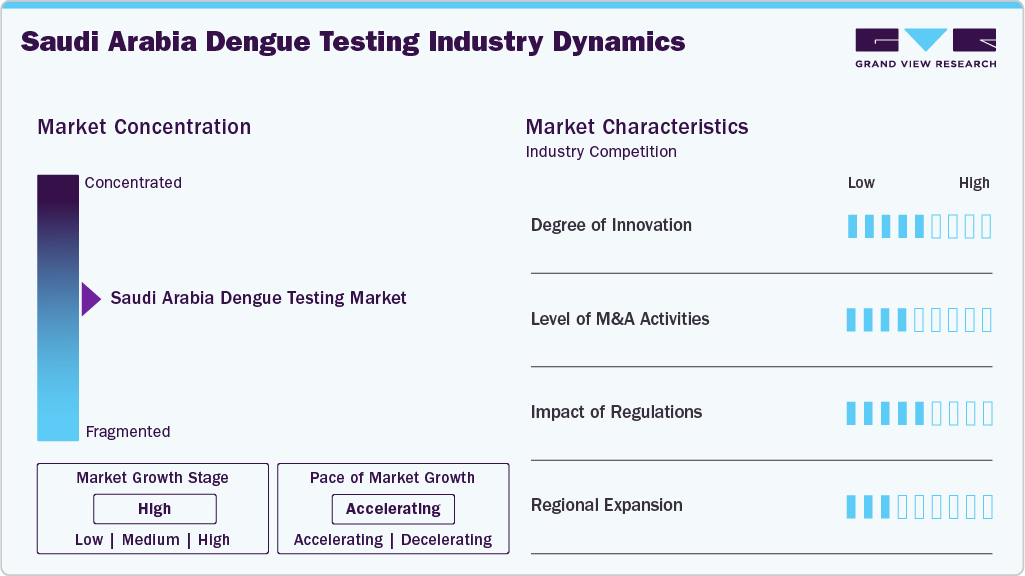
Regulatory frameworks play a significant role in shaping the Saudi Arabia dengue testing market by ensuring the safety, quality, and accuracy of diagnostic tests, including RT-PCR, ELISA, and rapid antigen assays. The Saudi Food and Drug Authority (SFDA) has established strict approval and quality requirements for in-vitro diagnostic devices, thereby increasing compliance costs and extending product registration timelines for manufacturers. However, these regulations support market growth by promoting the adoption of reliable and clinically validated dengue diagnostic solutions across hospitals, laboratories, and public health institutions. The implementation of stringent regulatory standards and post-market surveillance further improves confidence in diagnostic testing and strengthens infectious disease monitoring in the country.
The market is being driven by the rising incidence of dengue infections, increasing government focus on infectious disease surveillance, and ongoing improvements in healthcare infrastructure across the country. Diagnostic companies are expanding their presence through partnerships with hospitals, laboratories, and public health agencies to strengthen dengue detection capabilities. Expanding healthcare services in high-risk regions such as Jeddah, Makkah, and Jazan, along with increased awareness of early disease diagnosis and outbreak management, is further driving the adoption of dengue testing solutions across Saudi Arabia.
Test Type Insights
The ELISA based tests segment dominated the Saudi Arabia dengue testing market, accounting for the largest revenue share of 31.73% in 2025. The adoption of ELISA-based tests in dengue testing in Saudi Arabia is increasing due to their high sensitivity, cost-effectiveness, and suitability for large-scale screening programs. ELISA tests are widely used to detect dengue NS1 antigens and IgM and IgG antibodies, enabling healthcare providers to identify both early-stage and past infections with high accuracy. These tests are particularly valuable in hospital laboratories and public health surveillance programs because they can process a large number of samples simultaneously, which is essential during seasonal outbreaks and mass screening initiatives. The increasing dengue burden in regions such as Jeddah and Makkah has also prompted healthcare authorities to strengthen laboratory diagnostic capabilities, thereby increasing demand for ELISA-based testing platforms. In addition, Saudi Arabia’s growing investments in infectious disease monitoring, vector-borne disease control programs, and improved laboratory infrastructure are supporting the wider adoption of ELISA diagnostics.
The molecular diagnostic kits segment is anticipated to grow at the fastest CAGR of 5.99% over the forecast period. Molecular diagnostic tests are being adopted in Saudi Arabia for their ability to provide accurate, early detection of dengue virus infections. Techniques such as RT-PCR are widely used in hospitals and reference laboratories to detect dengue virus RNA at the early stage of infection, enabling healthcare professionals to initiate timely patient management and reduce the risk of severe complications. According to an article published in Transactions of the Royal Society of Tropical Medicine and Hygiene in April 2026, researchers in Saudi Arabia reported that dengue diagnosis across seven regions was primarily conducted using RT-PCR molecular testing, with more than 2,850 suspected patient samples analyzed. The study identified 1,447 PCR-confirmed dengue cases. Such cases highlight the increasing reliance on molecular diagnostic kits for accurate outbreak surveillance and infection monitoring
Product Insights
The consumables segment held the largest share of the Saudi Arabia dengue testing market, accounting for 77.04% in 2025. The segment is driven by the increasing demand for dengue diagnostic procedures across hospitals, laboratories, and healthcare centers. Consumables include reagents, assay kits, PCR cartridges, sample collection swabs, buffers, and rapid diagnostic test kits required for every testing process. Since these products are disposable and require continuous replenishment, their demand rises directly with increases in dengue testing volumes. Rising awareness regarding early disease diagnosis and infection control has encouraged healthcare providers to conduct more screening and confirmatory tests. A December 2025 study conducted across six regions in Saudi Arabia used large volumes of NS1 antigen tests, IgM/IgG ELISA kits, and RT-PCR assays to evaluate more than 2,850 patient samples for dengue diagnosis. This highlights the growing routine consumption of reagents, assay kits, and PCR consumables in hospitals and regional laboratories.
The others segment is expected to grow significantly over the forecast period. The segment is driven by increasing demand for diagnostic materials used during dengue detection procedures. As hospitals and laboratories conduct more dengue tests, demand for reagents, assay kits, sample collection products, quality control materials, and laboratory accessories is also rising. These products are essential for ensuring accurate and reliable test results in RT-PCR, ELISA, and rapid diagnostic testing methods. In addition, the growing focus on early disease detection and infection surveillance in Saudi Arabia is encouraging healthcare facilities to improve their laboratory capabilities. This has increased the use of specialized diagnostic support products and testing components. The expansion of automated laboratory systems and molecular diagnostic technologies is further driving demand in this segment.
End Use Insights
The hospitals segment dominated the Saudi Arabia dengue testing market, accounting for the largest revenue share of 42.68% in 2025, driven by the rising number of mosquito-borne infections and the increasing need for early and accurate diagnosis. Hospitals remain the primary centers for dengue testing because they are equipped with advanced laboratory infrastructure, molecular diagnostic technologies, and skilled healthcare professionals. Patients with moderate to severe dengue symptoms are commonly treated in hospitals, increasing demand for rapid, reliable diagnostic methods such as RT-PCR, ELISA, and NS1 antigen tests. Hospitals also play a major role in disease surveillance, outbreak monitoring, and infection control, particularly in high-risk regions including Makkah, Jeddah, and Jazan. The growth of hospital-based testing is further supported by Saudi Arabia’s increasing healthcare investments and stronger infectious disease surveillance programs. Hospitals are adopting combined diagnostic approaches, such as NS1 antigen and IgM ELISA testing, to improve diagnostic accuracy and reduce testing time.

The research institutes segment is expected to grow at the fastest CAGR over the forecast period, fueled by the country’s increasing focus on strengthening infectious disease surveillance and advancing diagnostic research. Research institutes and academic centers play an important role in studying the spread patterns of mosquito-borne diseases, particularly in regions where dengue cases are more frequently reported. Their work helps in understanding seasonal trends, transmission behavior, and risk factors associated with outbreaks, which supports better preparedness and response strategies. In addition, Saudi Arabia is placing strong emphasis on developing advanced diagnostic technologies and improving early detection of infectious diseases such as dengue and Zika. Research institutes contribute significantly to this goal by conducting clinical studies, validating molecular diagnostic methods, and supporting the development of innovative tools for disease detection and vector monitoring. These activities are essential for improving the accuracy and speed of testing, which is critical for effective disease control
Key Saudi Arabia Dengue Testing Company Insights
Key players operating in the market are undertaking various initiatives to strengthen their market presence and increase the reach of their technology and services. Strategies such as expansion activities and partnerships are playing a key role in propelling the market growth.
Key Saudi Arabia Dengue Testing Companies:
-
Abbott
-
F. Hoffmann-La Roche Ltd
-
Thermo Fisher Scientific, Inc.
-
Bio-Rad Laboratories, Inc.
-
SD Biosensor, Inc.
-
QuidelOrtho Corporation
-
InBios International, Inc.
-
CTK Biotech, Inc.
-
GENBODY INC.
Competitive Benchmarking
Operating Strategies
Competitive Edge
Weaknesses
Mature Players: Abbott
- Focus on expanding integrated dengue diagnostic portfolios including RT-PCR systems, rapid diagnostic kits, immunoassays, reagents, and laboratory consumables.
- Strengthening presence in Saudi Arabia through distributor partnerships, hospital collaborations, and public healthcare tenders.
- Strong global brand recognition and established distribution networks across Saudi Arabia.
- Broad infectious disease testing capabilities with advanced molecular and immunodiagnostic technologies
- High cost of advanced molecular diagnostic systems limits adoption among smaller laboratories and clinics.
- Dependence on imported diagnostic instruments and consumables increases operational costs.
Emerging Players: CTK Biotech, Inc.
- Focus on affordable and rapid dengue diagnostic solutions targeting mid-sized laboratories, clinics, and point-of-care settings.
- Expansion through local distributors and partnerships with local healthcare suppliers.
- Competitive pricing strategies supporting adoption in cost-sensitive healthcare facilities.
- Greater flexibility in addressing niche diagnostic requirements and regional healthcare demands.
- Limited global presence and lower brand recognition compared to multinational diagnostic companies.
- Lower financial and R&D capabilities restricting large-scale product development and expansion activities.
Recent Developments
-
In April 2026, Co-Diagnostics announced a joint venture with Arabian Eagle Manufacturing to establish CoMira Diagnostics in Saudi Arabia for the development, manufacturing, and commercialization of molecular diagnostic technologies.
-
In December 2025, a study published in Sensors reviewed next-generation dengue diagnostic technologies, including CRISPR-based assays, biosensors, AI-enabled diagnostics, and microfluidic platforms, amid rising dengue incidence in Saudi Arabia, highlighting the growing focus on advanced testing innovation.
Saudi Arabia Dengue Testing Market Report Scope
Report Attribute
Details
Market size value in 2025
USD 624.35 Thousand
Market size value in 2026
USD 654.00 Thousand
Revenue forecast in 2033
USD 889.83 Thousand
Growth rate
CAGR of 4.50% from 2026 to 2033
Actual data
2021 - 2024
Forecast period
2026 - 2033
Quantitative units
Revenue in USD thousand and CAGR from 2026 to 2033
Report coverage
Revenue forecast, company ranking, competitive landscape, growth factors, and trends
Segments covered
test type, product, end use
Key companies profiled
Abbott; F. Hoffmann-La Roche Ltd; Thermo Fisher Scientific, Inc.; Bio-Rad Laboratories, Inc.; SD Biosensor, Inc.; QuidelOrtho Corporation; InBios International, Inc.; CTK Biotech, Inc.; GENBODY INC.
Customization scope
Free report customization (equivalent to up to 8 analysts working days) with purchase. Addition or alteration to country, regional & segment scope.
Pricing and purchase options
Avail customized purchase options to meet your exact research needs. Explore purchase options
Saudi Arabia Dengue Testing Market Report Segmentation
This report forecasts revenue growth at country levels and provides an analysis of the latest industry trends in each of the sub-segments from 2021 to 2033. For this study, Grand View Research has segmented the Saudi Arabia dengue testing market report based on test type, product, and end use:
-
Test Type (Revenue, USD Thousands, 2021 - 2033)
-
ELISA-Based Tests
-
Molecular Diagnostic Kits
-
Rapid Diagnostic Tests (RDTs)
-
Lateral Flow Assays (Antigen-Based)
-
-
Product Outlook (Revenue, USD Thousands, 2021 - 2033)
-
Consumables
-
Instruments
-
Others
-
-
End Use Outlook (Revenue, USD Thousands, 2021 - 2033)
-
Hospitals
-
Diagnostic Laboratories
-
Government & Public Health Laboratories
-
Research Institutes
-
Delivered Customizations
This report has been delivered with the following In-depth customizations
Client Request
Customization Delivered
Value Adds
Dengue Burden & Outbreak Trend Analysis
Assessment of dengue incidence, seasonal outbreak patterns, regional hotspots, and disease surveillance trends across Saudi Arabia.
Helps identify testing demand drivers and high-opportunity regions for market expansion.
Public Health & Diagnostic Infrastructure Assessment
Analysis of dengue testing capabilities across hospitals, public health laboratories, reference labs, and infectious disease centers.
Provides insights into testing capacity, infrastructure gaps, and growth opportunities.
Molecular & Rapid Testing Adoption Analysis
Evaluation of PCR, RT-PCR, NS1 antigen tests, serology assays, and multiplex infectious disease panels used for dengue diagnosis.
Tracks technology adoption trends and supports product positioning strategies.
Vector Control & Emerging Diagnostics Landscape
Assessment of government dengue control initiatives, surveillance programs, next-generation diagnostic technologies, and innovation trends.
Identifies future market opportunities linked to disease prevention, monitoring, and public health investments.
Frequently Asked Questions About This Report
The Saudi Arabia dengue testing market size was estimated at USD 624.35 thousand in 2025 and is expected to reach USD 654.00 thousand in 2026.
The Saudi Arabia dengue testing market is expected to grow at a compound annual growth rate of 4.50% from 2026 to 2033 to reach USD 889.83 thousand by 2033.
The ELISA based tests segment dominated the Saudi Arabia dengue testing market, accounting for the largest revenue share of 31.73% in 2025. The adoption of ELISA-based tests in dengue testing in Saudi Arabia is increasing due to their high sensitivity, cost-effectiveness, and suitability for large-scale screening programs.
Some key players operating in the dengue testing market include Abbott; F. Hoffmann-La Roche Ltd.; Thermo Fisher Scientific, Inc.; Bio-Rad Laboratories, Inc.; SD Biosensor, Inc.; QuidelOrtho Corporation; InBios International, Inc.; CTK Biotech, Inc.; GENBODY INC.
The increasing prevalence of dengue infections is a major driver of growth in the Saudi Arabia dengue testing market. Saudi Arabia has reported an increase in dengue fever cases, particularly in Jeddah, Makkah, and Jazan, where environmental and climatic conditions favor mosquito breeding.
About the authors:
Author: GVR Clinical Diagnostics Research Team | Last Updated:


Share this report with your colleague or friend.
Need a Tailored Report?
Customize this report to your needs — add regions, segments, or data points, with 20% free customization.


ISO 9001:2015 & 27001:2022 Certified
We are GDPR and CCPA compliant! Your transaction & personal information is safe and secure. For more details, please read our privacy policy.












