
- Home
- »
- Clothing, Footwear & Accessories
- »
-
School Bags Market Size, Share & Trends Report, 2026-2033GVR Report cover

School Bags Market (2026 - 2033)
Size, Share & Trends Analysis Report By Fabric (Canvas, Polyester, Nylon, Leather), By Distribution Channel (Offline, Online), By Region (North America, Europe, Asia Pacific, Latin America, Middle East And Africa), And Segment Forecasts
Market Size, 2025
$23.3BMarket Estimate, 2026
$24.3BMarket Forecast, 2033
$36.2BCAGR, 2026–2033
5.8%School Bags Market Summary
The global school bags market size was valued at USD 23.3 billion in 2025 and is projected to grow from USD 24.3 billion in 2026 to USD 36.3 billion by 2033, at a CAGR of 5.8% from 2026 to 2033. Asia Pacific dominated the global market with the largest revenue share of 56.4% in 2025. The growth of the global school bags market is driven by the increasing student enrollment rates worldwide, supported by government initiatives to promote education, significantly boosting the demand for school bags.
 Source: Grand View Research, IR Documents, Primary Interviews, Paid DatabasesTo learn more about this report,
 Download Free Sample Report
 Key Market Trends & Insights
- By fabric: Polyester segment led the market with the largest revenue share of 37.8% in 2025.
- By distribution channel: Online segment led the market with the largest revenue share of 56.84% in 2025.
Regional Highlights
- Largest regional market: Asia Pacific (56.4% revenue share, 2025)
- By country: The U.S. school bags market is projected to grow significantly in the coming years.
Market Size & Forecast
- Market Size in 2025: USD 23.3 Billion
- Estimated Market Size in 2026: USD 24.3 Billion
- Projected Market Size by 2033: USD 36.3 Billion
- CAGR (2026-2033): 5.8%
Three ways to get this report
Buy it, customize it, or ask a question.Ask an Analyst
A direct answer, usually in 1 working day
- AccessReport author, directly
- Reply timeWithin 1 working day
- No sales callDirect answer only
- FormatEmail reply
- CostFree, no cost
Get the Full Report
What the study covers
- FormatsPDF · Excel · Dashboard
- Timeline2026–2033 annual, 2025 base
- Coverage20+ countries, 5 regions
- Companies10+ key players profiled
Customize the Report
20% free customization
- IncludeCountries, segments, points
- TailorTo your product definition
- ExtendDeeper competitor detail
- OrA fully bespoke study
- Turnaround5–10 working days
Additionally, the rising emphasis on providing quality education and the growing number of schools and colleges contribute to the market’s expansion. The evolving fashion trends among students and the demand for sturdy, spacious, trendy school bags also drive market growth.The increasing use of eco-friendly materials, such as recycled plastics, and the focus on lightweight and durable bags to accommodate electronic gadgets such as tablets and laptops are expected to fuel innovation and demand in the market. These factors collectively create a positive outlook for the school bags market, ensuring steady growth in the coming years.
 To learn more about this report, Download Free Sample Report
 Evolving teaching methodologies and rapid digitization have increased the use of tablets, laptops, and other electronic gadgets. These gadgets increase the weight of bags, which is anticipated to drive the demand for lightweight bags and fuel innovation in raw materials and manufacturing technologies. The rising use of eco-friendly materials such as recycled plastics is expected to influence the market's growth positively.
Market Dynamics
The school bags market is witnessing steady growth driven by rising school enrollment rates, increasing parental focus on children's comfort and posture, and growing demand for durable, lightweight, and ergonomically designed bags. Manufacturers are introducing innovative features such as padded shoulder straps, waterproof materials, multiple storage compartments, and sustainable fabrics to enhance functionality and user convenience. Additionally, evolving fashion preferences among students and the increasing popularity of branded and character-themed school bags are expected to support continued market expansion.
The increasing number of school-going children globally, coupled with growing awareness regarding student health and comfort, is a major driver of the school bags market. Rising enrollment rates in primary and secondary education, particularly in emerging economies, have significantly increased demand for school bags. At the same time, concerns regarding posture-related issues and back pain caused by carrying heavy school materials have encouraged parents and educational institutions to prioritize ergonomic and lightweight bag designs. Features such as padded shoulder straps, back support systems, multiple compartments, and lightweight materials are gaining popularity. Additionally, increasing disposable incomes and growing spending on premium educational accessories are further supporting market growth.
Price sensitivity among consumers and intense competition from local and unorganized manufacturers remain key restraints for the school bags market. In many developing regions, purchasing decisions are heavily influenced by affordability, limiting the adoption of premium and branded school bags. The presence of numerous low-cost alternatives often puts pressure on established manufacturers to maintain competitive pricing, affecting profit margins. Furthermore, the seasonal nature of school bag purchases and fluctuations in raw material costs, including polyester, nylon, and other synthetic fabrics, can create pricing challenges for market participants. These factors may hinder revenue growth, particularly in price-sensitive markets.
The growing emphasis on sustainability and product innovation is creating significant opportunities in the school bags market. Consumers are increasingly seeking eco-friendly products made from recycled plastics, organic fabrics, and sustainable materials, encouraging manufacturers to develop environmentally responsible product lines. Additionally, the emergence of smart school bags featuring GPS tracking, anti-theft mechanisms, USB charging ports, reflective safety strips, and integrated technology solutions is gaining attention among parents and students. Rising urbanization, increasing digital connectivity, and growing demand for premium educational accessories are expected to accelerate the adoption of innovative and sustainable school bags, creating new growth avenues for market participants.
Analyst Perspective
The school bags market is supported by strong and recurring demand fundamentals driven by rising student enrollment, increasing expenditure on educational accessories, and growing consumer preference for ergonomic and durable products. The market is gradually shifting from being a purely utility-driven category to a combination of functionality, comfort, and style, with parents increasingly prioritizing features such as lightweight construction, back-support systems, water resistance, and sustainability. The key competitive advantage will belong to manufacturers that successfully combine ergonomic design, durable materials, innovative features, and attractive aesthetics while maintaining affordability. As demand for premium, eco-friendly, and technology-enabled school bags continues to rise, brands that balance product innovation with cost efficiency are expected to capture long-term market share and strengthen customer loyalty.
Fabric Insights
Based on fabric, the polyester segment led the market with the largest revenue share of 37.8% in 2025 and is expected to grow at the fastest CAGR over the forecast period. Polyester is highly favored for its durability and lightweight properties, making it an ideal material for school bags that must withstand daily wear and tear. It is also cost-effective, which appeals to manufacturers and consumers looking for affordable yet reliable options. The material’s resistance to water and stains further enhances its practicality, ensuring that school bags remain in good condition despite exposure to various elements. Moreover, advancements in polyester production have led to the development of eco-friendly variants, aligning with the growing consumer preference for sustainable products. These factors collectively contribute to the strong market position of polyester in the school bags segment, driving its continued growth and popularity.
The nylon segment is expected to grow at a CAGR of 4.4% over the forecast period. Nylon’s high elasticity and strength make it an ideal material for school bags, capable of handling various load requirements without compromising durability. Additionally, the lightweight nature of nylon ensures that bags remain easy to carry, which is a crucial consideration for students. The material’s resistance to wear and tear further enhances its appeal, ensuring longevity and reliability. Moreover, the availability of trendy designs and patterns in nylon bags caters to the evolving fashion preferences of students, driving demand.
Distribution Channel Insights
Based on distribution channel, the online segment led the market with the largest revenue share of 56.8% in 2025. Traditional brick-and-mortar stores continue to be the preferred shopping destination for many consumers, especially parents who physically inspect school bags' quality and durability before purchasing. Additionally, offline retailers' personalized customer service and immediate product availability enhance the shopping experience. The presence of a wide variety of brands and styles in physical stores also allows consumers to make informed choices. Furthermore, offline stores' promotional activities, discounts, and seasonal sales attract many buyers.
 To learn more about this report, Download Free Sample Report
 The online channel segment is expected to grow at the fastest CAGR over the forecast period. The increasing penetration of the internet and the widespread use of smartphones have made online shopping more accessible and convenient for consumers. Additionally, the ability to compare prices, read reviews, and access a wider variety of products online appeals to many buyers. E-commerce platforms often offer attractive discounts and promotions, further incentivizing online purchases. The convenience of home delivery and easy return policies also enhance the appeal of online shopping. These factors collectively contribute to the rapid growth of the market's online channel segment.
Regional Insights
North America school bags market is expected to grow significantly at a CAGR of 3.6% over the forecast period. The growing popularity of branded and high-quality school bags among consumers and increasing disposable income support market expansion. Additionally, the rising trend of using ergonomic and health-conscious designs in school bags to prevent back problems among students is boosting demand.
U.S. School Bags Market Trends
The U.S. school bags market is projected to grow significantly in the coming years. The U.S. school bags market is projected to grow significantly in the coming years owing to the high emphasis on education and the increasing enrollment rates in schools across the country drive this growth. Moreover, the advancements in e-commerce and the convenience of online shopping are making it easier for consumers to access a wide variety of school bags, contributing to the market’s growth.
Asia Pacific's School Bags Market Trends
Asia Pacific dominated the school bags market with the largest revenue share of 56.4% in 2025. The region's growing student population and rising awareness about the importance of education have significantly boosted the demand for school bags. The total population of school-aged children (between 5 and 18) is estimated to be around 1.3 billion. Additionally, the increasing disposable income among consumers in countries such as China and India has led to higher spending on quality educational products, including school bags.
 To learn more about this report, Download Free Sample Report
 Japan's school bags market is expected to grow significantly over the forecast period. The changing lifestyles and the trend towards more fashionable and functional school bags contribute to market growth. Furthermore, many local manufacturers offer various products at competitive prices to enhance the market's appeal. These factors collectively ensure the robust growth and dominance of the Japanese school bags market.
Europe School Bags Market Trends
Europe's school bags market was identified as a lucrative region in 2024. The region's high standard of living and a strong emphasis on education have led to a consistent demand for quality school bags. Additionally, European consumers' preference for sustainable and eco-friendly products has spurred innovation in the market, with manufacturers increasingly offering bags made from recycled and biodegradable materials.
The UK school bags market is expected to grow significantly over the forecast period. The presence of well-established brands and a robust retail infrastructure enhance market growth. Moreover, the trend towards customizing and personalizing school bags to cater to individual preferences has gained traction, adding to the market's appeal. Furthermore, the growing enrollment ratio in schools and high disposable income are expected to drive the country's growth in this market.
Key School Bags Company Insights
Some key school bag market companies include Nike, Inc., Puma SE, Delsey, Targus, and others. Companies are focusing on launching new bag designs and increasing product ranges. Moreover, key players are taking several strategic initiatives, such as mergers and acquisitions and partnerships with other major companies.
-
Nike, Inc. plays a significant role in the school bags market by leveraging its strong brand reputation and innovative design capabilities. Known for its high-quality and durable products, Nike offers a wide range of school bags that cater to students' needs. The company's focus on incorporating ergonomic features and stylish designs ensures that its school bags are both functional and fashionable. Additionally, Nike's extensive distribution network and strong offline and online retail presence help it reach a broad customer base, further solidifying its position in the market.
-
Puma SE is recognized for its trendy and sporty school bags that appeal to a younger demographic. The company's emphasis on combining functionality with contemporary aesthetics makes its products popular among students. Puma's commitment to sustainability is also evident in its use of eco-friendly materials in the production of school bags, aligning with the growing consumer preference for environmentally responsible products.
Key School Bags Companies
The following key companies have been profiled for this study on the school bags market.
-
Nike, Inc.
-
Puma SE
-
Delsey
-
Targus
-
VIP Industries
-
Herschel Supply Company
-
JanSport
-
The North Face
-
Fjällräven
-
Adidas
Competitive Benchmarking
Category
Operating Strategies
Competitive Edge
Weakness
Established Players (Samsonite International S.A., VF Corporation (JanSport), Adidas AG, Nike, Inc., Puma SE, Wildcraft India Pvt. Ltd.)
- Expand product portfolios with ergonomic, lightweight, and durable school bags. Invest in brand collaborations, sustainability initiatives, and omnichannel distribution. Strengthen presence through school partnerships, retail networks, and e-commerce platforms.
- Strong brand recognition, extensive distribution networks, high consumer trust, and the ability to leverage premium materials and innovative designs. Significant marketing budgets and global reach enhance market penetration.
- Higher production, marketing, and distribution costs compared to smaller competitors. Slower response to rapidly changing fashion trends and consumer preferences due to larger organizational structures. Greater exposure to supply chain disruptions, fluctuating raw material prices, and intense competition from low-cost regional brands.
Emerging Players (Skybags, Uppercase, Safari Industries, Gear, Lavie Sport, Mi Step)
- Focus on affordable, trend-driven, and niche school bag offerings. Utilize digital marketing, influencer collaborations, and direct-to-consumer sales channels. Emphasize innovative designs, customization, and eco-friendly materials to attract younger consumers.
- Greater agility in responding to changing fashion trends and consumer preferences. Ability to target specific customer segments and capitalize on online retail growth. Competitive pricing strategies help gain market share.
- Limited brand awareness and smaller distribution footprints compared to established players. Lower financial resources may restrict large-scale marketing, product development, and international expansion efforts.
Recent Developments
-
In March 2024, DOMS Industries, a prominent stationery and art materials manufacturer, expanded its product portfolio by entering the bag market and focusing on school bags and pouches.
-
In July 2022, Nike unveiled its latest collection of back-to-school backpacks, engineered to enhance students' academic and extracurricular experiences. These backpacks are designed to be durable, spacious, and comfortable, ensuring children are well-prepared and enthusiastic about their return to educational settings.
School Bags Market Report Scope
Report Attribute
Details
Market size value in 2025
USD 23.3 billion
Estimated market size in 2026
USD 24.3 billion
Projected market size by 2033
USD 36.2 billion
Growth rate
CAGR of 5.8% from 2026 to 2033
Base year for estimation
2025
Historical data
2021 - 2024
Forecast period
2026 - 2033
Quantitative units
Revenue in USD million/billion and CAGR from 2026 to 2033
Report coverage
Revenue forecast, company ranking, competitive landscape, growth factors, and trends
Segments covered
Fabric, distribution channel, region
Regional scope
North America; Europe; Asia Pacific; Latin America; MEA
Country scope
U.S.; Canada; Mexico; Germany; UK; France; Italy; Spain; Norway; Denmark; Sweden; Russia; Iceland; Finland; China; Japan; India; South Korea; Australia; Thailand; Singapore; Brazil; Argentina; Saudi Arabia; South Africa; UAE; Kuwait; Israel
Key companies profiled
Nike, Inc.; Puma SE; Delsey; Targus; VIP Industries; Herschel Supply Company; JanSport; The North Face; Fjällräven; Adidas
Customization scope
Free report customization (equivalent up to 8 analysts' working days) with purchase. Addition or alteration to country, regional & segment scope.
Pricing and purchase options
Avail customized purchase options to meet your exact research needs. Explore purchase options
Global School Bags Market Report Segmentation
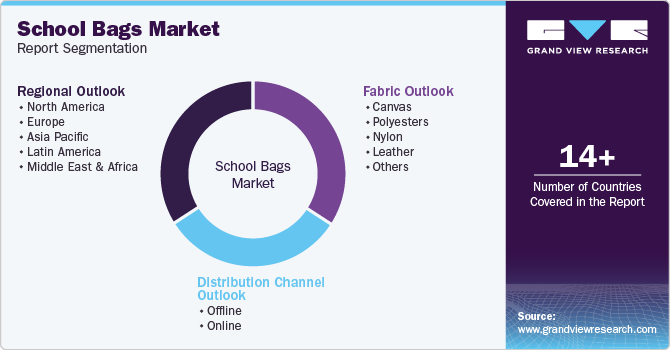
This report forecasts revenue growth at global, regional, and country levels and provides an analysis of the latest industry trends in each of the sub-segments from 2021 to 2033. For this study, Grand View Research has segmented the global school bags market report based on fabric, distribution channel and region:
 To learn more about this report, Download Free Sample Report
 -
Fabric Outlook (Revenue, USD Million, 2021 - 2033)
-
Canvas
-
Polyesters
-
Nylon
-
Leather
-
Others
-
-
Distribution Channel Outlook (Revenue, USD Million, 2021 - 2033)
-
Offline
-
Online
-
-
Regional Outlook (Revenue, USD Million, 2021 - 2033)
-
North America
-
U.S.
-
Canada
-
Mexico
-
-
Europe
-
Germany
-
UK
-
France
-
Italy
-
Spain
-
-
Asia Pacific
-
China
-
Japan
-
India
-
-
Latin America
-
Brazil
-
Argentina
-
-
Middle East and Africa (MEA)
-
South Africa
-
Saudi Arabia
-
-
Research Methodology
Segment Definition
Segment - Type
Revenue capture definition
Canvas
This segment covers the revenues generated through the sales of school bags made from canvas fabric, known for its durability, strength, and resistance to wear and tear. These bags are widely used for everyday school activities due to their sturdy construction. Examples: Canvas backpacks, tote-style school bags, and heavy-duty student bags.
Nylon
This segment covers the revenues generated through the sales of school bags made from nylon fabric, which offers high durability, flexibility, and resistance to abrasion and moisture. Examples: Lightweight backpacks, sports-style school bags, and premium student backpacks.
Leather
This segment covers the revenues generated through the sales of school bags manufactured using genuine or synthetic leather materials. These bags are typically positioned in the premium segment and offer enhanced aesthetics and durability. Examples: Leather satchels, premium school backpacks, and formal student bags.
Others
This segment covers the revenues generated through the sales of school bags made from alternative materials such as recycled fabrics, cotton, jute, neoprene, and blended textiles. Examples: Eco-friendly school bags, recycled plastic backpacks, and specialty fabric school bags.
Segment - Distribution Channel
Revenue capture definition
Offline
This segment covers the revenues generated through the sales of school bags via physical retail channels where customers purchase products in person. Examples: Supermarkets, hypermarkets, stationery stores, department stores, specialty bag stores, school supply shops, and brand-owned retail outlets.
Online
This segment covers the revenues generated through the sales of school bags through digital and e-commerce platforms. Examples: Company websites, online marketplaces such as Amazon and Flipkart, e-commerce platforms, and mobile shopping applications.
Estimation Model
Layer
Focus / Inquiry
Methodology & Data
Epidemiology Layer
Who needs school bags?
Identify the total school-going population across preschool, primary, secondary, and higher education institutions. Use enrollment rates and student demographics to define the addressable user base. Rising global student enrollment remains the primary demand driver for school bags.
Digital Access Layer
Who can purchase school bags??
Apply household income levels, school attendance rates, and retail accessibility (offline stores and e-commerce penetration) to estimate students with purchasing access to school bags. Online retail expansion is increasing market reach, particularly in emerging economies.
Behavioural Layer
Who actively buys/replaces school bags?
Apply annual replacement rates (typically driven by wear-and-tear, grade transitions, fashion trends, and ergonomic upgrades). Factor in demand for specialized bags with laptop compartments, lightweight materials, and branded designs.
Monetisation Layer
How much revenue is generated??
Multiply annual purchasers by average selling price (ASP) across product categories (basic, premium, ergonomic, branded, and eco-friendly bags). Include sales through offline retail, supermarkets, specialty stores, and online marketplaces to estimate total market revenue.
Delivered Customizations
This report has been delivered with the following In-depth customizations
Client Request
Customization Delivered
Value Adds
School Bag Product Innovation & Design Trends
Conducted a focused analysis of school bag designs covering ergonomic features, lightweight materials, anti-theft compartments, smart backpacks, sustainable materials, and child-friendly functionality trends.
Helps stakeholders identify high-demand product features, evaluate evolving consumer preferences, and uncover innovation opportunities in the premium and eco-friendly school bag segments.
Consumer Buying Behavior & Distribution Channel Trends
Evaluated purchasing trends across online and offline channels, seasonal demand patterns, brand preferences, pricing strategies, and the growing influence of e-commerce and back-to-school promotions.
Provides insights into purchasing drivers, channel performance, and customer expectations to support sales optimization, marketing strategies, and retail expansion initiatives.
School Bags Market Infrastructure & Growth Opportunity Assessment
Assessed demand across primary, secondary, and higher education segments, including urban-rural penetration, sustainability adoption, customization trends, and supply chain dynamics impacting market growth.
Supports investment and expansion strategies by identifying high-growth customer segments, emerging regional opportunities, competitive positioning factors, and long-term market development potential.
Frequently Asked Questions About This Report
The global school bags market size was estimated at USD 23.3 billion in 2025 and is expected to reach USD 24.3 billion in 2026.
Some key players operating in the school bags market include Delsey, Nike, Puma, Targus Inc., VF Corp, Wildcraft, VIP Industries, Belmil and Trek Bicycle Corporation.
Key factors that are driving the market growth include growing student enrollment ratio and continued government efforts around the world to encourage education for all children.
Asia Pacific dominated the school bags market with a share of 56.4% in 2025. This is attributable to the rising number of school-going children in countries such as India, Japan, and China, South Korea, Australia, Rest of APAC.
Online segment led the market with the largest revenue share of 56.84% in 2025.
Europe is the region is the fastest growing over the forecast period.
Polyester segment led the market with the largest revenue share of 37.8% in 2025.
The global school bags market is expected CAGR is of 5.8% from 2026 to 2033 to reach USD 36.3 billion by 2033.
About the Author(s)
Clothing, Footwear & Accessories Research Team
Consumer Goods · Clothing, Footwear & AccessoriesThis report was authored by the clothing, footwear & accessories research team at Grand View Research - comprising two research analysts, one senior research analyst, and one industry expert - with specialized expertise in the clothing, footwear & accessories segment of the consumer goods industry. All findings are based on proprietary consumer goods databases, executive interviews, and regulatory analysis, subject to internal peer review prior to publication.
Last Updated:
Speak to Analyst

Customize this report to your needs - add regions, segments, or data points, with 20% free customization.
Or view our licence options:


ISO 9001:2015 & 27001:2022 Certified
We are GDPR and CCPA compliant! Your transaction & personal information is safe and secure. For more details, please read our privacy policy.


