
- Home
- »
- Digital Media
- »
-
Screen and Script Writing Software Market Size Report, 2033GVR Report cover
![Screen And Script Writing Software Market (2026 - 2033)Report]()
Screen And Script Writing Software Market (2026 - 2033)
Size, Share & Trends Analysis Report By Platform (Desktop-based, Web-based, Mobile-based, Cross-platform), By Deployment (Cloud, On-premises), By Pricing Model, By End User, By Region, And Segment Forecasts
Market Size, 2025
$195.1MMarket Estimate, 2026
$219.9MMarket Forecast, 2033
$670.9MCAGR, 2026–2033
17.3%Screen And Script Writing Software Market Summary
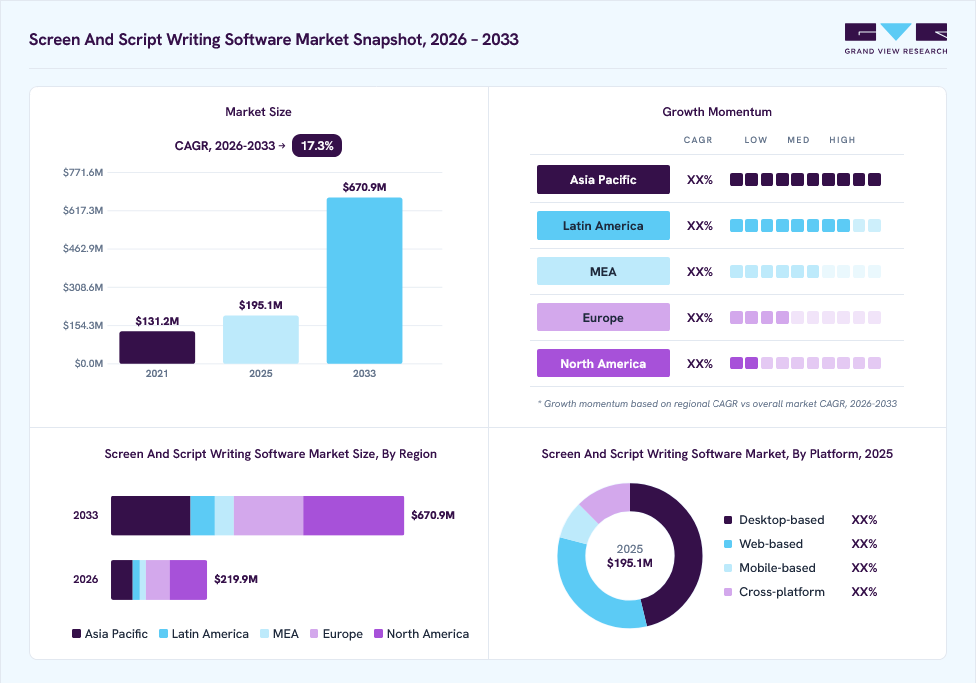
The global screen and script writing software market size was valued at USD 195.1 million in 2025 and is projected to grow from USD 219.9 million in 2026 to USD 670.9 million by 2033, at a CAGR of 17.3% from 2026 to 2033. The market in North America dominated with a revenue share of 39.6% in 2025. The market is driven by the growing demand for digital content production, expanding adoption of cloud-based collaborative writing tools, and increasing production of films, television, streaming, gaming, and other multimedia content.
Key Market Trends & Insights
- By platform: Desktop-based segment held the largest market share of 46.2% in 2025.
- By deployment: Cloud segment held the largest market share of 62.5% in 2025.
- By pricing model: Subscription-based segment held the largest market share of 62.3% in 2025.
- By end user: Film & television production companies segment held the largest market share of 37.8% in 2025.
Regional Highlights
- Largest regional market: North America (39.6% revenue share, 2025)
- Fastest-growing regional market: Asia Pacific (highest CAGR, 2026-2033)
- By country: The U.S. held the largest market share in 2025
Market Size & Forecast
- Market size in 2025: USD 195.1 Million
- Estimated market size in 2026: USD 219.9 Million
- Projected market size by 2033: USD 670.9 Million
- CAGR (2026-2033): 17.3%
The market is primarily driven by the rapid expansion of digital content production across films, television, OTT platforms, online video, gaming, podcasts, advertising, and other multimedia formats. The growing volume of original content being commissioned by studios, production houses, independent creators, and streaming platforms is increasing the need for specialized tools that streamline screenplay formatting, story development, script organization, revision tracking, and production planning.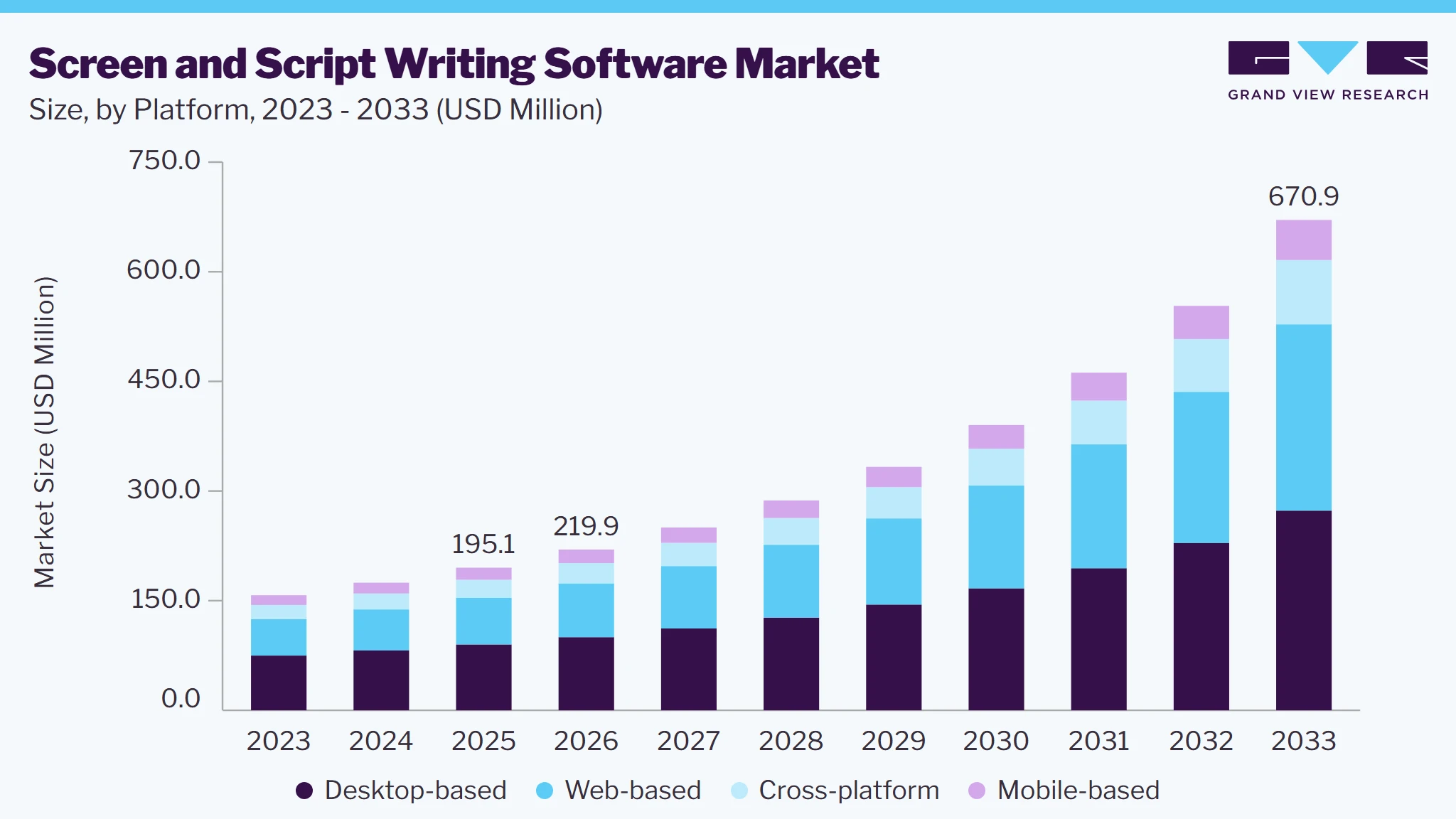
The increasing adoption of cloud-based and collaborative writing platforms is another major growth driver. Modern screenwriting and scriptwriting software enables multiple writers, editors, producers, and other stakeholders to work on the same project, share feedback, manage revisions, and access scripts remotely. This supports distributed creative teams and improves workflow efficiency throughout the script development process.
In addition, the emergence of AI-powered writing and productivity capabilities is supporting market growth. Features such as idea generation, dialogue assistance, grammar and style suggestions, script analysis, character development, automated formatting, and content organization can help writers accelerate parts of the creative process. For instance, in April 2026, Google Cloud and Emtek Group announced an expanded collaboration to develop a Studio of the Future that uses generative AI across media and entertainment production. The initiative includes an exploration of Enterprise Knowledge Graph technology to enrich scriptwriting workflows, highlighting the growing integration of AI into storytelling and script development.
Market Dynamics
The market is driven by the growing digitization and professionalization of script development across film, television, streaming, advertising, gaming, podcasts, and other content formats. Screenwriters, production companies, studios, and independent creators are increasingly adopting specialized software to standardize screenplay formatting, organize story elements, manage revisions, coordinate feedback, and improve efficiency throughout the pre-production process. The integration of cloud computing, artificial intelligence (AI), natural language processing, collaboration tools, mobile accessibility, and production management capabilities is further expanding the functionality of screen- and scriptwriting platforms beyond basic text editing.
The expanding volume and diversity of professionally produced content are driving demand for specialized screenwriting and scriptwriting software. Studios, production houses, independent filmmakers, advertising agencies, game developers, and digital content creators require tools that can simplify screenplay formatting, character and scene organization, revision management, version control, and script breakdown. Unlike conventional word-processing applications, dedicated screenwriting platforms are designed around industry-specific formats and workflows, enabling writers and creative teams to manage complex scripts more efficiently. The growing participation of independent creators and smaller production teams is also broadening the addressable user base for accessible and subscription-based screenwriting software.
The widespread availability of free screenplay templates, open-source applications, basic scriptwriting tools, and general-purpose word-processing software may limit the adoption of premium screenwriting and scriptwriting platforms. Individual writers, students, and independent creators with limited budgets may rely on conventional writing applications rather than investing in specialized software. In addition, some users may perceive advanced capabilities such as collaboration, production planning, analytics, or AI assistance as unnecessary during the early stages of script development. This creates pricing pressure on software vendors and requires providers to demonstrate clear advantages in productivity, workflow, and collaboration over lower-cost alternatives.
A significant opportunity exists for software providers to expand beyond standalone scriptwriting functionality and to develop integrated platforms that support the broader content development and pre-production lifecycle. Platforms can increasingly combine scriptwriting with story development, character management, research, budgeting, scheduling, script breakdown, production planning, rights management, version control, and secure collaboration. Such integration can create a centralized environment for writers, producers, directors, script editors, and production teams, reducing the need to transfer information across multiple disconnected applications. The growing importance of protecting unpublished scripts and intellectual property also creates opportunities for secure cloud storage, access controls, audit trails, digital rights management, and controlled content-sharing capabilities.
Analyst Perspective
The market is expected to evolve from a niche category focused primarily on screenplay formatting toward a broader ecosystem supporting digital content development and pre-production workflows. Software providers are likely to differentiate themselves through deeper integration with production management systems, cloud collaboration environments, content libraries, and intellectual property management tools. As content creation becomes increasingly decentralized, demand is expected to grow for platforms that enable writers and creative teams to securely access, edit, review, and manage projects across locations and devices.
Platform Insights
The desktop-based segment dominated the market, accounting for 46.2% of revenue in 2025, driven by the continued need for dedicated writing environments that provide comprehensive screenplay formatting, offline accessibility, advanced editing capabilities, and compatibility with professional production workflows. Professional writers and production teams often require feature-rich interfaces to manage lengthy scripts, character databases, scene structures, revisions, and detailed formatting without relying on continuous internet connectivity. The ability to integrate with local storage, peripherals, and established desktop production workflows further supports adoption among users handling complex or sensitive projects.
The cross-platform segment is anticipated to grow at a significant CAGR during the forecast period, driven by the increasing need to access and manage scripts across Windows, macOS, tablets, and other devices throughout the content-development process. Writers and creative teams frequently move between home, studio, production locations, and travel environments, creating demand for software that maintains consistent functionality and project data across operating systems. Cross-platform compatibility also broadens software accessibility for organizations with heterogeneous IT environments and reduces the need to standardize all users on a single operating system.
Deployment Insights
The cloud segment dominated the market, accounting for 62.5% of revenue in 2025 as screenwriting workflows became increasingly distributed and required continuous access to project files, revisions, feedback, and shared resources. Cloud-based platforms enable writers, editors, producers, and other stakeholders to work on current script versions from different locations while simplifying file synchronization, backup, and centralized project management. This deployment model also allows vendors to deliver software updates and new capabilities without requiring users to manually install major upgrades, supporting faster adoption of evolving functionality.
The on-premises segment is anticipated to grow at a significant CAGR during the forecast period, supported by production organizations that prioritize direct control over confidential scripts, intellectual property, user access, and internal IT infrastructure. Studios and established production companies may prefer keeping sensitive creative assets within their controlled environments to comply with internal security policies, contractual requirements, and content-protection practices. On-premises installations can also provide greater control over software configuration, integration with existing enterprise systems, and access management, particularly for organizations operating mature internal technology infrastructures.
Pricing Model Insights
The subscription-based segment dominated the market, accounting for 62.3% of revenue in 2025, driven by the preference for predictable software expenditure and continuous access to evolving screenwriting functionality. Subscription models allow users to obtain regular feature enhancements, technical support, cloud capabilities, collaboration functions, and security updates without purchasing major software upgrades separately. For production companies managing multiple writers or projects, subscription licensing can also provide greater flexibility in scaling user counts and software capabilities to meet project requirements.
The freemium segment is expected to grow at a significant CAGR during the forecast period, driven by the large population of aspiring screenwriters, students, independent creators, and occasional users seeking to begin writing without high upfront costs. Vendors can provide basic screenplay formatting and writing capabilities at no charge while reserving advanced features such as collaboration, analytics, additional templates, cloud storage, or production tools for paid tiers. This model lowers barriers to entry, enables users to evaluate the software before purchasing, and creates a broad conversion pipeline as writers' projects and professional requirements become more sophisticated.
End User Insights
The film & television production companies segment dominated the market, accounting for 37.8% of revenue in 2025, driven by the increasing complexity of professional content-development workflows and the need to coordinate writers, producers, directors, script editors, and other stakeholders around standardized script documents. Production companies require capabilities such as version control, revision tracking, script formatting, scene organization, collaboration, and script breakdown to efficiently manage multiple projects and successive drafts. Specialized software can therefore reduce administrative effort and improve consistency between the creative development stage and downstream production activities.
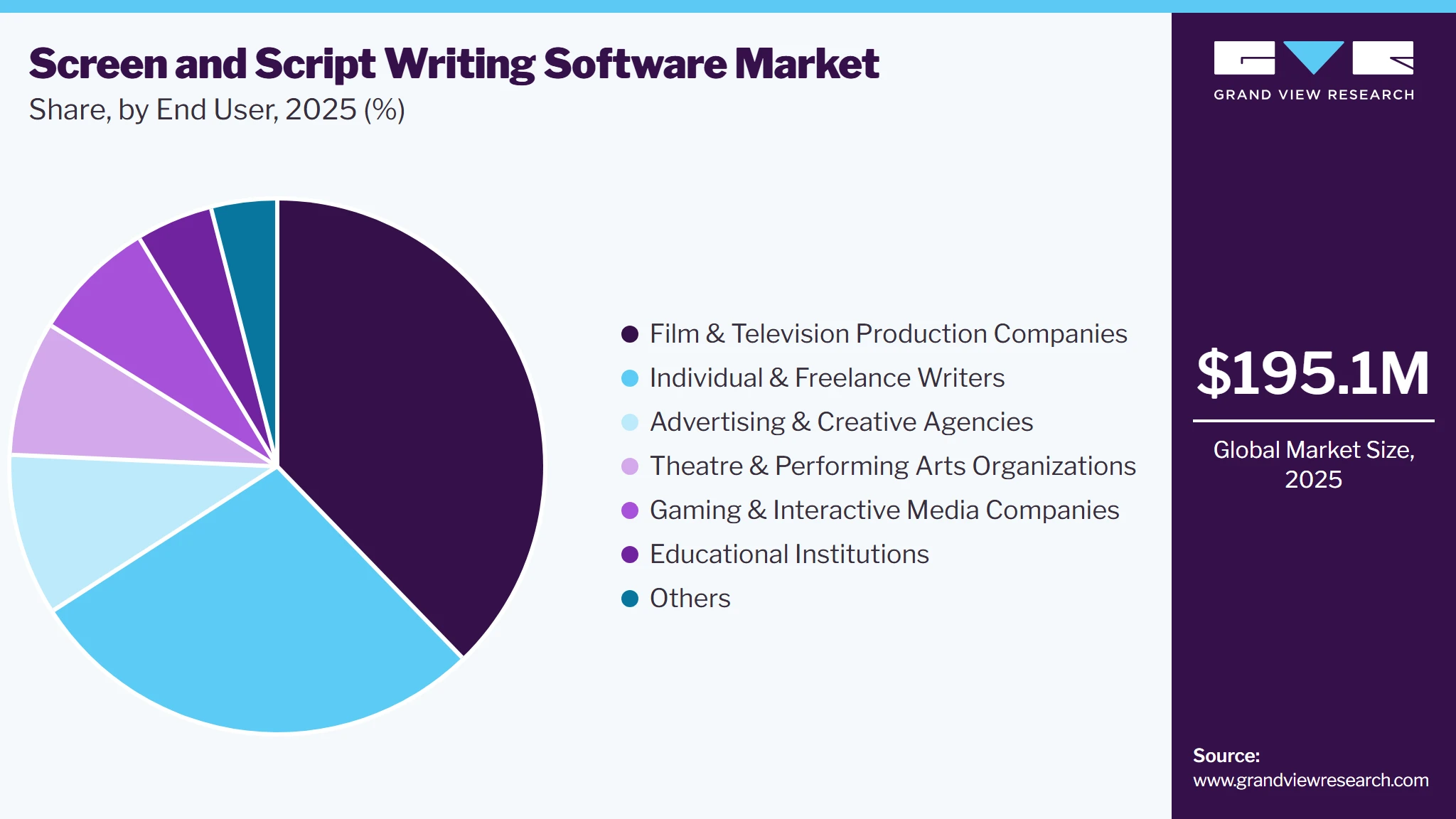
The individual & freelance writers segment is expected to grow at a significant CAGR over the forecast period, driven by the expansion of independent filmmaking, self-produced digital content, and opportunities to pitch scripts to studios, streaming platforms, and production companies. Dedicated software helps these users produce industry-standard screenplays, manage multiple projects, develop stories systematically, and present professionally formatted work to potential buyers or collaborators. Affordable plans and accessible software are particularly important for this segment because many independent writers operate without dedicated production or technical support.
Regional Insights
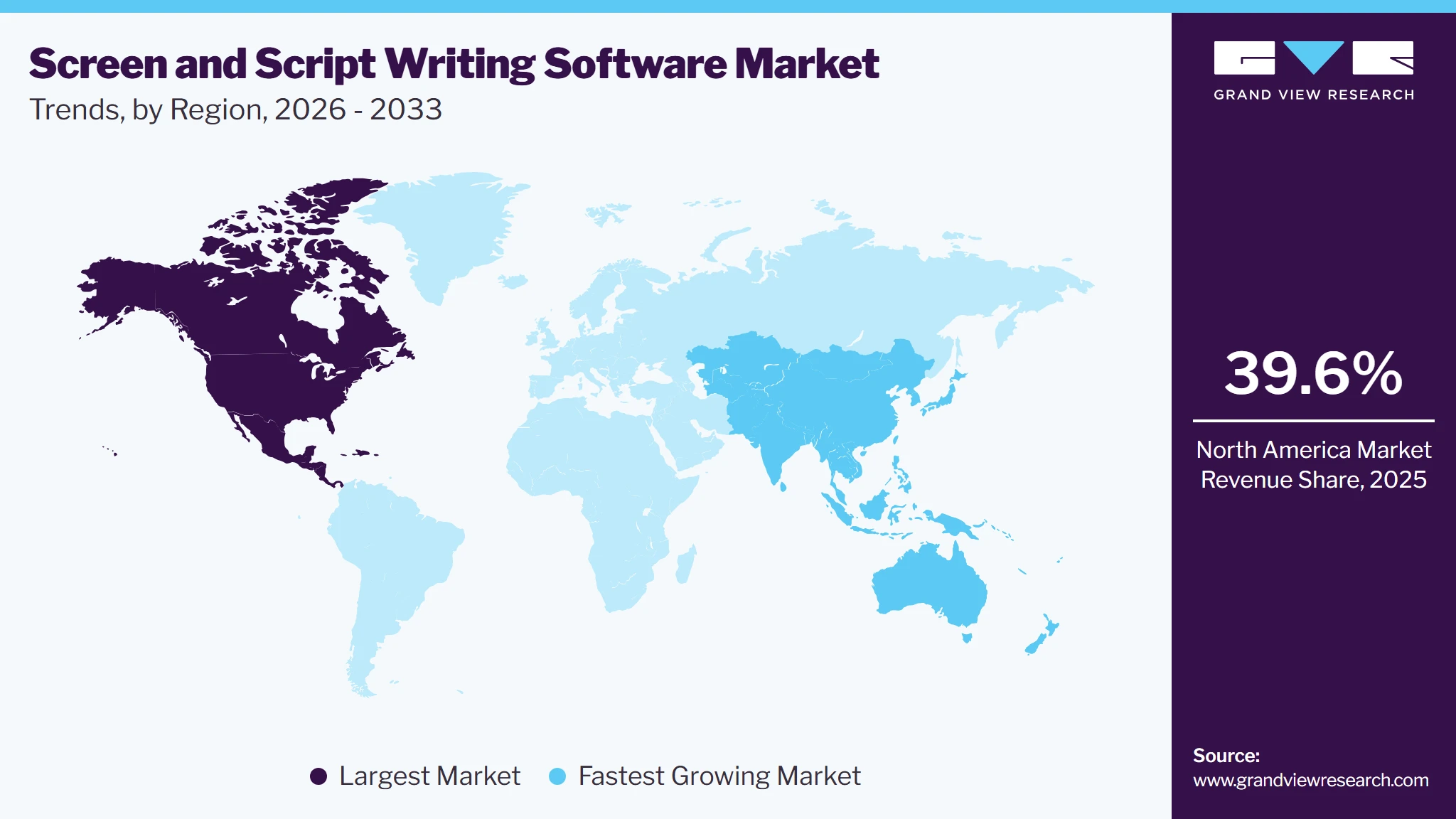
North America dominated the global market, with the largest revenue share of 39.6% in 2025, driven by its large, mature film, television, streaming, advertising, and digital media ecosystem, which generates sustained demand for professional script-development tools. The concentration of major studios, production companies, streaming platforms, and independent creators creates a broad user base requiring specialized solutions for screenplay development, formatting, revision management, and pre-production coordination.
U.S. Screen and Script Writing Software Market Trends
The screen and script writing software market in the U.S. is expected to grow significantly at a CAGR of 15.2% from 2026 to 2033, driven by Hollywood's scale and the country’s extensive production ecosystem, including major film studios, television networks, streaming services, and independent production houses.
Europe Screen and Script Writing Software Market Trends
The screen and script writing software market in Europe is anticipated to grow considerably from 2026 to 2033, driven by the expansion of locally produced audiovisual content and the increasing cross-border distribution of European films and television programs. Public funding mechanisms, national film institutions, broadcasters, and streaming platforms are supporting content development across multiple European markets, creating demand for digital tools to help creative teams develop, manage, and standardize scripts in multilingual, geographically dispersed production environments.
The UK screen and script writing software market is expected to grow rapidly in the coming years, owing to the established film and television production industry and strong international production activity. The presence of major studios, broadcasters, streaming productions, and a large community of professional screenwriters supports demand for specialized software, particularly tools that facilitate script development, professional formatting, revisions, and collaboration throughout complex production processes.
The screen and script writing software market in Germany held a substantial share in 2025 due to the country’s robust television, film, and media production ecosystem, including public-service broadcasters, commercial media companies, production houses, and independent filmmakers.
Asia Pacific Screen and Script Writing Software Market Trends
The screen and script writing software market in the Asia Pacific region is expected to grow at the highest CAGR over the forecast period, driven by the rapid growth of regional streaming ecosystems and the increasing production of localized original entertainment content. Expanding OTT platforms, rising digital video consumption, and growing investments in regional-language films and series are creating a larger pool of professional and independent creators who require software for structured story development, screenplay preparation, and management of increasingly sophisticated content-production workflows.
Japan screen and script writing software market is expected to grow rapidly in the coming years, driven by the country's well-established anime, film, television, and gaming industries, where structured storytelling and script development are integral to content creation. The convergence of traditional entertainment production with digital distribution and multimedia franchises is increasing the need for specialized software to organize complex narratives, character information, scenes, and iterative script development across different content formats.
The screen and script writing software market in China held a substantial market share in 2025, due to the rapid expansion of domestic digital entertainment and the scale of online video and streaming content production. Large domestic platforms and production companies are increasingly producing original films, television programs, web series, and other audiovisual content, creating substantial demand for digital tools to improve screenplay development, project organization, and coordination among large creative teams.
Key Company Insights
Key players operating in the screen and script writing software industry are Cast & Crew, Celtx Inc., Microsoft, STUDIOBINDER INC., and Literature & Latte Ltd. The companies are focusing on various strategic initiatives, including new product development, partnerships & collaborations, and agreements to gain a competitive advantage over their rivals. The following are some instances of such initiatives.
-
In October 2025, Literature & Latte released Scrivener 3.5 for macOS, introducing full compatibility with macOS 26 Tahoe along with multiple bug fixes and performance enhancements. The company subsequently released versions 3.5.1 and 3.5.2 in November and December 2025 to address additional issues and improve compatibility with macOS updates.
-
In April 2025, Celtx announced the launch of its Screenplay Plugin for Adobe Premiere Pro, enabling editors to import Celtx screenplay data into Premiere Pro and automatically organize scenes, dialogue, and project assets. The integration connects script development and post-production by allowing editors to build project structures and rough cuts directly from screenplay information, streamlining editing workflows, reducing preparation time, and improving coordination between script and production teams.
Key Screen And Script Writing Software Companies
The following key companies have been profiled for this study on the screen and script writing software market:
-
Arc Studio
-
Cast & Crew
-
Celtx Inc.
-
Fade In LLC
-
KIT Scenarist LLC
-
Literature & Latte Ltd.
-
Microsoft
-
Outerframe Studio
-
Slugline
-
Storyist Software L.L.C.
-
STUDIOBINDER INC.
-
The Quote-Unquote Company
-
Trelby developers
-
Ulysses GmbH & Co. KG
-
Write Brothers Inc.
Competitive Benchmarking
Category
Operating Strategies
Competitive Edge
Weakness
Established Players (Cast & Crew, Celtx Inc., Microsoft, STUDIOBINDER INC., and Literature & Latte Ltd.)
- Invest in advanced screenwriting, story-development, cloud collaboration, screenplay formatting, production planning, AI-assisted writing, script breakdown, and workflow-management capabilities.
- Expand product ecosystems through integrations with video-production, editing, scheduling, and other media-production platforms while strengthening subscription and cloud-based offerings.
- Strong brand recognition, established user communities, and extensive customer bases spanning professional screenwriters, production companies, studios, independent creators, and other media professionals.
- Broad functionality covering screenplay formatting, story organization, collaboration, production planning, project management, and cross-device access.
- Higher subscription or licensing costs for advanced features can limit adoption among students, aspiring writers, and budget-conscious independent creators. Broad feature sets may also create greater complexity for users seeking simple writing tools.
- Established platforms can face challenges in adapting legacy workflows rapidly to emerging AI-powered writing technologies.
Emerging Players (Fade In LLC, Outerframe Studio, Storyist Software L.L.C., Write Brothers Inc.)
- Focus on specialized screenplay and creative-writing applications emphasizing professional formatting, intuitive interfaces, offline writing, story organization, and streamlined script-development workflows.
- Differentiate through responsive product development, niche functionality, competitive pricing, and compatibility with specific operating systems and writer preferences.
- Greater flexibility in addressing specialized writer requirements and the ability to maintain focused, streamlined products without the complexity of broader production-management suites.
- Competitive pricing, lightweight interfaces, and professional screenplay-formatting capabilities can appeal to independent writers and smaller creative teams.
- Smaller customer bases and lower brand visibility compared with established platforms can constrain market penetration. Limited financial and technical resources may restrict investment in advanced AI, cloud infrastructure, collaboration capabilities, and integrations.
- Dependence on relatively narrow product portfolios can also increase vulnerability to competition from multifunctional platforms.
Screen And Script Writing Software Market Report Scope
Report Attribute
Details
Market size in 2025
USD 195.1 million
Estimated market size in 2026
USD 219.9 million
Projected market size by 2033
USD 670.9 million
Growth rate
CAGR of 17.3% from 2026 to 2033
Actual data
2021 - 2025
Forecast period
2025 - 2033
Quantitative units
Revenue in USD million and CAGR from 2026 to 2033
Report coverage
Revenue forecast, company share, competitive landscape, growth factors, and trends
Segments covered
Platform, deployment, pricing model, end user, region
Regional scope
North America; Europe; Asia Pacific; Latin America; MEA
Country scope
U.S.; Canada; Mexico; UK; Germany; France; China; India; Japan; Australia; South Korea; Brazil; UAE; Saudi Arabia; South Africa
Key companies profiled
Arc Studio; Cast & Crew; Celtx Inc.; Fade In LLC; KIT Scenarist LLC; Literature & Latte Ltd.; Microsoft; Outerframe Studio; Slugline; Storyist Software L.L.C.; STUDIOBINDER INC.; The Quote-Unquote Company; Trelby developers; Ulysses GmbH & Co. KG; Write Brothers Inc.
Customization scope
Free report customization (equivalent to 8 analysts working days) with purchase. Addition or alteration to country, regional & segment scope.
Pricing and purchase options
Avail customized purchase options to meet your exact research needs. Explore purchase options
Global Screen And Script Writing Software Market Report Segmentation
This report forecasts revenue growth at the global, regional, and country levels and provides an analysis of the latest industry trends in each of the sub-segments from 2021 to 2033. For this study, Grand View Research has segmented the global screen and script writing software market report based on platform, deployment, pricing model, end user, and region:
-
Platform Outlook (Revenue, USD Million, 2021 - 2033)
-
Desktop-based
-
Web-based
-
Mobile-based
-
Cross-platform
-
-
Deployment Outlook (Revenue, USD Million, 2021 - 2033)
-
Cloud
-
On-premises
-
-
Pricing Model Outlook (Revenue, USD Million, 2021 - 2033)
-
Subscription-based
-
Perpetual License
-
Freemium
-
-
End User Outlook (Revenue, USD Million, 2021 - 2033)
-
Individual & Freelance Writers
-
Film & Television Production Companies
-
Theatre & Performing Arts Organizations
-
Advertising & Creative Agencies
-
Gaming & Interactive Media Companies
-
Educational Institutions
-
Others
-
-
Regional Outlook (Revenue, USD Million, 2021 - 2033)
-
North America
-
U.S.
-
Canada
-
Mexico
-
-
Europe
-
UK
-
Germany
-
France
-
-
Asia Pacific
-
China
-
India
-
Japan
-
South Korea
-
Australia
-
-
Latin America
-
Brazil
-
-
Middle East & Africa
-
UAE
-
Saudi Arabia
-
South Africa
-
-
Research Methodology
The screen and script writing software market figures in this report are based on a proven research process that combines executive interviews with secondary research from proprietary databases, company filings, and recognized regulatory and institutional sources. Market size is built through value-chain sizing-reconciling supply-side and demand-side estimates-and triangulated with bottom-up and top-down approaches. Every estimate passes multiple levels of expert validation before publication, with each screen and script writing software segment quantified using the revenue-capture definitions in the table below.
Segment Definition
Platform
Revenue capture definition
Desktop-based
Market value captured through software licenses, subscriptions, upgrades, and other software-related fees attributable to desktop-based screen and script writing applications.
Web-based
Market value captured through subscriptions, licenses, usage fees, and other charges for browser-accessible screen and script writing platforms.
Mobile-based
Market value captured through paid application purchases, subscriptions, in-app purchases, and other fees generated by mobile screen and script writing applications.
Cross-platform
Market value captured through subscriptions, licenses, and other software fees for solutions providing screen and script writing functionality across multiple operating systems or device types.
Deployment
Revenue capture definition
Cloud
Market value captured through recurring subscriptions, usage-based charges, storage fees, and other software revenue attributable to cloud-hosted screen and script writing solutions.
On-premises
Market value captured through perpetual licenses, installation fees, maintenance contracts, upgrades, and other charges attributable to locally deployed screen and script writing software.
Pricing Model
Revenue capture definition
Subscription-based
Market value captured through recurring subscription payments for access to software features, updates, cloud services, collaboration capabilities, and related functionality.
Perpetual License
Market value captured through one-time software license fees, including applicable upgrade, maintenance, or support charges attributable to perpetual-license products.
Freemium
Market value captured only from paid upgrades, premium subscriptions, additional features, or other monetized services purchased by freemium users. Free access itself is not included as market revenue.
End User
Revenue capture definition
Individual & Freelance Writers
Market value captured from software licenses, subscriptions, and related fees paid by individual and freelance users.
Film & Television Production Companies
Market value captured from software licenses, subscriptions, enterprise plans, and related services purchased by film and television production organizations.
Theatre & Performing Arts Organizations
Market value captured from software licenses, subscriptions, and related fees paid by theatre and performing arts organizations.
Advertising & Creative Agencies
Market value captured from software licenses, subscriptions, team plans, and related services purchased by advertising and creative agencies.
Gaming & Interactive Media Companies
Market value captured from software licenses, subscriptions, enterprise plans, and related fees paid by gaming and interactive media companies.
Educational Institutions
Market value captured from institutional licenses, education subscriptions, volume licenses, and other software fees paid by educational institutions.
Others
Market value captured from licenses, subscriptions, enterprise plans, and other software-related fees paid by users falling outside the defined end-user categories.
Estimation Model
Layer
Question
Analysis
Content Creation & Script Development Layer
Where is screen and script writing software required?
Identify content-development environments where writers and creative professionals require specialized tools for screenplay creation, script formatting, story development, dialogue writing, character development, scene organization, revisions, and script management. This layer evaluates film and television production, streaming content, theatre, advertising, gaming, educational content, and independent creative production, where structured script-development workflows are required to transform concepts and narratives into production-ready scripts.
Screen & Script Writing Technology Layer
What enables screen and script writing workflows?
Assess the technologies and software capabilities supporting script development, including screenplay formatting engines, story-development tools, character and scene management, script templates, revision tracking, version control, cloud storage, collaboration features, AI-assisted writing, natural language processing, synchronization, mobile access, and integrations with production-management and editing applications. Effective implementation depends on intuitive interfaces, industry-standard formatting, interoperability, data security, reliable synchronization, and the ability to manage complex scripts and multiple versions.
Software Application & Deployment Layer
How are screen and script writing capabilities delivered to users?
Analyze the delivery models and applications through which screen and script writing functionality is provided, including desktop-based, web-based, mobile-based, and cross-platform solutions, as well as cloud and on-premises deployments. Providers deliver capabilities through standalone writing applications, browser-based platforms, mobile applications, collaborative workspaces, AI writing assistants, script breakdown tools, production integrations, and APIs.
Screen & Script Writing Solutions & Enterprise Economics Layer
How is value generated within the connected-worker ecosystem?
Evaluate revenue generated through software subscriptions, perpetual licenses, freemium upgrades, premium features, enterprise plans, cloud services, collaboration capabilities, and related support or maintenance services. Additional value is generated through improved screenplay formatting, faster content development, reduced revision and administrative effort, streamlined collaboration, centralized script management, improved version control, standardized workflows, and integration with broader pre-production and media-production processes.
Delivered Customization
This report has been delivered with the following In-depth customizations
Client Request
Customization Delivered
Value Adds
Screen & Script Writing Software Technology Integration & Content Creation Trends
Analyzed screen and script writing technologies, including screenplay formatting, cloud collaboration, AI-assisted writing, story development, character and scene management, version control, mobile access, and integrations with production software.
Evaluated the adoption of AI, cloud computing, cross-platform access, and digital collaboration across script-development workflows.
Helps identify technology and software integration opportunities within the screen and script writing ecosystem.
Provides insights into the evolution of traditional screenplay tools toward AI-enabled, collaborative, and integrated content-development platforms.
Screen & Script Writing, AI-Assisted Content Development & Creative Workflow Trends
Evaluated adoption of screenwriting and script-development solutions across film and television, streaming, theatre, advertising, gaming, and independent content creation.
Assessed AI-assisted writing, automated formatting, story development, collaboration, script analysis, and digital workflow capabilities.
Highlights emerging screenwriting technologies and digital content-development opportunities.
Enables understanding of the convergence of AI, cloud platforms, collaborative writing, and automated script-development capabilities.
Screen & Script Writing Software Application & Enterprise Opportunity Assessment
Assessed key applications across individual and freelance writers, film and television production companies, theatre and performing arts organizations, advertising and creative agencies, gaming and interactive media companies, and educational institutions.
Supports identification of high-growth end-user segments, platforms, deployment models, and pricing structures.
Helps prioritize opportunities for screenwriting software vendors, production technology providers, and media-technology companies.
Frequently Asked Questions About This Report
Key factors include the growing demand for digital content production, expanding adoption of cloud-based collaborative writing tools, and increasing production of films, television, streaming, gaming, and other multimedia content.
North America dominated with 39.6% revenue share in 2025.
Asia Pacific is the fastest-growing region over the forecast period.
The cloud segment led with a 62.5% revenue share in 2025.
The film & television production companies segment held the largest share (over 37.0%) in 2025, while individual & freelance writers segment is the fastest-growing segment.
Key players operating in the screen and script writing software market include Arc Studio, Cast & Crew, Celtx Inc., Fade In LLC, KIT Scenarist LLC, Literature & Latte Ltd., Microsoft, Outerframe Studio., Slugline, Storyist Software L.L.C., STUDIOBINDER INC., The Quote-Unquote Company, Trelby developers, Ulysses GmbH & Co. KG, Write Brothers Inc.
The subscription-based segment led with a 62.3% revenue share in 2025, while the freemium segment is the fastest-growing.
The global screen and script writing software market size was valued at USD 195.1 million in 2025 and is estimated at USD 219.9 million for 2026.
The global screen and script writing software market is expected to grow at a CAGR of 17.3% from 2026 to 2033, reaching USD 670.9 million by 2033.
The desktop-based segment led with a 46.2% revenue share in 2025, while the web-based segment is the fastest-growing segment.
About the Author(s)
Digital Media Research Team
Technology · Digital MediaThis report was authored by the digital media research team at Grand View Research - comprising two research analysts, one senior research analyst, and one industry expert - with specialized expertise in the digital media segment of the technology industry. All findings are based on proprietary technology databases, executive interviews, and regulatory analysis, subject to internal peer review prior to publication.
Last Updated:
Speak to Analyst


Customize this report to your needs — add regions, segments, or data points, with 20% free customization.
Or view our licence options:


ISO 9001:2015 & 27001:2022 Certified
We are GDPR and CCPA compliant! Your transaction & personal information is safe and secure. For more details, please read our privacy policy.


