
- Home
- »
- Automotive & Transportation
- »
-
Self-Storage Market Size And Share Report, 2026-2033GVR Report cover

Self-storage Market (2026 - 2033)
Size, Share & Trends Analysis Report By Unit Size (Small, Medium, Large), By Application (Personal, Business), By Region (North America, Europe, Asia Pacific, Latin America, Middle East and Africa (MEA)), And Segment Forecasts
Market Size, 2025
$61.7BMarket Estimate, 2026
$64.7BMarket Forecast, 2033
$104.8BCAGR, 2026–2033
7.1%Self-storage Market Summary
The global self-storage market size was estimated at USD 61.7 billion in 2025 and is projected to grow from USD 64.7 billion in 2026 to USD 104.8 billion by 2033, growing at a CAGR of 7.1% from 2026 to 2033. North America dominated the global market with the largest revenue share of 46.8% in 2025. Several factors are driving the growth of the global self-storage market, contributing to its expansion and increasing relevance in the real estate and logistics sectors.
 Source: Grand View Research, IR Documents, Primary Interviews, Paid DatabasesTo learn more about this report,
 Download Free Sample Report
Key Market Trends & Insights
- By unit size: Medium segment dominated the market, with a revenue share of 45.2% in 2025
- By application: Personal segment held the largest market share in 2025
Regional Highlights
- Largest regional market: North America (46.8% revenue share, 2025)
- Fastest-growing regional market: Asia Pacific (highest CAGR, 2026-2033)
- By country: The U.S. held the largest market share in 2025.
Market Size & Forecast
- Market size in 2025: USD 61.7 Billion
- Estimated market size in 2026: USD 64.7 Billion
- Projected market size by 2033: USD 104.8 Billion
- CAGR (2026-2033): 7.1%
Three ways to get this report
Buy it, customize it, or ask a question.Ask an Analyst
Analyst response in 1 business day
- AccessReport author, directly
- Reply timeWithin 1 working day
- No sales callDirect answer only
- FormatEmail reply
- CostFree, no cost
Get the Full Report
What the study covers
- FormatsPDF · Excel · Dashboard
- Timeline2026–2033 annual, 2025 base
- Coverage20+ countries, 5 regions
- Companies10+ key players profiled
Customize the Report
20% free customization
- IncludeCountries, segments, points
- TailorTo your product definition
- ExtendDeeper competitor detail
- OrA fully bespoke study
- Turnaround5–10 working days
These include urbanization & population growth and expansion of e-commerce and retail. Self-storage is a service offering secure and convenient storage units that individuals or businesses can rent whenever they require additional space for storing their belongings.Self-storage facilities are ideal for individuals and businesses seeking temporary or long-term storage solutions. Self-storage proves invaluable during relocation, offering a secure space to store belongings while people search for their new home or apartment. Additionally, it provides a haven for items that may not fit into a new residence. Self-storage is well-suited for businesses requiring additional space for inventory or equipment. Business owners can securely store items such as furniture and office supplies, ensuring these items do not occupy valuable workspace.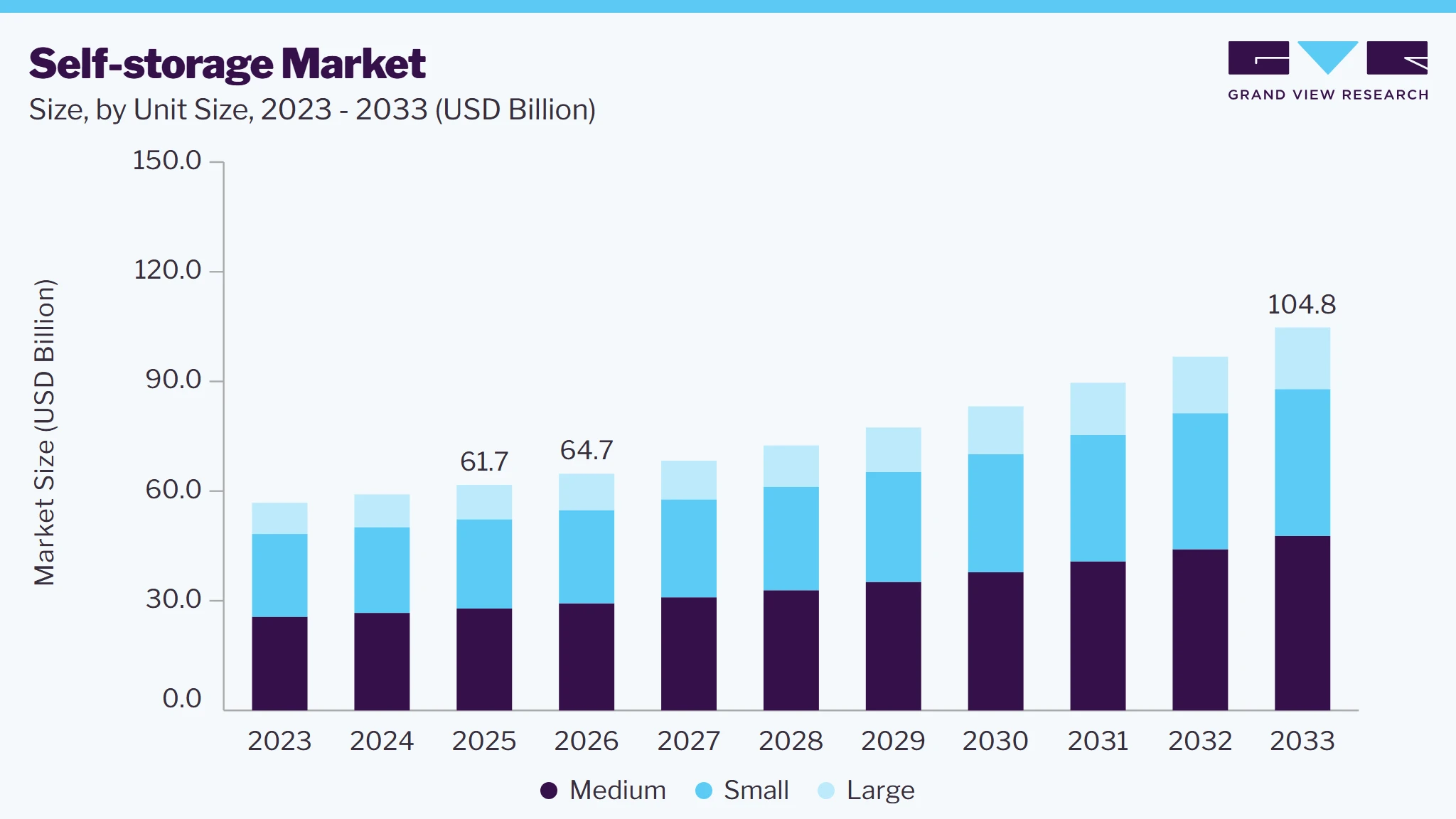 To learn more about this report, Download Free Sample Report
The self-storage sector is experiencing a significant trend toward improving customer convenience, highlighting a focus on delivering smooth user experiences. Facilities are investing more in intuitive websites and online platforms, enabling customers to conveniently book and manage their storage units remotely. Additionally, the implementation of contactless access options allows individuals to retrieve their belongings without physical contact, addressing safety considerations. These efforts are part of broader industry initiatives aimed at adapting to changing customer expectations and preferences.
Amid increasing environmental awareness, there is a heightened focus on sustainability within the self-storage sector. Facilities are integrating energy-efficient technologies such as Light Emitting Diode (LED) lighting and smart climate-control systems to reduce energy usage. Some are also investigating renewable energy options, such as solar panels, to support their operational needs. These sustainable practices are aimed at lowering the industry's carbon footprint, cutting utility costs, and potentially enhancing property valuations.
The growing adoption of technology is expected to present significant growth opportunities for the market. Companies are launching new technology solutions for the self-storage sector. For instance, in September 2023, Vantiva, a France-based company, announced the launch of Vantiva Smart Storage, a software-as-a-service solution for the self-storage sector, integrating Wi-Fi and Internet of Things (IoT) capabilities. This platform enhances operational efficiencies, reduces costs, and improves customer experiences by integrating various technologies and delivering actionable insights, aiming to modernize self-storage facilities into smart spaces.
Market Dynamics
The self-storage market is experiencing sustained expansion driven by structural shifts in urban living, changing consumer mobility patterns, and growing needs for space optimization among residential and commercial users. Macroeconomic factors such as urban densification, rising penetration of rental housing, and growth in small and medium-sized enterprises are reinforcing demand for flexible storage solutions. Technology adoption, including digital access control, automated facility management systems, and online reservation platforms, is improving operational efficiency and customer experience. Moreover, the market is transitioning toward professionally managed, technology-enabled facilities with diversified unit sizes and application-driven offerings.
Rapid urbanization has intensified pressure on residential and commercial real estate, resulting in reduced living and working spaces across major metropolitan areas. High property prices and shrinking unit sizes in urban housing markets have limited on-site storage availability for households, while businesses increasingly operate from compact offices or flexible workspaces. These structural constraints create a persistent need for external storage options that can accommodate seasonal items, excess inventory, or personal belongings without requiring relocation or property expansion.
Self-storage facilities directly address these challenges by offering scalable, off-site storage units that can be rented on flexible terms. Climate-controlled units, varied unit sizes, and proximity to urban centers enable users to manage space efficiently without long-term capital commitments. As urban density continues to rise, self-storage solutions serve as an extension of residential and commercial real estate, accelerating market growth through recurring rental demand.
The self-storage market faces constraints due to elevated land acquisition, construction, and regulatory compliance costs, particularly in prime urban locations. Zoning restrictions, permitting delays, and rising construction material prices increase upfront capital requirements for new facility development. These cost pressures can limit new supply additions and reduce return on investment, particularly for smaller operators or new entrants.
Downstream, high development costs disproportionately affect urban and high-growth metropolitan regions, where land scarcity is most pronounced. Operators may delay expansion plans or focus on secondary locations, slowing capacity growth in high-demand areas. This restraint moderates market expansion by constraining supply elasticity and increasing rental rates, which can impact price-sensitive personal storage segments.
The increasing integration of digital technologies presents a significant opportunity in the self-storage market. Advancements in cloud-based facility management software, mobile access systems, and automated payment platforms are enabling operators to streamline operations and enhance customer engagement. Growing consumer acceptance of self-service, contactless transactions further support the adoption of smart storage models.
This opportunity supports revenue growth through improved occupancy rates, dynamic pricing, and reduced operating costs. Operators with strong digital capabilities and scalable platforms are well positioned to capture demand across both personal and business segments. Facilities offering seamless online booking, remote monitoring, and enhanced security features are expected to gain a competitive advantage, particularly in developed markets.
Analyst Perspective
The self-storage market remains structurally resilient, supported by persistent space constraints, high residential mobility, and steady business storage demand. Technology adoption is reshaping facility operations through automation, remote access, and data-driven pricing strategies. Investment activity is increasingly directed toward modern, multi-story urban facilities and digitally enabled platforms that enhance asset utilization. Competitive dynamics are shifting toward consolidation, with larger operators leveraging scale and technology to expand regional footprints. Over the medium term, professionally managed and technology-integrated storage assets are expected to attract sustained capital inflows.
Unit Size Insights
Based on unit size, the medium segment led the market with the largest revenue share of 45.2% in 2025. The segment’s growth is attributed to the versatility and cost-effectiveness of the medium-sized self-storage units. Medium-sized units offer a balance between space and cost, making them versatile for a wide range of storage needs. They are ideal for storing household items, furniture, and business inventory, catering to both individual and business customers. Medium units provide a cost-effective storage solution for customers who need more space than small units but do not require the extensive capacity of large units. This makes them an attractive option for a wide range of customers.
The large segment is projected to witness the fastest CAGR of 6.6% from 2024 to 2030. The large segment’s growth is attributed to the convenience and security offered by them. Large units offer convenience by allowing customers to store all their items in one place rather than renting multiple smaller units. Enhanced security features at storage facilities also make these units appealing for storing valuable or bulky items. Moreover, large units are particularly attractive to businesses that need substantial space for storing inventory, equipment, or seasonal stock. As e-commerce and retail sectors expand, the demand for sizable storage solutions increases.
Application Insights
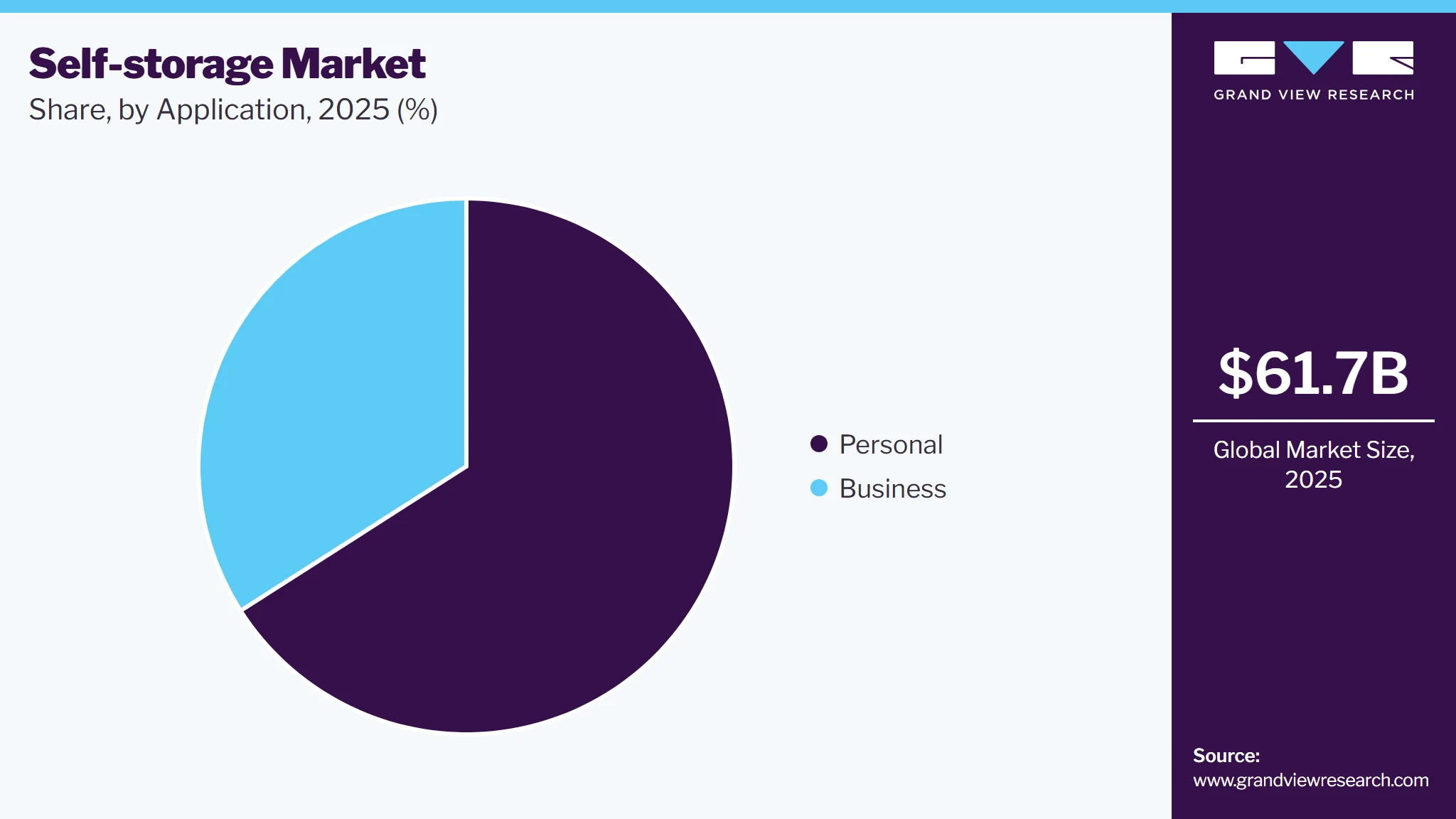
Based on application, the personal segment led the market with the largest revenue share of 65.9% in 2025. The factors contributing to the segment's growth include growing urbanization, a rise in smaller living spaces, and lifestyle changes. As more people move to urban areas, living spaces tend to be smaller, creating a need for additional storage solutions for personal belongings that can't fit in smaller apartments or homes. According to The World Bank Group, the percentage of the global urban population has grown from 52% in 2010 to 57% in 2023. Moreover, increased mobility, frequent relocations, and lifestyle changes such as downsizing, retirement, or divorce drive the demand for personal storage. People often need temporary storage during transitions.
 To learn more about this report, Download Free Sample Report
The business segment is projected to witness the fastest CAGR of 6.5% from 2024 to 2030. The expansion of the e-commerce sector is contributing to the growth of the segment. The rise of e-commerce has led to increased demand for storage space to manage inventory, packaging materials, and shipping supplies. Small and medium-sized businesses (SMBs) often turn to self-storage as a cost-effective solution for warehousing needs. Moreover, businesses benefit from the flexibility to scale their storage space up or down based on demand, allowing them to respond quickly to market changes without committing to long-term leases.
Regional Insights
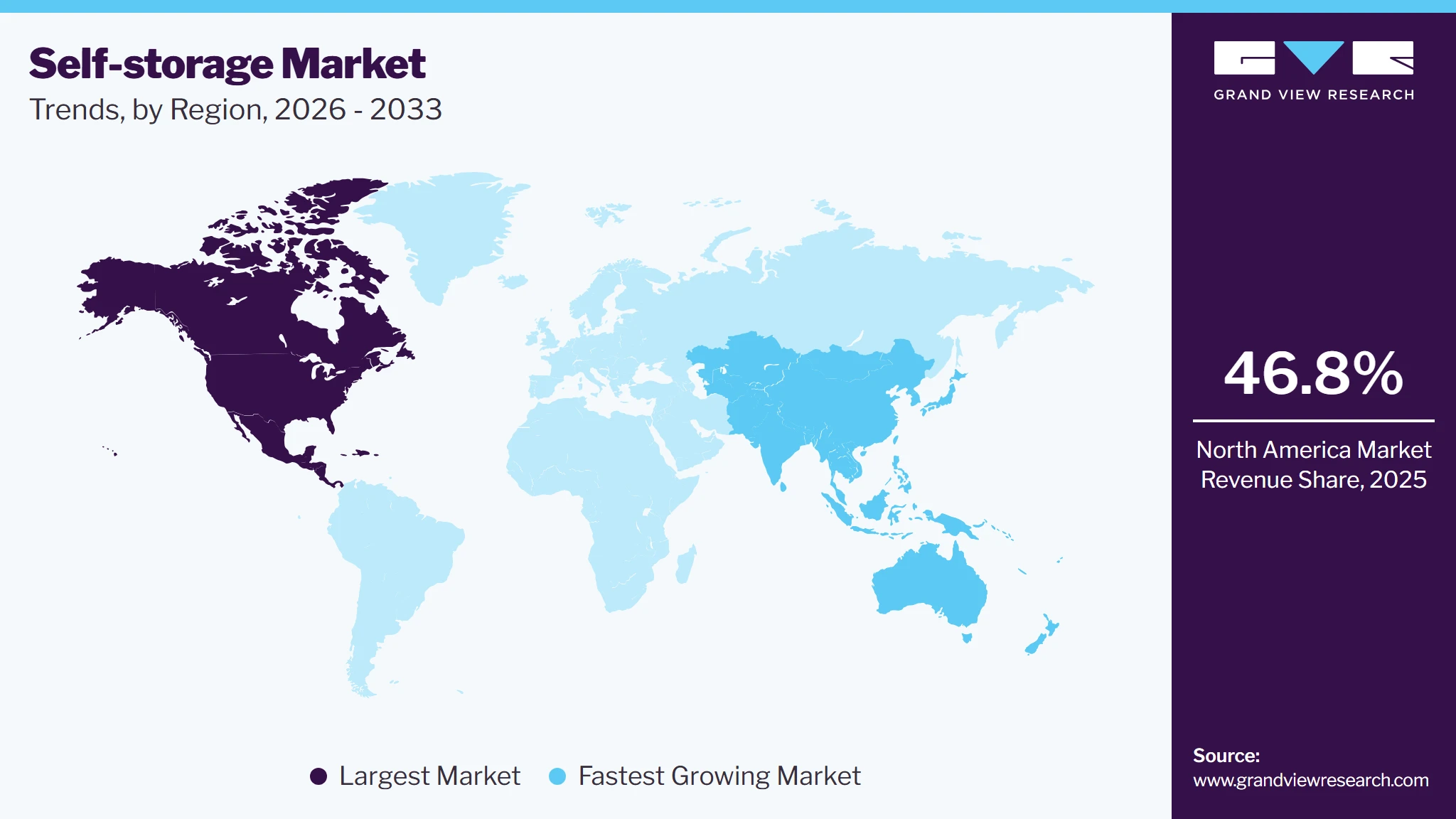
North America dominated the global self-storage market with the largest revenue share of 46.8% in 2025. An aging population and the growing integration of technology for self-storage units drive the market’s growth in the region. The aging population in North America often downsizes their living spaces, requiring storage for personal belongings they wish to keep but cannot accommodate in smaller homes or retirement communities. Moreover, the adoption of technology in self-storage operations, including online booking platforms, digital access controls, and security enhancements, improves customer convenience and satisfaction, driving market growth.
 To learn more about this report, Download Free Sample Report
U.S. Self-storage Market Trends
The self-storage market in the U.S. held the largest share in the North America region in 2025. Numerous self-storage providers, such as CubeSmart, Life Storage Inc., and Prime Storage, contribute to the market’s growth in the country. Moreover, high domestic migration rates within the country have led to an increase in demand for self-storage that aids in storing household items and swift relocation.
Asia Pacific Self-storage Market Trends
The self-storage market in Asia Pacific is expected to grow at the fastest CAGR of 7.1% from 2024 to 2030. Rapid urbanization and increasing population density in major cities across Asia Pacific lead to smaller living spaces, creating a need for external storage solutions for personal belongings and household items. Manila, Philippines; Mumbai, India; and Dhaka, Bangladesh, are among the cities with the highest population densities across the globe. Moreover, the significant expansion of e-commerce in the region leads to increased demand for storage space to manage inventory, packaging materials, and shipping supplies.
Europe Self-storage Market Trends
The self-storage market in Europe is expected to grow at a significant CAGR of 5.7% from 2024 to 2030. The presence of a significant expatriate population in major European cities drives demand for temporary storage solutions for personal belongings during relocations. According to Eurostat, in 2022, 5.1 million immigrants entered the European Union (EU) from non-EU countries, growing by 117% from 2021.
Key Self-storage Company Insights
Some of the key companies operating in the market include CubeSmart, Public Storage, Life Storage Inc., and Safestore, among others.
-
CubeSmart, headquartered in Pennsylvania, U.S., is a self-administered and self-managed Real Estate Investment Trust (REIT) specializing in owning, acquiring, operating, and developing self-storage facilities. It provides various storage unit sizes and types, including climate-controlled and outdoor options, prioritizing customer service and convenience with advanced facility technologies.
SmartStop Self Storage and Storage Giant are some of the emerging companies in the target market.
-
SmartStop Self Storage is a diversified real estate company specializing in self-storage assets. It operates as a self-administered and self-managed REIT. SmartStop Self Storage owns and operates a portfolio of self-storage facilities across the U.S. and Canada. They offer storage solutions for personal, business, and vehicle storage needs.
Key Self-storage Companies:
The following key companies have been profiled for this study on the self-storage market.
- CubeSmart
- Metro Storage LLC
- SmartStop Self Storage
- Life Storage Inc.
- Safestore
- W. P. Carey Inc.
- Public Storage
- Prime Storage
- Shurgard Self Storage
- Storage Giant
- Big Yellow Self Storage Company
Competitive Benchmarking
Category
Operating Strategies
Competitive Edge
Weakness
Established Players (Public Storage, CubeSmart, Life Storage Inc., Shurgard Self Storage)
- These players focus on large-scale facility portfolios, urban presence, and standardized operating models
- These players have strong brand recognition, geographic scale, pricing power, and access to capital
- High exposure to real estate cycles and regulatory constraints
Emerging Players (Prime Storage, SmartStop Self Storage, Safestore)
- These players are focused on expansion through acquisitions, secondary markets, and digital-first operations
- Agile expansion strategies and modernized facilities
- Limited scale compared to established operators and higher integration risk
Recent Developments
-
In April 2024, SmartStop Self Storage announced the acquisition of a self-storage facility in Colorado, U.S., spanning approximately 64,700 net rentable square feet. The facility consists of 20 single-story buildings with around 450 units and 100 parking spaces. It features 24-hour video surveillance, drive-up access, and climate-controlled office suites, serving the local communities and nearby military installations.
-
In November 2022, Storage Giant, a U.K.-based self-storage service provider, announced the launch of a new high-security storage facility, Bridgend. The Bridgend facility offers over 41,000 sq ft of domestic, personal, and business storage space. Over 600 storage rooms are available, with sizes ranging from 10 sq ft to 250 sq ft. The new storage facility is expected to help the company attract new customers and increase its market share in the U.K.
Self-storage Market Report Scope
Report Attribute
Details
Market size in 2025
USD 61.7 billion
Estimated market size in 2026
USD 64.7 billion
Projected market size by 2033
USD 104.8 billion
Growth rate
CAGR of 7.1% from 2026 to 2033
Base year for estimation
2025
Historical data
2021 - 2024
Forecast period
2026 - 2033
Quantitative units
Revenue in USD billion and CAGR from 2026 to 2033
Report coverage
Revenue forecast, company market share, competitive landscape, growth factors, and trends
Segments covered
Unit size, application, region
Regional scope
North America; Europe; North America; Latin America; MEA
Country scope
U.S.; Canada; Mexico; Germany; U.K.; France; China; Japan; India; South Korea; Australia; Brazil; Saudi Arabia; UAE; and South Africa
Key companies profiled
CubeSmart; Metro Storage LLC; SmartStop Self Storage; Life Storage Inc.; Safestore; W. P. Carey Inc.; Public Storage; Prime Storage; Shurgard Self Storage; Storage Giant
Customization scope
Free report customization (equivalent up to 8 analysts' working days) with purchase. Addition or alteration to country, regional & segment scope.
Pricing and purchase options
Avail customized purchase options to meet your exact research needs. Explore purchase options
Global Self-storage Market Report Segmentation
This report forecasts revenue growth at global, regional, and country levels and provides an analysis of the latest industry trends in each of the sub-segments from 2021 to 2033. For this study, Grand View Research has segmented the global self-storage market report based on unit size, application, and region.
-
Unit Size Outlook (Revenue, USD Million, 2021 - 2033)
-
Small
-
Medium
-
Large
-
-
Application Outlook (Revenue, USD Million, 2021 - 2033)
-
Personal
-
Business
-
-
Regional Outlook (Revenue, USD Million, 2021 - 2033)
-
North America
-
U.S.
-
Canada
-
Mexico
-
-
Europe
-
UK
-
Germany
-
France
-
-
Asia Pacific
-
India
-
China
-
Japan
-
South Korea
-
Australia
-
-
Latin America
-
Brazil
-
-
Middle East and Africa (MEA)
-
Kingdom of Saudi Arabia (KSA)
-
UAE
-
South Africa
-
-
Research Methodology
The self-storage market figures in this report are based on a proven research process that combines executive interviews with secondary research from proprietary databases, company filings, and recognized regulatory and institutional sources. Market size is built through value-chain sizing - reconciling supply-side and demand-side estimates - and triangulated with bottom-up and top-down approaches. Every estimate passes multiple levels of expert validation before publication, with each self-storage segment quantified using the revenue-capture definitions in the table below.
Segment Definition
Segment - Unit Size
Revenue capture definition
Small Revenue derived from compact units typically leased for personal belongings, seasonal items, documents, and small inventory, including short-term and month-to-month contracts.
Medium
Revenue derived from mid-sized units used for household moves, apartment storage, and small business inventory, including standard rentals and value-added services such as climate control.
Large
Revenue from large-capacity units catering to commercial users, equipment storage, bulk inventory, and long-term leases, often with higher monthly rates and extended contracts.
Segment - Application
Revenue capture definition
Personal
This segment includes revenue generated from individual consumers renting storage units for household goods, seasonal items, relocation-related storage, and lifestyle-driven space optimization.
Business
This segment captures revenue from commercial users utilizing self-storage facilities for inventory storage, document archiving, equipment holding, and operat
Estimation Model
Layer Name
Key Question
Description
Macro Demand Assessment
What structural factors generate demand?
This layer evaluates urbanization trends, housing density, consumer mobility, and SME growth influencing storage demand. It establishes the baseline addressable need for self-storage solutions.
Facility Supply Mapping
How much storage capacity exists?
This layer assesses the number of facilities, total rentable square footage, unit mix, and geographic distribution across regions. It reflects supply-side readiness and expansion capacity.
Utilization and Pricing Analysis
How effectively is capacity monetized?
Occupancy rates, average rental prices, and lease duration are analyzed to estimate realized revenue potential. This layer captures operational efficiency and pricing power.
Revenue Consolidation
What is the total market value?
Aggregated revenues from all unit sizes and applications are consolidated to estimate overall market size, adjusted for regional penetration and competitive intensity.
Delivered Customizations
This report has been delivered with the following In-depth customizations
Client Request
Customization Delivered
Value Adds
Regional Self-storage Market Opportunity Assessment
Country/region-wise market sizing and forecasts
Analysis of demand, adoption trends, and regulatory landscape
Identification of high-growth regions and investment hotspots
Identified region-specific growth opportunities
Supported expansion and go-to-market strategy
Enabled informed regional investment decisions
Cross-Segmentation Analysis for the Self-storage Market
Criss-cross market analysis by unit size and application
Demand and adoption assessment across key segments
Segment attractiveness and growth potential benchmarking
Identified high-potential market segments
Supported targeted product positioning and marketing strategy
Improved customer and segment prioritization
Competitive Benchmarking and Strategic Positioning in the Self-storage Market
Benchmarking of key competitors across products, pricing, partnerships, and innovation
Comparative assessment of market share, capabilities, and strategies
Analysis of competitive strengths, gaps, and differentiation areas
Identified competitive white spaces and growth gaps
Supported strategic positioning and differentiation
Enabled data-driven competitive strategy development
Frequently Asked Questions About This Report
The global self-storage market size was estimated at USD 61.7 billion in 2025 and is expected to reach USD 64.7 billion in 2026.
The global self-storage market is expected to grow at a compound annual growth rate of 7.1% from 2026 to 2033, reaching USD 104.8 billion by 2033.
Medium segment dominated the market, with a revenue share of 45.2% in 2025. The segment’s growth is attributed to the versatility and cost-effectiveness of the medium-sized self-storage units.
Some key players operating in the self-storage market include CubeSmart, Metro Storage LLC, SmartStop Self Storage, Life Storage Inc., Safestore, W. P. Carey Inc., Public Storage, Prime Storage, Shurgard Self Storage, Storage Giant, and Big Yellow Self Storage Company.
Several factors are driving the growth of the global self-storage market, contributing to its expansion and increasing relevance in the real estate and logistics sectors.
North America dominated the global market with the largest revenue share of 46.8% in 2025. An aging population and the growing integration of technology for self-storage units drive the market’s growth in the region.
The U.S. held the largest market share in 2025.
Personal segment held the largest market share of 65.9% in 2025, while business is the fastest growing segment.
The expansion of the e-commerce sector is contributing to the growth of the segment.
About the Author(s)
Automotive & Transportation Research Team
Technology · Automotive & TransportationThis report was authored by the automotive & transportation research team at Grand View Research - comprising two research analysts, one senior research analyst, and one industry expert - with specialized expertise in the automotive & transportation segment of the technology industry. All findings are based on proprietary technology databases, executive interviews, and regulatory analysis, subject to internal peer review prior to publication.
Last Updated:
Speak to Analyst

Customize this report to your needs - add regions, segments, or data points, with 20% free customization.
Or view our licence options:


ISO 9001:2015 & 27001:2022 Certified
We are GDPR and CCPA compliant! Your transaction & personal information is safe and secure. For more details, please read our privacy policy.


