
- Home
- »
- Pharmaceuticals
- »
-
Semi-Solid Dosage Drugs Market Size Report, 2026-2033GVR Report cover

Semi-Solid Dosage Drugs Market (2026 - 2033)
Size, Share & Trends Analysis Report By Application, (Antifungal Topicals (Single API), Corticosteroid Topicals (Single API)), By Distribution Channel, By Region (Semi-Solid Dosage Drugs Market), And Segment Forecasts
Market Size, 2025
$8.6BMarket Estimate, 2026
$9.1BMarket Forecast, 2033
$14.2BCAGR, 2026–2033
6.5%Semi-Solid Dosage Drugs Market Summary
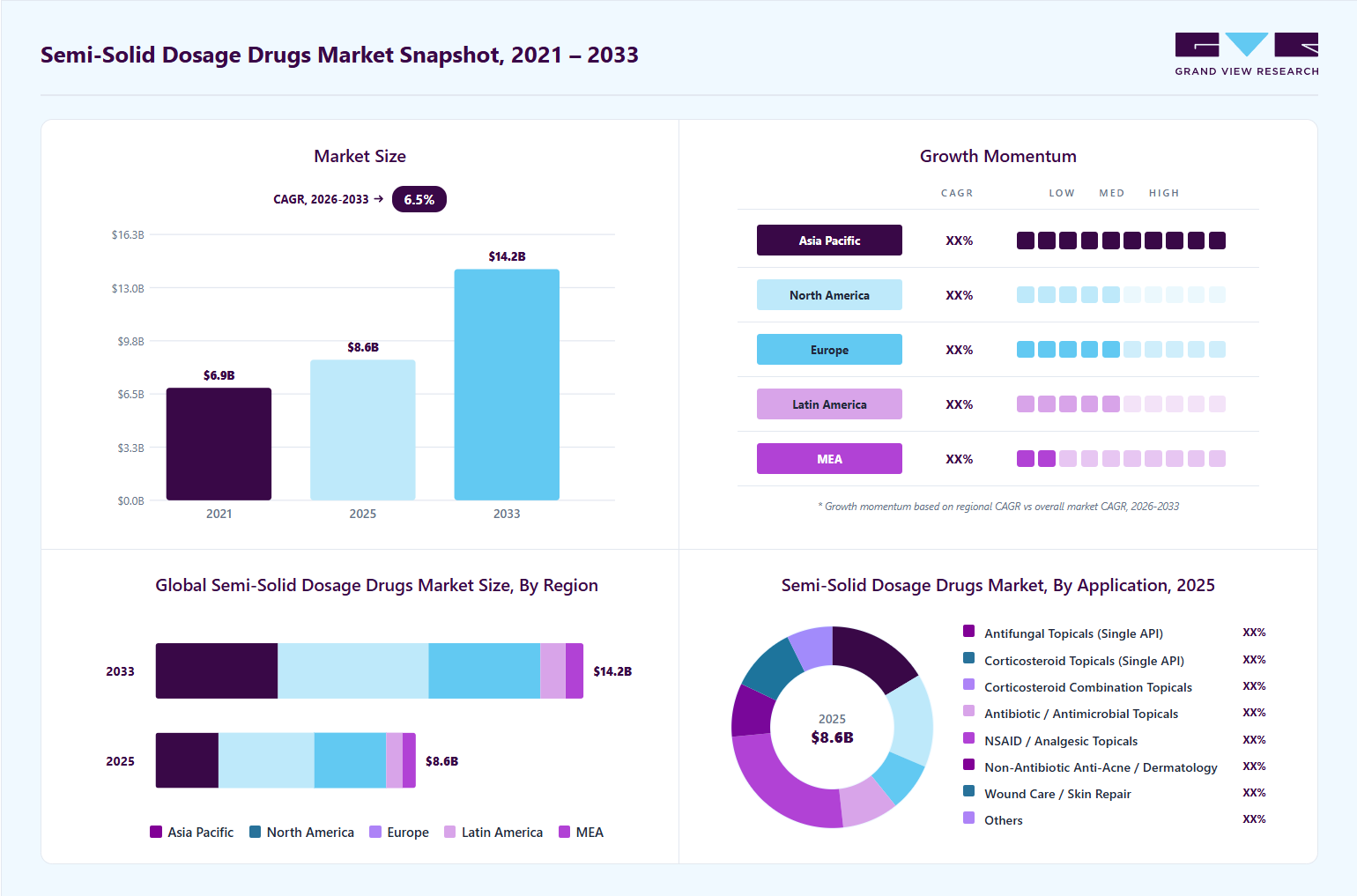
The global Semi-Solid dosage drugs market size was valued at USD 8.6 billion in 2025 and is projected to grow from USD 9.1 billion in 2026 to USD 14.2 billion by 2033, at a CAGR of 6.5% from 2026 to 2033. The market in North America dominated with a revenue share of 36.9% in 2025. The market is growing steadily due to the rising incidence of skin diseases, fungal infections, chronic wounds, acne, eczema, and muscle or joint pain disorders worldwide.
 Source: Grand View Research, IR Documents, Primary Interviews, Paid DatabasesTo learn more about this report,
 Download Free Sample Report
 Key Market Trends & Insights
- By distribution channel: Retail pharmacy segment held the largest market share of 61.8% in 2025.
- By application: NSAID / analgesic topicals segment held the largest market share of 25.2% in 2025.
Regional Highlights
- Largest regional market: North America (36.9% revenue share, 2025)
- Fastest-growing regional market: Asia Pacific (highest CAGR, 2026-2033)
- By country: The U.S. held the largest market share in 2025
Market Size & Forecast
- Market size in 2025: USD 8.6 Billion
- Estimated market size in 2026: USD 9.1 Billion
- Projected market size by 2033: USD 14.2 Billion
- CAGR (2026-2033): 6.5%
Three ways to get this report
Buy it, customize it, or ask a question.Ask an Analyst
A direct answer, usually in 1 working day
- AccessReport author, directly
- Reply timeWithin 1 working day
- No sales callDirect answer only
- FormatEmail reply
- CostFree, no cost
Get the Full Report
What the study covers
- FormatsPDF · Excel · Dashboard
- Timeline2026–2033 annual, 2025 base
- Coverage20+ countries, 5 regions
- Companies10+ key players profiled
Customize the Report
20% free customization
- IncludeCountries, segments, points
- TailorTo your product definition
- ExtendDeeper competitor detail
- OrA fully bespoke study
- Turnaround5–10 working days
Semi-solid formulations such as creams, gels, ointments, and lotions are increasingly preferred because they deliver medication directly to the affected area, provide faster relief, and reduce the risk of systemic side effects compared to oral drugs. Growing consumer awareness regarding self-medication and easy availability of over-the-counter topical products are also supporting market demand. In addition, pharmaceutical companies are investing in advanced transdermal and topical drug delivery technologies that improve drug absorption, stability, and patient convenience. The rapid expansion of e-commerce and online pharmacy platforms has further improved accessibility to dermatology and pain management products. Increasing availability of low-cost generic topical formulations is also contributing significantly to the market’s long-term global growth trajectory. To learn more about this report, Download Free Sample Report
 The growing elderly population is another major factor driving the expansion of the global semi-solid dosage drugs market. Older individuals are more vulnerable to chronic pain conditions, arthritis, diabetic foot ulcers, pressure sores, and skin-related disorders, increasing the demand for topical pain management and wound care products. Semi-solid formulations are preferred among geriatric patients because they are easy to apply, non-invasive, and generally associated with better patient compliance. Hospitals, clinics, and long-term care facilities are increasingly utilizing medicated creams, gels, and ointments for post-surgical wound management and infection prevention. In addition, increasing awareness regarding skincare and aesthetic dermatology is driving demand for medicated cosmetic formulations and anti-acne products among younger consumers. Rising healthcare expenditure and improved access to healthcare in emerging economies are further driving the adoption of semi-solid pharmaceutical products across multiple therapeutic applications globally.
Technological advancements and continuous innovation in pharmaceutical formulation development are creating significant opportunities in the semi-solid dosage drugs market. Manufacturers are increasingly investing in research and development focused on advanced transdermal drug delivery systems, nanoformulations, liposomal gels, and bioadhesive topical products that enhance drug absorption and therapeutic efficacy. Combination therapies containing corticosteroids, antifungals, antibiotics, and analgesics are also gaining popularity due to their improved clinical outcomes and patient convenience. Regulatory approvals for novel topical formulations and increasing product launches by pharmaceutical companies are further expanding the competitive landscape of the market. In addition, strategic collaborations among drug manufacturers, dermatology companies, and healthcare providers are accelerating product innovation and commercialization. Rapid urbanization, changing lifestyles, and increasing demand for convenient and effective topical therapies are expected to continue supporting long-term market growth across both developed and developing regions.
Market Concentration & Characteristics
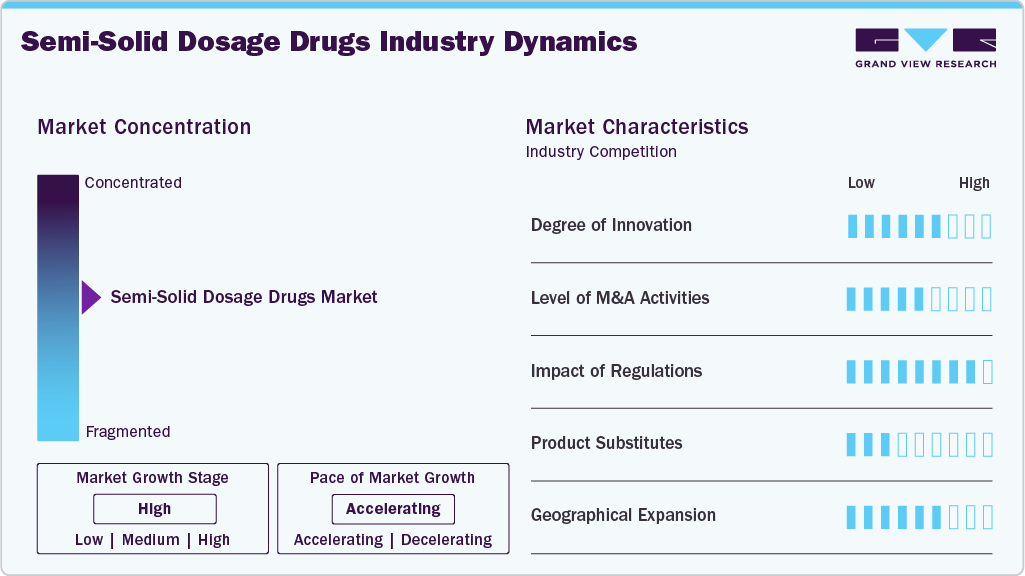
The semi-solid dosage drugs market demonstrates a moderate to high degree of innovation driven by advancements in topical and transdermal drug delivery technologies. Pharmaceutical companies are increasingly developing nano-formulations, liposomal gels, bioadhesive creams, and controlled-release topical products to improve drug absorption and therapeutic outcomes. Innovation is also focused on enhancing formulation stability, texture, and patient convenience. Combination therapies integrating corticosteroids, antifungals, antibiotics, and analgesics are gaining significant attention due to their improved treatment efficiency. Manufacturers are also investing in dermatology-focused research to address chronic skin disorders and pain management. The growing demand for non-invasive, patient-friendly therapies continues to drive continuous product development and technological advancement across the market.
The market has moderate barriers to entry due to stringent regulatory requirements and high formulation development standards. Companies entering the market must invest significantly in research, product testing, manufacturing infrastructure, and quality assurance systems to meet pharmaceutical safety and efficacy standards. Maintaining formulation stability, skin compatibility, and consistent drug absorption presents additional technical challenges for manufacturers. Established pharmaceutical companies also benefit from strong brand recognition, extensive distribution networks, and long-standing relationships with healthcare providers and pharmacies. Patent protections and regulatory approvals for specialized formulations can further limit new competitor participation. Additionally, pricing pressure from generic manufacturers creates competitive challenges for smaller or emerging companies attempting to establish market presence.
 To learn more about this report, Download Free Sample Report
 Regulatory frameworks play a critical role in shaping the semi-solid dosage drugs market globally. Pharmaceutical authorities such as the U.S. FDA, EMA, and other regional agencies impose strict guidelines regarding product safety, efficacy, manufacturing quality, labeling, and topical bioequivalence testing. Companies are required to comply with Good Manufacturing Practices (GMP) and conduct extensive clinical and stability studies before commercialization. Regulatory scrutiny is particularly high for corticosteroid, antibiotic, and combination topical products due to concerns regarding antimicrobial resistance and long-term side effects. Changes in healthcare regulations and drug approval pathways can significantly influence product launch timelines and development costs. However, supportive regulatory initiatives encouraging generic topical drug approvals are also contributing to increased market competition and product availability worldwide.
The industry faces competition from several alternative drug delivery formats and treatment approaches. Oral medications, injectable therapies, sprays, transdermal patches, and advanced biologic treatments often serve as substitutes depending on the severity and type of medical condition being treated. In dermatology and pain management applications, oral anti-inflammatory drugs and systemic antibiotics are frequently prescribed as alternatives to topical therapies. Additionally, cosmetic skincare products, herbal remedies, and natural treatment solutions are gaining popularity among consumers seeking non-pharmaceutical options. However, semi-solid formulations continue to maintain strong market demand due to their localized therapeutic action, convenience, lower systemic exposure, and ease of self-administration. Their effectiveness in treating mild to moderate conditions supports continued preference among both healthcare providers and patients globally.
The market is expanding geographically due to rising healthcare awareness, improving pharmaceutical access, and increasing prevalence of dermatological and chronic pain disorders worldwide. North America and Europe currently dominate the market because of advanced healthcare infrastructure, strong pharmaceutical manufacturing capabilities, and high consumer spending on dermatology and pain management products. Meanwhile, the Asia Pacific is emerging as the fastest-growing regional market driven by expanding healthcare systems, growing urban populations, and increasing availability of affordable generic topical medications. Countries such as China, India, and South Korea are witnessing rising investments in pharmaceutical production and research activities. Latin America and the Middle East & Africa are also experiencing gradual market growth driven by improving healthcare infrastructure, increased retail pharmacy penetration, and growing consumer awareness of topical therapies.
Application Insights
The NSAID / Analgesic topicals segment dominated the market with the largest revenue share of 25.22% in 2025, driven by the rising prevalence of musculoskeletal disorders, arthritis, sports injuries, and chronic joint pain conditions globally. Increasing consumer preference for topical pain relief products with localized therapeutic action and reduced gastrointestinal side effects compared to oral NSAIDs significantly supported segment growth. Strong demand for diclofenac, ketoprofen, and piroxicam-based gels and creams across both prescription and over-the-counter categories further strengthened market expansion. The growing aging population and increasing adoption of self-medication for pain management also contributed to higher product utilization. In addition, continuous product innovation, greater retail pharmacy availability, and rising awareness of non-invasive pain treatment solutions accelerated the growth of the NSAID/Analgesic Topicals segment worldwide.
The Non-Antibiotic Anti-Acne / Dermatology segment is projected to grow at a CAGR of 11.73% over the forecast period, fueled by the rising prevalence of acne, eczema, psoriasis, and other chronic skin disorders among adolescents and adults globally. Increasing consumer awareness regarding skincare, aesthetic dermatology, and early acne treatment is significantly driving demand for topical dermatology products such as adapalene, benzoyl peroxide, and tretinoin formulations. The growing preference for non-antibiotic therapies, driven by concerns about antimicrobial resistance, is further supporting segment expansion. The rapid growth of cosmetic dermatology clinics and the increasing use of prescription retinoid-based topical products also contribute to market growth. In addition, expanding online pharmacy channels, rising disposable income, and continuous innovation in advanced skincare formulations are expected to accelerate demand for non-antibiotic dermatology treatments worldwide.
Distribution Channel Insights
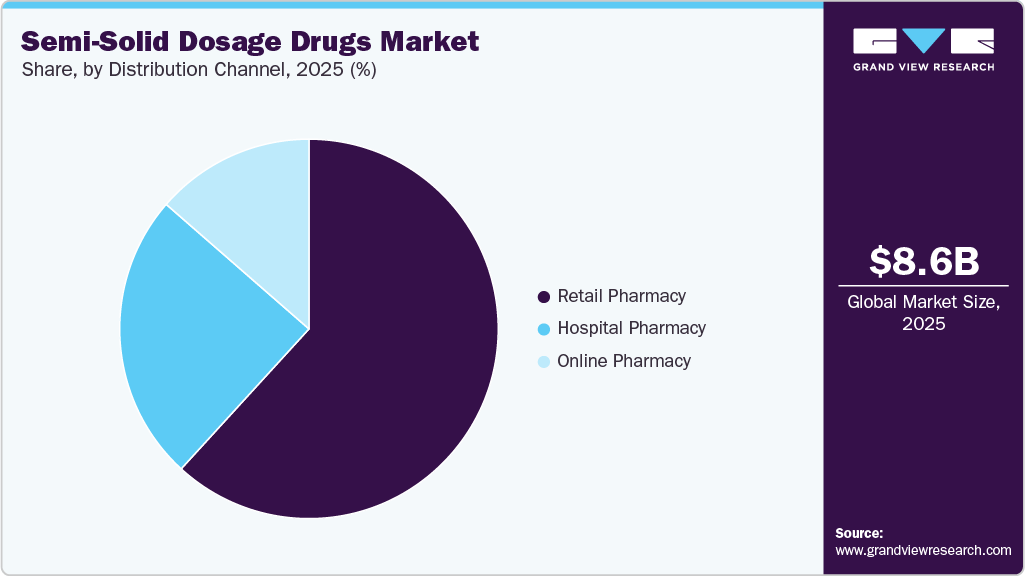
The retail pharmacy segment dominated the market with the largest revenue share of 61.80% in 2025, due to the widespread availability of semi-solid dosage drugs across retail pharmacy chains and independent drug stores globally. Consumers frequently prefer retail pharmacies for purchasing topical creams, gels, ointments, and lotions due to convenience, immediate product access, and pharmacist guidance. Strong demand for over-the-counter dermatology, antifungal, wound care, and pain relief products significantly contributed to segment growth. Retail pharmacies also offer a broad range of branded and generic topical medications, supporting affordability and product accessibility for diverse patient populations. In addition, increasing self-medication practices, rising consumer awareness regarding topical treatments, and expansion of organized retail pharmacy networks further strengthened the dominance of the retail pharmacy segment in the global semi-solid dosage drugs market.
 To learn more about this report, Download Free Sample Report
 The online pharmacy segment is projected to grow at a CAGR of 8.9% over the forecast period due to increasing consumer preference for convenient digital healthcare, purchasing platforms, and home delivery services. Rising internet penetration and growing smartphone usage have significantly improved access to topical creams, gels, ointments, and dermatology products through online channels. Consumers increasingly use online pharmacies to purchase over-the-counter pain relief, antifungal, anti-acne, and skincare medications due to competitive pricing and broader product availability. The expansion of e-commerce healthcare platforms and subscription-based medicine delivery services is further supporting segment growth globally. In addition, growing awareness regarding self-care treatments, increasing adoption of digital healthcare services, and rising availability of generic semi-solid dosage products online are expected to accelerate the growth of the online pharmacy segment during the forecast period.
Regional Insights
The North America semi-solid dosage drugs industry accounted for the largest share of 36.92% in 2025, due to strong demand for dermatology treatments, pain relief products, and advanced topical therapies. The region has a high prevalence of eczema, psoriasis, fungal infections, and chronic musculoskeletal disorders that increase the use of creams, gels, and ointments. Consumers show a strong preference for over-the-counter topical medications for quick and convenient treatment. Pharmaceutical companies continuously introduce innovative semi-solid formulations with improved absorption and skin compatibility. The presence of major drug manufacturers and extensive retail pharmacy networks further strengthens product accessibility across the region. Increasing adoption of transdermal drug delivery systems also supports long-term market expansion in North America.
 To learn more about this report, Download Free Sample Report
 U.S. Semi-Solid Dosage Drugs Market Trends
The semi-solid dosage drugs industry in the U.S. is the largest market in North America due to high healthcare spending and the broad availability of topical pharmaceutical products. Rising cases of arthritis, skin allergies, acne, and sports injuries continue to increase demand for analgesic and dermatology creams. Consumers actively use prescription and nonprescription topical formulations for pain management and cosmetic skin treatments. Pharmaceutical manufacturers in the country focus heavily on advanced transdermal technologies and specialty dermatology products. Online pharmacy expansion and strong consumer awareness regarding self-treatment further accelerate product sales. Continuous product launches and growing use of generic topical formulations contribute significantly to market growth in the United States.
Europe Semi-Solid Dosage Drugs Market Trends
The semi-solid dosage drugs industry in Europe holds a significant share in the global market due to growing demand for topical anti-inflammatory, antifungal, and wound care products. The region has an aging population that frequently requires pain relief creams and skin repair medications for chronic conditions. Consumers increasingly prefer localized drug delivery therapies that provide targeted treatment with minimal systemic effects. Pharmaceutical companies across Europe are focusing on premium dermatology formulations and combination topical therapies to improve therapeutic outcomes. Retail pharmacies and hospital distribution channels maintain strong penetration of semi-solid pharmaceutical products across major European countries. Rising interest in medicated skincare and cosmetic dermatology products continues to support regional market growth.
The UK semi-solid dosage drugs industry is expanding steadily due to the increasing prevalence of eczema, acne, psoriasis, and fungal skin infections. Consumers widely utilize topical creams, gels, and ointments for self-care treatment and routine dermatological management. Demand for anti-inflammatory and pain relief formulations continues to rise among the aging population and sports injury patients. Pharmaceutical companies are introducing advanced topical formulations that improve patient comfort and enhance therapeutic effectiveness. The growth of online pharmacies and the availability of strong retail pharmacies have improved access to dermatology and wound care products nationwide. Rising consumer awareness regarding skincare and cosmetic dermatology further contributes to the market’s steady development in the UK.
The semi-solid dosage drugs industry in Germany represents a major market due to strong pharmaceutical manufacturing capabilities and high usage of topical therapeutic products. The country has substantial demand for pain management gels, corticosteroid creams, and antifungal ointments for chronic and acute conditions. Consumers prefer topical drug delivery systems that offer rapid symptom relief and easy administration. Dermatology clinics and healthcare providers frequently prescribe semi-solid formulations for inflammatory skin disorders and post-surgical wound treatment. Pharmaceutical companies in Germany continue investing in innovative topical drug technologies and combination therapies. The growing elderly population and rising incidence of arthritis-related disorders further support long-term market expansion across the country.
The France semi-solid dosage drugs industry maintains a stable position in the market due to the increasing consumer focus on dermatological care and topical pain management therapies. Demand for medicated creams and ointments continues to rise for conditions such as dermatitis, acne, fungal infections, and muscle pain. Consumers show a strong preference for localized treatment solutions that provide convenience and lower systemic drug exposure. Cosmetic dermatology and prescription skincare products are gaining popularity among younger and middle-aged populations. Pharmaceutical manufacturers are expanding their topical product portfolios through improved formulations and enhanced skin-absorption technologies. Strong pharmacy distribution networks and increasing use of over-the-counter topical medications continue to support market growth in France.
Asia Pacific Semi-Solid Dosage Drugs Market Trends
The semi-solid dosage drugs industry in the Asia Pacific is expected to register the fastest CAGR of 8.79% over the forecast period, due to rising healthcare awareness and increasing prevalence of skin and pain-related disorders. Rapid urbanization and changing lifestyles have contributed to higher demand for acne treatments, antifungal creams, and topical analgesics across the region. Expanding middle-class populations and increasing consumer spending on healthcare products continue to drive market growth. Pharmaceutical manufacturers are actively introducing affordable generic topical formulations to meet growing regional demand. The expansion of retail pharmacy chains and e-commerce healthcare platforms has improved product accessibility in both urban and semi-urban areas. Rising investments in pharmaceutical manufacturing and dermatology product development further strengthen the growth outlook for the Asia Pacific.
The Japan semi-solid dosage drugs industry holds a significant share in the market due to a strong demand for advanced dermatology and pain management products. The country has a rapidly aging population that frequently utilizes topical formulations for arthritis, joint pain, and chronic skin disorders. Consumers prefer high-quality pharmaceutical products with improved formulation stability and enhanced therapeutic performance. Pharmaceutical companies in Japan focus on innovative topical drug-delivery technologies and premium skincare products. Demand for medicated creams and ointments continues to increase in hospitals, clinics, and retail pharmacies. Growing interest in cosmetic dermatology and anti-aging skincare products further supports market expansion across Japan.
The semi-solid dosage drugs industry in China is experiencing rapid growth due to the increasing prevalence of fungal infections, acne, and inflammatory skin disorders. Rising disposable income and expanding healthcare access have increased consumer spending on topical pharmaceutical products. Local pharmaceutical companies are strengthening production capacity for affordable creams, gels, and ointments across multiple therapeutic categories. Consumers increasingly prefer over-the-counter topical treatments for common dermatological and musculoskeletal conditions. E-commerce platforms and retail pharmacy expansion have significantly improved product availability throughout the country. Growing awareness regarding skincare, wound care, and pain management solutions continues to drive strong market demand in China.
Latin America Semi-Solid Dosage Drugs Market Trends
The semi-solid dosage drugs industry in Latin America is growing steadily due to increasing awareness regarding topical dermatology and pain management treatments. Rising cases of skin infections, fungal diseases, and chronic pain conditions continue to support demand for creams, ointments, and gels across the region. Consumers increasingly rely on over-the-counter topical medications for convenient and affordable treatment options. Pharmaceutical companies are expanding distribution networks and introducing cost-effective generic formulations to strengthen regional market presence. Retail pharmacies remain the primary sales channel for semi-solid pharmaceutical products in many Latin American countries. Improving healthcare accessibility and increasing consumer interest in skincare products further contribute to market growth across the region.
The Brazil semi-solid dosage drugs industry is the leading market in Latin America, due to high demand for dermatology and topical pain relief products. The country experiences strong consumption of anti-acne creams, antifungal ointments, and anti-inflammatory gels among various age groups. Consumers actively use topical formulations for cosmetic skincare and chronic pain management applications. Pharmaceutical companies continue expanding their generic topical product portfolios to address growing demand for affordable medications. Retail pharmacies and online healthcare platforms have improved access to semi-solid pharmaceutical products throughout major urban centers. Rising awareness regarding personal skincare and increasing prevalence of dermatological conditions continue supporting market growth in Brazil.
Middle East & Africa Semi-Solid Dosage Drugs Market Trends
The semi-solid dosage drugs industry in the Middle East and Africa is witnessing gradual growth due to increasing demand for topical treatments for skin infections, wounds, and pain-related conditions. Harsh climatic conditions and rising skin sensitivity issues have increased the use of creams, lotions, and medicated ointments across several countries in the region. Consumers increasingly prefer localized therapies that offer convenient application and effective symptom management. Pharmaceutical companies are expanding their presence through broader distribution of affordable topical formulations. Retail pharmacies continue to play a major role in improving access to dermatology and wound care products. Rising healthcare awareness and growing urban populations are expected to support future market expansion across the MEA region.
The Saudi Arabia semi-solid dosage drugs industry is emerging as an important market due to increasing consumer demand for dermatology and topical pain management products. The high prevalence of skin dryness, fungal infections, and inflammatory skin conditions continues to drive the use of creams and ointments across the country. Consumers are increasingly adopting medicated skincare and over-the-counter topical therapies for routine skin treatment applications. Pharmaceutical companies are expanding product availability through retail pharmacies, hospital channels, and online healthcare platforms. Demand for analgesic gels and anti-inflammatory creams is also increasing among the aging population and physically active individuals. Growing awareness regarding advanced dermatological care and personal skincare continues to support steady market growth in Saudi Arabia.
Key Semi-Solid Dosage Drugs Company Insights
Pfizer and GlaxoSmithKline (GSK) maintain strong positions in the semi-solid dosage drugs market through extensive portfolios of topical anti-inflammatory, dermatology, and pain management products. Johnson & Johnson and Viatris continue expanding their presence with broad offerings of over-the-counter creams, ointments, and generic topical formulations across global markets. Teva Pharmaceutical Industries and Bausch Health Companies focus on dermatology and specialty topical therapies supported by continuous formulation improvements and product portfolio expansion. Sun Pharmaceutical Industries and Taro Pharmaceutical Industries strengthen market competitiveness through cost-effective generic topical medications and strong dermatology-focused manufacturing capabilities. Haleon continues to expand consumer healthcare topical products targeting pain relief and skincare applications, while Sanofi focuses on innovative dermatological and transdermal treatment solutions. The market remains highly competitive with ongoing emphasis on advanced drug delivery technologies, generic product launches, dermatology innovation, and expansion across retail and online pharmacy distribution channels.
Key Semi-Solid Dosage Drugs Companies:
The following key companies have been profiled for this study on the semi-solid dosage drugs market.
- Pfizer
- GlaxoSmithKline (GSK)
- Johnson & Johnson
- Viatris
- Teva Pharmaceutical Industries
- Bausch Health Companies
- Sun Pharmaceutical Industries
- Taro Pharmaceutical Industries
- Haleon
- Sanofi
Recent Developments
-
In May 2026, Haleon announced a multi-year partnership with UEFA Medical to advance evidence-based topical pain management, supporting growth in the Semi-Solid Dosage Drugs Market. The collaboration focused on topical-first approaches using products such as Voltaren, a topical pain reliever. The company reported that 40% of active people experienced injuries annually, up to 41% of recreational athletes reported pain, and 1 in 5 individuals suffered moderate-to-severe pain. UEFA Medical also supported more than 2,500 professional matches across Europe each season.
-
In October 2024, Sun Pharmaceutical Industries Limited presented data at the 44th Annual Fall Clinical Dermatology Conference supporting the use of WINLEVI (clascoterone) cream 1% in the Semi-Solid Dosage Drugs Market. The company reported that WINLEVI cream 1% significantly reduced sebum production and demonstrated stability when combined with other topical acne medications.
-
In July 2024, Pfizer continued expanding the clinical positioning of EUCRISA (crisaborole ointment 2%) for atopic dermatitis treatment, with updated clinical policy reviews and an extended dermatology usage focus in pediatric patients.
Semi-Solid Dosage Drugs Market Report Scope
Report Attribute
Details
Market size in 2025
USD 8.6 billion
Estimated market size in 2026
USD 9.1 billion
Projected market size by 2033
USD 14.2 billion
Growth rate
CAGR of 6.5% from 2026 to 2033
Base year for estimation
2025
Historical data
2021 - 2024
Forecast period
2026 - 2033
Quantitative units
Revenue in USD million/billion and CAGR from 2026 to 2033
Report coverage
Revenue forecast, company ranking, competitive landscape, growth factors, trends
Segments covered
Application, distribution channel, region
Regional scope
North America; Europe; Asia Pacific; Latin America; Middle East & Africa
Country scope
U.S.; Canada; Mexico; UK; Germany; France; Italy; Spain; Denmark; Sweden; Norway; China; Japan; India; Australia; South Korea; Thailand; Brazil; Argentina; South Africa; Saudi Arabia; UAE; Kuwait
Key company profiled
Pfizer; GlaxoSmithKline (GSK); Johnson & Johnson; Viatris; Teva Pharmaceutical Industries; Bausch Health Companies; Sun Pharmaceutical Industries; Taro Pharmaceutical Industries; Haleon; Sanofi
Customization scope
Free report customization (equivalent up to 8 analysts working days) with purchase. Addition or alteration to country, regional & segment scope.
Pricing and purchase options
Avail customized purchase options to meet your exact research needs. Explore purchase options
Global Semi-Solid Dosage Drugs Market Report Segmentation
This report forecasts revenue growth at global, regional, and country levels and provides an analysis of the latest industry trends in each of the sub-segments from 2021 to 2033. For this study, Grand View Research has segmented the global semi-solid dosage drugs market report based on application, distribution channel, and region:
 To learn more about this report, Download Free Sample Report
 -
Application Outlook (Revenue, USD Million, 2021 - 2033)
-
Antifungal Topicals (Single API)
-
Product (API)
-
Clotrimazole (Canesten Cream)
-
Clotrimazole (Clotrimazole Sandoz)
-
Clotrimazole (Clotrimazole Teva)
-
Terbinafine (Lamisil Cream)
-
Terbinafine (Terbinafine Teva)
-
Ketoconazole (Nizoral Cream)
-
Ketoconazole (Ketoconazole EG)
-
Econazole (Pevaryl Cream)
-
Econazole (Econazole Mylan)
-
Others
-
-
-
Corticosteroid Topicals (Single API)
-
Product (API)
-
Hydrocortisone (Hydrocortisone Generic
-
Cream)
-
Betamethasone Valerate (Betnovate)
-
Betamethasone Valerate (Betamethasone
-
Generic)
-
Mometasone Furoate (Elocon)
-
Mometasone Furoate (Mometasone Generic)
-
Clobetasol Propionate (Dermovate)
-
Clobetasol Propionate (Clobetasol Generic)
-
Others
-
-
-
Corticosteroid Combination Topicals
-
Product (API)
-
Betamethasone + Clotrimazole (Travocort)
-
Betamethasone + Fusidic Acid (Fucicort)
-
Clobetasol + Antibiotic (Clobetasol
-
Combination Cream)
-
Others
-
-
-
Antibiotic / Antimicrobial Topicals
-
Product (API)
-
Mupirocin (Bactroban)
-
Mupirocin (Mupirocin Generic)
-
Fusidic Acid (Fucidin)
-
Fusidic Acid (Fusidic Acid Generic)
-
Others
-
-
-
NSAID / Analgesic Topicals
-
Product (API)
-
Diclofenac (Voltaren Emulgel)
-
Diclofenac (Diclofenac Generic Gel)
-
Ketoprofen (Fastum Gel)
-
Ketoprofen (Ketoprofen Generic)
-
Piroxicam (Feldene Gel)
-
Others
-
-
-
Non-Antibiotic Anti-Acne / Dermatology
-
Product (API)
-
Adapalene (Differin)
-
Benzoyl Peroxide (Benzac)
-
Tretinoin (Retincare)
-
Others
-
-
-
Wound Care / Skin Repair
-
Product (API)
-
Dexpanthenol (Bepanthen)
-
Zinc Oxide (Zinc Oxide Ointment)
-
Others
-
-
-
Others
-
-
Distribution Channel Outlook (Revenue, USD Million, 2021 - 2033)
-
Antifungal Topicals (Single API)
-
Retail Pharmacy
-
Hospital Pharmacy
-
Online Pharmacy
-
-
Corticosteroid Topicals (Single API)
-
Retail Pharmacy
-
Hospital Pharmacy
-
Online Pharmacy
-
-
Corticosteroid Combination Topicals
-
Retail Pharmacy
-
Hospital Pharmacy
-
Online Pharmacy
-
-
Antibiotic / Antimicrobial Topicals
-
Retail Pharmacy
-
Hospital Pharmacy
-
Online Pharmacy
-
-
NSAID / Analgesic Topicals
-
Retail Pharmacy
-
Hospital Pharmacy
-
Online Pharmacy
-
-
Non-Antibiotic Anti-Acne / Dermatology
-
Retail Pharmacy
-
Hospital Pharmacy
-
Online Pharmacy
-
-
Wound Care / Skin Repair
-
Retail Pharmacy
-
Hospital Pharmacy
-
Online Pharmacy
-
-
Others
-
-
Regional Outlook (Revenue, USD Million, 2021 - 2033)
-
North America
-
U.S.
-
Canada
-
Mexico
-
-
Europe
-
UK
-
Germany
-
France
-
Italy
-
Spain
-
Denmark
-
Sweden
-
Norway
-
-
Asia Pacific
-
Japan
-
China
-
India
-
Australia
-
South Korea
-
Thailand
-
-
Latin America
-
Brazil
-
Argentina
-
-
Middle East & Africa
-
South Africa
-
Saudi Arabia
-
UAE
-
Kuwait
-
-
Frequently Asked Questions About This Report
North America dominated with a 36.9% revenue share in 2025.
Asia Pacific is the fastest-growing region over the forecast period.
The retail pharmacy segment dominated the market and accounted for the largest revenue share of 61.8% in 2025.
The global semi-solid dosage drugs market size was valued at USD 8.6 billion in 2025 and is estimated at USD 9.1 billion for 2026.
The global semi-solid dosage drugs market is expected to grow at a CAGR of 6.5% from 2026 to 2033, reaching USD 14.2 billion by 2033.
The NSAID / Analgesic Topicals segment dominated the market with the largest revenue share of 25.2% in 2025, driven by the rising prevalence of musculoskeletal disorders, arthritis, sports injuries, and chronic joint pain conditions globally..
Key players include Pfizer; GlaxoSmithKline (GSK); Johnson & Johnson; Viatris; Teva Pharmaceutical Industries; Bausch Health Companies; Sun Pharmaceutical Industries; Taro Pharmaceutical Industries; Haleon; Sanofi.
The semi-solid dosage drugs market is growing steadily due to the rising incidence of skin diseases, fungal infections, chronic wounds, acne, eczema, and muscle or joint pain disorders worldwide. Semi-solid formulations such as creams, gels, ointments, and lotions are increasingly preferred because they deliver medication directly to the affected area, provide faster relief, and reduce the risk of systemic side effects compared to oral drugs.
About the Author(s)
Pharmaceuticals Research Team
Healthcare · PharmaceuticalsThis report was authored by the pharmaceuticals research team at Grand View Research - comprising two research analysts, one senior research analyst, and one industry expert - with specialized expertise in the pharmaceuticals segment of the healthcare industry. All findings are based on proprietary healthcare databases, executive interviews, and regulatory analysis, subject to internal peer review prior to publication.
Last Updated:
Speak to Analyst

Customize this report to your needs - add regions, segments, or data points, with 20% free customization.
Or view our licence options:


ISO 9001:2015 & 27001:2022 Certified
We are GDPR and CCPA compliant! Your transaction & personal information is safe and secure. For more details, please read our privacy policy.


