
- Home
- »
- Next Generation Technologies
- »
-
Short-Wave Infrared Cameras & Sensors Market Report, 2030GVR Report cover

Short-Wave Infrared Cameras & Sensors Market (2025 - 2030) Size, Share & Trends Analysis Report By Technology, By Product (SWIR Cameras, SWIR FPAs), By Application, By Interface, By Region, And Segment Forecasts
Market Size, 2024
$328.4MMarket Estimate, 2026
$362.7MMarket Forecast, 2030
$620.2MCAGR, 2025–2030
11.3%Short-Wave Infrared Cameras & Sensors Market Summary
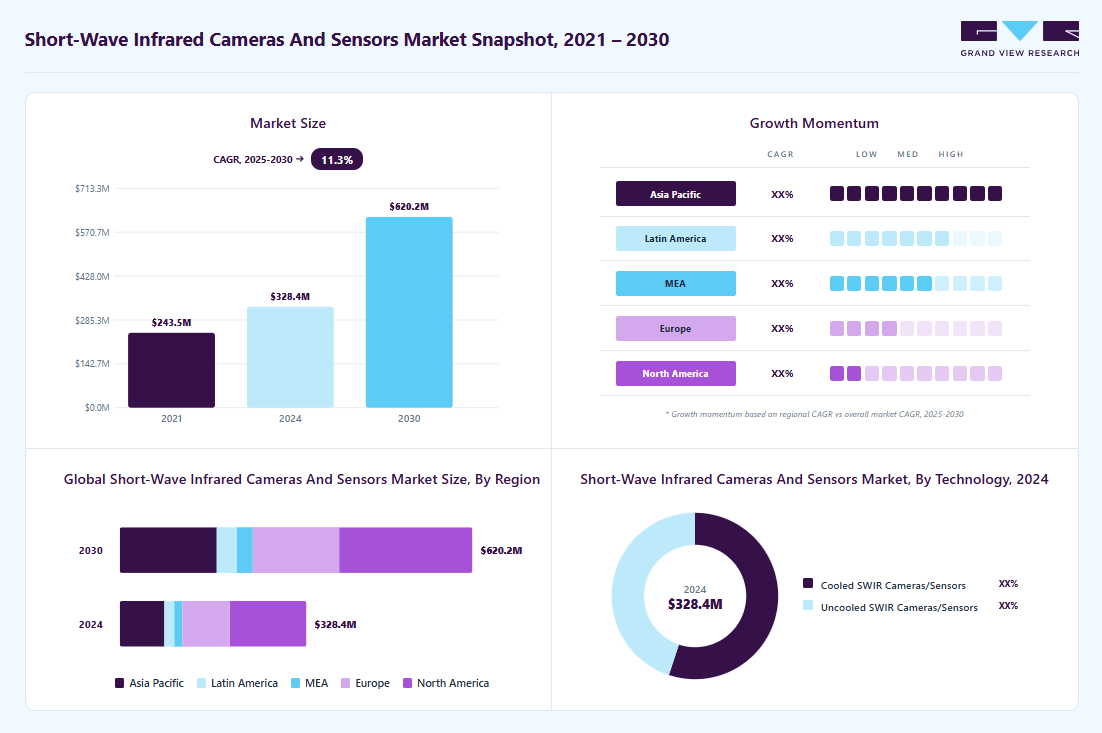
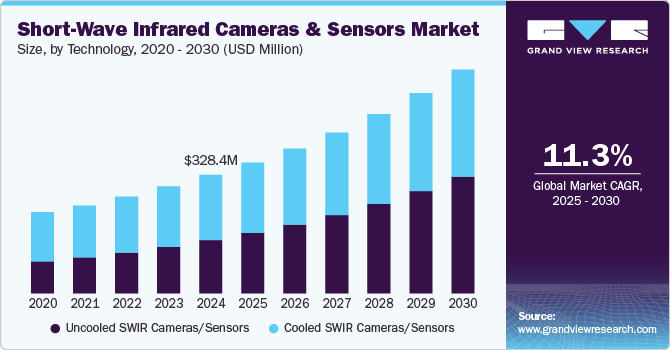
The global short-wave infrared cameras & sensors market size was estimated at USD 328.4 million in 2024 and is projected to reach USD 620.2 million by 2030, growing at a CAGR of 11.3% from 2025 to 2030. The growth is driven by rising demand for high-precision imaging technologies across industries such as defense, semiconductors, food inspection, and industrial automation.
 Source: Grand View Research, IR Documents, Primary Interviews, Paid DatabasesTo learn more about this report,
 Download Free Sample Report
 Key Market Trends & Insights
- North America Short-Wave Infrared cameras & sensors industry dominated globally with the largest revenue share of 38.4% in 2024.
- The Short-Wave Infrared (SWIR) cameras & sensors industry in the U.S. is driven by the rapid adoption of SWIR cameras & sensors.
- By technology, the cooled SWIR cameras/sensors segment accounted for the largest revenue share of 55.1% in 2024.
- By product, the SWIR FPAs segment is predicted to foresee significant growth in the forecast period.
- By application, the defense & military segment held the largest market revenue share in 2024.
Market Size & Forecast
- 2024 Market Size: USD 328.4 Million
- 2030 Projected Market Size: USD 620.2 Million
- CAGR (2025-2030): 11.3%
- North America: Largest market in 2024
- Asia Pacific: Fastest growing market
Three ways to get this report
Buy it, customize it, or ask a question.Ask an Analyst
Analyst response in 1 business day
- AccessReport author, directly
- Reply timeWithin 1 working day
- No sales callDirect answer only
- FormatEmail reply
- CostFree, no cost
Get the Full Report
What the study covers
- FormatsPDF · Excel · Dashboard
- Timeline2025–2030 annual, 2024 base
- Coverage20+ countries, 5 regions
- Companies10+ key players profiled
Customize the Report
20% free customization
- IncludeCountries, segments, points
- TailorTo your product definition
- ExtendDeeper competitor detail
- OrA fully bespoke study
- Turnaround5–10 working days
The increasing adoption of short-wave infrared (SWIR) technology for quality control, material sorting, and surveillance applications is a major contributor to market expansion. In addition, advancements in SWIR sensor designs, such as lower power consumption, miniaturization, and improved sensitivity, are making these solutions more accessible for broader industrial use.SWIR cameras & sensors, specifically those based on focal plane array (FPA) technology, are emerging as vital components in a wide range of imaging applications. Operating in the 0.9 to 1.7-micron wavelength range, SWIR imaging offers capabilities that surpass traditional visible and thermal imaging systems, enabling the detection of hidden features, material differences, and moisture levels. These advantages make SWIR FPAs valuable in fields such as industrial inspection, surveillance, defense, and scientific research. Their ability to operate in low-light or obscured environments also enhances their utility in applications where clarity and detail are required.
 To learn more about this report, Download Free Sample Report
 The market for SWIR cameras & sensors is witnessing robust growth, driven by increasing demand across both commercial and military sectors. Defense applications have historically led the adoption curve due to SWIR's ability to see through smoke, fog, and camouflage. However, recent advancements in sensor miniaturization, cost reductions, and innovations in InGaAs (Indium Gallium Arsenide) technology are expanding use cases into agriculture, machine vision, semiconductor inspection, and medical diagnostics. As industries pursue higher accuracy and automation in imaging processes, SWIR systems are becoming indispensable for enabling non-destructive testing and quality control.
Technology Insights
The cooled SWIR cameras/sensors segment accounted for the largest revenue share of 55.1% in 2024, driven by their superior imaging performance, especially in low-light and long-range applications. Cooled SWIR cameras & sensors are rapidly gaining traction within the SWIR cameras & sensors market due to their exceptional sensitivity, high signal-to-noise ratio, and ability to function effectively in challenging environments. Their ability to detect low-intensity signals in complex conditions makes them ideal for demanding applications in defense, aerospace, and semiconductor inspection. As the need for high-performance imaging in these fields continues to rise, cooled SWIR solutions offer a significant advantage over uncooled SWIR systems, especially when it comes to achieving high resolution and precision. These attributes make cooled SWIR cameras indispensable for tasks requiring detailed analysis in low-light or extreme conditions, such as detecting small targets at long distances or under variable weather.
The uncooled SWIR cameras/sensors segment registered a CAGR of 14.1% from 2025 to 2030. Uncooled SWIR cameras & sensors are increasingly being adopted for a variety of applications due to their efficient design and cost-effectiveness. These sensors operate without the need for complex cooling systems, reducing both their weight and power consumption, which makes them ideal for portable systems. Their simplicity and reduced component count lead to lower production costs, making them accessible to a wider range of industries and applications. Moreover, their ease of integration into existing systems makes them a practical choice for manufacturers looking to incorporate infrared technology into their products. As a result, they are becoming essential components in systems where size, weight, and energy efficiency are critical.
Product Insights
The SWIR cameras segment dominated the market in 2024. The integration of visible (RGB) and SWIR sensors in a single camera reflects the growing demand for multispectral imaging. Industries are increasingly looking to combine multiple imaging capabilities into one system. This approach helps streamline operations by reducing the need for separate devices. As a result, it enhances efficiency and minimizes equipment size and complexity. For instance, in August 2024, JAI, a Danish manufacturer of industrial cameras, offered the SW-4010Q-MCL line scan camera, which integrates three CMOS sensors for visible imaging and one InGaAs sensor for SWIR. This camera enables simultaneous multispectral data capture from 400 to 1700 nm. It also features advanced capabilities such as pixel rescaling, color space conversions, and synchronized dual-stream output, making it an excellent choice for high-precision machine vision applications.
The SWIR FPAs segment is predicted to foresee significant growth in the forecast period. SWIR FPAs, including InGaAs-based, HgCdTe-based, and Quantum Dot-based technologies, are witnessing significant growth due to their exceptional imaging capabilities in the short-wave infrared spectrum, which is essential for a wide range of applications. InGaAs-based FPAs are experiencing significant growth due to their exceptional performance in the short-wave infrared (SWIR) spectrum, which is essential for applications in industrial, scientific, and defense sectors. These sensors are particularly valuable in machine vision, security, and aerospace, where high sensitivity and low-light performance are critical. HgCdTe-based FPAs are gaining traction in thermal imaging applications, especially in environments where precise temperature measurements are needed, such as in environmental monitoring, space exploration, and military surveillance.
Application Insights
The defense & military segment held the largest market revenue share in 2024. Companies are integrating advanced technologies into SWIR cameras & sensors to enhance intelligence, autonomy, and operational efficiency in military operations. These capabilities are essential for improving situational awareness and effectiveness in defense applications. With these systems, multiple targets can be continuously monitored and identified in real-time. The integration of accurate distance measurement technologies improves targeting precision. Accurate target identification ensures military forces make more informed decisions during operations. As these innovations develop, they will be crucial in modern defense strategies. These advancements help minimize human error and increase mission success rates in military environments.
The security & surveillance segment is projected to grow significantly over the forecast period. Dual-spectrum imaging combining visible and SWIR wavelengths is gaining momentum in various applications. It enables systems to operate effectively across different lighting and atmospheric conditions. This approach enhances detection capabilities, especially in environments where visibility is limited. The ability to capture a broader spectral range improves data accuracy. As industries demand more reliable imaging, dual-spectrum setups are becoming increasingly preferred. The demand for rugged and durable systems is increasing, especially in industries operating in extreme conditions. These systems are designed to withstand harsh environments, ensuring reliable performance. Applications in defense, industrial inspection, and security are driving this trend. As industries face more challenging conditions, the need for robust equipment continues to grow.
Interface Insights
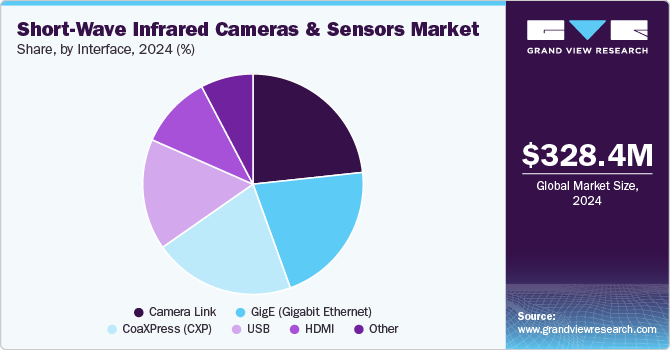
The camera link segment registered significant growth in 2024. Integrating camera link with SWIR sensors enables precise, automated inspections in various industries. This technology improves the accuracy of inspections by reducing human error. In sectors such as food manufacturing, semiconductor production, and electronics, it enhances overall process efficiency. The ability to automate inspections ensures higher throughput and consistency. As a result, industries can achieve faster production cycles and improved quality control. For instance, in October 2023, Omron Corporation, a Japanese automation company, introduced its new SWIR Camera Series. It utilizes short-wave infrared technology to overcome manufacturing challenges, offering versatile inspection capabilities and unique interfaces such as camera link. This technology improves precision in industries such as food and commodity by removing the dependency on traditional lighting. It enhances inspection in the semiconductor and electronics industries by enabling visibility through materials such as plastic wrap or silicon coating.
 To learn more about this report, Download Free Sample Report
 The CoaXPress segment is expected to register the fastest CAGR over the forecast period. CoaXPress-enabled SWIR cameras offer versatility across multiple industries, including agriculture, food safety, and medical diagnostics. Their ability to capture detailed images in the SWIR spectrum allows for in-depth analysis of various materials and biological tissues. In agriculture, these cameras help monitor plant health and detect early signs of disease. In food safety, they are used to inspect products for contaminants or inconsistencies. Medical diagnostics benefit from their capacity to reveal tissue structures and abnormalities for better disease detection. With their high-speed data transfer and precision, CoaXPress-enabled SWIR cameras provide invaluable insights across diverse sectors.
Regional Insights
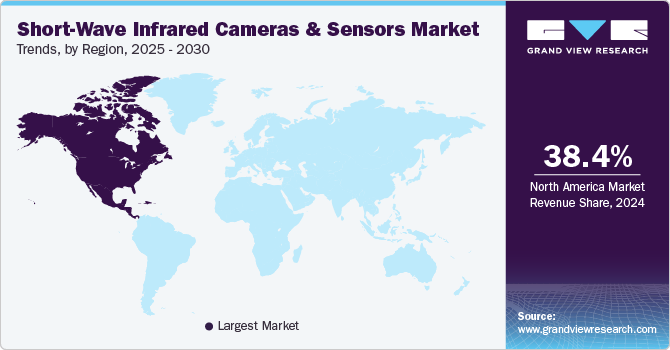
North America Short-Wave Infrared cameras & sensors industry dominated globally with the largest revenue share of 38.4% in 2024. Driven by technological advancements and rising demand across various industries. Military and defense applications are key drivers of this growth, with SWIR technology proving essential for surveillance, reconnaissance, and targeting systems in low-visibility environments. The ability of SWIR cameras to detect objects and details in darkness or through obscurants provides a significant advantage for defense operations. As defense technology evolves, the need for advanced imaging systems grows. The military’s increased reliance on SWIR for tactical operations is driving its adoption and influencing the market’s future. The industrial sector is another major contributor to the growth of the SWIR market, with SWIR sensors being crucial for quality control and process monitoring. In manufacturing, these sensors are used to detect defects in materials, ensuring product quality and minimizing waste.
 To learn more about this report, Download Free Sample Report
 U.S. Short-Wave Infrared Cameras & Sensors Market Trends
The Short-Wave Infrared (SWIR) cameras & sensors industry in the U.S. is driven by the rapid adoption of SWIR cameras & sensors. Broader spectral detection is extending the range of SWIR sensors in the U.S., enabling them to capture information across a much wider portion of the infrared spectrum. This advancement enhances the sensitivity of focal plane arrays used in domestic applications that require precise spectral differentiation. Access to more wavelengths improves imaging accuracy across varied lighting environments common in U.S. industrial and environmental settings.
Europe Short-Wave Infrared Cameras & Sensors Market Trends
The Short-Wave Infrared (SWIR) cameras & sensors industry in Europe is witnessing significant momentum in the ICT sector amidst the rising demand for advanced imaging solutions across defense, automotive, and industrial sectors. SWIR technologies offer the advantage of capturing high-quality images under low-light and challenging environmental conditions. This capability is driving their adoption in applications such as quality control, security, and surveillance. Moreover, SWIR sensors are being integrated into autonomous vehicles to improve navigation in low-visibility situations. Europe’s strong commitment to research and development is further accelerating the adoption of these advanced technologies.
Asia Pacific Short-Wave Infrared Cameras & Sensors Market Trends
Asia Pacific Short-Wave Infrared (SWIR) cameras & sensors industry is anticipated to register the fastest CAGR over the forecast period. Countries such as China and India are boosting their defense budgets, driving demand for advanced surveillance systems. SWIR technology improves imaging in low-light conditions, essential for effective reconnaissance. These systems support national security initiatives by providing superior visibility in challenging environments. Technology enhances military operations with real-time, high-quality imaging capabilities. This growing demand is accelerating the adoption of SWIR in defense sectors across the region. The adoption of SWIR cameras in Asia Pacific's industrial sectors is growing rapidly, especially for quality control and process monitoring.
Key Short-Wave Infrared Cameras & Sensors Company Insights
Prominent firms have used product launches and developments, followed by expansions, mergers and acquisitions, contracts, agreements, partnerships, and collaborations as their primary business strategy to increase their market share. The companies have used various techniques to enhance market penetration and boost their position in the competitive industry.
-
Teledyne FLIR designs, develops, manufactures, markets, and distributes SWIR technologies that enhance perception and awareness. The company brings innovative sensing solutions into daily life through thermal imaging, visible-light imaging, video analytics, measurement and diagnostics, and advanced threat detection systems. Teledyne FLIR offers a diversified portfolio that serves a number of applications in government & defense, industrial, and commercial markets. The company’s products help first responders and military personnel protect and save lives, promote efficiency within the trades, and innovate consumer-facing technologies.
-
Hamamatsu Photonics develops and manufactures advanced optical sensors, including high-speed and high-sensitivity photomultiplier tubes. The company produces photodiodes, photo ICs, image sensors, and various opto-semiconductor devices. It also creates specialized systems for life science, medical, and semiconductor industries. In addition, Hamamatsu designs high-power semiconductor lasers and conducts fundamental and applied research on light. The Global Strategic Challenge Center drives long-term strategic initiatives to ensure sustainable growth.
Key Short-Wave Infrared Cameras & Sensors Companies:
The following are the leading companies in the short-wave infrared cameras & sensors market. These companies collectively hold the largest market share and dictate industry trends.
- Teledyne Technologies Incorporated.
- Hamamatsu Photonics
- Xenics (Exosens)
- Allied Vision Technologies
- Sensors Unlimited (Collins Aerospace)
- New Imaging Technologies (NIT)
- Princeton Infrared Technologies Inc.
- Raptor Photonics
- TriEye
- Chunghwa Leading Photonics Tech (CLPT)
- Active Silicon
- BitFlow, Inc.
Recent Developments
-
In March 2025, Xenics, a member of Exosens, formed a strategic partnership with the German Aerospace Center to supply cutting-edge imaging technology for NASA/JPL’s VERITAS mission and ESA’s EnVision mission to Venus. One of the key components of these missions is Xenics’s Bobcat Short-Wave Infrared (SWIR) sensor, engineered for high-resolution imaging in the harsh conditions of space. This collaboration is set to produce detailed surface maps and uncover new geological insights about Venus, representing a major step forward in global cooperation for planetary exploration.
-
In April 2024, Hamamatsu Photonics Europe entered into a strategic partnership with VUB, a European research university, to drive forward innovation and research in photonics. The collaboration focuses on helping companies with feasibility studies, prototyping, and quality assurance in photonics, while also focusing on the development of photonic modules and subsystems to strengthen Hamamatsu’s product offerings. In addition, the partnership leverages the PhotonHub Europe platform to enhance cooperation with other research institutions across Europe and includes the introduction of “Pilot Lines” to support the transition of photonics technologies from concept to commercialization.
Short-Wave Infrared Cameras & Sensors Market Report Scope
Report Attribute
Details
Market size value in 2025
USD 362.7 million
Revenue forecast in 2030
USD 620.2 million
Growth rate
CAGR of 11.3% from 2025 to 2030
Base year for estimation
2024
Historical data
2018 - 2023
Forecast period
2025 - 2030
Quantitative units
Revenue in USD million/billion and CAGR from 2025 to 2030
Report coverage
Revenue forecast, company ranking, competitive landscape, growth factors, and trends
Segments covered
Technology, product, application, interface, region
Regional scope
North America; Europe; Asia Pacific; Latin America; MEA
Country scope
U.S.; Canada; Mexico; UK; Germany; France; China; Japan; India; South Korea; Australia; Brazil; KSA; UAE; South Africa
Key companies profiled
Teledyne Technologies Incorporated.; Hamamatsu Photonics; Xenics (Exosens); Allied Vision Technologies; Sensors Unlimited; New Imaging Technologies (NIT); Princeton Infrared Technologies Inc.; Raptor Photonics; TriEye; Chunghwa Leading Photonics Tech; Active Silicon; BitFlow, Inc.
Customization scope
Free report customization (equivalent up to 8 analysts working days) with purchase. Addition or alteration to country, regional & segment scope.
Pricing and purchase options
Avail customized purchase options to meet your exact research needs. Explore purchase options
Global Short-Wave Infrared Cameras & Sensors Market Report Segmentation
This report forecasts revenue growth at the global, regional, and country levels and provides an analysis of the latest industry trends in each of the sub-segments from 2018 to 2030. For this study, Grand View Research has segmented the global Short-wave Infrared cameras & sensors market report based on technology, product, application, interface, and region.
-
Technology Outlook (Revenue, USD Million, 2018 - 2030)
-
Cooled SWIR Cameras/Sensors
-
Uncooled SWIR Cameras/Sensors
-
-
Product Outlook (Revenue, USD Million, 2018 - 2030)
-
SWIR Cameras
-
Area Scan Cameras
-
Line Scan Cameras
-
-
SWIR FPAs
-
InGaAs-based FPAs
-
HgCdTe-based FPAs
-
Quantum Dot-based FPAs
-
Others
-
-
-
Application Outlook (Revenue, USD Million, 2018 - 2030)
-
Defense & Military
-
Industrial
-
Security & Surveillance
-
Healthcare & Research
-
Automotive
-
Agriculture & Food
-
Others
-
-
Interface Outlook (Revenue, USD Million, 2018 - 2030)
-
Camera Link
-
CoaXPress (CXP)
-
GigE
-
HDMI
-
USB
-
Other
-
-
Regional Outlook (Revenue, USD Million, 2018 - 2030)
-
North America
-
U.S.
-
Canada
-
Mexico
-
-
Europe
-
UK
-
Germany
-
France
-
-
Asia Pacific
-
China
-
Japan
-
India
-
South Korea
-
Australia
-
-
Latin America
-
Brazil
-
-
Middle East and Africa (MEA)
-
KSA
-
UAE
-
South Africa
-
-
Frequently Asked Questions About This Report
The global short-wave infrared cameras & sensors market size was estimated at USD 328.4 million in 2024 and is expected to reach USD 362.7 million in 2025.
The global short-wave infrared cameras & sensors market is expected to grow at a compound annual growth rate of 11.3% from 2025 to 2030 to reach USD 620.2 million by 2030.
North America dominated the short-wave infrared (SWIR) camera and sensor market with a share of 38.4% in 2024. Driven by technological advancements and rising demand across various industries. Military and defense applications are key drivers of this growth, with SWIR technology proving essential for surveillance, reconnaissance, and targeting systems in low-visibility environments.
Some key players operating in the short-wave infrared (SWIR) camera and sensor market include Teledyne Technologies Incorporated.; Hamamatsu Photonics; Xenics (Exosens); Allied Vision Technologies; Sensors Unlimited (Collins Aerospace); New Imaging Technologies (NIT); Princeton Infrared Technologies Inc.; Raptor Photonics; TriEye; Chunghwa Leading Photonics Tech (CLPT); Active Silicon; BitFlow, Inc.; Pleora Technologies Inc.; Euresys; Matrox Graphics Inc.
Key factors that are driving the market growth include Industrial automation as it is increasingly reliant on advanced imaging technologies for real-time decision-making, and SWIR cameras play a vital role in this transformation. Unlike traditional visible light cameras, SWIR sensors detect materials and features that are invisible to the human eye, such as moisture, contamination, and internal defects
About the Author(s)
Next Generation Technologies Research Team
Technology · Next Generation TechnologiesThis report was authored by the next generation technologies research team at Grand View Research - comprising two research analysts, one senior research analyst, and one industry expert - with specialized expertise in the next generation technologies segment of the technology industry. All findings are based on proprietary technology databases, executive interviews, and regulatory analysis, subject to internal peer review prior to publication.
Last Updated:
Speak to Analyst

Customize this report to your needs - add regions, segments, or data points, with 20% free customization.
Or view our licence options:


ISO 9001:2015 & 27001:2022 Certified
We are GDPR and CCPA compliant! Your transaction & personal information is safe and secure. For more details, please read our privacy policy.


