
- Home
- »
- Advanced Interior Materials
- »
-
Silica Fume Market Size, Share & Trends Report, 2026-2033GVR Report cover

Silica Fume Market (2026-2033)
Size, Share & Trend Analysis Report By Product (Densified, Semi-densified, Undensified), By End Use (Building & Construction, Oil & Gas, Refractories & Ceramics), By Region, And Segment Forecasts
Market Size, 2025
$1.5BMarket Estimate, 2026
$1.6BMarket Forecast, 2033
$2.4BCAGR, 2026–2033
6.0%Silica Fume Market Summary
The global silica fume market size was valued at USD 1.5 billion in 2025 and is projected to grow from USD 1.6 billion in 2026 to USD 2.4 billion by 2033, at a CAGR of 6.0% from 2026 to 2033. Asia Pacific dominated the market, accounting for a revenue share of 42.9% in 2025. Rising demand for high-performance concrete and durable construction materials is a key growth driver. Silica fume enhances compressive strength, reduces permeability, and improves resistance to chemical attack, making it suitable for bridges, tunnels, marine structures, industrial facilities, and high-rise buildings.
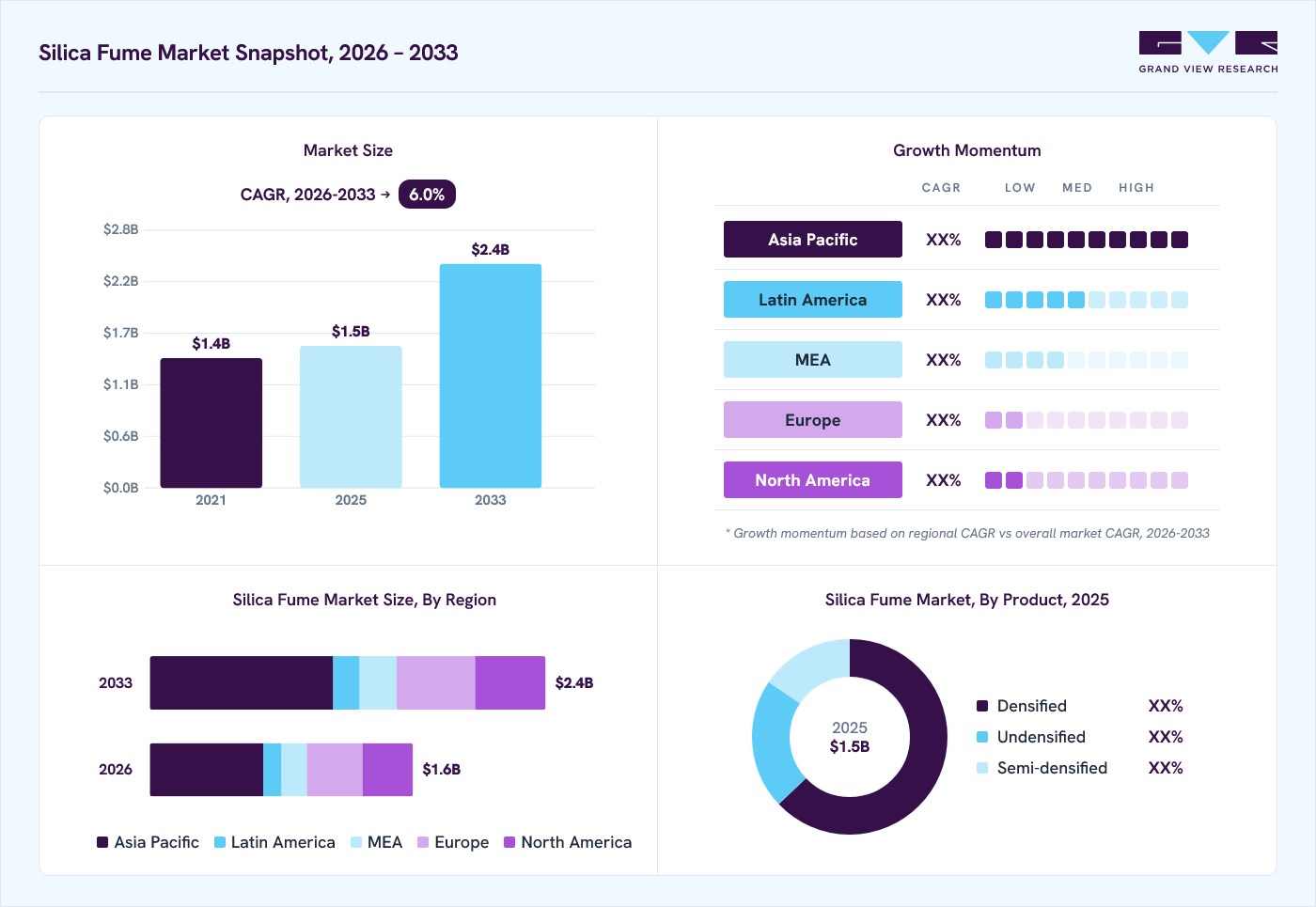 Source: Grand View Research, IR Documents, Primary Interviews, Paid DatabasesTo learn more about this report,
 Download Free Sample Report
 Key Market Trends & Insights
- By product: Densified accounted for the largest market revenue share of 62.9% in 2025.
- By end use: Polymers & elastomers segment is anticipated to register the fastest CAGR of 8.3% from 2026 to 2033.
Regional Highlights
- Largest regional market: Asia Pacific (42.9% revenue share, 2025)
- By country: China held the largest market share in 2025.
Market Size & Forecast
- Market Size in 2025: USD 1.5 billion
- Estimated Market Size in 2026: USD 1.6 billion
- Projected Market Size by 2033: USD 2.4 billion
- CAGR (2026-2033): 6.0%
Three ways to get this report
Buy it, customize it, or ask a question.Ask an Analyst
Analyst response in 1 business day
- AccessReport author, directly
- Reply timeWithin 1 working day
- No sales callDirect answer only
- FormatEmail reply
- CostFree, no cost
Get the Full Report
What the study covers
- FormatsPDF · Excel · Dashboard
- Timeline2026–2033 annual, 2025 base
- Coverage20+ countries, 5 regions
- Companies10+ key players profiled
Customize the Report
20% free customization
- IncludeCountries, segments, points
- TailorTo your product definition
- ExtendDeeper competitor detail
- OrA fully bespoke study
- Turnaround5–10 working days
The growing demand for high-performance concrete and durable construction materials is a major driver of demand. Silica fume improves compressive strength, reduces permeability, and enhances resistance to chemical attack, making it valuable in applications such as bridges, tunnels, marine structures, dams, and high-rise buildings. Increasing investments in infrastructure development and the adoption of advanced concrete formulations for demanding operating environments are supporting its use.
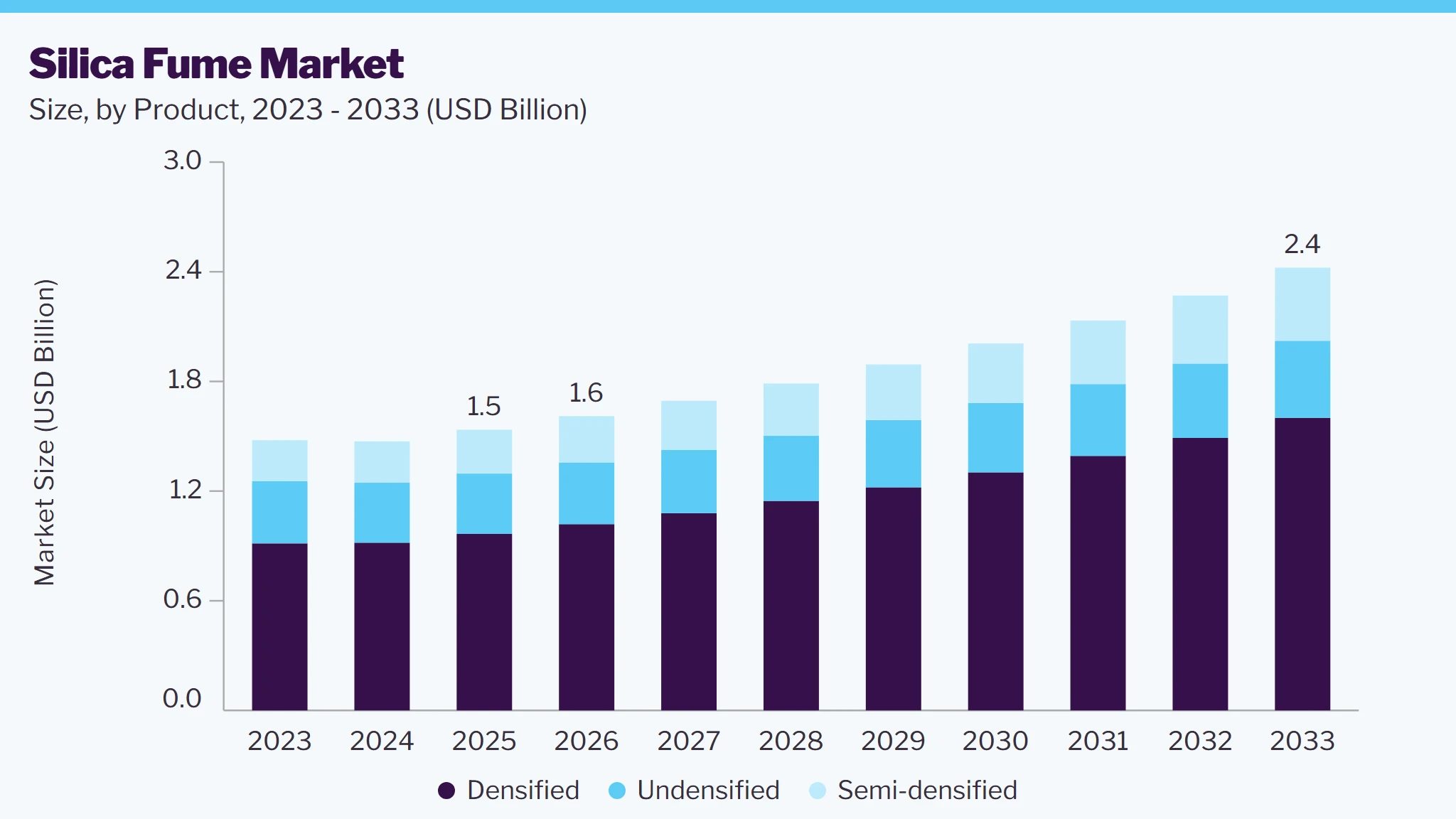 To learn more about this report, Download Free Sample Report
 The expansion of refractory applications is creating additional demand opportunities. Silica fume improves particle packing, cohesion, and performance in refractory castables used in steelmaking, cement production, and other high-temperature industrial processes. Growing industrial activity and the need for materials that can withstand extreme temperatures and harsh operating conditions are expected to support further adoption.
Increasing investments in transportation infrastructure, water management projects, and industrial construction are further contributing to demand. Silica fume supports the development of durable structures exposed to moisture, chemicals, and mechanical stress, reducing permeability and improving service life. The growing focus on infrastructure longevity, structural performance, and reduced maintenance requirements is expected to strengthen demand across construction and industrial applications.
Market Dynamics
The increasing use of high-performance concrete across infrastructure, commercial construction, and industrial projects is driving demand for silica fume. Its fine particle size and pozzolanic properties improve compressive strength, reduce permeability, and enhance resistance to chemical attack, making it suitable for bridges, tunnels, marine structures, and high-rise buildings. Rising investments in infrastructure development and the growing emphasis on durable, long-lasting structures are further supporting adoption.
The expansion of refractory applications is also contributing to demand. Silica fume improves particle packing, cohesion, and performance in refractory castables used in steelmaking, cement production, and other high-temperature industrial processes. Increasing industrial output and the need for materials capable of withstanding extreme temperatures and aggressive operating conditions are expected to support continued demand.
The availability of silica fume is closely linked to silicon metal and ferrosilicon production, as it is generated as a by-product of these manufacturing processes. Consequently, changes in furnace operating rates, alloy production, and industrial output can affect supply volumes. Limited availability in certain regions and logistical constraints may create procurement challenges for downstream consumers.
High transportation, handling, and processing costs can further restrict adoption, particularly for smaller construction companies and price-sensitive applications. Densification, storage, and moisture-control requirements add to supply-chain complexity, while fluctuations in energy costs and raw material production economics can influence pricing and purchasing decisions.
Increasing investment in bridges, tunnels, ports, dams, and other infrastructure projects presents opportunities for silica fume producers. The growing use of high-strength and high-performance concrete in structures requiring enhanced durability and reduced permeability is encouraging the development of application-specific formulations. Expanding infrastructure investment in emerging economies is expected to create additional opportunities for suppliers.
Advancements in refractory technology and the growing emphasis on industrial energy efficiency are also opening new avenues for adoption. Silica fume is increasingly relevant in specialized refractory castables, and repair materials used in steel, cement, and other high-temperature industries. Product optimization, improved densification technologies, and stronger distribution networks can help manufacturers address diverse customer requirements and expand their presence across industrial applications.
Analyst Perspective
The silica fume market is positioned for steady growth, supported by rising demand for high-performance concrete and durable construction materials across infrastructure, commercial buildings, marine structures, and industrial facilities. Expansion in oil & gas cementing and refractory applications is further supporting consumption, as silica fume enhances strength, reduces permeability, and improves resistance to chemical attack and high temperatures. Building & construction remains a key area of demand, while infrastructure modernization and growing investment in advanced refractory materials are creating additional opportunities for manufacturers to expand their product offerings and regional presence.
Product Insights
The densified segment accounted for a 62.9% revenue share in 2025, driven by its widespread suitability for bulk transportation, storage, and large-volume industrial applications. Densification reduces the volume of silica fume without fundamentally changing its chemical composition, improving logistics efficiency for suppliers and buyers. Its applicability in high-performance concrete and infrastructure projects supports its commercial relevance.
End Use Insights
By end use, polymers & elastomers segment is anticipated to register the fastest CAGR of 8.3% from 2026 to 2033. The polymers & elastomers segment is expected to witness growth as manufacturers explore specialized silica-based additives and fillers for improving material performance.
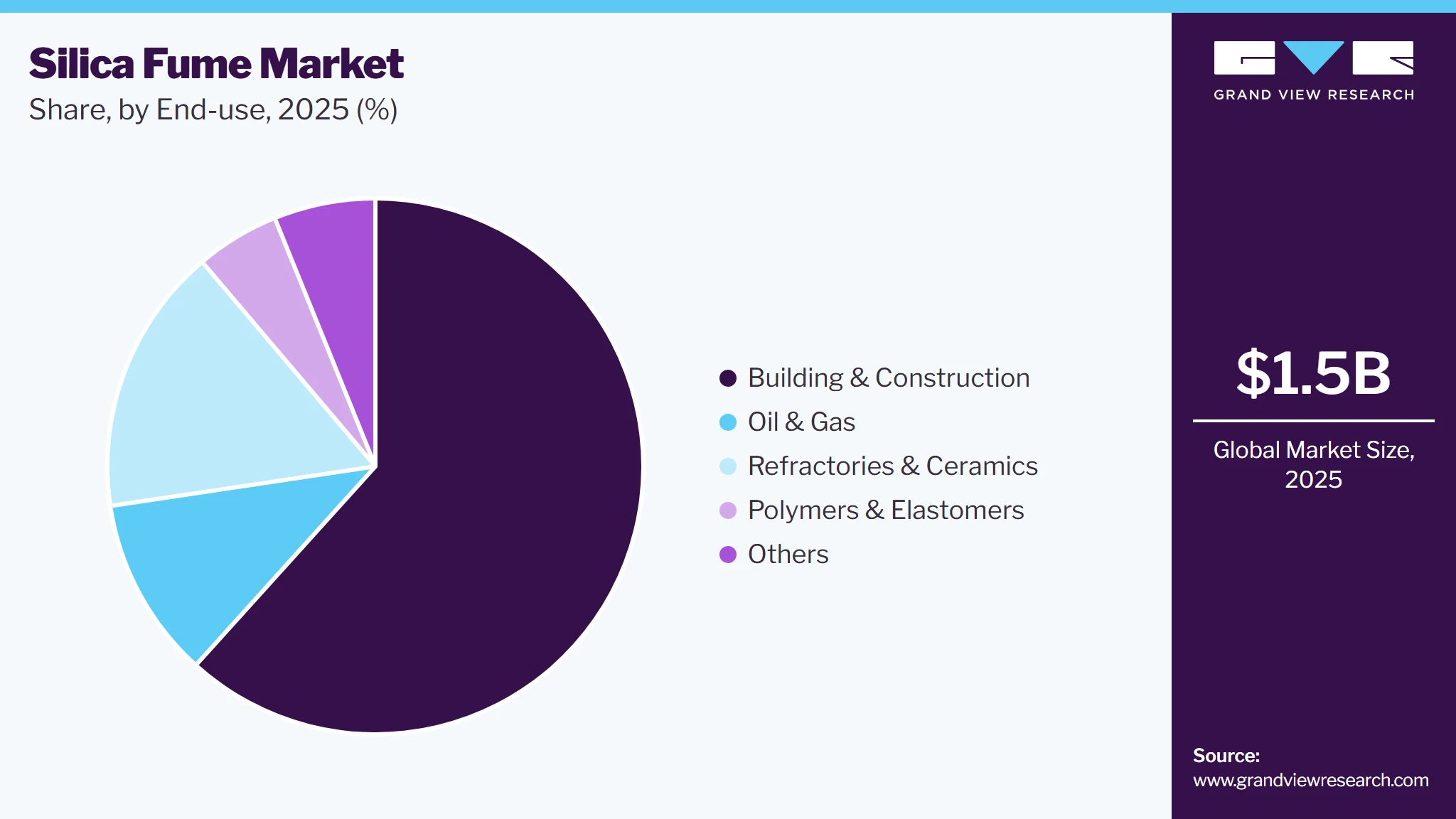 To learn more about this report, Download Free Sample Report
 However, precipitated silica and fumed silica are more commonly used in polymer and elastomer reinforcement than conventional silica fume. Growth in this segment will therefore depend on application-specific suitability and verified commercial usage.
Regional Insights
Asia Pacific dominated the silica fume market with the largest market revenue share of 42.9% in 2025. Asia Pacific benefits from extensive infrastructure development, rapid urbanization, and expanding industrial construction. Increasing investments in transportation networks, commercial buildings, ports, and energy infrastructure are driving demand for high-performance concrete. Growth in steelmaking, cement production, and other high-temperature industries further supports consumption, particularly as manufacturers and construction companies seek materials that enhance structural durability and operational performance.
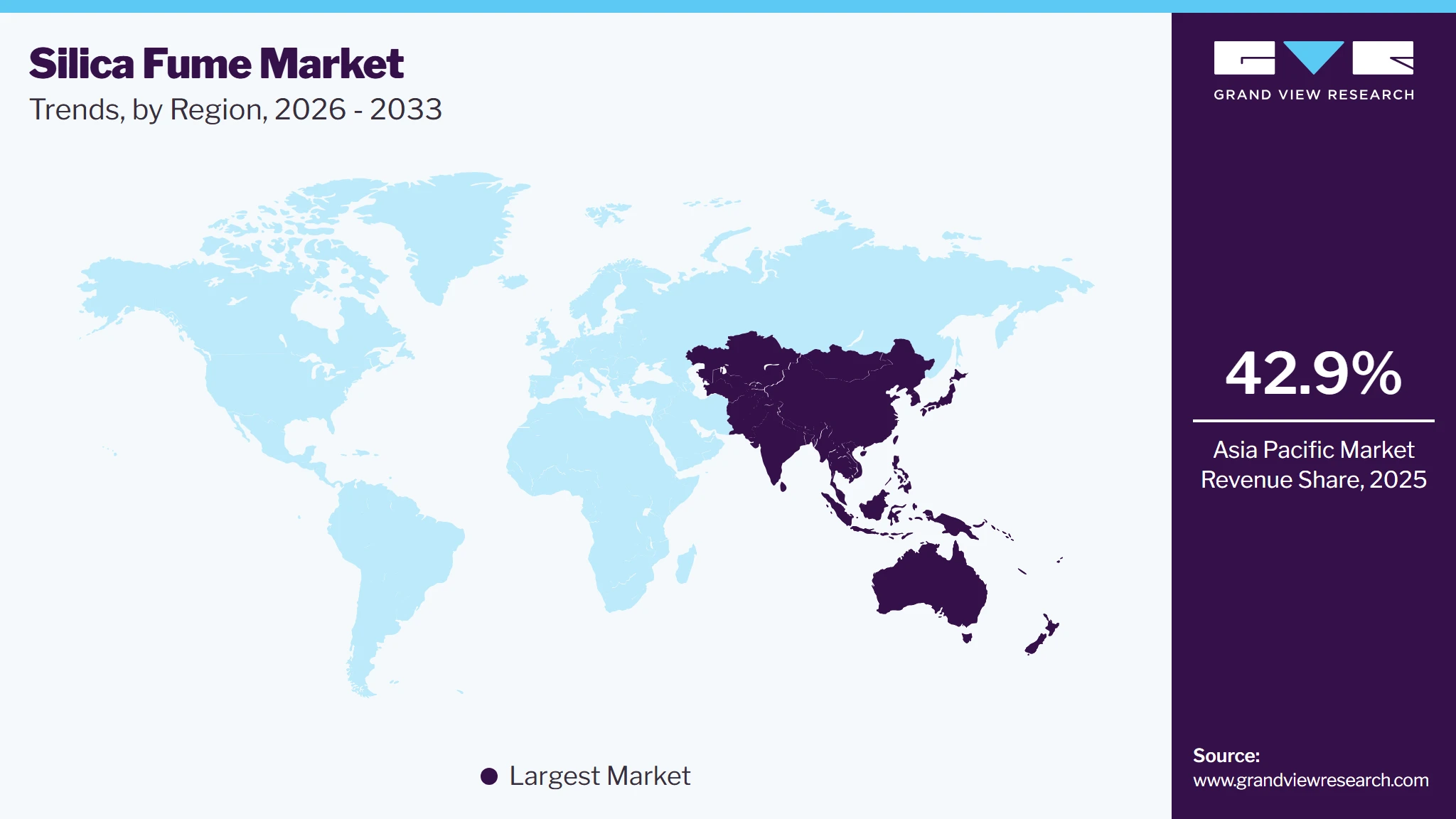 To learn more about this report, Download Free Sample Report
 The silica fume industry in the China held the largest revenue share in 2025. China's demand is supported by large-scale infrastructure development, urban redevelopment, transportation projects, and industrial construction. The use of high-performance concrete in bridges, tunnels, ports, and major civil engineering projects creates opportunities for silica fume adoption. The country's substantial steel and cement industries also support demand for refractory applications, while continued investment in industrial modernization contributes to consumption.
Europe Silica Fume Market Trends
Demand in Europe is supported by infrastructure renovation, sustainable construction practices, and stringent requirements for building durability. The use of high-performance concrete in bridges, tunnels, transport networks, and marine infrastructure is encouraging adoption. Established steel and cement industries also contribute to demand for refractory materials, while the focus on resource efficiency and longer-lasting structures supports the use of advanced construction additives.
North America Silica Fume Market Trends
Demand across North America is supported by investments in infrastructure modernization, commercial construction, and industrial facilities. The growing adoption of high-performance concrete in bridges, highways, tunnels, and water infrastructure is encouraging the use of silica fume to improve strength, durability, and resistance to chemical exposure. Demand from refractory applications in steelmaking and other high-temperature industries also contributes to regional consumption.
U.S. Silica Fume Market Trends
The U.S. is driven by infrastructure rehabilitation, commercial construction, and investments in industrial facilities. The use of high-strength concrete in transportation infrastructure, marine structures, and large-scale construction projects supports demand for silica fume. Additionally, ongoing maintenance and modernization activities in steel, cement, and other industrial facilities are contributing to its use in refractory formulations.
Middle East & Africa Silica Fume Market Trends
Demand across the Middle East & Africa is supported by infrastructure expansion, urban development, and investments in transportation, water management, energy, and industrial facilities. Large-scale construction projects in the Gulf countries are encouraging the use of durable concrete capable of withstanding high temperatures, moisture, and aggressive environmental conditions. In Africa, mining, metals processing, and industrial infrastructure projects provide additional opportunities for refractory applications and high-performance construction materials.
Latin America Silica Fume Market Trends
Demand in Latin America is influenced by infrastructure modernization, urban development, and investments in mining, energy, and industrial facilities. Construction projects involving bridges, ports, water infrastructure, and industrial structures create opportunities for high-performance concrete applications. Mining and metals production also support demand for specialized refractory materials, although infrastructure investment cycles, economic volatility, and supply-chain costs can influence adoption across the region.
Key Silica Fume Company Insights
Some of the key players operating in the market include Elkem ASA, Ferroglobe PLC, and others
-
Elkem ASA (Established in 1904) is a Norwegian metals and advanced materials company headquartered in Oslo, with operations spanning silicon materials, ferrosilicon alloys, foundry products, and carbon solutions. The company manufactures silica fume as a co-product of silicon and ferrosilicon production and supplies it under the Microsilica brand. Its products are used in high-performance concrete, refractory castables, oil-well cementing, and other industrial applications requiring improved strength, durability, and high-temperature performance.
-
Ferroglobe PLC (Established in 2015) is a global producer of silicon metal, silicon-based alloys, and manganese-based alloys, formed through the combination of FerroAtlántica and Globe Specialty Metals. The company recovers silica fume from silicon metal and ferrosilicon manufacturing operations, where it is collected through industrial filtration systems. Its products are primarily used in high-performance concrete and mortar, supporting construction applications such as bridges, ports, skyscrapers, and offshore structures.
-
Gansu Sanyuan Silicon Materials Co., Ltd. (Established in 2001) is a Chinese manufacturer specializing in silica fume and microsilica products for construction and industrial applications. The company has developed dedicated production and laboratory capabilities, including a silica fume facility established in Yinchuan in 2008 and a further factory in Lanzhou in 2018. Its products serve concrete engineering, water conservancy, transportation infrastructure, nuclear power projects, and oilfield cementing, with exports reaching customers across the Middle East, Africa, South America, and Europe.
Key Silica Fume Companies
The following key companies have been profiled for this study on the silica fume market.
-
Capital Microns Pvt. Ltd. (Global Microns)
-
Chengdu Rongjian Engineering Materials Co., Ltd.
-
Elkem ASA
-
Ferroglobe PLC
-
Gansu Sanyuan Silicon Materials Co., Ltd.
-
Henan Langhua New Materials Co., Ltd.
-
N K Enterprises (Silpozz)
-
Symphony Tradecomm Pvt. Ltd.
-
Wuhan Newreach Materials Co., Ltd.
-
Wuxi Evnt New Materials Co., Ltd.
Competitive Benchmarking
Category
Operating Strategies
Competitive Edge
Weakness
Established Players (e.g. Elkem ASA, Ferroglobe PLC, Finnfjord AS)
- Focus on silicon metal and ferrosilicon production, with silica fume recovered as a by-product.
- Optimize collection, densification, quality control, and distribution to serve construction and refractory customers.
- Strengthen long-term customer relationships through consistent product quality and reliable supply.
- Established silicon-based production infrastructure and silica fume recovery capabilities.
- Technical expertise in product handling, processing, and application-specific quality requirements.
- Established industrial customer networks and access to international distribution channels.
- Supply depends on operating rates of silicon metal and ferrosilicon furnaces.
- Energy costs, logistics, and production economics can affect competitiveness.
- Silica fume availability is constrained by its by-product nature rather than independent production demand.
Emerging & Regional Players (e.g., Capital Microns Pvt. Ltd., N K Enterprises (Silpozz), Wuhan Newreach Materials Co., Ltd.)
- Focus on supplying densified, semi-densified, and undensified grades for construction and industrial applications.
- Develop customized packaging, particle characteristics, and product specifications to address regional customer requirements.
- Expand through export partnerships, regional distribution networks, and application-specific product offerings.
- Flexibility in serving smaller orders and customized customer requirements.
- Potential cost advantages through regional sourcing and proximity to end users.
- Opportunities to serve underserved regional markets and specialized applications.
- Limited publicly available information on production capacity and manufacturing scale.
- Dependence on reliable sourcing, quality consistency, and logistics infrastructure.
- Lower brand recognition and potentially more limited international distribution networks than established producers.
Recent Development
-
In February 2026, Ferroglobe PLC reported its fourth-quarter and full-year 2025 financial results, highlighting changes in European ferroalloy trade conditions and U.S. silicon-metal trade proceedings. The company also disclosed in its 2025 annual filing that silica fume accounted for 2.1% of consolidated sales, compared with 1.9% in 2024, reflecting its continued role as a commercial by-product of silicon-metal and ferrosilicon production.
-
In October 2025, Elkem ASA announced production curtailments at its Rana and Salten plants in Norway and Iceland, citing challenging operating conditions. Since silica fume is recovered during silicon-metal and ferrosilicon production, changes in furnace operating rates can affect the availability of this by-product. The development highlights the link between upstream alloy production and silica fume supply.
Silica Fume Market Report Scope
Report Attribute
Details
Market Definition
Market size represents the annual revenue generated from the sale and consumption of silica fume across various product types and end use applications.
Market size in 2025
USD 1.5 billion
Estimated market size in 2026
USD 1.6 billion
Projected market size by 2033
USD 2.4 billion
Growth rate
CAGR of 6.0% from 2026 to 2033
Base year for estimation
2025
Historical data
2021 - 2024
Forecast period
2026 - 2033
Quantitative units
Revenue in USD million/billion, volume in kilotons, and CAGR from 2026 to 2033
Report coverage
Revenue and volume forecast, competitive landscape, growth factors, and trends
Segments covered
Product, end use, region
Regional scope
North America; Europe; Asia Pacific; Latin America; Middle East & Africa
Country scope
U.S.; Canada; Mexico; Germany; France; UK; Italy; Spain; China; India; Japan; Australia
Key companies profiled
Capital Microns Pvt. Ltd. (Global Microns); Chengdu Rongjian Engineering Materials Co., Ltd.; Elkem ASA; Ferroglobe PLC; Gansu Sanyuan Silicon Materials Co., Ltd.; Henan Langhua New Materials Co., Ltd.; N K Enterprises (Silpozz); Symphony Tradecomm Pvt. Ltd.; Wuhan Newreach Materials Co., Ltd.; Wuxi Evnt New Materials Co., Ltd.
Customization scope
Free report customization (equivalent up to 8 analysts working days) with purchase. Addition or alteration to country, regional & segment scope.
Pricing and purchase options
Avail customized purchase options to meet your exact research needs. Explore purchase options
Global Silica Fume Market Report Segmentation
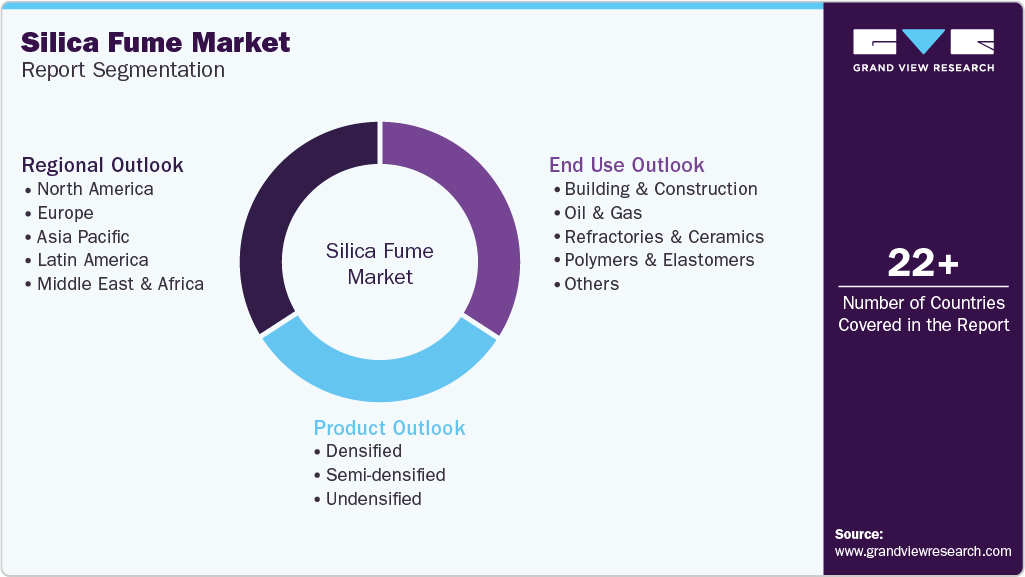
This report forecasts revenue and volume growth at global, regional, and country levels and provides an analysis of the latest industry trends in each of the sub-segments from 2021 to 2033. For this study, Grand View Research has segmented the global silica fume market report on the basis of product, end use, and region.
 To learn more about this report, Download Free Sample Report
 -
Product Outlook (Volume, Kilotons; Revenue, USD Million, 2021 - 2033)
-
Densified
-
Semi-densified
-
Undensified
-
-
End Use Outlook (Volume, Kilotons; Revenue, USD Million, 2021 - 2033)
-
Building & Construction
-
Oil & Gas
-
Refractories & Ceramics
-
Polymers & Elastomers
-
Others
-
-
Regional Outlook (Volume, Kilotons; Revenue, USD Million, 2021 - 2033)
-
North America
-
U.S.
-
Canada
-
Mexico
-
-
Europe
-
Germany
-
France
-
UK
-
Italy
-
Spain
-
-
Asia Pacific
-
China
-
India
-
Japan
-
Australia
-
-
Latin America
-
Middle East & Africa
-
Research Methodology
The silica fume market figures in this report are based on a proven research process that combines executive interviews with secondary research from proprietary databases, company filings, and recognized regulatory and institutional sources. Market size is built through value-chain sizing-reconciling supply-side and demand-side estimates-and triangulated with bottom-up and top-down approaches. Every estimate passes multiple levels of expert validation before publication, with each silica fume segment quantified using the revenue-capture definitions in the table below.
Segment Definition
Product
Revenue Capture Definition
Densified
The densified segment captures revenue generated from silica fume that has been compacted to reduce volume and improve storage, handling, and transportation efficiency. It is primarily used in ready-mix concrete, precast concrete, infrastructure projects, and refractory applications.
Semi-densified
The semi-densified segment represents revenue generated from silica fume that has undergone partial compaction, balancing handling efficiency with ease of dispersion during mixing. It is used in construction materials, refractory formulations, and other industrial applications.
Undensified
The undensified segment captures revenue generated from loose, uncompacted silica fume, which offers low bulk density and requires greater storage and transportation capacity. It is used in specialized concrete formulations, refractory products, and industrial applications where material handling and processing requirements support its use.
End Use
Revenue Capture Definition
Building & Construction
The building & construction segment captures revenue generated from silica fume used as a supplementary cementitious material in high-performance concrete, precast products, bridges, tunnels, marine structures, high-rise buildings, and other infrastructure projects.
Oil & Gas
The oil & gas segment represents revenue generated from silica fume used in oil-well cementing formulations to improve slurry stability, reduce permeability, and enhance resistance to high-pressure and high-temperature conditions.
Refractories & Ceramics
The refractories & ceramics segment captures revenue generated from silica fume used in refractory castables, monolithic linings, and specialized ceramic formulations. Its fine particle size and pozzolanic properties improve particle packing, cohesion, and performance in high-temperature industrial applications.
Polymers & Elastomers
The polymers & elastomers segment represents revenue generated from silica fume used in specialized applications involving polymer and elastomer compounds, where applicable. It is important to distinguish these uses from conventional silica fume applications, as precipitated silica and fumed silica are more commonly used as reinforcing fillers in rubber and polymer formulations.
Others
The others segment includes revenue generated from silica fume used in grouts, mortars, mining and tunneling applications, chemical-resistant construction materials, and other specialized industrial applications not classified elsewhere.
Estimation Model
Layer Name
Key Question
Description
Industrial & Construction Demand Base Layer
What forms the demand base?
Identify global demand from major silica fume-consuming industries, including building & construction, oil & gas, refractories & ceramics, and other specialized industrial applications. Assess concrete production, infrastructure development, oil-well cementing activity, and refractory material consumption to establish the total addressable demand for silica fume.
Silica Fume End-Use Penetration Layer
Where is silica fume utilized?
Estimate penetration across key end uses, including high-performance concrete, precast concrete, oil-well cementing, refractory castables, grouts, and specialized construction materials. Analyze adoption across product forms, including densified, semi-densified, and undensified silica fume, based on application requirements, regional construction practices, and industrial specifications.
Silica Fume Consumption Intensity Layer
How much silica fume is consumed?
Analyze consumption intensity based on concrete production volumes, cementitious material content, oil-well cementing activity, refractory output, and industrial material requirements. Evaluate usage according to silica fume dosage, concrete mix design, product form, performance specifications, and processing requirements. Consumption intensity varies by application, structural requirements, exposure conditions, and manufacturing efficiency.
Revenue Layer
How is revenue generated?
Quantify revenue generated through the sale of densified, semi-densified, and undensified silica fume across building & construction, oil & gas, refractories & ceramics, and other end uses. Revenue is influenced by product form, silica content, production volumes, silicon metal and ferrosilicon production economics, processing and densification costs, transportation expenses, and regional supply-demand dynamics.
Delivered Customizations
This report has been delivered with the following In-depth customizations
Client Request
Customization Delivered
Value Adds
Regional Price Differential Analysis
Comparison of silica fume prices across selected countries and regions, considering product form (densified, semi-densified, and undensified), packaging formats, transportation expenses, import duties, and applicable handling costs. The analysis evaluates differences between domestic and imported products and examines the factors influencing regional price variations and landed costs.
Supports regional pricing decisions, supplier selection, and identification of cost-competitive sourcing locations. Help businesses evaluate export opportunities, optimize procurement strategies, and improve price competitiveness across target geographies.
Infrastructure Project Pipeline
Assessment of announced, ongoing, and planned infrastructure projects, including bridges, tunnels, ports, dams, highways, high-rise buildings, and water infrastructure. The analysis examines project locations, development timelines, construction requirements, and potential applications of high-performance concrete to identify projects that may generate demand for silica fume.
Helps identify prospective demand centers and develop project-based sales pipelines. Supports early engagement with contractors, concrete producers, engineering companies, and infrastructure developers while enabling better regional sales planning and customer targeting.
Price & Cost Analysis
Assessment of silica fume pricing by product form, grade, region, packaging type, and supply channel. The analysis considers manufacturing and densification costs, raw material production conditions, transportation, storage, handling, and supply-demand fluctuations to understand the key factors influencing selling prices and procurement costs.
Supports pricing strategy, procurement negotiations, and cost planning. Help manufacturers evaluate cost drivers, distributors optimize margins, and buyers compare sourcing alternatives to improve purchasing efficiency and manage price volatility.
About the Author(s)
Advanced Interior Materials Research Team
Advanced Materials · Advanced Interior MaterialsThis report was authored by the advanced interior materials research team at Grand View Research - comprising two research analysts, one senior research analyst, and one industry expert - with specialized expertise in the advanced interior materials segment of the advanced materials industry. All findings are based on proprietary advanced materials databases, executive interviews, and regulatory analysis, subject to internal peer review prior to publication.
Last Updated:
Speak to Analyst

Customize this report to your needs - add regions, segments, or data points, with 20% free customization.
Or view our licence options:


ISO 9001:2015 & 27001:2022 Certified
We are GDPR and CCPA compliant! Your transaction & personal information is safe and secure. For more details, please read our privacy policy.


