
- Home
- »
- Advanced Interior Materials
- »
-
Silicon Carbide Fibers Market Size, Growth Report, 2026-2033GVR Report cover

Silicon Carbide Fibers Market (2026 - 2033)
Size, Share & Trends Analysis By Form (Continuous, Woven), By Usage (Composite, Non-composites), By End Use (Aerospace & Defense, Energy & Power, Industrial), By Region, And Segment Forecasts
Market Size, 2025
$1.1BMarket Estimate, 2026
$1.4BMarket Forecast, 2033
$6.9BCAGR, 2026–2033
26.2%Silicon Carbide Fibers Market Summary
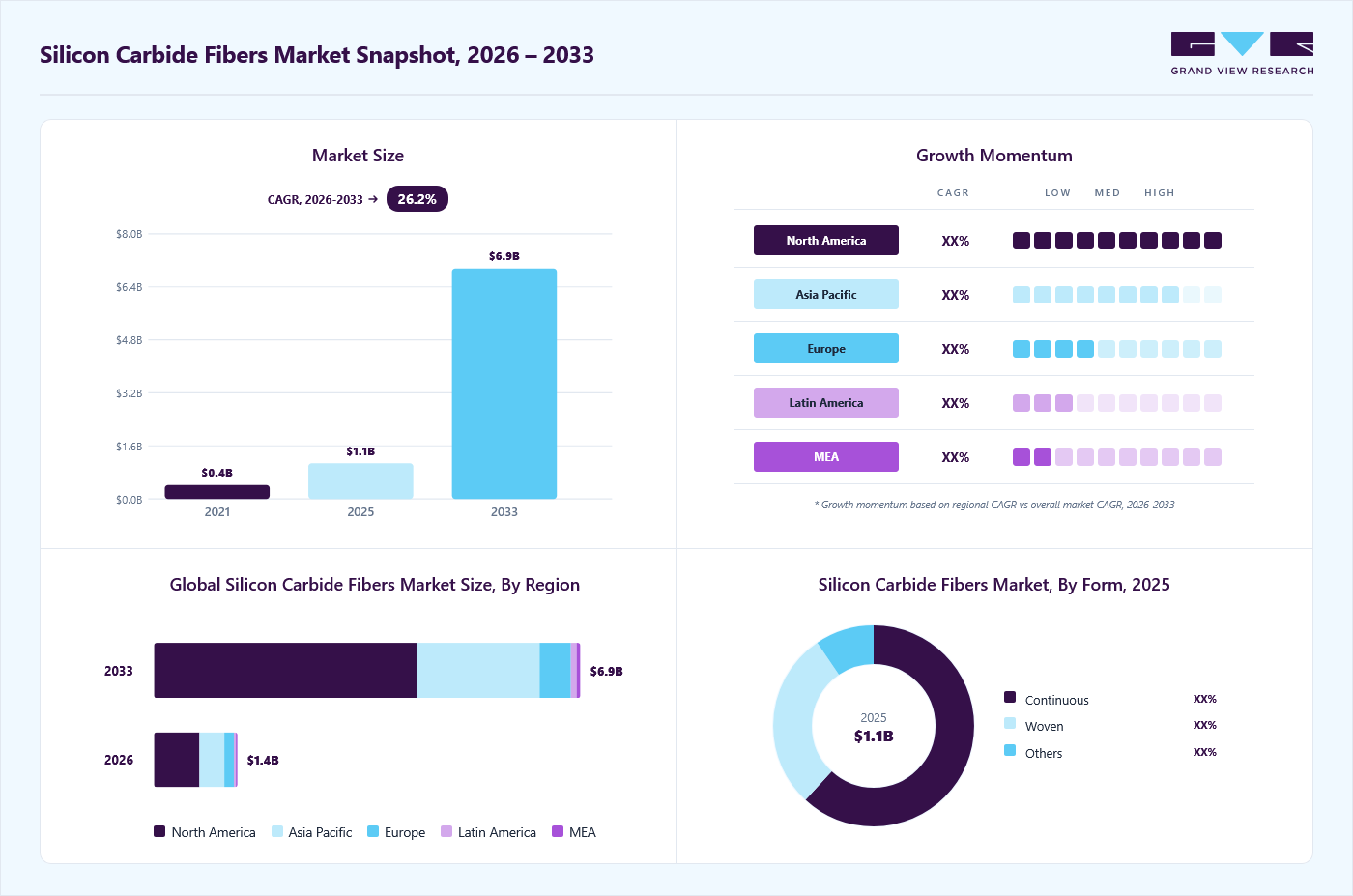
The global silicon carbide fibers market size was valued at USD 1.1 billion in 2025 and is projected to grow from USD 1.4 billion in 2026 to USD 6.9 billion by 2033, at a CAGR of 26.2% from 2026 to 2033. North America dominated the global market, accounting for the largest revenue share of 53.36% in 2025. This growth is attributed to the increasing demand in the aerospace and automotive industries for lightweight, high-strength materials that enhance performance and fuel efficiency.
 Source: Grand View Research, IR Documents, Primary Interviews, Paid DatabasesTo learn more about this report,
 Download Free Sample Report
 Key Market Trends & Insights
- By form: Continuous segment is expected to grow at the fastest CAGR of 28.7% from 2026 to 2033.
- By usage: Composite segment held the largest share in 2025.
- By end use: Defense thermal protection systems (TPS) segment is expected to grow at the fastest CAGR of 31.0% from 2026 to 2033.
Regional Highlights
- Largest regional market: North America (53.36% revenue share, 2025)
- By country: The Mexico silicon carbide fibers industry is a major contributor to the global market.
Market Size & Forecast
- Market size in 2025: USD 1.1 Billion
- Estimated market size in 2026: USD 1.4 Billion
- Projected market size by 2033: USD 6.9 Billion
- CAGR (2026-2033): 26.2%
GVR research-powered AIAsk Prism AI about the silicon carbide fibers marketGet cited answers from GVR research on market growth, segments, regulations and forecasts.Start with✓ Source-linked answers ✓ Market-specific context ✓ Traceable figuresExplore Prism AI ↗
In addition, technological advancements in manufacturing processes improve fiber properties and reduce production costs. Furthermore, the growing emphasis on energy efficiency and sustainability is driving the adoption of silicon carbide fibers across a range of applications, including electronics and renewable energy systems. These factors collectively contribute to global market expansion. Silicon carbide fibers are advanced materials known for their exceptional strength, thermal stability, and oxidation resistance. The market for these fibers is experiencing significant growth, driven by rising demand for lightweight, high-strength composites across sectors such as aerospace, automotive, and defense.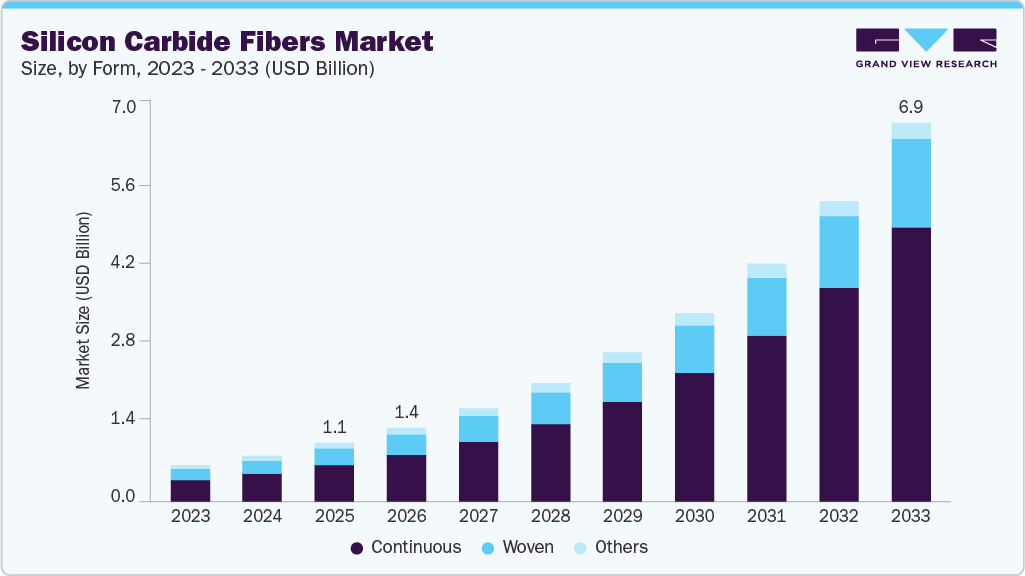 To learn more about this report, Download Free Sample Report
 These composites leverage silicon carbide fibers to provide superior mechanical properties, making them suitable for applications where minimizing weight while maintaining structural integrity is essential.
 To learn more about this report, Download Free Sample Report
 Drivers, Opportunities & Restraints
Ongoing technological advancements are driving market growth. Manufacturers are investing in research and development to enhance the performance of silicon carbide fibers, resulting in improved mechanical properties such as higher tensile strength and better fiber-to-matrix adhesion.
Moreover, government initiatives to promote environmental sustainability and fuel efficiency are influencing market dynamics. Stricter regulations worldwide to curb carbon emissions are encouraging industries to adopt lightweight materials, such as silicon carbide fiber composites. These materials not only help manufacturers comply with regulations but also reduce their overall carbon footprint. Furthermore, government funding for research into advanced materials provides additional support for the growth of the silicon carbide fiber market, highlighting its importance in the transition toward more sustainable industrial practices.
Market Concentration & Characteristics
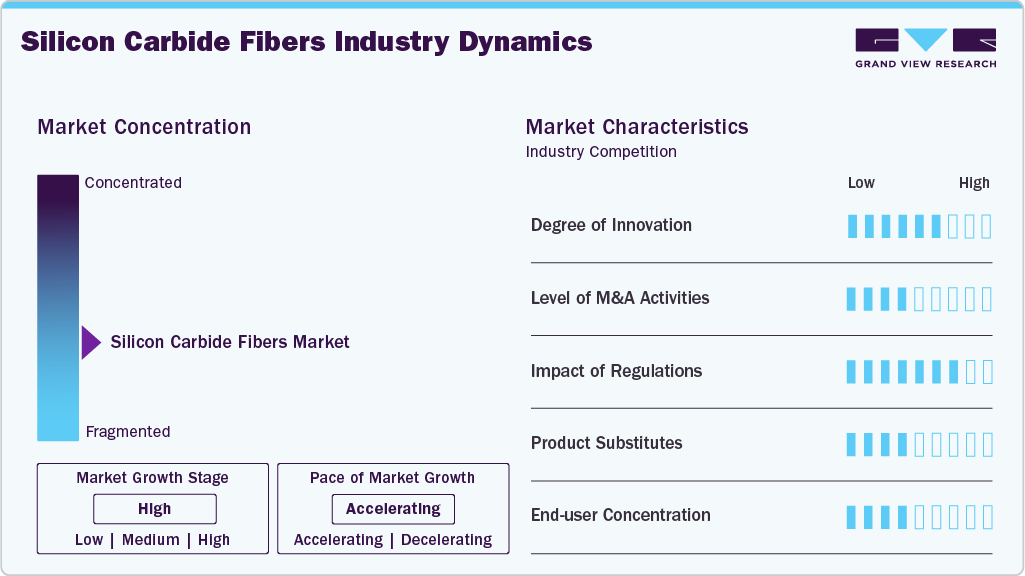
The market growth stage is exponential, and growth is accelerating. The market exhibits fragmentation, with key players dominating the industry landscape. Major companies such as SGL Carbon, Toyobo Co., Ltd., CeramTec, 3M, and others play a significant role in shaping the market dynamics. These leading players often drive innovation in the market, introducing new products, technologies, and product types to meet the industry's evolving demands.
Innovation in the silicon carbide (SiC) fibers market is driven by relentless enhancements in precursor chemistry, fiber microstructure control, and manufacturing processes that elevate performance under extreme conditions. Continuous SiC fibers now deliver tensile strengths exceeding 2.8 GPa at temperatures above 1,600 °C, enabling next-generation ceramic matrix composites (CMCs) for aerospace propulsion and advanced energy systems. Manufacturers leverage defect-controlled spinning, surface coatings, and robotics-assisted preform fabrication to shrink defect rates, expand service envelopes, and embed the material into complex structural components. Such technology leadership creates high entry barriers and preserves premium pricing even as production scales up.
 To learn more about this report, Download Free Sample Report
 Substitution risk in the silicon carbide fibers market arises from alternative advanced ceramic fibers, such as alumina, silicon nitride, and zirconia-based grades, which compete in mid-temperature and cost-sensitive applications. These substitutes often offer lower manufacturing costs, sometimes 25-30 % below SiC prices, and sufficient performance for industrial heating or moderate service environments, thereby curbing SiC adoption outside flagship aerospace and nuclear segments. To maintain relevance, SiC fiber makers pursue hybrid solutions or performance differentiation that conventional substitutes cannot match at temperatures beyond 1,600°C, but substitution pressure continues to shape segment strategies and keep cost reduction central to future innovation.
Form Insights
Continuous segment dominated the market, accounting for a 61.81% market share in 2025, and is forecasted to grow at a 28.7% CAGR from 2026 to 2033, attributed to the increasing demand for high-performance materials in the aerospace, automotive, and defense industries. In addition, continuous fibers provide exceptional mechanical properties, including high tensile strength and thermal stability, making them ideal for applications that require lightweight yet durable composites. Furthermore, their ability to enhance structural integrity while reducing weight is crucial in advanced engineering applications, leading to a growing preference for continuous silicon carbide fibers in critical components and systems.
The woven segment is anticipated to grow at a substantial CAGR of 23.1% over the forecast period, driven by the versatility and enhanced performance these materials offer across various applications. In addition, woven fabrics offer greater flexibility and adaptability in composite structures, making them suitable for complex geometries in aerospace and industrial applications. Furthermore, the growing emphasis on lightweight materials that can withstand extreme temperatures and harsh environments further drives demand for woven silicon carbide fibers. Moreover, advancements in weaving techniques improve fiber-to-matrix adhesion, enhancing overall performance in composite materials.
Usage Insights
Composite segment dominated the market across all usage segments in terms of revenue, accounting for a 78.96% market share in 2025, and is forecasted to grow at the fastestCAGR from 2026 to 2033, driven by advancements in manufacturing technologies and increasing demand from various industries. These fibers are favored for their superior strength-to-weight ratio, thermal stability, and resistance to chemical degradation, making them ideal for aerospace, automotive, and energy applications. Furthermore, the push for lightweight materials to enhance fuel efficiency in transportation sectors is driving the adoption of composite silicon carbide fibers, which offer significant performance benefits over traditional materials.
The non-composites segment is anticipated to grow at a substantial CAGR of 20.9% over the forecast period, driven by its cost-effectiveness and versatility across various applications. Non-composite silicon carbide fibers are increasingly utilized in industrial processes with high temperatures and corrosive environments, such as semiconductor manufacturing and heating elements. In addition, the expanding electronics sector and the growing need for durable materials in harsh conditions are driving demand for non-composite fibers. Furthermore, ongoing research into new applications and improvements in fiber production techniques is expected to bolster the segment growth.
End Use Insights
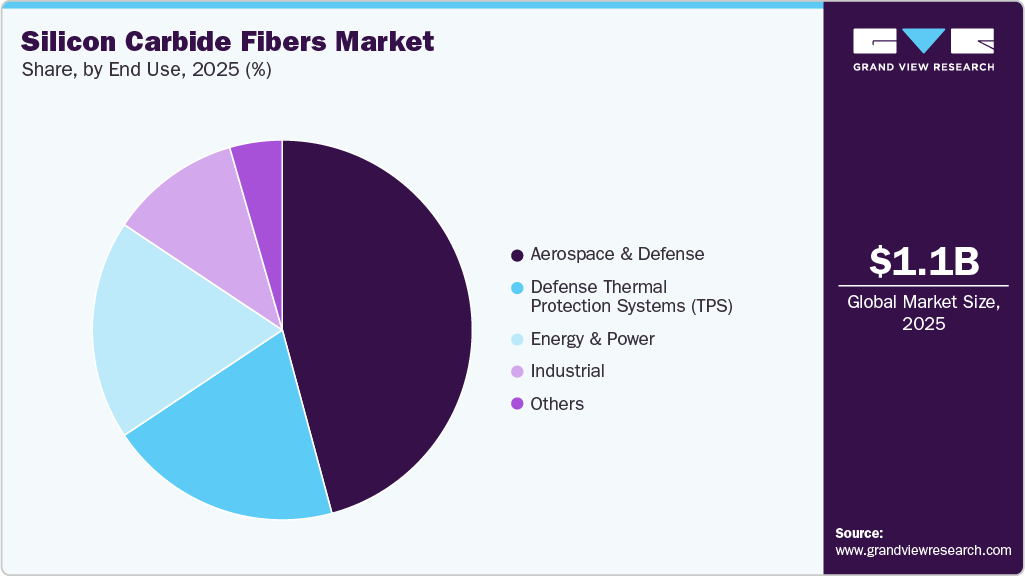
Aerospace & defense segment dominated the market with the largest revenue share of 45.80% in 2025, and is forecast to grow at the fastestCAGR from 2026 to 2033, driven by the increasing demand for lightweight, high-strength materials that can withstand extreme conditions. In addition, silicon carbide fibers offer exceptional thermal stability and mechanical properties, making them ideal for critical applications in aircraft and military equipment. Furthermore, the rising production of advanced aircraft and the need for improved performance in defense systems further fuel this demand as manufacturers seek materials that enhance efficiency and reduce overall weight.
 To learn more about this report, Download Free Sample Report
 The defense thermal protection systems (TPS) segment is expected to grow at a robust 6.7% CAGR over the forecast period. A unique driver for silicon carbide fibers in defense thermal protection systems is the material’s ability to enable next-generation hypersonic and re-entry platforms to withstand extreme aerothermal loads. SiC fibers incorporated into ceramic matrix composites provide exceptional thermal stability and oxidation resistance at temperatures above 1,500 °C, far exceeding the limits of traditional metals and organic composites. This performance is essential for TPS on missiles, space vehicles, and hypersonic glide bodies, where surface heating can rapidly exceed design thresholds, leading to material failure and compromising mission success. Government defense programs and accelerated investments in hypersonic development are directly expanding demand for SiC fiber-reinforced TPS solutions.
Regional Insights & Trends
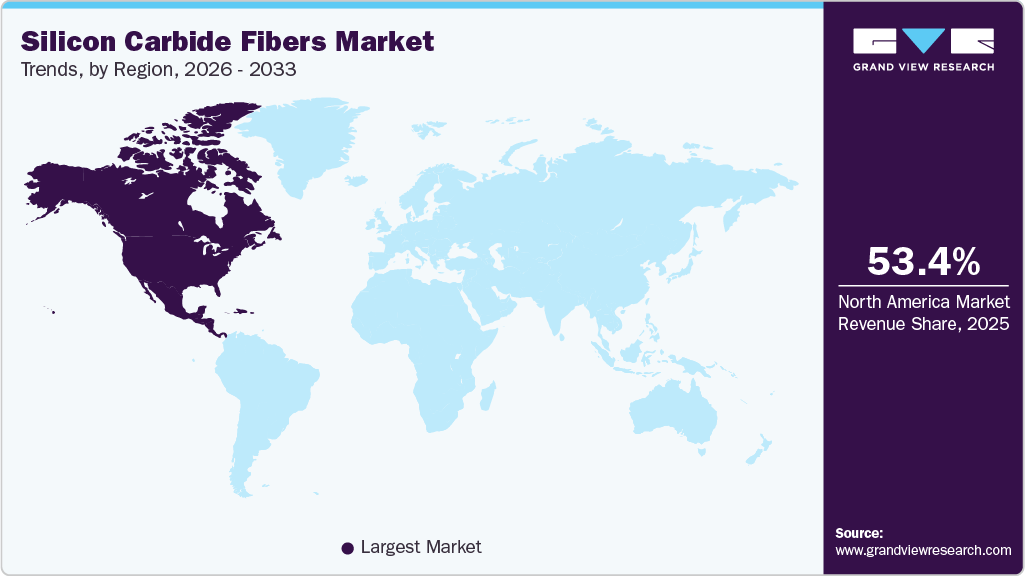
The North America silicon carbide fibers industry held the largest share, accounting for 53.36% of revenue in 2025, and is expected to grow at the fastest CAGR of 28.5% over the forecast period, driven by the strong presence of the aerospace and defense industries, which demand high-performance materials. In addition, the region's focus on developing lightweight, durable composites that can withstand extreme conditions drives the adoption of silicon carbide fibers. Furthermore, substantial research and development investments and government initiatives supporting advanced manufacturing technologies further enhance market growth. Moreover, the established supply chain and presence of key manufacturers also contribute to the market's expansion in North America.
 To learn more about this report, Download Free Sample Report
 U.S. Silicon Carbide Fibers Market Trends
The silicon carbide fibers market in the U.S. dominated the North American market and accounted for the largest revenue share in 2025, driven by advancements in aerospace technology and defense applications. Furthermore, the growing production of military aircraft and satellites requires materials with superior strength and thermal resistance, making silicon carbide fibers highly desirable. Moreover, government regulations promoting energy efficiency and sustainability encourage industries to adopt lightweight materials.
Europe Silicon Carbide Fibers Market Trends
The European silicon carbide fiber market is expected to witness substantial growth over the forecast period, driven by growing demand from the aerospace and automotive sectors for lightweight materials. Furthermore, Europe’s commitment to sustainability fosters research and development activities aimed at enhancing fiber properties. Moreover, collaborations between industry leaders and academic institutions further advance silicon carbide fiber technologies across the region.
Asia Pacific Silicon Carbide Fibers Market Trends
The Asia Pacific silicon carbide fiber market is expected to grow rapidly over the forecast period, driven by rapid industrialization and increasing investments in the aerospace, automotive, and energy sectors. In addition, countries such as China and India are focusing on developing advanced materials to meet the demands of their expanding industries. Furthermore, the push for lightweight composites that enhance performance and efficiency drives the adoption of silicon carbide fibers. Moreover, government initiatives to promote sustainable practices further support market growth as industries seek to comply with environmental regulations.
Key Silicon Carbide Fibers Company Insights
The silicon carbide fibers industry is highly competitive, with several key players dominating the landscape. Major companies include SGL Carbon, Toyobo Co., Ltd., U.S. Specialty Materials (USSM), CeramTec, 3M, H.C. Starck, Nippon Carbon Co., Ltd., GE Aviation, Dow Chemical (Dow Inc.), and Applied Materials. The silicon carbide fibers industry is characterized by a competitive landscape with several key players driving innovation and market growth. Major companies in this sector are investing heavily in research and development to enhance the performance, cost-effectiveness, and sustainability of their products.
Key Silicon Carbide Fibers Companies:
The following key companies have been profiled for this study on the silicon carbide fibers market.
- SGL Carbon
- Toyobo Co., Ltd.
- U.S. Specialty Materials (USSM)
- CeramTec
- 3M
- H.C. Starck
- Nippon Carbon Co., Ltd.
- GE Aviation
- Dow Chemical (Dow Inc.)
- Applied Materials
Recent Developments
-
In May 2024, Tokai Carbon and Soitec formed a strategic partnership to co-develop polycrystalline SiC substrates for SmartSiC wafers. The tie-up expands regional SiC capacity and strengthens the upstream supply chain for SiC materials across Europe and Asia.
-
In 2024, the company committed an additional $105 million to expand ceramic matrix composite manufacturing at its Asheville facility. The funding accelerated tooling, automated layup, and quality systems. This move directly increases demand for continuous silicon carbide fibers used in high-temperature engine components.
Silicon Carbide Fibers Market Report Scope
Report Attribute
Details
Market size in 2025
USD 1.1 billion
Estimated Market size in 2026
USD 1.4 billion
Projected Market size by 2033
USD 6.9 billion
Growth rate
CAGR of 26.2% from 2026 to 2033
Historical data
2021 - 2024
Forecast period
2026 - 2033
Quantitative units
Revenue in USD million/billion, volume in kilotons, and CAGR from 2026 to 2033
Report coverage
Revenue forecast, competitive landscape, growth factors, and trends
Segments covered
Form, usage, end use, region
Regional scope
North America; Europe; Asia Pacific; Central & South America; Middle East & Africa
Country Scope
U.S.; Canada; Mexico; China; Japan; Germany; UK; France; Brazil
Key companies profiled
SGL Carbon; Toyobo Co., Ltd.; U.S. Specialty Materials (USSM); CeramTec; 3M; H.C. Starck; Nippon Carbon Co., Ltd.; GE Aviation; Dow Chemical (Dow Inc.); Applied Materials
Customization scope
Free report customization (equivalent to up to 8 analyst working days) with purchase. Addition or alteration to country, regional & segment scope
Pricing and purchase options
Avail customized purchase options to meet your exact research needs. Explore purchase options
Global Silicon Carbide Fibers Market Report Segmentation
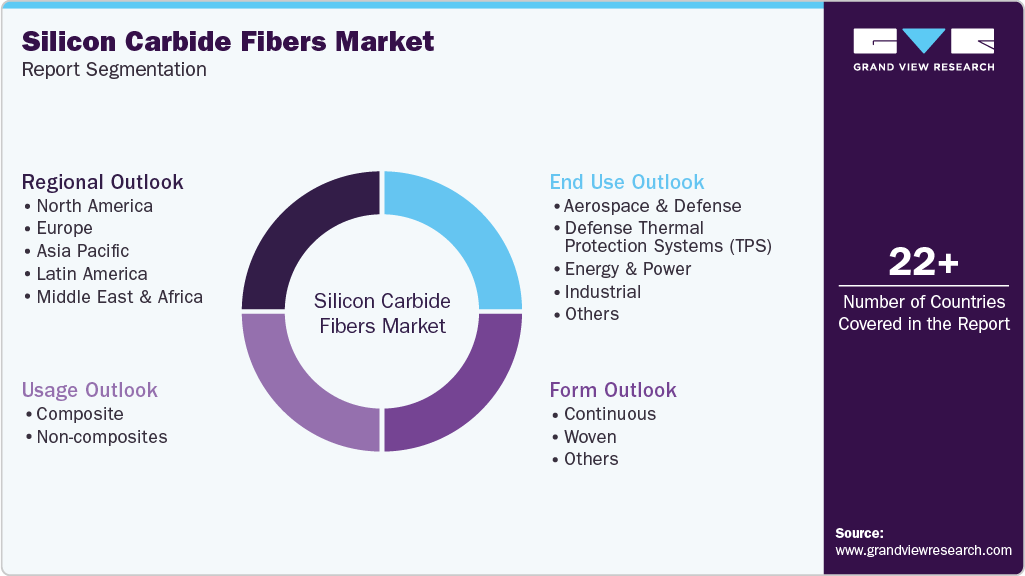
This report forecasts revenue growth at the global, regional, and country levels and provides an analysis of the latest industry trends across sub-segments from 2021 to 2033. For this study, Grand View Research has segmented the silicon carbide fibers market report based on form, usage, end use, and region:
 To learn more about this report, Download Free Sample Report
 -
Form Outlook (Volume, Kilotons; Revenue, USD Million, 2021 - 2033)
-
Continuous
-
Woven
-
Others
-
-
Usage Outlook (Volume, Kilotons; Revenue, USD Million, 2021 - 2033)
-
Composite
-
Non-composites
-
-
End Use Outlook (Volume, Kilotons; Revenue, USD Million, 2021 - 2033)
-
Aerospace & Defense
-
Hypersonic missiles
-
Hypersonic vehicles / glide bodies
-
Space & launch vehicles
-
Aircraft engines & high-temperature components
-
Others
-
-
Defense Thermal Protection Systems (TPS)
-
Energy & Power
-
Industrial
-
Others
-
-
Regional Outlook (Volume, Kilotons; Revenue, USD Million, 2021 - 2033)
-
North America
-
U.S.
-
Canada
-
Mexico
-
-
Europe
-
UK
-
Germany
-
France
-
-
Asia Pacific
-
China
-
Japan
-
-
Latin America
-
Brazil
-
- Middle East and Africa
-
Frequently Asked Questions About This Report
The growth is attributed to the increasing demand in the aerospace and automotive industries for lightweight, high-strength materials that enhance performance and fuel efficiency.
North America dominated with a 53.4% revenue share in 2025.
Aerospace & defense segment led with a 45.8% revenue share in 2025, and is the fastest-growing segment.
Composite segment held the largest share (over 78.0%) in 2025, while composite is the fastest-growing usage.
The global silicon carbide fibers market size was valued at USD 1.1 billion in 2025 and is estimated at USD 1.4 billion for 2026.
The global silicon carbide fibers market is expected to grow at a CAGR of 26.2% from 2026 to 2033, reaching USD 6.9 billion by 2033.
Continuous dominated the market across all form segments in terms of revenue, accounting for a 61.8% market share in 2025, and is forecasted to grow at a 28.7% CAGR from 2026 to 2033, attributed to the increasing demand for high-performance materials in the aerospace, automotive, and defense industries.
Key players include SGL Carbon; Toyobo Co., Ltd.; U.S. Specialty Materials (USSM); CeramTec; 3M; H.C. Starck; Nippon Carbon Co., Ltd.; GE Aviation; Dow Chemical (Dow Inc.); Applied Materials.
About the Author(s)
Advanced Interior Materials Research Team
Advanced Materials · Advanced Interior MaterialsThis report was authored by the advanced interior materials research team at Grand View Research - comprising two research analysts, one senior research analyst, and one industry expert - with specialized expertise in the advanced interior materials segment of the advanced materials industry. All findings are based on proprietary advanced materials databases, executive interviews, and regulatory analysis, subject to internal peer review prior to publication.
Last Updated:
Speak to Analyst

Customize this report to your needs - add regions, segments, or data points, with 20% free customization.
Or view our licence options:


ISO 9001:2015 & 27001:2022 Certified
We are GDPR and CCPA compliant! Your transaction & personal information is safe and secure. For more details, please read our privacy policy.


