
- Home
- »
- Plastics, Polymers & Resins
- »
-
Silicone Fluids Market Size And Share Report, 2026-2033GVR Report cover

Silicone Fluids Market (2026 - 2033) Size, Share & Trends Analysis Report By Type (PDMS, Methyl Silicone Fluids, Fluorosilicone Fluids), By Application (Automotive, Textile Finishing, Healthcare, Personal care & cosmetics), By Region, And Segment Forecasts
Market Size, 2025
$7.4BMarket Estimate, 2026
$7.9BMarket Forecast, 2033
$12.9BCAGR, 2026–2033
7.2%Silicone Fluids Market Summary
The global silicone fluids market size was valued at USD 7.41 billion in 2025 and is projected to grow from USD 7.93 billion in 2026 to USD 12.90 billion by 2033, growing at a CAGR of 7.2% from 2026 to 2033. Asia Pacific dominated the global silicone fluids industry with the largest revenue share of 50.1% in 2025. The global market is expanding due to rising demand from personal care & cosmetics, electrical & electronics, industrial lubricants, automotive, textile finishing, paints & coatings, defoamers & surfactants, chemical processing, and healthcare applications, owing to their strong temperature stability, excellent electrical insulation, low surface tension, water repellency, and chemically inert, non-corrosive nature.
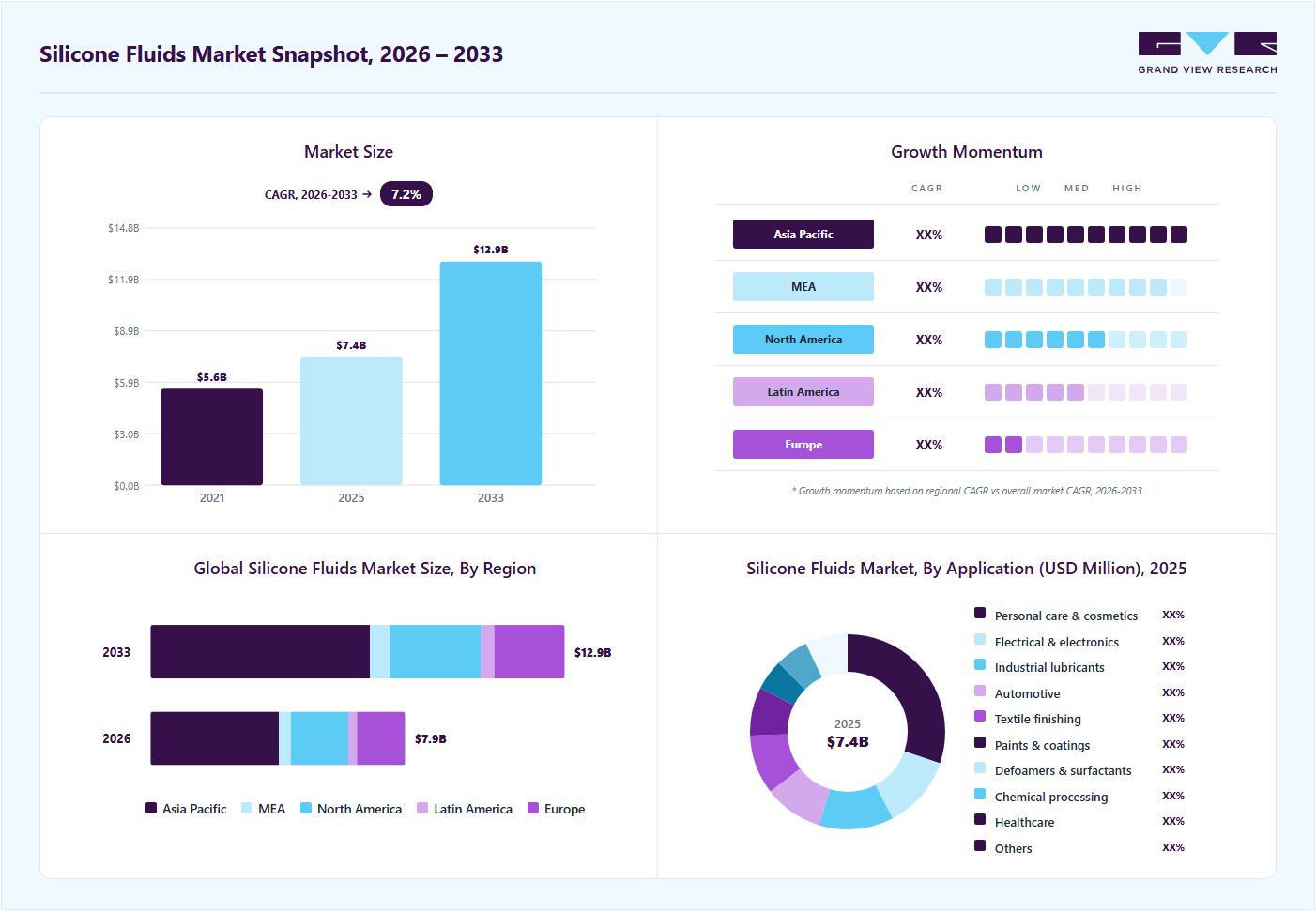 Source: Grand View Research, IR Documents, Primary Interviews, Paid DatabasesTo learn more about this report,
 Download Free Sample Report
 Key Market Trends & Insights
- The silicone fluids industry in India is expected to grow at a CAGR of 9.5% from 2026 to 2033.
- The fluorosilicone fluids segment is anticipated to grow at a CAGR of 10.2% in the type segment.
- By application, the electrical & electronics segment is expected to grow at an 8.8% CAGR in revenue from 2026 to 2033.
Market Size & Forecast
- 2025 Market Size: USD 7.41 Billion
- 2033 Projected Market Size: USD 12.90 Billion
- CAGR (2026-2033): 7.2%
- Asia Pacific: Largest market in 2025
Three ways to get this report
Buy it, customize it, or ask a question.Ask an Analyst
A direct answer, usually in 1 working day
- AccessReport author, directly
- Reply timeWithin 1 working day
- No sales callDirect answer only
- FormatEmail reply
- CostFree, no cost
Get the Full Report
What the study covers
- FormatsPDF · Excel · Dashboard
- Timeline2026–2033 annual, 2025 base
- Coverage20+ countries, 5 regions
- Companies10+ key players profiled
Customize the Report
20% free customization
- IncludeCountries, segments, points
- TailorTo your product definition
- ExtendDeeper competitor detail
- OrA fully bespoke study
- Turnaround5–10 working days
Rapid adoption of silicone fluids for immersion cooling in EV battery packs and power electronics is emerging as a major market trend. Automotive manufacturers are increasingly integrating advanced thermal management systems to improve battery efficiency, charging performance, and operational safety in electric vehicles. Silicone fluids are gaining popularity due to their superior dielectric strength, thermal stability, low flammability, and efficient heat transfer. Demand is rising across EV battery modules, onboard chargers, inverters, and data-intensive automotive electronics. Increasing investments in high-performance electric mobility platforms and fast-charging infrastructure are further accelerating market expansion.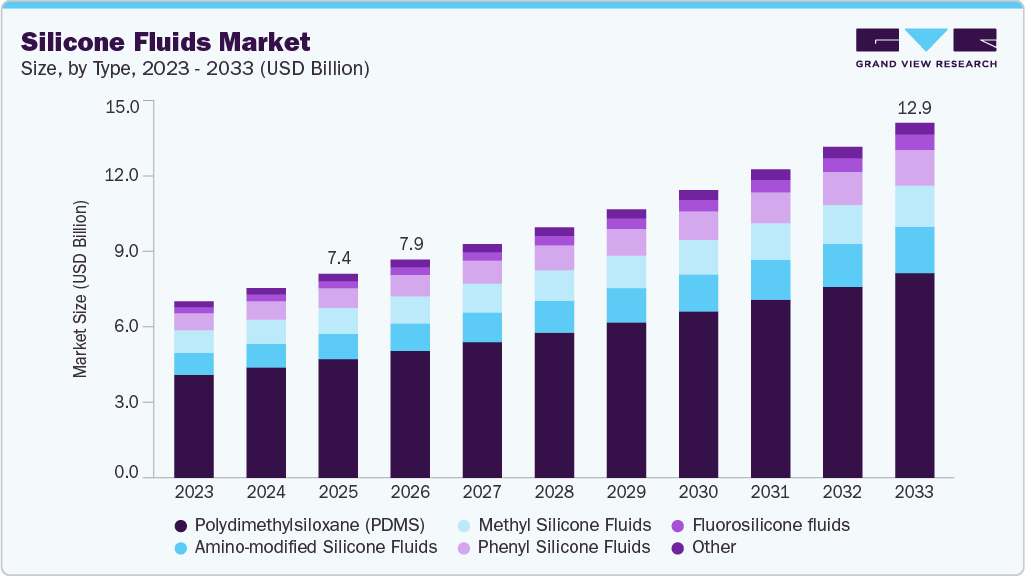 To learn more about this report, Download Free Sample Report
 Bio-based and specialty silicone formulations are gaining significant market traction due to rising environmental regulations and evolving consumer preferences. Manufacturers are investing in biodegradable, PFAS-free, and ultra-low-VOC silicone fluids to comply with strict sustainability standards, particularly in Europe and North America. Growing demand from personal care applications is driving the development of multifunctional modified silicones with enhanced UV protection, antibacterial performance, and long-lasting hydration properties. The healthcare and pharmaceutical sectors are also increasing the adoption of medical-grade silicone fluids for advanced wound care, diagnostic devices, soft robotics, and minimally invasive medical technologies.
Market Dynamics
The market is experiencing strong demand from the personal care & cosmetics industry, supported by rising disposable incomes and rapid urbanization across developing economies. Expanding middle- and upper-middle-income consumer groups are increasing spending on premium skincare, haircare, and beauty products, even amid moderate economic uncertainty. Urban consumers are increasingly preferring convenience-oriented, daily-use cosmetic solutions, which is accelerating demand for silicone-based conditioning agents and emollients. Silicone fluids are widely used in creams, serums, shampoos, and color cosmetics due to their smooth texture, spreadability, moisture retention, and long-lasting sensory performance.
The rapid expansion of quick commerce platforms is further supporting market growth by improving accessibility to premium and specialized beauty products. Faster product delivery and wider digital product availability are encouraging frequent consumer purchases across urban markets. At the same time, growing demand for personalized skincare and haircare solutions is driving the use of customized silicone fluid formulations tailored to different skin textures, climatic conditions, and hair types. Manufacturers are focusing on multifunctional silicone ingredients that enhance product stability, improve shine, improve softness, and deliver non-greasy performance while meeting evolving consumer expectations for high-quality cosmetic formulations.
One of the key restraints affecting the market is the growing regulatory pressure on volatile methyl siloxanes and cyclic silicone compounds. Regulatory agencies, such as the REACH framework and the U.S. EPA, have imposed strict controls on the use and disposal of D4, D5, and D6 silicone fluids due to concerns about environmental persistence and bioaccumulation. These restrictions have particularly impacted demand from personal care and cosmetics applications, where silicone-based ingredients are widely used. In addition, manufacturers are facing higher formulation costs and longer product development cycles as they shift toward compliant alternatives and reformulate existing products to meet evolving environmental standards.
Market Concentration & Characteristics
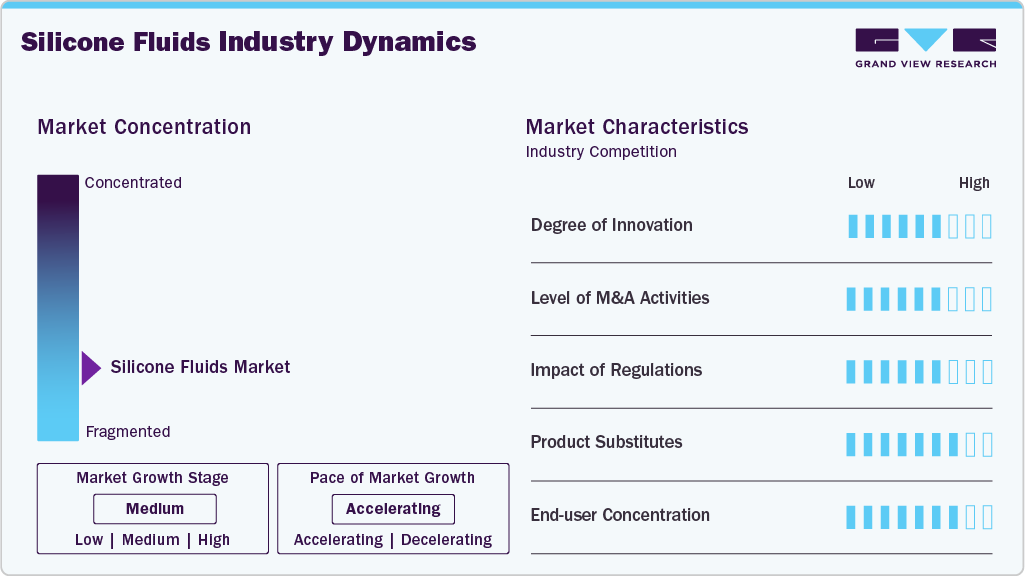
The market growth stage is medium, and growth is accelerating. The market exhibits slight fragmentation, with key players dominating the industry landscape. Major companies such as AB Specialty Silicones, CHT Silicones, Dow, Elkem, Gelest, Innospec, KCC Silicone, Momentive Performance Materials, Shin-Etsu Chemical, Siltech, and others play a significant role in shaping the market dynamics. These leading players often drive innovation in the market by introducing new products, technologies, and materials to meet the industry's evolving demands.
The degree of innovation in the silicone fluids industry is driven by continuous product development and performance improvement. Key innovations such as low-viscosity formulations, high-purity grades, and bio-based or more sustainable variants are expanding application scope across personal care, automotive, electronics, and industrial processing. Advances in thermal stability, water repellency, and lubrication performance are improving product efficiency and reliability. These innovations are also helping manufacturers meet stricter regulatory and environmental requirements, while creating opportunities for premium applications and value-added product differentiation in a competitive market.
 To learn more about this report, Download Free Sample Report
 Environmental and chemical safety regulations are significantly influencing the silicone fluids industry by increasing compliance requirements for manufacturers and end users. Regulations related to volatile organic compounds, hazardous substance control, and industrial emissions are driving the development of low-toxicity, environmentally safer silicone fluid formulations. Standards introduced by agencies such as the U.S. Environmental Protection Agency and the European Chemicals Agency are pushing companies to improve product safety, labeling, and waste management practices. While these regulations increase production and testing costs, they also create opportunities for innovation in high-purity, bio-based, and sustainable silicone fluid technologies across industrial and personal care applications.
Type Insights
The polydimethylsiloxane (PDMS) segment dominated the market across type segmentation in terms of revenue, accounting for 58.2% market share in 2025, and is forecast to grow at a 7.1% CAGR from 2026 to 2033. The growth is driven by rising demand from the electrical & electronics sector, particularly in semiconductor manufacturing, advanced processors, and electronic packaging applications. The growing use of silicone-based dielectric fluids and thermal management materials is driving commercial adoption across high-performance electronic systems. Government incentives for domestic manufacturing plants and expanding investments in semiconductor production are further strengthening market demand. In addition, rapid growth in IoT devices, smart consumer electronics, and industrial automation is accelerating the need for high-purity silicone fluids. Their strong thermal stability, dielectric strength, and long operational reliability make them suitable for next-generation electronic and electrical applications.
The fluorosilicone fluids segment is expected to expand at a 10.2% CAGR in the market over the forecast period. Rising electric vehicle production and increasing automation in automotive manufacturing are significantly driving demand for silicone fluids across fuel systems, EV battery cooling systems, and emission control components. Rapid industrialization and expansion of commercial vehicle fleets for logistics and supply chain operations are further supporting market growth. Silicone fluids are increasingly used in fuel-delivery O-rings, specialized diaphragms, and thermal management applications due to their excellent chemical and solvent resistance. Their ability to operate over a wide temperature range and to resist swelling when exposed to gasoline, motor oils, kerosene, and synthetic lubricants makes them suitable for demanding automotive environments.
Application Insights
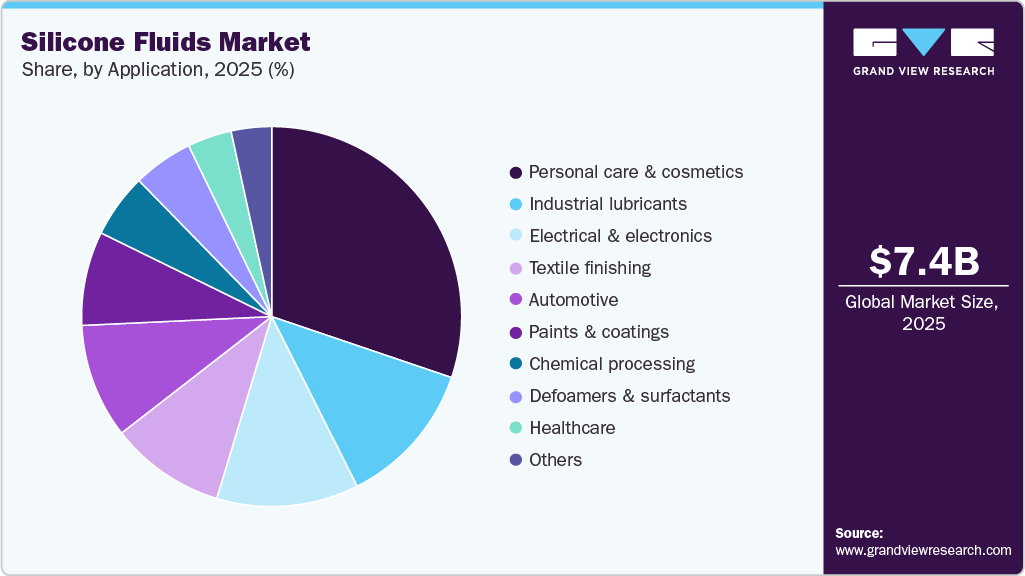
The personal care & cosmetics segment led the market by application, accounting for 30.2% of revenue in 2025, and is projected to grow at a 7.7% CAGR from 2026 to 2033. Rising disposable incomes, rapid urbanization, and expanding quick commerce networks are accelerating demand for silicone fluids in personal care and cosmetic applications. Consumers are increasingly spending on premium skincare, haircare, and beauty products that offer enhanced texture, spreadability, and long-lasting performance. Growing urban populations are driving demand for convenient, routine-based beauty solutions through online and rapid-delivery channels. Manufacturers are also developing personalized formulations for different skin and hair types, increasing the use of silicone fluids in customized cosmetic products. Demand continues to rise as brands focus on product differentiation, sensory performance, and premium consumer experiences.
 To learn more about this report, Download Free Sample Report
 The electrical & electronics segment is expected to grow at the fastest CAGR of 8.8% over the forecast period. Rising demand for home appliances, electrical equipment, and smart consumer electronics is driving market growth across electrical insulation, thermal management, lubrication, and protective coating applications. The expansion of semiconductor manufacturing and high-end processor production is increasing the consumption of silicone fluids due to their dielectric stability and heat resistance. Government incentives supporting domestic electronics manufacturing and industrial production are further strengthening market demand. Growth in IoT devices, home automation systems, and online retail platforms, combined with increasing disposable income, is accelerating the adoption of advanced electronic products that extensively utilize silicone fluid technologies.
Regional Insights
The Asia Pacific silicone fluids industry held the largest revenue share of 50.1% in 2025. The region is expected to grow at a CAGR of 8.0% over the forecast period due to rapid industrialization, expanding electronics manufacturing, and strong demand from personal care, automotive, and textile industries across China, India, Japan, and South Korea. Rising consumption of silicone emulsions, dielectric fluids, thermal management fluids, and textile softening agents is supporting market expansion. Increasing demand for electric vehicle battery production, semiconductor fabrication, and high-performance coatings is further accelerating adoption. Growth in cosmetics manufacturing and industrial processing activities also strengthens consumption. However, price-sensitive markets and rising environmental concerns regarding silicone waste disposal continue to challenge long-term profitability and regulatory compliance.
 To learn more about this report, Download Free Sample Report
 India Silicone Fluids Market Trends
The silicone fluids market in India is witnessing steady growth due to rising demand from the personal care, cosmetics, electronics, and automotive industries. Increasing disposable income, changing consumer preferences, and growing awareness regarding premium beauty products are supporting the use of modified silicone fluids in skincare, haircare, and cosmetic formulations. Manufacturers are increasingly focusing on eco-friendly and high-performance ingredients to meet evolving consumer expectations. In addition, rapid urbanization and government support for domestic manufacturing are accelerating growth in the electronics and automotive sectors. Silicone fluids are increasingly used for thermal management, lubrication, and component protection in electronic devices and automotive manufacturing applications across India.
North America Silicone Fluids Market Trends
The silicone fluids market in North America is witnessing steady growth, driven by rising demand from personal care, automotive, electronics, and healthcare industries. The U.S. and Canada are experiencing increased adoption of silicone-based thermal management fluids, dielectric fluids, industrial lubricants, and anti-foaming agents across advanced manufacturing and EV production facilities. Demand is further supported by growing investments in medical devices, semiconductor manufacturing, and premium cosmetic formulations. Expansion of industrial automation and high-performance electronics production is also accelerating consumption. However, stringent regulations on volatile silicone compounds and fluctuating raw material prices continue to create challenges for market expansion across key end-use industries.
The U.S. silicone fluids market is experiencing steady growth due to rising demand from the automotive and electric vehicle sectors, along with expanding use in personal care, medical, and electronics applications. In the automotive industry, silicone fluids are increasingly used in thermal management systems, lubricants, coatings, and battery protection solutions for electric vehicles. The growing production of EVs and advanced automotive components is supporting higher material consumption. In personal care and cosmetics, silicone fluids are widely used in skincare, haircare, and beauty formulations because of their smooth texture and conditioning properties. Demand is also increasing in the medical and electronics sectors due to the need for high-performance materials with strong thermal stability, flexibility, insulation, and biocompatibility characteristics.
Europe Silicone Fluids Market Trends
The silicone fluids market in Europe is mature yet technology-focused, supported by strong demand from the personal care, automotive, healthcare, industrial machinery, and renewable energy sectors. Countries including Germany, France, and Italy are emphasizing low-emission materials, energy-efficient manufacturing, and advanced specialty chemicals. Rising electric vehicle production and the expansion of wind energy infrastructure are driving increased use of silicone-based heat transfer fluids, dielectric fluids, and specialty lubricants. Regulatory focus on REACH compliance and sustainable formulations is encouraging manufacturers to develop high-purity, low-VOC silicone fluids with improved thermal stability, durability, and compatibility across industrial and consumer applications.
Central & South America Silicone Fluids Market Trends
The silicone fluids market in CSA is witnessing steady growth driven by rising demand from the construction, automotive refinishing, and personal care industries. The growing use of silicone-based lubricants, surfactants, release agents, and textile finishing chemicals is driving industrial consumption across Brazil and Mexico. Expanding urbanization and infrastructure development are further driving demand for paints, coatings, sealants, and water-repellent construction materials. Growth in cosmetics and household care manufacturing is also strengthening product adoption. However, market expansion is constrained by economic volatility, currency fluctuations, and limited regional production capacities for specialty silicone materials.
Middle East and Africa Silicone Fluids Market Trends
The silicone fluids market in MEA is gaining traction due to rising investments in infrastructure development, oil & gas processing, water treatment, and premium personal care manufacturing. Increasing demand for silicone heat transfer fluids, hydraulic fluids, and industrial defoamers is supporting product adoption across the petrochemical and processing industries. Expansion of healthcare facilities, commercial construction, and urban development projects is further strengthening market demand. The growing focus on equipment efficiency, operational safety, and high-temperature performance is driving the adoption of advanced silicone-based formulations. However, dependence on imports, limited regional production capacity, and fluctuations in crude oil-linked raw material prices continue to challenge long-term market expansion.
Key Silicone Fluids Company Insights
Some of the key players operating in the market include Dow and Elkem.
-
Dow is a major market participant with a diversified portfolio of specialty silicones, performance additives, and advanced fluid technologies. The company focuses on high-performance applications across personal care, automotive, construction, electronics, and industrial processing sectors. Its emphasis on product consistency, thermal stability, and low-VOC formulations strengthens its position in high-value and environmentally compliant silicone fluid solutions. Dow’s integrated manufacturing network, strong distribution capabilities, and ongoing investment in material innovation support the development of application-specific silicone fluids to meet evolving industrial and consumer requirements.
-
Elkem is a prominent market participant with a diversified portfolio of specialty silicones, silicone emulsions, and high-purity fluid technologies. The company focuses on advanced applications across personal care, automotive, construction, electronics, and industrial processing sectors. Its emphasis on sustainable silicone production, low-VOC formulations, and energy-efficient manufacturing strengthens its position in high-performance fluid solutions. Elkem’s integrated silicon-based materials platform and global production network support the development of customized silicone fluids for evolving industrial and consumer application requirements.
Gelest and Siltech are some of the emerging market participants.
-
Gelest is strengthening its market position by developing high-purity specialty silicone materials for personal care, electronics, medical, and industrial applications. The company focuses on advanced silicone fluid chemistries with enhanced thermal stability, low volatility, and precise functional performance for high-value end uses. Its emphasis on custom formulation capabilities and application-specific material innovation supports demand across semiconductor processing, cosmetic formulations, and specialty coatings. Strong expertise in organosilicon chemistry and niche performance materials is supporting Gelest’s expansion into technologically advanced, regulatory-driven application segments.
-
Siltech is a specialized participant in the market, with strong expertise in developing high-performance organo-functional silicone technologies for personal care, industrial, automotive, textile, and coating applications. The company focuses on customized silicone fluid formulations that improve lubrication, surface modification, water repellency, and thermal stability across demanding industrial processes. Its emphasis on application-specific product development, technical collaboration, and specialty silicone innovation supports its position in premium performance segments. Siltech’s expanding portfolio of modified silicone fluids and sustainable chemistry solutions is strengthening demand across advanced manufacturing and specialty formulation industries.
Key Silicone Fluids Companies
The following key companies have been profiled for this study on the silicone fluids market.
-
AB Specialty Silicones
-
CHT Silicones
-
Dow
-
Elkem
-
Gelest
-
Innospec
-
KCC Silicone
-
Momentive Performance Materials
-
Shin-Etsu Chemical
-
Siltech
Competitive Benchmarking
Operating Strategies
Competitive Edge
Weakness
Mature Players: Dow; Elkem; Momentive Performance Materials; Shin-Etsu Chemical
- Expands specialty and high-performance silicone fluids for automotive, electronics, healthcare, aerospace, personal care, semiconductor, and industrial applications, with a strong focus on customized solutions, innovation, and application-specific product development.
- Emphasizes sustainable, environmentally compliant manufacturing through low-VOC formulations, renewable energy integration, advanced production technologies, and continuous investment in high-purity silicone innovation.
- Strengthens global and regional market presence by expanding production capacity, improving supply chain capabilities, forming strategic partnerships, and providing robust technical and customer support.
- Strong global market presence, broad distribution network, and diversified silicone product portfolio support stable business growth across multiple end-use industries. Integrated manufacturing operations and efficient supply chains improve production reliability and cost management.
- Advanced research and development capabilities, combined with expertise in specialty and high-performance silicone technologies, strengthen product innovation and customized solution development for technically demanding applications.
- A strong financial position, sustainability focus, and established presence in key industries such as electronics, automotive, and industrial applications enhance long-term competitiveness and customer retention.
- Exposure to raw-material price fluctuations, energy cost volatility, and industrial demand cycles may affect profit margins and short-term business performance. Large operational structures can also reduce flexibility in responding to rapidly changing niche market requirements.
- Limited global penetration in certain regions, combined with higher European regulatory and energy-related costs, may affect operational efficiency and restrict expansion opportunities in emerging markets.
- Narrower product diversification, dependence on specialty industrial and electronics sectors, and premium product positioning may increase vulnerability during economic slowdowns and create pricing pressure from Asian competitors.
Emerging Players: Gelest; Siltech
- Focuses on specialty silicone fluids, silanes, and advanced organosilicon materials for niche industrial and research applications, with strong capabilities in custom synthesis and application-specific product development.
- Emphasizes customer-focused solutions through formulation flexibility, performance enhancement, and close technical collaboration with industries such as electronics, biomedical, coatings, personal care, textiles, agriculture, and polyurethane additives.
- Strengthens market position through specialty product innovation, targeted partnerships, technical support services, and integration with advanced material research and application expertise.
- Strong expertise in specialty organosilicon chemistry and customized silicone fluid formulations supports its position in high-performance niche applications. Strong collaboration with research institutions and specialty manufacturers drives innovation-focused growth.
- Flexible manufacturing capabilities enable quick response to customized and low-volume customer requirements, providing an advantage over larger multinational competitors.
- Strong specialization in silicone surfactants, silicone polyethers, and modified silicone fluids, along with high formulation flexibility, strengthens its competitive position in performance-oriented industrial markets.
- Smaller global manufacturing and distribution network compared to leading silicone fluid manufacturers, resulting in limited economies of scale and lower presence in high-volume industrial sectors such as automotive and construction.
- Narrower product portfolio, lower international brand visibility, and reduced penetration in commodity-grade silicone fluid markets compared to established multinational competitors.
- Limited financial capacity for large-scale R&D, global expansion, and supply chain integration, while greater reliance on niche specialty applications may expose the company to fluctuations in specific end-use industries.
Recent Developments
-
In September 2025, Dow launched DOWSIL EG-4175 Silicone Gel to support emerging requirements in electric vehicles and renewable energy systems. The product addresses the growing shift from 400V to 800V battery architectures in electric vehicles, which are being adopted to improve inverter efficiency and enable faster battery charging performance.
-
In October 2025, Henkel launched Loctite TCF 14001, a silicone-based liquid thermal interface material designed with high thermal conductivity properties to support efficient heat management in advanced electronic and industrial applications.
Silicone Fluids Market Report Scope
Report Attribute
Details
Market size value in 2025
USD 7.41 billion
Market size value in 2026
USD 7.93 billion
Revenue forecast in 2033
USD 12.90 billion
Growth rate
CAGR of 7.2% from 2026 to 2033
Historical data
2021 - 2025
Forecast period
2026 - 2033
Quantitative units
Revenue in USD million/billion, volume in kilotons, and CAGR from 2026 to 2033
Report coverage
Revenue & volume forecast, competitive landscape, growth factors, and trends
Segments covered
Type, application, region
Regional scope
North America; Europe; Asia Pacific; CSA; MEA
Country Scope
U.S.; Canada; Mexico; Germany; UK; France; Italy; Spain; China; India; Japan; South Korea; Australia; Brazil; Argentina; Saudi Arabia; UAE; South Africa
Key companies profiled
AB Specialty Silicones; CHT Silicones; Dow; Elkem; Gelest; Innospec; KCC Silicone; Momentive Performance Materials; Shin-Etsu Chemical; Siltech
Customization scope
Free report customization (equivalent to up to 8 analyst working days) with purchase. Addition or alteration to country, regional & segment scope
Pricing and purchase options
Avail customized purchase options to meet your exact research needs. Explore purchase options
Global Silicone Fluids Market Report Segmentation
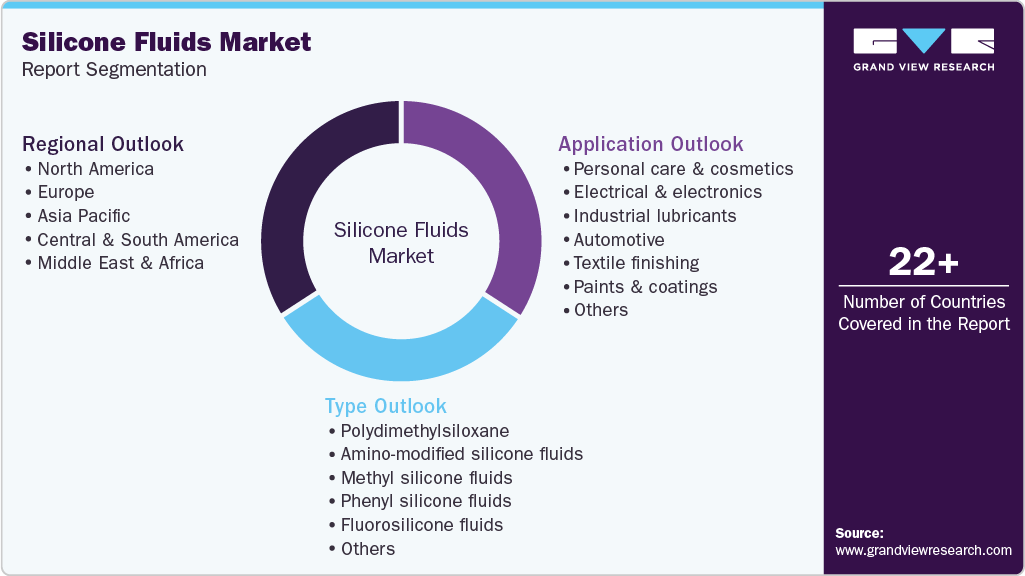
This report forecasts revenue growth at the global, regional, and country levels and provides an analysis of the latest industry trends across sub-segments from 2021 to 2033. For this study, Grand View Research has segmented the global silicone fluids market report based on type, application, and region:
 To learn more about this report, Download Free Sample Report
 -
Type Outlook (Volume, Kilotons; Revenue, USD Million, 2021 - 2033)
-
Polydimethylsiloxane
-
Amino-modified silicone fluids
-
Methyl silicone fluids
-
Phenyl silicone fluids
-
Fluorosilicone fluids
-
Others
-
-
Application Outlook (Volume, Kilotons; Revenue, USD Million, 2021 - 2033)
-
Personal care & cosmetics
-
Electrical & electronics
-
Industrial lubricants
-
Automotive
-
Textile finishing
-
Paints & coatings
-
Defoamers & surfactants
-
Chemical processing
-
Healthcare
-
Others
-
-
Regional Outlook (Volume, Kilotons; Revenue, USD Million, 2021 - 2033)
-
North America
-
U.S.
-
Canada
-
Mexico
-
-
Europe
-
Germany
-
UK
-
France
-
Italy
-
Spain
-
-
Asia Pacific
-
China
-
India
-
Japan
-
South Korea
-
Australia
-
-
Central & South America
-
Brazil
-
Argentina
-
-
Middle East & Africa
-
Saudi Arabia
-
UAE
-
South Africa
-
-
Delivered Customizations
This report has been delivered with the following In-depth customizations
Client Request
Customization Delivered
Value Adds
Regional Segmentation
Breaks the market into key regions and sub-regions such as North America, Europe, Asia Pacific, Central & South America, and the Middle East & Africa
Helps identify region-wise demand patterns, growth pockets, and local market dynamics
Trade Assessment
Evaluates import-export flow, trade balance, key exporting and importing countries, and supply chain movement
Helps identify trade dependencies, sourcing trends, and cross-border opportunities.
Cross-Segmentation
Analyzes the market across multiple dimensions, including type, application, end-use industry, and region.
Provides a deeper view of demand intersections and supports targeted market positioning
Frequently Asked Questions About This Report
The global silicone fluids market was estimated at around USD 7.41 billion in the year 2025 and is expected to reach around USD 7.93 billion in 2026.
The global silicone fluids market is expected to grow at a compound annual growth rate of 7.2% from 2026 to 2033 to reach around USD 12.90 billion by 2033.
The polydimethylsiloxane led the silicone fluids market in 2025 with a 58.2 % share. The growth is driven by rising semiconductor and electronics production, increasing demand for thermal management and dielectric materials, and expanding adoption of high-purity silicone fluids in advanced electronic, IoT, and automation applications.
The key players in the silicone fluids market are AB Specialty Silicones, CHT Silicones, Dow, Elkem, Gelest, Innospec, KCC Silicone, Momentive Performance Materials, Shin-Etsu Chemical, and Siltech
The silicone fluids market is expanding due to rising demand from personal care & cosmetics, electrical & electronics, industrial lubricants, automotive, textile finishing, paints & coatings, defoamers & surfactants, chemical processing, and healthcare applications, owing to their strong temperature stability, excellent electrical insulation, low surface tension, water repellency, and chemically inert, non-corrosive nature
About the Author(s)
Plastics, Polymers & Resins Research Team
Bulk Chemicals · Plastics, Polymers & ResinsThis report was authored by the plastics, polymers & resins research team at Grand View Research - comprising two research analysts, one senior research analyst, and one industry expert - with specialized expertise in the plastics, polymers & resins segment of the bulk chemicals industry. All findings are based on proprietary bulk chemicals databases, executive interviews, and regulatory analysis, subject to internal peer review prior to publication.
Last Updated:
Speak to Analyst

Customize this report to your needs - add regions, segments, or data points, with 20% free customization.
Or view our licence options:


ISO 9001:2015 & 27001:2022 Certified
We are GDPR and CCPA compliant! Your transaction & personal information is safe and secure. For more details, please read our privacy policy.


