
- Home
- »
- Biotechnology
- »
-
Single-use Bioprocessing Connectors Market Report, 2026-2033GVR Report cover

Single-use Bioprocessing Connectors Market (2026 - 2033)
Size, Share & Trends Analysis Report By Product (Aseptic Connectors, Conventional Connectors), By Application (Upstream Bioprocessing, Downstream Bioprocessing), By End Use, By Region, And Segment Forecasts
Market Size, 2025
$1.7BMarket Estimate, 2026
$1.9BMarket Forecast, 2033
$4.9BCAGR, 2026–2033
14.2%Single-use Bioprocessing Connectors Market Summary
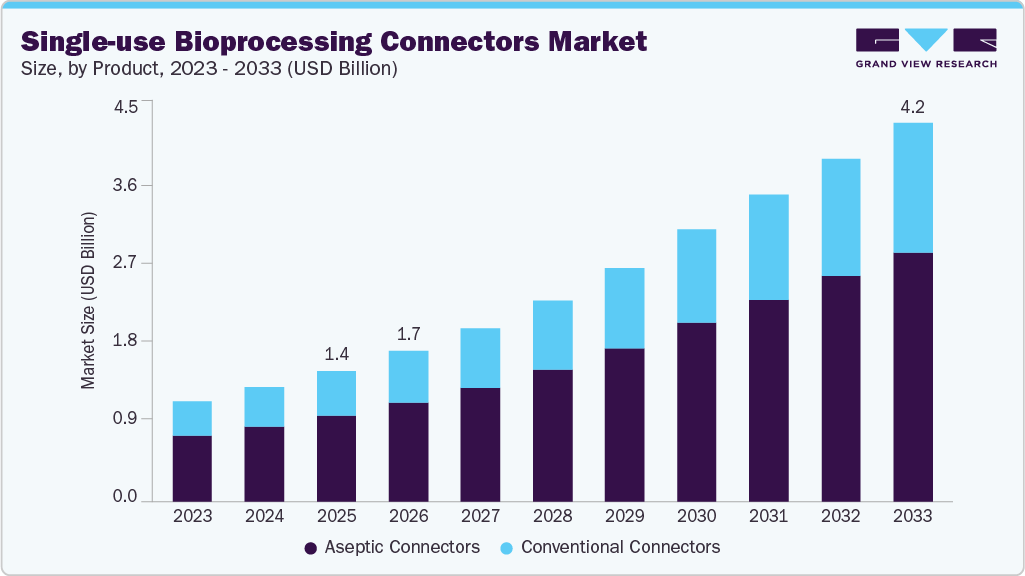
The global single-use bioprocessing connectors market size was valued at USD 1.7 billion in 2025 and is projected to grow from USD 1.9 billion in 2026 to USD 4.9 billion by 2033, at a CAGR of 14.2% from 2026 to 2033. The North America single-use bioprocessing connectors market held the largest share of 47.2% of the global market in 2025.This growth is driven by the increasing adoption of single-use bioprocessing systems, the rising production of biologics and biosimilars, and continuous advancements in connector design and functionality. Growing emphasis on reducing contamination risks and improving operational efficiency.
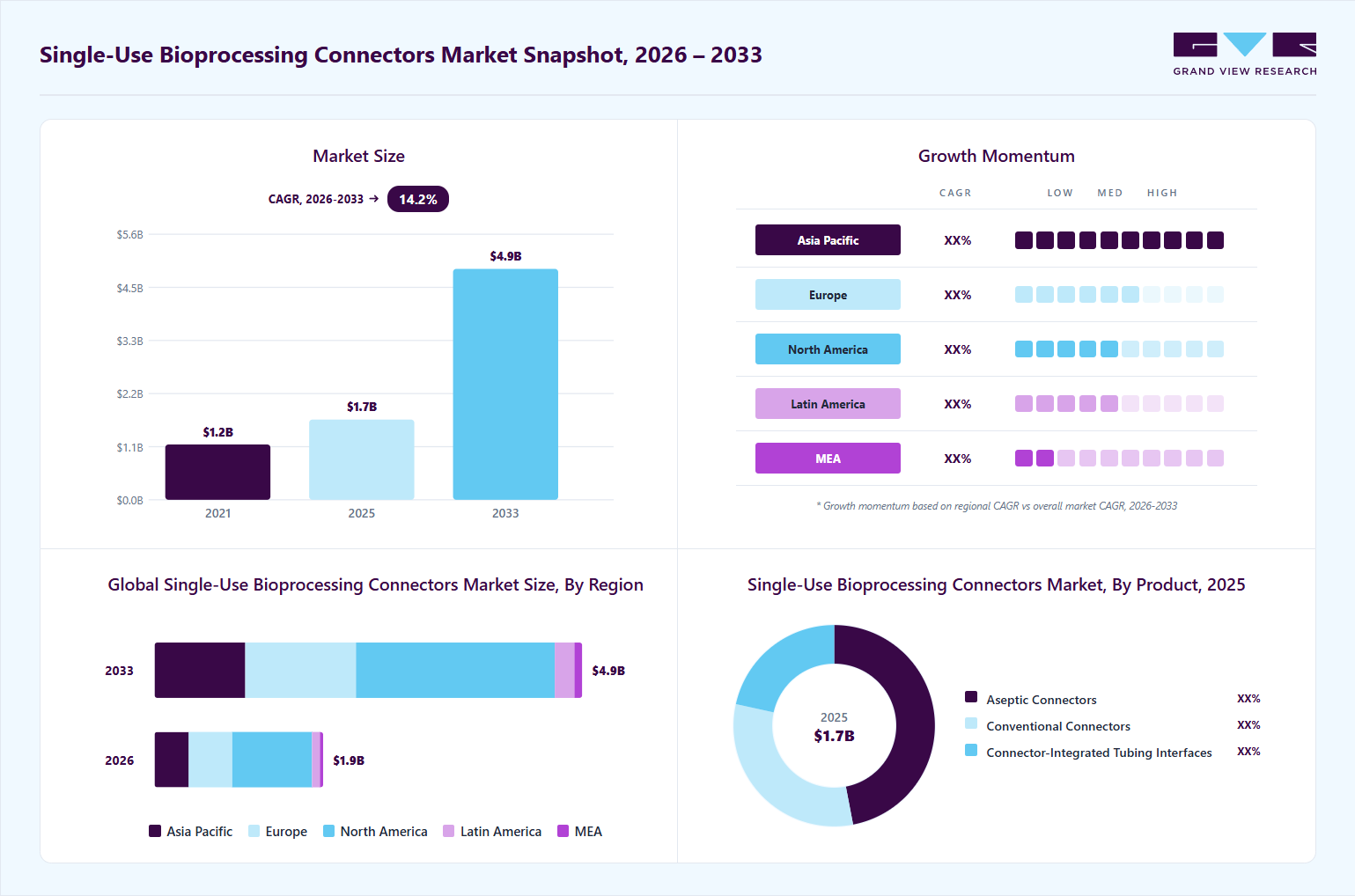 Source: Grand View Research, IR Documents, Primary Interviews, Paid DatabasesTo learn more about this report,
 Download Free Sample Report
 Key Market Trends & Insights
- By product: Aseptic connectors segment led the global single-use bioprocessing connectors industry and accounted for a share of 47.0% in 2025.
- By application: Upstream bioprocessing segment led the market and accounted for a share of 43.0% in 2025.
- By end use: Biopharmaceutical & pharmaceutical companies segment led the market and accounted for a share of 43.7% in 2025.
Regional Highlights
- Largest regional market: North America (47.2% revenue share, 2025)
- Fastest-growing regional market: Asia Pacific (highest CAGR, 2026-2033)
- By country: The single-use bioprocessing connectors industry in the U.S. held the largest revenue share in 2025.
Market Size & Forecast
- Market size in 2025: USD 1.7 Billion
- Estimated market size in 2026: USD 1.9 Billion
- Projected market size by 2033: USD 4.9 Billion
- CAGR (2026-2033): 14.2%
Three ways to get this report
Buy it, customize it, or ask a question.Ask an Analyst
Analyst response in 1 business day
- AccessReport author, directly
- Reply timeWithin 1 working day
- No sales callDirect answer only
- FormatEmail reply
- CostFree, no cost
Get the Full Report
What the study covers
- FormatsPDF · Excel · Dashboard
- Timeline2026–2033 annual, 2025 base
- Coverage20+ countries, 5 regions
- Companies10+ key players profiled
Customize the Report
20% free customization
- IncludeCountries, segments, points
- TailorTo your product definition
- ExtendDeeper competitor detail
- OrA fully bespoke study
- Turnaround5–10 working days
 To learn more about this report, Download Free Sample Report
 Market Dynamics
The increasing adoption of single-use technologies in biopharmaceutical manufacturing is significantly driving the single-use bioprocessing connectors industry. Biopharma companies and CDMOs are increasingly replacing traditional stainless-steel systems with flexible disposable setups to achieve faster production turnaround, lower contamination risk, reduced cleaning requirements, and greater operational flexibility.
The expanding production of biologics, vaccines, and advanced therapies such as cell and gene therapies is further increasing demand for sterile, leak-free connector solutions that ensure safe fluid transfer in controlled processing environments. In addition, ongoing product innovations are supporting market growth. For instance, in April 2026, CPC Biotech launched an integrated bioprocess fluid management portfolio featuring sterile single-use connectors for biopharma and advanced therapy manufacturing.
Regulatory concerns regarding leachables and extractables (L&E) are a key restraint on the single-use bioprocessing connectors market, as disposable connector materials may release trace amounts of chemical compounds into process fluids, potentially affecting product purity, safety, and batch consistency. Due to strict regulatory requirements, manufacturers must conduct extensive material testing, compatibility studies, and validation processes before adoption in biopharmaceutical production, which increases approval timelines and slows the implementation of new single-use connector systems.
The growing focus on sustainability in the biopharmaceutical industry is creating significant opportunities for the single-use bioprocessing connectors industry. Manufacturers are increasingly investing in recyclable materials, bio-based polymers, lightweight designs, and recycling programs to reduce the environmental impact of single-use systems while maintaining benefits such as lower water and energy consumption compared to stainless-steel systems. In addition, rising regulatory emphasis on sustainable manufacturing and improved operational efficiency is accelerating adoption.
A major challenge in the single-use bioprocessing connectors market is the lack of industry-wide standardization in connector designs and compatibility specifications. Many manufacturers use proprietary connector systems with unique materials and connection interfaces, limiting interoperability in multi-vendor bioprocessing environments. This creates integration challenges, increases setup complexity, and reduces operational flexibility for biopharmaceutical manufacturers using equipment from multiple suppliers.
Market Characteristics & Concentration
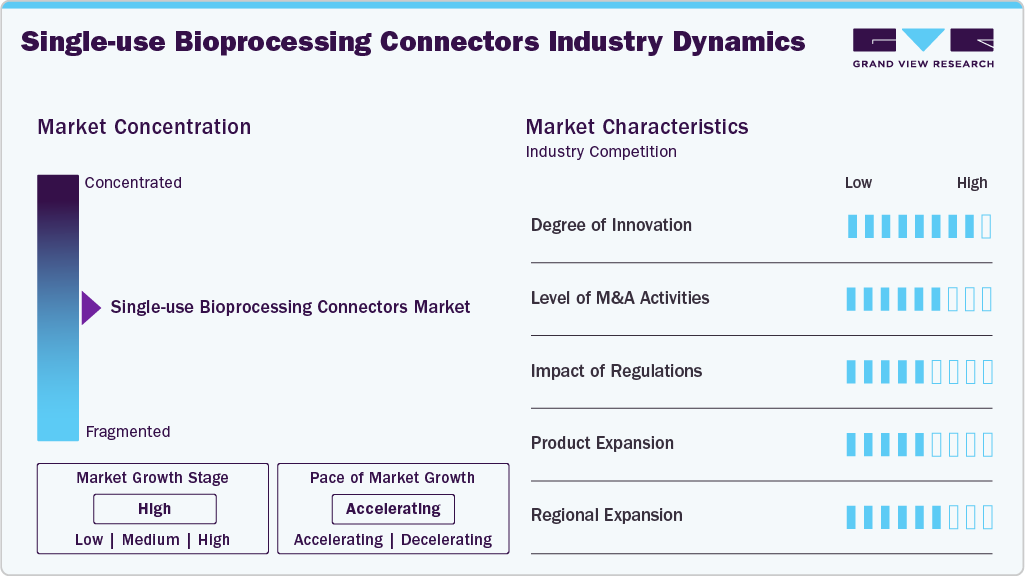
The single-use bioprocessing connectors industry has seen moderate to high levels of innovation, driven by the growing adoption of flexible biomanufacturing, sterility requirements, and advances in automation. Innovation is focused on enhancing aseptic processing, improving material compatibility, integrating smart technologies, and ensuring regulatory compliance. Key areas of innovation include genderless, self-sealing, automated sterile, and pre-sterilized, ready-to-use connectors.
The single-use bioprocessing connectors market has seen significant collaboration and partnerships, driven by the need for scalability, regulatory compliance, and supply chain resilience. These collaborations involve biopharma companies, contract manufacturers, raw material suppliers, and technology providers to advance innovation and address market demands. For instance, in September 2023, Repligen Corporation acquired Metenova, a Sweden-based provider of single-use mixing solutions, to strengthen its fluid management portfolio and enhance capabilities in integrated bioprocessing systems. This move highlights the growing trend of strategic acquisitions aimed at expanding single-use technology offerings and improving end-to-end bioprocessing solutions.
 To learn more about this report, Download Free Sample Report
 Regulations play a critical role in shaping the market, influencing product design, material selection, sterility assurance, and market adoption. Regulatory bodies such as the FDA (U.S.), EMA (Europe), USP, ISO, and WHO set stringent guidelines to ensure the safety, quality, and performance of Single-use Bioprocessing Connectors used in biopharmaceutical manufacturing.
The single-use bioprocessing connectors industry is experiencing significant product expansion, driven by advancements in aseptic processing, modular biomanufacturing, and automation. Companies are expanding their product portfolios to address the growing demand from biopharmaceutical production, including cell and gene therapies, monoclonal antibodies (mAbs), vaccines, and biosimilars. For instance, in August 2024, Freudenberg Medical expanded its biopharma portfolio by introducing custom single-use assemblies, including Y-connector manifolds, tubing assemblies, and bottle cap systems, for critical fluid transfer applications. This development highlights the growing focus on customized, high-performance single-use solutions to support complex, scalable bioprocessing operations.
The single-use bioprocessing connectors market is experiencing strong regional expansion, driven by increasing biopharmaceutical production, investments in advanced therapies, and regulatory support. While North America and Europe dominate the market, Asia-Pacific (APAC) is witnessing the fastest growth, and Latin America, the Middle East, and Africa (MEA) are emerging markets.
Case Study: CPC Biotech Enabling Modular Single-Use Bioprocessing Systems Through Advanced Connector Technologies
Background
The growing adoption of single-use systems (SUS) in biopharmaceutical manufacturing has increased the need for flexible, scalable, and contamination-free production processes. However, highly customized single-use assemblies often create operational inefficiencies, long lead times, and supply chain challenges.
To address these issues, CPC Biotech developed sterile connector technologies that support modular single-use bioprocessing systems.
Challenge
Biopharmaceutical manufacturers faced several challenges with traditional customized single-use assemblies, including:
-
Limited process flexibility
-
Difficulty scaling operations
-
Long procurement lead times
-
Supply chain risks
-
Complex technology transfer between facilities
These issues increased operational costs and slowed production timelines.
Solution
CPC Biotech introduced standardized sterile connector technologies, including AseptiQuik and MicroCNX connectors, to enable modular “building block” bioprocessing systems.
These connectors allowed rapid and sterile integration of components such as:
-
Tubing manifolds
-
Bags
-
Filters
-
Bioreactors
-
Fluid transfer systems
The modular approach enabled plug-and-play assembly and simplified scale-up from the laboratory to commercial production.
Outcomes
-
Improved manufacturing flexibility and scalability
-
Faster equipment changeovers and reduced downtime
-
Lower contamination risk through closed aseptic processing
-
Simplified procurement and enhanced supply chain resilience
-
Reduced operational costs and improved production efficiency
The case highlights how sterile connector technologies are becoming critical components in the growing market, particularly for biologics, vaccines, and cell & gene therapy manufacturing.
Product Insights
The aseptic connectors segment led the market with the largest revenue share of 47.0% in 2025, owing to their critical role in maintaining sterility across biopharmaceutical processes. Aseptic connectors are widely used in fluid transfer, filtration, mixing, and storage applications, enabling secure, contamination-free connections in single-use systems while reducing cross-contamination risks and improving process efficiency. For instance, in September 2024, Colder Products Company launched the MicroCNX ULT Series, which is the advanced aseptic micro-connectors are designed for cell and gene therapy cryopreservation and can withstand ultra-low temperatures while maintaining sterility, highlighting the growing demand for high-performance connectors in specialized bioprocessing applications.
The connector-integrated tubing interfaces segment is expected to grow at the fastest CAGR during the forecast period. This growth is driven by demand for fully assembled, ready-to-use fluid-transfer systems in biologics manufacturing. These systems combine tubing, sterile connectors, manifolds, valves, filters, and fittings into a single closed fluid pathway, reducing contamination risk and improving operational efficiency. They are widely used in upstream processing, downstream purification, media and buffer transfer, sampling, and fill-finish operations, as well as in cell and gene therapy manufacturing.
Application Insights
The upstream bioprocessing segment led the market with the largest revenue share of 43.0% in 2025. Upstream bioprocessing involves the initial stages of biological drug production, including cell culture, fermentation, and media preparation. Single-use connectors play a critical role in ensuring sterile, contamination-free fluid transfer during these processes.
The fill-finish operations segment is expected to grow at the fastest CAGR during the forecast period, driven by increasing demand for sterile fluid transfer, contamination control, and flexible manufacturing in biologics, vaccines, and cell & gene therapy production. The rising adoption of single-use technologies in aseptic filling processes, along with growing biopharmaceutical manufacturing capacity and stricter regulatory requirements for product safety, is further accelerating demand for reliable single-use connector solutions in fill-finish operations.
End Use Insights
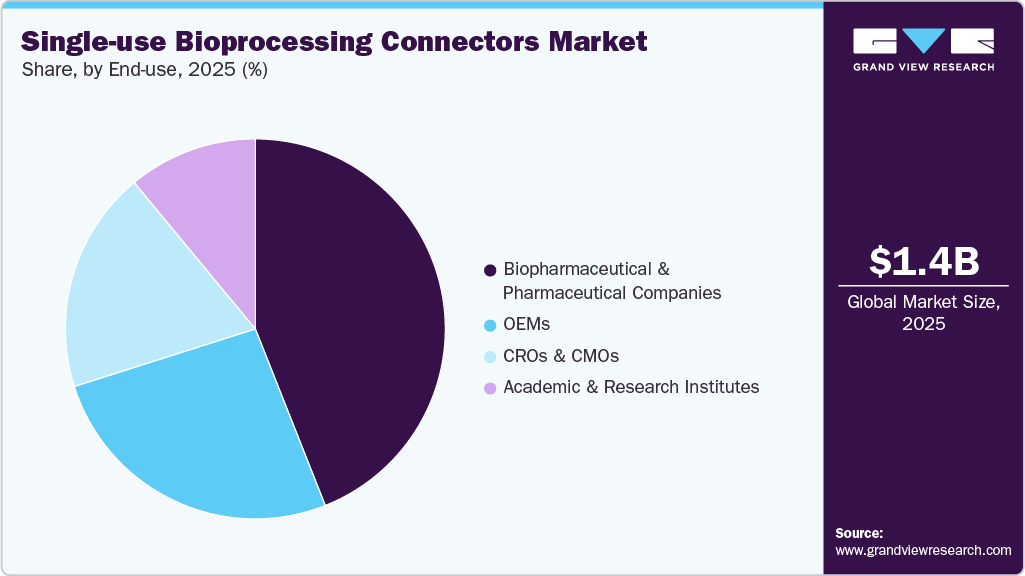
The biopharmaceutical & pharmaceutical companies segment led the market with the largest revenue share of 43.7% in 2025. The growing demand for cell and gene therapies and personalized medicine is driving the adoption of single-use bioprocessing connectors across upstream and downstream processing by these end-users. This is supported by increasing investments in flexible biomanufacturing infrastructure, as companies expand production capacity using single-use technologies to improve efficiency and reduce contamination risks. For instance, in October 2023, Thermo Fisher Scientific expanded its biologics manufacturing facility in St. Louis by adding 58,000 square feet of production space to support complex therapies, including cancer and rare diseases. The expansion includes the integration of single-use bioreactors to enhance scalability and manufacturing flexibility. This development highlights increasing investments in single-use technology-enabled infrastructure to support advanced biologics production.
 To learn more about this report, Download Free Sample Report
 The CMOs / CDMOs segment is anticipated to register at the fastest CAGR over the forecast period. The rising trend of outsourcing services to Contract Manufacturing Organization and CDMOs has greatly contributed to the expansion of this end-user segment within the global market. As biologics and cell and gene therapies continue to evolve and gain importance in the healthcare sector, biopharmaceutical companies are increasingly seeking cutting-edge technologies to improve the efficiency of their production processes.
Regional Insights
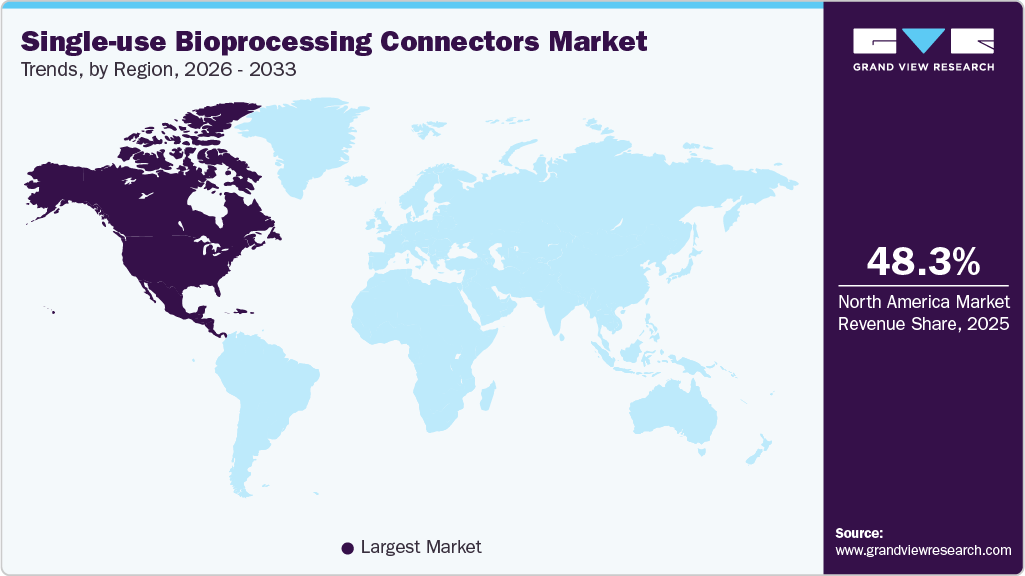
North America dominated the single-use bioprocessing connectors market with the largest revenue share of 47.2% in 2025. This significant market share can be attributed to the expansion of the biotechnology and pharmaceutical sectors, advancements in product offerings, and the rising prevalence of diseases like cancer. In addition, increased investment in drug discovery research is crucial. For instance, in June 2025, Cytiva announced a USD 1.6 billion global investment plan to expand biomanufacturing capacity, including the development of new manufacturing facilities and the expansion of filtration and single-use product lines across North America. This initiative aims to strengthen supply chain resilience and support the growing demand for biologics and single-use technologies.
 To learn more about this report, Download Free Sample Report
 U.S. Single-use Bioprocessing Connectors Market Trends
The single-use bioprocessing connectors industry in the U.S. accounted for the largest market revenue share in North America in 2025, mainly due to its large-scale biopharmaceutical manufacturing facilities. The biopharmaceutical sector is the most R&D-intensive in the U.S., and its development is a high-impact factor in the industry. Increasing investments in advanced biologics, cell and gene therapies, and widespread adoption of single-use technologies to enhance manufacturing flexibility and reduce contamination risks further support market growth.
Europe Single-use Bioprocessing Connectors Market Trends
The single-use bioprocessing connectors industry in Europe is driven by established biopharmaceutical companies and advanced manufacturing infrastructure. Countries like the UK, France, Italy, Germany, Switzerland, Spain, and the Netherlands hold significant positions in the biopharmaceutical sector. The region hosts several events and summits on innovations in bioprocessing. Strong regulatory frameworks and growing investments in biologics and advanced therapy manufacturing support the adoption of single-use technologies across Europe.
The UK single-use bioprocessing connectors market is growing rapidly, driven by strong government support to strengthen domestic biomanufacturing capabilities and enhance competitiveness against global players. Initiatives such as funding for life sciences innovation, expansion of advanced therapy manufacturing centers, and support for cell and gene therapy development are accelerating the adoption of single-use technologies. In addition, the presence of leading research institutions and increasing collaboration between academia and industry are further contributing to market growth.
The single-use bioprocessing connectors market in Germany is experiencing significant growth. The presence of key players for single-use technology in Germany and contract service providers continuing to invest in the expansion of their single-use capacity are among the factors driving the country’s market.
Asia Pacific Single-use Bioprocessing Connectors Market Trends
The single-use bioprocessing connectors industry in the Asia Pacific is anticipated to grow at the fastest CAGR of 15.1% during the forecast period. The growth of this region is expected to be mainly driven by China and India. Key factors driving the industry growth include an increase in access to technologies, a large patient pool, and an improvement in healthcare infrastructure. The increasing adoption of single-use assemblies by mature players in emerging markets to refine processes is also a significant factor driving the region’s growth. Moreover, the growing biotechnology sector, the presence of many research & academic institutes, and significant investments by market participants are projected to drive the region’s market.
The China single-use bioprocessing connectors market is rapidly expanding due to the increasing demand for biopharmaceuticals, including biologics and biosimilars. The country’s strong focus on developing domestic biomanufacturing capabilities, supported by government initiatives, is further accelerating market growth. In addition, several international companies are expanding their presence through strategic partnerships and joint ventures with local firms to strengthen supply chains and market access. Rising investments in advanced manufacturing technologies and the growing number of biopharma facilities are also contributing to the increased adoption of single-use systems, including connectors, across China.
Latin America Single-use Bioprocessing Connectors Market Trends
The single-use bioprocessing connectors industry in Latin America is experiencing steady growth due to the expansion of the biopharmaceutical and biotechnology sectors across countries such as Brazil and Argentina. The increasing demand for biologics and biosimilars, along with rising healthcare investments, is driving market growth. The adoption of single-use technologies is growing as manufacturers seek cost-effective and flexible production solutions. However, limited local manufacturing capabilities and dependence on imports may slightly restrain market growth in the region.
Middle East & Africa Single-use Bioprocessing Connectors Market Trends
The single-use bioprocessing connectors industry in the Middle East & Africa (MEA) is expected to grow at a moderate CAGR over the forecast period, driven by differences in economic development across countries. Growth is driven by expanding pharmaceutical and biotechnology sectors, and a limited skilled workforce and lower R&D investments remain key challenges. South Africa holds a significant position in the region due to its relatively developed healthcare and life sciences industry. In contrast, the UAE market is witnessing stronger growth, driven by ongoing improvements in healthcare infrastructure and increasing investments in the biopharmaceutical sector.
Key Single-use Bioprocessing Connectors Company Insights
The market players operating in the single-use bioprocessing connectors industry are adopting product approval to increase the reach of their products in the market, improve their availability in diverse geographical areas, and expand to enhance production/research activities. This strategy enables companies to increase their capabilities, expand their product portfolios, and improve their competencies.
Key Single-use Bioprocessing Connectors Companies
The following key companies have been profiled for this study on the single-use bioprocessing connectors market.
-
Sartorius AG
-
Merck KGaA
-
Danaher Corporation
-
Saint-Gobain Life Sciences
-
Colder Products Company
-
Thermo Fisher Scientific Inc.
-
Avantor Inc.
-
Foxx Life Sciences
-
Repligen Corporation
-
Entegris Inc.
-
Nordson Corporation
-
Eldon James
-
Watson-Marlow Fluid Technology Solutions
-
Savillex
Competitive Benchmarking
Operating Strategies
Competitive Edge
Weaknesses
Mature Player: Thermo Fisher Scientific Inc.
- Expand single-use bioprocess portfolios through advanced tubing assemblies, sterile fluid transfer systems, and customized flow-path solutions.
- Strong global distribution networks and established relationships with major biopharmaceutical manufacturers.
- High dependence on biopharmaceutical capital expenditure cycles and large-scale biologics manufacturing investments.
Emerging Player: Foxx Life Sciences
- Expand market visibility through OEM partnerships, flexible manufacturing capabilities, and targeted regional distribution strategies.
- Greater flexibility in custom product development and faster response to customer-specific assembly requirements.
- Limited global manufacturing footprint and comparatively lower brand recognition than established market leaders.
Recent Development
-
In January 2025, CPC (Colder Products Company), a subsidiary of Dover Corporation, launched its MicroCNX Nano Series aseptic connectors. These connectors are designed to enhance the efficiency of closed sterile processing in cell and gene therapy. This innovation addresses the industry's reliance on outdated techniques, such as tube welding and biosafety cabinets, which can be cumbersome and time-consuming.
"Now, CGT processing assemblies that include the MicroCNX Nano connectors will allow users to easily click together the connector halves to create a sterile flow path. This is a major advancement for CGT applications."
-Troy Ostreng, Senior Product Manager for CPC's biopharmaceutical business
-
In October 2024, Thermo Fisher Scientific Inc. announced the establishment of a Bioprocess Design Center in Genome Valley, Hyderabad, in collaboration with the Government of Telangana. This facility will cover 10,000 square feet and is expected to commence operations in early 2025. Such developments are expected to grow demand for the Single-use Bioprocessing Connectors for bioprocessing applications.
Single-use Bioprocessing Connectors Market Report Scope
Report Attribute
Details
Market size in 2025
USD 1.7 billion
Estimated Market size in 2026
USD 1.9 billion
Projected Market size by 2033
USD 4.9 billion
Growth rate
CAGR of 14.2% from 2026 to 2033
Base year for estimation
2025
Historical data
2021 - 2024
Forecast period
2026 - 2033
Quantitative units
Revenue in USD million/billion, CAGR from 2026 to 2033
Report coverage
Revenue forecast, company ranking, competitive landscape, growth factors, and trends
Segments covered
Product, application, end use, region
Regional scope
North America; Europe; Asia Pacific; Latin America; MEA
Country scope
U.S.; Canada; Mexico; Germany; UK; France; Italy; Spain; Denmark; Sweden; Norway; China; Japan; India; South Korea; Australia; Thailand; Brazil; Argentina; South Africa; Saudi Arabia, UAE; Kuwait
Key companies profiled
Sartorius AG; Merck KGaA; Danaher Corporation; Saint-Gobain Life Sciences; Colder Products Company; Thermo Fisher Scientific Inc.; Avantor Inc.; Foxx Life Sciences; Repligen Corporation; Entegris Inc.; Nordson Corporation; Eldon James; Watson-Marlow Fluid Technology Solutions; Savillex
Customization scope
Free report customization (equivalent up to 8 analyst’s working days) with purchase. Addition or alteration to country, regional & segment scope.
Global Single-use Bioprocessing Connectors Market Report Segmentation
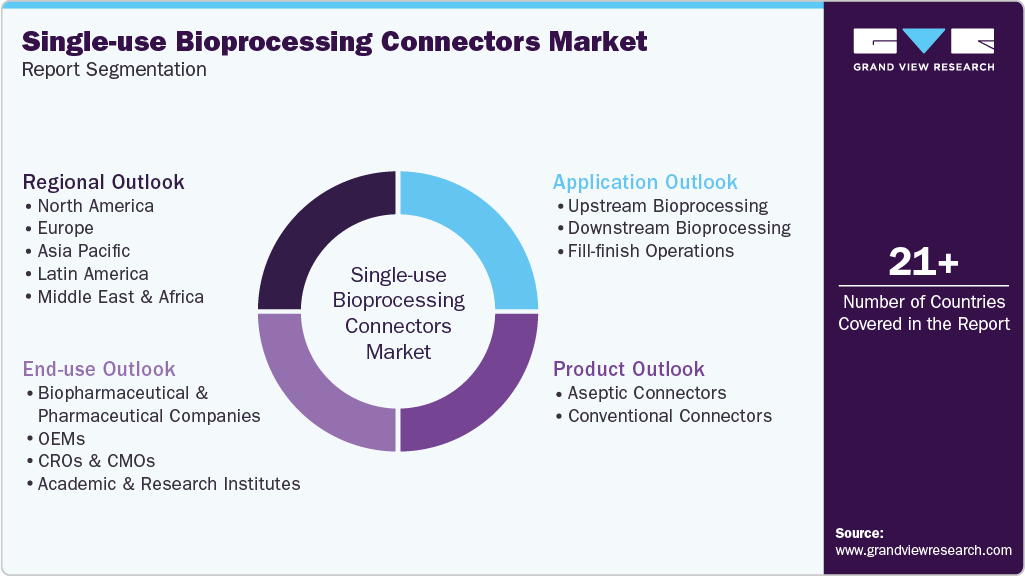
This report forecasts volume & revenue growth at global, regional, and country levels and provides an analysis of the latest industry trends in each of the sub-segments from 2021 to 2033. For this study, Grand View Research has segmented the global single-use bioprocessing connectors market report based on product, application, end use, and region:
 To learn more about this report, Download Free Sample Report
 -
Product Outlook (Revenue, USD Billion, 2021 - 2033)
-
Aseptic Connectors
-
Tube-to-tube connectors
-
Tube-to-bag connectors
-
Genderless sterile connectors
-
High-flow aseptic connectors
-
-
Conventional Connectors
-
Luer-based systems
-
Hose barb connectors
-
Quick disconnects
-
-
Connector-Integrated Tubing Interfaces
-
Pre-attached tubing connector systems
-
Tubing-compatible sterile interfaces
-
Integrated fluid transfer connection sets
-
-
-
Application Outlook (Revenue, USD Billion, 2021 - 2033)
-
Upstream Bioprocessing
-
Downstream Bioprocessing
-
Fill-finish Operations
-
Fluid Transfer & Sampling Applications
-
-
End Use Outlook (Revenue, USD Billion, 2021 - 2033)
-
Biopharmaceutical & Pharmaceutical Companies
-
CMOs / CDMOs
-
OEM & Assembly Integrators
-
Academic & Research Institutes
-
-
Regional Outlook (Revenue, USD Billion, 2021 - 2033)
-
North America
-
U.S.
-
Canada
-
Mexico
-
-
Europe
-
Germany
-
UK
-
France
-
Italy
-
Spain
-
Denmark
-
Sweden
-
Norway
-
-
Asia Pacific
-
China
-
India
-
Japan
-
South Korea
-
Australia
-
Thailand
-
-
Latin America
-
Brazil
-
Argentina
-
-
Middle East and Africa (MEA)
-
South Africa
-
Saudi Arabia
-
UAE
-
Kuwait
-
-
Delivered Customizations
This report has been delivered with the following In-depth customizations
Client Request
Customization Delivered
Value Adds
Region-Oriented Single-use Bioprocessing Connectors Market Analysis
Delivered detailed regional assessment covering North America, Europe, Asia Pacific, Latin America, and MEA, including country-level demand trends, biopharmaceutical manufacturing expansion, regulatory landscape, and adoption of single-use technologies.
Helps clients identify high-growth regional markets, evaluate expansion opportunities, and align commercialization strategies with regional bioprocessing infrastructure trends.
Product Compatibility & Process Integration Analysis
Developed assessment of connector compatibility across tubing systems, bioprocess assemblies, filtration systems, and upstream/downstream processing applications within biologics manufacturing facilities.
Enables clients to optimize process integration, improve operational flexibility, and evaluate connector selection across different manufacturing workflows.
Biopharmaceutical Capacity Expansion & Investment Analysis
Delivered assessment of global biomanufacturing facility expansions, single-use system investments, and CDMO adoption trends driving demand for single-use bioprocessing connectors.
Supports strategic planning by identifying investment hotspots, outsourcing trends, and future growth opportunities across biologics manufacturing markets.
Frequently Asked Questions About This Report
Major market players operating in the global single-use connectors market include, Sartorius AG, Merck KGaA, Danaher, Saint-Gobain, Colder Products Company (Dover Corporation), Liquidyne Process Technologies, Inc., Foxx Life Sciences, Watson-Marlow Fluid Technology Solutions
The growth of the single-use bioprocessing connectors market can be attributed to several key factors, including the increasing adoption of single-use bioprocessing assemblies, rising biologics and biosimilar production, and technological advancements in connector designs.
The global single-use bioprocessing connectors market was valued at USD 1.7 billion in 2025 and is expected to reach USD 1.9 billion by 2026.
The global single-use connectors market is anticipated to reach USD 4.9 billion by 2033 and grow at a CAGR of 14.2% from 2026 to 2033 during the forecast period.
The aseptic connectors segment held the largest market share in 2025 based on product. They are designed to maintain a sterile connection between fluid paths and are widely used in biologics, vaccine production, and cell and gene therapy.
North America dominated with a 38.4% revenue share in 2025.
Asia Pacific is the fastest-growing region over the forecast period.
The aseptic connectors segment led with a 47.0% revenue share in 2025, while connector-integrated tubing interfaces is the fastest-growing segment.
The upstream bioprocessing segment held the highest market share in 2025, while fill-finish operations is the fastest-growing segment.
The biopharmaceutical & pharmaceutical companies segment accounted for the largest share in 2025, while CMOs / CDMOs is the fastest-growing segment.
About the Author(s)
Biotechnology Research Team
Healthcare · BiotechnologyThis report was authored by the biotechnology research team at Grand View Research - comprising two research analysts, one senior research analyst, and one industry expert - with specialized expertise in the biotechnology segment of the healthcare industry. All findings are based on proprietary healthcare databases, executive interviews, and regulatory analysis, subject to internal peer review prior to publication.
Last Updated:
Speak to Analyst

Customize this report to your needs - add regions, segments, or data points, with 20% free customization.
Or view our licence options:


ISO 9001:2015 & 27001:2022 Certified
We are GDPR and CCPA compliant! Your transaction & personal information is safe and secure. For more details, please read our privacy policy.


