
- Home
- »
- Homecare & Decor
- »
-
Sleeping Pods Market Size, Share & Growth Report, 2033GVR Report cover

Sleeping Pods Market (2026 - 2033) Size, Share & Trends Analysis Report By Pod (Compact Nap Pods, Single Sleeping Pods, Double Sleeping Pods), By Application, By Revenue Model (Direct Sales, Rental & Pay-per-use), By Region, And Segment Forecasts
Market Size, 2025
$471.8MMarket Estimate, 2026
$500.9MMarket Forecast, 2033
$814.1MCAGR, 2026–2033
7.2%Sleeping Pods Market Summary
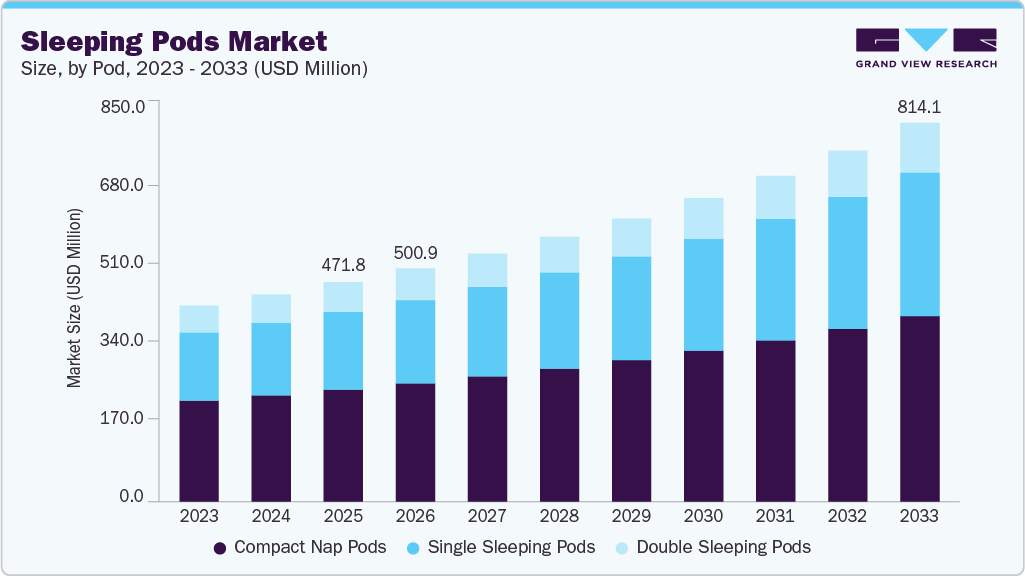
The global sleeping pods market size was valued at USD 471.8 million in 2025 and is projected to grow from USD 500.9 million in 2026 to USD 814.1 million by 2033, at a CAGR of 7.2% from 2026 to 2033. North America dominated the global sleeping pods market with the largest revenue share of 32.7% in 2025. Rising global air passenger traffic, combined with longer transit durations, is creating sustained demand for short-duration rest solutions within airport environments.
 Source: Grand View Research, IR Documents, Primary Interviews, Paid DatabasesTo learn more about this report,
 Download Free Sample Report
 Key Market Trends & Insights
- By sleeping pod: Compact sleeping pods accounted for a market share of 51.0% in 2025.
- By application: Airport sleeping pods accounted for a market share of 28.1% in 2025.
- By revenue model: Direct sales accounted for a market share of 56.6% in 2025.
Regional Highlights
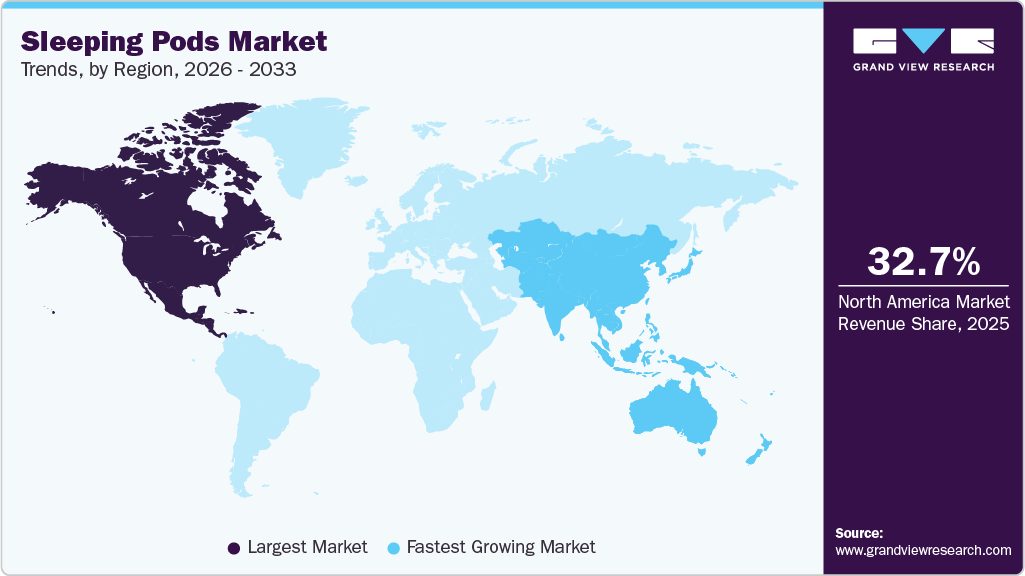
- Largest regional market: North America (32.7% revenue share, 2025)
- Fastest-growing regional market: Asia Pacific (highest CAGR, 2026-2033)
- By country: The U.S. held the largest market share in 2025.
Market Size & Forecast
- Market size in 2025: USD 471.8 Million
- Estimated market size in 2026: USD 500.9 Million
- Projected market size by 2033: USD 814.1 Million
- CAGR (2026-2033): 7.2%
Three ways to get this report
Buy it, customize it, or ask a question.Ask an Analyst
A direct answer, usually in 1 working day
- AccessReport author, directly
- Reply timeWithin 1 working day
- No sales callDirect answer only
- FormatEmail reply
- CostFree, no cost
Get the Full Report
What the study covers
- FormatsPDF · Excel · Dashboard
- Timeline2026–2033 annual, 2025 base
- Coverage20+ countries, 5 regions
- Companies10+ key players profiled
Customize the Report
20% free customization
- IncludeCountries, segments, points
- TailorTo your product definition
- ExtendDeeper competitor detail
- OrA fully bespoke study
- Turnaround5–10 working days
Growth in long-haul travel, multi-leg itineraries, and increasing flight delays has led to a higher number of passengers experiencing extended layovers and overnight waits. This shift is directly increasing the need for private, accessible sleeping infrastructure inside terminals. Travel frequency is also rising, with travelers taking an average of 6.4 trips in 2025 and 27% planning to increase leisure travel in 2026, reflecting continued pressure on airport facilities to accommodate rest and recovery needs during transit. Sleeping pods address this requirement efficiently by offering compact, scalable rest solutions without the spatial and operational constraints associated with full-service airport hotels.
Airports are increasingly repositioning themselves as experience-driven infrastructure, where passenger comfort plays a central role in influencing dwell time and non-aeronautical revenue generation. This shift is driving the integration of sleeping pods as part of broader passenger experience strategies that include wellness zones, quiet areas, and digitally enabled services. Rather than functioning solely as transit points, modern airports are being designed as commercial and lifestyle environments where convenience, privacy, and comfort are prioritized. Design-led innovations, including app-based booking systems and seamless access control for sleeping pods, are further supporting adoption by reducing friction and improving usability in high-traffic airport settings.
 To learn more about this report, Download Free Sample Report
 Growing awareness of the health and productivity benefits associated with short-duration naps is also contributing to market expansion. Controlled naps of 20-30 minutes have been linked to improved alertness, reduced fatigue, and enhanced cognitive performance, making them relevant not only for travelers but also for professionals and shift workers. Organizations such as the Sleep Foundation highlight that nap pods are specifically designed to optimize rest through ergonomic positioning, controlled lighting, and noise reduction, enabling effective recovery even in busy environments. This increasing recognition of rest as a functional requirement rather than a luxury is encouraging adoption across airports, corporate offices, and healthcare facilities.
Technological advancements are further strengthening the value proposition of sleeping pods by transforming them into smart, self-service units. Modern pods are equipped with features such as app-based reservations, biometric or OTP-enabled access, automated sanitation systems, and IoT-based controls for lighting, temperature, and reclining positions. These capabilities improve operational efficiency while enhancing user experience by offering greater personalization and convenience. At the same time, digital integration allows operators to implement real-time monitoring, dynamic pricing, and utilization analytics, enabling higher revenue optimization and more efficient asset management across high-footfall environments.
The expansion of flexible, pay-per-use micro-hospitality models is also accelerating adoption of sleeping pods globally. Consumers are increasingly seeking short-duration, on-demand accommodation options that align with their immediate needs rather than committing to full-day hotel bookings. Sleeping pods cater to this shift by offering hourly pricing structures that appeal to transit passengers, solo travelers, and budget-conscious users. The integration of mobile booking platforms and digital payment systems further simplifies access, making these services more convenient and widely accessible. This model not only improves affordability for users but also allows operators to maximize revenue per unit through higher turnover and efficient space utilization, reinforcing the commercial viability of sleeping pods across airports and other high-density public spaces.
Market Dynamics
The growing modernization of railway stations, smart cities, and public infrastructure is one of the major factors contributing to the growth of the sleeping pods industry. Governments and private operators are investing in passenger-centric infrastructure to improve convenience, comfort, and accessibility across transportation hubs and urban public spaces. The rising number of daily commuters, business travelers, and urban professionals is creating strong demand for short-duration private rest facilities in high-traffic environments. In addition, the expansion of capsule-style micro hospitality concepts and pay-per-use accommodation services is further supporting market growth. The increasing popularity of flexible and on-demand lifestyle services among consumers is encouraging the adoption of sleeping pods across commercial complexes, co-living spaces, and healthcare facilities. Furthermore, rising investments in sustainable modular infrastructure, energy-efficient pod systems, AI-enabled personalization features, and integrated digital payment platforms are strengthening the overall ecosystem of smart rest solutions, thereby accelerating the growth of the market.
Limited awareness and lack of familiarity among potential users remain key challenges restraining the growth of the market, often resulting in low adoption rates and underutilization of available facilities. Many consumers are still unaware of the availability, functionality, and benefits of sleeping pods, particularly in public infrastructure such as airports, railway stations, and commercial complexes. Additionally, misconceptions regarding comfort, hygiene standards, and safety further limit user confidence in adopting these services. For instance, in several developing regions, travelers continue to rely on traditional waiting lounges or nearby hotels due to limited exposure to pod-based rest solutions. Reports from airport service providers indicate that first-time users often require guidance to understand booking systems, usage duration, and operational features of sleeping pods. This lack of awareness and education among end users continues to act as a barrier to wider adoption, thereby restraining the overall growth of the market.
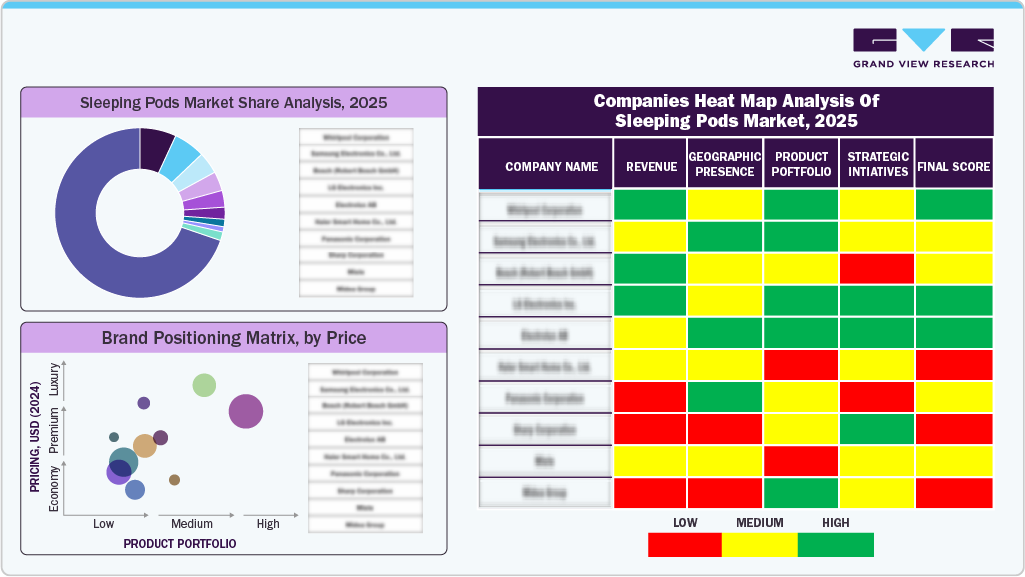
Brand Market Share Insights
The global sleeping pods industry is characterized by a competitive landscape shaped by specialized pod manufacturers, airport service operators, and emerging micro-hospitality providers focused on compact, technology-enabled rest solutions. Leading companies such as MetroNaps, GoSleep, Sleepbox, and NapCabs maintain strong market positions through proprietary pod designs, integrated digital systems, and strategic deployment partnerships with airports and commercial infrastructure operators. Competition is increasingly driven by product innovation, including modular pod configurations, IoT-enabled controls, and app-based booking platforms that enhance user convenience and operational efficiency. At the same time, expanding adoption across corporate offices, healthcare facilities, and co-working spaces is attracting new entrants and regional players offering customized and cost-effective solutions, further intensifying competition and driving continuous innovation in the global sleeping pods industry.
 To learn more about this report, Download Free Sample Report
 Pod Insights
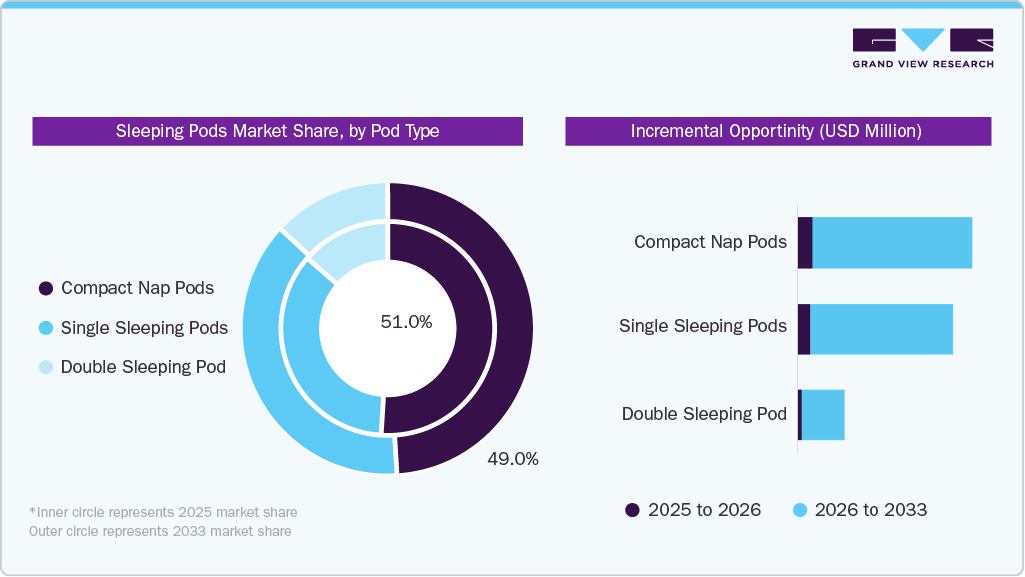
Compact nap pods accounted for a market share of 51.0% in 2025. These pods require minimal installation space, allowing operators to maximize revenue per square foot while addressing increasing demand for short-duration rest solutions driven by rising passenger traffic and longer dwell times. The segment is further driven by growing preference for quick, controlled naps among business travelers and urban professionals, with compact pods offering essential features such as reclining seating, privacy enclosures, and noise reduction within a 20-30 minute usage cycle.
 To learn more about this report, Download Free Sample Report
 The demand for single sleeping pods is anticipated to grow with a CAGR of 8.1% from 2026 to 2033, driven by increasing preference for private, fully enclosed rest solutions that offer higher levels of comfort, security, and noise isolation compared to compact pod formats. These pods are particularly suited for long-haul travelers and transit passengers with extended layovers who require uninterrupted rest in high-traffic environments such as airports and railway stations. The segment is further supported by rising awareness around personal space and hygiene, along with growing willingness among users to pay a premium for full-body sleeping arrangements, climate control, and additional in-pod features. Expanding adoption across premium settings, including airport lounges, hotels, and corporate campuses, combined with the integration of app-based booking, automated access, and smart controls, is enhancing both accessibility and operational efficiency.
Application Insights
Sleeping pods at the airports accounted for a market share of 28.1% in 2025. These pods are widely deployed across international airports and major aviation hubs, offering standardized, space-efficient units equipped with features such as privacy enclosures, reclining systems, and digital access controls, enabling travelers to rest without exiting secure zones. The segment is further supported by increasing passenger traffic, longer layovers, and flight delays, which are driving consistent demand for convenient in-terminal rest options. In addition, the hourly, pay-per-use pricing structure allows seamless integration into airport service ecosystems and digital booking platforms, making them accessible to a broad traveler base, including business travelers, solo passengers, and international tourists.
The demand for sleeping pods in corporate offices is anticipated to grow at a CAGR of 8.8% from 2026 to 2033, driven by increasing focus on employee productivity, workplace wellness, and fatigue management across modern organizations. Companies are increasingly recognizing the impact of short-duration naps on cognitive performance, alertness, and overall work efficiency, leading to the integration of sleeping pods as part of office infrastructure. This trend is particularly evident in high-intensity work environments such as technology firms, consulting companies, and large corporate campuses, where long working hours and mental fatigue are common. Employers are investing in dedicated wellness spaces that include nap pods, relaxation zones, and quiet rooms to support employee well-being and improve retention.
Revenue Model Insights
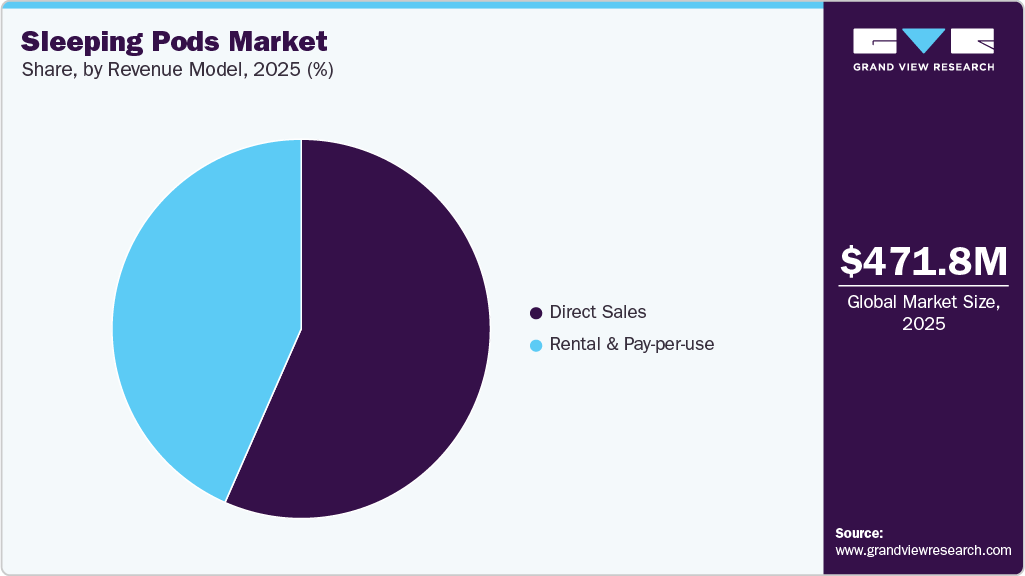
Direct sales accounted for a share of 56.5% in 2025. Sleeping pod providers are leveraging mobile applications, self-service kiosks, and integrated booking interfaces within airports and commercial spaces to offer real-time access to availability, pricing, and duration-based usage, enabling quick and frictionless transactions. This model allows operators to maintain control over pricing, improve utilization rates, and retain higher margins by eliminating intermediary commissions. The segment is further supported by the time-sensitive nature of pod usage, where users prioritize instant access and convenience, along with the integration of features such as automated payments, dynamic pricing, and personalized settings that enhance user experience and encourage repeat usage.
 To learn more about this report, Download Free Sample Report
 Rental & Pay-per-use is projected to grow at a CAGR of 8.0% over the forecast period of 2026 to 2033. driven by the increasing preference for flexible, short-duration access to rest solutions rather than full-day or fixed bookings. Consumers, particularly transit passengers and urban professionals, are seeking on-demand services that align with immediate needs, making hourly usage models highly attractive. This shift is supported by the integration of digital platforms that provide real-time information on pod availability, pricing, location, and duration options, enabling users to make quick and informed decisions. The transparency offered through these platforms, including clear pricing structures and usage details, enhances user confidence and encourages adoption.
In addition, rental and pay-per-use models allow operators to maximize asset utilization by enabling high turnover rates within limited physical space, making them commercially viable in high-footfall environments such as airports, corporate offices, and public infrastructure. The ability to cater to a wide range of users, from budget-conscious travelers to premium customers seeking short-term privacy, further strengthens demand.
Regional Insights
North America Sleeping Pods Market Trends
The North American sleeping pods industry accounted for the largest share of 32.7% of the global market in 2025. The North American market is driven by the region’s advanced airport infrastructure, high air passenger traffic, and strong adoption of passenger-centric service solutions. Major airports across the U.S. and Canada are increasingly integrating sleeping pods to address growing demand from transit and long-haul travelers seeking convenient, in-terminal rest options during layovers and delays. The presence of leading manufacturers such as MetroNaps and Sleepbox is further supporting market expansion through continuous product innovation and wider deployment across airports, corporate offices, and healthcare facilities.
 To learn more about this report, Download Free Sample Report
 U.S. Sleeping Pods Market Trends
The sleeping pods industry in the U.S. accounted for a revenue share of around 85.2% of the North America market in 2025. The U.S. market is driven by increasing investments in smart infrastructure and technology-enabled services across airports and commercial spaces. The expansion of airport modernization programs and digital passenger solutions is enabling seamless integration of sleeping pods within smart terminal ecosystems, improving accessibility and user experience. In addition, the growing presence of co-working spaces, premium lounges, and urban mobility hubs is expanding deployment beyond airports, allowing operators to target a broader user base. The market is also driven by the need for space-efficient, high-revenue assets in high-cost real estate environments, where modular sleeping pods offer scalable and flexible installation.
Canada's sleeping pods industry is expected to grow at a CAGR of 9.2% from 2026 to 2033. The Canadian market is driven by the increasing adoption of space-efficient, modular infrastructure across high-cost urban environments where optimizing floor space is a key priority. Operators in airports, co-working spaces, and public facilities are deploying sleeping pods as compact, revenue-generating units that can be installed with minimal structural changes, enabling scalable expansion. The market is further supported by rising demand for flexible, on-demand rest solutions among urban consumers and travelers, along with the growing use of mobile-based booking platforms and integrated payment systems that enhance accessibility and utilization.
Europe Sleeping Pods Market Trends
Europe's sleeping pods industry accounted for a revenue share of 25.8% of the global market in 2025. The European market is driven by the region’s extensive rail and air transit networks and strong emphasis on passenger convenience across transportation infrastructure. Major airports and railway stations across countries such as Germany, the UK, and France are increasingly integrating sleeping pods to cater to high volumes of transit passengers requiring short-duration rest during layovers, delays, and long-distance travel. The region’s dense intercity mobility and high frequency of business and leisure travel are creating consistent demand for accessible, in-terminal rest solutions that offer privacy and efficiency.
The sleeping pods industry in Germany accounted for a revenue share of around 18.5% of the European market in 2025. The German market is driven by high passenger traffic across major aviation and rail hubs such as Frankfurt, Munich, and Berlin, where Germany’s position as a central European transit hub drives consistent demand for short-duration rest solutions. The presence of major infrastructure such as Frankfurt Airport and an extensive high-speed rail network is encouraging the integration of sleeping pods within terminals to serve business travelers, long-distance commuters, and international transit passengers. The market is further driven by a strong focus on engineering efficiency and space optimization, where modular sleeping pods offer high utilization in premium, space-constrained environments. In addition, increasing adoption across corporate offices and co-working spaces in key business cities, along with the presence of established players such as NapCabs, is supporting innovation and deployment.
The UK sleeping pods industry is expected to grow at a CAGR of 10.0% from 2026 to 2033. The UK market is driven by the country’s high air passenger traffic and the presence of major international transit hubs such as London Heathrow and Gatwick, where increasing volumes of long-haul and connecting passengers are creating consistent demand for short-duration rest solutions. Frequent flight delays, overnight layovers, and tight travel schedules are encouraging airports to integrate sleeping pods as part of passenger convenience services within terminals. The market is also supported by the UK’s strong adoption of digital infrastructure, enabling seamless access to sleeping pods through app-based booking systems, automated check-ins, and contactless payment solutions.
Asia Pacific Sleeping Pods Market Trends
The Asia Pacific sleeping pods industry accounted for the revenue share of 30.6% in 2025. The market in Asia Pacific is driven by the region’s rapidly expanding air travel network and continuous development of large-scale airport infrastructure across countries such as China, India, Japan, and Southeast Asia. Increasing passenger traffic, supported by the growth of low-cost carriers and rising middle-class travel demand, is creating a strong need for short-duration rest solutions among transit passengers facing layovers and delays. The market is further supported by growing adoption of sleeping pods across urban commercial spaces such as co-working hubs, IT parks, and business centers, where high work intensity and population density are driving demand for quick, private rest options.
The sleeping pods industry in China accounted for a revenue share of around 22.6% of the Asia Pacific market in 2025. The market in China is driven by the growing adoption of sleeping pods across urban commercial environments, including shopping malls, co-working spaces, and technology parks, where high population density and long working hours are driving demand for convenient, private rest options. In addition, China’s strong digital ecosystem is facilitating seamless access through mobile-based booking platforms, QR-enabled entry systems, and integrated payment solutions, improving user convenience and utilization rates.
India's sleeping pods industry is expected to grow at a CAGR of 9.7% from 2026 to 2033. The market in India is driven by the rapid expansion of airport infrastructure and increasing air passenger traffic across major cities such as Delhi, Mumbai, Bengaluru, and Hyderabad. Rising domestic travel, supported by the growth of low-cost carriers and improved regional connectivity, is leading to higher volumes of transit passengers requiring short-duration rest solutions during layovers and delays. Airports are increasingly integrating sleeping pods as part of passenger convenience services, particularly within terminals and lounges, to enhance the travel experience while optimizing space utilization.
Central & South America Sleeping Pods Market Trends
The Central & South America sleeping pods industry is expected to grow at a CAGR of 7.4% from 2026 to 2033. The Central & South America market is driven by the gradual expansion of airport infrastructure and increasing regional air connectivity across countries such as Brazil, Mexico, and Colombia. Rising passenger traffic, supported by the recovery of international tourism and growing domestic travel, is creating consistent demand for short-duration rest solutions within transit environments, particularly for passengers experiencing layovers and delays. The market is further supported by the expansion of urban commercial spaces such as co-working hubs, business centers, and transport terminals, where demand for flexible, on-demand rest options is increasing.
Middle East & Africa Sleeping Pods Market Trends
The Middle East & Africa sleeping pods industry is expected to grow at a CAGR of 6.5% from 2026 to 2033. The market in the Middle East & Africa is driven by the region’s rapid expansion of airport infrastructure and its role as a major global transit hub connecting Europe, Asia, and Africa. High volumes of international transit passengers passing through key airports in cities such as Dubai, Doha, and Abu Dhabi are creating consistent demand for short-duration rest solutions, particularly for long-haul and connecting flights. Airports are increasingly integrating sleeping pods as part of passenger experience enhancements while optimizing space utilization and generating additional non-aeronautical revenue.
Key Sleeping Pods Companies:
The following key companies have been profiled for this study on the sleeping pods market.
- My Office Pod
- napcabs GmbH
- Podtime UK
- Sleeping Pods
- Nap & Up
- BIDUA Pods
- Rest Works
- RestSpaceLDN
- OBIDUA
- Gosleep
Recent Developments
-
In January 2026, Indian Railways introduced modern sleeping pods at Guntur Railway Station in Andhra Pradesh to provide a comfortable and affordable resting option for transit passengers. Designed as short-stay accommodations, the facility offers features such as Wi-Fi, lockers, clean washrooms, and designated spaces for families and women, with around 64 beds available. Priced at budget-friendly rates, the initiative aims to improve passenger convenience during long waits or layovers, while also enhancing station infrastructure and overall travel experience.
Sleeping Pods Market Report Scope
Report Attribute
Details
Market size in 2025
USD 471.8 million
Estimated market size in 2026
USD 500.9 million
Projected market size by 2033
USD 814.1 million
Growth rate
CAGR of 7.2% from 2026 to 2033
Actuals
2021 - 2025
Forecast period
2026 - 2033
Quantitative units
Revenue in USD million and CAGR from 2026 to 2033
Report coverage
Revenue forecast, company ranking, competitive landscape, growth factors, and trends
Segments covered
Pod, application, revenue model, region
Regional scope
North America; Europe; Asia Pacific; Central & South America; Middle East & Africa
Country scope
U.S.; Canada; Mexico; UK; Germany; France; Italy; Spain; China; India; Japan; Australia & New Zealand; South Korea; Brazil; South Africa
Key companies profiled
My Office Pod; napcabs GmbH; Podtime UK; Sleeping Pods; Nap & Up; BIDUA Pods; Rest Works; RestSpaceLDN; OBIDUA; Gosleep
Customization scope
Free report customization (equivalent up to 8 analysts working days) with purchase. Addition or alteration to country, regional & segment scope.
Pricing and purchase options
Avail customized purchase options to meet your exact research needs. Explore purchase options
Global Sleeping Pods Market Report Segmentation
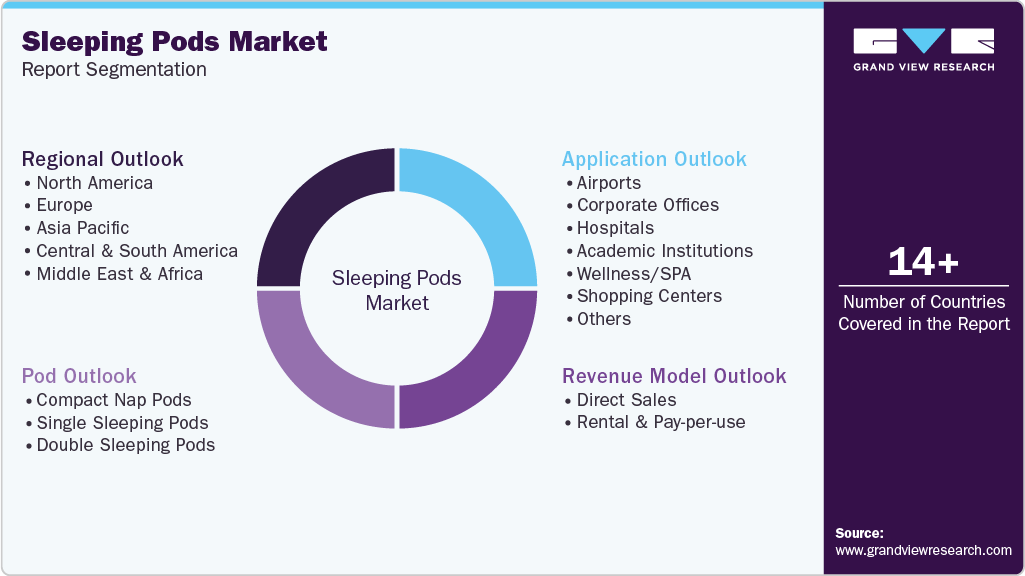
This report forecasts revenue growth at global, regional & country levels and provides an analysis of the latest trends and opportunities in each of the sub-segments from 2021 to 2033. For this study, Grand View Research has segmented the sleeping pods market report based on pod, application, revenue model, and region.
 To learn more about this report, Download Free Sample Report
 -
Pod Outlook (Revenue, USD Million, 2021 - 2033)
-
Compact Nap Pods
-
Single Sleeping Pods
-
Double Sleeping Pods
-
-
Application Outlook (Revenue, USD Million, 2021 - 2033)
-
Airports
-
Corporate Offices
-
Hospitals
-
Academic Institutions
-
Wellness/SPA
-
Shopping Centers
-
Others
-
-
Revenue Model Outlook (Revenue, USD Million, 2021 - 2033)
-
Direct Sales
-
Rental & Pay-per-use
-
-
Regional Outlook (Revenue, USD Million, 2021 - 2033)
-
North America
-
U.S.
-
Canada
-
Mexico
-
-
Europe
-
UK
-
Germany
-
France
-
Italy
-
Spain
-
-
Asia Pacific
-
China
-
India
-
Japan
-
Australia & New Zealand
-
South Korea
-
-
Central & South America
-
Brazil
-
-
Middle East & Africa (MEA)
-
South Africa
-
-
Delivered Customizations
This report has been delivered with the following In-depth customizations
CLIENT REQUEST
CUSTOMIZATION DELIVERED
VALUE ADDS
Airport Infrastructure & Transit Hub Development Analysis
Developed a tailored analysis of the sleeping pods market focused on deployment across key high-traffic environments such as airports, railway stations, corporate offices, co-working spaces, hospitals, and shopping complexes. The study incorporated assessment of infrastructure expansion trends, passenger flow intensity, urban mobility patterns, and regulatory frameworks influencing the installation and operation of sleeping pod systems across regions.
Enables stakeholders to identify high-potential installation locations, evaluate infrastructure readiness, assess regulatory compliance requirements, and understand the impact of transportation and urban development projects on long-term sleeping pod adoption and market scalability.
User Adoption & Demand Behavior Trends
Delivered a customized evaluation of consumer and enterprise adoption patterns for sleeping pods, including trend analysis of usage frequency, commuter behavior, corporate wellness adoption, travel-related demand, and willingness to pay for short-duration rest services. The analysis also examined demographic preferences, digital booking behavior, and factors influencing adoption across different end-use environments.
Provides actionable insights into shifting user behavior, emerging demand clusters, and high-growth application segments, helping clients identify commercially attractive locations and align service offerings with evolving consumer expectations.
Infrastructure Deployment & Smart Pod Ecosystem Opportunity Assessment
Conducted a focused assessment of investment and operational requirements for sleeping pod deployment, including installation costs, maintenance models, hygiene management systems, IoT-enabled features, energy efficiency solutions, and modular design adoption. The analysis also evaluated gaps in smart infrastructure integration and service standardization across regions.
Supports investment planning for manufacturers and operators by quantifying infrastructure needs, identifying underserved locations, evaluating revenue potential from rental and pay-per-use models, and strengthening business cases for expansion and technology integration.
Frequently Asked Questions About This Report
Direct sales held the largest revenue share 56.5% in 2025.
Airports held the largest share (over 28.1%) in 2025.
North America dominated with a 32.7% revenue share in 2025.
The global sleeping pods market size was estimated at USD 471.8 million in 2025 and is expected to reach USD 500.9 million in 2026.
The global sleeping pods market is expected to grow at a compound annual growth rate of 7.2% from 2026 to 2033 to reach USD 814.1 million by 2033.
Compact nap pods accounted for a market share of 51.0% in 2025, due to their space-efficient design, lower installation cost, and suitability for high-traffic environments such as offices, airports, and co-working spaces.
Some key players operating in the sleeping pods market include My Office Pod., napcabs GmbH , Podtime U.K., Sleeping Pods, Nap & Up, BIDUA Pods. , Rest Works, RestSpaceLDN, OBIDUA, Gosleep
The sleeping pods market is driven by increasing workplace fatigue and demand for short rest solutions in offices, airports, and transit hubs. Rising urbanization, long commuting hours, and growing adoption of wellness-focused infrastructure in commercial spaces are further accelerating market growth.
About the Author(s)
Homecare & Decor Research Team
Consumer Goods · Homecare & DecorThis report was authored by the homecare & decor research team at Grand View Research - comprising two research analysts, one senior research analyst, and one industry expert - with specialized expertise in the homecare & decor segment of the consumer goods industry. All findings are based on proprietary consumer goods databases, executive interviews, and regulatory analysis, subject to internal peer review prior to publication.
Last Updated:
Speak to Analyst

Customize this report to your needs - add regions, segments, or data points, with 20% free customization.
Or view our licence options:


ISO 9001:2015 & 27001:2022 Certified
We are GDPR and CCPA compliant! Your transaction & personal information is safe and secure. For more details, please read our privacy policy.


