
- Home
- »
- Advanced Interior Materials
- »
-
Smart Power Tools Market Size And Share Report, 2033GVR Report cover

Smart Power Tools Market (2026 - 2033)
Size, Share & Trends Analysis Report By Product Type (Drilling & Fastening Tools, Cutting & Sawing Tools), By End-use (Industrial, Residential), By Region, And Segment Forecasts
Market Size, 2025
$3.8BMarket Estimate, 2026
$4.2BMarket Forecast, 2033
$7.9BCAGR, 2026–2033
9.6%Smart Power Tools Market Summary
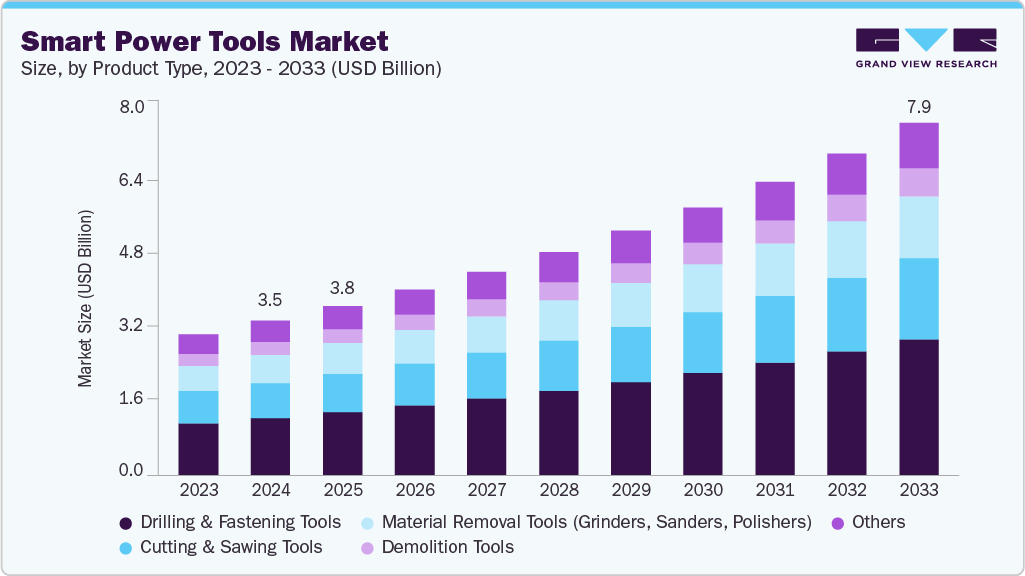
The global smart power tools market size was valued at USD 3.8 billion in 2025 and is projected to grow from USD 4.2 billion in 2026 to USD 7.9 billion by 2033, at a CAGR of 9.6% from 2026 to 2033. Asia Pacific dominated the market, accounting for a revenue share of 33.5% in 2025. These innovations enhance tool efficiency, extend battery life, and enable real-time data analytics such as usage monitoring and predictive maintenance.
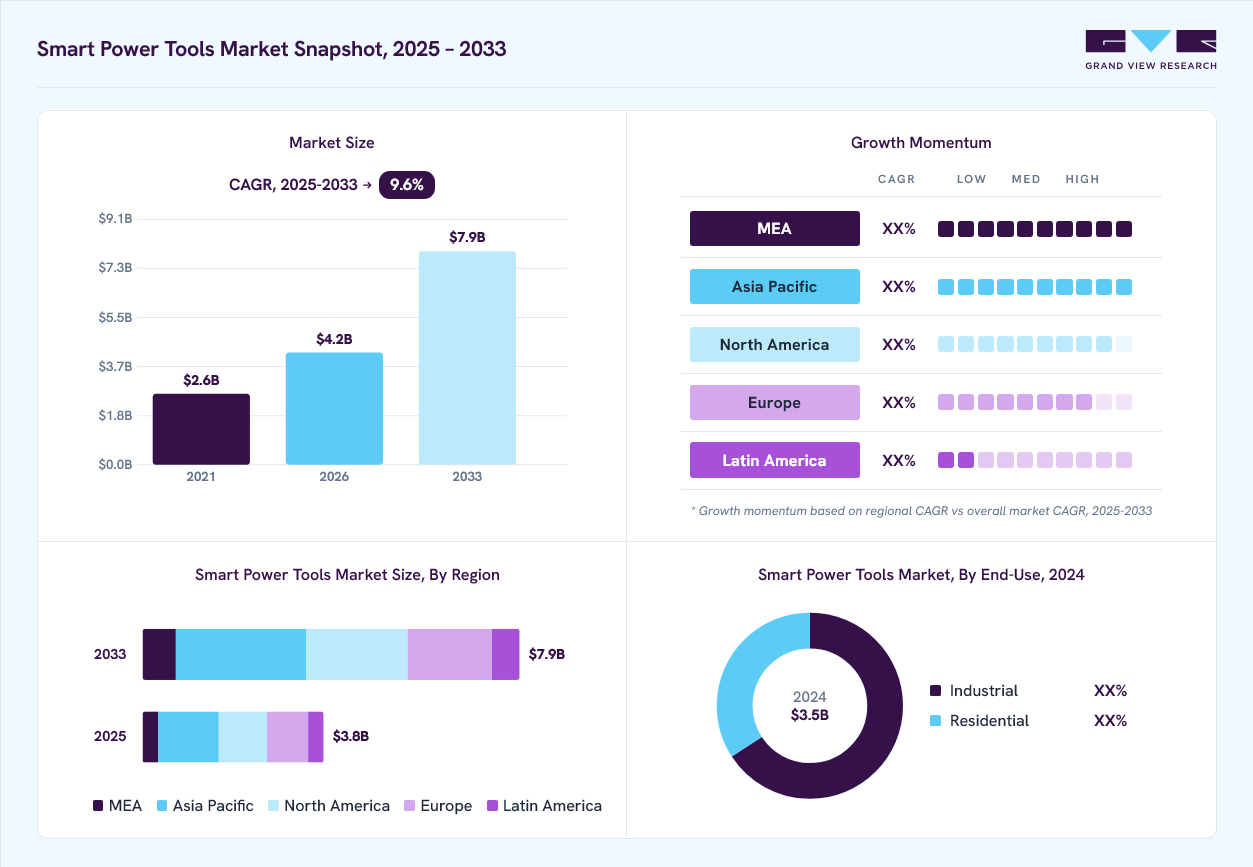 Source: Grand View Research, IR Documents, Primary Interviews, Paid DatabasesTo learn more about this report,
 Download Free Sample Report
 Key Market Trends & Insights
- By product: Drilling & fastening tools segment led the market with the largest revenue share of 37.4% in 2025.
- By end use: Industrial segment led the market with the largest revenue share of 66.0% in 2025.
Regional Highlights
- Largest regional market: Asia Pacific (33.5% revenue share, 2025)
- By country: China held the largest market share in 2025.
Market Size & Forecast
- Market size in 2025: USD 3.8 Billion
- Estimated market size in 2026: USD 4.2 Billion
- Projected market size by 2033: USD 7.9 Billion
- CAGR (2026-2033): 9.6%
Three ways to get this report
Buy it, customize it, or ask a question.Ask an Analyst
Analyst response in 1 business day
- AccessReport author, directly
- Reply timeWithin 1 working day
- No sales callDirect answer only
- FormatEmail reply
- CostFree, no cost
Get the Full Report
What the study covers
- FormatsPDF · Excel · Dashboard
- Timeline2026–2033 annual, 2025 base
- Coverage20+ countries, 5 regions
- Companies10+ key players profiled
Customize the Report
20% free customization
- IncludeCountries, segments, points
- TailorTo your product definition
- ExtendDeeper competitor detail
- OrA fully bespoke study
- Turnaround5–10 working days
These innovations enhance tool efficiency, extend battery life, and enable real-time data analytics such as usage monitoring and predictive maintenance. This technological evolution caters to the need for precision, reliability, and reduced downtime in construction, manufacturing, and other industrial applications, thus elevating demand for smart power tools worldwide. Infrastructure development and a booming construction sector significantly propel the smart power tools market. Massive government initiatives such as the U.S. Infrastructure Investment and Jobs Act, India’s National Infrastructure Pipeline, and China’s Belt and Road Initiative are fueling demand for advanced power tools that deliver better performance and productivity on construction sites. The rise of modern construction techniques such as modular building and smart infrastructure further necessitates power tools equipped with intelligent features, positioning the construction industry as a vital market driver.
 To learn more about this report, Download Free Sample Report
 The growing popularity of Do-It-Yourself (DIY) culture and home improvement activities also contributes to the market’s expansion. Post-pandemic lifestyle changes have encouraged more homeowners to engage in DIY projects, which increases the adoption of cordless and smart power tools for household use. Enhanced e-commerce platforms are making these advanced tools more accessible to end-users globally. Manufacturers are responding by incorporating features such as battery health monitoring and automated inventory management in smart power tools, catering both to DIY consumers and professionals.
Market Dynamics
The smart power tools market is shaped by the ongoing digital transformation of the construction and industrial sectors, where connected equipment improves productivity, precision, and asset management. Integration of wireless connectivity, cloud-based tool management platforms, and real-time performance monitoring is changing how professionals operate and maintain power tools. The growing preference for cordless equipment with longer runtime and enhanced battery performance is further expanding product adoption across professional and DIY applications. Manufacturers are also focusing on ergonomic designs, enhanced safety features, and software-enabled functionalities to differentiate their offerings. However, high product costs, compatibility challenges across battery platforms, concerns regarding data security in connected tools, and fluctuations in electronic component and battery material supply continue to influence market competition and investment strategies.
The increasing preference for cordless and digitally connected power tools is accelerating the growth of the smart power tools market. Construction, manufacturing, automotive, and maintenance professionals are adopting tools equipped with Bluetooth connectivity, real-time diagnostics, inventory tracking, and performance monitoring to improve productivity and reduce equipment downtime. Advancements in lithium-ion battery technology and brushless motors are further enhancing runtime, power output, and operational efficiency, encouraging the replacement of conventional tools with smart alternatives.
The adoption of smart power tools is constrained by their higher upfront cost compared to conventional power tools, particularly for small contractors and price-sensitive users. In addition, proprietary battery ecosystems and limited compatibility between brands often require users to invest in dedicated batteries and chargers, increasing the overall cost of ownership. Frequent software updates, electronic component costs, and maintenance requirements also present challenges for broader market penetration.
The increasing adoption of digital construction practices and Industry 4.0 technologies is creating new opportunities for smart power tool manufacturers. Organizations are investing in connected job sites and intelligent asset management solutions that enable tool tracking, usage analytics, predictive maintenance, and remote fleet management. The growing emphasis on improving workforce productivity, reducing equipment loss, and enhancing operational efficiency is encouraging demand for integrated smart tool ecosystems, opening new avenues for innovation and long-term market growth.
Market Concentration & Characteristics
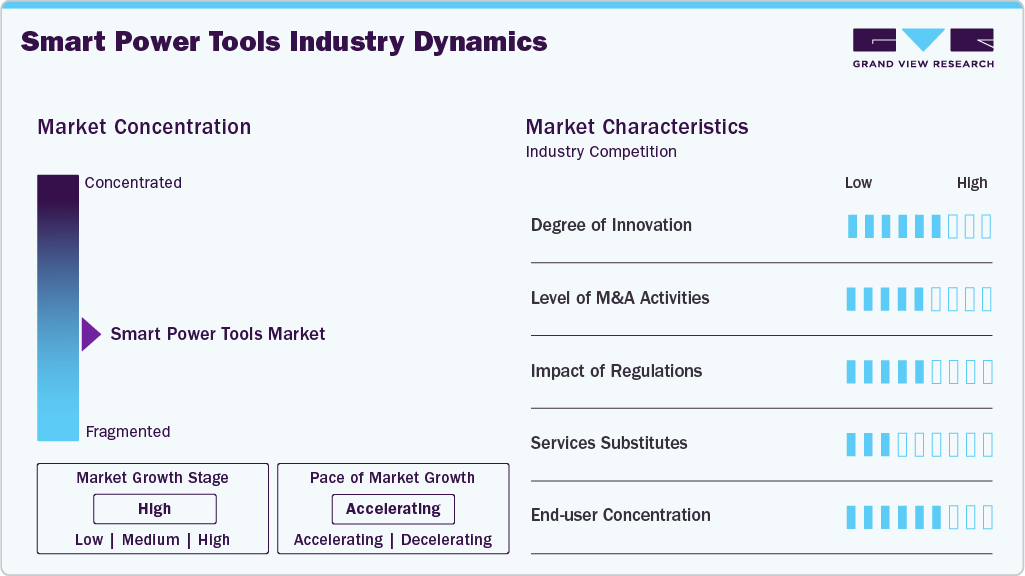
The Smart Power Tools market exhibits a moderately concentrated structure dominated by leading global players such as Stanley Black & Decker, Robert Bosch, Techtronic Industries, Makita, and Hilti. These companies leverage both organic innovation and inorganic growth through product launches, strategic partnerships, and mergers to maintain competitive advantage and broaden their product portfolios. The industry is characterized by a strong focus on technological innovation including IoT integration, brushless motors, and advanced battery systems, driving constant improvements in performance, durability, and connectivity. Patent filings and R&D investments are significant, underlining the sector’s commitment to advancing smart functionalities and enhancing user experience
Regulatory frameworks impact market dynamics notably with evolving safety, environmental, and digital compliance requirements in key regions such as the EU, UK, and China. These regulations influence design standards, emissions restrictions, and security protocols for smart products, thus shaping product development cycles and market entry strategies. Service substitutes such as traditional power tools still hold market share, but increasing user preference for connected, battery-operated devices is reducing substitution risks.
 To learn more about this report, Download Free Sample Report
 End-user concentration is observed mainly in construction, manufacturing, and maintenance sectors, where demand for precision, efficiency, and tool reliability is acute. The adoption of smart power tools is also growing in the DIY segment, although industrial and professional users remain the primary drivers of market growth.
Analyst Perspective
The smart power tools market is expanding rapidly as construction, manufacturing, and industrial users increasingly adopt connected tools to improve productivity, asset visibility, and operational efficiency. Growing demand for IoT-enabled equipment with features such as real-time tool tracking, performance monitoring, predictive maintenance, and remote diagnostics is transforming traditional power tools into intelligent jobsite solutions. In addition, advancements in brushless motor technology, lithium-ion batteries, wireless connectivity, and cloud-based fleet management platforms enabling higher performance, longer runtime, and improved equipment utilization. Manufacturers are strengthening their digital ecosystems by integrating smart tools with mobile applications and enterprise asset management platforms, allowing users to monitor tool health, optimize maintenance schedules, and reduce equipment loss. As industries continue to embrace digital construction and Industry 4.0 practices, suppliers offering connected, high-performance, and application-specific smart power tools are expected to benefit from sustained long-term market growth.
Product Type Insights
Based on product type, the drilling & fastening tools segment led the market with the largest revenue share of 37.4% in 2025, driven by growing demand for precision, efficiency, and connectivity in industrial and construction applications. The integration of smart sensors, torque control, and digital monitoring systems enables users to achieve consistent fastening accuracy while minimizing errors. Increasing adoption of battery-operated and brushless motor-based tools also enhances durability and energy efficiency. In addition, manufacturers are developing app-connected drilling and fastening systems that allow users to adjust settings and track performance in real time.
The cutting & sawing tools segment is expected to significantly at CAGR of 9.7% over the forecast period, driven by rising need for automation and precision in wood, metal, and composite material processing. Smart cutting tools equipped with AI-based monitoring systems and load sensors optimize blade performance and reduce material waste. Advancements in safety technologies, such as automatic shut-off and overload protection, further enhance user experience. The growing use of cordless and IoT-enabled saws in residential renovation and industrial manufacturing projects supports the market’s growth trajectory.
End Use Insights
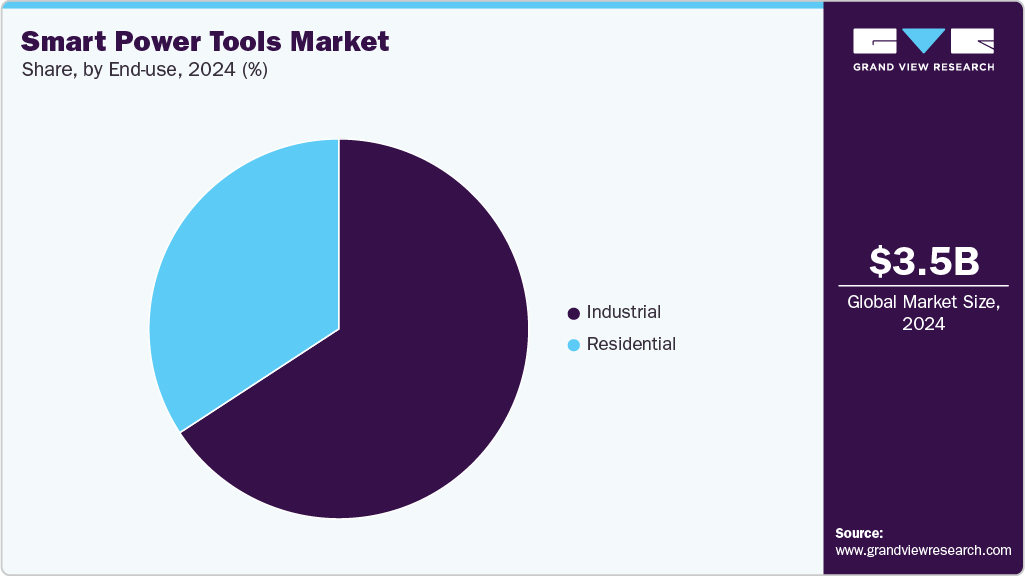
Based on end use, the industrial segment led the market with the largest revenue share of 66.0% in 2025, driven by rising popularity of home improvement and renovation activities worldwide. Consumers are increasingly investing in smart power tools for do-it-yourself (DIY) projects that require convenience, precision, and safety. Connectivity features such as mobile app integration and usage tracking are enabling users to monitor performance and battery life efficiently. The demand for compact, energy-efficient, and easy-to-operate smart tools is expanding among urban households.
 To learn more about this report, Download Free Sample Report
Industrial segment is expected to grow significantly at CAGR of 8.7% over the forecast period, driven by rising implementation of Industry 4.0 principles and automation in production environments. Smart power tools integrated with sensors, data analytics, and wireless connectivity enhance productivity, quality control, and safety in manufacturing and assembly lines. Industries such as automotive, aerospace, and heavy machinery are adopting connected tools to reduce human error and optimize torque performance. Predictive maintenance features enabled by IoT connectivity help reduce downtime and extend tool lifespan.Regional Insights
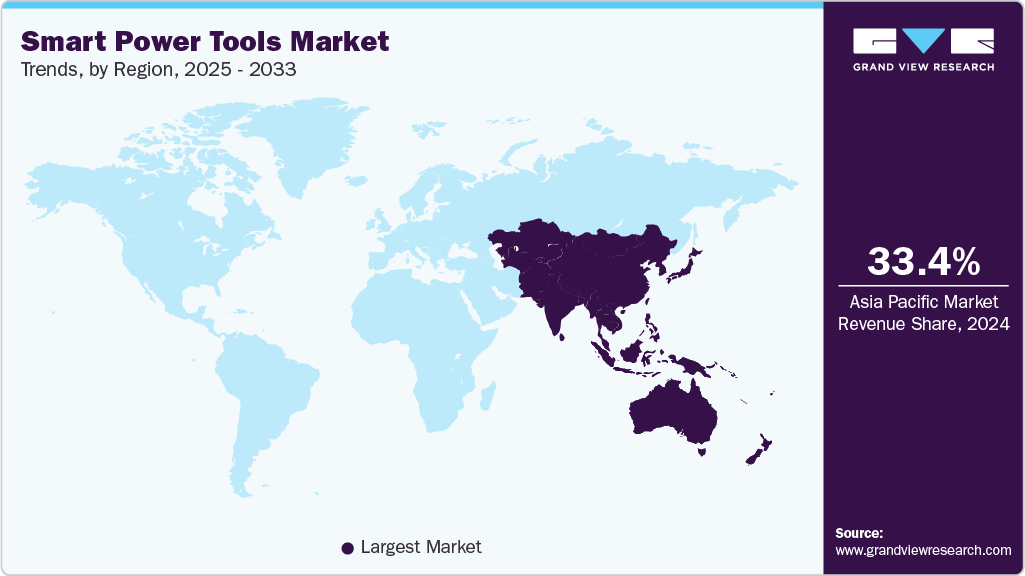
Asia Pacific dominated the smart power tools market with the largest revenue share of 33.5% in 2025, driven by booming infrastructure development and rapid urbanization across key economies such as India and Southeast Asia. The construction sector’s growth demands advanced, cordless, and IoT-enabled tools for enhanced productivity and cost efficiency. In addition, rising DIY interest supported by expanding e-commerce platforms fuels residential market growth. Competition is intense with major global players synergizing technological leadership with regional manufacturing to address price-sensitive segments, while sustainability initiatives promote eco-friendly tool development in line with government policies.
 To learn more about this report, Download Free Sample Report
 China Smart Power Tools Market Trends
The smart power tools market in China held the largest share in the Asia Pacific region in 2025. China’s market stands out due to rapid industrialization and urbanization accelerating demand in construction, manufacturing, and DIY sectors. Technological progress in brushless motors and battery efficiency boosts portable power tool adoption. The widespread move to smart, connected tools with AI and IoT functionalities enables precision, predictive maintenance, and operational optimization. As the world’s manufacturing hub, Chinese producers expand capacity to meet domestic and export demand. Sustainability and energy-efficiency considerations are strongly influencing product innovation in response to regulatory and consumer pressures.
North America Smart Power Tools Market Trends
North America’s Smart Power Tools market is invigorated by rapid technological advancements such as brushless motors and IoT integration, which enhance tool efficiency and connectivity. The emergence of lithium-ion battery technology has substantially improved cordless tool performance with longer runtimes and faster charging. Additionally, the expansion of e-commerce channels facilitates widespread consumer access, catalyzing market growth by making smart tools more accessible across professional and DIY segments. The construction and automotive industries remain pivotal, driving demand for reliable, portable, and feature-rich power tools that meet evolving operational needs
The U.S. market mirrors these drivers with an added emphasis on strong DIY culture and home renovation activities that fuel demand. Technological innovations in cordless and smart tools continue to shape buyer preferences toward enhanced ergonomics, real-time monitoring, and predictive maintenance. Rising infrastructure investment and industrial automation further boost demand in professional sectors. Moreover, regulatory focus on sustainability encourages manufacturers to develop low-emission, energy-efficient tool variants, aligning with government incentives and green building initiatives for a resilient market expansion.
Europe Smart Power Tools Market Trends
Europe’s Smart Power Tools market benefits from the presence of industry leaders like Bosch and Makita, which emphasize product innovation, eco-friendly designs, and IoT integration. The market is shaped by strict environmental and safety regulations driving manufacturers to develop ergonomic, low-emission tools. E-commerce channels support the growing DIY customer base, though industrial sectors including automotive and construction remain dominant end users. Strategic collaborations and geographic expansions into emerging Eastern European markets further bolster competitive positioning and market diversification.
Germany, as a key European market, experiences steady growth grounded in advanced industrial development and technological adoption. The increasing preference for wireless, IoT-integrated, and energy-efficient power tools is complemented by stringent national and EU environmental regulations fostering sustainable product innovation. The construction and automotive sectors lead demand for smart tools designed for precision and safety. Online retail growth also facilitates broader tool accessibility across professional and DIY segments, supporting the market’s steady expansion trajectory
Latin America Smart Power Tools Market Trends
In Latin America, the Smart Power Tools market is propelled by ongoing infrastructure projects and expanding industrial sectors requiring durable and efficient power tools. DIY home improvement trends supported by rising disposable incomes and increasing e-commerce penetration foster broader tool adoption. The demand spans from professional construction applications to residential usage, with manufacturers adapting products for regional affordability and reliability. Economic reforms and foreign investments further stimulate market growth, highlighting Latin America as an emerging opportunity for smart tool manufacturers
Middle East & Africa Smart Power Tools Market Trends
The Middle East & Africa market is strongly driven by infrastructure development, especially in countries like Saudi Arabia and the UAE, where substantial investments in construction and industrial expansion create demand for high-performance, reliable power tools. Key players focus on tailored solutions to address regional project needs, integrating smart features that enhance efficiency. The region’s growing industrial sectors and urbanization, coupled with government initiatives supporting modernization, underpin the market’s growth momentum. In addition, sustainability trends and regulatory considerations are pushing manufacturers to provide energy-efficient and eco-friendly tool options.
Key Smart Power Tools Company Insights
Some of the key players operating in market include Stanley Black & Decker, Inc., Robert Bosch GmbH
-
Stanley Black & Decker, Inc. is a global provider of tools, storage, and industrial solutions. The company’s smart power tools portfolio includes connected drills, saws, and impact drivers integrated with Bluetooth and tool management platforms. Through its DEWALT Tool Connect system, users can monitor tool location, diagnostics, and performance in real time, enhancing job site efficiency and safety.
-
Robert Bosch GmbH offers an extensive range of smart power tools for both professional and consumer markets. Its products include connected screwdrivers, drills, and measuring devices equipped with Bluetooth and sensor-based feedback systems. Bosch’s “PRO360” platform allows centralized tool management, facilitating data analytics and predictive maintenance for industrial users.
Makita Corporation, Techtronic Industries Co. Ltd. are some of the emerging market participants in smart power tools market.
-
Makita Corporation is a prominent Japanese manufacturer specializing in cordless and battery-powered smart tools. The company’s offerings include IoT-enabled drills, grinders, and impact wrenches designed for energy efficiency and precision. Makita’s advanced lithium-ion battery technology and smart controls improve productivity while ensuring tool longevity.
-
Techtronic Industries Co. Ltd. (TTI) manufactures innovative smart power tools under brands such as Milwaukee, Ryobi, and AEG. The company focuses on connected and battery-operated solutions for industrial, construction, and DIY applications. TTI’s ONE-KEY digital platform enables users to customize settings, track inventory, and remotely manage tools, enhancing workflow efficiency.
Key Smart Power Tools Companies:
The following key companies have been profiled for this study on the smart power tools market.
-
Stanley Black & Decker, Inc.
-
Robert Bosch GmbH
-
Makita Corporation
-
Techtronic Industries Co. Ltd.
-
Hilti Corporation
-
Snap-on Incorporated
-
Festool GmbH
-
Panasonic Corporation
-
Hitachi Koki Co., Ltd.
Competitive Benchmarking
Category
Operating Strategies
Competitive Edge
Weakness
Established Players (e.g., Stanley Black & Decker, Inc.; Robert Bosch GmbH; Techtronic Industries Co. Ltd.; Makita Corporation; Hilti Corporation)
- Invest in smart connected tools, advanced battery platforms, and brushless motor technologies to strengthen product innovation.
- Expand global manufacturing, distribution networks, and strategic partnerships while increasing R&D investments.
- Strong global brands with diversified product portfolios and extensive distribution networks.
- Advanced connected tool ecosystems, proprietary battery platforms, and established relationships with professional customers.
- High investment requirements for product innovation, software development, and manufacturing expansion.
- Vulnerability to battery material costs, electronic component shortages, and intense market competition.
Emerging & Regional Players (e.g., Snap-on Incorporated; Festool GmbH; Koki Holdings Co., Ltd.; Emerson Electric Co. (RIDGID); Apex Tool Group, LLC)
- Focus on premium, application-specific smart tools with advanced connectivity and precision features.
- Differentiate through customer-focused innovation, ergonomic designs, and specialized professional solutions.
- Strong expertise in niche professional applications with high-quality, durable products.
- Greater flexibility to develop customized solutions and respond quickly to evolving customer needs.
- Smaller global footprint and lower manufacturing scale than leading competitors.
- Greater dependence on regional markets and professional end-user demand for sustained growth.
Recent Developments
- Bosch Power Tools' launch of the GWS 800 Professional in January 2023 marks a strategic expansion in the angle grinder market, emphasizing performance and compact design tailored for the Indian market. This Made-in-India product enhances Bosch’s competitive portfolio by addressing the demand for durable, high-power tools suitable for both professional and industrial users.
Smart Power Tools Market Report Scope
Report Attribute
Details
Market size in 2025
USD 3.8 billion
Estimated market size in 2026
USD 4.2 billion
Projected market size by 2033
USD 7.9 billion
Growth rate
CAGR of 9.6% from 2026 to 2033
Base year for estimation
2025
Historical data
2021 - 2024
Forecast period
2026 - 2033
Quantitative units
Revenue in USD billion and CAGR from 2026 to 2033
Report coverage
Revenue forecast, company ranking, competitive landscape, growth factors, and trends
Segments covered
Product type, end use, region
Regional scope
North America; Europe; Asia Pacific; Central & South America; Middle East & Africa
Country scope
U.S.; Canada; Mexico; Germany; UK; France; Italy; Spain; Japan; China; India
Key companies profiled
Stanley Black & Decker, Inc.; Robert Bosch GmbH; Techtronic Industries Co. Ltd.; Makita Corporation; Hilti Corporation; Snap-on Incorporated; Festool GmbH; Koki Holdings Co., Ltd.; Emerson Electric Co. (RIDGID); Apex Tool Group, LLC.
Customization scope
Free report customization (equivalent up to 8 analysts' working days) with purchase. Addition or alteration to country, regional & segment scope.
Pricing and purchase options
Avail customized purchase options to meet your exact research needs. Explore purchase options
Global Smart Power Tools Market Report Segmentation
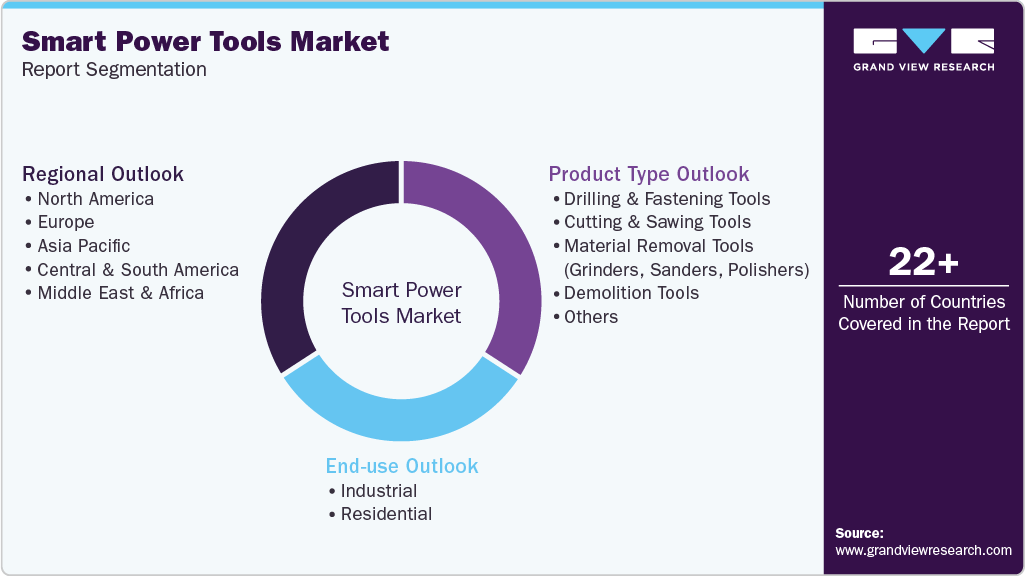
This report forecasts revenue growth at global, regional, and country levels and provides an analysis of the latest industry trends in each of the sub-segments from 2021 to 2033. For this study, Grand View Research has segmented the global smart power tools market report based on product type, end use, and region:
 To learn more about this report, Download Free Sample Report
 -
Product Type Outlook (Revenue, USD Million, 2021 - 2033)
-
Drilling & Fastening Tools
-
Cutting & Sawing Tools
-
Material Removal Tools (Grinders, Sanders, Polishers)
-
Demolition Tools
-
Others
-
-
End Use Outlook (Revenue, USD Million, 2021 - 2033)
-
Industrial
-
Residential
-
-
Regional Outlook (Revenue, USD Million, 2021 - 2033)
-
North America
-
U.S.
-
Canada
-
Mexico
-
-
Europe
-
Germany
-
UK
-
France
-
Italy
-
Spain
-
-
Asia Pacific
-
China
-
Japan
-
India
-
-
Central & South America
-
Middle East & Africa
-
Research Methodology
The smart power tools market figures in this report are based on a proven research process that combines executive interviews with secondary research from proprietary databases, company filings, and recognized regulatory and institutional sources. Market size is built through value-chain sizing - reconciling supply-side and demand-side estimates - and triangulated with bottom-up and top-down approaches. Every estimate passes multiple levels of expert validation before publication, with each smart power tools segment quantified using the revenue-capture definitions in the table below.
Segment Definition
Segment - Product Type
Revenue Capture Definition
Drilling & Fastening Tools
Revenue generated from the sale of smart drilling and fastening power tools, including connected drills, impact drivers, screwdrivers, rotary hammers, and related smart-enabled fastening equipment.
Cutting & Sawing Tools
Revenue generated from the sale of smart cutting and sawing power tools, including connected circular saws, reciprocating saws, jigsaws, band saws, and other smart-enabled cutting equipment.
Material Removal Tools (Grinders, Sanders, Polishers)
Revenue generated from the sale of smart material removal power tools, including connected grinders, sanders, polishers, and other smart-enabled surface finishing equipment.
Demolition Tools
Revenue generated from the sale of smart demolition power tools, including connected demolition hammers, breakers, rotary demolition tools, and other smart-enabled heavy-duty demolition equipment.
Others
Revenue generated from the sale of other smart power tools not covered under the above categories, including connected heat guns, planers, routers, oscillating multi-tools, nailers, inflators, and specialty smart tools.
Segment – End Use
Revenue Capture Definition
Industrial
Revenue is generated from the sale of smart power tools used across industrial and commercial sectors, including construction, manufacturing, automotive, aerospace, energy, maintenance, and infrastructure applications.
Residential
Revenue is generated from the sale of smart power tools purchased for residential and DIY applications, including home improvement, repair, renovation, woodworking, and gardening activities.
Estimation Model
Layer Name
Key Question
Description
Smart Power Tools Demand Layer
Where are smart power tools required?
Analyze demand across construction, manufacturing, automotive, woodworking, metalworking, infrastructure development, facility maintenance, and DIY applications. Assess tool utilization, digital workflow adoption, and productivity requirements to establish the addressable demand for smart power tools.
Construction & Industrial Digitalization Layer
Where is new equipment demand being created?
Evaluate investments in construction projects, industrial automation, connected job sites, manufacturing facilities, and infrastructure development. Assess equipment modernization initiatives, replacement of conventional tools, and adoption of digital asset management systems that drive procurement of new smart power tools.
Product Adoption Layer
Which smart power tool technologies are being deployed?
Segment demand by product type, connectivity technology, power source, application, end-use industry, and distribution channel. Apply adoption rates based on productivity gains, remote monitoring capabilities, battery performance, tool tracking, predictive maintenance, and fleet management requirements.
Revenue Generation Layer
How much market revenue is generated?
Estimate annual shipments of smart power tools by product type, connectivity technology, application, end-use industry, and region. Quantify revenues generated exclusively from the sale of new smart power tools supplied through OEMs, distributors, retailers, and e-commerce channels.
Delivered Customizations
This report has been delivered with the following In-depth customizations
CLIENT REQUEST
CUSTOMIZATION DELIVERED
VALUE ADDS
Competitive Benchmarking
A competitive benchmarking analysis was conducted by evaluating leading smart power tool manufacturers based on product portfolio, connected tool capabilities, battery platform innovations, manufacturing footprint, strategic initiatives, financial strength, and competitive positioning within the smart power tools market.
This benchmarking enabled stakeholders to evaluate competitive strengths, identify product and technology differentiation opportunities, understand evolving competitive strategies, and develop informed market positioning and growth plans.
Regional Segmentation
A comprehensive regional analysis was provided across key markets, highlighting demand for cordless and connected power tools, construction and industrial activity, manufacturing capabilities, distribution networks, technology adoption, and regulatory standards. The assessment also evaluated the contribution of major countries to regional market performance.
The regional insights helped stakeholders identify high-growth markets, optimize expansion strategies, prioritize investments, and align product offerings with regional demand patterns and industry requirements.
Opportunity Assessment
A detailed opportunity assessment was conducted by evaluating advancements in cordless technology, smart tool connectivity, lithium-ion battery innovations, digital jobsite solutions, and growing adoption across construction, manufacturing, automotive, maintenance, and residential applications. The analysis identified high-growth opportunities across product categories, end-use industries, and emerging smart tool ecosystems.
This assessment enabled stakeholders to prioritize investment opportunities, align product development with evolving customer requirements, strengthen competitive positioning, and capitalize on the growing adoption of connected, high-performance cordless power tools.
Frequently Asked Questions About This Report
The industrial segment accounted for the largest revenue share of 66.0% in 2025.
The global smart power tools market size was estimated at USD 3.8 billion in 2025 and is expected to be USD 4.2 billion in 2026.
Asia Pacific dominated the smart power tools market with the largest revenue share of 33.5% in 2025.
Stanley Black & Decker, Inc., Robert Bosch GmbH, Makita Corporation, Techtronic Industries Co. Ltd., Hilti Corporation, Snap-on Incorporated, Festool GmbH, Panasonic Corporation, and Hitachi Koki Co., Ltd. are prominent companies in the smart power tools market.
The key factors driving the smart power tools market include increasing adoption of IoT-enabled tools, rising demand for automation in construction and manufacturing, and growing emphasis on energy efficiency and precision.
The global smart power tools market, in terms of revenue, is expected to grow at a compound annual growth rate of 9.6% from 2026 to 2033 to reach USD 7.9 billion by 2033.
The drilling & fastening tools segment led the market with the largest revenue share of 37.4% in 2025.
About the Author(s)
Advanced Interior Materials Research Team
Advanced Materials · Advanced Interior MaterialsThis report was authored by the advanced interior materials research team at Grand View Research - comprising two research analysts, one senior research analyst, and one industry expert - with specialized expertise in the advanced interior materials segment of the advanced materials industry. All findings are based on proprietary advanced materials databases, executive interviews, and regulatory analysis, subject to internal peer review prior to publication.
Last Updated:
Speak to Analyst

Customize this report to your needs - add regions, segments, or data points, with 20% free customization.
Or view our licence options:


ISO 9001:2015 & 27001:2022 Certified
We are GDPR and CCPA compliant! Your transaction & personal information is safe and secure. For more details, please read our privacy policy.


