
- Home
- »
- Advanced Interior Materials
- »
-
Smart Room Heater Market Size & Share Report, 2026-2033GVR Report cover

Smart Room Heater Market (2026 - 2033) Size, Share & Trends Analysis Report By Technology (Oil-Filled Radiator Smart Heaters, Convection Panel Smart Heaters, Fan-Forced Smart Heaters), By Connectivity, By End Use, By Distribution Channel, By Region, And Segment Forecasts
Market Size, 2025
$2.2BMarket Estimate, 2026
$2.3BMarket Forecast, 2033
$3.2BCAGR, 2026–2033
4.8%Smart Room Heater Market Summary
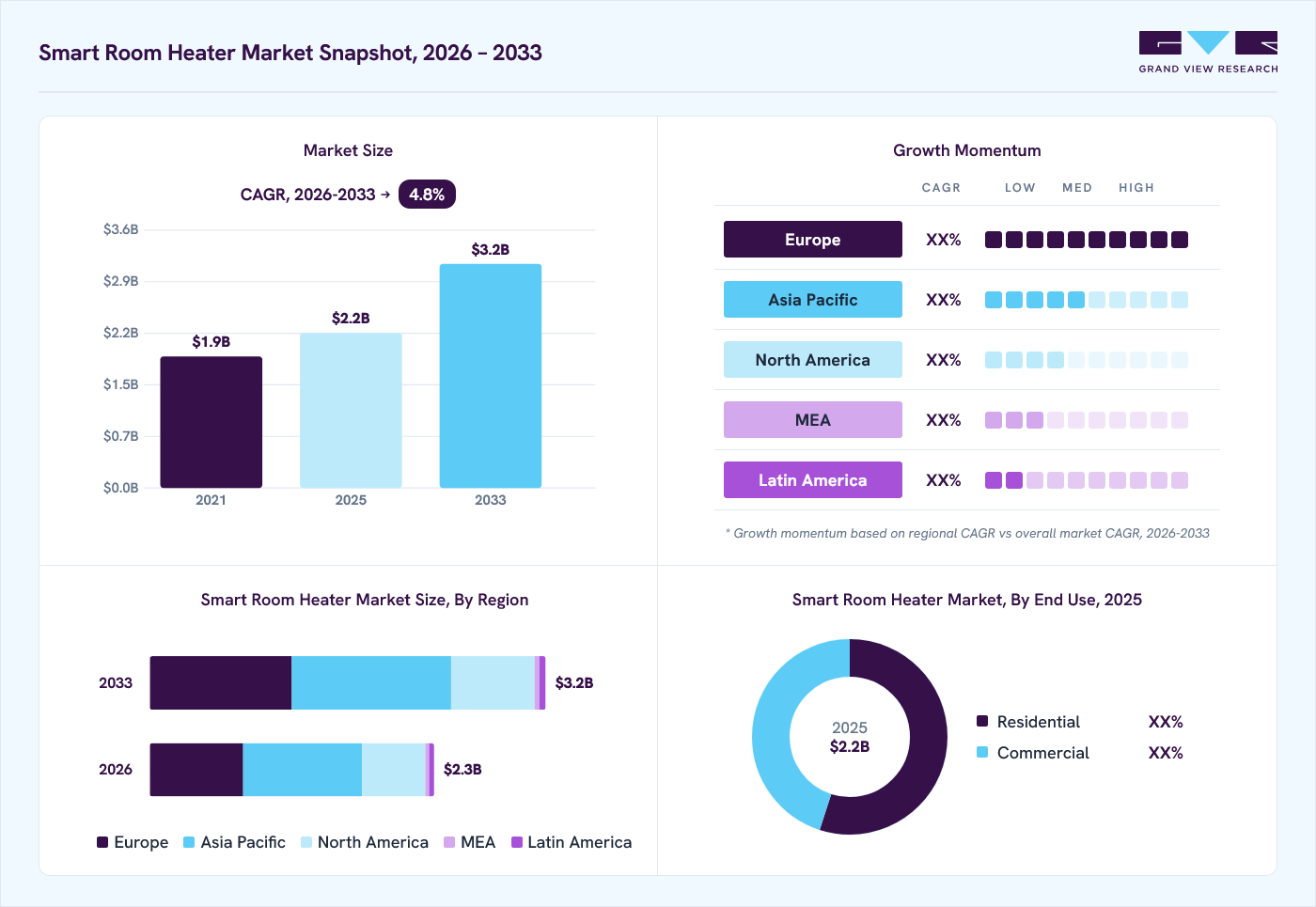
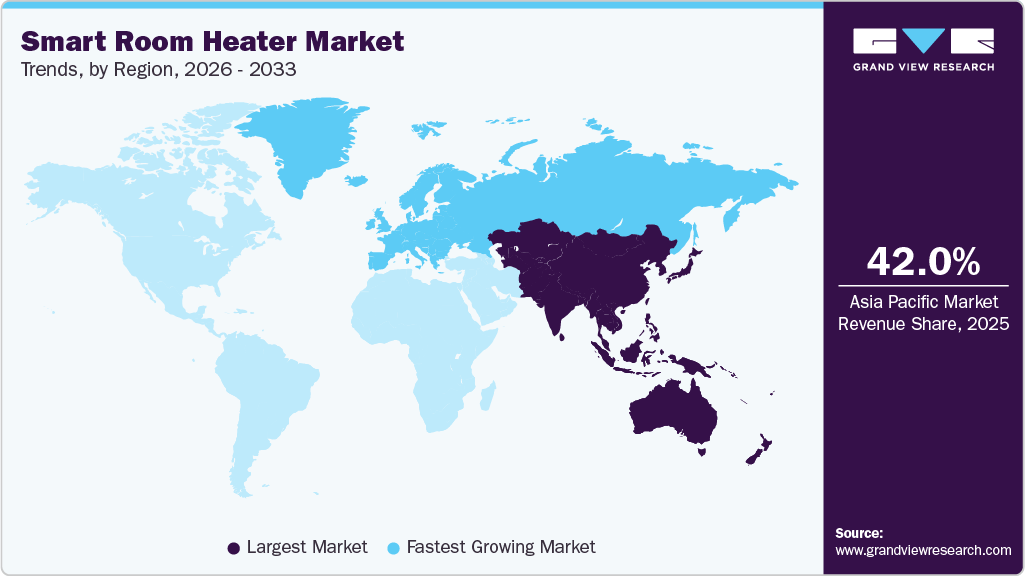
The global smart room heater market size was valued at USD 2.2 billion in 2025 and is projected to grow from USD 2.3 billion in 2026 to USD 3.2 billion by 2033, at a CAGR of 4.8% from 2026 to 2033. The Asia Pacific smart room heater market held the largest share of 42.0% of the global market in 2025. The industry is driven by increasing demand for energy-efficient and connected home solutions.
 Source: Grand View Research, IR Documents, Primary Interviews, Paid DatabasesTo learn more about this report,
 Download Free Sample Report
 Key Market Trends & Insights
- By technology: Fan-forced smart heaters segment dominated the market and accounted for a share of 34.5% in 2025.
- By connectivity: Wi-Fi-enabled smart room heater segment is projected to expand at a CAGR of 5.3% from 2026 to 2033 in terms of revenue.
- By end use: Commercial segment is expected to grow at a CAGR of 4.6% during the forecast period.
- By distribution channel: Offline segment dominated the market, accounting for 62.8% market share in 2025.
Regional Highlights
- Largest regional market: Asia Pacific ( 42.0% revenue share, 2025)
- Fastest-growing regional market: Europe (highest CAGR, 2026-2033)
- China dominated the smart room heater market in Asia Pacific region in 2025.
Market Size & Forecast
- Market size in 2025: USD 2.2 Billion
- Estimated market size in 2026: USD 2.3 Billion
- Projected market size by 2033: USD 3.2 Billion
- CAGR (2026-2033): 4.8%
Three ways to get this report
Buy it, customize it, or ask a question.Ask an Analyst
Analyst response in 1 business day
- AccessReport author, directly
- Reply timeWithin 1 working day
- No sales callDirect answer only
- FormatEmail reply
- CostFree, no cost
Get the Full Report
What the study covers
- FormatsPDF · Excel · Dashboard
- Timeline2026–2033 annual, 2025 base
- Coverage20+ countries, 5 regions
- Companies10+ key players profiled
Customize the Report
20% free customization
- IncludeCountries, segments, points
- TailorTo your product definition
- ExtendDeeper competitor detail
- OrA fully bespoke study
- Turnaround5–10 working days
Rising adoption of smart home ecosystems is encouraging consumers to choose heaters with Wi-Fi connectivity, app-based controls, and voice assistant integration.These features enable better temperature management, energy savings, and user convenience. Growing awareness of energy conservation and rising electricity costs are further supporting demand.
 To learn more about this report, Download Free Sample Report
 Technological advancements, such as AI-based temperature optimization and occupancy sensing, are enhancing product efficiency. Demand is also increasing in colder regions and urban households seeking compact, portable heating solutions. Additionally, government regulations promoting energy-efficient appliances and the expansion of e-commerce platforms are making smart room heaters more accessible to a wider consumer base.
Market Concentration & Characteristics
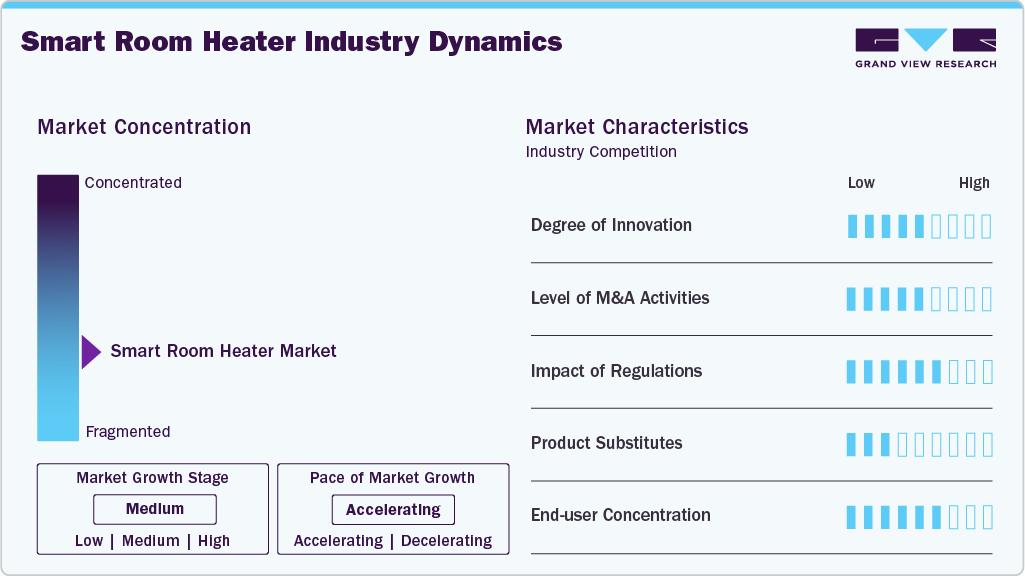
The industry is fragmented, with a mix of established appliance manufacturers, smart home technology companies, and emerging startups competing across regions. Large players benefit from brand recognition and distribution networks, while smaller firms focus on niche features and competitive pricing. Rapid technological advancements encourage new entrants, but product differentiation through connectivity, energy efficiency, and design creates competitive diversity, preventing high market concentration.
The industry is highly innovative, driven by advancements in IoT, AI, and energy management technologies. Manufacturers are introducing features such as app-based controls, voice assistant compatibility, occupancy sensors, and adaptive heating. Integration with smart home ecosystems enhances user convenience. Continuous improvements in safety features, energy efficiency, and compact designs are further strengthening product appeal and supporting market differentiation.
 To learn more about this report, Download Free Sample Report
 Merger and acquisition activity in the smart room heaters industry is gradually increasing as companies aim to expand product portfolios and technological capabilities. Established appliance manufacturers are acquiring smart technology firms to enhance connectivity features, while partnerships with IoT providers are also common. These strategic moves help companies strengthen market presence, access new customer segments, and accelerate innovation in competitive and rapidly evolving smart home markets.
Regulations are significantly shaping the industry by promoting energy efficiency, safety standards, and environmental compliance. Governments are implementing strict guidelines on power consumption, emissions, and product safety, encouraging manufacturers to develop efficient and eco-friendly devices. Energy labeling programs and efficiency certifications influence consumer purchasing decisions. Compliance with these standards increases production costs but drives innovation and ensures long-term sustainability in the market.
Drivers, Opportunities & Restraints
Growing adoption of smart home technologies and connected devices is driving the smart room heaters market. Consumers increasingly prefer appliances that offer remote control, automation, and energy monitoring through mobile apps or voice assistants. Rising awareness of energy efficiency and convenience, along with increasing electricity costs, is encouraging users to shift from conventional heaters to smarter, more efficient heating solutions.
Expansion of smart home ecosystems and increasing penetration in emerging markets is creating significant opportunities for the smart room heaters. As internet connectivity improves and disposable incomes rise, more consumers are adopting connected appliances. Integration with renewable energy systems and the development of AI-based heating solutions offer further growth potential. E-commerce platforms also enable wider product reach and accessibility, supporting market expansion.
A significant challenge in the industry is the relatively high upfront cost compared to traditional heating devices. Price sensitivity in developing regions can limit adoption. Additionally, concerns related to data privacy, cybersecurity, and device compatibility may discourage some consumers. Dependence on stable internet connectivity and potential technical issues can also affect user experience, creating barriers to widespread adoption in certain markets.
Technology Insights
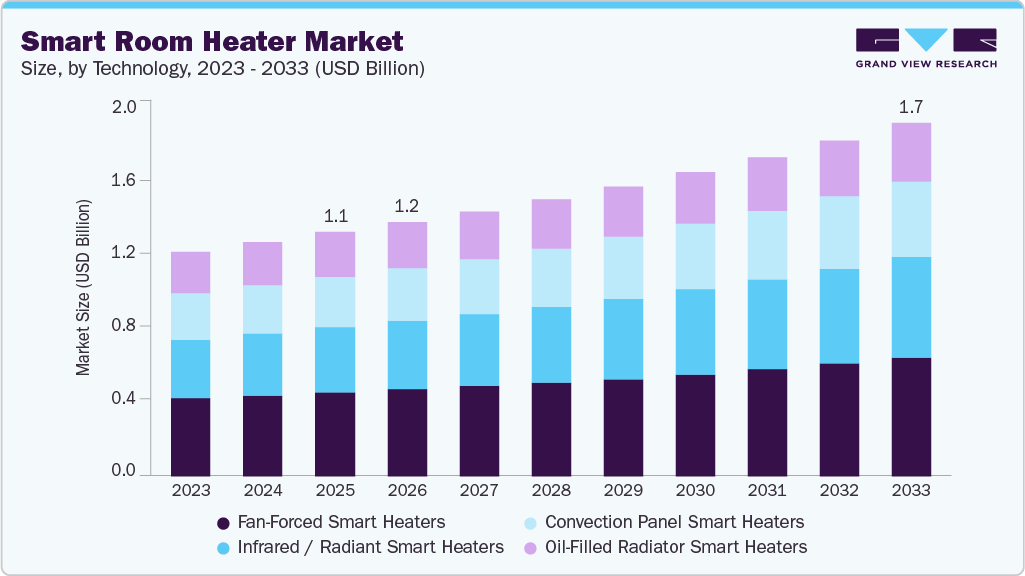
The fan-forced smart heaters segment dominated the market and accounted for a share of 34.5% in 2025, due to its ability to provide rapid and uniform heat distribution. These heaters are preferred for quick warming in residential and commercial spaces. Integration with smart features such as app control and timers enhances convenience. Rising demand for compact, efficient, and fast-heating solutions is supporting segment growth.
The convection panel smart heaters segment is driven by demand for consistent and uniform room heating. These heaters are suitable for enclosed spaces and are widely used in residential and commercial settings. Smart features such as programmable timers, remote access, and energy monitoring improve convenience and efficiency. Growing preference for aesthetically designed, wall-mounted heating solutions is further contributing to segment growth.
Connectivity Insights
Non-connected / remote controlled segment accounted for a share of 49.5% in 2025. Heat pumps dominate the smart room heaters market due to their affordability and ease of use. Consumers in price-sensitive regions or those seeking simple heating solutions prefer this segment. While lacking advanced connectivity features, these heaters still offer convenience through remote operation and basic programmable settings, making them suitable for households and small offices looking for reliable, cost-effective heating solutions without smart home integration.
Wi-Fi-enabled smart room heaters segment is projected to expand at a CAGR of 5.3% from 2026 to 2033, driven by increasing adoption of smart home ecosystems and demand for connected appliances. These heaters offer remote control via mobile apps, voice assistant integration, and energy monitoring, enhancing convenience and efficiency. Rising consumer awareness of energy savings, automation, and personalized comfort is boosting adoption. Growth is particularly strong in urban areas and tech-savvy households seeking advanced, flexible, and energy-efficient heating solutions.
Distribution Channel Insights
The offline segment dominated the market, accounting for 62.8% market share in 2025. The offline segment is driven by traditional retail channels such as appliance stores, electronics outlets, and home improvement centers. Consumers often prefer in-store purchases to physically inspect products, compare features, and receive immediate assistance. Established brand presence and trusted retail networks support growth, especially in regions with lower e-commerce penetration or where customers value personalized guidance before purchasing smart heating solutions.
The online segment is expected to grow rapidly at 5.2% CAGR during the forecast period in the smart room heaters market, driven by the expansion of e-commerce platforms and increasing consumer preference for convenient, doorstep delivery. Online channels enable easy comparison of features, prices, and customer reviews, supporting informed purchase decisions. Growth is particularly strong in urban areas and tech-savvy markets, where digital adoption is high, and manufacturers are leveraging online promotions and direct-to-consumer strategies to reach a broader audience.
End Use Insights
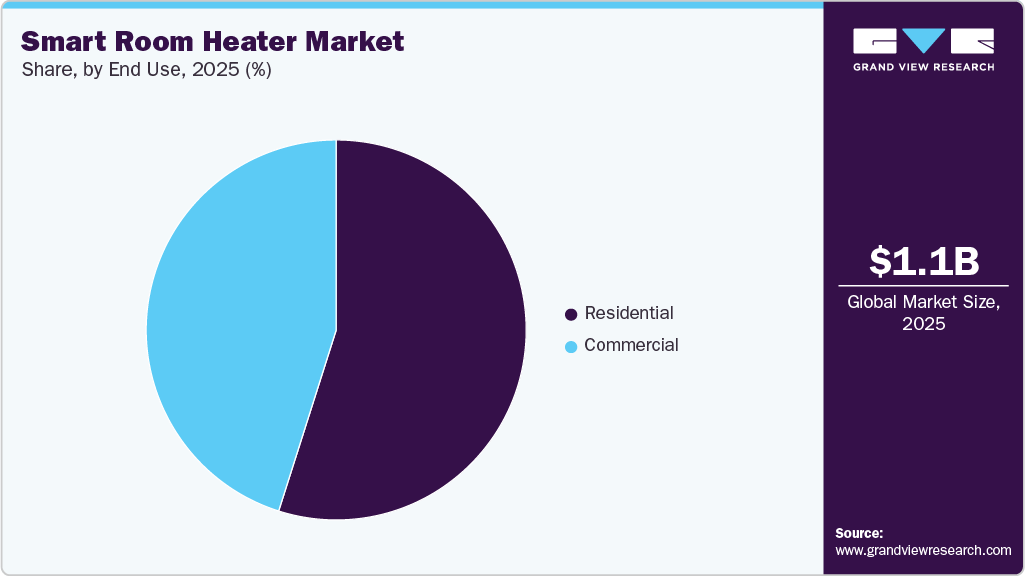
The residential segment dominated the market and accounted for a share of 54.9% in 2025 due to increasing adoption of smart home devices and rising demand for energy-efficient heating solutions. Consumers are prioritizing convenience, remote control, and automation features. Growing awareness of energy savings, coupled with rising electricity costs, is encouraging households to shift toward smart heaters, especially in urban areas and colder regions with higher heating needs.
 To learn more about this report, Download Free Sample Report
 The commercial segment is expected to grow at a CAGR of 4.6% during the forecast period, driven by demand from offices, hotels, retail spaces, and small businesses. These users seek efficient and controllable heating solutions to manage energy costs and maintain comfort. Smart features such as centralized control, scheduling, and energy monitoring support operational efficiency. Increasing focus on sustainability and cost optimization is further encouraging adoption in commercial environments.
Regional Insights
North America smart room heater market is growing due to the rising adoption of smart home technologies and connected devices. Consumers are increasingly focused on energy efficiency, automation, and convenience. Harsh winters in certain regions drive demand for reliable heating solutions. Technological innovations, government incentives for energy-efficient appliances, and the expansion of e-commerce platforms further support growth. The presence of key market players and increasing urbanization also contribute to steady market expansion.
U.S. Smart Room Heater Market Trends
The smart room heater market in the U.S. is expanding rapidly, driven by strong consumer preference for smart home integration and energy-efficient heating solutions. Rising electricity costs, harsh winters in northern states, and increased awareness of energy savings encourage adoption. E-commerce and retail availability of Wi-Fi-enabled and app-controlled heaters support convenience. Continuous product innovation, integration with voice assistants, and smart home ecosystems are accelerating market growth across residential and small commercial segments.
Mexico smart room heater market is growing gradually, supported by increasing urbanization and rising disposable incomes. Consumers are becoming more aware of energy-efficient heating solutions and smart home technologies. E-commerce expansion and greater access to connected appliances are improving product reach. While adoption is moderate due to price sensitivity, growing interest in comfort, convenience, and energy savings is driving gradual demand, particularly in colder regions and urban residential developments.
Europe Smart Room Heater Market Trends
The smart room heater market in Europe is expected to grow fastest at a 6.2% CAGR during the forecast period, driven by rising awareness of energy efficiency, government incentives, and strict regulations for low-energy appliances. Adoption is strong in residential and small commercial spaces across Western and Northern Europe. Smart home integration, connectivity features, and energy monitoring capabilities are boosting demand. The region’s focus on reducing electricity consumption and carbon emissions is encouraging consumers and developers to choose Wi-Fi-enabled and programmable heaters.
Germany smart room heater market is growing steadily due to high awareness of energy-efficient and sustainable appliances. Consumers favor smart and connected heating solutions with app controls, timers, and voice integration. Strict energy efficiency regulations and incentives for low-consumption appliances are promoting adoption. The country’s cold climate drives seasonal demand, and urbanization supports increased usage in apartments and homes. Innovation and the availability of Wi-Fi-enabled products enhance market growth.
The smart room heater market in the UK is expanding due to increasing interest in energy-efficient and connected home solutions. Rising electricity costs, government energy-saving initiatives, and smart home adoption encourage consumer investment. Residential segments, especially apartments and urban homes, are adopting Wi-Fi-enabled and programmable heaters. E-commerce platforms and retail availability improve accessibility. Integration with voice assistants and app-based controls provides convenience, boosting adoption in tech-savvy households.
Asia Pacific Smart Room Heater Market Trends
The smart room heater market in Asia Pacific dominated with a revenue share of 2025 due to rapid urbanization, rising disposable incomes, and increasing awareness of energy-efficient solutions. Adoption is expanding in residential, small office, and hospitality sectors. Technological advancements, including smart controls, connectivity, and energy monitoring, are enhancing appeal. Growth is supported by expanding e-commerce platforms, government initiatives for energy efficiency, and rising adoption of smart home ecosystems, particularly in China, India, Japan, and Southeast Asia.
 To learn more about this report, Download Free Sample Report
 China dominated the smart room heater market in Asia Pacific region in 2025. China smart room heaters market is expanding rapidly due to growing urbanization, rising disposable income, and increasing adoption of smart home devices. Energy efficiency awareness and government initiatives for low-consumption appliances are boosting demand. The residential segment drives growth, while commercial applications contribute steadily. E-commerce penetration, app-based control features, and integration with voice assistants enhance convenience and accessibility, further accelerating market expansion in urban households.
The smart room heater market in India is growing steadily, fueled by rising urbanization, increasing disposable incomes, and the adoption of connected home solutions. Seasonal cold regions and rising awareness of energy-efficient appliances drive demand. E-commerce expansion and the availability of affordable smart heaters enhance reach. Growth is particularly strong in residential and small commercial segments, with Wi-Fi-enabled and app-controlled products gaining traction in tech-savvy urban households.
Middle East & Africa Smart Room Heaters Market Trends
The smart room heaters market in the Middle East and Africa is growing gradually, driven by residential demand in colder regions and commercial adoption in offices and hospitality sectors. Rising disposable incomes, growing awareness of energy-efficient appliances, and expanding smart home technologies support market expansion. E-commerce availability and increasing adoption of Wi-Fi-enabled and programmable heaters are enhancing accessibility, particularly in urban areas and high-income households across the region.
Saudi Arabia smart room heaters market is growing steadily, driven by rising demand for energy-efficient and convenient heating solutions in colder regions and winter months. Residential and commercial adoption is increasing with Wi-Fi-enabled and app-controlled heaters. Growing urbanization, awareness of energy savings, and smart home adoption support market growth. Expansion of e-commerce platforms and product availability further accelerates adoption among tech-savvy consumers.
Latin America Smart Room Heater Market Trends
The smart room heater market in Latin America is expanding gradually, supported by increasing urbanization, rising disposable incomes, and awareness of energy-efficient appliances. Adoption is driven by residential and small commercial segments in colder regions. E-commerce and retail channels enhance accessibility. Price sensitivity and infrastructure challenges may slow growth, but rising interest in smart home technologies and convenient heating solutions is creating opportunities for market expansion across the region.
Brazil smart room heater market is growing steadily, driven by rising urbanization, seasonal cold weather, and increasing disposable incomes. Residential adoption is key, with demand for energy-efficient and connected heaters rising. E-commerce and retail availability enhance accessibility, while consumer awareness of cost savings and convenience supports growth. Smart home integration, Wi-Fi-enabled devices, and programmable features are further accelerating adoption in tech-savvy urban households.
Key Smart Room Heater Companies Insights
Some of the key players operating in the market include Dyson Ltd., DAIKIN INDUSTRIES Ltd., and Honeywell International Inc.
-
Daikin Industries, Ltd. specializes in heating, ventilation, and air conditioning (HVAC) solutions, including smart room heaters. The company focuses on energy-efficient and environmentally friendly technologies, integrating IoT and smart controls into its products. Daikin’s innovation-driven approach, extensive R&D, and global distribution network support its strong presence in residential and commercial heating markets worldwide.
-
Honeywell International Inc. is a diversified technology company offering smart room heaters with advanced connectivity and energy-efficient features. Its products integrate with smart home ecosystems, enabling app control, scheduling, and energy monitoring. Honeywell leverages global R&D expertise and a strong brand reputation to provide reliable, safe, and user-friendly heating solutions across residential and commercial sectors.
Key Smart Room Heater Companies:
The following key companies have been profiled for this study on the smart room heater market.
- Dyson Ltd.
- DAIKIN INDUSTRIES Ltd.
- Honeywell International Inc.
- De’Longhi Appliances S.r.l.
- Lasko Products, LLC
- Vornado Air, LLC
- Samsung Electronics Co., Ltd.
- Siemens AG
- LG Electronics
- Midea Group Co., Ltd.
- Trotec GmbH
- Stiebel Eltron GmbH & Co. KG
- Black+Decker
- Argo S.p.A.
- Rowenta
Recent Developments
-
In November 2025, Nuuk launched energy-efficient heaters, including the HÖT BLOX oil-filled radiator featuring RapidHeat technology. The product is designed to deliver warmth faster while improving energy efficiency.
-
In January 2024, Laars Heating Systems Company Inc. acquired Electro Industries Inc. to strengthen its heating solutions portfolio. The acquisition enables Laars to expand into electric and hydronic heating systems, enhancing its product offerings.
Smart Room Heater Market Report Scope
Report Attribute
Details
Market size in 2025
USD 2.2 billion
Estimated market size in 2026
USD 2.3 billion
Revenue forecast in 2033
USD 3.2 billion
Growth rate
CAGR of 4.8% from 2026 to 2033
Historical data
2021 - 2024
Forecast period
2026 - 2033
Quantitative units
Revenue in USD million/billion and CAGR from 2026 to 2033
Report coverage
Revenue forecast, company ranking, competitive landscape, growth factors, and trends
Segments covered
Technology, connectivity, end use, distribution channel, region
Regional scope
North America; Europe; Asia Pacific; Latin America; Middle East & Africa
Country scope
U.S.; Canada; Mexico; UK; Germany; France; Spain; Italy; China; Japan; India; Australia; South Korea; Brazil; Argentina; Saudi Arabia; South Africa; UAE
Key companies profiled
Dyson Ltd..; DAIKIN INDUSTRIES Ltd.; Honeywell International Inc.; De’Longhi Appliances S.r.l.; Lasko Products, LLC; Vornado Air, LLC; Samsung Electronics Co., Ltd.; Siemens AG; LG Electronics; Midea Group Co., Ltd.; Trotec GmbH; Stiebel Eltron GmbH & Co. KG; Black+Decker; Argo S.p.A.; Rowenta
Customization scope
Free report customization (equivalent up to 8 analysts working days) with purchase. Addition or alteration to country, regional & segment scope.
Pricing and purchase options
Avail customized purchase options to meet your exact research needs. Explore purchase options
Global Smart Room Heater Market Report Segmentation
This report forecasts revenue growth at global, regional, and country levels and provides an analysis of the latest industry trends in each of the sub-segments from 2021 to 2033. For this study, Grand View Research has segmented the global smart room heater market report based on technology, connectivity, end use, distribution channel, and region:
-
Technology Outlook (Revenue, USD Million, 2021 - 2033)
-
Infrared / Radiant Smart Heaters
-
Oil-Filled Radiator Smart Heaters
-
Convection Panel Smart Heaters
-
Fan-Forced Smart Heaters
-
-
Connectivity Outlook (Revenue, USD Million, 2021 - 2033)
-
Wi-Fi Enabled
-
Bluetooth Enabled
-
Non-Connected / Remote Controlled
-
-
End Use Outlook (Revenue, USD Million, 2021 - 2033)
-
Residential
-
Commercial
-
-
Distribution Channel Outlook (Revenue, USD Million, 2021 - 2033)
-
Online
-
Offline
-
-
Regional Outlook (Revenue, USD Million, 2021 - 2033)
-
North America
-
U.S.
-
Canada
-
Mexico
-
-
Europe
-
Germany
-
France
-
Italy
-
Spain
-
UK
-
-
Asia Pacific
-
China
-
India
-
Japan
-
South Korea
-
Australia
-
-
Latin America
-
Brazil
-
Argentina
-
-
Middle East and Africa
-
Saudi Arabia
-
UAE
-
South Africa
-
-
Frequently Asked Questions About This Report
The global smart room heater market size was valued at USD 2.2 billion in 2025 and is estimated at USD 2.3 billion for 2026.
The global smart room heater market is expected to grow at a CAGR of 4.8% from 2026 to 2033, reaching USD 3.2 billion by 2033.
Key factors include demand for energy-efficient and connected home solutions.
Asia Pacific dominated with a 42.0% revenue share in 2025.
Europe is the fastest-growing region over the forecast period.
the fan-forced smart heaters segment dominated the market and accounted for a share of 34.5% in 2025, while convection panel smart heaters is the fastest-growing segment.
The non-connected / remote controlled segment accounted for a share of 49.5% in 2025, while Wi-Fi-enabled smart room heaters is the fastest-growing area.
The offline segment dominated the market, accounting for 62.8% market share in 2025, while online is the fastest-growing area.
Key players include Dyson Ltd..; DAIKIN INDUSTRIES Ltd.; Honeywell International Inc.; De’Longhi Appliances S.r.l.; Lasko Products, LLC; Vornado Air, LLC; Samsung Electronics Co., Ltd.; Siemens AG; LG Electronics; Midea Group Co., Ltd.; Trotec GmbH; Stiebel Eltron GmbH & Co. KG; Black+Decker; Argo S.p.A.; Rowenta.
About the Author(s)
Advanced Interior Materials Research Team
Advanced Materials · Advanced Interior MaterialsThis report was authored by the advanced interior materials research team at Grand View Research - comprising two research analysts, one senior research analyst, and one industry expert - with specialized expertise in the advanced interior materials segment of the advanced materials industry. All findings are based on proprietary advanced materials databases, executive interviews, and regulatory analysis, subject to internal peer review prior to publication.
Last Updated:
Speak to Analyst

Customize this report to your needs - add regions, segments, or data points, with 20% free customization.
Or view our licence options:


ISO 9001:2015 & 27001:2022 Certified
We are GDPR and CCPA compliant! Your transaction & personal information is safe and secure. For more details, please read our privacy policy.


