
- Home
- »
- Next Generation Technologies
- »
-
Social Robots Market Size & Share Report, 2026-2033GVR Report cover

Social Robots Market (2026 - 2033)
Size, Share & Trends Analysis Report By Component (Hardware, Services), By Robot Type (Service Robot, Entertainment Robots), By Technology (Natural Language Processing), By Mobility, By End Use, By Region, And Segment Forecasts
Market Size, 2025
$10.6BMarket Estimate, 2026
$13.9BMarket Forecast, 2033
$98.8BCAGR, 2026–2033
32.4%Social Robots Market Summary
The global social robots market size was valued at USD 10.6 billion in 2025 and is projected to grow from USD 13.9 billion in 2026 to USD 98.8 billion by 2033, at a CAGR of 32.4% from 2026 to 2033. North America dominated the market, accounting for a revenue share of 34.2% in 2025. The market is driven by rising adoption of AI-enabled social robots across healthcare and elderly care, increasing deployment in education and retail, growing investments in AI and robotics technologies, and rising demand for personalized human-robot interaction and enhanced customer engagement.
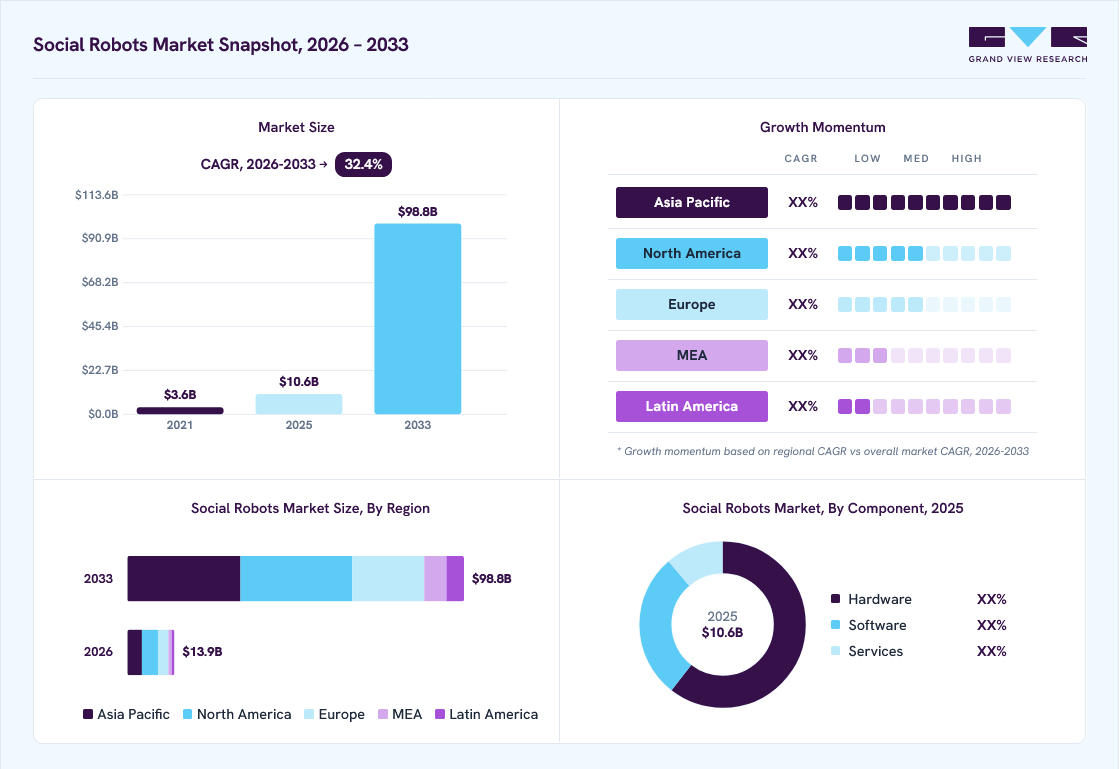 Source: Grand View Research, IR Documents, Primary Interviews, Paid DatabasesTo learn more about this report,
 Download Free Sample Report
 Key Market Trends & Insights
- By Component: The Hardware segment held the largest market share of around 60.4% in 2025.
- By Robot Type: Humanoid Robot segment held the largest market revenue share in 2025.
- By Technology: Machine Learning segment led the market with the largest revenue share in 2025.
- By Mobility: Mobile Wheeled segment held the largest market revenue share in 2025.
- By End Use: Healthcare segment led the market with the largest revenue share in 2025.
Regional Highlights
- Largest regional market: North America (34.2% revenue share, 2025)
- Fastest-growing regional market: Asia Pacific (highest CAGR, 2026-2033)
- By country: The U.S. held the largest share in 2025
Market Size & Forecasts
- Market size in 2025: USD 10.6 Billion
- Estimated market size in 2026: USD 13.9 Billion
- Projected market size by 2033: USD 98.8 Billion
- CAGR (2026-2033): 32.4%
Three ways to get this report
Buy it, customize it, or ask a question.Ask an Analyst
Analyst response in 1 business day
- AccessReport author, directly
- Reply timeWithin 1 working day
- No sales callDirect answer only
- FormatEmail reply
- CostFree, no cost
Get the Full Report
What the study covers
- FormatsPDF · Excel · Dashboard
- Timeline2026–2033 annual, 2025 base
- Coverage20+ countries, 5 regions
- Companies10+ key players profiled
Customize the Report
20% free customization
- IncludeCountries, segments, points
- TailorTo your product definition
- ExtendDeeper competitor detail
- OrA fully bespoke study
- Turnaround5–10 working days
The demand for social robots is increasing as healthcare providers, educational institutions, businesses, and households accelerate the adoption of intelligent robotic solutions for companionship, elderly care, education, customer engagement, entertainment, and personal assistance. Organizations are investing in AI-enabled robots, natural language processing, computer vision, emotional intelligence, speech recognition, and advanced human-robot interaction technologies to enable more personalized interactions, improve user engagement, support learning and care activities, and enhance service experiences across diverse environments.
 To learn more about this report, Download Free Sample Report
 Market Dynamics
The social robots market is experiencing significant growth, driven by increasing demand for human-robot interaction, AI-enabled robotic companions, personalized assistance, and interactive robotic solutions across healthcare, education, retail, hospitality, entertainment, and residential applications. Organizations are expanding the use of social robots for elderly care, education and learning, customer engagement, entertainment, companionship, and personal assistance. The integration of artificial intelligence, machine learning, natural language processing, computer vision, speech recognition, emotional intelligence, and advanced robot interaction capabilities is improving the ability of social robots to understand users, respond naturally, adapt to individual needs, and deliver more personalized experiences.
The social robots market is primarily driven by increasing demand for intelligent and interactive robotic solutions that can communicate and engage with users in natural and personalized ways. Healthcare providers, educational institutions, retailers, hospitality businesses, and households are increasingly adopting social robots for elderly care, education, companionship, customer service, entertainment, and personal assistance. The growing need for personalized support and continuous user engagement is increasing demand for robots equipped with speech recognition, natural language processing, computer vision, facial and emotion recognition, and conversational AI. In parallel, advancements in generative AI, machine learning, and multimodal interaction are enabling social robots to understand voice, facial expressions, gestures, and contextual cues, improving their ability to provide responsive and adaptive interactions.
Despite strong growth prospects, the social robots market faces challenges associated with the high cost and technical complexity of developing, integrating, deploying, and maintaining advanced social robots. Sophisticated AI processors, sensors, cameras, microphones, actuators, connectivity technologies, and robotic platforms can increase acquisition and operating costs. Integrating multiple technologies for speech recognition, computer vision, navigation, emotional intelligence, and natural language interaction can also create challenges related to system reliability, interoperability, and performance. In addition, social robots frequently collect and process voice, video, behavioral, and interaction data, creating concerns related to user privacy, data security, and cybersecurity. Regulatory requirements concerning personal data, AI transparency, safety, and human oversight can further complicate deployment. The need for specialized expertise in robotics, AI, software, and human-robot interaction can also increase implementation costs and limit adoption among organizations with constrained technical capabilities.
The increasing development of generative AI-enabled social robots, personalized human-robot interaction, cloud and edge-based intelligence, and multimodal communication is creating substantial opportunities for market participants. Generative AI and machine learning can enable social robots to engage in more natural conversations, understand user preferences, recognize emotional cues, and adapt responses based on individual interactions. The integration of voice, vision, touch, gesture, and contextual awareness can further enhance the intelligence and personalization of social robots. Expanding applications across healthcare and elderly care, education and research, retail and hospitality, customer service, entertainment and gaming, companionship, and personal assistance are creating new opportunities for market growth. Furthermore, advancements in autonomous navigation, cloud connectivity, IoT integration, and AI-powered analytics are enabling social robots to perform increasingly diverse tasks and operate effectively across residential, institutional, and commercial environments.
Market Concentration & Characteristics
The social robots market is moderately fragmented, with competition led by established robotics, artificial intelligence, consumer electronics, and specialized social robotics companies with strong capabilities in humanoid and companion robots, conversational AI, natural language processing, computer vision, emotional intelligence, autonomous navigation, and human-robot interaction. The market is characterized by continuous advancements in generative AI, multimodal interaction, speech recognition, facial and emotion recognition, autonomous mobility, sensor integration, cloud connectivity, and personalized robotic experiences. High costs associated with advanced robotic hardware and AI technologies, complex system integration requirements, data privacy and cybersecurity concerns, safety and regulatory requirements, and the need for specialized expertise create barriers to entry. These factors enable established companies to maintain competitive positions through technological innovation, product differentiation, strategic partnerships, AI development, application-specific solutions, and expansion across healthcare, education, retail, hospitality and entertainment, and residential applications.
Major players such as SoftBank Robotics Group Corp.; UBTECH Robotics Corp. Ltd.; Intuition Robotics Ltd.; Furhat Robotics AB; Hanson Robotics Ltd.; Blue Frog Robotics SAS; Embodied Inc.; LuxAI S.A.; Diligent Robotics Inc.; PAL Robotics SL; Engineered Arts Ltd.; Sony Corporation; Wonder Workshop Inc.; KOMPAI Robotics; and Yukai Engineering Inc. compete across different segments of the social robots market through investments in AI-enabled social robots, conversational intelligence, computer vision, emotional recognition, autonomous navigation, human-robot interaction, and personalized user experiences.
Analyst Perspective
The social robots market is expected to witness strong growth, supported by increasing adoption of artificial intelligence, advancements in human-robot interaction technologies, and growing demand for personalized and interactive robotic solutions. Healthcare providers, educational institutions, retailers, hospitality businesses, and households are increasingly adopting social robots for elderly care, education, companionship, customer engagement, entertainment, and personal assistance. Advancements in generative AI, natural language processing, computer vision, speech recognition, emotional intelligence, autonomous navigation, and multimodal interaction are enhancing the ability of social robots to communicate naturally, understand user behavior, and deliver personalized experiences.
Component Insights
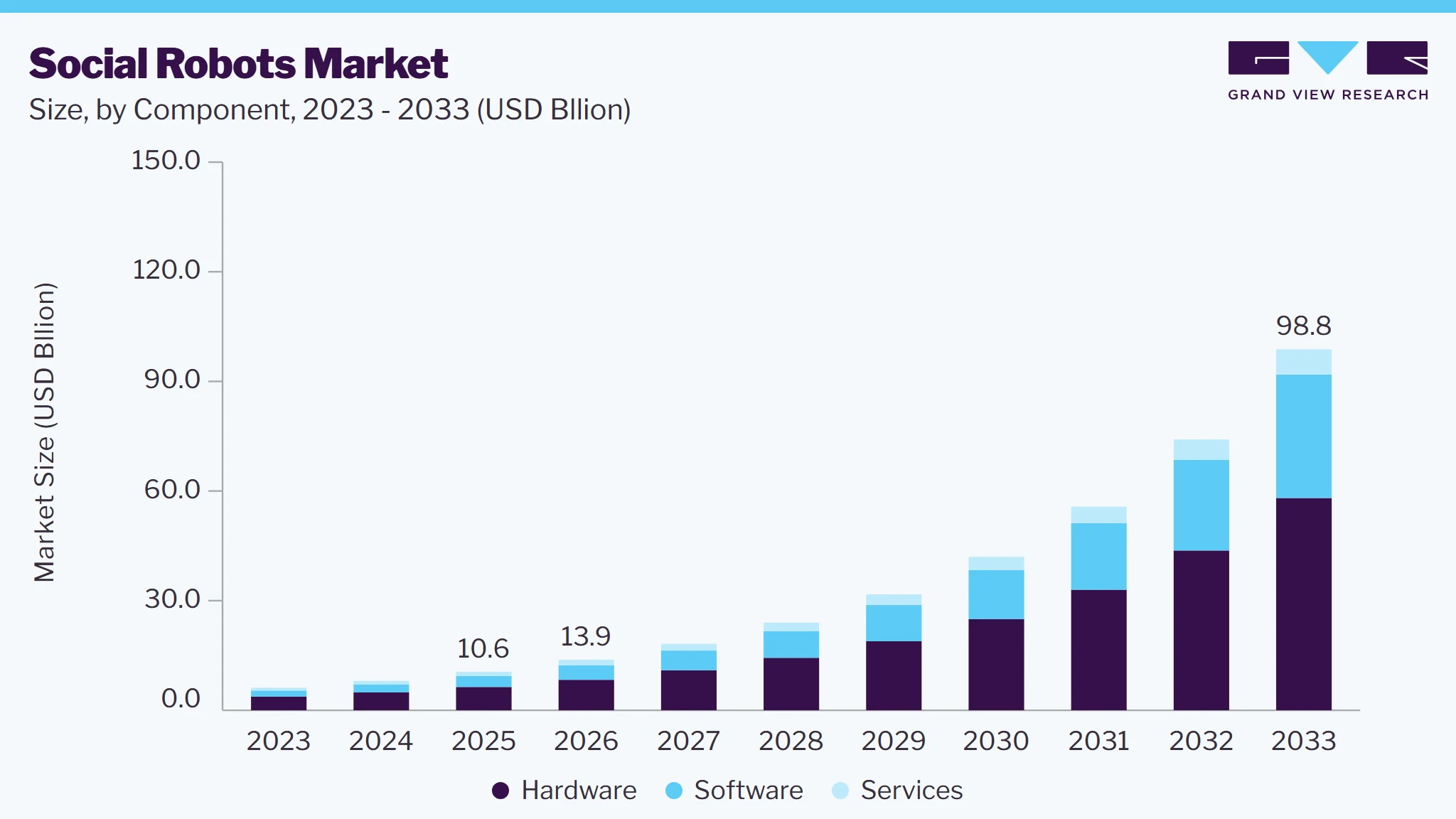
The Hardware segment holds a significant share of 60.4% of the Social Robots Market in 2025, driven by the increasing adoption of advanced robotic platforms, sensors, actuators, processors, cameras, microphones, displays, and communication systems. These hardware components are extensively used to enable physical interaction, autonomous movement, environmental perception, speech and facial recognition, human-robot interaction, and real-time responsiveness across healthcare, education, residential, retail and hospitality, entertainment, and other applications.
The Software segment is expected to witness significant growth in the Social Robots Market, driven by increasing adoption of AI, machine learning, natural language processing, computer vision, context awareness, speech recognition, and emotion recognition technologies. Growing integration of advanced software capabilities is enabling social robots to deliver more natural communication, personalized interactions, autonomous decision-making, and adaptive behavior across healthcare, education, residential, retail and hospitality, entertainment, and other applications.
Robot Type Insights
The Humanoid Robot segment holds the largest share of 35.4% of the Social Robots Market in 2025, driven by increasing adoption of human-like robotic platforms for education, healthcare, entertainment, customer engagement, companionship, and personal assistance. Advancements in artificial intelligence, natural language processing, computer vision, speech recognition, and human-robot interaction are enhancing the ability of humanoid robots to communicate, recognize users, perform interactive tasks, and deliver more personalized experiences across diverse applications.
The Service Robot segment is expected to witness significant growth in the Social Robots Market, driven by increasing demand for robotic solutions that support customer service, healthcare assistance, hospitality, retail operations, education, delivery, and personal assistance. Advancements in artificial intelligence, autonomous navigation, computer vision, natural language processing, and human-robot interaction are enabling service robots to perform tasks more efficiently, interact naturally with users, and provide personalized assistance across commercial, institutional, and residential environments.
Technology Insights
The Machine Learning segment holds the largest share of 29.5% of the Social Robots Market in 2025, driven by increasing integration of adaptive AI capabilities that enable robots to learn from user interactions, recognize behavioral patterns, and improve responses over time. Machine learning technologies support personalized interaction, behavioral adaptation, predictive decision-making, speech and emotion recognition, user preference learning, and autonomous task execution, enhancing the capabilities of social robots across healthcare, education, residential, entertainment, and service applications.
The Natural Language Processing segment is expected to witness significant growth in the Social Robots Market, driven by increasing demand for more natural, intuitive, and personalized human-robot communication. Advancements in conversational AI, speech recognition, language understanding, and generative AI are enabling social robots to interpret voice commands, understand context, conduct conversations, respond to user queries, support multilingual interaction, and adapt communication based on user preferences, accelerating adoption across healthcare, education, companionship, entertainment, retail, hospitality, and residential application.
Mobility Insights
The Mobile Wheeled segment holds the largest share of 39.7% of the social robots market in 2025, driven by the increasing adoption of wheeled robotic platforms for healthcare assistance, education, retail, hospitality, customer service, entertainment, and residential applications. Their relatively efficient mobility, maneuverability, and ability to navigate indoor environments enable social robots to provide information, guidance, monitoring, delivery, communication, and personalized assistance, while advancements in autonomous navigation, sensors, computer vision, and AI are further supporting their adoption across diverse environments.
The Mobile Legged segment is expected to witness significant growth in the social robots market, driven by increasing adoption of legged robotic platforms capable of navigating diverse indoor and semi-structured environments. Advancements in AI-powered autonomous navigation, computer vision, sensor fusion, balance control, and human-robot interaction are enhancing the mobility and adaptability of legged social robots, supporting their growing use across healthcare, education, companionship, entertainment, research, and personal assistance applications.
End Use Insights
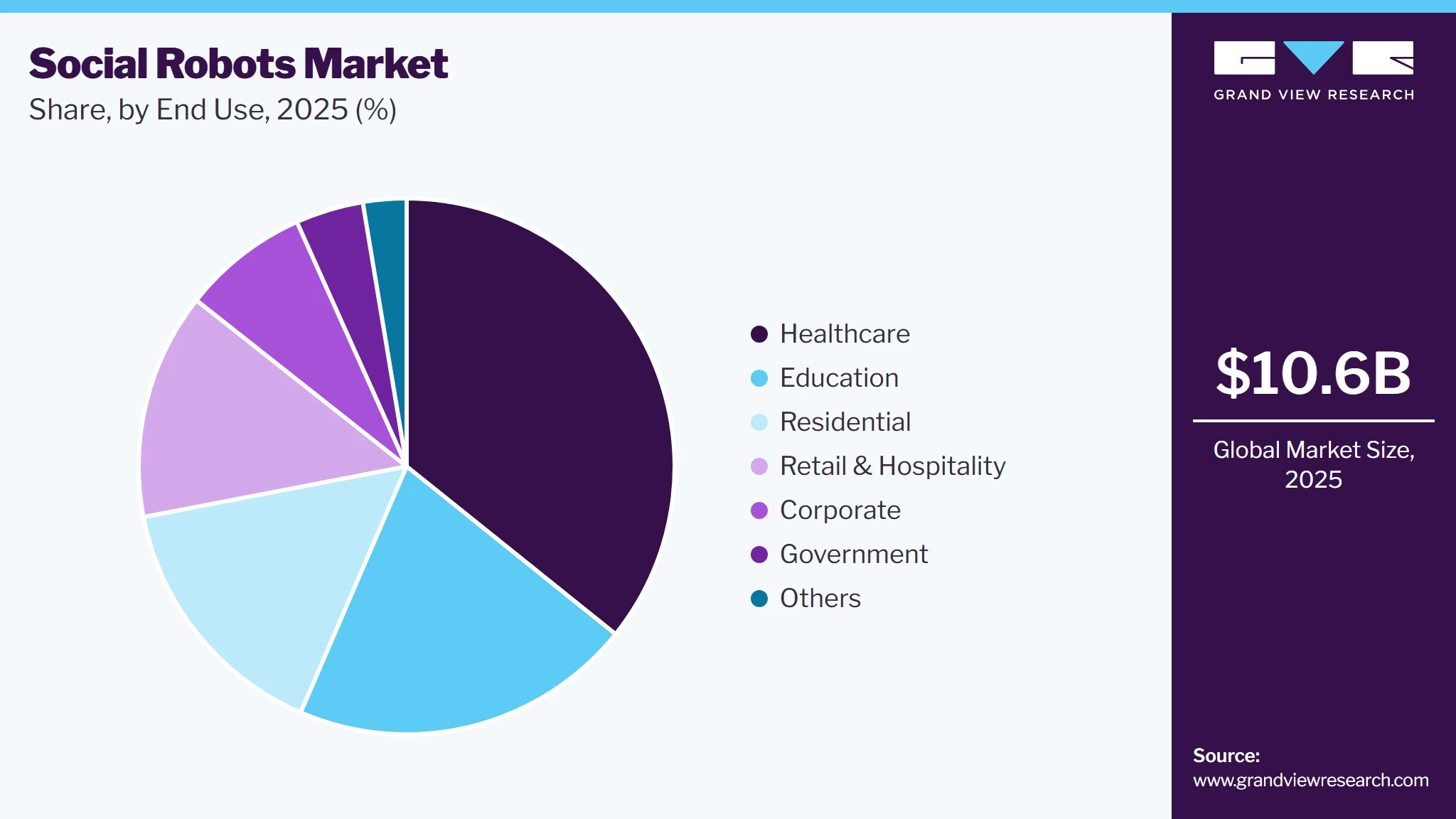
The Healthcare segment holds the largest share of 35.8% of the social robots market in 2025, driven by increasing adoption of social robots for elderly care, patient engagement, companionship, cognitive stimulation, rehabilitation support, and healthcare assistance. Growing demand for assistive technologies, aging populations, and the integration of AI, natural language processing, computer vision, and emotion recognition are enhancing the ability of social robots to provide personalized interaction and support across hospitals, care facilities, rehabilitation centers, and home healthcare environments.
 To learn more about this report, Download Free Sample Report
 The Retail & Hospitality segment is expected to witness significant growth in the Social Robots Market, driven by increasing adoption of interactive robots for customer assistance, information delivery, visitor guidance, check-in, ordering, entertainment, and service support. Advancements in conversational AI, natural language processing, computer vision, autonomous navigation, and human-robot interaction are enabling social robots to improve customer engagement, personalize interactions, and automate routine service activities across retail stores, hotels, restaurants, shopping centers, and other hospitality.
Regional Insights
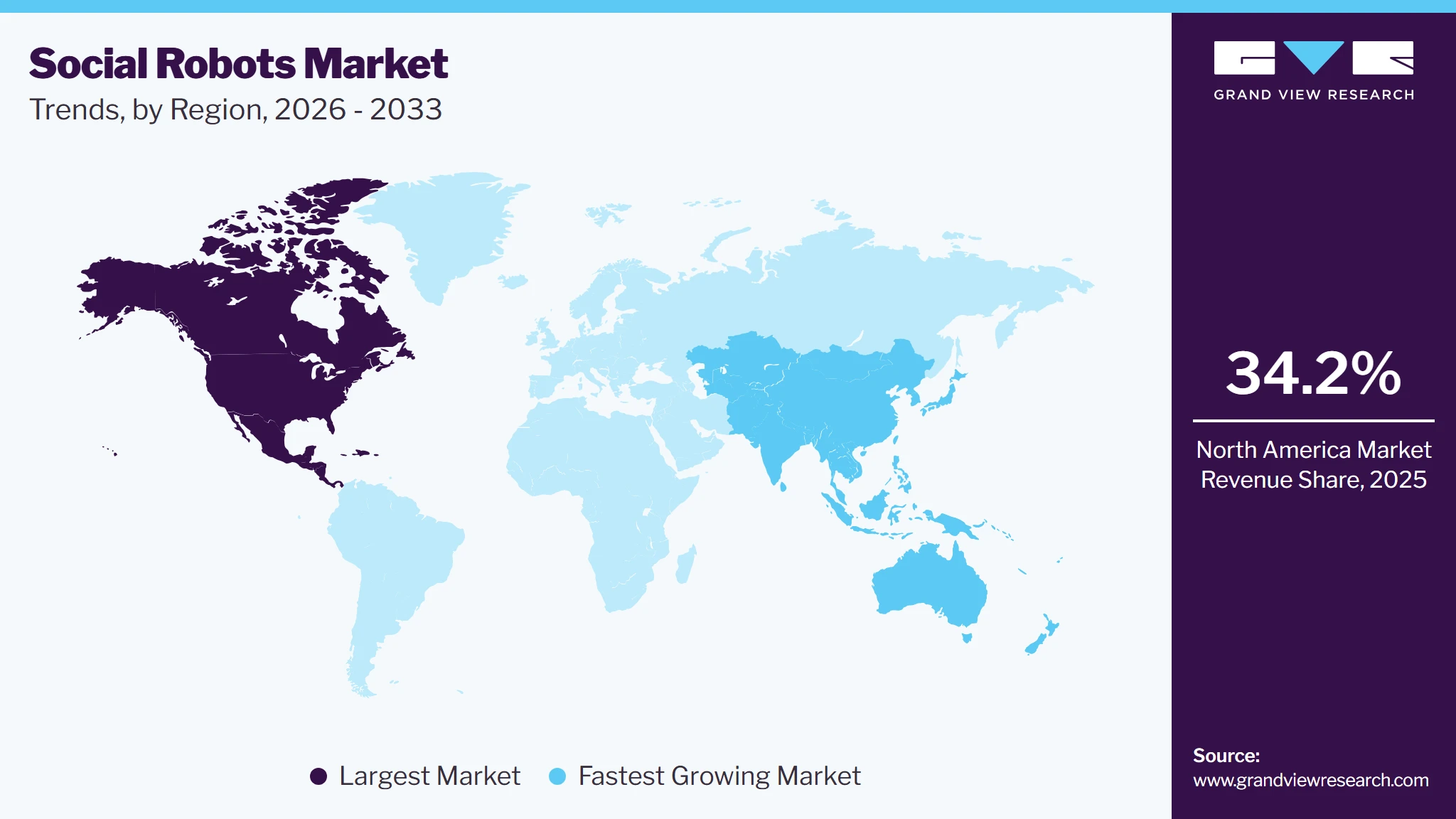
North America dominates the social robots market, supported by strong adoption of artificial intelligence, advanced robotics technologies, established healthcare and education infrastructure, and increasing deployment of social robots across healthcare, retail, hospitality, and residential applications. The region, led by the U.S. benefits from strong AI research capabilities, venture investment, advanced cloud infrastructure, and early enterprise adoption of intelligent robotic solutions.
 To learn more about this report, Download Free Sample Report
 U.S. Social Robots Market Trends
The U.S. social robots market is witnessing strong growth, supported by increasing investments in artificial intelligence, robotics, healthcare technology, and human-robot interaction. The country benefits from a well-established technology ecosystem, advanced AI and cloud infrastructure, and growing adoption of social robots across healthcare, elderly care, education, retail, hospitality, entertainment, and residential applications. Increasing demand for personalized assistance, patient engagement, educational support, and customer interaction is further supporting market expansion.
Europe Social Robots Market Trends
The Europe social robots market is witnessing steady growth, driven by increasing investments in artificial intelligence, robotics research, healthcare innovation, and digital transformation. European countries are expanding the use of social robots across healthcare, elderly care, education, retail, hospitality, and public-service applications. Growing demand for assistive technologies, aging populations, personalized healthcare support, and interactive educational solutions is further supporting adoption. In addition, strong research capabilities and emphasis on privacy, safety, and trustworthy AI are shaping the development and deployment of social robots across the region.
The UK social robots market is experiencing growth through increasing adoption of AI-enabled robotics across healthcare, education, hospitality, and customer-service applications. Growing investments in human-robot interaction, conversational AI, natural language processing, and assistive robotics are supporting the deployment of social robots for elderly care, patient engagement, education, and public-facing services. The country's strong research ecosystem and focus on responsible AI are further supporting the adoption of socially interactive robotic technologies.
The Germany social robots market is expanding, supported by strong robotics expertise, increasing investments in artificial intelligence, and growing demand for automation across healthcare, education, retail, and service environments. Germany is strengthening its social robotics capabilities through advancements in human-robot interaction, computer vision, autonomous navigation, and AI-enabled communication. Increasing requirements for elderly care, patient assistance, customer engagement, and interactive service delivery are further creating opportunities for social robots across the country
Asia Pacific Social Robots Market Trends
The Asia Pacific social robots market is witnessing strong growth and is expected to remain the fastest-growing regional market, supported by advanced robotics ecosystems, expanding AI capabilities, strong electronics manufacturing infrastructure, and increasing demand for elderly care and service automation. Japan, China, South Korea, India, and other Asian markets are increasing investments in social robotics for healthcare, education, retail, hospitality, companionship, and public services.
The China social robots market is witnessing rapid growth, driven by increasing investments in artificial intelligence, robotics manufacturing, smart technologies, and domestic automation. The country is expanding the deployment of social robots across healthcare, education, retail, hospitality, entertainment, and public-service applications. Growing investments in AI infrastructure, advanced sensors, autonomous navigation, computer vision, and natural language processing are improving the capabilities of social robots, while strong domestic manufacturing and an expanding technology ecosystem are supporting China's position as a key growth market in Asia-Pacific.
Key Social Robots Company Insights
The social robots market is characterized by the presence of established robotics, artificial intelligence, consumer electronics, and specialized social robotics companies with strong capabilities across humanoid and companion robots, conversational AI, natural language processing, computer vision, emotional intelligence, autonomous navigation, speech recognition, and human-robot interaction. Competition is driven by continuous innovation in AI-enabled interaction, multimodal communication, emotion recognition, autonomous mobility, personalized user experiences, sensor technologies, and intelligent robotic platforms. Established players maintain strong market positions through extensive R&D capabilities, proprietary robotics and AI technologies, strategic partnerships, product innovation, application-specific solutions, and expansion across healthcare, education, retail, hospitality, entertainment, and residential applications.
-
Blue Frog Robotics SAS is a prominent player in the social robots market, offering social robots designed to provide interactive communication, companionship, and assistance across residential, healthcare, and service environments. Its capabilities in human-robot interaction, voice communication, facial recognition, and autonomous functionality support personalized and engaging user experiences.
-
Diligent Robotics Inc. is a key participant in the social robots market, providing autonomous robotic solutions designed to support healthcare environments through human-robot collaboration and interactive assistance. Its robotic platforms combine autonomous navigation, AI-enabled perception, and intelligent task management to improve operational efficiency and support healthcare personnel.
Key Social Robots Companies
The following key companies have been profiled for this study on the social robots market.
-
Blue Frog Robotics SAS
-
Diligent Robotics Inc
-
Embodied, Inc.
-
Furhat Robotics AB
-
Hanson Robotics Ltd.
-
Intuition Robotics Ltd.
-
KOMPAI Robotics
-
PAL Robotics S.L.
-
SoftBank Robotics Group Corp.
-
Sony Corporation
-
UBTECH Robotics Corp. Ltd.
-
Wonder Workshop Inc.
Competitive Benchmarking
Operating Strategies
Competitive Edge
Weaknesses
Mature Players: (SoftBank Robotics Group Corp.; Sony Corporation; UBTECH Robotics Corp. Ltd.; PAL Robotics S.L.; Hanson Robotics Ltd.; Furhat Robotics AB; Intuition Robotics Ltd.)
- Focus on expanding social robot portfolios across healthcare, education, entertainment, hospitality, companionship, and personal assistance applications.
- Invest heavily in AI, natural language processing, computer vision, emotional intelligence, autonomous navigation, and human-robot interaction technologies.
- Established expertise in robotics, AI, and human-robot interaction technologies.
- Broad product portfolios and established customer relationships across multiple application areas.
- High R&D, manufacturing, software development, and system-integration costs.
- Complex integration of AI, sensors, speech recognition, navigation, and interaction technologies.
Emerging Players: (Blue Frog Robotics SAS; Diligent Robotics Inc.; Embodied, Inc.; KOMPAI Robotics; Wonder Workshop Inc.)
- Focus on specialized social robot applications, including elderly care, healthcare assistance, education, companionship, and interactive learning.
- Invest in AI-enabled interaction, personalized experiences, autonomous navigation, conversational capabilities, and application-specific robotic platforms.
- Agile product development enables faster adaptation to emerging customer requirements and application niches.
- Strong specialization in targeted social robotics applications provides differentiated value propositions.
- Focused AI and human-robot interaction capabilities support personalized and engaging user experiences.
- Smaller global footprint and distribution networks compared with established robotics and technology companies.
- Limited manufacturing scale can increase production costs and restrict pricing competitiveness.
Recent Developments
-
In May 2026, SoftBank Robotics introduced its STEAMA and FLAMA autonomous cooking robots in the U.S., expanding its robotics portfolio into food-service applications and demonstrating the broader shift toward AI-enabled robotic assistance in commercial environments.
-
In June 2026, UBTECH Robotics launched the UWORLD U1 Series, a full-size ultra-bionic humanoid robot designed for mass production, with applications including emotional companionship, education, and entertainment. The company reported more than 13,361 cumulative orders at launch, highlighting growing demand for consumer-oriented humanoid social robots.
Social Robots Market Report Scope
Report Attribute
Details
Market size in 2025
USD 10.6 billion
Estimated market size in 2026
USD 13.9 billion
Projected market size by 2033
USD 98.8 billion
Growth rate
CAGR of 32.4% from 2026 to 2033
Actual data
2021 - 2025
Forecast period
2026 - 2033
Quantitative units
Revenue in USD million/billion and CAGR from 2026 to 2033
Report coverage
Revenue forecast, company share, competitive landscape, growth factors, and trends
Segments covered
Component, robot type, technology, mobility, end use, and region
Regional scope
North America; Europe; Asia Pacific; Latin America; Middle East and Africa
Country scope
U.S.; Canada; Mexico; UK; Germany; France; China; Japan; India; South Korea; Australia; Brazil; UAE; KSA; South Africa
Key companies profiled
Blue Frog Robotics SAS; Diligent Robotics Inc; Embodied, Inc.; Furhat Robotics AB; Hanson Robotics Ltd.; Intuition Robotics Ltd.; KOMPAI Robotics; PAL Robotics S.L.; SoftBank Robotics Group Corp.; Sony Corporation; UBTECH Robotics Corp. Ltd.; Wonder Workshop Inc.
Customization scope
Free report customization (equivalent to up to 8 analyst working days) with purchase. Addition or alteration to country, regional & segment scope.
Pricing and purchase options
Avail customized purchase options to meet your exact research needs. Explore purchase options
Global Social Robots Market Report Segmentation
This report forecasts revenue growth at global, regional, and country levels and provides an analysis of the latest industry trends in each of the sub-segments from 2021 to 2033. For this study, Grand View Research has segmented the global social robots market report based on component, robot type, technology, mobility, end use, and region.
-
Component Outlook (Revenue, USD Million, 2021 - 2033)
-
Hardware
-
Software
-
Services
-
-
Robot Type Outlook (Revenue, USD Million, 2021 - 2033)
-
Humanoid Robot
-
Companion Robot
-
Service Robot
-
Educational Robots
-
Entertainment Robots
-
Others
-
-
Technology Outlook (Revenue, USD Million, 2021 - 2033)
-
Machine Learning
-
Computer Vision
-
Natural Language Processing
-
Context Awareness
-
Others
-
-
Mobility Outlook (Revenue, USD Million, 2021 - 2033)
-
Mobile Wheeled
-
Stationary
-
Mobile Legged
-
Semi-Mobile/Others
-
-
End Use Outlook (Revenue, USD Million, 2021 - 2033)
-
Healthcare
-
Education
-
Residential
-
Retail & Hospitality
-
Corporate
-
Government
-
Others
-
-
Regional Outlook (Revenue, USD Million, 2021 - 2033)
-
North America
-
U.S.
-
Canada
-
Mexico
-
-
Europe
-
UK
-
Germany
-
France
-
-
Asia Pacific
-
China
-
Japan
-
India
-
South Korea
-
Australia
-
-
Latin America
-
Brazil
-
-
Middle East and Africa
-
UAE
-
KSA
-
South Africa
-
-
Research Methodology
The social robots market figures in this report are based on a proven research process that combines executive interviews with secondary research from proprietary databases, company filings, and recognized regulatory and institutional sources. Market size is built through value-chain sizing - reconciling supply-side and demand-side estimates - and triangulated with bottom-up and top-down approaches. Every estimate passes multiple levels of expert validation before publication, with each social robots segment quantified using the revenue-capture definitions in the table below.
Segment Definition
Component
Revenue Capture Definition
Hardware
Hardware revenue in the Social Robots Market is generated through the sale of social robot platforms and their physical components, including robot bodies and frames, sensors, cameras, microphones, speakers and displays, actuators and motors, processors and control units, batteries and power systems, communication modules, navigation systems, and other hardware components used to enable social interaction, perception, mobility, autonomous operation, and physical engagement with users
Software
Software revenue in the Social Robots Market is generated through the sale and licensing of software platforms and applications, including artificial intelligence and machine learning software, natural language processing, conversational AI, computer vision, speech recognition, emotion and facial recognition, autonomous navigation, human-robot interaction (HRI) software, behavior and dialogue management, cloud-based platforms, and robot operating and control software used to enable perception, communication, decision-making, personalization, and autonomous interaction
Services
Services revenue in the Social Robots Market is generated through installation, system integration, customization, maintenance and repair, software updates, technical support, training, consulting, and robot-as-a-service (RaaS) offerings associated with social robots. These services support the deployment, operation, personalization, and ongoing management of social robots across healthcare, education, retail, hospitality, entertainment, and residential applications.
Robot Type
Revenue Capture Definition
Humanoid Robot
Revenue from humanoid robots is generated through the sale of human-shaped robotic platforms and associated hardware, including robotic bodies, actuators, sensors, cameras, microphones, processors, batteries, control systems, communication modules, and other components that enable human-like movement, perception, interaction, communication, and autonomous operation.
Companion Robot
Revenue from companion robots is generated through the sale of interactive robotic platforms designed to provide companionship, emotional support, social interaction, monitoring, and personalized assistance, including hardware components such as sensors, cameras, microphones, speakers, processors, actuators, batteries, and connectivity modules.
Service Robot
Revenue from service robots is generated through the sale of robotic platforms designed to perform useful tasks for people or equipment outside industrial manufacturing, including hardware such as sensors, cameras, processors, actuators, navigation systems, communication modules, and power systems.
Educational Robots
Revenue from educational robots is generated through the sale of interactive and programmable robotic platforms designed to support teaching, learning, coding, STEM education, robotics training, and hands-on experimentation, including hardware such as sensors, actuators, controllers, processors, motors, mechanical structures, power systems, and connectivity modules.
Entertainment Robots
Revenue from entertainment robots is generated through the sale of interactive robotic platforms designed for amusement, recreation, gaming, storytelling, performances, and immersive user experiences, including robotic toys, interactive characters, robotic pets, humanoid entertainment robots, and related hardware such as sensors, cameras, microphones, processors, actuators, displays, speakers, and connectivity modules.
Others
Revenue from other social robots is generated through the sale of specialized interactive robotic platforms and related hardware that do not fall under humanoid, companion, service, educational, or entertainment robots.
Technology
Revenue Capture Definition
Machine Learning
Revenue from machine learning in the social robots market is generated through AI and machine-learning software, adaptive learning algorithms, behavioral models, predictive analytics, and personalized interaction capabilities that enable social robots to learn from user interactions and environmental data
Computer Vision
Revenue from computer vision in the social robots market is generated through vision-based software, AI algorithms, image-processing systems, and visual perception technologies that enable robots to detect and recognize faces, people, objects, gestures, body movements, and surrounding environments.
Natural Language Processing
Revenue from natural language processing in the social robots market is generated through NLP software, speech-understanding systems, conversational AI, dialogue management, language-generation models, and voice-interaction technologies that enable robots to understand and respond to human language
Context Awareness
Revenue from context-awareness technologies in the Social Robots Market is generated through context-recognition software, environmental sensing, user-state modeling, activity recognition, behavioral analysis, and adaptive decision-making systems that enable social robots to understand users, surroundings, activities, and interaction scenarios
Others
Revenue from other technologies in the Social Robots Market is generated through emotion recognition, affective computing, gesture and posture recognition, touch and tactile sensing, multimodal interaction, voice and speech technologies, behavioral modeling, and adaptive interaction systems that enhance robots’ ability to perceive and respond to human social and emotional cues.
Mobility
Revenue Capture Definition
Mobile Wheeled
Revenue from mobile wheeled social robots is generated through the sale of wheeled robotic platforms designed for autonomous movement, navigation, social interaction, and assistance, including hardware such as wheels and drive systems, motors, sensors, cameras, processors, batteries, communication modules, and navigation systems.
Stationary
Revenue from stationary social robots is generated through the sale of fixed-position robotic platforms designed for social interaction, communication, information delivery, monitoring, and assistance, including hardware such as displays, cameras, microphones, speakers, processors, sensors, and communication modules
Mobile Legged
Revenue from mobile legged social robots is generated through the sale of legged robotic platforms designed for mobility, social interaction, companionship, and assistance, including hardware such as articulated legs, actuators, motors, sensors, cameras, processors, batteries, communication modules, and navigation systems.
Semi-Mobile/Others
Revenue from semi-mobile and other social robots is generated through the sale of robotic platforms capable of limited, assisted, or hybrid mobility, including robots that combine stationary interaction with repositioning, tracked or hybrid locomotion, or other specialized movement mechanisms.
End Use
Revenue Capture Definition
Healthcare
Revenue from social robots in healthcare is generated through the sale and deployment of socially assistive robotic platforms designed to support elderly care, patient engagement, companionship, cognitive stimulation, rehabilitation support, monitoring, and communication.
Education
Revenue from social robots in education is generated through the sale and deployment of interactive robotic platforms designed to support teaching, tutoring, programming, STEM learning, language learning, student engagement, and educational assistance
Residential
Revenue from social robots in residential applications is generated through the sale and deployment of home-based robotic platforms designed to provide companionship, entertainment, personal assistance, communication, safety monitoring, and support for daily activities.
Retail & Hospitality
Revenue from social robots in retail and hospitality is generated through the sale and deployment of interactive robotic platforms designed to assist customers, provide information, guide visitors, support check-in and ordering, deliver products or services, and enhance customer engagement
Corporate
Revenue from social robots in corporate applications is generated through the sale and deployment of interactive robotic platforms designed to support employee engagement, workplace assistance, reception, information delivery, customer interaction, wellness programs, and routine service activities
Government
Revenue from social robots in government applications is generated through the sale and deployment of interactive robotic platforms designed to support citizen assistance, information delivery, public-service engagement, visitor guidance, communication, and administrative support.
Others
Revenue from social robots in other end-user applications is generated through the sale and deployment of interactive robotic platforms for public services, transportation, cultural institutions, research facilities, museums, libraries, and specialized environments.
Estimation Model
Layer
Key Questions
Description
Addressable Social Robots Base Layer
Which social robot platforms, technologies, applications, and capabilities are currently deployed or addressable?
Estimate the global addressable base of social robots across humanoid, companions, service, educational, entertainment, and other social robots, including robotic hardware, sensors, processors, actuators, communication systems, AI capabilities, and supporting infrastructure.
Social Robot Adoption Layer
Which social robot platforms, technologies, and capabilities are currently deployed?
Apply adoption and deployment rates across robot hardware, software, and services, considering the use of artificial intelligence, machine learning, natural language processing, computer vision, context awareness, emotion recognition, autonomous navigation, human-robot interaction, conversational AI, and multimodal interaction across healthcare, education, residential, retail & hospitality, corporate, government, entertainment, and other applications.
Technology & Solution Configuration Layer
What social robotics technologies and capabilities are incorporated into each solution?
Estimate solution value based on the integration of robotic hardware, artificial intelligence, machine learning, natural language processing, computer vision, context awareness, speech recognition, emotion recognition, autonomous navigation, human-robot interaction, multimodal sensing, connectivity, cloud and edge computing, and behavior-management capabilities.
Revenue Generation Layer
How is revenue generated from Social Robots?
Estimate market revenue from the sale and leasing of social robot hardware, AI and robotic software, platform licensing, system integration, customization, deployment, training, maintenance, technical support, content and application subscriptions, remote monitoring, and robot-as-a-service (RaaS) offerings.
Delivered Customizations
This report has been delivered with the following In-depth customizations
Client Request
Customization Delivered
Value Adds
Comprehensive market segmentation
Detailed segmentation by robot type, component, technology, mobility, application, end user, distribution channel, price range, and region
Enables granular assessment of market size, growth opportunities, and segment-level trends
Technology landscape assessment
Analysis of machine learning, computer vision, natural language processing, context awareness, and other enabling technologies
Provides visibility into technology adoption and innovation trends
Application-level analysis
Assessment across healthcare, education, residential, retail & hospitality, corporate, government, and other applications
Identify key demand centers and application-specific growth opportunities
About the Author(s)
Next Generation Technologies Research Team
Technology · Next Generation TechnologiesThis report was authored by the next generation technologies research team at Grand View Research - comprising two research analysts, one senior research analyst, and one industry expert - with specialized expertise in the next generation technologies segment of the technology industry. All findings are based on proprietary technology databases, executive interviews, and regulatory analysis, subject to internal peer review prior to publication.
Last Updated:
Speak to Analyst

Customize this report to your needs - add regions, segments, or data points, with 20% free customization.
Or view our licence options:


ISO 9001:2015 & 27001:2022 Certified
We are GDPR and CCPA compliant! Your transaction & personal information is safe and secure. For more details, please read our privacy policy.


