
- Home
- »
- Disinfectants & Preservatives
- »
-
Sodium Hypochlorite Market Size & Share Report, 2026-2033GVR Report cover
![Sodium Hypochlorite Market (2026 - 2033)Report]()
Sodium Hypochlorite Market (2026 - 2033)
Size, Share & Trends Analysis Report By Application (Cleaning & Disinfection, Bleaching, Production of Other Chemicals), By Region (North America, Europe, Asia Pacific, Middle East & Africa, Latin America), And Segment Forecasts
Market Size, 2025
$18.3BMarket Estimate, 2026
$19.0BMarket Forecast, 2033
$27.8BCAGR, 2026–2033
4.9%Sodium Hypochlorite Market Summary
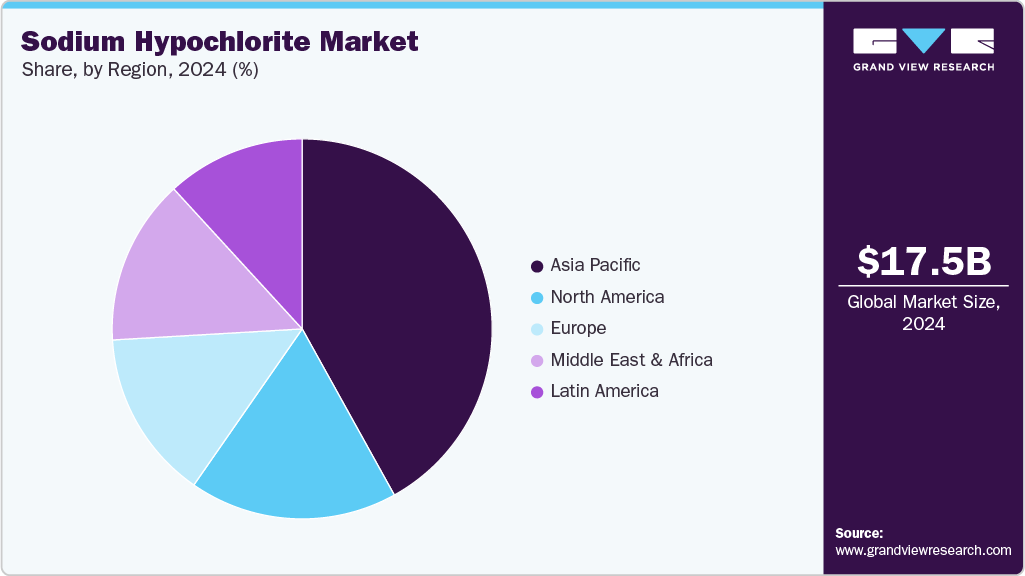
The global sodium hypochlorite market size was valued at USD 18.3 billion in 2025 and is projected to grow from USD 19.0 billion in 2026 to USD 27.8 billion by 2033, at a CAGR of 4.9% from 2026 to 2033. The market in Asia Pacific dominated with a revenue share of 42.2% in 2025. This growth is attributed to rising demand for the product from water treatment chemical manufacturing companies as well as from sanitizer producers worldwide and it is projected to remain key factor for market growth.

Key Market Trends & Insights
- By application: Cleaning and disinfection segment held the largest market share of 49.4% in 2025.
Regional Highlights
- Largest regional market: Asia Pacific (42.2% revenue share, 2025)
- By country: China held the largest market share in 2025
Market Size & Forecast
- Market size in 2025: USD 18.3 Billion
- Estimated market size in 2026: USD 19.0 Billion
- Projected market size by 2033: USD 27.8 Billion
- CAGR (2026-2033): 4.9%
Rising emphasis on hygiene and sanitation standards across public and industrial spaces in several Asian countries is significantly boosting the use of sodium hypochlorite-based solutions. Regulatory guidelines mandating specific concentration levels for disinfecting offices, residential areas, public restrooms, and outdoor environments are further reinforcing steady consumption across institutional and municipal applications.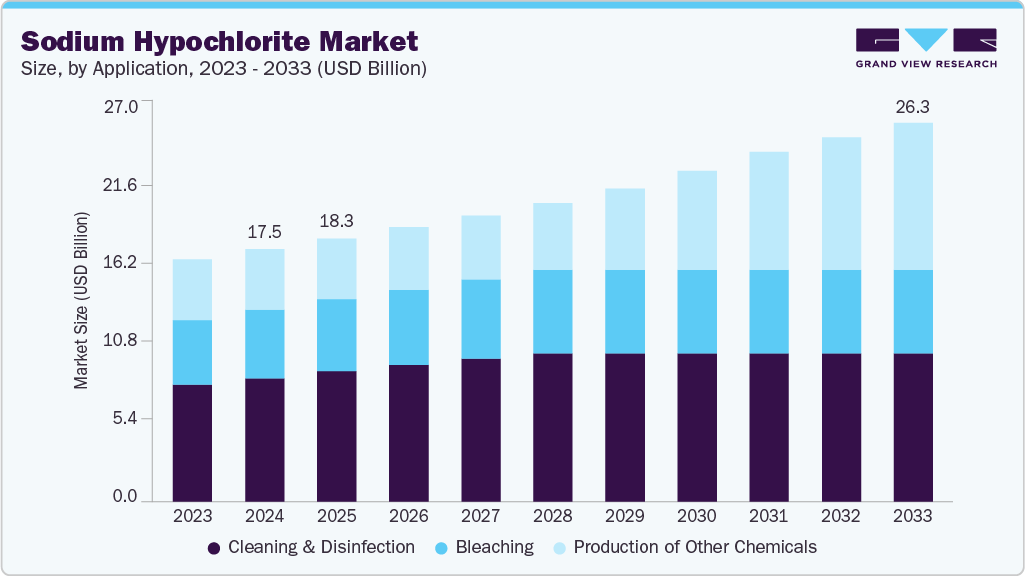
Growing reliance on efficient and decentralized production methods through the sodium hypochlorite generator market is improving supply accessibility and reducing operational dependency on bulk chemical procurement. This shift, combined with the strong pathogen-elimination capability of chlorine-based disinfection, is expected to support sustained demand growth for sodium hypochlorite in sanitation and cleaning applications over the coming years.
Market Dynamics
Renewable methanol also acts as an important feedstock for producing biobased chemicals, such as biobased polymers and bioplastics, which are used in various industrial and consumer applications, including packaging, textiles, and consumer goods. Additionally, it can be used as a fuel-blending component. Renewable methanol can also be converted into biofuels such as dimethyl ether (DME) and biodiesel.
Carbon Clean Solutions, a leading producer of renewable methanol, uses carbon capture technology to capture carbon dioxide emitted during various industrial processes and use it to produce methanol. Furthermore, Methanex, a methanol producer, uses natural gas to manufacture methanol. It is also investigating the use of renewable methanol as a feedstock for the production of chemicals and materials. This green methanol can then be converted into various chemicals such as formaldehyde and acetic acid, which are widely used in various industrial and consumer applications. Such factors are expected to positively impact the growth of renewable methanol market worldwide over the forecast period.
The main barrier to the global adoption of renewable methanol is its high cost of production. Presently, the cost of manufacturing renewable methanol from sustainable feedstocks such as biomass is higher than the cost of producing traditional fossil fuel-based methanol using natural gas or coal. This is mainly because technologies employed to produce renewable methanol are still relatively new and the economies of scale have not yet been fully realized.
According to a study by the National Renewable Energy Laboratory (NREL), the current cost of producing renewable methanol from biomass is approximately USD 2.50–USD 3.50 per gallon, while the cost of producing traditional fossil fuel-based methanol is approximately USD 1.00–USD 1.50 per gallon. This cost difference between these two types of methanol makes it difficult for renewable methanol to compete with traditional fossil fuel-based methanol in the market in terms of prices.
Market Concentration & Characteristics
The market for sodium hypochlorite is characterized by its strong dependence on demand from water treatment, household disinfectants, and industrial bleaching applications. It is widely used as a cost-effective oxidizing and disinfecting agent, especially in municipal water systems and sanitation services. The market is relatively price-sensitive and influenced by chlorine and caustic soda supply trends, as sodium hypochlorite is typically produced from these base chemicals. Its shelf-life and transportation stability also affect distribution dynamics, particularly in regions with strict safety regulations.
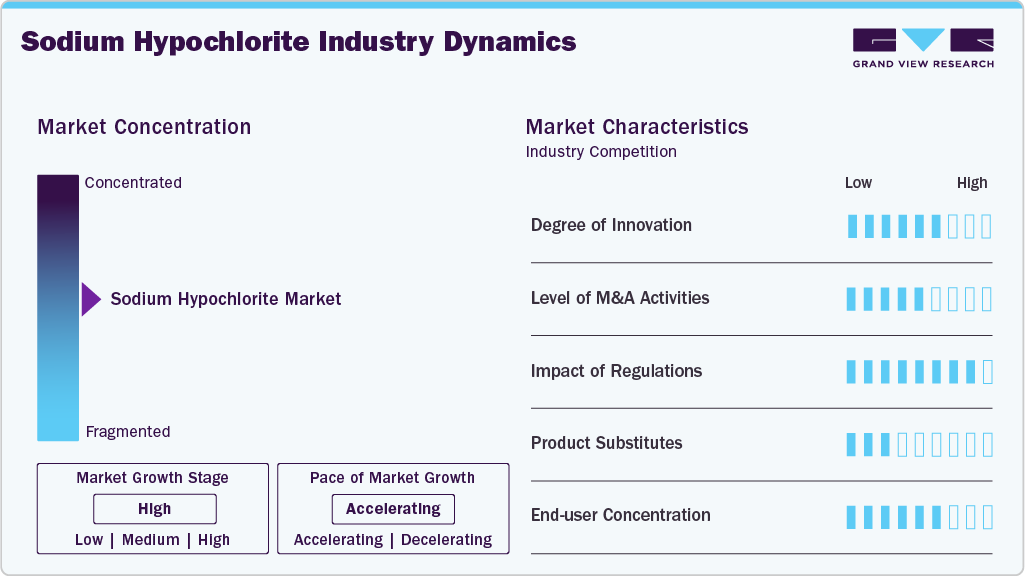
Geographically, North America and Europe represent mature markets with stable demand, driven by regulatory standards for water quality and public hygiene. In contrast, Asia Pacific and Latin America are experiencing more dynamic growth due to urbanization, rising healthcare awareness, and infrastructure expansion. The market is also shaped by environmental and safety regulations, particularly regarding storage, handling, and concentration limits of sodium hypochlorite in end-use products. Technological advancements in dosing systems and packaging formats are further influencing adoption patterns in both industrial and consumer sectors.
Application Insights
The cleaning and disinfection dominated the application segment of the global market for sodium hypochlorite with revenue share of 49.4% in 2025. Demand is driven by its widespread use in household cleaning, water treatment, swimming pool sanitation, and other related applications. Its strong antimicrobial properties, combined with cost efficiency and ease of formulation, continue to support high adoption across these areas.
Bleaching is expected to grow at a CAGR of 4.8%, in terms of revenue, during the forecast period, driven by its strong oxidizing and whitening properties across multiple industries. Increasing demand from textiles, pulp and paper, and household cleaning applications is supporting higher consumption, as manufacturers prioritize cost-effective and efficient bleaching agents. The shift toward high-performance and consistent-quality bleaching processes is further strengthening the adoption of sodium hypochlorite, positioning this segment as a key growth driver in the overall market.
Regional Insights
Asia Pacific sodium chlorite market dominated the global industry with a revenue share of 42.2% in 2025, driven by increasing demand for water purification, sanitation, and industrial cleaning across rapidly urbanizing countries such as China, India, and Southeast Asian nations. Government initiatives to strengthen municipal water infrastructure and enhance public hygiene are further boosting consumption in both urban and rural areas. In addition, rising industrial activity across sectors such as textiles, food processing, and chemicals is supporting steady demand for sodium hypochlorite as a disinfectant and oxidizing agent. Growing adoption of the food grade sodium hypochlorite applications, particularly in food processing and hygiene compliance processes, is further expanding its usage base across the region.
China’s sodium hypochlorite industry is supported by its large municipal water treatment network and increasing demand for industrial sanitation. Rapid urbanization, along with a strong focus on public health and environmental safety, continues to drive usage in disinfection and wastewater treatment. Ongoing demand from industries such as textiles, paper, and chemical processing further supports stable market growth.
Europe Sodium Hypochlorite Market Trends
The European sodium hypochlorite industry remains stable, supported by demand from public water utilities, food hygiene, and industrial sanitation. Western Europe has an established base in municipal water treatment and disinfection, backed by strict environmental and public health regulations. Continued use in textiles, chemicals, and cleaning industries sustains steady consumption, while rising environmental concerns are promoting a shift toward more sustainable formulations.
Germany’s sodium hypochlorite industry benefits from a mature industrial ecosystem where stringent hygiene regulations and high operational standards play a key role in shaping demand. Food processing facilities and healthcare institutions maintain steady usage due to strict sanitation and safety compliance requirements. Manufacturing activities continue to rely on it for cleaning and oxidation processes. A notable shift is also emerging through the food grade sodium hypochlorite, where increasing focus on food safety regulations and quality assurance in processing environments is driving greater adoption of certified-grade disinfectant solutions.
North America Sodium Hypochlorite Market Trends
The North American sodium hypochlorite industry is mature, anchored by well-established applications in water treatment, industrial disinfection, and cleaning solutions. Strict public health regulations and water quality standards in the U.S. and Canada ensure consistent demand from municipal and commercial end users. Strong usage in residential cleaning products and institutional hygiene further reinforces market stability. Also, the expansion of the sodium hypochlorite bleach market is contributing significantly to overall consumption, driven by sustained household demand for effective bleaching and disinfecting solutions.
U.S. Sodium Hypochlorite Market Trends
The U.S. sodium hypochlorite industry has wide applications in water and wastewater treatment, as well as in household and industrial cleaning applications. Demand is supported by strict federal regulations on sanitation and water safety across municipalities and healthcare facilities. It is also used in food processing, pulp and paper, and pool sanitation due to its strong disinfecting and bleaching properties. The sodium hypochlorite bleach market further contributes to steady demand through widespread use in residential and commercial cleaning products.
Middle East & Africa Sodium Hypochlorite Market Trends
The Middle East & Africa sodium hypochlorite industry is an emerging market for sodium hypochlorite, with increasing demand linked to water scarcity challenges, rapid urban population growth, and expanding healthcare infrastructure. Countries such as Saudi Arabia, the UAE, and South Africa are investing heavily in water disinfection and sanitation, driving higher consumption. In particular, the Saudi Arabia sodium hypochlorite industry is gaining traction due to large-scale water treatment projects and strong government focus on public health and desalination-linked water safety. While the overall regional market is still developing, ongoing government-led water treatment initiatives and public health programs are expected to support sustained future growth.
Latin America Sodium Hypochlorite Market Trends
Latin America sodium hypochlorite industry is experiencing growing demand for sodium hypochlorite, particularly in Brazil, Mexico, and Argentina, where urbanization and efforts to expand access to clean water are priorities. Municipal water treatment, household sanitation, and agriculture are key application areas. However, market growth can be uneven due to economic volatility and infrastructure gaps, making sodium hypochlorite usage more concentrated in urban and industrial centers.
Key Sodium Hypochlorite Company Insights
Key players in the market for sodium hypochlorite focus on expanding production capacity, enhancing distribution networks, and innovating in formulation and packaging. Strategic partnerships, regional expansion, and compliance with environmental and safety regulations remain central to maintaining competitiveness and capturing growth across industrial, municipal, and consumer segments.
-
PPG Industries leverages its strong chemical manufacturing capabilities to serve the market, focusing on high-quality production for industrial, municipal, and consumer applications. The company emphasizes operational efficiency, regulatory compliance, and strategic supply chain management to maintain a competitive position in key regions.
-
Westlake Chemical Corporation operates in the market by supplying cost-effective, reliable solutions for water treatment, cleaning, and industrial disinfection. The company prioritizes scalability, product consistency, and adherence to environmental and safety standards to support steady growth across commercial and industrial segments.
Key Sodium Hypochlorite Companies:
The following key companies have been profiled for this study on the sodium hypochlorite market.
- Unilever
- AkzoNobel
- PPG Industries
- Westlake Chemical Corporation
- Mitsui Chemical Corporation
- LANXESS
- Chlorotec
- Tessenderlo Group
- Vynova
- ICL
Competitive Benchmarking
Operating Strategies
Competitive Edge
Weaknesses
Mature Players: BASF SE, OCI N.V., Uniper SE
- Companies are strengthening partnerships with renewable energy developers, shipping companies, carbon capture providers, and industrial emitters to establish integrated renewable methanol value chains.
- Long-term supply agreements and investments in renewable fuel infrastructure are being emphasized to secure future market positioning.
- Players are increasingly targeting European and North American markets driven by tightening carbon regulations and clean fuel mandates.
- Large players benefit from established customer networks in chemicals, marine fuels, and industrial energy markets.
- Strong regulatory alignment and sustainability capabilities support participation in government-backed decarbonization initiatives.
- Access to renewable energy sourcing and carbon management expertise strengthens long-term competitiveness.
- Dependence on renewable electricity availability, carbon capture infrastructure, and green hydrogen economics can affect scalability.
- Regulatory uncertainty and varying global certification standards for renewable fuels may create commercialization challenges.
- Large-scale projects often involve lengthy development timelines and permitting complexities.
Emerging Players: Nordic Green, Sodra, Innogy
- Players are targeting niche and regional low-carbon fuel markets, particularly in transportation, marine fuels, and industrial decarbonization applications.
- Strategic regional partnerships and sustainability-driven investments are being leveraged to support renewable fuel ecosystem development.
- Companies are emphasizing localized feedstock sourcing and low-carbon production pathways to align with regional climate goals.
- Strong regional sustainability positioning and access to biomass or renewable energy resources support competitive differentiation.
- Flexibility in project development and regional collaboration enables targeted market penetration.
- Strong alignment with circular economy and carbon neutrality initiatives enhances attractiveness for government and industrial partnerships.
- Smaller production scale and limited global market presence may restrict competitiveness against multinational energy and chemical companies.
- Dependence on regional policy incentives and renewable energy economics may affect project viability.
- Limited financial resources and infrastructure capabilities may slow expansion and commercialization activities.
Recent Developments
-
On June 30, 2025, Olin Corporation and K2 Pure Solutions announced an expanded strategic partnership to strengthen bleach (sodium hypochlorite) distribution across California and the broader Western United States. The collaboration aims to improve supply reliability, broaden regional coverage, and enhance service responsiveness, while reducing railcar chlorine transport to support safety and environmental goals.
-
In February 2024, HASA, Inc., a leading manufacturer and supplier of liquid sodium hypochlorite and water treatment solutions, acquired Chem Eleven Products, Inc. and associated assets from parent company FSTI, Inc. This strategic acquisition strengthens HASA’s operational footprint and service capabilities across the North American market.
Sodium Hypochlorite Market Report Scope
Report Attribute
Details
Market size in 2025
USD 18.3 billion
Estimated market size in 2026
USD 19.0 billion
Projected market size by 2033
USD 27.8 billion
Growth rate
CAGR of 4.9% from 2026 to 2033
Base year for estimation
2025
Historical data
2021 - 2024
Forecast period
2026 - 2033
Quantitative units
Revenue in USD million/billion, volume in kilotons, and CAGR from 2026 to 2033
Report coverage
Revenue forecast, volume forecast, company ranking, competitive landscape, growth factors, and trends
Segments covered
Application, region
Regional scope
North America; Europe; Asia Pacific; Middle East & Africa; Latin America
Country scope
U.S.; Canada; Mexico; Germany; UK; France; Italy; Spain, China; India; Japan; South Korea; Brazil; Argentina; Saudi Arabia, South Africa
Key companies profiled
Unilever; AkzoNobel; PPG Industries; Westlake Chemical Corporation; Mitsui Chemical Corporation; LANXESS; Chlorotec; Tessenderlo Group; Vynova; ICL
Customization scope
Free report customization (equivalent up to 8 analysts’ working days) with purchase. Addition or alteration to country, regional & segment scope.
Pricing and purchase options
Avail customized purchase options to meet your exact research needs. Explore purchase options
Global Sodium Hypochlorite Market Report Segmentation
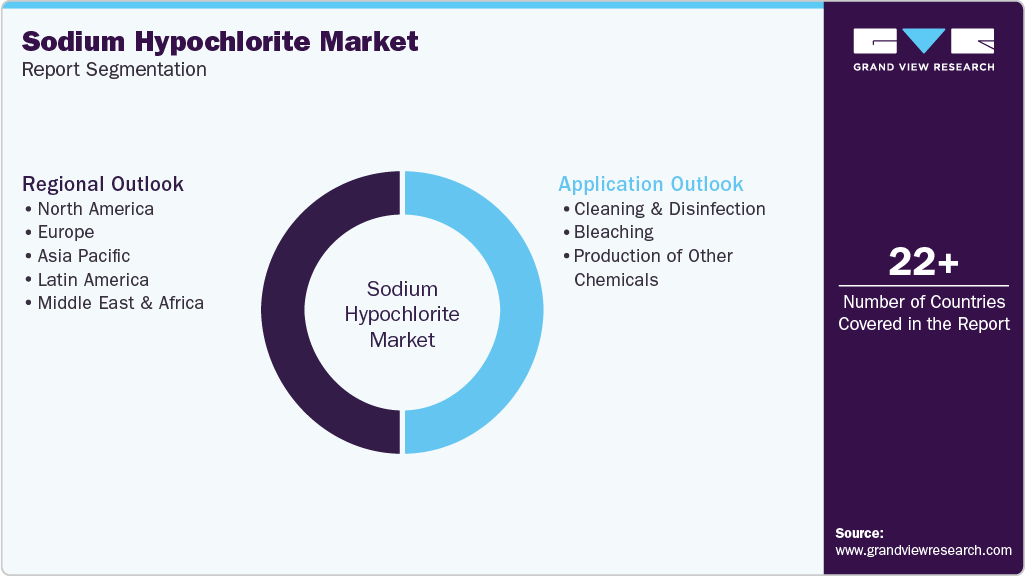
This report forecasts volume & revenue growth at global, regional, and country levels and provides an analysis of the latest industry trends in each of the sub-segments from 2021 to 2033. For this study, Grand View Research has segmented the global sodium hypochlorite market report based on application, and region:
-
Application Outlook (Volume, Kilotons; Revenue, USD Million, 2021 - 2033)
-
Cleaning & Disinfection
-
Household
-
Water Treatment
-
Swimming Pool Sanitation
-
Other Cleaning & Disinfection
-
-
Bleaching
-
Textile Industry
-
Paper & Pulp Industry
-
Other Bleaching
-
-
Production of Other Chemicals
-
-
Regional Outlook (Volume, Kilotons; Revenue, USD Million, 2021 - 2033)
-
North America
-
U.S.
-
Canada
-
Mexico
-
-
Europe
-
Germany
-
UK
-
France
-
Italy
-
Spain
-
-
Asia Pacific
-
China
-
India
-
Japan
-
South Korea
-
-
Latin America
-
Brazil
-
Argentina
-
-
Middle East & Africa
-
Saudi Arabia
-
South Africa
-
-
Delivered Customizations
This report has been delivered with the following In-depth customizations
Client Request
Customization Delivered
Value Adds
Competitive Benchmarking
Detailed benchmarking of renewable methanol producers, based on production capacity, project pipeline, technology pathway (bio-methanol/e-methanol), feedstock integration, geographic presence, strategic partnerships, carbon capture capabilities, and commercialization status. The assessment further includes vendor landscape mapping across technology providers, EPC contractors, carbon capture companies, and biomass/waste processing participants.
Enable clear visibility into competitive positioning, production scalability, and technology leadership across the renewable methanol ecosystem. Support strategic partner identification, investment evaluation, capacity planning, and understanding of competitive intensity within emerging low-carbon fuel markets.
Regional Segmentation
Comprehensive regional analysis covering renewable methanol demand and project development trends across Europe, North America, Asia Pacific, Latin America, and Middle East & Africa. The study evaluates regulatory support, renewable energy availability, green hydrogen ecosystem maturity, carbon pricing mechanisms, marine fuel transition trends, and regional feedstock accessibility.
Identify the most commercially attractive regions and policy-supported growth hubs for renewable methanol adoption. Support expansion prioritization, regional investment planning, and market entry strategy development by understanding localized infrastructure and decarbonization drivers.
Supplier Portfolio Analysis
Comprehensive supplier assessment framework covering renewable methanol feedstock providers, green hydrogen suppliers, carbon capture companies, biomass aggregators, and technology licensors. The analysis incorporates Kraljic portfolio segmentation, supplier engagement models, negotiation strategy assessment, raw material trend evaluation, supply risk profiling, and identification of best sourcing practices across renewable energy and carbon utilization value chains.
Support procurement optimization and long-term supply security through structured supplier prioritization and sourcing strategy development. Enable identification of high-risk and strategic suppliers, strengthen negotiation leverage, improve supplier collaboration models, and enhance resilience across renewable methanol supply chains.
Frequently Asked Questions About This Report
The cleaning and disinfection segment led with a 49.4% revenue share in 2025, while the bleaching segment is the fastest-growing.
The global sodium hypochlorite market size was valued at USD 18.3 billion in 2025 and is estimated at USD 19.0 billion for 2026.
The global sodium hypochlorite market is expected to grow at a CAGR of 4.9% from 2026 to 2033, reaching USD 27.8 billion by 2033.
Asia Pacific dominated with a 42.2% revenue share in 2025.
Key players include Unilever; AkzoNobel; PPG Industries; Westlake Chemical Corporation; Mitsui Chemical Corporation; LANXESS; Chlorotec; Tessenderlo Group; Vynova; ICL
The growth is attributed to rising demand for the product from water treatment chemical manufacturing companies as well as from sanitizer producers worldwide is projected to remain key factor for market growth.
About the Author(s)
Disinfectants & Preservatives Research Team
Bulk Chemicals · Disinfectants & PreservativesThis report was authored by the disinfectants & preservatives research team at Grand View Research - comprising two research analysts, one senior research analyst, and one industry expert - with specialized expertise in the disinfectants & preservatives segment of the bulk chemicals industry. All findings are based on proprietary bulk chemicals databases, executive interviews, and regulatory analysis, subject to internal peer review prior to publication.
Last Updated:
Speak to Analyst


Customize this report to your needs — add regions, segments, or data points, with 20% free customization.
Or view our licence options:


ISO 9001:2015 & 27001:2022 Certified
We are GDPR and CCPA compliant! Your transaction & personal information is safe and secure. For more details, please read our privacy policy.


