
- Home
- »
- Petrochemicals
- »
-
Sodium Sulfate Market Size And Share Report, 2026-2033GVR Report cover
![Sodium Sulfate Market (2026 - 2033)Report]()
Sodium Sulfate Market (2026 - 2033)
Size, Share & Trends Analysis Report By Nature (Natural, Synthetic), By End-use (Paper & Pulp, Detergents, Glass, Food & Beverage), By Region (North America, Asia Pacific, Europe), And Segment Forecasts
Market Size, 2025
$1.5BMarket Estimate, 2026
$1.6BMarket Forecast, 2033
$2.1BCAGR, 2026–2033
3.7%Sodium Sulfate Market Summary
The global sodium sulfate market size was valued at USD 1.5 billion in 2025 and is projected to grow from USD 1.6 billion in 2026 to USD 2.1 billion by 2033, growing at a CAGR of 3.7% from 2026 to 2033. Asia Pacific dominated the market, accounting for a revenue share of 44.0% in 2025. The growing demand from the detergent industry significantly drives the market.

Key Market Trends & Insights
- By nature: Natural segment led the market with the largest revenue share of 66.0% in 2025.
- By end-use: Detergents segment accounted for the dominating revenue share of 45.9% in 2025.
Regional Highlights
- Largest regional market: Asia Pacific (44.0% revenue share, 2025)
- By country: China accounted for dominating revenue share of the Asia Pacific sodium sulfate market in 2025.
Market Size & Forecast
- Market size in 2025: USD 1.5 Billion
- Estimated market size in 2026: USD 1.6 Billion
- Projected market size by 2033: USD 2.1 Billion
- CAGR (2026-2033): 3.7%
The product is widely used as a filler in powdered detergents, enhancing their performance and improving texture. As urbanization grows and disposable incomes rise, consumers are buying more cleaning products, driving a surge in detergent consumption. This trend is especially noticeable in emerging markets, where the demand for efficient and affordable cleaning solutions continues to increase.
China's sodium sulfate market is significantly driven by the rapid growth of the detergent industry. As one of the largest consumers of household and industrial cleaning products, the demand for sodium sulfate as a filler in powdered detergents has surged. The increasing urbanization and rising disposable incomes among the Chinese population have led to higher consumption of laundry detergents, thereby boosting the need for sodium sulfate. This trend is further supported by the growing awareness of hygiene and cleanliness, especially in urban areas, which has resulted in a consistent demand for effective cleaning agents.
Another critical factor contributing to the demand for sodium sulfate in China is its use in the pulp and paper industry. As the country continues to expand its paper production capabilities to meet both domestic and international demand, sodium sulfate plays a vital role in the kraft pulping process. This process is essential for producing high-quality paper products, and sodium sulfate is used to recover chemicals, making the production process more sustainable. The growth of the packaging and printing sectors, driven by e-commerce and consumer goods, has further amplified the need for sodium sulfate in this industry.
As a food additive, it plays a crucial role in the food and beverage industry, particularly in improving the texture and extending the shelf life of products such as dairy, baked goods, and meat. Sodium sulfate's long history of safe use has contributed to its widespread acceptance in both sweet and savory food products. Additionally, the increasing global meat consumption, especially in high-income countries such as Australia, as well as significant consumption in Europe and North America, has fueled the demand for sodium sulfate. Over the past 50 years, meat production has more than tripled, with current global production surpassing 350 million tonnes annually.
Furthermore, the consumption of milk and milk products is on the rise, particularly in developing countries, where over 6 billion people consume these products. These trends are all contributing to the growing demand for sodium sulfate in the food industry. Another key factor propelling the market is its essential role in the pulp and paper industry. Sodium sulfate is utilized in the kraft process, a method for producing high-quality pulp from wood chips.
Market Dynamics
Sodium sulfate is an inorganic salt widely utilized across detergents, paper & pulp, glass manufacturing, food processing, textile processing, and chemical production applications. The compound serves as a filler, processing aid, and raw material in numerous industrial processes due to its cost-effectiveness, chemical stability, and broad functional properties. Growing industrial production and increasing demand from detergent and glass manufacturing industries continue to support market growth globally.
The detergent industry remains one of the largest consumers of sodium sulfate, making its growth a major driver for the market. Sodium sulfate is extensively used as a filler in powdered detergents, helping manufacturers improve product consistency, flowability, and formulation efficiency while maintaining cost competitiveness. Growing population levels, urbanization, and rising hygiene awareness continue to support demand for household cleaning products worldwide.
In addition, increasing consumption of laundry detergents across emerging economies is contributing to market expansion. Expanding retail distribution networks, rising disposable incomes, and improving living standards are encouraging higher usage of cleaning products, thereby supporting sustained demand for sodium sulfate from detergent manufacturers.
The increasing preference for liquid detergent formulations presents a challenge for sodium sulfate demand growth. Unlike powdered detergents, liquid products typically require little or no sodium sulfate, reducing consumption within one of the market's key application areas. Changing consumer preferences toward convenient and premium cleaning products are accelerating this trend in several developed markets. Furthermore, manufacturers continue to invest in concentrated detergent formulations that require lower filler content. These evolving product development strategies may limit long-term growth opportunities for sodium sulfate within traditional detergent applications.
Rapid industrialization across emerging economies is creating significant opportunities for sodium sulfate manufacturers. Growing investments in glass manufacturing, paper production, chemicals, textiles, and infrastructure development are supporting increased consumption of industrial-grade sodium sulfate across multiple sectors. Additionally, rising manufacturing activity in Asia Pacific, Latin America, and parts of the Middle East is expected to generate new demand streams. Expanding industrial capacity and increasing domestic production capabilities continue to create favorable conditions for long-term market growth.
Analyst Perspective
The sodium sulfate market is gradually transitioning from a mature commodity chemical industry toward a more application-diversified market supported by detergents, glass manufacturing, pulp & paper, and specialty chemical sectors. While detergent applications continue to account for the largest share of consumption, emerging opportunities are developing in industrial processing and specialty chemical formulations where consistent product quality and purity are critical. Market participants are increasingly focusing on supply chain optimization, cost efficiency, and sustainable production practices to maintain competitiveness.
Nature Insights
Based on nature, the natural segment led the market with the largest revenue share of 66.0% in 2025. Natural sodium sulfate, often referred to as Glauber's salt, is derived from natural mineral deposits or through the evaporation of seawater. It is typically found in large quantities in regions with arid climates. Glauber's salt provides eco-friendly advantages in textile dyeing, such as lower pollution, reduced total dissolved solids (TDS), and a decreased effluent load. Serving as a catalyst, it improves dye absorption, fixation, and shade depth. In comparison to common salts, it not only minimizes environmental impact but also enhances dyeing efficiency and fabric quality.
The synthetic sodium sulfate market is estimated to grow significantly at a CAGR of 4.2% over the forecast period. Synthetic sodium sulfate is produced through chemical processes, often as a byproduct of other industrial activities, such as the production of hydrochloric acid or the neutralization of sulfuric acid. This form of sodium sulfate is typically more consistent in quality and purity compared to its natural counterpart. Synthetic sodium sulfate is used in similar applications, including detergents and industrial processes, but it may be preferred in situations where specific purity levels are required or where natural sources are not readily available.
End-use Insights
By end-use, the detergents segment accounted for the dominating revenue share of 45.9% in 2025, owing to the fact that sodium sulfate plays a crucial role in the detergent industry, where it is primarily used as a filler in powdered detergents. Its high solubility in water makes it an effective agent for enhancing detergents' cleaning performance. The rise of infectious diseases, including COVID-19, has increased global awareness of hygiene, driving higher demand for cleaning products, hand sanitizers, and laundry detergents. Economic growth in emerging markets has boosted disposable incomes, allowing consumers to purchase higher-quality products. Additionally, the expansion of e-commerce platforms has made detergent products more accessible, further fueling global demand and opening new opportunities for manufacturers in the market.

Glass in the sodium sulfate market is expected to grow at the fastest CAGR of 4.9% over the forecast period. Sodium sulfate anhydrous aids in eliminating small air bubbles trapped in molten glass during the melting process, ensuring that the resulting glass is smooth and free of imperfections. The rising demand for glass manufacturing with sodium sulfate is driven by global construction growth, particularly in emerging economies, and the trend toward modern, energy-efficient architecture.
In the pulp and paper industry, sodium sulfate is utilized in various processes, including paper production. It serves as a key component in the kraft process, a method of producing pulp from wood chips. Sodium sulfate helps recover chemicals used in the pulping process, making it essential for the sustainability of paper production. The increasing demand for paper products, driven by both consumer and industrial needs, is expected to boost the demand for the product in this sector.
Regional Insights
North America sodium sulfate market is expected to grow significantly at a CAGR of 4.6% over the forecast period. As urbanization increases and disposable incomes rise, consumers are purchasing more cleaning products, leading to a surge in detergent consumption. Technological advancements in the paper and pulp industry are increasing the demand for sodium sulfate, as it helps control viscosity and improve paper quality. In textile processing, sodium sulfate enhances dyeing and color brightness, driving higher demand, particularly with the growth of the textile industry in countries such as Mexico.
U.S. Sodium Sulfate Market Trends
The sodium sulfate market in the U.S. led the North American market with the largest revenue share in 2024. The growth in strategic inward investment, manufacturing, and large-scale infrastructure projects focused on de-carbonization, backed by the U.S. Inflation Reduction Act, is driving expansion in the U.S. construction market - the second largest globally. This growth is a major factor increasing the demand for sodium sulfate in glass manufacturing, a key component of the construction industry in the region. The food industry is a major contributor to the U.S. economy, driving increased demand for sodium sulfate in food processing, preservatives, and glass packaging for beverages.
Asia Pacific Sodium Sulfate Market Trends
Asia Pacific dominated the sodium sulfate market with the highest revenue share of 44.0% in 2025. The growth is driven primarily by the increasing demand from various end-use industries. Rapid development in emerging economies across the Asia Pacific has significantly boosted various industries. The expanding construction and automotive sectors, with increasing demand for glass in windows, windshields, and building materials, are major contributors to the rising need for sodium sulfate in glass manufacturing. Additionally, the growing adoption of washing machines in countries such as China, India, and ASEAN has led to higher demand for detergents, further driving sodium sulfate usage in detergent production. Urbanization and population growth also contribute to this surge.

China accounted for dominating revenue share of the Asia Pacific sodium sulfate market in 2025. In 2022, Chinese consumers increasingly sought laundry care products with advanced features, such as multifunctional liquid tablet detergents or laundry sanitizers, driving demand for sodium sulfate in detergent manufacturing. Despite rising raw material and logistics costs, prices in China remained stable, with positive volume growth but declining real-value sales. The growth of e-commerce, especially budget-friendly platforms such as Pinduoduo, exerted downward pressure on prices. To compete, offline retailers, including supermarkets and hypermarkets, launched strong promotions, intensifying price competition and contributing to the rising need for sodium sulfate in detergent production.
Europe Sodium Sulfate Market Trends
Europe sodium sulfate market accounted for a substantial market share in 2024. The surge in construction activity will drive an increased demand for glass, subsequently boosting the need for sodium sulfate. In Europe, sodium sulfate is primarily used in the production of detergents, glass, paper and pulp, and textiles. The detergent industry, especially, is a major consumer, where sodium sulfate serves as a filler to modify the concentration of active ingredients and enhance the flow properties.
Key Sodium Sulfate Company Insights
Some key sodium sulfate market companies include Nippon Chemical Industrial CO., LTD; Elementis PLC.; LENZING AG; and SHIKOKU KASEI HOLDINGS CORPORATION; among others. Key companies in the global sodium sulfate market stay competitive by diversifying product applications, investing in technology, and focusing on sustainability. They expand through strategic partnerships, regional growth, and cost optimization, ensuring efficiency and reducing costs. By fostering strong customer relationships and offering customized solutions, these companies maintain their market position and adapt to growing demand across various industries.
-
Nippon Chemical Industrial CO., LTD offers products primarily used in industries such as detergents, glass manufacturing, and textiles. The company focuses on research and development to enhance production processes and improve product performance. Through strategic investments and maintaining strong customer relationships, the company continues to meet the growing demand for sodium sulfate while contributing to the evolving needs of various industries globally.
-
Elementis PLC. is a global specialty chemicals company that manufactures a wide range of products used in industries such as coatings, personal care, automotive, and consumer goods. Known for its expertise in providing innovative solutions, it offers high-performance additives, including those used in glass manufacturing and detergents. With a strong focus on sustainability and operational efficiency, it caters to diverse market needs.
Key Sodium Sulfate Companies:
The following key companies have been profiled for this study on the sodium sulfate market.
-
Nippon Chemical Industrial CO., LTD
-
Elementis PLC.
-
LENZING AG
-
SHIKOKU KASEI HOLDINGS CORPORATION
-
Bahubali Chemical Industries
-
Cooper Natural Resources
-
Sun European Partners, LLP
-
Sigma-Aldrich Solutions
-
Tokyo Chemical Industry Pvt. Ltd.
-
Jiangsu Yinzhu Chemical Group Co., Ltd
Competitive Benchmarking
Category
Operating Strategies
Competitive Edge
Weakness
Established Players (Nippon Chemical Industrial Co., Ltd., Elementis PLC., LENZING AG, SHIKOKU KASEI HOLDINGS CORPORATION, Sigma-Aldrich Solutions, Jiangsu Yinzhu Chemical Group Co., Ltd.)
- Expanding production capabilities and strengthening supply networks to meet growing industrial demand.
- Enhancing product quality and operational efficiency through process optimization and technological improvements.
- Strong manufacturing infrastructure supports reliable supply across multiple industrial application sectors.
- Established customer relationships and extensive industry experience strengthen long-term market positioning.
- Exposure to fluctuations in industrial demand can impact production utilization and profitability.
- Commodity-oriented pricing environment may create pressure on operating margins and competitiveness.
Emerging Players (Bahubali Chemical Industries, Cooper Natural Resources, Sun European Partners, LLP, Tokyo Chemical Industry Pvt. Ltd.)
- Focusing on regional market expansion and strengthening distribution channels to increase customer reach.
- Developing specialized grades and application-specific offerings to enhance market differentiation.
- Flexible operational structures enable faster adaptation to changing customer requirements and market trends.
- Strong regional expertise supports efficient servicing of local industrial and chemical manufacturing sectors.
- Limited international presence may restrict access to large-volume global customers and export markets.
- Smaller production capacities can reduce economies of scale compared to established market leaders.
Recent Developments
-
In May 2024, Grasim Industries Ltd launched EcoSodium, an eco-friendly solution sourced from extracted Sodium Sulphate during Viscose Staple Fiber production. By minimizing wastewater discharge, EcoSodium reduces environmental impact. Compliant with REACH and ZDHC MRSL standards, it ensures responsible sourcing and manufacturing.
-
In September 2023, Cinis Fertilizer announced plans to build a new sodium sulfate creation site in Hopkinsville, Kentucky. They partnered with Ascend Elements to obtain sodium sulfate for the project.
-
In November 2023, the USFDA approved Stride’s generic version of the Suprep Bowel Prep Kit. The kit contains sodium sulfate, potassium sulfate, and magnesium sulfate.
Sodium Sulfate Market Report Scope
Report Attribute
Details
Market size value in 2025
USD 1.5 billion
Estimated market size in 2026
USD 1.6 billion
Projected market size by 2033
USD 2.1 billion
Growth rate
CAGR of 3.7% from 2026 to 2033
Base year for estimation
2025
Historical data
2021 - 2024
Forecast period
2026 - 2033
Quantitative units
Revenue in USD million/billion, volume in kilotons and CAGR from 2026 to 2033
Report coverage
Revenue forecast, company ranking, competitive landscape, growth factors, and trends
Segments covered
Product, application, region
Regional scope
North America; Europe; Asia Pacific; Latin America; MEA
Country scope
U.S.; Canada; Mexico; Germany; UK; France; China; Japan; India; Brazil; South Africa; Saudi Arabia;
Key companies profiled
Nippon Chemical Industrial Co., Ltd.; Elementis PLC; Lenzing AG; SHIKOKU KASEI HOLDINGS CORPORATION; Bahubali Chemical Industries; Cooper Natural Resources; Sun European Partners, LLP; Sigma-Aldrich Solutions; Tokyo Chemical Industry Pvt. Ltd.; Jiangsu Yinzhu Chemical Group Co., Ltd.
Customization scope
Free report customization (equivalent up to 8 analysts' working days) with purchase. Addition or alteration to country, regional & segment scope.
Pricing and purchase options
Avail customized purchase options to meet your exact research needs. Explore purchase options
Global Sodium Sulfate Market Report Segmentation
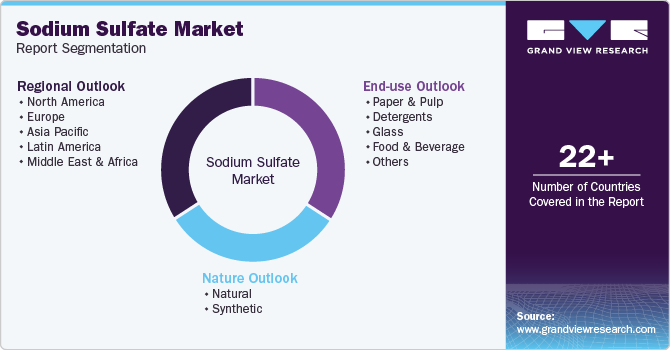
This report forecasts revenue growth at global, regional, and country levels and provides an analysis of the latest industry trends in each of the sub-segments from 2021 to 2033. For this study, Grand View Research has segmented the global sodium sulfate market report based on nature, end-use, and region.
-
Nature Outlook (Volume, Kilotons; Revenue, USD Million, 2021 - 2033)
-
Natural
-
Synthetic
-
-
End-use Outlook (Volume, Kilotons; Revenue, USD Million, 2021 - 2033)
-
Paper & Pulp
-
Detergents
-
Glass
-
Food & Beverage
-
Others
-
-
Regional Outlook (Volume, Kilotons; Revenue, USD Million, 2021 - 2033)
-
North America
-
U.S.
-
Canada
-
Mexico
-
-
Europe
-
Germany
-
UK
-
France
-
-
Asia Pacific
-
China
-
India
-
Japan
-
-
Latin America
-
Brazil
-
Argentina
-
-
MEA
-
Saudi Arabia
-
South Africa
-
-
Research Methodology
The sodium sulfate market figures in this report are based on a proven research process that combines executive interviews with secondary research from proprietary databases, company filings, and recognized regulatory and institutional sources. Market size is built through value-chain sizing - reconciling supply-side and demand-side estimates - and triangulated with bottom-up and top-down approaches. Every estimate passes multiple levels of expert validation before publication, with each sodium sulfate segment quantified using the revenue-capture definitions in the table below.
Segment Definition
Segment - Nature
Revenue capture definition
Natural Sodium Sulfate
As the dominant nature segment, revenue is generated through the extraction and commercial supply of naturally occurring sodium sulfate utilized across detergent, glass, paper, and chemical manufacturing industries. Cost advantages and large-scale availability support substantial market demand.
Synthetic Sodium Sulfate
Revenue is supported by sodium sulfate produced as a byproduct or through chemical manufacturing processes. Demand is influenced by industrial production volumes, purity requirements, and applications requiring consistent product specifications for downstream processing operations.
Segment - Application
Revenue capture definition
Paper & Pulp
Revenue is generated through the use of sodium sulfate in kraft pulping and chemical recovery processes. Demand is supported by paper manufacturing volumes, packaging industry growth, and ongoing consumption of pulp-based products globally.
Detergents
As the dominant application segment, revenue capture is driven by extensive utilization as a filler and formulation aid in powdered detergents. Large-scale household and industrial cleaning product manufacturing continues to support significant commercial consumption volumes.
Glass
Revenue is supported by sodium sulfate consumption in glass manufacturing processes where it assists in removing air bubbles and improving product quality. Expanding construction, automotive, and packaging industries contribute to segment growth.
Food & Beverage
Market value is derived from regulated applications involving food processing and specialty ingredient formulations. Demand is influenced by food manufacturing activity and compliance with industry quality and safety standards.
Other Applications
This segment captures revenue from textile processing, chemical manufacturing, pharmaceuticals, and various industrial applications utilizing sodium sulfate as a processing aid, intermediate, or functional ingredient.
Estimation Model
Layer Name
Key Question
Description
Industrial Demand Layer
What forms the addressable base?
Identify global production volumes across detergent manufacturing, paper & pulp processing, glass production, food processing, and chemical industries utilizing sodium sulfate within their manufacturing operations.
Application Adoption Layer
Where is sodium sulfate utilized?
Estimate the proportion of industrial processes incorporating natural or synthetic sodium sulfate based on formulation requirements, production technologies, and regional manufacturing practices.
Consumption Layer
How much sodium sulfate is consumed?
Analyze inclusion rates, manufacturing volumes, process requirements, and industry-specific usage patterns to determine annual sodium sulfate consumption across major application sectors.
Revenue Layer
How is market revenue generated?
Market revenue is quantified through the sale of natural and synthetic sodium sulfate supplied to detergent manufacturers, glass producers, paper mills, food processors, and industrial users worldwide.
Delivered Customizations
This report has been delivered with the following In-depth customizations
Client Request
Customization Delivered
Value Adds
Regional Segmentation
The study delivers additional country-level analysis covering 10-15 countries, including Türkiye, Indonesia, Qatar, UAE, Jordan, and others, evaluating market size, consumption trends, trade dynamics, end-use demand patterns, and growth outlook across the sodium sulfate market.
Enables stakeholders to identify country-specific growth opportunities, assess regional demand variations, understand market dynamics, and formulate targeted expansion strategies across emerging and high-potential markets.
Cross-Segmentation Analysis
The study delivers detailed cross-segmentation analysis assessing sodium sulfate demand across major applications by grade, including Industrial Grade, Detergent Grade, Food Grade, and among others, highlighting consumption patterns, demand concentration, and growth trends across end-use industries.
Helps companies identify the most attractive grade-application combinations, optimize product portfolio strategies, target high-growth customer segments, and improve commercial decision-making based on application-specific demand dynamics.
Opportunity Assessment
The study delivers detailed assessment of emerging opportunities across detergent manufacturing, glass production, pulp & paper processing, and specialty industrial applications, identifying high-growth demand pockets, evolving industry requirements, and future market expansion prospects.
Supports strategic planning by identifying lucrative growth areas, evaluating investment potential, uncovering underserved application segments, and aligning business development initiatives with evolving end-user demand trends.
Frequently Asked Questions About This Report
The Natural Sodium Sulfate segment dominated the sodium sulfate market in 2025, accounting for 66.0% of the total market share. Its dominance is attributed to abundant natural reserves, cost-effective extraction processes, and widespread use across detergents, glass manufacturing, and pulp & paper applications.
Growing Demand from Emerging Economies and Industrial Applications presents a significant opportunity for the sodium sulfate market. Rapid industrialization, urbanization, and increasing consumption of detergents, glass, and chemical products in developing regions are driving demand.
Fluctuations in production levels, changing consumer preferences, and shifts toward alternative materials or formulations can impact sodium sulfate consumption, creating uncertainty for manufacturers and suppliers.
The Detergents segment dominated the market with a 45.9% share in 2025. Sodium sulfate is widely used as a filler and processing aid in powdered detergents, supporting its strong demand from household and industrial cleaning product manufacturers.
Asia Pacific dominated the sodium sulfate market, with a share of 44.0% in 2025.
Some key players operating in the sodium sulfate market include Nippon Chemical Industrial Co., Elementis Plc., Lenzing AG, Shikoku Chemicals Corporation, Nikunj Chemicals, Cooper Natural resources Inc, Searles valley minerals, Sigma Aldrich, TCI Chemicals, Jiangsu Yinzhu Chemical Group Co. Ltd.
Key factors driving market growth include increasing urbanization and disposable incomes and consumers purchasing more cleaning products.
The global sodium sulfate market is expected to grow at a CAGR of 3.7% from 2026 to 2033, reaching USD 2.1 billion by 2033.
The global sodium sulfate market size was valued at USD 1.5 billion in 2024 and is estimated at USD 1.6 billion for 2026.
About the Author(s)
Petrochemicals Research Team
Bulk Chemicals · PetrochemicalsThis report was authored by the petrochemicals research team at Grand View Research - comprising two research analysts, one senior research analyst, and one industry expert - with specialized expertise in the petrochemicals segment of the bulk chemicals industry. All findings are based on proprietary bulk chemicals databases, executive interviews, and regulatory analysis, subject to internal peer review prior to publication.
Last Updated:
Speak to Analyst


Customize this report to your needs — add regions, segments, or data points, with 20% free customization.
Or view our licence options:


ISO 9001:2015 & 27001:2022 Certified
We are GDPR and CCPA compliant! Your transaction & personal information is safe and secure. For more details, please read our privacy policy.


