
- Home
- »
- Next Generation Technologies
- »
-
Software-Defined Military Radio Market Size Report, 2033GVR Report cover
![Software-Defined Military Radio Market Size, Share & Trends Report]()
Software-Defined Military Radio Market (2026 - 2033) Size, Share & Trends Analysis Report By Platform (Ground, Naval, Space), By Component (Hardware, Software, Services), By Type (General Purpose Radio, Joint Tactical Radio System), By Frequency Band, By Region, And Segment Forecasts
- Report ID: GVR-4-68040-898-8
- Number of Report Pages: 140
- Format: PDF
- Historical Range: 2021 - 2025
- Forecast Period: 2026 - 2033
- Industry: Technology
- Report Summary
- Table of Contents
- Segmentation
- Methodology
- Download FREE Sample
-
 Download Sample Report
Software-Defined Military Radio Market Summary
The global software-defined military radio market size was estimated at USD 4,605.6 million in 2025 and is projected to reach USD 8,735.9 million by 2033, growing at a CAGR of 8.4% from 2026 to 2033. The market expansion is driven by the increasing modernization of military communication infrastructure, the integration of advanced encryption technologies, and the growing demand for secure, interoperable, and real-time communication.
Key Market Trends & Insights
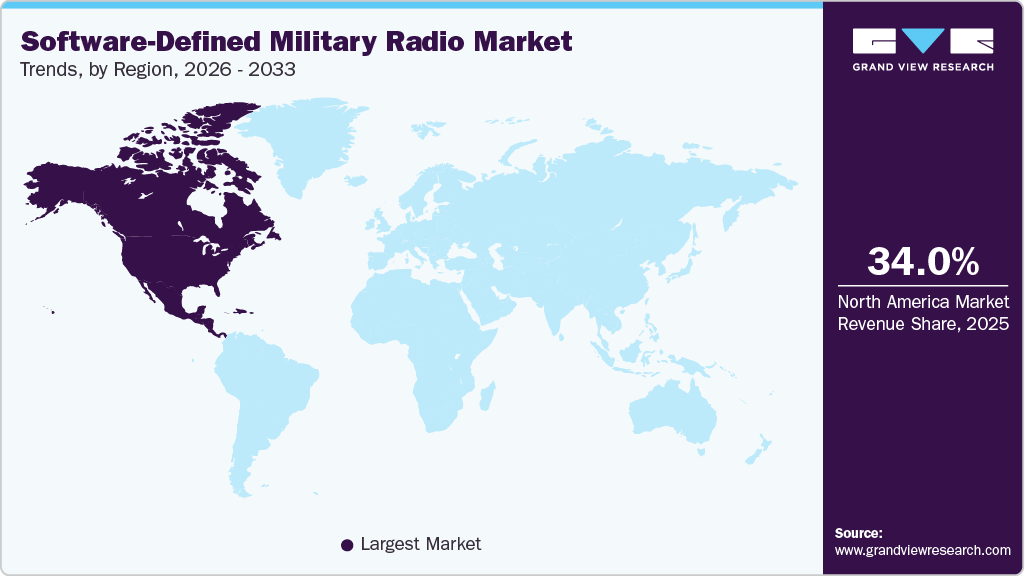
- North America dominated the global software-defined military radio market with the largest revenue share of over 34% in 2025.
- The software-defined military radio market in the U.S. led the North America market and held the largest revenue share of over 85% in 2025.
- By type, joint tactical radio system held the dominant position and accounted for the highest revenue share of over 33% in 2025.
- By component, software is expected to grow at the highest CAGR of over 10% from 2026 to 2033.
- By frequency band, ultra-high frequency (VHF) accounted for the largest revenue share of over 31% in 2025.
Market Size & Forecast
- 2025 Market Size: USD 4,605.6 Million
- 2033 Projected Market Size: USD 8,735.9 Million
- CAGR (2026-2033): 8.4%
- North America: Largest market in 2025
The market growth is driven by the rapid advancement of secure wireless communication technologies, enhanced spectrum management capabilities, and the increasing deployment of multi-band and multi-mission tactical radio systems. The adoption of software-defined military radio is accelerating as governments and defense agencies seek reliable, interoperable communication solutions to strengthen battlefield coordination and support mission-critical operations across land, air, and naval platforms. The increasing integration of artificial intelligence-enabled signal processing, cognitive radio technologies, and cloud-based command-and-control systems enhances communication resilience, real-time situational awareness, and decision-making capabilities in the industry.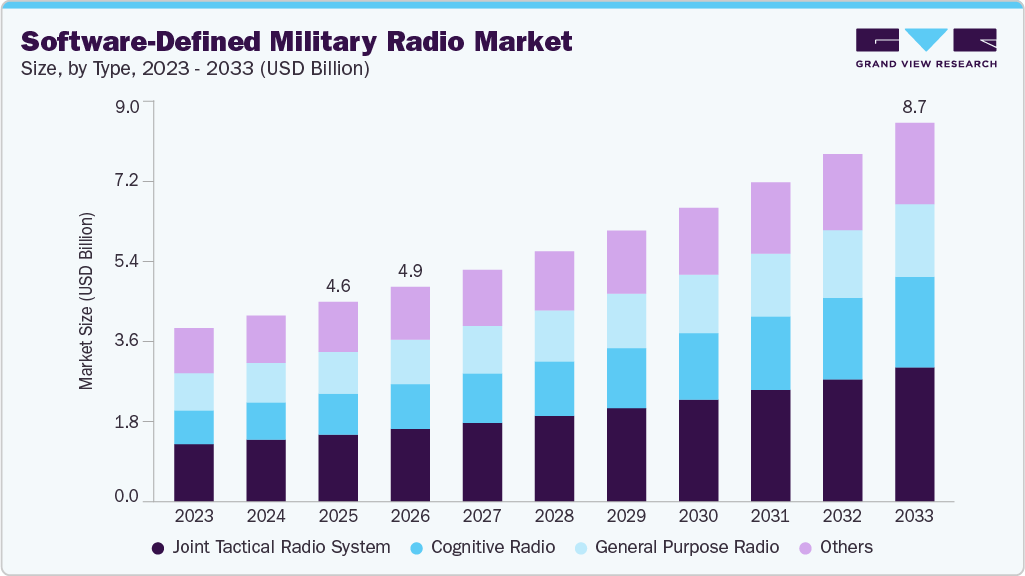
The rapid advancement of secure wireless communication protocols, software-upgradable waveform technologies, and multi-band frequency management systems is significantly transforming battlefield communication capabilities by enabling reliable, interoperable, and resilient connectivity across complex operational environments. These innovations improve communication clarity, signal security, and operational flexibility to support mission-critical applications. The integration of advanced miniaturized radio components and modular open-system architectures further supports scalable deployment and lifecycle cost optimization in the software-defined military radio industry.
In addition, the market is witnessing growing momentum toward the integration of software-defined military radio into national defense modernization programs and digital battlefield networking initiatives designed to enhance situational awareness and command efficiency. Government agencies and armed forces are increasingly incorporating secure tactical communication systems into border security operations to provide real-time communication, encrypted data exchange, and synchronized mission planning capabilities. This shift toward network-centric warfare infrastructure is enabling defense organizations to improve operational coordination and enhance force protection in the market.
Moreover, the expansion of unmanned systems deployment, integrated soldier modernization programs, and multinational peacekeeping operations is driving demand for reliable, portable, and mission-adaptive communication solutions. Defense organizations are increasingly investing in software-defined military radio to support unmanned aerial vehicle (UAV) control, vehicle-to-vehicle communication, and secure field communications, enabling faster response times and improved operational continuity in dynamic combat environments. This growing emphasis on mobility, interoperability, and communication resilience is strengthening the role of advanced tactical radio systems across defense, homeland security, and emergency response sectors.
Furthermore, the rising adoption of artificial intelligence-enabled signal processing, cybersecurity frameworks, and cloud-based command-and-control communication platforms is reshaping application opportunities across the market. Military organizations are leveraging automated spectrum allocation, interference detection algorithms, and real-time network management tools to optimize communication performance and maintain secure connectivity. This transition toward intelligent communication ecosystems positions software-defined military radio providers to meet the evolving demands for electronic warfare readiness and mission coordination.
Type Insights
The joint tactical radio system segment accounted for the largest market share of over 33% in 2025, driven by its ability to enable interoperable, secure communication and coalition forces operating in complex mission environments. The rapid expansion of network-centric warfare programs, integrated command-and-control infrastructure, and digital battlefield communication networks is reinforcing the segment’s dominant position. The widespread deployment of multi-band, multi-mode tactical radios supporting voice, data, and video transmission is enabling seamless coordination among ground, air, and naval units, thereby strengthening market growth.
The cognitive radio segment is expected to witness the fastest CAGR of over 10% from 2026 to 2033. The segment growth is driven by its capability to dynamically sense spectrum conditions, automatically adjust frequencies, and optimize communication performance. The rising demand for adaptive communication technologies that enhance spectrum efficiency, electronic warfare resilience, and secure data transmission is encouraging defense organizations to adopt cognitive radio-enabled systems. Advancements in artificial intelligence-driven signal processing, autonomous spectrum management, and real-time interference mitigation technologies are expected to accelerate adoption in the cognitive radio segment.
Component Insights
The hardware segment accounted for the largest market share in 2025, propelled by the increasing deployment of advanced tactical radio devices, antennas, transceivers, and encryption modules. The rapid expansion of soldier modernization programs, vehicle-mounted communication systems, and battlefield networking equipment is reinforcing the segment’s dominant position. The integration of ruggedized components, secure communication hardware, and multi-band radio platforms is enabling reliable mission-critical communication, thereby strengthening the growth trajectory of the hardware segment in the software-defined military radio industry.
The software segment is expected to witness the highest CAGR from 2026 to 2033, owing to the growing reliance on programmable waveforms, network management systems, and secure communication applications. The rising demand for real-time spectrum management, cyber-secure communication protocols, and remote radio configuration capabilities is encouraging defense organizations to adopt advanced software-defined radio platforms. Advancements in cloud-based communication control systems and over-the-air software updates are expected to accelerate adoption in the software segment in the market.
Platform Insights
The ground segment accounted for the largest market share in 2025, owing to the growing demand for secure, interoperable communication systems, mission synchronization, and resilient data exchange among ground forces. The increasing deployment of software-defined military radio across land-based defense operations, tactical command centers, and armored vehicle communication networks to strengthen national security and battlefield coordination. The rising emphasis on military modernization programs, soldier communication upgrades, and integrated command-and-control infrastructure is strengthening market growth.
The airborne segment is expected to witness the highest CAGR from 2026 to 2033. This growth is driven by the rising demand for advanced communication systems, unmanned aerial vehicles (UAVs), and airborne surveillance platforms. The increasing focus on enhancing aerial mission effectiveness and improving communication reliability is encouraging the adoption of airborne software-defined radios. Advancements in miniaturized radio technologies and secure waveform integration are accelerating the deployment of next-generation airborne communication capabilities, thereby supporting expansion in the airborne segment.
Frequency Band Insights
The ultra-high frequency (VHF) segment accounted for the largest market share in 2025, driven by the growing demand for reliable beyond-line-of-sight communication, satellite connectivity, and secure tactical data transmission. The increasing deployment of software-defined military radio operating in UHF bands across naval fleets, ground forces, and joint command units is strengthening real-time communication and mission coordination capabilities. The rising emphasis on secure communication resilience, spectrum efficiency, and interoperability among allied forces is further supporting the dominance of the segment in the software-defined military radio industry.
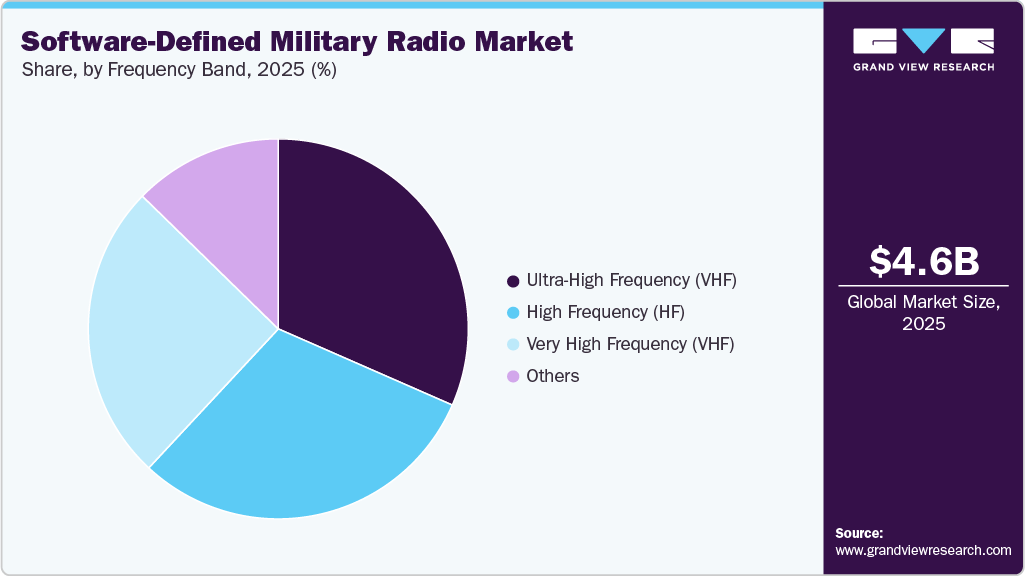
The very high frequency (VHF) segment is expected to witness a considerable CAGR from 2026 to 2033. This growth is attributed to the rising demand for short-range, high-clarity communication systems across infantry units and border security operations. The increasing focus on enhancing frontline coordination, improving situational awareness, and ensuring uninterrupted voice and data transmission in rugged terrain is encouraging the adoption of VHF-based software-defined radios. Advancements in lightweight handheld radio systems, digital modulation technologies, and frequency-agile waveform integration are accelerating the deployment of next-generation VHF communication solutions, thereby supporting expansion in the VHF segment of the market.
Regional Insights
North America dominated the software-defined military radio market with a share of over 34% in 2025, driven by the strong presence of advanced defense communication infrastructure, well-established military modernization programs, and continuous investments in next-generation tactical communication systems. The region is witnessing increasing demand for secure, interoperable communication capabilities to support joint operations, homeland security, and mission-critical defense coordination. The growing collaboration between government defense agencies and communication system providers is accelerating innovation of scalable software-defined military radio solutions across battlefield networking, emergency response, and national security applications.
U.S. Software-Defined Military Radio Market Trends
The software-defined military radio market in the U.S. dominated with a share of over 85% in 2025, fueled by strong government investments in network-centric warfare programs, secure communication infrastructure modernization, and the rapid deployment of advanced tactical radio systems across military branches. The increasing demand for resilient and encrypted communication for battlefield coordination and homeland defense is encouraging the adoption of advanced software-defined military radio for real-time command and control operations. The presence of established defense contractors, continuous innovation in electronic warfare communication technologies, and ongoing military digitization initiatives are contributing to sustained market growth in the country.
Europe Software-Defined Military Radio Market Trends
The software-defined military radio market in Europe is expected to grow at a CAGR of over 7% from 2026 to 2033. The market growth is driven by the increasing focus on regional defense cooperation, the modernization of military communication networks, and cross-border interoperability initiatives in Europe. The region is experiencing rising demand for secure tactical communication systems that support joint military exercises, border security coordination, and emergency response operations. The integration of advanced encryption standards and digital battlefield communication platforms is supporting improved operational efficiency and technology adoption across the market.
The UK software-defined military radio market is expected to grow significantly in the coming years, driven by the expanding use of advanced communication systems for defense readiness, maritime security operations, and national infrastructure protection. Increasing collaboration between defense ministries, research institutions, and private technology companies is fostering innovation in secure communication protocols, portable tactical radios, and resilient battlefield networking solutions. The growing focus on rapid-response defense capabilities and secure mission coordination is boosting demand for the industry.
The software-defined military radio market in Germany is fueled by the increasing focus on military digitalization, critical infrastructure protection, and the modernization of defense communication systems. The country is witnessing rising adoption of advanced tactical radio technologies for secure communication across armored vehicles, command centers, and logistics operations to improve operational reliability and coordination efficiency. Strong emphasis on engineering excellence, defense readiness, and integrated communication networks is encouraging the development and deployment of highly reliable and performance-driven software-defined military radio technologies.
Asia Pacific Software-Defined Military Radio Market Trends
The software-defined military radio market in Asia-Pacific is expected to grow at the highest CAGR of over 10% from 2026 to 2033, driven by the rapid expansion of defense modernization programs, increasing investments in border security communication systems, and rising demand for secure tactical communication capabilities. The region is experiencing strong adoption of advanced radio communication technologies that support military coordination, disaster response operations, and maritime security. The growing deployment of digital battlefield communication networks and expanding regional defense cooperation initiatives are enhancing demand for advanced software-defined military radio across the market.
Japan software-defined military radio market is gaining traction owing to the increasing adoption of secure communication systems for disaster response coordination, maritime surveillance, and national defense readiness. The country is focusing on integrating advanced tactical radio technologies into emergency communication frameworks and defense communication infrastructure to improve operational resilience and public safety. The growing emphasis on technological innovation, disaster preparedness, and secure communication reliability is encouraging investments in high-performance software-defined military radio systems.
The software-defined military radio market in China is rapidly expanding, driven by strong government investments in indigenous defense communication technologies and strategic initiatives supporting military modernization and internal security operations. The country is witnessing increasing adoption of software-defined military radio for border protection, coordinated military operations, and emergency communication management applications. The expansion of domestic defense manufacturing capabilities and the rising demand for secure, high-capacity communication networks are accelerating the large-scale deployment of software-defined military radio technologies across the country.
Key Software-Defined Military Radio Company Insights
Some of the key players operating in the market are L3Harris Technologies, Inc., and Lockheed Martin Corporation, among others.
-
L3Harris Technologies, Inc. is a global leader in tactical communication and software-defined radio technologies, offering advanced multi-band, secure communication systems designed to support modern network-centric warfare and joint military operations worldwide. The company’s strong portfolio of interoperable battlefield radios, command-and-control communication platforms, and resilient spectrum management solutions has strengthened its position as one of the most dominant players in the global software-defined military radio industry.
-
Lockheed Martin Corporation is a leading provider of integrated defense communication and software-defined radio platforms, delivering advanced command, control, communications, computers, intelligence, surveillance, and reconnaissance (C4ISR) solutions that enhance situational awareness and operational coordination across multi-domain missions. The company’s expertise in secure networking, electronic warfare communication systems, and software-programmable radio architectures has positioned it as a key technology provider in the market.
Elbit Systems Ltd. and RAFAEL Advanced Defense Systems Ltd. are some of the emerging market participants.
-
Elbit Systems Ltd. is an emerging innovator in next-generation software-defined military radio solutions, offering advanced tactical communication systems such as the E-LynX family of multi-band radios that support secure voice, data, and video transmission across complex battlefield environments. The company’s growing focus on digital soldier modernization, networked communication technologies, and integrated battlefield management systems is strengthening its role as a rapidly expanding player in the global market.
-
RAFAEL Advanced Defense Systems Ltd. is an emerging provider of advanced defense communication and network-centric warfare technologies, developing integrated electronic warfare, command-and-control, and secure communication systems for military and homeland security applications. The company’s expanding investments in advanced signal processing, cyber defense, and digital battlefield technologies are enhancing its capabilities in secure communication infrastructure, positioning it as a growing participant in the industry.
Key Software-Defined Military Radio Companies:
The following key companies have been profiled for this study on the software-defined military radio market.
- L3Harris Technologies, Inc.
- RTX Corporation
- Thales
- General Dynamics Corporation
- Northrop Grumman
- BAE Systems
- Leonardo S.p.A.
- Elbit Systems Ltd.
- Lockheed Martin Corporation.
- RAFAEL Advanced Defense Systems Ltd.
Recent Developments
-
In February 2026, L3Harris Technologies, Inc. introduced its Key Management System (KMS), designed to support secure cryptographic key generation and management for the Falcon® IV software-defined radio family used by NATO and allied forces. The solution enables countries to independently create and manage encryption keys for national communication networks, strengthening high-assurance tactical communication and interoperability across coalition operations. This development underscores L3Harris Technologies’ strategy to expand secure communication infrastructure and enhance cyber-resilient battlefield networking capabilities in the software-defined military radio industry.
-
In January 2026, Elbit Systems Ltd. expanded deployment of its E-LynX Software-Defined Radio family, designed to support digital soldier modernization and secure battlefield communication across multi-band tactical networks. The system enables real-time voice, data, and video transmission in highly dynamic operational environments, supporting mission coordination and situational awareness. This expansion highlights Elbit Systems Ltd.’s strategy to strengthen its global presence in advanced military communication technologies.
-
In September 2025, Thales Group signed a contract with Malaysian defense partner Advanced Defense Systems to deliver HF XL TRC 3900 vehicle-mounted software-defined radio stations designed to provide high-data-rate, long-range communications in remote and challenging environments. The deployment enhances secure and resilient communication networks for military operations and supports interoperability. This expansion highlights Thales Group’s focus on strengthening next-generation tactical radio infrastructure.
Software-Defined Military Radio Market Report Scope
Report Attribute
Details
Market size value in 2026
USD 4,954.6 million
Revenue forecast in 2033
USD 8,735.9 million
Growth rate
CAGR of 8.4% from 2026 to 2033
Historical data
2021 - 2025
Forecast period
2026 - 2033
Quantitative units
Revenue in USD million/billion and CAGR from 2026 to 2033
Report Product
Revenue forecast, company ranking, competitive landscape, growth factors, and trends
Segments covered
Type, component, frequency band, platform, region
Region scope
North America; Europe; Asia Pacific; Latin America; MEA
Country scope
U.S.; Canada; Mexico; UK; Germany; France; China; Japan; India; South Korea; Australia; Brazil; Saudi Arabia; UAE; South Africa
Key companies profiled
L3Harris Technologies, Inc.; RTX Corporation; Thales; General Dynamics Corporation; Northrop Grumman; BAE Systems; Leonardo S.p.A.; Elbit Systems Ltd.; Lockheed Martin Corporation; RAFAEL Advanced Defense Systems Ltd.
Customization scope
Free report customization (equivalent to up to 8 analyst’s working days) with purchase. Addition or alteration to country, regional & segment scope.
Pricing and purchase options
Avail customized purchase options to meet your exact research needs. Explore purchase options
Global Software-Defined Military Radio Market Report Segmentation
This report forecasts revenue growth at global, regional, and country levels and provides an analysis of the latest technological trends in each of the sub-segments from 2021 to 2033. For this study, Grand View Research has segmented the global software-defined military radio market report based on type, component, frequency band, platform, and region:
-
Type Outlook (Revenue, USD Million, 2021 - 2033)
-
General Purpose Radio
-
Joint Tactical Radio System
-
Cognitive Radio
-
Others
-
-
Component Outlook (Revenue, USD Million, 2021 - 2033)
-
Hardware
-
Antenna
-
Transmitter
-
Receiver
-
Others
-
-
Software
-
Services
-
-
Frequency Band Outlook (Revenue, USD Million, 2021 - 2033)
-
High Frequency (HF)
-
Very High Frequency (VHF)
-
Ultra-High Frequency (VHF)
-
Others
-
-
Platform Outlook (Revenue, USD Million, 2021 - 2033)
-
Ground
-
Naval
-
Airborne
-
Space
-
-
Regional Outlook (Revenue, USD Million, 2021 - 2033)
-
North America
-
U.S.
-
Canada
-
Mexico
-
-
Europe
-
UK
-
Germany
-
France
-
-
Asia Pacific
-
China
-
Japan
-
India
-
South Korea
-
Australia
-
-
Latin America
-
Brazil
-
-
Middle East and Africa (MEA)
-
Saudi Arabia
-
UAE
-
South Africa
-
-
Frequently Asked Questions About This Report
b. The global software-defined military radio market size was estimated at USD 4,605.6 million in 2025 and is expected to reach USD 4,954.6 million in 2026.
b. The global software-defined military radio market is expected to grow at a compound annual growth rate (CAGR) of 8.4% from 2026 to 2033, reaching USD 8,735.9 million by 2033.
b. The joint tactical radio system segment accounted for the largest market share of over 33% in 2025, driven by its ability to enable interoperable, secure communication and coalition forces operating in complex mission environments. The rapid expansion of network-centric warfare programs, integrated command-and-control infrastructure, and digital battlefield communication networks is reinforcing the segment’s dominant position. The widespread deployment of multi-band, multi-mode tactical radios supporting voice, data, and video transmission is enabling seamless coordination among ground, air, and naval units, thereby strengthening the growth of the segment in the software-defined military radio industry.
b. Some key players operating in the software-defined military radio market include L3Harris Technologies, Inc., RTX Corporation, Thales, General Dynamics Corporation, Northrop Grumman, BAE Systems, Leonardo S.p.A., Elbit Systems Ltd., Lockheed Martin Corporation., RAFAEL Advanced Defense Systems Ltd.
b. The market expansion is driven by the increasing modernization of military communication infrastructure, the integration of advanced encryption technologies, and the growing demand for secure, interoperable, and real-time communication.


Share this report with your colleague or friend.
Need a Tailored Report?
Customize this report to your needs — add regions, segments, or data points, with 20% free customization.


ISO 9001:2015 & 27001:2022 Certified
We are GDPR and CCPA compliant! Your transaction & personal information is safe and secure. For more details, please read our privacy policy.
Trusted market insights - try a free sample
See how our reports are structured and why industry leaders rely on Grand View Research. Get a free sample or ask us to tailor this report to your needs.













