
- Home
- »
- Next Generation Technologies
- »
-
Software Defined Security Market Size Report, 2026-2033GVR Report cover

Software Defined Security Market (2026 - 2033)
Size, Share & Trends Analysis Report By Component (Solution, Services), By Deployment (Public Cloud, Private Cloud, On-premise), By Enforcement Point, By End Use, By Region, And Segment Forecasts
Market Size, 2025
$12.4BMarket Estimate, 2026
$14.1BMarket Forecast, 2033
$37.8BCAGR, 2026–2033
15.1%Software Defined Security Market Summary
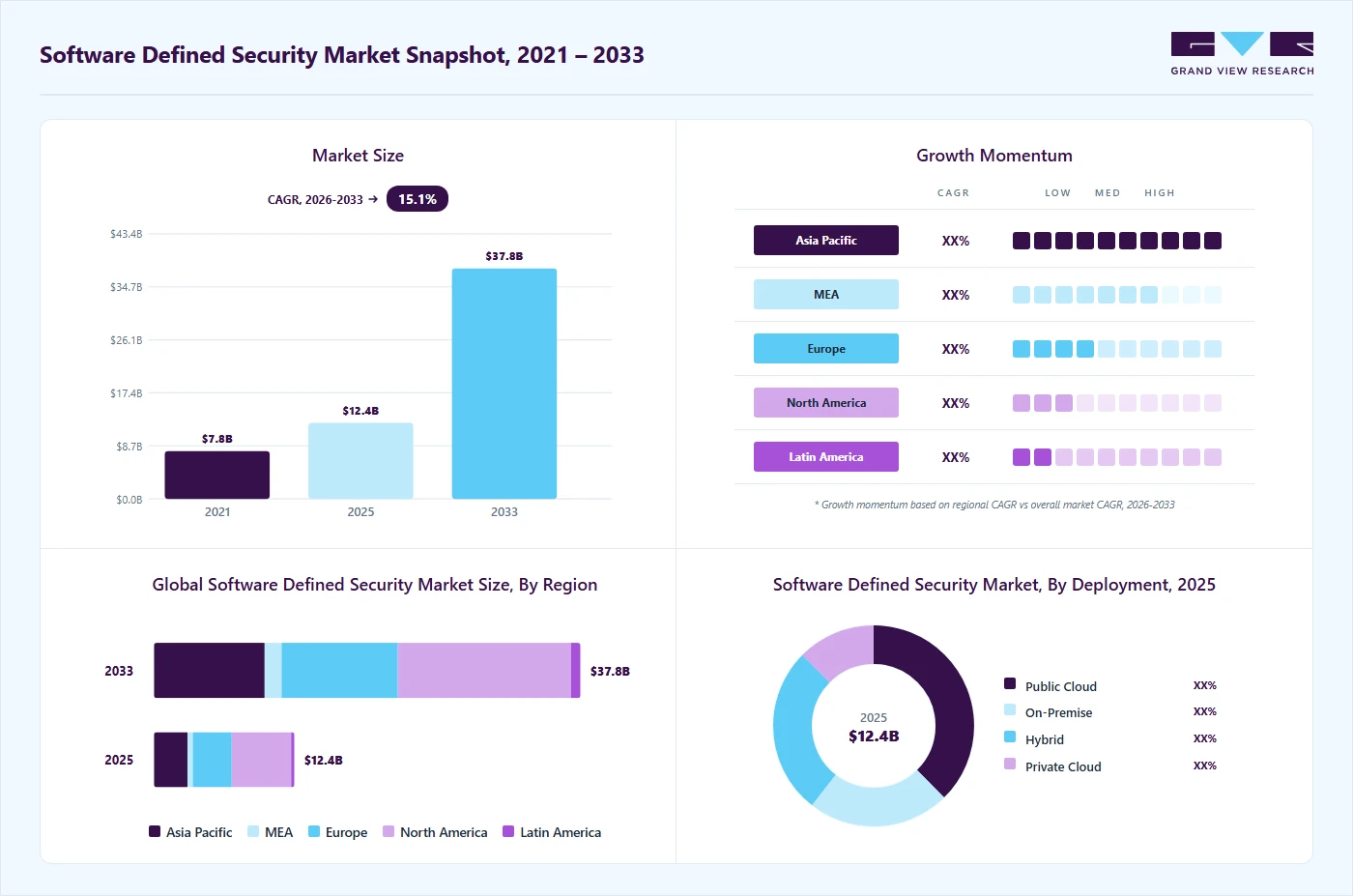
The global software defined security market size was valued at USD 12.4 billion in 2025 and is projected to grow from USD 14.1 billion in 2026 to USD 37.8 billion by 2033, at a CAGR of 15.1% from 2026 to 2033. The North America held the largest share of 42.3% of the global market in 2025. As organizations shift toward highly virtualized, cloud-based, and software-centric IT infrastructures.
 Source: Grand View Research, IR Documents, Primary Interviews, Paid DatabasesTo learn more about this report,
 Download Free Sample Report
 Key Market Trends & Insights
- By component: Solution led the market and held the largest revenue share of 66.0% in 2025.
- By deployment: Public cloud segment accounted for the largest revenue share in 2025.
- By end-use: Healthcare segment is expected to grow at the fastest CAGR from 2026 to 2033.
Regional Highlights
- Largest regional market: North America (42.3% revenue share, 2025)
- Fastest-growing regional market: Asia Pacific (highest CAGR, 2026-2033)
- By country: The U.S. led the North America market in 2025.
Market Size & Forecast
- Market size in 2025: USD 12.4 Billion
- Estimated market size in 2026: USD 14.1 Billion
- Projected market size by 2033: USD 37.8 Billion
- CAGR (2026-2033): 15.1%
GVR research-powered AIAsk Prism AI about the software defined security marketGet cited answers from GVR research on market growth, segments, regulations and forecasts.Start with✓ Source-linked answers ✓ Market-specific context ✓ Traceable figuresExplore Prism AI ↗
Traditional hardware-based security architectures struggle to keep pace with dynamic workloads and distributed environments, prompting enterprises to adopt software-defined approaches that deliver security through programmable policies and centralized management. SDSec solutions allow organizations to dynamically configure security controls, automate threat responses, and integrate security across virtual machines, containers, and hybrid cloud environments. As enterprises pursue digital transformation and software-defined networking (SDN), the demand for security frameworks that can scale and adapt in real time is significantly increasing.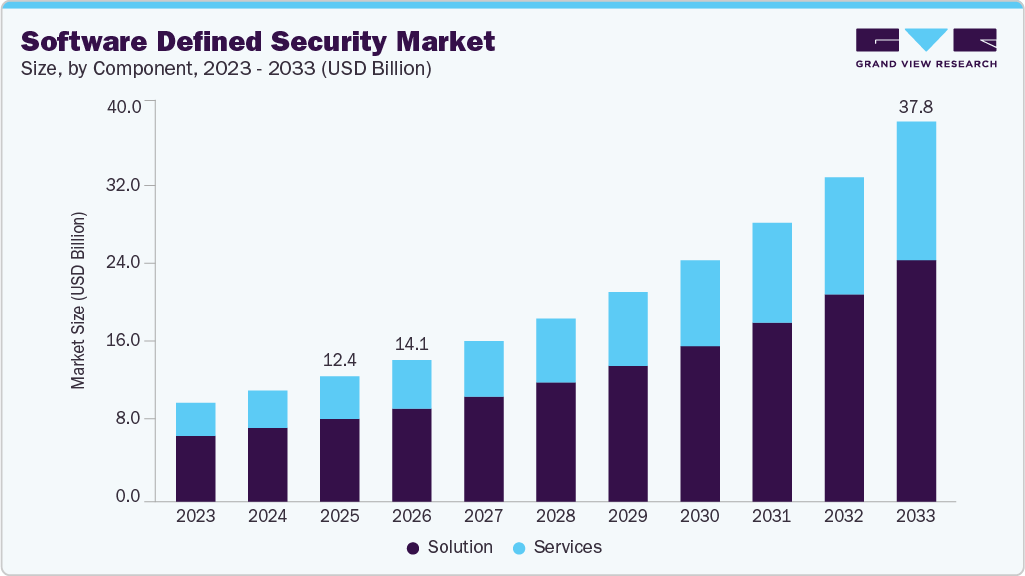 To learn more about this report, Download Free Sample Report
 The rapid expansion of cloud computing and hybrid/multi-cloud environments is contributing to the growth in the software defined security industry. Organizations are increasingly deploying workloads across public clouds, private clouds, and edge environments, which creates complex and fragmented security requirements. Software-defined security platforms provide centralized visibility, policy orchestration, and automated protection across multiple environments without relying on dedicated hardware appliances. This flexibility allows IT teams to implement consistent security policies, protect cloud-native applications, and maintain compliance across geographically distributed infrastructure, driving widespread adoption of SDS technologies.
The rising sophistication and frequency of cyberattacks are also accelerating demand for software-defined security solutions. Advanced persistent threats, ransomware, and zero-day vulnerabilities require more agile and intelligent defense mechanisms than traditional perimeter-based security models. SDS solutions integrate advanced capabilities such as micro-segmentation, real-time analytics, AI-driven threat detection, and automated response mechanisms. These capabilities enable organizations to isolate compromised systems quickly, limit lateral movement within networks, and respond to threats in real time, significantly strengthening overall cyber resilience.
Component Insights
The solution segment dominated the market and accounted for the revenue share of 66.0% in 2025. The rising frequency and complexity of cyberattacks, including ransomware, zero-day exploits, and advanced persistent threats, are driving organizations to adopt advanced security solutions. Traditional hardware-based security systems often struggle to detect and respond to evolving threats in dynamic IT environments. Software-Defined Security (SDS) solutions address this challenge by using technologies such as artificial intelligence, behavioral analytics, and automated threat detection to continuously monitor networks and workloads. These capabilities enable real-time threat identification, faster response, and improved incident management. As cyber risks continue to increase, organizations are increasingly relying on SDS solutions to strengthen their overall cybersecurity posture.
The services segment is anticipated to grow at the highest CAGR during the forecast period due to the increasing complexity of modern IT infrastructures. Organizations are adopting hybrid cloud, multi-cloud platforms, containers, and virtualized networks, which require advanced security management. Many enterprises lack the internal expertise to design and maintain such environments. As a result, they rely on professional services providers for consulting, system integration, deployment, and ongoing support to ensure effective implementation and management of SDS solutions.
Deployment Insights
The public cloud segment dominated the market and accounted for the largest revenue share in 2025. Organizations across industries are shifting applications, databases, and business processes to public cloud environments to benefit from scalability, flexibility, and cost efficiency. However, this transition also increases security challenges due to distributed workloads and shared infrastructure. Software-Defined Security solutions help address these issues by enabling centralized policy management, real-time monitoring, and automated threat detection. These capabilities ensure secure access, protect cloud workloads, and maintain consistent security controls across dynamic and distributed public cloud environments.
The hybrid segment is expected to grow at a significant CAGR during the forecast period. Organizations are increasingly adopting multi-cloud strategies to improve operational resilience and avoid dependence on a single cloud provider. Hybrid cloud environments often combine multiple public cloud platforms with private infrastructure, creating complex and distributed IT ecosystems. Software-Defined Security solutions help address these challenges by providing unified visibility, centralized policy management, and consistent security controls. This ensures secure communication, better monitoring, and effective threat protection across diverse and interconnected cloud environments.
Enforcement Point Insights
The network security segment dominated the market and accounted for the largest revenue share in 2025. The increasing adoption of software-defined networking (SDN) in enterprise data centers and telecom networks is a key driver for the network security segment in the Software-Defined Security market. SDN separates the control plane from the data plane, enabling centralized management of network resources. This architecture allows organizations to deploy flexible and scalable security policies across their networks. Software-defined security platforms integrate with SDN environments to provide real-time traffic monitoring, dynamic policy enforcement, and automated threat detection. These capabilities help organizations strengthen network protection while improving visibility, operational efficiency, and response to evolving cyber threats.
The cloud & container security segment is expected to grow at a significant CAGR during the forecast period. The growing adoption of containers and Kubernetes orchestration platforms is driving demand for advanced container security solutions. Containers are highly dynamic and can scale quickly, which increases the complexity of managing security across workloads. Software-Defined Security platforms help address these challenges by providing runtime protection, vulnerability scanning, and identity-based access controls. These capabilities enable organizations to secure containerized applications, detect potential threats early, and maintain consistent security policies in rapidly changing cloud-native environments.
End Use Insights
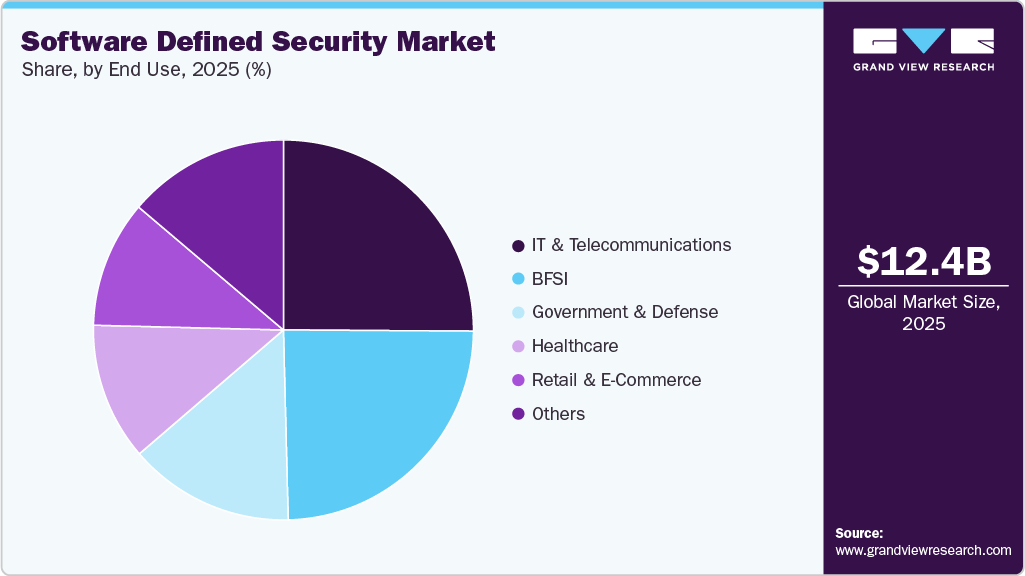
The IT & telecommunications segment dominated the market and accounted for the largest revenue share in 2025. IT service providers and telecom companies are rapidly expanding cloud platforms, hyperscale data centers, and edge computing infrastructure to support growing digital services and high data traffic. These large and distributed environments increase the complexity of managing network security and protecting critical workloads. Software-Defined Security solutions help address these challenges by offering centralized policy management, automated threat detection, and real-time monitoring across interconnected systems. By providing consistent security controls across cloud, data center, and edge environments, SDS platforms enable telecom and IT providers to maintain strong cybersecurity while ensuring reliable and scalable network operations.
 To learn more about this report, Download Free Sample Report
 The healthcare segment is expected to grow at a significant CAGR over the forecast period. Hospitals and healthcare providers are increasingly adopting electronic health records (EHR), telemedicine platforms, and digital patient management systems to improve care delivery and operational efficiency. These technologies generate and store large volumes of sensitive patient data, making healthcare organizations prime targets for cyber threats. Software-Defined Security solutions help address these risks by enabling secure access controls, continuous monitoring, and centralized policy management, ensuring the protection of patient information and maintaining data integrity across healthcare systems.
Regional Insights
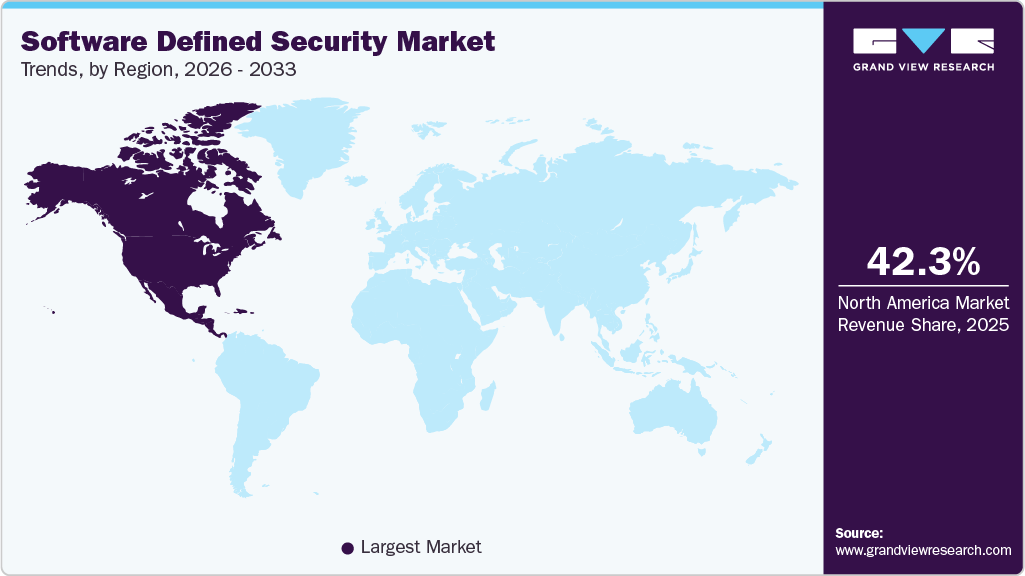
North America software defined security market dominated the global market with the largest revenue share of 42.3% in 2025. Organizations in North America are rapidly adopting cloud computing, hybrid cloud environments, and digital transformation strategies. Enterprises across industries are migrating workloads to cloud platforms, increasing the need for software-defined security solutions that provide centralized policy management, workload protection, and secure access across distributed infrastructures.
 To learn more about this report, Download Free Sample Report
 U.S. Software Defined Security Market Trends
The software defined security market in the U.S. is expected to grow significantly at a CAGR of 14.2% from 2026 to 2033. The U.S. hosts several leading cybersecurity companies and technology innovators, including Cisco Systems, Palo Alto Networks, Fortinet, and IBM. The presence of these vendors accelerates innovation, product development, and adoption of advanced SDS platforms across enterprises and government organizations.
Europe Software Defined Security Market Trends
The software defined security market in Europe is anticipated to register considerable growth from 2026 to 2033. European organizations are experiencing a rising number of ransomware attacks, phishing campaigns, and advanced cyber threats. Industries such as BFSI, healthcare, and government are particularly vulnerable. SDS solutions help organizations enhance network visibility, implement micro-segmentation, and automate threat detection to protect critical systems.
The UK software defined security market is expected to grow rapidly in the coming years. The rollout of 5G networks and software-defined networking (SDN) across the UK telecom sector is creating demand for flexible and scalable security frameworks. SDS platforms enable telecom operators to secure virtualized network environments and edge infrastructure.
The software defined security market in Germany held a substantial market share in 2025. German enterprises are increasingly adopting cloud computing and hybrid IT environments to improve operational efficiency and scalability. SDS platforms provide unified security policies and real-time monitoring across on-premise infrastructure and cloud workloads, supporting secure digital transformation.
Asia Pacific Software Defined Security Market Trends
The software defined security market in Asia Pacific held a significant share in the global market in 2025. Countries such as China, India, Japan, and South Korea are experiencing rapid digital transformation across industries, including finance, retail, telecom, and manufacturing. As organizations modernize their IT infrastructure and adopt digital platforms, the need for scalable and flexible security frameworks like SDS continues to grow.
The Japan software defined security market is expected to grow rapidly in the coming years. Japan has witnessed rising cybersecurity threats, including ransomware attacks and data breaches, targeting critical sectors such as finance, healthcare, and government. SDS platforms provide real-time threat detection, network segmentation, and automated response capabilities to strengthen cybersecurity defenses.
The software defined security market in China held a substantial share in 2025. China is witnessing significant growth in cloud computing, hyperscale data centers, and digital platforms. Enterprises are increasingly migrating workloads to cloud environments, creating demand for software-defined security solutions that can provide centralized policy management and protection across distributed infrastructures.
Key Software Defined Security Company Insights
Key players operating in the software defined security industry are Cisco Systems, Inc., Palo Alto Networks, Inc., Fortinet, Inc., Check Point Software Technologies Ltd., VMware, Inc. (Broadcom), Juniper Networks, Inc., IBM Corporation, Intel Corporation, Trend Micro Inc., Microsoft Corporation, Oracle Corporation, Zscaler, Inc., Akamai Technologies, Inc., Netskope, Inc., and Illumio, Inc. The companies are focusing on various strategic initiatives, including new product development, partnerships & collaborations, and agreements to gain a competitive advantage over their rivals. The following are some instances of such initiatives.
-
In May 2025, Network Innovations launched Argus, a software-defined security platform designed to simplify and secure communications across complex networks. The platform integrates multiple connectivity technologies, including satellite, wireless, and terrestrial networks, into a unified system. Argus provides centralized orchestration with features such as real-time monitoring, policy enforcement, and service analytics. It also supports multi-path SD-WAN capabilities for intelligent traffic routing and failover. This approach improves network visibility, security, and operational efficiency for organizations operating across distributed communication environments.
-
In April 2025, Darktrace expanded its Network Detection and Response (NDR) capabilities to help enterprises secure modern, distributed environments and remote workforces. The update enhances network visibility, autonomous threat response, and proactive risk management. It also integrates with Secure Access Service Edge (SASE) and Zero Trust Network Access (ZTNA) technologies to improve detection of emerging threats across cloud services, remote devices, and enterprise networks.
Key Software Defined Security Companies:
The following key companies have been profiled for this study on the software defined security market.
- Akamai Technologies, Inc.
- Check Point Software Technologies Ltd.
- Cisco Systems, Inc.
- Fortinet, Inc.
- IBM Corporation
- Illumio, Inc.
- Intel Corporation
- Juniper Networks, Inc.
- Microsoft Corporation
- Netskope, Inc.
- Oracle Corporation
- Palo Alto Networks, Inc.
- Trend Micro Inc.
- VMware, Inc. (Broadcom)
- Zscaler, Inc.
Software Defined Security Market Report Scope
Report Attribute
Details
Market size in 2025
USD 12.4 billion
Market size in 2026
USD 14.07 billion
Revenue forecast in 2033
USD 37.76 billion
Growth rate
CAGR of 15.1% from 2026 to 2033
Actual data
2021 - 2025
Forecast period
2026 - 2033
Quantitative units
Revenue in USD million/billion and CAGR from 2026 to 2033
Report enterprise size
Revenue forecast, company share, competitive landscape, growth factors, and trends
Segments covered
Component, deployment, enforcement point, end use, region
Regional scope
North America; Europe; Asia Pacific; Latin America; MEA
Country scope
U.S.; Canada; Mexico; UK; Germany; France; China; India; Japan; Australia; South Korea; Brazil; UAE; Kingdom of Saudi Arabia; South Africa
Key companies profiled
Akamai Technologies, Inc.; Check Point Software Technologies Ltd.; Cisco Systems, Inc.; Fortinet, Inc.; IBM Corporation; Illumio, Inc.; Intel Corporation; Juniper Networks, Inc.; Microsoft Corporation; Netskope, Inc.; Oracle Corporation; Palo Alto Networks, Inc.; Trend Micro Inc.; VMware, Inc. (Broadcom); Zscaler, Inc.
Customization scope
Free report customization (equivalent to 8 analysts working days) with purchase. Addition or alteration to country, regional & segment scope.
Pricing and purchase options
Avail customized purchase options to meet your exact research needs. Explore purchase options
Software Defined Security Market Report Segmentation
This report forecasts revenue growth at the global, regional, and country levels and provides an analysis of the latest industry trends in each of the sub-segments from 2021 to 2033. For this study, Grand View Research has segmented the global software defined security market report based on component, deployment, enforcement point, end use, and region.
-
Component Outlook (Revenue, USD Billion, 2021 - 2033)
-
Solutions
-
Services
-
-
Deployment Outlook (Revenue, USD Billion, 2021 - 2033)
-
Public Cloud
-
Private Cloud
-
On-premise
-
Hybrid Cloud
-
-
Enforcement Point Outlook (Revenue, USD Billion, 2021 - 2033)
-
Network Security
-
Endpoint Security
-
Application Security
-
Cloud & Container Security
-
Others
-
-
End Use Outlook (Revenue, USD Billion, 2021 - 2033)
-
BFSI
-
IT & Telecommunications
-
Government & Defense
-
Healthcare
-
Retail & E-Commerce
-
Others
-
-
Regional Outlook (Revenue, USD Billion, 2021 - 2033)
-
North America
-
U.S.
-
Canada
-
Mexico
-
-
Europe
-
UK
-
Germany
-
France
-
-
Asia Pacific
-
China
-
India
-
Japan
-
South Korea
-
Australia
-
-
Latin America
-
Brazil
-
-
Middle East & Africa
-
UAE
-
Saudi Arabia
-
South Africa
-
-
Frequently Asked Questions About This Report
Asia Pacific is the fastest-growing region over the forecast period.
The solution segment led with a 66.0% revenue share in 2025, while services is the fastest-growing component.
The public cloud segment held the largest revenue share in 2025.
The IT & telecommunications segment led the market with the largest revenue share in 2025.
Network security segment dominated the market and accounted for the largest share in 2025.
Key players include Akamai Technologies, Inc.; Check Point Software Technologies Ltd.; Cisco Systems, Inc.; Fortinet, Inc.; IBM Corporation; Illumio, Inc.; Intel Corporation; Juniper Networks, Inc.; Microsoft Corporation; Netskope, Inc.; Oracle Corporation; Palo Alto Networks, Inc.; Trend Micro Inc.; VMware, Inc. (Broadcom); Zscaler, Inc.
The global software defined security market size was valued at USD 12.4 billion in 2025 and is estimated at USD 14.1 billion for 2026.
The global software defined security market is expected to grow at a CAGR of 15.1% from 2026 to 2033, reaching USD 37.8 billion by 2033.
North America dominated the global market with the largest revenue share of 42.3% in 2025. Organizations in North America are rapidly adopting cloud computing, hybrid cloud environments, and digital transformation strategies. Enterprises across industries are migrating workloads to cloud platforms, increasing the need for software-defined security solutions that provide centralized policy management, workload protection, and secure access across distributed infrastructures.
The global software defined security market is driven by key factors such as organizations shift toward highly virtualized, cloud-based, and software-centric IT infrastructures. Traditional hardware-based security architectures struggle to keep pace with dynamic workloads and distributed environments, prompting enterprises to adopt software-defined approaches that deliver security through programmable policies and centralized management.
About the Author(s)
Next Generation Technologies Research Team
Technology · Next Generation TechnologiesThis report was authored by the next generation technologies research team at Grand View Research - comprising two research analysts, one senior research analyst, and one industry expert - with specialized expertise in the next generation technologies segment of the technology industry. All findings are based on proprietary technology databases, executive interviews, and regulatory analysis, subject to internal peer review prior to publication.
Last Updated:
Speak to Analyst

Customize this report to your needs - add regions, segments, or data points, with 20% free customization.
Or view our licence options:


ISO 9001:2015 & 27001:2022 Certified
We are GDPR and CCPA compliant! Your transaction & personal information is safe and secure. For more details, please read our privacy policy.


