
- Home
- »
- Advanced Interior Materials
- »
-
Soil Remediation Equipment Market, Industry Report, 2033GVR Report cover
![Soil Remediation Equipment Market Size, Share & Trends Report]()
Soil Remediation Equipment Market (2026 - 2033) Size, Share & Trends Analysis Report By Type (Excavation Equipment, Separation Equipment, Stabilization Equipment, Decontamination Equipment), By Method, By Remediation Process, By Application, By Region And Segment Forecasts
- Report ID: GVR-4-68040-874-2
- Number of Report Pages: 100
- Format: PDF
- Historical Range: 2021 - 2024
- Forecast Period: 2026 - 2033
- Industry: Advanced Materials
- Report Summary
- Table of Contents
- Segmentation
- Methodology
- Download FREE Sample
-
 Download Sample Report
Soil Remediation Equipment Market Summary
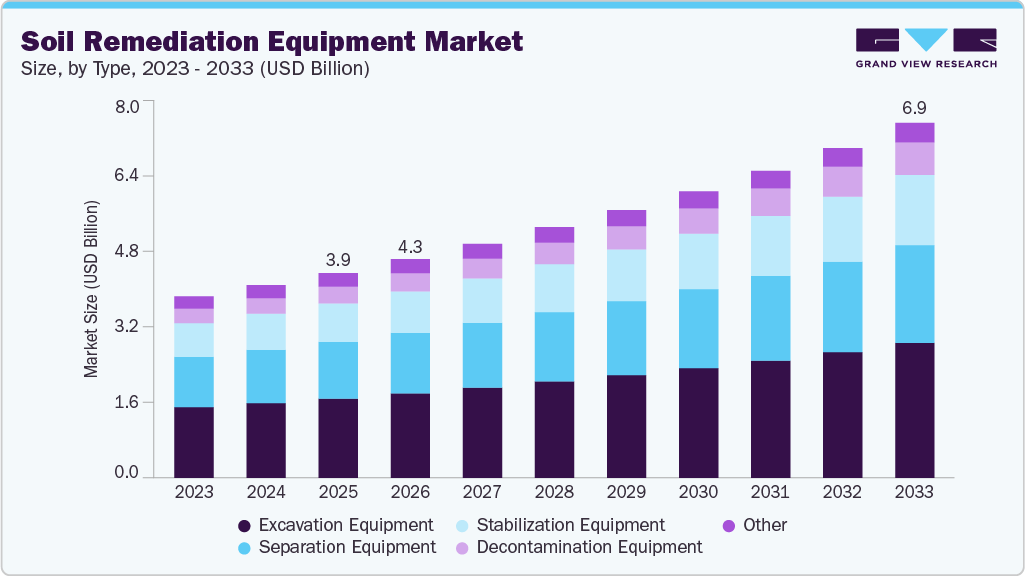
The global soil remediation equipment market size was estimated at USD 3,984.0 million in 2025 and is projected to reach USD 6,913.3 million by 2033, growing at a CAGR of 7.2% from 2026 to 2033. Strict environmental regulations and growing concerns about soil contamination are key drivers of the market.
Key Market Trends & Insights
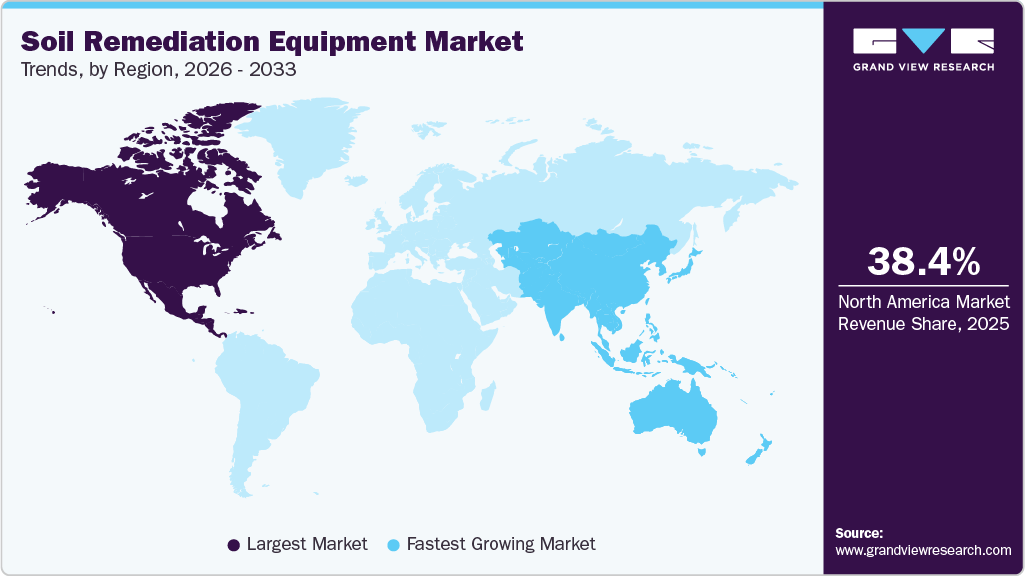
- North America held the dominating position with 38.4% share in 2025.
- The decontamination equipment segment is projected to register a CAGR of 8.6% from 2026 to 2033 in terms of revenue.
- Based on the remediation process, the chemical remediation segment is expected to record a CAGR of 7.8% from 2026 to 2033.
- By application, the industrial site segment led the soil remediation equipment market and accounted for 40.3% share in 2025.
Market Size & Forecast
- 2025 Market Size: USD 3,984.0 Million
- 2033 Projected Market Size: USD 6,913.3 Million
- CAGR (2026-2033): 7.2%
- North America: Largest market in 2025
- Asia Pacific: Fastest growing market
Governments across many countries have introduced stricter policies to manage contaminated land resulting from industrial activities, mining, chemical spills, and improper waste disposal. Another important driver is the growing focus on land restoration and sustainable environmental management. Rapid industrialization and urban expansion have led to a rise in contaminated industrial sites and brownfield areas that require remediation before they can be safely used for agriculture, construction, or infrastructure projects. As a result, industries and public authorities are investing in advanced remediation technologies such as soil washing, thermal treatment, and bioremediation systems, which are supporting the demand for specialized soil remediation equipment.Market Concentration & Characteristics
The soil remediation equipment industry is fragmented, with numerous specialized companies manufacturing systems such as soil vapor extraction units, soil washing plants, and thermal desorption equipment. Most manufacturers focus on specific remediation technologies or customized solutions for contaminated sites. The presence of many small- and mid-sized equipment suppliers across regions limits market concentration, resulting in a competitive, technologically diverse industry landscape.
The market shows steady technological progress as manufacturers and research institutions work on more effective and environmentally sustainable remediation methods. Companies are developing advanced systems such as thermal treatment units, soil washing plants, and automated soil vapor extraction equipment to improve contaminant removal and reduce cleanup time. Innovation is also expanding into biological and nature-based remediation approaches. For example, a spinout from Imperial College London, RemePhy, has developed a technology that uses specially selected plants and microbes to absorb heavy metals from contaminated soil, offering a more efficient approach to phytoremediation.
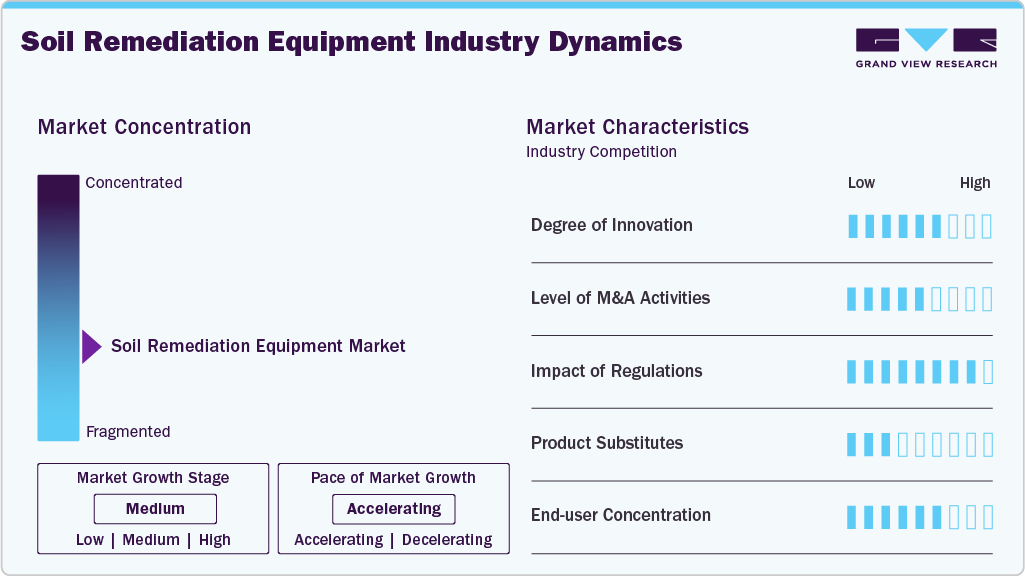
Environmental regulations significantly influence the demand for soil remediation equipment. Governments across many regions have established strict policies for managing contaminated land, industrial pollution, and hazardous waste. These rules require companies to clean up polluted sites before land can be reused or redeveloped. As a result, industries are increasingly adopting specialized remediation equipment to meet regulatory requirements and ensure environmental safety.
The demand for soil remediation equipment is mainly driven by a limited group of industrial and public-sector users. Key end users include industries such as oil and gas, mining, chemical manufacturing, and waste management, where soil contamination risks are relatively high. In addition, government agencies and construction companies involved in brownfield redevelopment projects also require remediation technologies. Because large-scale cleanup projects are often handled by these sectors, the market’s end-user base remains relatively concentrated.
Drivers, Opportunities & Restraints
Rising concerns about soil contamination and the growing need for environmental restoration are major drivers of the soil remediation equipment market. Industrial activities, mining operations, oil spills, and improper waste disposal have increased the number of contaminated sites worldwide. Governments and environmental agencies are implementing stricter regulations for land cleanup and pollution control, which is encouraging industries to adopt advanced remediation equipment to treat contaminated soil and restore affected land.
Increasing investments in brownfield redevelopment and sustainable land management are creating new opportunities for the industry. Many countries are focusing on converting contaminated industrial sites into usable land for infrastructure, commercial, or residential development. This trend is boosting the demand for efficient soil treatment technologies such as soil washing systems, thermal desorption units, and biological remediation equipment, opening growth opportunities for equipment manufacturers.
High installation and operational costs of remediation equipment remain a key challenge for the market. Advanced soil treatment technologies often require significant capital investment, specialized expertise, and ongoing maintenance, which can limit adoption among smaller companies and developing regions. In addition, remediation projects can be technically complex and time-consuming, further increasing overall project costs and slowing market growth in certain areas.
Type Insights
Excavation equipment accounted for the largest share of the global market, holding 38.7% share in 2025, as it is widely used in remediation projects that require the removal of contaminated soil from affected sites. This equipment plays a critical role in ex-situ remediation processes, where polluted soil must be excavated and transported for further treatment or disposal. The widespread use of excavation machinery in large-scale industrial cleanup projects, construction site remediation, and brownfield redevelopment has supported the strong demand for this equipment segment.
The decontamination equipment segment is expected to witness the fastest growth during the forecast period, with an 8.6% CAGR, driven by the increasing adoption of advanced technologies for on-site soil treatment. These systems are designed to remove or neutralize contaminants such as heavy metals, hydrocarbons, and hazardous chemicals without the need for extensive soil removal. Growing environmental regulations and the need for more efficient, sustainable remediation solutions are encouraging industries to invest in advanced decontamination equipment.
Method Insights
Ex-situ remediation accounted for the largest share, accounting for 63.3% share in 2025, as it is widely used to treat heavily contaminated soil that requires removal from the site for effective cleanup. This method involves excavating polluted soil and transporting it to treatment facilities where processes such as soil washing, thermal treatment, or chemical treatment are carried out.
In-situ remediation is expected to register the fastest growth during the forecast period, growing at a CAGR of 7.8%, due to its cost efficiency and minimal site disturbance. This method treats contaminated soil directly at the site without the need for excavation, reducing transportation costs and environmental disruption. The increasing adoption of technologies such as soil vapor extraction, bioremediation, and chemical injection systems is driving the growth of in-situ remediation, particularly for projects focused on sustainable, less invasive cleanup approaches.
Remediation Process Insights
Physical remediation process accounted for the largest share of 45.7% share in 2025, as it includes widely used techniques such as soil vapor extraction, soil washing, and excavation. These methods physically remove or separate contaminants from soil, making them highly effective for treating petroleum hydrocarbons, volatile organic compounds, and other pollutants. The strong adoption of physical remediation processes in large industrial cleanup projects and contaminated site restoration has supported the dominance of this segment.
Chemical remediation is expected to be the fastest-growing segment during the forecast period at a CAGR of 7.8%, owing to its ability to rapidly neutralize or transform hazardous contaminants in soil. This process uses chemical agents, such as oxidants or stabilizing compounds, to break down or immobilize pollutants directly in the soil. The increasing use of in-situ chemical oxidation and stabilization technologies, along with the need for faster and more efficient soil treatment solutions, is driving the growth of chemical remediation in remediation projects.
Application Insights
Industrial sites accounted for the largest share of the market, registering 40.3% in 2025, due to the high risk of soil contamination associated with manufacturing activities, chemical processing, mining, and oil and gas operations. These industries often generate pollutants, such as hydrocarbons, heavy metals, and hazardous chemicals, which can accumulate in soil over time. As a result, large-scale remediation projects are frequently required to restore contaminated industrial land and ensure compliance with environmental regulations.
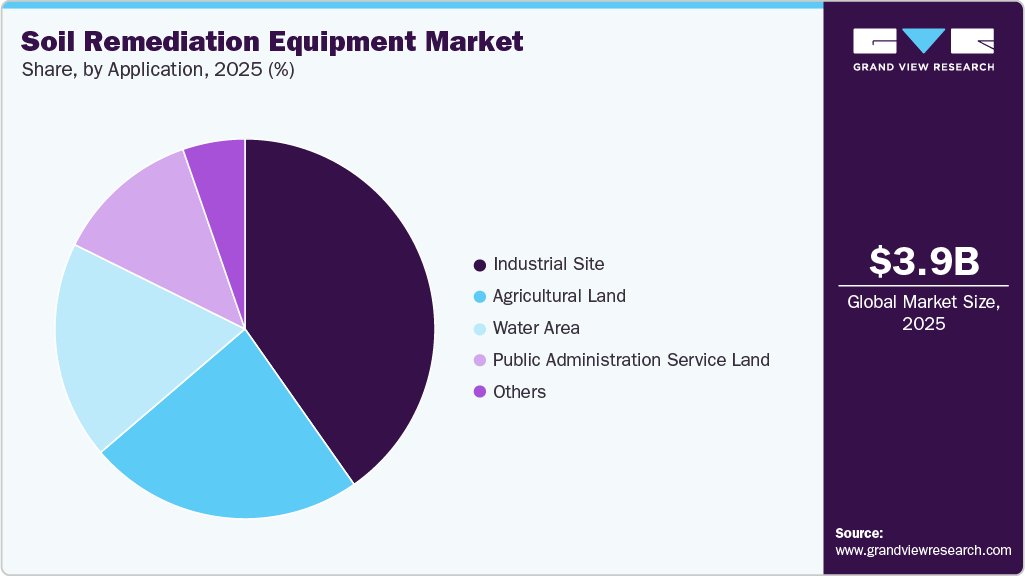
Agricultural land is expected to be the fastest-growing application segment with a CAGR of 8.0% over the forecast period, as concerns over soil health and food safety increase. According to the Food and Agriculture Organization (FAO), global agricultural land reached about 4,800 million hectares in 2023, including 1,600 million hectares of cropland and 3,200 million hectares of permanent meadows and pastures. The large scale of agricultural land and rising focus on soil quality are supporting the growing adoption of soil remediation technologies.
Regional Insights
The soil remediation equipment industry in North America accounted for the largest share, contributing 38.4% share towards the global market in 2025, supported by strong environmental enforcement and extensive remediation activities across the U.S. and Canada. Many contaminated industrial sites and legacy pollution areas require cleanup before redevelopment, particularly under environmental programs focused on brownfield restoration. The presence of advanced remediation technologies and well-established environmental monitoring systems has also supported the region’s market leadership.
U.S. Soil Remediation Equipment Market Trends
The soil remediation equipment industry in the U.S. dominated the market in North America due to extensive environmental cleanup programs and strict land contamination regulations. Federal agencies actively support the restoration of polluted industrial and hazardous sites through initiatives such as the United States Environmental Protection Agency Superfund and Brownfields programs. In addition, according to the United States Department of Agriculture (USDA), the Agriculture and Interior Departments announced USD 2.8 billion in investments to protect public lands and strengthen conservation efforts across the United States, further supporting environmental restoration activities and the demand for remediation equipment.
The Canada soil remediation equipment industry is witnessing steady growth, underpinned by increasing efforts to manage contaminated industrial land and legacy mining sites. Government initiatives focused on environmental protection, land restoration, and sustainable resource management are encouraging remediation projects across several provinces. These efforts, along with growing awareness of soil contamination risks, are contributing to rising demand for soil remediation equipment in the country.
Europe Soil Remediation Equipment Market Trends
The soil remediation equipment industry in Europe is experiencing steady growth due to strict environmental regulations and strong sustainability initiatives. Several European countries are actively addressing contaminated industrial land and former mining sites through large-scale remediation programs. Policies promoting environmental protection and sustainable land use are encouraging the adoption of advanced remediation technologies.
The Germany soil remediation equipment industry is witnessing steady growth, supported by strict environmental regulations and increasing redevelopment of former industrial land. Brownfield redevelopment has become a key trend as these sites often have established transport, energy, and broadband infrastructure, making them suitable for modern logistics developments. For example, GARBE Industrial Real Estate reported that more than 50% of new logistics properties developed in Germany in the first half of 2025 were built on brownfield sites. This growing reuse of previously developed land is increasing the need for soil remediation activities before redevelopment projects begin.
The soil remediation equipment industry in the UK is also expanding, bolstered by increasing efforts to redevelop contaminated industrial land and former manufacturing sites. Environmental regulations and land regeneration programs aimed at restoring brownfield areas for residential and commercial development are driving remediation activities. Growing focus on environmental sustainability and urban redevelopment is further contributing to the demand for soil remediation equipment in the country.
Asia Pacific Soil Remediation Equipment Market Trends
The soil remediation equipment industry in the Asia Pacific is expected to register the fastest growth during the forecast period due to rapid industrialization, urban expansion, and increasing awareness of environmental protection. Countries such as China, India, and Japan are strengthening policies to control soil pollution and restore land. Growing investments in industrial site cleanup and government-led initiatives to address contaminated land are driving demand for remediation equipment across the region.
The China soil remediation equipment industry dominates the Asia Pacific region due to the large number of contaminated industrial and mining sites and strong government efforts to address soil pollution. The country has introduced strict soil pollution control policies and national action plans to restore contaminated farmland and industrial land. Increasing investments in environmental protection projects and large-scale land remediation programs are driving the demand for soil remediation equipment across the country.
The soil remediation equipment industry in India is witnessing growing demand due to rising concerns over soil contamination caused by rapid industrialization, mining activities, and excessive use of agrochemicals. The government has been strengthening environmental regulations and promoting initiatives to restore land and promote sustainable agricultural practices. In addition, increasing infrastructure development and industrial site redevelopment projects are contributing to the market growth in the country.
Middle East & Africa Soil Remediation Equipment Market Trends
The soil remediation equipment industry in the Middle East & Africa region is witnessing gradual growth, largely driven by environmental concerns linked to oil and gas operations, mining activities, and industrial development. Governments in several countries are introducing initiatives to manage contaminated land and improve environmental sustainability. For instance, The United Nations allocated USD 3 billion to remediate 114 km² of oil-contaminated soil in Kuwait caused by the Gulf War oil fires, through a joint venture between Lamor Corporation and Khalid Ali Al-Kharafi & Bros. Co. for soil remediation using bioremediation and soil washing technologies.
The Saudi Arabia soil remediation equipment industry is witnessing gradual growth, primarily driven by environmental concerns related to oil and gas operations, industrial activities, and infrastructure development. The country is increasingly focusing on environmental protection and sustainable land management as part of long-term development initiatives such as Saudi Vision 2030. Efforts to manage industrial pollution, restore contaminated land, and support large-scale construction and urban development projects are contributing to the growing demand for soil remediation equipment in the country.
Latin America Soil Remediation Equipment Market Trends
The soil remediation equipment industry in Latin America is gradually expanding, supported by increasing environmental monitoring and remediation efforts in sectors such as mining, oil and gas, and agriculture. Countries, including Brazil and Argentina, are strengthening environmental policies and investing in contaminated land management. Growing industrial development and rising awareness of soil pollution are contributing to market growth.
The Brazil soil remediation equipment industry is experiencing gradual growth due to increasing environmental monitoring and land restoration efforts across industrial and mining regions. The country has a large mining sector and expanding industrial activities, raising concerns about soil contamination and environmental impacts. Strengthening environmental regulations and growing investments in contaminated land management and site restoration projects are contributing to the rising demand for soil remediation equipment in Brazil.
Key Soil Remediation Equipment Company Insights
Some of the key players operating in the market include Geotech Environmental Equipment, Inc., PRM Filtration, and Newterra.
-
Geotech Environmental Equipment, Inc. is a U.S.-based manufacturer specializing in environmental monitoring and remediation equipment. The company develops a range of products used in groundwater sampling, soil monitoring, and hydrocarbon recovery from contaminated sites. Its portfolio includes systems such as groundwater pumps, hydrocarbon recovery units, soil vapor extraction equipment, and water quality monitoring instruments. These solutions are widely used by environmental consultants, government agencies, and industrial operators for site investigation, contamination monitoring, and soil and groundwater remediation projects.
-
PRM Filtration is a U.S.-based company that manufactures environmental filtration and remediation equipment. The company develops systems used for treating contaminated air, soil, and water in environmental and industrial applications. Its product range includes soil vapor extraction systems, air sparging equipment, carbon filtration units, air strippers, oil-water separators, and various treatment components used in remediation projects. These systems are widely used in landfill management, groundwater treatment, and environmental cleanup operations.
Key Soil Remediation Equipment Companies:
The following key companies have been profiled for this study on the soil remediation equipment market.
- Geotech Environmental Equipment, Inc.
- PRM Filtration
- Newterra
- ESD Waste2Water, Inc.
- EPG Companies Inc.
- Remediation Service International (RSI)
- pdblowers, Inc.
- Geiger Pump & Equipment Company
- Tarmac International Inc.
- Matec Industries S.r.l.
Recent Developments
-
In April 2025, TerraVolt Soil Remediation announced a new phase of growth with a rebranding initiative, updated leadership, and a USD 3.1 million funding effort. The company plans to commercialize its electrokinetic soil treatment technology and conduct a pilot demonstration in 2025. The investment will support further technology development and expansion of soil remediation solutions across North America.
-
In September 2025, news reports suggested that The Kuwait Soil Remediation Program was progressing steadily, with over 8 million tons of contaminated soil treated so far. The initiative aims to restore land damaged by oil spills during the 1991 Gulf War and plans to treat nearly 26 million m³ of contaminated soil. Advanced technologies such as soil washing plants are being used to process large volumes of polluted soil. The project is expected to play a significant role in restoring affected desert ecosystems and improving environmental conditions in Kuwait.
Soil Remediation Equipment Market Report Scope
Report Attribute
Details
Market size value in 2026
USD 4,257.1 million
Revenue forecast in 2033
USD 6,913.3 million
Growth rate
CAGR of 7.2% from 2026 to 2033
Base year for estimation
2025
Historical data
2021 - 2024
Forecast period
2026 - 2033
Quantitative units
Revenue in USD million and CAGR from 2026 to 2033
Report coverage
Revenue forecast, company ranking, competitive landscape, growth factors, and trends
Segments covered
Type, method, remediation process, application, region
Regional scope
North America; Europe; Asia Pacific; Latin America; Middle East & Africa
Country scope
U.S.; Canada; Mexico; UK; Germany; France; Spain; Italy; China; Japan; India; Australia; South Korea; Brazil; Argentina; Saudi Arabia; South Africa; UAE
Key companies profiled
Geotech Environmental Equipment, Inc.; PRM Filtration; Newterra; ESD Waste2Water, Inc.; EPG Companies Inc.; Remediation Service International (RSI); pdblowers, Inc.; Geiger Pump & Equipment Company; Tarmac International Inc.; Matec Industries S.r.l.
Customization scope
Free report customization (equivalent up to 8 analysts working days) with purchase. Addition or alteration to country, regional & segment scope.
Pricing and purchase options
Avail customized purchase options to meet your exact research needs. Explore purchase options
Global Soil Remediation Equipment Market Report Segmentation
This report forecasts revenue growth at global, regional, and country levels and provides an analysis of the latest industry trends in each of the sub-segments from 2021 to 2033. For this study, Grand View Research has segmented the global soil remediation equipment market report based on type, method, remediation process, application and region.
-
Type Outlook (Revenue, USD Million, 2021 - 2033)
-
Excavation Equipment
-
Separation Equipment
-
Stabilization Equipment
-
Decontamination Equipment
-
Other
-
-
Method Outlook (Revenue, USD Million, 2021 - 2033)
-
In-situ Remediation
-
Ex-situ Remediation
-
-
Remediation Process Outlook (Revenue, USD Million, 2021 - 2033)
-
Biological Remediation
-
Chemical Remediation
-
Physical Remediation
-
Others
-
-
Application Outlook (Revenue, USD Million, 2021 - 2033)
-
Agricultural Land
-
Industrial Site
-
Water Area
-
Public Administration Service Land
-
Others
-
-
Regional Outlook (Revenue, USD Million, 2021 - 2033)
-
North America
-
U.S.
-
Canada
-
Mexico
-
-
Europe
-
Germany
-
France
-
Italy
-
Spain
-
UK
-
-
Asia Pacific
-
China
-
India
-
Japan
-
South Korea
-
Australia
-
-
Latin America
-
Brazil
-
Argentina
-
-
Middle East and Africa
-
Saudi Arabia
-
South Africa
-
UAE
-
-
Frequently Asked Questions About This Report
b. The global soil remediation equipment market size was estimated at USD 3,984.0 million in 2025 and is expected to be USD 4,257.1 million in 2026.
b. The global soil remediation equipment market, in terms of revenue, is expected to grow at a compound annual growth rate of 7.2% from 2026 to 2033 to reach USD 6,913.3 million by 2033.
b. North America accounted for the largest share of the soil remediation equipment market and holds 38.4% share in 2025, supported by strong environmental enforcement and extensive remediation activities across the U.S. and Canada. Many contaminated industrial sites and legacy pollution areas require cleanup before redevelopment, particularly under environmental programs focused on brownfield restoration.
b. Some of the key players operating in the global soil remediation equipment market include Geotech Environmental Equipment, Inc.; PRM Filtration; Newterra; ESD Waste2Water, Inc.; EPG Companies Inc.; Remediation Service International (RSI); pdblowers, Inc.; Geiger Pump & Equipment Company; Tarmac International Inc.; Matec Industries S.r.l.
b. The global soil remediation equipment market is driven by rising concerns over soil contamination caused by industrial activities, mining, and improper waste disposal. Increasing government regulations on land restoration and environmental protection are encouraging industries to adopt remediation technologies. In addition, growing investments in brownfield redevelopment and sustainable land management are further supporting market growth.


Share this report with your colleague or friend.
Need a Tailored Report?
Customize this report to your needs — add regions, segments, or data points, with 20% free customization.


ISO 9001:2015 & 27001:2022 Certified
We are GDPR and CCPA compliant! Your transaction & personal information is safe and secure. For more details, please read our privacy policy.
Trusted market insights - try a free sample
See how our reports are structured and why industry leaders rely on Grand View Research. Get a free sample or ask us to tailor this report to your needs.













