
- Home
- »
- Power Generation & Storage
- »
-
Solar Hybrid Inverter Market Size & Share Report 2026-2033GVR Report cover

Solar Hybrid Inverter Market (2026 - 2033)
Size, Share & Trends Analysis Report, By Product (Single-Phase Hybrid, Three-Phase Hybrid), By End Use (Commercial, Residential), By Region (North America, Europe, Asia Pacific, Latin America, Middle East & Africa), And Segment Forecasts
Market Size, 2025
$7.8BMarket Estimate, 2026
$8.5BMarket Forecast, 2033
$14.6BCAGR, 2026–2033
8.1%Solar Hybrid Inverter Market Summary
The global solar hybrid inverter market size was valued at USD 7.8 billion in 2025 and is projected to grow from USD 8.5 billion in 2026 to USD 14.6 billion by 2033, at a CAGR of 8.1% from 2026 to 2033. The market in Asia Pacific dominated with a revenue share of 41.5% in 2025. This market is witnessing substantial growth, driven by increasing demand for efficient and reliable energy solutions that combine solar power with battery storage and grid supply.
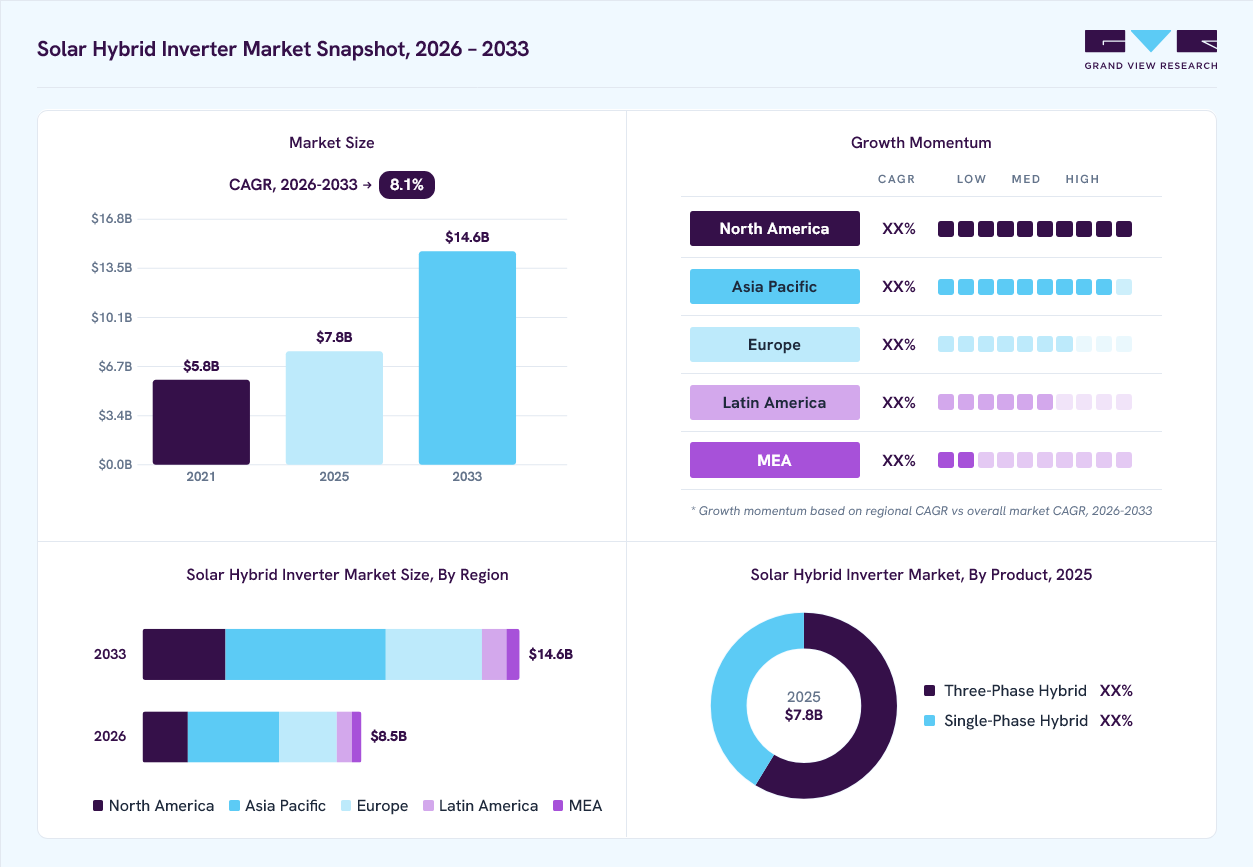 Source: Grand View Research, IR Documents, Primary Interviews, Paid DatabasesTo learn more about this report,
 Download Free Sample Report
Key Market Trends & Insights
- By product: Three-phase hybrid segment held the largest market share of 58.6% in 2025.
- By end use: Commercial segment held the largest market share of 62.7% in 2025.
Regional Highlights
- Largest regional market: Asia Pacific (41.5% revenue share, 2025)
- Fastest-growing regional market: North America (highest CAGR, 2026-2033)
- By country: China held the largest market share in 2025
Market Size & Forecast
- Market size in 2025: USD 7.8 Billion
- Estimated market size in 2026: USD 8.5 Billion
- Projected market size by 2033: USD 14.6 Billion
- CAGR (2026-2033): 8.1%
Three ways to get this report
Buy it, customize it, or ask a question.Ask an Analyst
Analyst response in 1 business day
- AccessReport author, directly
- Reply timeWithin 1 working day
- No sales callDirect answer only
- FormatEmail reply
- CostFree, no cost
Get the Full Report
What the study covers
- FormatsPDF · Excel · Dashboard
- Timeline2026–2033 annual, 2025 base
- Coverage20+ countries, 5 regions
- Companies10+ key players profiled
Customize the Report
20% free customization
- IncludeCountries, segments, points
- TailorTo your product definition
- ExtendDeeper competitor detail
- OrA fully bespoke study
- Turnaround5–10 working days
The rising adoption of renewable energy, technological improvements in inverter design, and the push for energy resilience are key factors propelling this growth. Moreover, favorable government policies and financial incentives supporting clean energy installations encourage widespread deployment, particularly in regions with unstable grids or high energy costs. Technological advancements, including the integration of artificial intelligence (AI) and the Internet of Things (IoT), are significantly improving the performance and management of solar hybrid inverters. These innovations enable real-time monitoring, smarter energy management, and enhanced efficiency, reducing energy costs and increasing system reliability. The growing emphasis on decentralized energy generation supports global sustainability goals, positioning solar hybrid inverters as a preferred solution for urban and off-grid applications seeking cleaner and more resilient power sources. To learn more about this report, Download Free Sample Report
The commercial and industrial sectors are rapidly adopting solar hybrid inverters to secure a stable energy supply and achieve sustainability objectives. The availability of flexible financing models, such as subscription-based services and pay-as-you-go plans, lowers the barrier of entry by minimizing upfront expenses, thereby accelerating adoption among businesses. This trend is especially strong in regions such as Asia Pacific, where increasing industrial activity and urban growth drive heightened energy consumption.
While the market outlook is promising, challenges such as substantial initial costs, complex regulatory frameworks, and concerns over system cybersecurity remain. Nevertheless, continuous technological progress and growing recognition of solar hybrid inverter benefits are expected to address these hurdles. As the energy industry evolves, solar hybrid inverters are set to become integral to delivering sustainable, reliable, and cost-efficient energy solutions globally.
Market Dynamics
The solar hybrid inverter market is growing due to increasing solar adoption, rising electricity costs, and growing demand for reliable backup power solutions. The integration of battery storage with solar systems is encouraging households and businesses to adopt hybrid inverters for better energy management. Supportive government policies, renewable energy targets, and declining battery costs are further driving market growth. However, high initial installation costs and limited awareness in some regions may restrict adoption. Technological advancements, smart energy management features, and increasing demand for energy independence are creating new market opportunities.
The increasing adoption of lithium-ion battery storage with solar photovoltaic systems is a major driver for the solar hybrid inverter market. Consumers and businesses are using hybrid inverters to store excess solar energy and use it during peak demand periods or grid outages, improving energy independence and reducing reliance on utility power. The ability of hybrid inverters to manage solar generation, battery charging, and grid interaction through a single system is encouraging greater adoption across residential and commercial applications.
A key example of this trend is Germany’s expanding residential solar-plus-battery market in 2025-2026. According to Ember, Germany’s residential battery market is the largest in Europe, with more than 2 million home battery systems installed, equivalent to around one in six homeowners already having a battery system. 30% of homeowners are considering purchasing a home battery within the next five years, driven by higher self-consumption, energy resilience, and EV charging optimization. This growing deployment of rooftop solar batteries is expected to increase demand for solar hybrid inverters that can manage both PV generation and energy storage.
The high initial investment required for solar hybrid inverter systems is a major restraint for market growth. Compared with conventional solar inverters, hybrid inverter systems involve additional costs associated with battery storage, advanced energy management components, and installation requirements. The higher upfront cost can discourage price-sensitive residential and small commercial users, particularly in developing markets where electricity savings and payback periods may not be sufficient to justify the investment. Limited access to financing options and low awareness about long-term cost benefits further restrict adoption.
The growing demand for intelligent energy management solutions is creating new opportunities for the solar hybrid inverter market. Consumers and businesses are increasingly seeking hybrid inverters with smart features such as IoT connectivity, AI-based energy optimization, predictive maintenance, remote monitoring, and automated load management. These advanced capabilities help users maximize solar utilization, reduce energy costs, and improve system reliability. The integration of digital technologies with solar-plus-storage systems is expected to drive the adoption of next-generation hybrid inverters. Huawei’s FusionSolar Smart PV solutions launched in 2025 integrated AI-based energy management features, including intelligent load control, remote monitoring, and predictive optimization, highlighting the increasing demand for AI-enabled hybrid inverters with advanced connectivity and automation capabilities.
Analyst Perspective
The solar hybrid inverter market is witnessing steady growth as increasing solar adoption and rising demand for energy storage solutions encourage consumers and businesses to shift toward self-managed power systems. The market is gradually moving toward intelligent hybrid inverters with advanced monitoring, battery integration, and smart energy management capabilities, improving system efficiency and reliability. Established players continue to strengthen their position through technology innovation and integrated solar-plus-storage offerings, while emerging companies compete through cost-effective solutions and regional expansion. Going forward, increasing grid instability, declining battery costs, and growing demand for energy independence are expected to accelerate hybrid inverter adoption across residential and commercial applications.
Product Insights
Based on product, the three-phase hybrid segment led the market with the largest revenue share of 58.6% in 2025. The three-phase hybrid inverter segment is pivotal in the solar hybrid inverter market, offering robust energy conversion solutions for large-scale commercial and industrial applications. These inverters are designed to manage higher loads efficiently, ensuring a stable power supply and seamless integration with solar panels and energy storage systems. As demand rises for grid-tied and off-grid solutions in high-demand environments, three-phase hybrids are becoming increasingly preferred due to their ability to support balanced energy distribution and system resilience.
The single-phase hybrid segment is gaining traction in residential and small-scale commercial installations, where ease of installation, affordability, and compact design are key considerations. These inverters support essential backup during outages and allow homeowners to optimize energy self-consumption. Growing adoption of rooftop solar in suburban and rural regions, with supportive policy incentives and rising energy costs, continues to drive the uptake of single-phase hybrid systems across emerging and developed markets.
End Use Insights
Based on end use, the commercial segment led the market with the largest revenue share of 62.7% in 2025, driven by the rising demand for uninterrupted and efficient power supply in offices, shopping complexes, educational institutions, and manufacturing facilities. These environments typically have higher and more consistent power requirements, making hybrid inverters a cost-effective and sustainable solution for reducing electricity bills and mitigating grid-related power fluctuations. The ability of commercial setups to incorporate larger PV systems, combined with growing environmental regulations and sustainability goals, is accelerating the adoption of solar hybrid inverters in this space.
 To learn more about this report, Download Free Sample Report
The residential segment is gaining momentum as homeowners seek reliable backup power and greater energy independence amid rising utility costs and frequent outages. Hybrid inverters' compact design, ease of installation, and compatibility with rooftop solar systems make them ideal for household use. Meanwhile, the "Others" category-including rural electrification programs, public sector projects, and community-based energy systems-is witnessing a steady uptick, especially in emerging markets where energy access remains challenging and solar hybrid systems offer a dependable off-grid solution.
Regional Insights
The North American solar hybrid inverter market is anticipated to grow at the highest CAGR, driven by increasing solar energy adoption, rising energy costs, and a growing emphasis on grid resilience. Frequent weather-related grid disruptions push residential and commercial users toward hybrid inverters that can provide backup during outages. The U.S. leads the region due to federal tax credits, net metering policies, and increasing solar-plus-storage installations. Canada also contributes to growth, especially in provinces offering clean energy incentives and off-grid community electrification initiatives.
U.S. Solar Hybrid Inverter Market Trends
Technological advancements in the U.S. are significantly boosting hybrid inverter adoption. Integrating AI, IoT, and energy management platforms enables intelligent energy distribution between solar panels, batteries, and the grid. These smart systems enhance energy reliability and reduce dependency on traditional power sources. As the country moves toward decarbonization, hybrid inverters are becoming integral to home and business energy ecosystems, particularly in states such as California, Texas, and Florida.
Asia Pacific Solar Hybrid Inverter Market Trends
Asia Pacific dominated the solar hybrid inverter market with the largest revenue share of 41.5% in 2025 due to rapid urbanization, expanding rooftop solar deployments, and supportive government policies. Countries like India and China spearhead growth through large-scale solar initiatives, rural electrification programs, and incentives for battery-backed solar systems. In India, hybrid inverters are critical in bridging power gaps in rural and semi-urban areas. Meanwhile, China's emphasis on distributed generation and battery innovation accelerates adoption across commercial and residential segments.
 To learn more about this report, Download Free Sample Report
Europe Solar Hybrid Inverter Market Trends
Europe's solar hybrid inverter market expands as countries advance their clean energy transitions and adopt decentralized power systems. Nations such as Germany, Italy, and the Netherlands are leading deployments driven by strong feed-in tariff structures, rising electricity prices, and robust residential solar demand. Hybrid inverters are particularly attractive due to their role in energy self-consumption, battery integration, and compliance with EU carbon neutrality goals. In addition, digital energy solutions and smart grid integration are accelerating uptake.
Latin America Solar Hybrid Inverter Market Trends
Latin America is emerging as a fast-growing market for solar hybrid inverters, supported by abundant solar resources, unreliable grid access in remote areas, and favorable regulatory environments. Countries such as Brazil and Chile invest in distributed solar systems, while Mexico promotes solar-plus-storage in rural electrification programs. The mining, agriculture, and small enterprise sectors also adopt hybrid inverters to manage fluctuating energy needs and ensure power reliability.
Middle East & Africa Solar Hybrid Inverter Market Trends
The Middle East and Africa region increasingly turns to solar hybrid inverters to meet rising energy demands, address energy access gaps, and leverage abundant solar resources. In the Middle East, nations such as the UAE and Saudi Arabia are integrating hybrid systems into residential and commercial solar projects aligned with long-term sustainability visions. In Africa, off-grid and weak-grid regions are adopting hybrid inverters as cost-effective alternatives to diesel generators, supported by international funding and NGO-led electrification projects.
Key Solar Hybrid Inverter Company Insights
Some of the key players operating in the solar hybrid inverter market include Flin Energy, Schneider Electric, Su-Kam Power Systems, Luminous, SolaX Power, and others.
-
In February 2024, SolarEdge Technologies unveiled its new high-capacity hybrid inverter series, designed for residential and commercial use. It integrates seamlessly with battery storage systems and improves energy management through advanced software features.
-
In January 2024, SolaX Power partnered with an Australian utility firm to deploy hybrid solar inverter systems across off-grid and grid-edge communities, enhancing energy reliability and optimizing renewable integration through real-time smart monitoring and control. The rising adoption of hybrid work models, where businesses require adaptable tools that can be moved between meeting rooms, workspaces, and remote locations, drives growth.
Key Solar Hybrid Inverter Companies:
The following key companies have been profiled for this study on the solar hybrid inverter market.
-
Flin Energy
-
Havells
-
Schneider Electric
-
Microtek Inverters
-
Delta Energy Systems
-
Pure Volt
-
Su-Kam Power Systems
-
Redback Technologies
-
Luminous
-
EAST Group
-
KACO new energy
-
Tabuchi Electric
-
SolarEdge Technologies
-
Voltronic Power Technology
-
SolaX Power
Competitive Benchmarking
Category
Operating Strategies
Competitive Edge
Weakness
Established Players (Havells India Ltd., Schneider Electric, Delta Electronics, Inc., EAST Group, TABUCHI ELECTRIC CO.,LTD., Voltronic Power Technology Corp., Microtek)
- Focus on expanding solar-plus-storage portfolios by integrating hybrid inverters with battery energy storage systems, smart monitoring platforms, and energy management solutions.
- Invest heavily in R&D to improve inverter efficiency, grid compatibility, safety features, and intelligent power optimization capabilities.
- Leverage global manufacturing networks, established distribution channels, and partnerships with solar installers and EPC companies to strengthen market reach.
- Strong brand recognition and customer trust due to long-term presence in power electronics and energy markets.
- Advanced technology capabilities, including smart energy management, remote monitoring, high-efficiency conversion, and battery integration.
- Strong financial capabilities enabling continuous product innovation, capacity expansion, and global market penetration.
- Higher product pricing compared with regional and emerging competitors, limiting adoption among price-sensitive customers.
- Larger organizational structures can result in slower product customization and response to rapidly changing market requirements.
- Dependence on premium segments may create challenges in highly competitive residential markets with low-cost alternatives.
Emerging Players (SolaX Power, PURE Energy, Flin Energy )
- Focus on residential and small commercial markets by offering affordable hybrid inverter solutions with battery backup capabilities.
- Expand through regional distributors, online sales channels, and partnerships with local solar installers.
- Differentiate through flexible product offerings, localized solutions, and faster adaptation to customer requirements.
- Competitive pricing enables greater penetration in cost-sensitive residential and small business segments.
- Greater flexibility in product development allows quicker adaptation to market trends and customer preferences.
- Strong understanding of local market requirements, especially in emerging solar markets such as India and Southeast Asia.
- Limited global presence and smaller distribution networks compared with established international players.
- Lower R&D investment capacity may restrict development of advanced inverter technologies and large-scale energy management solutions.
- Limited brand recognition can create challenges in securing large commercial and industrial projects.
Solar Hybrid Inverter Market Report Scope
Report Attribute
Details
Market Definition
The solar hybrid inverter market is defined as the revenue generated from the sales of single-phase and three-phase hybrid inverters used across residential, commercial, and other end-use applications for integrating solar power generation with energy storage and grid management systems.
Market size in 2025
USD 7.8 billion
Estimated market size in 2026
USD 8.5 billion
Projected market size by 2033
USD 14.6 billion
Growth rate
CAGR of 8.1% from 2026 to 2033
Base year for estimation
2025
Historical data
2021 - 2024
Forecast period
2026 - 2033
Quantitative units
Revenue in USD Million and CAGR from 2026 to 2033
Report coverage
Revenue forecast, company ranking, competitive landscape, growth factors, and trends
Segments covered
Product, End Use, Region
Regional scope
North America, Europe, Asia Pacific, Latin America, Middle East & Africa
Country scope
U.S., Canada, Mexico, Germany, Spain, UK, France, Italy, Russia, China, India, Japan, Australia, Brazil, Argentina, Saudi Arabia, South Africa, UAE
Key companies profiled
Havells India Ltd., Schneider Electric, Delta Electronics, Inc., EAST Group, TABUCHI ELECTRIC CO.,LTD., Voltronic Power Technology Corp., Microtek, SolaX Power, PURE Energy, Flin Energy
Customization scope
Free report customization (equivalent up to 8 analysts' working days) with purchase. Addition or alteration to country, regional & segment scope.
Pricing and purchase options
Avail customized purchase options to meet your exact research needs. Explore purchase options
Global Solar Hybrid Inverter Market Report Segmentation
This report forecasts revenue and volume growth at global, regional, and country levels and provides an analysis of the latest industry trends in each of the sub-segments from 2021 to 2033. For the purpose of this study, Grand View Research has segmented the global solar hybrid inverter market report on the basis of product, end use, and region.
 To learn more about this report, Download Free Sample Report
-
Product Outlook (Revenue, USD Million, 2021 - 2033)
-
Single-Phase Hybrid
-
Three-Phase Hybrid
-
-
End Use Outlook (Revenue, USD Million, 2021 - 2033)
-
Commercial
-
Residential
-
Others
-
-
Regional Outlook (Revenue, USD Million, 2021 - 2033)
-
North America
-
U.S.
-
Canada
-
Mexico
-
-
Europe
-
Germany
-
UK
-
Spain
-
France
-
Italy
-
Russia
-
-
Asia Pacific
-
China
-
India
-
Japan
-
Australia
-
-
Latin America
-
Brazil
-
Argentina
-
-
Middle East
-
Saudi Arabia
-
South Africa
-
UAE
-
-
Research Methodology
The solar hybrid inverter market figures in this report are based on a proven research process that combines executive interviews with secondary research from proprietary databases, company filings, and recognized regulatory and institutional sources. Market size is built through value-chain sizing - reconciling supply-side and demand-side estimates - and triangulated with bottom-up and top-down approaches. Every estimate passes multiple levels of expert validation before publication, with each solar hybrid inverter segment quantified using the revenue-capture definitions in the table below.
Segment Definition
Segment - Product
Revenue capture definition
Single-Phase Hybrid
Single-phase hybrid inverters include solar hybrid inverter systems designed for single-phase electrical connections, typically used in low-power residential and small-scale commercial applications. Revenue is generated from the sales of single-phase hybrid inverters used to integrate solar PV systems with battery storage, grid connectivity, and backup power solutions.
Three-Phase Hybrid
Three-phase hybrid inverters include solar hybrid inverter systems designed for three-phase electrical connections, offering higher power handling capacity for commercial, industrial, and large residential applications. Revenue is generated from the sales of three-phase hybrid inverters used in solar-plus-storage systems requiring efficient energy management, higher load capacity, and grid interaction capabilities.
Segment - End Use
Revenue capture definition
Commercial
Commercial solar hybrid inverters include systems deployed across offices, retail facilities, commercial buildings, and small businesses to manage solar generation, energy storage, and electricity consumption. Revenue is generated from the sales of hybrid inverters installed in commercial solar-plus-storage projects to reduce energy costs, improve power reliability, and optimize energy usage.
Residential
Residential solar hybrid inverters include systems used in homes and small residential properties to combine rooftop solar generation with battery storage and grid power management. Revenue is generated from the sales of hybrid inverters installed in residential solar systems to provide backup power, increase self-consumption, and support energy independence.
Others
Other solar hybrid inverter applications include utility support systems, off-grid installations, remote power solutions, and specialized energy projects outside residential and commercial segments. Revenue is generated from the sales of hybrid inverters used in these applications for decentralized power generation, energy storage integration, and reliable electricity supply.
Estimation Model
Layer Name
Key Question
Description
Solar Hybrid Inverter Demand Layer
What drives the demand for solar hybrid inverters?
Identify key demand drivers for solar hybrid inverters, including increasing solar PV adoption, rising demand for energy independence, growing integration of battery energy storage systems, grid reliability concerns, and increasing electricity costs. Assess factors such as renewable energy targets, distributed power generation growth, backup power requirements, and advancements in smart energy management technologies influencing hybrid inverter demand.
Solar Hybrid Inverter Product Layer
What types of solar hybrid inverters are adopted?
Analyze solar hybrid inverter adoption based on product types, including single-phase hybrid and three-phase hybrid inverters. Assess product preferences based on power requirements, load management capabilities, compatibility with residential and commercial solar-plus-storage systems, energy efficiency, scalability, and suitability for different electricity consumption patterns.
Solar Hybrid Inverter End Use Layer
Where are solar hybrid inverters deployed?
Evaluate solar hybrid inverter demand across end-use applications, including residential, commercial, and other applications. Assess adoption based on energy consumption requirements, backup power needs, rooftop solar deployment, commercial energy management, and integration of battery storage systems for reliable and cost-effective power supply.
Revenue Layer
How is market revenue generated?
Market revenue is quantified through the sales of solar hybrid inverter systems across different product types and end-use applications. The overall market value is determined by revenue generated from single-phase and three-phase hybrid inverter sales deployed in residential, commercial, and other solar energy applications integrated with energy storage solutions.
Delivered Customizations
This report has been delivered with the following In-depth customizations
Client Request
Customization Delivered
Value Adds
Regional Opportunity Assessment
Regional solar hybrid inverter markets were evaluated based on solar installation growth, electricity tariff trends, grid stability concerns, renewable energy policies, storage adoption, and distributed energy generation trends across key geographies.
Enabled identification of high-potential regions, market entry opportunities, and regional factors influencing hybrid inverter adoption and competitive dynamics.
Product & End-Use Cross-Segmentation
Solar hybrid inverter demand was analyzed by cross-segmenting single-phase hybrid inverters across residential, commercial, and other applications. The analysis evaluated product adoption based on power requirements, installation scale, load management needs, battery integration capabilities, and suitability for different end-user energy requirements.
Provided insights into product-specific demand trends, identified high-growth inverter segments, and highlighted evolving requirements for efficient, scalable, and storage-compatible hybrid inverter solutions.
Competitive Benchmarking
Major solar hybrid inverter players were benchmarked based on product portfolio, single-phase and three-phase hybrid inverter offerings, power capacity range, battery compatibility, inverter efficiency, smart energy management capabilities, monitoring solutions, distribution networks, geographic presence, pricing strategies, partnerships with solar installers/EPC companies, and recent strategic developments.
Provided insights into competitive positioning, technology differentiation, product innovation, market expansion strategies, and key factors influencing competitive advantage among established and emerging hybrid inverter manufacturers.
Frequently Asked Questions About This Report
The global solar hybrid inverter market size was valued at USD 7.8 billion in 2025 and is estimated at USD 8.5 billion for 2026.
The global solar hybrid inverter market is expected to grow at a CAGR of 8.1% from 2026 to 2033, reaching USD 14.6 billion by 2033.
The Asia Pacific region dominated the solar hybrid inverters market with a revenue share of 41.5% in 2025.
China dominated the Asia Pacific region market with a revenue share of 35.8% in 2025.
The key players operating in the solar hybrid inverters market are Havells India Ltd., Schneider Electric, Delta Electronics, Inc., EAST Group, TABUCHI ELECTRIC CO.,LTD., Voltronic Power Technology Corp., Microtek, SolaX Power, PURE Energy, Flin Energy, and others.
The key factors driving the solar hybrid inverter market include rising solar PV adoption, increasing demand for energy storage and backup power solutions, growing electricity costs, grid reliability concerns, renewable energy initiatives, and advancements in smart energy management technologies.
North America is anticipated to register the fastest CAGR of 9.0% over the forecast period.
Based on product, the three-phase hybrid segment accounted for the largest revenue share of 58.6% in 2025.
Based on end use, the commercial segment accounted for the largest revenue share of 62.7% in 2025.
About the Author(s)
Power Generation & Storage Research Team
Energy & Power · Power Generation & StorageThis report was authored by the power generation & storage research team at Grand View Research - comprising two research analysts, one senior research analyst, and one industry expert - with specialized expertise in the power generation & storage segment of the energy & power industry. All findings are based on proprietary energy & power databases, executive interviews, and regulatory analysis, subject to internal peer review prior to publication.
Last Updated:
Speak to Analyst

Customize this report to your needs - add regions, segments, or data points, with 20% free customization.
Or view our licence options:


ISO 9001:2015 & 27001:2022 Certified
We are GDPR and CCPA compliant! Your transaction & personal information is safe and secure. For more details, please read our privacy policy.


