
- Home
- »
- Advanced Interior Materials
- »
-
Soldering Equipment Market Size & Share Report, 2026-2033GVR Report cover
![Soldering Equipment Market Size, Share & Trends Report]()
Soldering Equipment Market (2026 - 2033) Size, Share & Trends Analysis Report By Operation (Manual, Semi-Automatic, Automatic), By Technology (Through-Hole Soldering, Infrared/Reflow Soldering, Laser Soldering), By End Use (Electronics & Electrical, Automotive, Aerospace & Defense), By Region, And Segment Forecasts
- Report ID: GVR-4-68040-932-5
- Number of Report Pages: 150
- Format: PDF
- Historical Range: 2021 - 2024
- Forecast Period: 2026 - 2033
- Industry: Advanced Materials
- Report Summary
- Table of Contents
- Segmentation
- Methodology
- Download FREE Sample
-
 Download Sample Report
Market Size, 2025$1.2BMarket Estimate, 2026$1.3BMarket Forecast, 2033$2.3BCAGR, 2026 - 20338.5%Soldering Equipment Market Summary
The global soldering equipment market size was valued at USD 1.19 billion in 2025 and is projected to grow from USD 1.29 billion in 2026 to USD 2.28 billion by 2033, at a CAGR of 8.5% from 2026 to 2033. Asia Pacific dominated the global industry with the largest revenue share of 49.5% in 2025. The market is expected to grow significantly due to increasing demand from electronics manufacturing, automotive electronics, telecommunications, aerospace, and industrial equipment sectors. Rising production of consumer electronics, printed circuit boards, and semiconductor components is increasing the need for precision soldering systems and related consumables.

Key Market Trends & Insights
- China dominated the soldering equipment market in Asia Pacific in 2025, holding 57.5% revenue share.
- By operation, the semi-automatic segment is projected to grow at a CAGR of 8.2% during the forecast period.
- By technology, the laser soldering segment is projected to expand at a CAGR of 10.4% from 2026 to 2033 in terms of revenue.
- By end use, electronics & electrical dominated the market in 2025, accounting for 39% market share.
Market Size & Forecast
- 2025 Market Size: USD 1.19 Billion
- 2033 Projected Market Size: USD 2.28 Billion
- CAGR (2026-2033): 8.5%
- Asia Pacific: Largest market in 2025
Growth in electric vehicles and renewable energy equipment is also supporting demand for advanced soldering technologies used in electronic assembly processes. Technological developments in lead-free soldering equipment and temperature-controlled systems are supporting market growth by improving soldering precision, operational safety, and process consistency. Lead-free systems help manufacturers comply with environmental regulations related to hazardous substances in electronics production. Temperature-controlled soldering equipment also reduces component damage, improves energy efficiency, and supports reliable assembly of miniaturized electronic components used in industrial, automotive, telecommunications, and consumer electronics applications.
Market Dynamics
The industry is growing due to increasing electronics manufacturing activities across consumer electronics, automotive electronics, telecommunications, aerospace, and industrial equipment sectors. Rising demand for smartphones, laptops, printed circuit boards, sensors, and semiconductor devices is increasing the need for precision soldering systems.
The trend toward miniaturization of electronic components requires advanced soldering equipment capable of maintaining accuracy and thermal control during assembly processes. Growth in electric vehicle production and renewable energy systems is also supporting demand for reliable electronic assembly technologies. Manufacturers are increasingly adopting automated and robotic soldering systems to improve production efficiency, reduce defects, and maintain consistent solder joint quality.
High costs associated with advanced automated soldering equipment are restraining market growth, particularly for small and medium-sized electronics manufacturers. Automated soldering systems, robotic soldering machines, and precision temperature-controlled equipment require significant capital investment and specialized integration within manufacturing lines.
In addition to initial equipment costs, companies also face expenses related to maintenance, calibration, software upgrades, and operator training. Smaller manufacturers and regional assembly facilities may continue using manual soldering processes due to lower upfront costs.
Market Concentration & Characteristics
The industry is fragmented due to the presence of numerous global, regional, and local manufacturers offering manual, automated, and robotic soldering systems. Companies compete across different product categories, including soldering stations, irons, rework systems, and industrial soldering equipment for electronics and electrical applications. Variations in pricing, technology capabilities, production scale, and end-use requirements increase competition.
Manufacturers are introducing lead-free soldering systems and energy-efficient solutions to support electronics miniaturization and advanced circuit assembly. Innovation is also focused on improving process accuracy, reducing component damage, and supporting high-speed electronics manufacturing. Integration of digital controls, smart monitoring systems, and programmable soldering technologies is further improving production efficiency and operational consistency.
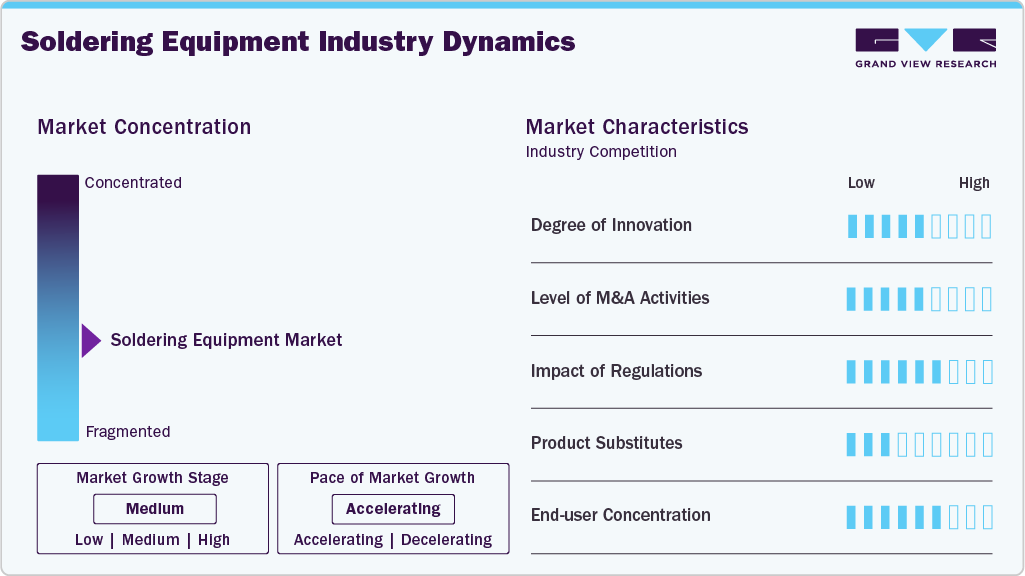
Larger industrial equipment and electronics manufacturing firms are acquiring specialized soldering technology companies to improve precision assembly solutions and regional market presence. These transactions also support expansion into automotive electronics, semiconductor manufacturing, and industrial automation applications. Strategic acquisitions help companies strengthen distribution networks, engineering capabilities, and technological competitiveness within the electronics production industry.
Standards related to lead-free soldering processes are driving the adoption of compliant soldering equipment and materials across industrial and consumer electronics production. Workplace safety regulations also encourage the use of temperature-controlled and fume-extraction soldering systems to improve operator safety. In addition, quality and reliability standards in automotive, aerospace, and medical electronics manufacturing are increasing the demand for precision soldering technologies and process control systems.
Operation Insights
The automatic segment led the market and accounted for 59.3% of the global revenue share in 2025, due to increasing adoption of automated electronics manufacturing and high-volume production processes. Automatic soldering systems improve precision, consistency, and production speed while reducing manual labor requirements. Manufacturers in automotive electronics, semiconductor, and consumer electronics industries are increasingly using robotic and programmable soldering equipment to support miniaturized component assembly, improve operational efficiency, and maintain product quality in large-scale manufacturing environments.
The semi-automatic segment is expected to grow due to its balance between operational efficiency and lower investment cost compared to fully automated systems. Small and medium-sized electronics manufacturers commonly adopt semi-automatic soldering equipment for controlled assembly processes and moderate production volumes. These systems improve soldering accuracy, reduce operator fatigue, and support flexible production requirements across industrial electronics, electrical equipment, and repair or rework applications.
Technology Insights
The surface mount technology (SMT) soldering segment dominated the market in 2025, accounting for 45.1% of the market share due to increasing production of compact and high-performance electronic devices. SMT soldering supports efficient assembly of miniaturized electronic components on printed circuit boards with high precision and speed. Rising demand for consumer electronics, automotive electronics, and telecommunications equipment is increasing the adoption of SMT soldering systems.
The laser soldering segment is expected to grow due to increasing demand for precision soldering in advanced electronics and semiconductor manufacturing. Laser soldering provides localized heating, reduced thermal damage, and accurate solder joint formation for sensitive electronic components. The technology is increasingly used in automotive electronics, medical devices, and compact electronic assemblies requiring high reliability.
End Use Insights
The electronics & electrical segment led the market in 2025 due to increasing production of consumer electronics, printed circuit boards, industrial control systems, and electrical components. Manufacturers require precise soldering equipment for the assembly of miniaturized and complex electronic devices. Rising demand for smartphones, computers, home appliances, and electric vehicle electronics is further supporting the adoption of automated and temperature-controlled soldering technologies across electronics manufacturing operations.

The telecommunications segment is expected to grow at a CAGR of 8.6% during the forecast period in the soldering equipment market, driven by increasing deployment of communication infrastructure, networking equipment, and 5G technologies. Telecommunications devices and circuit boards require precise soldering for reliable signal transmission and component performance. Rising production of routers, base stations, fiber-optic equipment, and wireless communication devices is increasing demand for advanced soldering systems. Growth in data transmission infrastructure and network expansion is further supporting soldering equipment adoption.
Regional Insights
The soldering equipment market in North America is fueled by increasing electronics manufacturing, aerospace production, and industrial automation activities. Demand for advanced soldering systems is rising in automotive electronics, semiconductor packaging, and medical device assembly applications. The region also benefits from strong adoption of automated and robotic soldering technologies. Investments in electric vehicle production, renewable energy systems, and communication infrastructure are further increasing the use of precision soldering equipment across industrial and commercial manufacturing operations.
U.S. Soldering Equipment Market Trends
The soldering equipment market in the U.S. is growing significantly, due to the expansion of semiconductor manufacturing, defense electronics production, and advanced industrial manufacturing activities. Increasing investments in domestic electronics production and printed circuit board assembly are supporting demand for automated soldering systems. Growth in electric vehicles, aerospace electronics, and telecommunications infrastructure is also increasing the adoption of high-precision soldering technologies.
Asia Pacific Soldering Equipment Market Trends
The soldering equipment market in Asia Pacific is driven by large-scale electronics manufacturing, semiconductor production, and the expansion of consumer electronics industries. Countries across the region are increasing investments in industrial automation and advanced assembly technologies. High production volumes of smartphones, computers, electrical appliances, and automotive electronics are driving demand for automated soldering systems. The region also benefits from expanding electronics export activities and growing manufacturing infrastructure supporting large-scale electronic component and circuit board assembly operations.

China soldering equipment market is experiencing growth due to its large electronics manufacturing industry and expanding semiconductor production capacity. The country produces significant volumes of consumer electronics, telecommunications equipment, and industrial electronic components requiring precision soldering technologies. Increasing automation in electronics assembly lines and investment in advanced manufacturing systems are supporting demand for robotic and automated soldering equipment. Growth in electric vehicle electronics and domestic semiconductor manufacturing further contributes to market expansion in China.
The soldering equipment market in India is growing due to increasing domestic electronics manufacturing and government initiatives supporting local production of electronic devices and components. Expansion of smartphone assembly, consumer electronics production, and electrical equipment manufacturing is driving demand for soldering systems. Growth in telecommunications infrastructure, renewable energy equipment, and automotive electronics manufacturing is also supporting market development. Rising investment in electronics manufacturing facilities and industrial automation technologies continues to increase the adoption of soldering equipment across Indian industries.
Europe Soldering Equipment Market Trends
The soldering equipment market in Europe is expected to grow at a CAGR of 7.5% during the forecast period due to increasing production of industrial electronics, automotive systems, and renewable energy equipment. Manufacturers across the region are adopting automated soldering technologies to improve production accuracy and support miniaturized electronic assembly. Strict environmental regulations are also encouraging the use of lead-free soldering systems. Expansion of electric vehicle manufacturing, industrial automation, and advanced communication infrastructure is further supporting demand for precision soldering equipment in electronics and electrical component production facilities.
Germany soldering equipment market is growing due to its strong automotive electronics, industrial machinery, and automation industries. Manufacturers require advanced soldering systems for precision electronic assembly in electric vehicles, industrial controls, and semiconductor applications. The country’s focus on Industry 4.0 and smart manufacturing is increasing the adoption of automated and robotic soldering technologies. Growth in renewable energy equipment production and high-performance industrial electronics manufacturing is also contributing to demand for modern soldering systems across German industries.
The soldering equipment market in the UK is driven by increasing demand from aerospace electronics, telecommunications equipment, and medical device manufacturing sectors. Electronics manufacturers are adopting advanced soldering technologies to improve assembly precision and product reliability. Growth in research and development activities related to semiconductor and communication technologies is supporting equipment demand. In addition, increasing investment in industrial automation and expansion of specialized electronics production facilities are contributing to soldering equipment adoption across the country’s manufacturing sector.
Middle East & Africa Soldering Equipment Market Trends
The soldering equipment market in the Middle East and Africa region is witnessing steady growth due to increasing industrial development, expansion of telecommunications infrastructure, and rising electronics assembly activities. Demand for soldering systems is increasing in electrical equipment manufacturing, industrial maintenance, and communication technology applications. Growth in renewable energy projects and industrial automation is also contributing to market expansion.
Saudi Arabia soldering equipment market is experiencing growth due to increasing industrial diversification and investment in electronics, telecommunications, and renewable energy infrastructure. Expansion of electrical equipment manufacturing and industrial automation projects is supporting demand for soldering technologies.
Latin America Soldering Equipment Market Trends
The soldering equipment market in Latin America is driven by increasing electronics assembly, automotive component manufacturing, and industrial equipment production activities. Manufacturers are adopting soldering technologies to support electrical component assembly and maintenance operations. Expansion of communication infrastructure and consumer electronics demand is also supporting market growth. Countries in the region are increasing investments in industrial manufacturing capabilities, creating additional demand for soldering equipment used in electronics production, repair, and industrial assembly applications.
Brazil soldering equipment market is experiencing growth due to the expansion of consumer electronics production, automotive manufacturing, and industrial electrical equipment assembly. Increasing local manufacturing activities are driving demand for manual and automated soldering systems used in electronic component assembly. Growth in telecommunications infrastructure and renewable energy equipment production is also supporting market development.
Key Soldering Equipment Company Insights
Some of the key players operating in the market include Hakko Corporation and Metcal (OK International), among others.
-
Hakko Corporation is a Japanese manufacturer of soldering, desoldering, and thermal control equipment used in electronics assembly and industrial applications. The company supplies soldering stations, rework systems, smoke absorbers, and related tools for electronics manufacturing and repair operations.
-
Metcal, part of OK International, manufactures soldering and rework systems for electronics manufacturing and precision assembly applications. The company provides soldering stations, desoldering equipment, fume extraction systems, and thermal management technologies used in semiconductor, aerospace, medical device, and industrial electronics production.
Key Soldering Equipment Companies
The following key companies have been profiled for this study on the soldering equipment market.
-
Hakko Corporation
-
Weller Tools
-
Metcal (OK International)
-
JBC Soldering S.L.
-
Kurtz Ersa GmbH
-
Quick Intelligent Equipment Co., Ltd.
-
Shenzhen Atten Technology Co., Ltd.
-
Apollo Seiko Ltd.
-
Japan Unix Co., Ltd.
-
SEHO Systems GmbH
-
Nordson Corporation
-
Saki Corporation
-
Pillarhouse International Ltd.
-
Thermaltronics USA, Inc.
-
Zhejiang Tonny Electric & Tools Co., Ltd.
Competitive Benchmarking
Operating Strategies
Competitive Edge
Weaknesses
Mature Players: Hakko Corporation, Weller Tools (Apex Tool Group), Metcal (OK International), JBC Soldering S.L., Kurtz Ersa GmbH, Apollo Seiko Ltd., Japan Unix Co., Ltd.
- Mature players focus on advanced product development, automated soldering technologies, and global distribution networks.
- They emphasize long-term partnerships with electronics manufacturers, technical support services, and integration of soldering systems with automated production lines.
- Mature companies benefit from established brand recognition, strong engineering expertise, and broad product portfolios covering manual, semi-automatic, and automated soldering systems.
- Their competitive advantage comes from advanced precision technologies, global distribution capabilities, and long-term relationships with electronics manufacturers.
- Mature players often face high operational and research costs due to advanced manufacturing infrastructure, global service networks, and continuous technology development requirements.
- Their large organizational structures may reduce flexibility in responding quickly to niche market demands or low-cost competition.
Emerging Players: Quick Intelligent Equipment Co., Ltd., Shenzhen Atten Technology Co., Ltd., Pillarhouse International Ltd., Thermaltronics USA, Inc.
- Emerging players in the soldering equipment market generally focus on cost-competitive products, regional distribution expansion, and flexible manufacturing operations.
- Many target small and medium-sized electronics manufacturers by offering affordable soldering stations, rework systems, and compact automated equipment.
- Emerging companies gain a competitive advantage through lower manufacturing costs, flexible production capabilities, and quicker response to customer-specific requirements.
- Their smaller operational structures allow faster product modifications and competitive pricing strategies.
- Emerging players often face limitations in global distribution reach, brand recognition, and investment capacity for advanced automation technologies.
- Limited research and development resources may restrict innovation in robotic and precision soldering systems.
Recent Developments
-
In March 2026, Cogiscan partnered with Ersa GmbH to integrate its Co-NECT platform into Ersa soldering machines as an OEM connectivity solution. The collaboration enables OPC UA-based communication, supporting easier integration of soldering equipment into smart factory environments. The partnership improves machine connectivity, production monitoring, and digitalization capabilities in electronics manufacturing and automated soldering operations.
-
In January 2025, Thermaltronics USA, Inc. launched the TMT-1000S Soldering Station featuring CURIE POINT temperature control technology for precision soldering applications. The system is designed to provide controlled thermal performance typically found in higher-cost soldering equipment. The product includes a soldering tip and power-down workstand, supporting electronics assembly, repair, and industrial soldering operations at a lower equipment cost.
Soldering Equipment Market Report Scope
Report Attribute
Details
Market size value in 2025
USD 1.19 billion
Market size value in 2026
USD 1.29 billion
Revenue forecast in 2033
USD 2.28 billion
Growth rate
CAGR of 8.5% from 2026 to 2033
Base year for estimation
2025
Historical data
2021 - 2024
Forecast period
2026 - 2033
Quantitative units
Revenue in USD million/billion and CAGR from 2026 to 2033
Report coverage
Revenue forecast, company market position analysis, competitive landscape, growth factors, and trends
Segments covered
Operation, technology, end use, region
Regional scope
North America; Europe; Asia Pacific; Latin America; Middle East & Africa
Country Scope
U.S.; Canada; Mexico; Germany; UK; Italy; Spain; France; China; Japan; India; Australia; South Korea; Brazil; Argentina; Saudi Arabia; UAE; South Africa
Key companies profiled
Hakko Corporation; Weller Tools (Apex Tool Group); Metcal (OK International); JBC Soldering S.L.; Kurtz Ersa GmbH; Quick Intelligent Equipment Co., Ltd.; Shenzhen Atten Technology Co., Ltd.; Apollo Seiko Ltd.; Japan Unix Co., Ltd.; SEHO Systems GmbH; Nordson Corporation; Saki Corporation; Pillarhouse International Ltd.; Thermaltronics USA, Inc.; Zhejiang Tonny Electric & Tools Co., Ltd.
Customization scope
Free report customization (equivalent up to 8 analysts working days) with purchase. Addition or alteration to country, regional & segment scope.
Pricing and purchase options
Avail customized purchase options to meet your exact research needs. Explore purchase options
Global Soldering Equipment Market Report Segmentation
This report forecasts revenue growth at global, regional & country levels and provides an analysis of the industry trends in each of the sub-segments from 2021 to 2033. For this study, Grand View Research has segmented the global soldering equipment market report on the basis of operation, technology, end use, and region:

-
Operation Outlook (Revenue, USD Billion, 2021 - 2033)
-
Manual
-
Semi-Automatic
-
Automatic
-
-
Technology Outlook (Revenue, USD Billion, 2021 - 2033)
-
Surface Mount Technology (SMT) Soldering
-
Through-Hole Soldering
-
Infrared / Reflow Soldering
-
Laser Soldering
-
Vapor Phase / Wave Soldering
-
Others
-
-
End Use Outlook (Revenue, USD Billion, 2021 - 2033)
-
Electronics & Electrical
-
Automotive
-
Aerospace & Defense
-
Medical Devices
-
Telecommunications
-
Power Generations
-
Others
-
-
Regional Outlook (Revenue, USD Billion, 2021 - 2033)
-
North America
-
U.S.
-
Canada
-
Mexico
-
-
Europe
-
Germany
-
France
-
UK
-
Spain
-
Italy
-
-
Asia Pacific
-
China
-
India
-
Japan
-
South Korea
-
Australia
-
-
Latin America
-
Brazil
-
Argentina
-
-
Middle East & Africa
-
Saudi Arabia
-
UAE
-
South Africa
-
-
Delivered Customizations
This report has been delivered with the following In-depth customizations
Client Request
Customization Delivered
Value Adds
Regional Segmentation
Detailed regional analysis was conducted across North America, Europe, Asia Pacific, Latin America, and the Middle East & Africa, including country-level assessment for key markets such as the U.S., Germany, China, India, Brazil, and Saudi Arabia. The study evaluated electronics manufacturing activities, semiconductor production, automotive electronics demand, industrial automation trends, and regulatory standards influencing soldering equipment adoption across regional markets.
Helped identify high-growth regional markets, country-specific opportunities, and evolving demand trends across electronics manufacturing and industrial assembly sectors. The analysis also supported market entry strategies, regional expansion planning, and identification of emerging electronics production hubs.
Competitive benchmarking
Comprehensive benchmarking was carried out for major market participants based on product portfolio, automation capabilities, precision soldering technologies, regional presence, pricing strategy, manufacturing capabilities, and distribution network strength. The assessment also compared mature and emerging players operating in the soldering equipment market.
Assisted clients in understanding competitor positioning, technology capabilities, and competitive gaps within the market. The study supported strategic planning, partnership evaluation, and differentiation opportunities across electronics manufacturing, semiconductor assembly, automotive electronics, and industrial soldering applications.
Opportunity assessment
In-depth opportunity assessment was conducted by analyzing electronics manufacturing expansion, semiconductor production growth, electric vehicle electronics demand, industrial automation adoption, and increasing use of miniaturized electronic components. The study also identified emerging opportunities in robotic soldering systems, smart factory integration, lead-free soldering technologies, and automated precision assembly applications.
Enabled clients to identify high-growth investment areas, prioritize regional expansion strategies, and evaluate future revenue opportunities across electronics, automotive, semiconductor, telecommunications, and industrial manufacturing sectors. The analysis also supported product development planning, technology adoption strategies, and long-term business growth initiatives in the soldering equipment market.
Frequently Asked Questions About This Report
The global soldering equipment market size was estimated at USD 1.19 billion in 2025 and is expected to reach USD 1.29 billion in 2026.
The global soldering equipment market, in terms of revenue, is expected to grow at a compound annual growth rate of 8.5% from 2026 to 2033 to reach USD 2.28 billion by 2033.
The automatic segment led the market and accounted for 59.3% of the global market revenue share in 2025 due to increasing adoption of automated electronics manufacturing and high-volume production processes. Automatic soldering systems improve precision, consistency, and production speed while reducing manual labor requirements.
Some of the key players operating in the soldering equipment include Hakko Corporation, Weller Tools (Apex Tool Group), Metcal (OK International), JBC Soldering S.L., Kurtz Ersa GmbH, Quick Intelligent Equipment Co., Ltd., Shenzhen Atten Technology Co., Ltd., Apollo Seiko Ltd., Japan Unix Co., Ltd., SEHO Systems GmbH, Nordson Corporation, Saki Corporation, Pillarhouse International Ltd., Thermaltronics USA, Inc., Zhejiang Tonny Electric & Tools Co., Ltd.
The soldering equipment market is driven by growing electronics manufacturing, increasing semiconductor and printed circuit board production, rising adoption of automated assembly systems, expansion of electric vehicle electronics, miniaturization of electronic components, and demand for precision soldering technologies across automotive, telecommunications, aerospace, industrial, and consumer electronics industries.
About the authors:
Author: GVR Advanced Interior Materials Research Team | Last Updated:


Share this report with your colleague or friend.
Need a Tailored Report?
Customize this report to your needs — add regions, segments, or data points, with 20% free customization.


ISO 9001:2015 & 27001:2022 Certified
We are GDPR and CCPA compliant! Your transaction & personal information is safe and secure. For more details, please read our privacy policy.












