
- Home
- »
- Renewable Energy
- »
-
Solid Oxide Fuel Cell Market Size & Share Report 2026-2033GVR Report cover

Solid Oxide Fuel Cell Market (2026 - 2033)
Size, Share & Trends Analysis Report By Application (Transportation, Portable, Stationary), By Region (North America, Europe, Asia Pacific, Latin America, Middle East & Africa), And Segment Forecasts
Market Size, 2025
$1.9BMarket Estimate, 2026
$2.3BMarket Forecast, 2033
$14.3BCAGR, 2026–2033
29.4%Solid Oxide Fuel Cell Market Summary
The global solid oxide fuel cell market size was valued at USD 1.9 billion in 2025 and is projected to grow from USD 2.3 billion in 2026 to USD 14.3 billion by 2033, at a CAGR of 29.4% from 2026 to 2033. Asia Pacific dominated the market, accounting for a revenue share of 42.0% in 2025. Rising demand for clean and efficient energy generation systems, especially in decentralized and off-grid applications, is a key factor driving the adoption of solid oxide fuel cell (SOFC) technology.
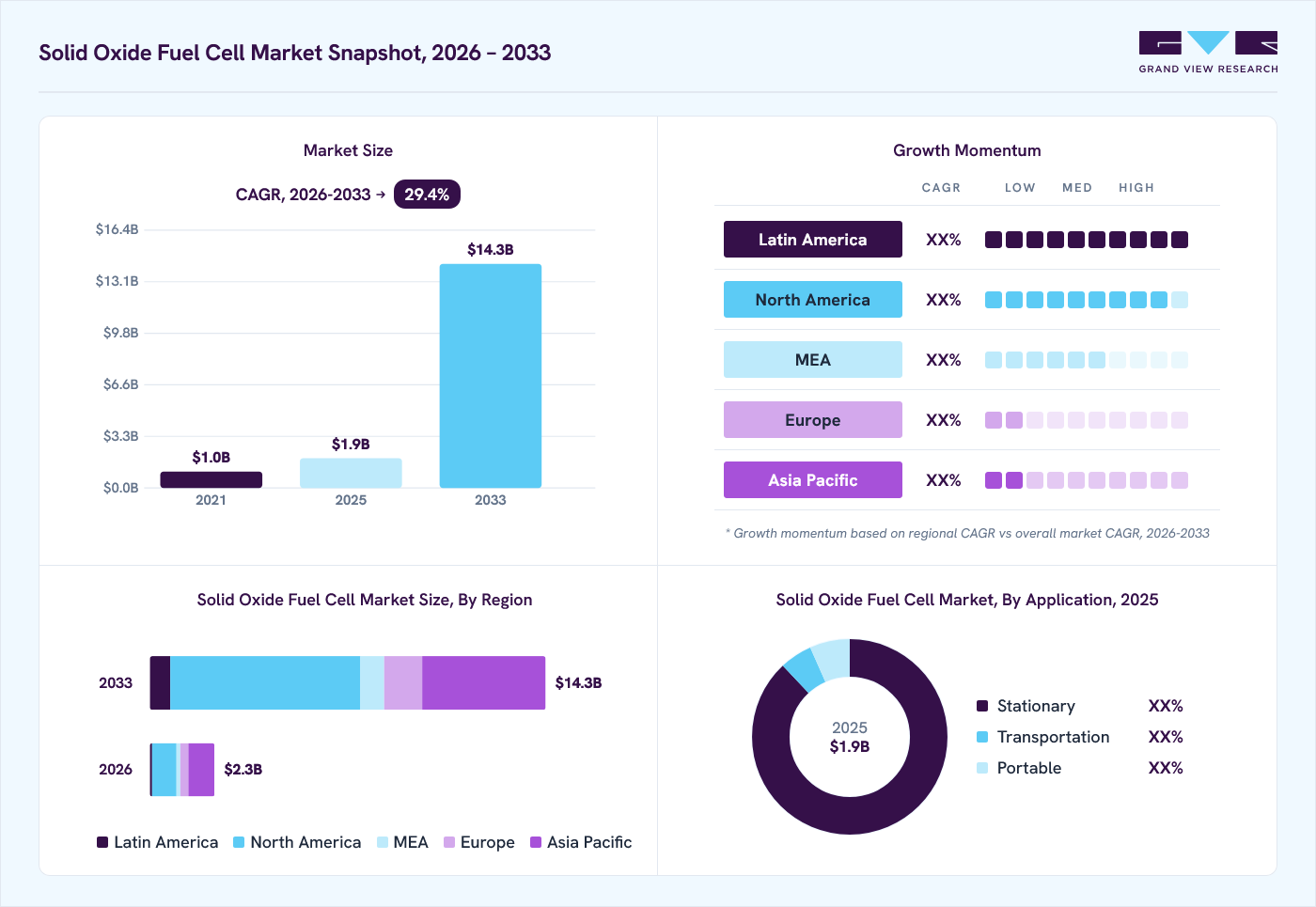 Source: Grand View Research, IR Documents, Primary Interviews, Paid DatabasesTo learn more about this report,
 Download Free Sample Report
 Key Market Trends & Insights
- By application: Stationary segment held the largest revenue share of 87.9% in 2025.
- The transportation application segment is projected to grow at the fastest CAGR of 40.2% over the forecast period.
Regional Highlights
- Largest regional market: Asia Pacific (42.0% revenue share, 2025)
- Fastest-growing regional market: Latin America (fastest CAGR, 2026-2033)
- By country: South Korea held the largest market share in 2025
Market Size & Forecast
- Market size in 2025: USD 1.9 Billion
- Estimated market size in 2026: USD 2.3 Billion
- Projected market size by 2033: USD 14.3 Billion
- CAGR (2026-2033):29.4%
Three ways to get this report
Buy it, customize it, or ask a question.Ask an Analyst
A direct answer, usually in 1 working day
- AccessReport author, directly
- Reply timeWithin 1 working day
- No sales callDirect answer only
- FormatEmail reply
- CostFree, no cost
Get the Full Report
What the study covers
- FormatsPDF · Excel · Dashboard
- Timeline2026–2033 annual, 2025 base
- Coverage20+ countries, 5 regions
- Companies10+ key players profiled
Customize the Report
20% free customization
- IncludeCountries, segments, points
- TailorTo your product definition
- ExtendDeeper competitor detail
- OrA fully bespoke study
- Turnaround5–10 working days
The growing need to decarbonize power generation, improve energy reliability, and transition toward cleaner fuels, particularly hydrogen, has placed SOFC technology at the forefront of sustainable energy solutions. Solid oxide fuel cells offer high fuel-to-electricity conversion efficiency, low emissions, and fuel flexibility, making them increasingly attractive across industrial and commercial power generation, distributed generation, combined heat and power (CHP), and auxiliary power applications. In recent years, heightened focus on energy security, grid resilience, and decarburization has supported interest in SOFC systems for stationary energy infrastructure, particularly in markets pursuing net-zero targets and greater energy-system flexibility.The SOFC market benefits from continued federal investment in hydrogen technologies and resilient, distributed energy systems in the U.S. In September 2024, the U.S. Department of Energy announced up to USD 4 million in funding for R&D focused on reversible SOFC systems, targeting applications such as hydrogen production, energy storage, microgrids, CHP, and distributed power generation. These initiatives are expected to support technology development, improve commercial viability, and stimulate demand for SOFC-based installations.
 To learn more about this report, Download Free Sample Report
 In addition, supportive policy frameworks, public-private collaboration, and investments in hydrogen infrastructure are enhancing the long-term scalability of solid-oxide technologies. Japan remains one of the most established markets for residential fuel-cell deployment, supported by its long-standing focus on energy efficiency, hydrogen utilization, and distributed generation. The country’s ENE-FARM program, launched in 2009, had surpassed 560,000 cumulative installations by the second quarter of FY2025. Japan is also strengthening its hydrogen policy framework and supply infrastructure to accelerate the adoption of hydrogen-related technologies.
SOFC and other fuel-cell systems are increasingly integrated into distributed energy and CHP applications, supporting efficient onsite power generation and improving energy resilience. Japan’s target of achieving carbon neutrality by 2050, coupled with ongoing R&D to reduce costs, improve durability, and enhance system performance, is expected to sustain demand for fuel-cell technologies. The country’s 2025 Strategic Energy Plan also calls for the development of highly efficient, durable, and lower-cost fuel-cell technologies, reinforcing the sector’s long-term growth prospects.
Solid oxide fuel cells provide a highly efficient and fuel-flexible power-generation solution, capable of operating on hydrogen, natural gas, and other fuels, depending on the system configuration. Their high operating temperature also enables integration with CHP, hydrogen production, and other energy-conversion applications. As grid stability, resilience, energy security, and emissions reduction become increasingly important, SOFC technology is gaining traction as a potential component of next-generation distributed energy systems. Government-backed R&D, subsidies, hydrogen initiatives, and industry partnerships are expected to strengthen the market outlook, although high capital costs, durability requirements, and system complexity remain important commercialization challenges.
Globally, the SOFC market is shaped by the convergence of hydrogen adoption, grid resilience, distributed generation, and rapidly rising electricity demand from data centers. Increasing interest in low-emission hydrogen and fuel-flexible power generation is encouraging the integration of SOFCs with hydrogen infrastructure, renewable energy, and reversible solid-oxide systems. The surge in demand for reliable on-site generation is gaining momentum as grid expansion faces cost, permitting, and capacity constraints, particularly in North America and Europe. Asia Pacific remains an important technology and deployment hub, supported by established fuel-cell programs in Japan and Korea, as well as expanding manufacturing capabilities in China. However, the global hydrogen sector continues to face high costs, infrastructure gaps, uncertain offtake, and evolving policy frameworks, which may moderate the pace of SOFC commercialization.
Market Dynamics
The solid oxide fuel cell market is growing due to increasing demand for high-efficiency, low-emission power generation solutions across commercial, industrial, and distributed energy applications. SOFCs are gaining adoption due to their ability to operate on multiple fuels, including hydrogen, natural gas, and biogas, while delivering high electrical efficiency and reliable baseload power. Rising investments in hydrogen infrastructure, clean energy technologies, and fuel cell-based distributed and backup power systems are supporting market growth. However, high operating temperatures, material and system costs, long start-up times, and durability challenges remain key factors limiting broader adoption and large-scale commercialization.
The growing focus on decarburization and the transition toward low-carbon energy systems are driving interest in SOFCs as an efficient alternative to conventional power generation technologies. Governments and industries are increasingly investing in clean hydrogen, renewable fuels, and distributed energy solutions to reduce emissions from fossil fuel-based electricity generation. SOFCs support this transition through high electrical efficiency, fuel flexibility, and the ability to operate on hydrogen and renewable gases, making them suitable for stationary power generation, microgrids, and backup power applications.
In 2025, the European Union continued advancing its hydrogen economy under the REPowerEU framework, which targets 10 million tonnes of domestic renewable hydrogen production and 10 million tonnes of imports by 2030. Continued policy support, funding mechanisms, and investments in hydrogen production and infrastructure are strengthening opportunities for solid-oxide technologies, including SOFCs, particularly in distributed power generation and combined heat and power (CHP) applications.
The high upfront cost associated with SOFC systems remains a key challenge limiting widespread adoption, particularly in residential and small-scale commercial applications. SOFCs require specialized ceramic materials, precision manufacturing processes, and high-temperature operating components, which increase system production and installation costs. Materials such as yttria-stabilized zirconia (YSZ) electrolytes, along with specialized electrodes, interconnects, seals, and thermal-management components, contribute to overall manufacturing and balance-of-plant expenses. As a result, the higher capital investment relative to conventional power generation technologies and other fuel cell systems limits market penetration among cost-sensitive end users, despite ongoing efforts to improve manufacturing efficiency and achieve economies of scale.
The increasing demand for reliable, decentralized, and low-carbon power solutions is creating significant growth opportunities for the SOFC market. As businesses, data centers, industrial facilities, and remote communities seek alternatives to conventional grid power, SOFC systems are gaining attention for their high efficiency, fuel flexibility, and ability to deliver continuous power with lower emissions. The integration of SOFCs with renewable hydrogen, biogas, and hybrid energy systems presents new opportunities for clean distributed generation, particularly in regions investing in energy resilience and decarbonization initiatives. In 2025, the U.S. DOE continued advancing its USD 7 billion Regional Clean Hydrogen Hubs program, supporting hydrogen production, infrastructure, and end-use applications that can expand opportunities for hydrogen-compatible SOFC-based power systems.
Analyst Perspective
The solid oxide fuel cell market is expected to witness steady growth as industries, data centers, and utilities increasingly seek highly efficient, low-emission, and reliable power generation solutions. Demand is being supported by the growing focus on hydrogen-based energy systems, distributed generation, grid resilience, and reliable backup power for critical infrastructure. A key trend shaping the market is the integration of SOFC technology with hydrogen, renewable and alternative fuels, and hybrid energy systems to improve efficiency and reduce emissions. However, high system costs, high-temperature operating requirements, material durability challenges, and the need for supporting fuel infrastructure remain key barriers to widespread adoption. Companies with advanced ceramic expertise, scalable manufacturing capabilities, and strategic partnerships are expected to gain a competitive advantage as commercialization accelerates.
Application Insights
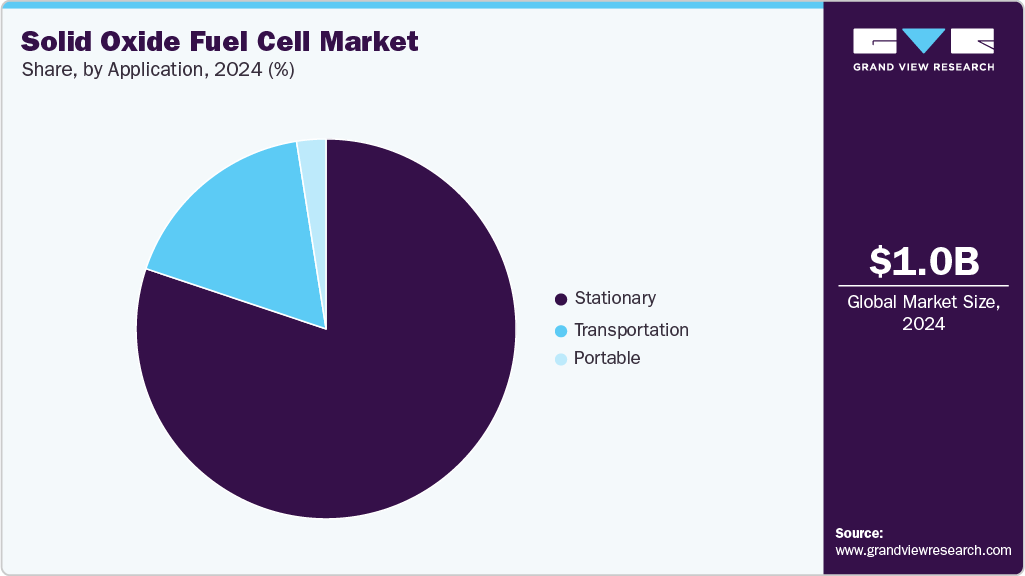
The stationary segment led the solid oxide fuel cell industry with the largest revenue share of 87.9% in 2025. This dominance is attributed to the growing deployment of SOFC systems for continuous power generation across commercial buildings, data centers, hospitals, industrial facilities, and utility-scale energy projects. Stationary SOFCs are being increasingly favored for their high electrical efficiency, fuel flexibility, reliable baseload operation, and low-emission power generation.
Growing demand for decentralized and resilient energy solutions is driving adoption in combined heat and power (CHP), microgrids, and onsite generation applications, particularly in regions facing grid capacity constraints, aging infrastructure, and stringent emissions requirements.The adoption of stationary SOFCs is increasingly driven by industries and institutions prioritizing energy resilience, operational reliability, and carbon reduction. SOFC systems are gaining attention for distributed generation, microgrids, data centers, and critical facilities that require continuous power while reducing dependence on conventional grid infrastructure.
The transportation application segment is projected to grow at the fastest CAGR of 40.2% over the forecast period. This rapid growth is primarily driven by increasing demand for high-efficiency, low-emission power solutions in the transportation sector, particularly for heavy-duty vehicles, auxiliary power units (APUs), marine applications, and hybrid-electric platforms. SOFCs offer key advantages such as high electrical efficiency, fuel flexibility, and lower emissions, making them attractive for applications where conventional power systems face efficiency and environmental limitations. As investments in clean mobility and alternative-fuel technologies continue to increase, transportation is expected to emerge as a significant growth opportunity within the SOFC market.
Regional Insights
North America region’s SOFC market is driven by the robust investments in clean energy technologies, growing demand for resilient and distributed power infrastructure, and an increasing emphasis on the development of the hydrogen economy. The U.S. represents the primary contributor to regional growth, supported by increasing deployment and commercialization of SOFC systems across commercial, industrial, data center, and distributed power applications.
 To learn more about this report, Download Free Sample Report
 SOFCs are gaining attention as reliable, high-efficiency alternatives to conventional power sources, particularly for data centers, healthcare facilities, commercial buildings, and microgrids. Federal support for fuel-cell R&D, hydrogen technologies, and clean energy infrastructure continues to support technology advancement and commercialization. In September 2024, the U.S. Department of Energy (DOE) announced up to USD 4 million in funding to advance reversible solid oxide fuel cell (R-SOFC) technology, supporting R&D aimed at reducing degradation and improving the commercial viability of SOFC systems. The initiative targets applications including distributed power generation, data centers, microgrids, combined heat and power (CHP), hydrogen production, and energy storage, thereby supporting the development and broader commercialization of SOFC technologies in the U.S.
Recent developments further reinforce North America’s market leadership. In April 2026, Bloom Energy expanded its strategic partnership with Oracle through an agreement to deploy up to 2.8 GW of fuel-cell capacity across the U.S., including an initial 1.2 GW that has already been contracted and is under deployment. The agreement highlights the growing importance of fuel-cell-based onsite generation in addressing data-center power requirements and grid constraints. In addition, GE Vernova identified solid oxide fuel cells as one of its breakthrough energy technologies targeted for commercialization, alongside technologies supporting data centers and grid modernization.
U.S. Solid Oxide Fuel Cell Market Trends
The U.S. solid oxide fuel cell industry held the largest share of 80.6% in 2025, in the North America region. The U.S. solid oxide fuel cell (SOFC) industry is growing rapidly, driven by strong federal support, state-level clean energy goals, and increasing interest in distributed, low-emission power generation. Legislative frameworks like the Inflation Reduction Act have created favorable conditions for fuel cell investments, offering tax credits and funding for hydrogen infrastructure, microgrid development, and zero-emission technologies.
With growing pressure to decarbonize power systems and strengthen energy reliability, SOFCs are gaining traction in commercial, industrial, and institutional applications, particularly for combined heat and power (CHP), data center backup, and off-grid operations. Rising demand for energy efficiency, grid resilience, and fuel flexibility is accelerating the adoption of SOFC technology in the U.S. The country is also advancing green hydrogen initiatives and electrolyzer integration, reinforcing SOFCs’ role in the emerging hydrogen economy.
Leading energy companies and research institutions heavily invest in next-generation SOFC systems, focusing on cost reduction, thermal efficiency, and long-term durability. As clean hydrogen production scales and distributed energy solutions become more widespread, the U.S. is positioned to remain a key market for SOFC deployment throughout the forecast period, supported by innovation, regulatory backing, and a growing base of commercial use cases.
Asia Pacific Solid Oxide Fuel Cell Market Trends
The Asia Pacific solid oxide fuel cell market is expected to grow at the fastest CAGR of 42.0% over the forecast period, driven by the large-scale investments in hydrogen infrastructure and a growing focus on low-emission technologies. The region is witnessing increased adoption of SOFC systems as part of its broader clean energy transition, with countries like Japan, South Korea, and China leading national efforts to deploy advanced fuel cell technologies.
Government-backed programs, decarburization mandates, and strategic investments in distributed power systems support this momentum. Integration of SOFCs into residential energy units, commercial CHP systems, and pilot hydrogen projects is steadily expanding, reinforcing the region’s role in global SOFC development. Policy-driven initiatives, rapid urbanization, and strong manufacturing capabilities continue to shape the Asia Pacific SOFC market.
Japan remains a frontrunner with its ENE-FARM residential fuel cell initiative, while China and South Korea are scaling up SOFC production capacity and demonstration projects. Regional governments also prioritize fuel diversification and grid resilience, creating favorable conditions for SOFC adoption. With growing energy demand, environmental concerns, and industrial decarbonization targets, Asia Pacific is expected to significantly contribute to the global solid oxide fuel cell industry throughout the forecast period.
China Solid Oxide Fuel Cell Market
China's presence in the SOFC market is attributed to strong government support for hydrogen and fuel cell technologies, extensive investments in clean energy infrastructure, and a well-established manufacturing base. The country has been actively promoting fuel cell development through national energy and decarbonization strategies, encouraging the deployment of advanced power generation technologies. In addition, increasing industrial demand for efficient and low-emission energy systems, coupled with ongoing research and commercialization efforts, has strengthened China's position in the global SOFC market.
Europe Solid Oxide Fuel Cell Market Trends
The Europe solid oxide fuel cell (SOFC) industry is projected to grow at a CAGR of 24.8% from 2026 to 2033, advancing steadily, supported by the region’s commitment to achieving climate neutrality, hydrogen integration goals, and energy diversification under frameworks like the European Green Deal and REPowerEU. As Europe transitions from fossil fuels, SOFCs are gaining attention for their high efficiency, flexibility, and compatibility with hydrogen-based energy systems. Governments across the region are increasingly funding pilot projects, R&D initiatives, and commercial demonstrations to scale SOFC deployment in industrial decarburization, distributed power generation, and combined heat and power (CHP) applications.
Rising energy security concerns, driven by geopolitical disruptions and the need to reduce reliance on imported gas, are accelerating investments in clean, decentralized energy technologies. SOFC systems are being adopted in manufacturing, transportation hubs, and large commercial facilities where continuous, low-emission power is critical. Europe’s mature regulatory environment, well-developed infrastructure, and strong public-private collaboration support the commercialization of fuel cell technologies. With growing momentum behind green hydrogen production, cross-border energy integration, and smart energy systems, Europe is expected to play a pivotal role in shaping the global SOFC market throughout the forecast period.
Latin America Solid Oxide Fuel Cell Market
Latin America region’s SOFC market is expected to register the fastest CAGR of 35.9% from 2026 to 2033. The growth of the SOFC market in Latin America is supported by the region's increasing focus on energy diversification, renewable energy integration, and sustainable power generation. Governments and utilities are exploring advanced energy technologies to enhance grid resilience and reduce carbon emissions. Growing industrialization, coupled with the need for efficient distributed power systems in remote areas, is creating favorable conditions for SOFC adoption. Continued investments in hydrogen and clean energy infrastructure are also contributing to market development.
Middle East & Africa Solid Oxide Fuel Cell Market
The Middle East & Africa solid oxide fuel cell market is gaining traction due to the region's expanding clean energy initiatives and increasing emphasis on energy transition strategies. Several countries are investing in hydrogen production, carbon reduction programs, and advanced power generation technologies to support long-term sustainability objectives. In addition, rising electricity demand from industrial facilities, commercial establishments, and emerging smart city projects is encouraging interest in high-efficiency fuel cell systems. These factors are expected to support the gradual expansion of SOFC deployments across the region.
Key Solid Oxide Fuel Cell Company Insights
Some of the key players operating in the global solid oxide fuel cell market include Bloom Energy, and General Electric, among others.
-
Bloom Energy is a prominent participant in the SOFC market, specializing in high-temperature fuel cell systems for distributed power generation. The company’s portfolio includes Bloom Energy Servers, which generate electricity using solid oxide fuel cell technology and can operate on natural gas, biogas, hydrogen, and blended fuels. Its solutions are deployed across data centers, commercial facilities, manufacturing sites, utilities, and critical infrastructure applications requiring reliable, low-emission power. Bloom Energy continues to advance fuel flexibility and efficiency through ongoing technology development and commercial deployments. The company’s growing presence in data centers, energy-intensive industries, and hydrogen-powered applications reinforces its position as one of the most established SOFC manufacturers globally.
-
General Electric (GE Vernova) is an important participant in the SOFC market through its focus on advanced power generation, grid integration, and decarbonization technologies. The company supports SOFC deployment by providing electrical balance-of-plant equipment, grid connection solutions, power electronics, digital monitoring systems, and energy management technologies that enable the integration of fuel cell systems into broader energy networks. GE Vernova's expertise in distributed energy resources, microgrids, and hybrid power systems positions it to support commercial and industrial SOFC applications. Through its strong presence in power infrastructure and energy transition projects, the company contributes to the development of efficient and resilient fuel-cell-based energy solutions.
Key Solid Oxide Fuel Cell Companies
The following key companies have been profiled for this study of the solid oxide fuel cell market.
-
Bloom Energy
-
MITSUBISHI HEAVY INDUSTRIES, LTD.
-
Ceres Power Holding plc
-
General Electric
-
FuelCell Energy Inc.
-
Ningbo Sofuren Energy Technology Co., Ltd
-
KYOCERA Corporation
-
AVL
-
Niterra Co., Ltd.
-
Elcogen
Competitive Benchmarking
Category
Operating Strategies
Competitive Edge
Weakness
Established Players (Bloom Energy, MITSUBISHI HEAVY INDUSTRIES, LTD., General Electric, FuelCell Energy, Inc., KYOCERA Corporation, AVL, Niterra Co., Ltd.)
- Focus on commercializing SOFC systems through large-scale deployments in distributed power generation, data centers, industrial facilities, and microgrids.
- Invest in R&D to improve fuel flexibility, efficiency, durability, and cost competitiveness of SOFC technologies.
- Leverage existing global energy, manufacturing, and customer networks to expand adoption.
- Develop integrated solutions combining fuel cells with hydrogen, renewable energy, and energy management systems.
- Strong brand recognition and customer trust due to long operating history in energy and industrial sectors.
- Established manufacturing capabilities and supply chain networks enabling commercial-scale production.
- Higher financial strength to support continuous R&D investments and large infrastructure projects.
- Broad application expertise across stationary power, distributed generation, and clean energy systems.
- High capital requirements and manufacturing costs compared with conventional power technologies.
- SOFC systems face challenges related to high operating temperatures, longer startup times, and material degradation.
- Dependence on availability of hydrogen and renewable fuel infrastructure for long-term adoption.
- Larger organizational structures may reduce agility in responding to rapidly evolving fuel cell technologies.
Emerging Players (Ceres Power Holding plc, Ningbo Sofuren Energy Technology Co., Ltd.)
- Focus on developing advanced SOFC stack technologies, materials innovation, and improving cell efficiency and durability.
- Adopt partnership-driven models through licensing, technology collaborations, and joint development agreements with larger industrial players.
- Target niche applications such as hydrogen production, distributed energy systems, and next-generation energy solutions.
- Scale manufacturing gradually while optimizing production costs and performance.
- Strong technological specialization and innovation capabilities in SOFC cells, stacks, and ceramic materials.
- Greater flexibility and faster innovation cycles compared with larger industrial companies.
- Advanced expertise in specific SOFC components can create differentiation through higher efficiency and improved durability.
- Partnership-oriented approach enables access to global markets without requiring extensive infrastructure investment.
- Limited commercial-scale deployment and lower market visibility compared with established players.
- Smaller manufacturing capacity and limited financial resources can slow commercialization.
- Greater dependence on strategic partnerships, investors, and government support.
- Challenges in achieving cost competitiveness and scaling production volumes.
Recent Developments
-
In April 2026, Ceres Power launched Ceres Endura, its next-generation solid oxide fuel cell stack platform designed to support large-scale power generation applications. The platform is positioned around lower cost, scalability, durability, and improved performance, targeting applications such as data centers and distributed power generation.
-
In November 2025, Ceres Power signed a manufacturing license agreement with Weichai Power for the production of Ceres’ proprietary solid oxide fuel cell technology in China. Under the agreement, Weichai intends to establish manufacturing capabilities for SOFC cells and stacks targeting stationary power applications, including AI data centers, commercial buildings, and industrial facilities.
-
In March 2025, Niterra announced that its joint venture, MORIMURA SOFC TECHNOLOGY, had developed a compact, high-efficiency mono-generation SOFC system aimed at supporting the emerging hydrogen economy.
-
In February 2025, Bloom Energy expanded its agreement with Equinix to more than 100 MW of fuel-cell capacity across 19 data centers in the U.S., with approximately 75 MW already operational and another 30 MW under construction. Bloom’s Energy Server platform is based on solid oxide fuel cell (SOFC) technology and is being deployed to provide reliable, cleaner onsite power for data centers.
-
In August 2024, Bloom Energy announced that its solid oxide fuel cell platform had achieved approximately 60% electrical efficiency while operating on 100% hydrogen, with up to 90% efficiency in high-temperature combined heat and power applications. The achievement represented a significant advancement in hydrogen-fueled SOFC performance and demonstrated the platform’s ability to operate on hydrogen while retaining high efficiency.
Solid Oxide Fuel Cell Market Report Scope
Report Attribute
Details
Market Definition
Solid Oxide Fuel Cells (SOFCs) are electrochemical energy-conversion devices that generate electricity through an electrochemical reaction between a fuel and oxygen using a solid ceramic electrolyte, typically operating at high temperatures. The Solid Oxide Fuel Cells Market represents the annual revenues generated from the sale of SOFC systems used across stationary, transportation, and portable applications.
Market size in 2025
USD 1.9 billion
Estimated market size in 2026
USD 2.3 billion
Projected market size by 2033
USD 14.3 billion
Growth rate
CAGR of 29.4% from 2026 to 2033
Base year for estimation
2025
Historical data
2021 - 2024
Forecast period
2026 - 2033
Quantitative units
Revenue in USD million/billion, Volume in Units, Capacity in kW, and CAGR from 2026 to 2033
Report coverage
Revenue forecast, volume forecast, capacity forecast, company ranking, competitive landscape, growth factors, and trends
Segments covered
Application and region
Regional scope
North America; Europe; Asia Pacific; Latin America; Middle East & Africa
Country scope
U.S.; Canada; Mexico; Germany; UK; France; China; India; Japan; South Korea; Brazil; Saudi Arabia; South Africa; UAE
Key companies profiled
Bloom Energy; MITSUBISHI HEAVY INDUSTRIES, LTD.; Ceres Power Holding plc; General Electric; FuelCell Energy, Inc.; Ningbo Sofuren Energy Technology Co., Ltd.; KYOCERA Corporation; AVL; Niterra Co., Ltd.; Elcogen
Customization scope
Free report customization (equivalent up to 8 analysts' working days) with purchase. Addition or alteration to country, regional & segment scope.
Pricing and purchase options
Avail customized purchase options to meet your exact research needs. Explore purchase options
Global Solid Oxide Fuel Cell Market Report Segmentation
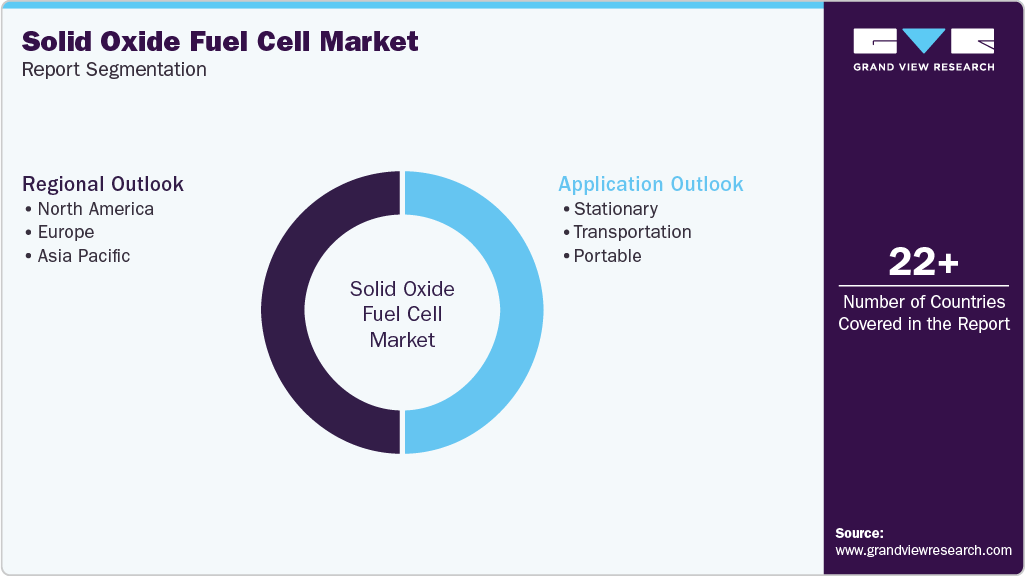
This report forecasts revenue growth at the global, regional & country levels and provides an analysis of the latest industry trends in each of the sub-segments from 2021 to 2033. For this study, Grand View Research has segmented the global solid oxide fuel cell market report based on application and region:
 To learn more about this report, Download Free Sample Report
 -
Application Outlook (Revenue, USD Million; Volume, Units; Capacity, KW; 2021-2033)
-
Stationary
-
Transportation
-
Portable
-
-
Regional Outlook (Revenue, USD Million; Volume, Units; Capacity, KW; 2021-2033)
-
North America
-
U.S.
-
Canada
-
Mexico
-
-
Europe
-
Germany
-
UK
-
France
-
-
Asia Pacific
-
China
-
Japan
-
South Korea
-
India
-
-
Latin America
-
Brazil
-
-
Middle East & Africa
-
UAE
-
Saudi Arabia
-
South Africa
-
-
Market Definitions
We have segmented the solid oxide fuel cell market based on application and region.
In the first level, the market has been segmented into the following types of applications:
-
Stationary: Stationary SOFCs are fixed fuel cell systems used for continuous power generation, combined heat and power (CHP), backup power, and distributed energy applications. Revenue is generated from the sales of stationary SOFC systems across residential, commercial, industrial, and utility sectors.
-
Transportation: Transportation SOFCs are fuel cell systems used in heavy-duty vehicles, marine vessels, and auxiliary power units (APUs). Revenue is generated from the sales of SOFC systems integrated into transportation platforms for onboard power generation.
-
Portable: Portable SOFCs are compact fuel cell systems designed for off-grid, remote, and mobile power applications. Revenue is generated from the sales of portable SOFC units for field power, emergency backup, military, and outdoor energy applications.
Based on region, the market has been segmented into North America, Europe, Asia Pacific, Latin America, and the Middle East & Africa.
-
North America: The North America regional market includes the U.S., Canada, and Mexico.
-
Europe: The Europe regional market includes the UK, Germany, and France.
-
Asia Pacific: The Asia Pacific regional market includes China, India, Japan, and South Korea.
-
Latin America: The Latin America regional market includes Brazil.
-
Middle East & Africa: The Middle East & Africa regional market includes Saudi Arabia, the UAE, and South Africa.
Research Methodology
The solid oxide fuel cell market figures in this report are based on a proven research process that combines executive interviews with secondary research from proprietary databases, company filings, and recognized regulatory and institutional sources. Market size is built through value-chain sizing - reconciling supply-side and demand-side estimates - and triangulated with bottom-up and top-down approaches. Every estimate passes multiple levels of expert validation before publication, with each solid oxide fuel cell segment quantified using the revenue-capture definitions in the table below.
Segment Definition
Segment - Application
Revenue capture definition
Stationary
Stationary SOFCs are fixed fuel cell systems used for continuous power generation, CHP, backup power, and distributed energy applications. Revenue is generated from the sales of stationary SOFC systems across residential, commercial, industrial, and utility sectors.
Transportation
Transportation SOFCs are fuel cell systems used in heavy-duty vehicles, marine vessels, and auxiliary power units (APUs). Revenue is generated from the sales of SOFC systems integrated into transportation platforms for onboard power generation.
Portable
Portable SOFCs are compact fuel cell systems designed for off-grid and remote applications. Revenue is generated from the sales of portable SOFC units for field power, emergency backup, military, and outdoor energy applications.
Estimation Model
Layer Name
Key Question
Description
Solid Oxide Fuel Cell Demand Layer
What drives the demand for SOFCs?
Identify key demand drivers for SOFCs, including increasing demand for clean energy generation, growing adoption of distributed power systems, rising focus on hydrogen-based energy solutions, and the need for high-efficiency power generation technologies. Assess factors such as decarbonization targets, energy security requirements, increasing demand for backup power, and advancements in fuel cell technologies influencing SOFC adoption.
Solid Oxide Fuel Cell Technology Layer
What types of SOFC technologies are adopted?
Analyze SOFC adoption based on technology developments, including electrolyte materials, fuel flexibility, system efficiency, operating temperature, and stack design. Assess technology preferences based on performance requirements, durability, cost reduction efforts, hydrogen compatibility, and suitability for stationary, transportation, and portable power applications.
Solid Oxide Fuel Cell Application Layer
Where are SOFCs deployed?
Evaluate SOFC demand across applications, including stationary, transportation, and portable uses. Assess adoption based on power generation requirements, emission reduction goals, energy reliability needs, distributed electricity generation, and suitability for applications such as commercial facilities, industrial sites, vehicles, and off-grid power systems.
Revenue Layer
How is market revenue generated?
Market revenue is quantified through the sales of solid oxide fuel cell systems across different applications. The overall market value is determined by revenue generated from stationary, transportation, and portable SOFC system sales used for electricity generation, backup power, combined heat and power (CHP), and other clean energy applications.
Delivered Customizations
This report has been delivered with the following In-depth customizations
Client Request
Customization Delivered
Value Adds
Application Opportunity Analysis
A detailed assessment was conducted to evaluate SOFC adoption opportunities across key applications, including distributed power generation, data centers, residential combined heat and power (CHP), industrial facilities, microgrids, backup power, and hydrogen-based energy systems. The analysis covered application-specific demand drivers, efficiency requirements, deployment trends, and future growth potential.
Provided insights into high-growth application areas, adoption barriers, and revenue opportunities for SOFC technology providers.
Competitive Landscape Assessment
Key SOFC players were benchmarked based on technology platforms, fuel cell stack capabilities, product portfolios, power generation capacity, efficiency performance, manufacturing capabilities, R&D investments, strategic partnerships, geographic presence, and recent developments.
Enabled evaluation of competitive positioning, technology differentiation, market strategies, and emerging opportunities among established and emerging SOFC companies.
Regional Market Opportunity Assessment
A region- and country-level analysis was conducted to assess SOFC market potential by evaluating clean energy policies, hydrogen economy initiatives, distributed generation demand, industrial decarbonization targets, fuel infrastructure development, and investment trends across North America, Europe, Asia Pacific, and other emerging regions.
Identified high-potential markets, regional growth drivers, and expansion opportunities for SOFC manufacturers and technology developers.
About the Author(s)
Renewable Energy Research Team
Energy & Power · Renewable EnergyThis report was authored by the renewable energy research team at Grand View Research - comprising two research analysts, one senior research analyst, and one industry expert - with specialized expertise in the renewable energy segment of the energy & power industry. All findings are based on proprietary energy & power databases, executive interviews, and regulatory analysis, subject to internal peer review prior to publication.
Last Updated:
Speak to Analyst

Customize this report to your needs - add regions, segments, or data points, with 20% free customization.
Or view our licence options:


ISO 9001:2015 & 27001:2022 Certified
We are GDPR and CCPA compliant! Your transaction & personal information is safe and secure. For more details, please read our privacy policy.


