
- Home
- »
- Clothing, Footwear & Accessories
- »
-
Southeast Asia Lingerie Market Size & Share Report, 2033GVR Report cover

Southeast Asia Lingerie Market (2026 - 2033)
Size, Share & Trends Analysis Report By Product (Briefs, Shapewear, Bras), By Distribution Channel (Online, Offline), By Country (Singapore, Indonesia, Malaysia), And Segment Forecasts
Market Size, 2025
$3.9BMarket Estimate, 2026
$4.0BMarket Forecast, 2033
$6.5BCAGR, 2026–2033
7.0%Southeast Asia Lingerie Market Summary
The Southeast Asia lingerie market size was valued at USD 3.9 billion in 2025 and is projected to grow from USD 4.0 billion in 2026 to USD 6.5 billion by 2033, at a CAGR of 7.0% from 2026 to 2033. The growth is driven by rising body-positivity and inclusivity trends that boost demand for comfortable, diverse styles, along with e-commerce growth and social media marketing that accelerate premiumization and global adoption. It is experiencing steady growth, driven by rising fashion awareness, increasing disposable incomes, and growing consumer preference for comfortable, functional, and aesthetically appealing intimate wear.
Key Market Trends & Insights
- By product: Briefs led the market and accounted for a share of 56.6% in 2025.
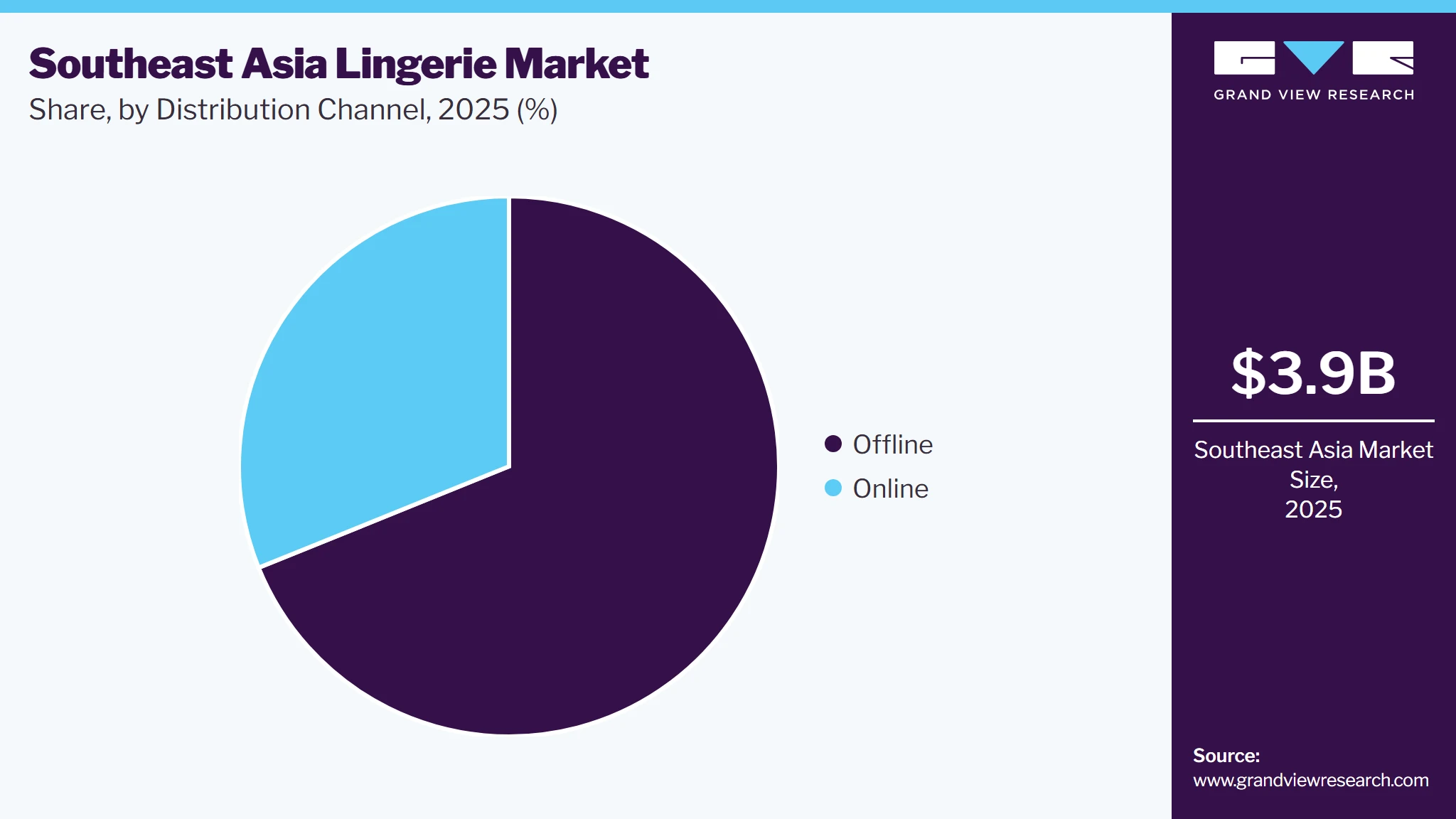
- By distribution channel: Offline sales held the largest market share of 68.9% in 2025.
Market Size & Forecast
- Market size in 2025: USD 3.9 Billion
- Estimated Market Size in 2026: USD 4.0 Billion
- Projected Market Size by 2033: USD 6.5 Billion
- CAGR (2026-2033): 7.0%
Prism AI by Grand View Research Free to tryAsk a question about the southeast asia lingerie market✓Every figure cited from GVR research Prefer the report? Download free sample →
Consumers are increasingly seeking products that combine comfort, support, and style, fueling demand for seamless bras, wireless bras, shapewear, sleepwear, and premium everyday lingerie. The rapid expansion of e-commerce, social commerce, and influencer-led marketing across countries such as Indonesia, Thailand, Vietnam, Malaysia, and the Philippines is further accelerating product accessibility and brand visibility.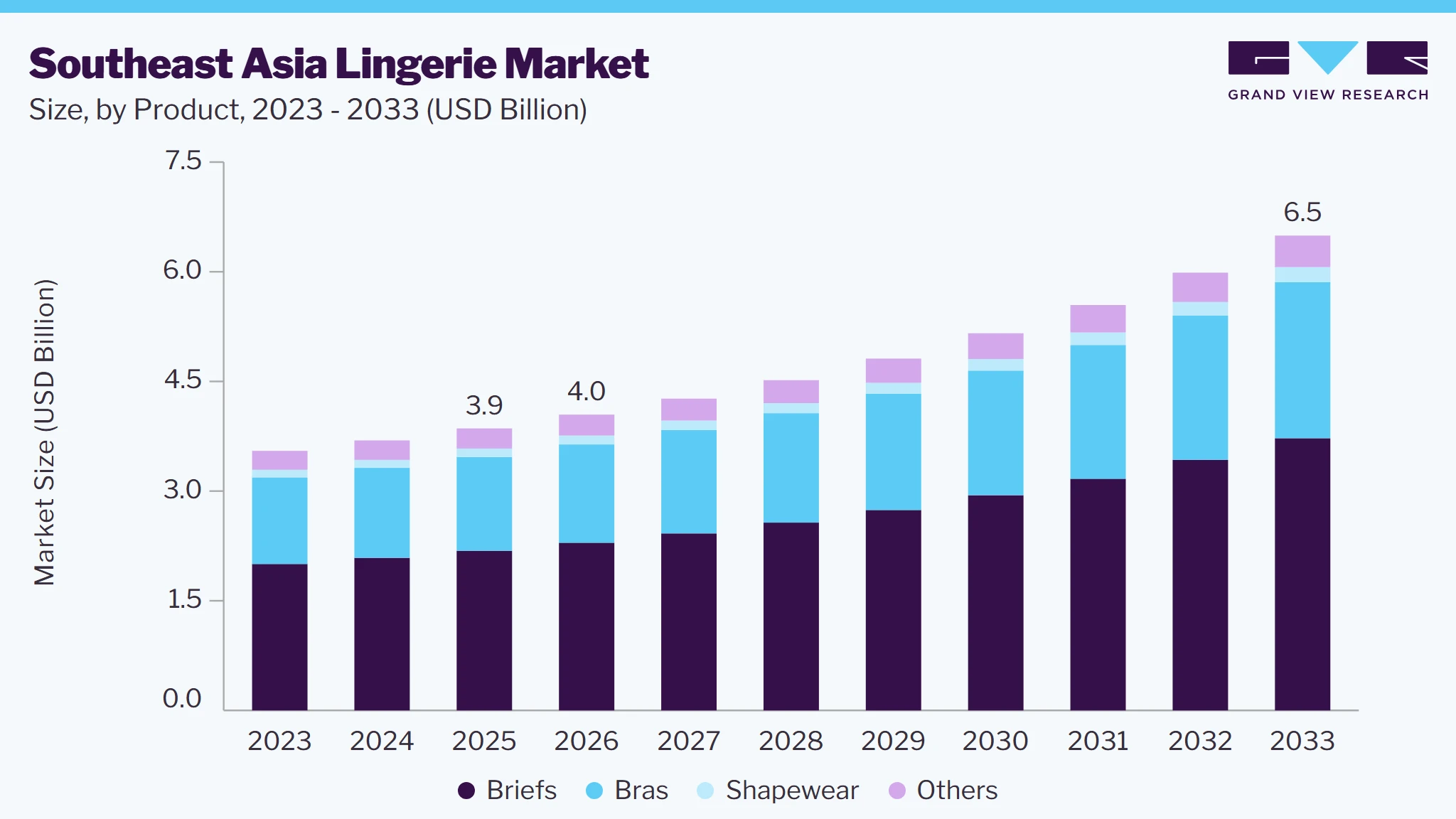 Source: Grand View Research, IR Documents, Primary Interviews, Paid DatabasesTo learn more about this report,
 Download Free Sample Report
The market is also witnessing a notable shift toward innovative and performance-oriented lingerie featuring breathable fabrics, seamless construction, moisture-wicking materials, and inclusive sizing. Brands are increasingly incorporating sustainable textiles, body-positive designs, and comfort-focused technologies to cater to evolving consumer preferences. For instance, in March 2025, Triumph expanded its Body Make-Up Illusion collection with innovative comfort-focused lingerie featuring Comfort Wire technology, lightweight fabrics, seamless cup edges, and cooling textile finishes, reflecting the growing demand for technologically advanced and premium everyday lingerie across Southeast Asia.
A prominent trend in the Southeast Asian lingerie market is the growing emphasis on inclusivity and body positivity. Contemporary consumers increasingly demand products that cater to diverse body types while ensuring comfort, functionality, and aesthetic appeal. Brands that integrate these values into design and marketing strategies are gaining significant traction, positioning lingerie as a medium for self-expression and personal empowerment rather than merely a functional garment. This shift is reshaping product development, promotional approaches, and competitive dynamics within the regional market.
Southeast Asia’s lingerie market is benefiting from rising middle-class incomes and increasing urban affluence. In countries like Indonesia and Thailand, rising disposable incomes have shifted consumer behavior from purchasing purely functional undergarments to seeking stylish, premium lingerie. Women are now willing to invest in quality, comfortable, and fashionable products, with mid‑segment and international brands gaining traction as aspirational purchases.
The rapid adoption of e‑commerce has also played a key role in market growth. Online platforms provide privacy and a wide range of options, which is especially important in culturally sensitive markets. Consumers in Singapore, Malaysia, and Vietnam are increasingly using social media and online stores to explore brands, compare fits, and buy lingerie discreetly. Influencer campaigns and targeted digital marketing have accelerated discovery and created demand for products that blend style with comfort.
Cultural attitudes toward lingerie are evolving with younger urban consumers seeking comfort, inclusivity, and fashion expression. In cities like Kuala Lumpur and Singapore, lingerie is embraced as part of personal style rather than just a necessity. Brands that offer diverse sizing, body-positive messaging, and modern designs are resonating with consumers who value authenticity. This shift encourages local and international brands to expand product lines and tailor marketing strategies to match changing preferences.
In August 2024, 6IXTY8IGHT launched a special summer collection with Chupa Chups across Asia, featuring playful bralettes and panties, available both offline and online, including its debut on Shopee Mall, targeting young women seeking style and comfort.
Market Dynamics
The market is being driven by rising consumer preference for comfortable, functional, and fashionable intimate apparel, supported by increasing disposable incomes, urbanization, and greater fashion awareness. Consumers across Indonesia, Thailand, Vietnam, Malaysia, Singapore, and the Philippines are increasingly opting for seamless bras, wireless bras, shapewear, and sleepwear that offer enhanced comfort, breathability, and all-day wearability. The rapid expansion of e-commerce platforms, social commerce, and direct-to-consumer (DTC) brands has significantly improved product accessibility, enabling consumers to explore a wider variety of styles, sizes, and premium collections. In addition, growing awareness of body positivity, inclusive sizing, and sustainable materials is encouraging brands to introduce innovative collections tailored to diverse consumer preferences. Celebrity endorsements, influencer marketing, and digital campaigns are further strengthening consumer engagement, resulting in higher purchase frequency and supporting the sustained growth of the Southeast Asia lingerie market.
Price sensitivity among consumers and the widespread availability of low-cost, unbranded, and counterfeit lingerie continue to restrain the growth of the Southeast Asia lingerie market. Although demand for premium and technologically advanced lingerie is increasing, a large share of consumers in emerging Southeast Asian economies remains highly price-conscious and often prefers affordable alternatives over branded products. This creates pressure pricing for established manufacturers while limiting the adoption of premium collections featuring innovative fabrics, seamless construction, moisture-wicking technologies, and sustainable materials. In addition, counterfeit products and unorganized local manufacturers often imitate premium designs at significantly lower prices, affecting brand reputation and reducing sales of authentic products. Variations in purchasing power, import duties, and uneven retail infrastructure across the region further challenge market expansion, particularly for international brands seeking to strengthen their presence in price-sensitive markets.
Brand Share Analysis
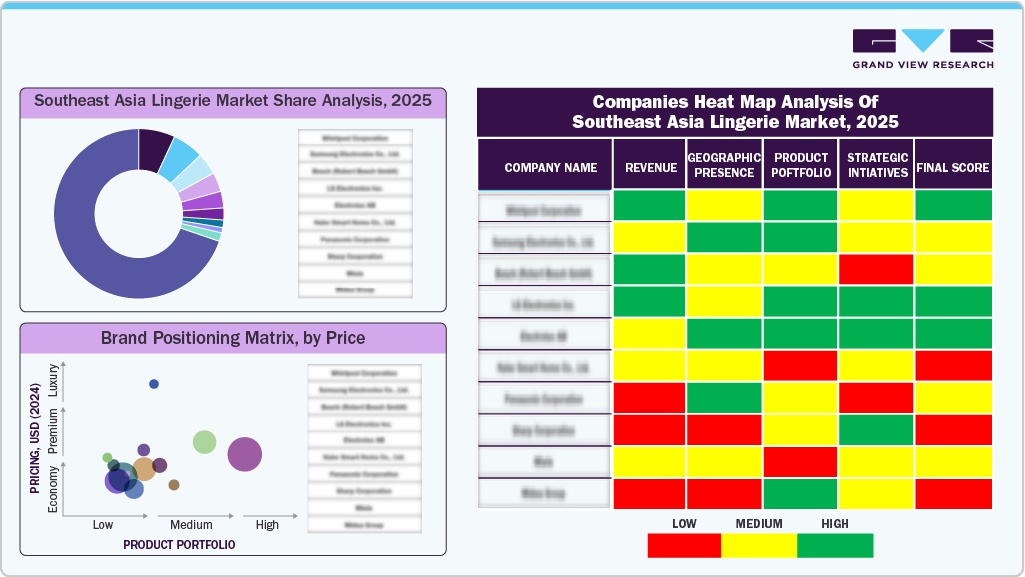
Brand share in Southeast Asia is driven by localization, with companies adapting sizes, fits, and designs to cultural preferences and tropical climates, which helps products resonate with everyday wear needs.
 To learn more about this report, Download Free Sample Report
Digital‑first strategies, including strong e‑commerce platforms and social media engagement, significantly influence brand visibility and sales, especially among younger, online-savvy consumers.
Brands that balance quality and affordability capture broader market segments, appealing simultaneously to aspirational buyers and price-sensitive shoppers across the region.
- In Southeast Asia, La Senza, Triumph, and Etam hold significant market share by localizing products to regional body types, cultural preferences, and tropical climate needs, ensuring high consumer relevance.
-
Zalora’s private labels, Marks & Spencer, and Victoria’s Secret leverage digital-first strategies and e‑commerce platforms to drive visibility and penetration among younger, online-savvy shoppers.
-
Mid-segment brands like SOKO and Wacoal expand reach by balancing comfort, quality, and affordability, appealing to both aspirational buyers and price-conscious consumers across the region.
Consumer Insights
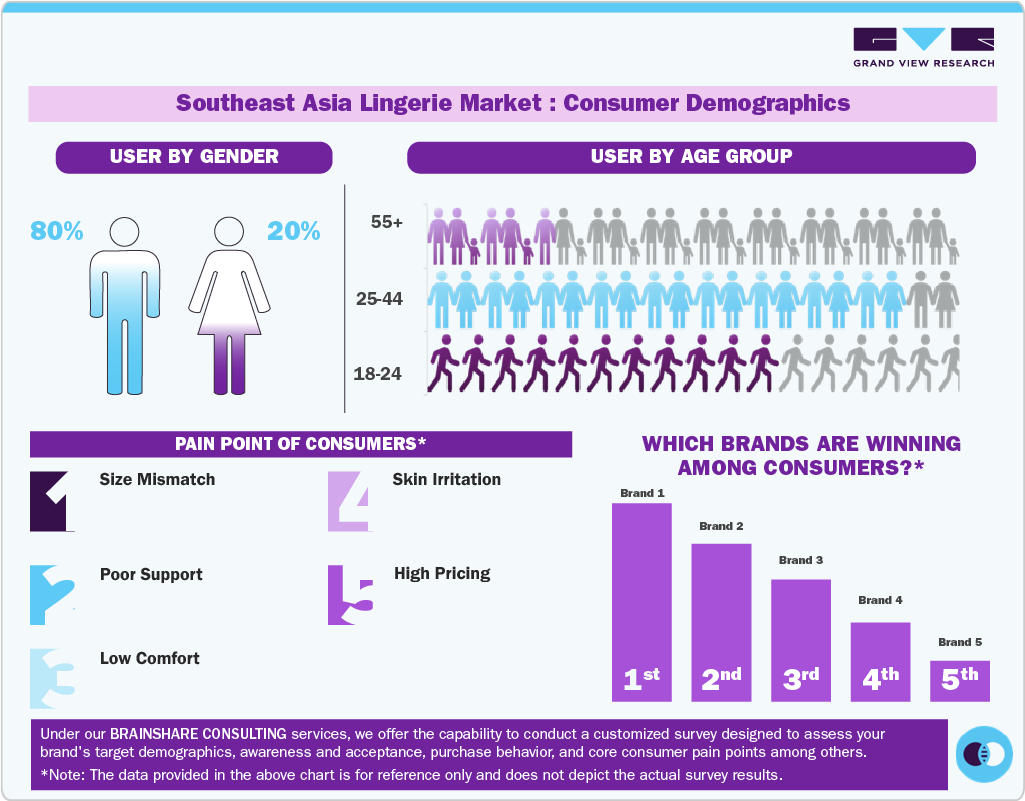
The Southeast Asian lingerie market is dominated by the value and essentials segment, which accounts for 80% of users, while premium and aspirational consumers make up the remaining 20%. This indicates that most purchases are driven by affordability and everyday needs rather than luxury positioning.
 To learn more about this report, Download Free Sample Report
In terms of age distribution, the 18-24 and 25-34 age groups form the core consumer base, with the younger segment slightly leading in numbers. Consumers aged 35-44 are also active but in smaller proportions, suggesting that lingerie marketing strategies should primarily target younger, urban women.
Key pain points for consumers include size mismatch, poor support, low comfort, skin irritation, and high pricing. These issues highlight the need for brands to focus on accurate sizing, ergonomic designs, and skin-friendly fabrics while maintaining competitive pricing.
Among brands, Triumph leads consumer preference, followed by Wacoal, Victoria’s Secret, La Perla, and Oysho. This ranking reflects the balance between trusted international names and brands that provide fit and comfort suited to regional consumers.
Analyst Perspective
The Southeast Asia lingerie market is evolving from a value-driven apparel category into a fashion-forward, comfort-oriented segment shaped by changing consumer lifestyles, digital retail expansion, and rising demand for premium intimate wear. Consumers are increasingly prioritizing seamless designs, wireless support, breathable fabrics, and inclusive sizing, prompting manufacturers to invest in product innovation and functional apparel. The rapid growth of e-commerce, social commerce, and direct-to-consumer (DTC) brands is enhancing market accessibility, while influencer marketing and personalized online shopping experiences are accelerating consumer engagement across the region. At the same time, sustainability initiatives, fabric innovation, and body-positive product offerings are strengthening brand differentiation. Although price sensitivity and competition from low-cost local and counterfeit products remain challenges, rising disposable incomes, premiumization, and increasing fashion consciousness are expected to support long-term market growth across Southeast Asia.
Product Insights
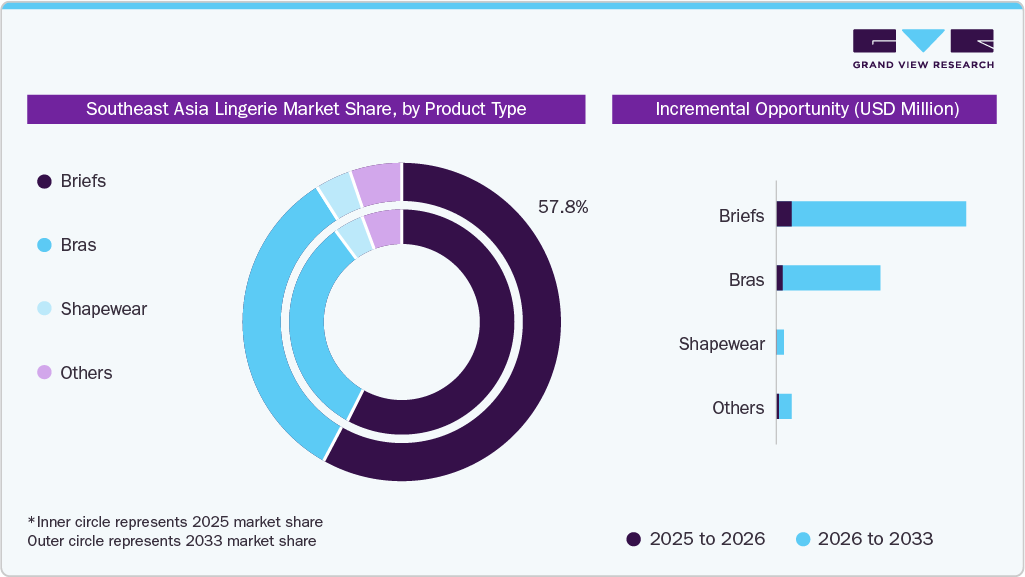
The briefs segment accounted for a 56.6% share of the market revenue in 2025, as they combine everyday comfort, versatile fit, and affordability, making them the go-to choice across age groups and markets. Unlike fashion-focused or premium designs, briefs suit daily wear, are easier to produce in multiple sizes, and appeal to both mass and premium consumers, driving consistent high sales globally.
 To learn more about this report, Download Free Sample Report
The shapewear segment is anticipated to grow at a CAGR of 7.7% from 2026 to 2033, due to rising body-consciousness and demand for figure-enhancing, confidence-boosting apparel. Consumers increasingly prefer versatile, comfortable shapewear that can be worn under everyday or formal outfits, while social media trends and influencer promotions are driving awareness and adoption.
In August 2022, Malaysian fashion designer Datuk Jovian Mandagie launched his latest shapewear line and tapped several well‑known Malaysian personalities, including music group Dolla and singer Ning Baizura, to front the campaign, using their star power to promote the collection and broaden its appeal in Malaysia’s fashion market.
Distribution Channel Insights
The sales of lingerie through offline channels accounted for 68.9% of the market. This can be attributed to the consistent consumer preference for in-person fitting, tactile experience, and immediate purchase, especially for items where comfort and fit are critical. Brick-and-mortar stores also offer personalized assistance, size guidance, and the ability to try multiple styles at once, making them the preferred choice for most buyers despite the rise in e-commerce. Brands like Victoria’s Secret and Marks & Spencer have leveraged this to boost sales and customer loyalty.
 To learn more about this report, Download Free Sample Report
The sale of lingerie through the online channel is expected to grow at a CAGR of 7.9% from 2026 to 2033, due to increasing internet penetration, widespread smartphone adoption, and the convenience of home delivery. Consumers in countries like Indonesia, Malaysia, and Thailand are increasingly comfortable purchasing intimate apparel online, driven by privacy, ease of comparison, and access to a wider variety of brands. For example, platforms like Zalora and Lazada frequently run targeted lingerie campaigns and personalized recommendations, encouraging repeat purchases and boosting consumer trust in e-commerce for fashion essentials.
Country Insights
The Indonesia lingerie market accounted for the share of 30.5% in 2025. The Indonesian market, a significant contributor to the Southeast Asia women's innerwear market, is driven by the country's large female population, expanding middle-income households, and increasing adoption of branded intimate apparel. Consumers are gradually shifting from basic innerwear to fashionable and functional products, creating strong demand in the lingerie market for everyday bras, seamless panties, nursing bras, and modest innerwear designed for comfort in tropical climates. Lightweight, breathable fabrics and affordable premium products are gaining traction as purchasing power continues to improve across urban centers.
The lingerie market in Indonesia is also benefiting from the rapid growth of mobile commerce and social commerce platforms, enabling domestic and international brands to reach consumers beyond major metropolitan areas. Local consumers are increasingly influenced by digital marketing campaigns, fashion influencers, and promotional events, encouraging higher demand for trend-driven collections and value-oriented product bundles. Additionally, manufacturers are expanding halal-compliant, skin-friendly, and sustainable product offerings while strengthening omnichannel distribution through modern retail stores and online marketplaces, supporting the continued development of the Indonesia lingerie market within the broader Southeast Asia women's innerwear market.
Singapore Lingerie Market Trends
The lingerie industry in Singapore is projected to grow at a CAGR of 8.6% from 2026 to 2033. The market is characterized by strong demand for premium, fashion-forward, and functional intimate apparel, backed up by the country's high disposable income and sophisticated retail landscape. Consumers increasingly prefer high-quality lingerie market products featuring seamless construction, moisture-wicking fabrics, wireless support, and minimalist designs that align with modern lifestyles. Demand for, shapewear, and athleisure-inspired innerwear is also rising as consumers place greater emphasis on comfort, aesthetics, and product durability.
The market is further shaped by Singapore's digitally connected consumer base, with online shopping, omnichannel retailing, and brand-owned e-commerce platforms driving product accessibility and personalized shopping experiences. Consumers are increasingly influenced by global fashion trends, sustainability initiatives, and innovative fabric technologies, encouraging brands to introduce eco-friendly collections, inclusive sizing, and limited-edition product launches. In addition, the presence of leading international lingerie brands, premium shopping destinations, and a strong preference for branded products continues to support innovation and premiumization within the Singapore lingerie market, reinforcing its position as one of the most mature lingerie markets in Southeast Asia.
Malaysia Lingerie Market Trends
The lingerie industry in Malaysia is projected to grow at a CAGR of 8.2% from 2026 to 2033. The market is driven by rising consumer preference for premium yet affordable intimate apparel, supported by increasing urbanization and growing participation of women in the workforce. Consumers are increasingly seeking lingerie market products that combine comfort, durability, and modern aesthetics, driving higher demand for wireless bras, seamless innerwear, shapewear, and multifunctional essentials suitable for daily wear. The country's warm and humid climate is also encouraging the adoption of lightweight, moisture-wicking, and breathable fabrics that enhance all-day comfort.
The market is further shaped by Malaysia's multicultural consumer base, which has increased demand for diverse product designs, modest innerwear collections, and inclusive sizing across different demographics. Retailers and brands are strengthening their presence through shopping malls, specialty lingerie stores, and digital commerce platforms, while leveraging loyalty programs and personalized online shopping experiences to improve customer engagement. In addition, growing consumer awareness of sustainable textiles, premium fabric quality, and international fashion trends is encouraging brands to introduce eco-friendly collections and innovative product designs, supporting the long-term growth of the Malaysia lingerie market within the broader Southeast Asia women's innerwear market.
Thailand Lingerie Market Trends
The lingerie industry in Thailand accounted for a share of 18.6% in 2025. The Thailand has gained ground from the country's well-established textile and apparel manufacturing industry, rising fashion awareness, and increasing consumer preference for premium intimate wear. Consumers are showing growing interest in the lingerie market for fashionable lace lingerie, seamless bras, shapewear, and multifunctional innerwear that combines comfort with contemporary designs. Demand is particularly strong among urban consumers seeking premium products with superior fit, moisture-management properties, and lightweight materials suited to Thailand's warm and humid climate.
The market is also witnessing increasing adoption of omnichannel retail strategies, with international and domestic brands expanding through shopping malls, specialty stores, and digital commerce platforms. Thai consumers are increasingly influenced by Korean and Western fashion trends, celebrity endorsements, and social media campaigns, driving demand for seasonal collections and premium branded lingerie. Additionally, the country's strong manufacturing capabilities are encouraging product innovation, faster product launches, and the introduction of sustainable fabrics and inclusive sizing, further strengthening the lingerie market within the broader Southeast Asia women's innerwear market.
Vietnam Lingerie Market Trends
The lingerie industry in Vietnam is projected to grow at a CAGR of 6.8% from 2026 to 2033. The growth is attributed to rapid urbanization, rising female workforce participation, and increasing disposable incomes. Consumers are becoming more brand-conscious and are shifting toward stylish yet practical intimate apparel, driving demand in the lingerie market for seamless bras, bralettes, shapewear, and multifunctional innerwear suitable for both daily wear and professional lifestyles. The growing preference for soft, lightweight, and breathable fabrics is also encouraging manufacturers to introduce products tailored to Vietnam's tropical climate.
The lingerie market in Vietnam is further supported by the expansion of modern retail formats and the country's thriving e-commerce ecosystem, which has significantly improved access to domestic and international lingerie brands. Consumers increasingly seek fashionable collections inspired by global trends while maintaining affordability, prompting brands to expand their mid-range offerings and launch products more frequently. In addition, Vietnam's strong textile and garment manufacturing capabilities enable faster product innovation and supply chain efficiency, while growing awareness of sustainable materials and premium-quality innerwear continues to reshape purchasing preferences across the Southeast Asia market.
Philippines Lingerie Market Trends
The lingerie industry in the Philippinesis is projected to grow at a CAGR of 7.6% from 2026 to 2033. It is evolving as changing fashion preferences, rising female workforce participation, and expanding urban populations encourage consumers to purchase branded intimate apparel more frequently. Within the broader Southeast Asia women's innerwear market, there is increasing demand for comfortable everyday lingerie, seamless bras, cotton underwear, and shapewear that offer both functionality and affordability. Consumers are also showing greater interest in modern designs and higher-quality fabrics, reflecting a gradual shift from unbranded products to established domestic and international brands.
Digitalization continues to reshape the lingerie market, with social commerce, influencer-led promotions, and mobile shopping applications significantly influencing purchasing decisions among younger consumers. Retailers are responding by expanding exclusive online collections, introducing inclusive size ranges, and offering value-driven promotional campaigns. At the same time, the expansion of organized retail, shopping malls, and specialty apparel stores has strengthened offline sales, while growing consumer awareness of premium fabrics, fit, and product durability is supporting the long-term development of the Philippines lingerie market within the Southeast Asia women's innerwear market.
Key Southeast Asia Lingerie Companies:
The following key companies have been profiled for this study on the southeast asia lingerie market.
-
Triumph International
-
WACOAL Holdings Corp.
-
Victoria’s Secret & Co.
-
La Perla Fashion Holding N.V.
-
Oysho (Inditex Group)
-
The Natori Company
-
Young Hearts Lingerie
-
GUNZE LIMITED
-
Jockey International, Inc.
-
Sabina Fareast Company Limited
Competitive Benchmarking
Category
Operating Strategies
Competitive Edge
Weakness
Established Players (Jockey International Inc.; Victoria’s Secret; Gap, Inc.; Hanesbrands Inc.; Triumph International Ltd.; Hunkemoller; Calvin Klein; MAS Holdings)
Focus on expanding product portfolios across bras, briefs, shapewear, and comfort-focused innerwear. Leverage strong retail presence, brand partnerships, e-commerce platforms, and regional manufacturing capabilities to strengthen market penetration across Southeast Asia.
Strong brand recognition, extensive distribution networks, established customer base, product innovation capabilities, and expertise in developing functional and fashion-oriented lingerie collections.
Higher product pricing compared to local brands, increasing competition from regional players, and challenges in adapting designs and sizing preferences across diverse Southeast Asian markets.
Emerging Players
(Zivame; Bare Necessities)Focus on online-first strategies, affordable product offerings, personalized shopping experiences, and wider size inclusivity. Utilize digital marketing, social media engagement, and e-commerce marketplaces to expand regional reach.
Agile business models, competitive pricing, strong digital presence, ability to respond quickly to changing preferences, and growing appeal among younger digitally connected consumers.
Limited brand awareness outside core markets, lower offline presence, challenges in building trust for lingerie purchases, and competition from established international brands.
Recent Developments
-
In March 2026, Wacoal Holdings, in collaboration with transcosmos, strengthened its presence across Asia by expanding its localized e-commerce operations with new online stores in Vietnam, Hong Kong, and Singapore, while announcing additional launches for the Philippines and Malaysia. Built on the Shopify Plus platform, the initiative streamlined multi-market operations, enhanced customer experience, and reinforced the company's regional omnichannel strategy.
-
In March 2026, Wacoal Holdings reported strong initial performance following the rollout of its new Southeast Asian e-commerce platforms, with Vietnam recording approximately a 40% improvement in conversion rates and around 70% new customer acquisition. These results highlight the effectiveness of localized digital commerce strategies in expanding customer reach and enhancing online sales performance across the region.
Southeast Asia Lingerie Market Report Scope
Report Attribute
Details
Market size in 2025
USD 3.9 billion
Estimated market size in 2026
USD 4.0 billion
Projected market size by 2033
USD 6.5 billion
Growth Rate (Revenue)
CAGR of 7.0% from 2026 to 2033
Actuals
2021 - 2025
Forecast period
2026 - 2033
Quantitative units
Revenue in USD billion and CAGR from 2026 to 2033
Report coverage
Revenue forecast, company ranking, competitive landscape, growth factors, and trends
Segments covered
Product, distribution channel, country
Country scope
Singapore; Indonesia; Malaysia; Thailand; Vietnam; Philippines
Key companies profiled
Triumph Intertrade AG; WACOAL Holdings Corp.; Victoria's Secret & Co.; La Perla Fashion Holding N.V.; Oysho España S.A. (Inditex Group); The Natori Company; Young Hearts Lingerie; GUNZE LIMITED; Sabina Fareast Company Limited; Jockey International, Inc.
Customization scope
Free report customization (equivalent up to 8 analysts working days) with purchase. Addition or alteration to country, regional & segment scope.
Pricing and purchase options
Avail customized purchase options to meet your exact research needs. Explore purchase options
Southeast Asia Lingerie Market Report Segmentation
This report forecasts revenue growth at the country levels and provides an analysis of the latest industry trends and opportunities in each of the sub-segments from 2021 to 2033. For this study, Grand View Research has segmented the Southeast Asia lingerie market report on the basis of product, distribution channel and region:
-
Product Outlook (Revenue, USD Billion, 2021 - 2033)
-
Briefs
-
Bras
-
Shapewear
-
Others
-
-
Distribution Channel (Revenue, USD Billion, 2021 - 2033)
-
Offline
-
Supermarkets & Hypermarkets
-
Specialty Stores
-
Others
-
-
Online
-
E-commerce/Marketplaces
-
Company Owned Website
-
-
-
Country Outlook (Revenue, USD Billion, 2021 - 2033)
-
Singapore
-
Indonesia
-
Malaysia
-
Thailand
-
Vietnam
-
Philippines
-
Research Methodology
The Southeast Asia lingerie market figures in this report are based on a proven research process that combines executive interviews with secondary research from proprietary databases, company filings, and recognized regulatory and institutional sources. Market size is built through value-chain sizing-reconciling supply-side and demand-side estimates-and triangulated with bottom-up and top-down approaches. Every estimate passes multiple levels of expert validation before publication, with each Southeast Asia lingerie segment quantified using the revenue-capture definitions in the table below.
Segment Definition
Segment - Distribution Channel
Revenue capture definition
Offline
This segment covers the revenues generated through the sales of the Southeast Asia Lingerie Market via digital commerce platforms, where consumers purchase lingerie products through brand-owned websites, online marketplaces, mobile shopping applications, and social commerce channels. The channel offers convenient access to a wide assortment of bras, panties, shapewear, sleepwear, and loungewear, along with product comparisons, customer reviews, personalized recommendations, and home delivery services. Real-life examples include purchases through Shopee, Lazada, ZALORA, TikTok Shop, and the official e-commerce websites of brands such as Triumph, Wacoal, and 6IXTY8IGHT.
Online
This segment covers the revenues generated through the sales of the Southeast Asia Lingerie Market via physical retail outlets, where consumers purchase products through in-store shopping experiences. These channels enable customers to evaluate fabric quality, fit, comfort, and sizing, while also benefiting from personalized assistance and professional fitting services. Real-life examples include department stores (such as Central Department Store, Parkson, and Robinsons Department Store), specialty lingerie stores, brand-exclusive outlets operated by Triumph, Wacoal, and 6IXTY8IGHT, as well as hypermarkets and supermarkets that stock everyday intimate apparel.
Estimation Model
Layer
Key Question
Description
Consumer Base Layer
Who purchases lingerie?
Identify the addressable consumer base by assessing the adult female population, rising disposable incomes, urbanization, increasing workforce participation, and growing fashion awareness.
Retail Access Layer
Who can be reached through retail channels?
Evaluate consumers with access to department stores, specialty lingerie retailers, supermarkets, and expanding e-commerce platforms across countries such as Indonesia, Thailand, Vietnam, Malaysia, the Philippines, and Singapore.
Purchase Behavior Layer
Who actively buys branded lingerie?
Apply adoption rates for branded and premium lingerie by considering increasing demand for comfort, body-inclusive fashion, rising online shopping penetration.
Revenue Generation Layer
How much revenue is generated?
Estimate revenue by multiplying active lingerie buyers with average annual spending, considering purchase frequency, product mix, premiumization, and online/offline sales channels.
Delivered Customizations
This report has been delivered with the following In-depth customizations
Client Request
Customization Delivered
Value Adds
Brand & Consumer Preference Analysis Across the Southeast Asia Lingerie Market
Comprehensive analysis of the Southeast Asia lingerie market by evaluating leading international and regional brands, consumer purchasing behavior, and demand across Indonesia, Thailand, Vietnam, Malaysia, Singapore, and the Philippines. The study assesses product demand by category (bras, briefs, shapewear, sleepwear, and intimate apparel), price segments (value, mid-range, and premium), fabric preferences, body-inclusive sizing, fashion trends, and country-specific purchasing patterns. It also evaluates the growing influence of comfort, affordability, sustainability, and digital-first shopping behavior on lingerie demand across the region.
Helps identify high-growth countries, leading brands, evolving consumer preferences, premiumization opportunities, and product demand trends, enabling businesses to strengthen portfolio strategies, optimize regional expansion, and target high-potential customer segments.
Market Performance, Consumer Trends & Competitive Benchmarking
Detailed assessment of historical and current market performance, including premiumization, body positivity, sustainable lingerie, product innovation, pricing strategies, promotional campaigns, and the competitive positioning of key lingerie brands across Southeast Asia. The study benchmarks companies based on product assortment, innovation, omnichannel presence, customer engagement, and brand visibility while analyzing country-level demand variations and emerging fashion trends.
Enables businesses to benchmark competitors, identify emerging consumer trends, evaluate innovation and branding strategies, and develop differentiated offerings that align with rapidly evolving regional demand and consumer expectations.
Distribution Channel & Retail Ecosystem Analysis
Comprehensive evaluation of Southeast Asia's lingerie retail ecosystem covering specialty lingerie stores, department stores, supermarkets, hypermarkets, brand-owned outlets, e-commerce marketplaces, company websites, and omnichannel retail strategies. The analysis examines channel-wise sales performance, online shopping penetration, promotional effectiveness, inventory availability, digital commerce adoption, and the expanding role of marketplaces and social commerce in driving lingerie sales across Southeast Asia.
Identifies the most effective distribution channels, highlights opportunities across e-commerce, social commerce, and organized retail, and supports channel expansion, retail partnership decisions, and go-to-market strategies for sustainable regional growth.
Frequently Asked Questions About This Report
The Southeast Asia lingerie market is expected to grow at a compounded growth rate of 7.0% from 2026 to 2033 to reach USD 6.5 billion by 2033.
Briefs led the market and accounted for a share of 56.6% in 2025, while shapewear segment is fastest growing product.
Some key players operating in the Southeast Asia lingerie market include Triumph Intertrade AG; WACOAL Holdings Corp.; Victoria's Secret & Co.; La Perla Fashion Holding N.V.; Oysho España S.A. (Inditex Group); The Natori Company; Young Hearts Lingerie; GUNZE LIMITED; Sabina Fareast Company Limited; Jockey International, Inc.
Key factors that are driving the market growth include shifting cultural attitudes toward lingerie, emphasizing self-expression and confidence. Also, women in the Southeast Asian countries are increasingly seeking lingerie that prioritizes comfort and well-being.
The sales of lingerie through offline channels accounted for 68.9% in 2025, while sale of lingerie through the online channel is fastest growing segment.
The Southeast Asia lingerie market size was estimated at USD 3.9 billion in 2025 and is expected to reach USD 4.0 billion in 2026.
About the Author(s)
Clothing, Footwear & Accessories Research Team
Consumer Goods · Clothing, Footwear & AccessoriesThis report was authored by the clothing, footwear & accessories research team at Grand View Research - comprising two research analysts, one senior research analyst, and one industry expert - with specialized expertise in the clothing, footwear & accessories segment of the consumer goods industry. All findings are based on proprietary consumer goods databases, executive interviews, and regulatory analysis, subject to internal peer review prior to publication.
Last Updated:
Speak to Analyst

Customize this report to your needs - add regions, segments, or data points, with 20% free customization.
Or view our licence options:


ISO 9001:2015 & 27001:2022 Certified
We are GDPR and CCPA compliant! Your transaction & personal information is safe and secure. For more details, please read our privacy policy.


