
- Home
- »
- Communication Services
- »
-
Spare Parts Management Power Market Size, Growth Report, 2026-2033GVR Report cover

Spare Parts Management Market (2026 - 2033)
Size, Share & Trends Analysis Report By Component (Software, Services), By Deployment (Cloud, On-premise), By Solution (Inventory Management, Supplier Management, Others), By End Use, By Region, And Segment Forecasts
Market Size, 2025
$1.1BMarket Estimate, 2026
$1.3BMarket Forecast, 2033
$2.6BCAGR, 2026–2033
10.5%Spare Parts Management Market Summary
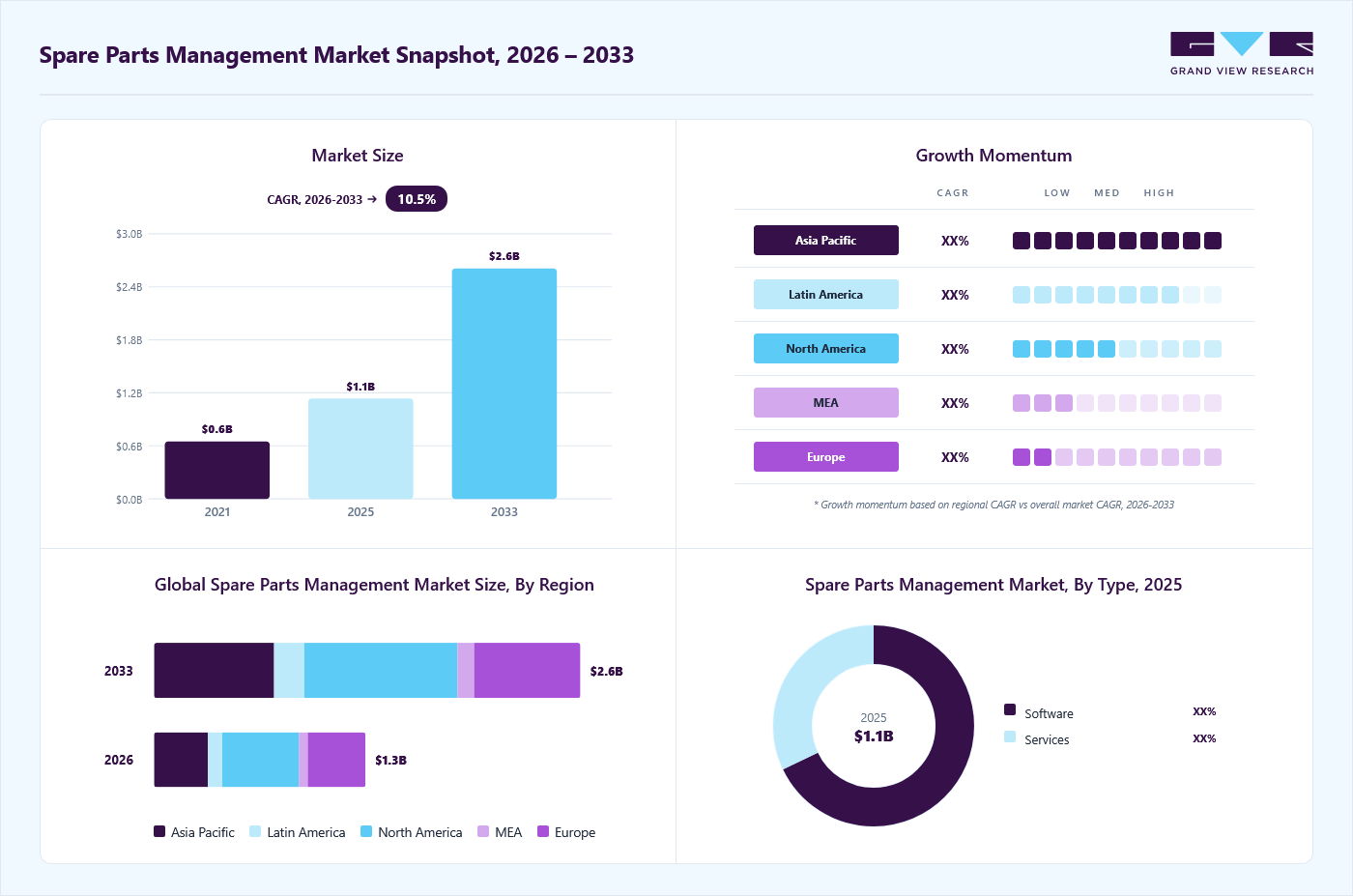
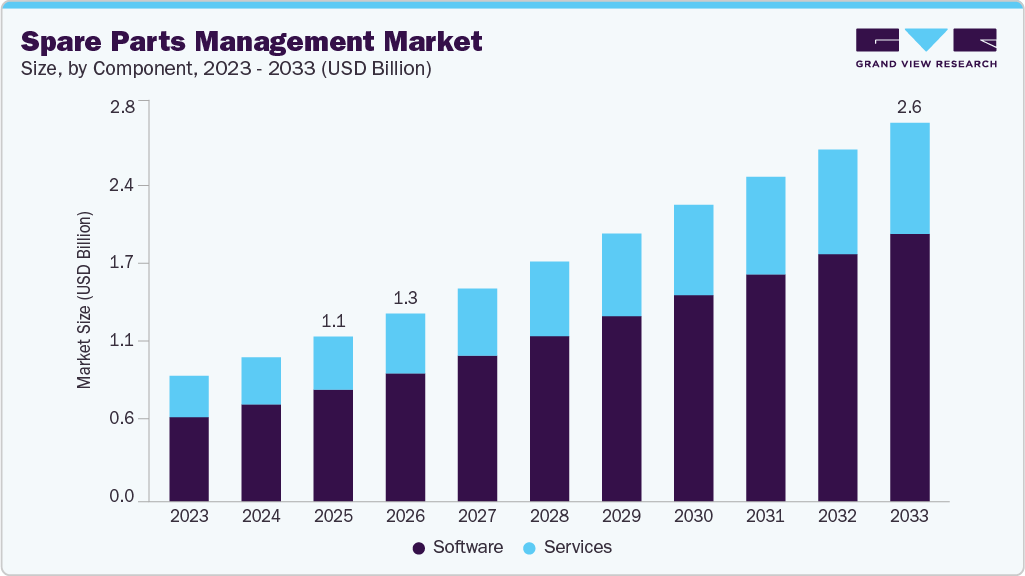
The global spare parts management market size was valued at USD 1.1 billion in 2025 and is projected to grow from USD 1.3 billion in 2026 to USD 2.6 billion by 2033, at a CAGR of 10.5% from 2026 to 2033. North America dominated the global market, accounting for the largest revenue share of 36.3% in 2025. The increasing complexity and automation of industrial equipment is driving market growth.
 Source: Grand View Research, IR Documents, Primary Interviews, Paid DatabasesTo learn more about this report,
 Download Free Sample Report
 Key Market Trends & Insights
- By type: Software segment held the largest revenue share of 67.8% in 2025.
- By deployment: Cloud segment held the largest revenue share in 2025.
- By solution: Inventory management segment held the largest revenue share in 2025.
Regional Highlights
- Largest regional market: North America (36.3% revenue share, 2025)
- Fastest-growing regional market: Asia Pacific (highest CAGR, 2026-2033)
- By country: The U.S. spare parts management industry is a major contributor to the global market.
Market Size & Forecast
- Market size in 2025: USD 1.1 Billion
- Estimated market size in 2026: USD 1.3 Billion
- Projected market size by 2033: USD 2.6 Billion
- CAGR (2026-2033): 10.5%
Three ways to get this report
Buy it, customize it, or ask a question.Ask an Analyst
Analyst response in 1 business day
- AccessReport author, directly
- Reply timeWithin 1 working day
- No sales callDirect answer only
- FormatEmail reply
- CostFree, no cost
Get the Full Report
What the study covers
- FormatsPDF · Excel · Dashboard
- Timeline2026–2033 annual, 2025 base
- Coverage20+ countries, 5 regions
- Companies10+ key players profiled
Customize the Report
20% free customization
- IncludeCountries, segments, points
- TailorTo your product definition
- ExtendDeeper competitor detail
- OrA fully bespoke study
- Turnaround5–10 working days
The integration of digital technologies such as IoT, artificial intelligence, and data analytics is also driving advancements in spare parts management. Connected devices generate real-time data on equipment performance, enabling organizations to continuously monitor asset conditions. This data helps forecast spare parts demand more accurately and supports better inventory optimization. Digital systems allow centralized tracking of spare parts across multiple facilities, improving visibility and coordination. Automation reduces manual intervention, leading to fewer errors and improved efficiency in inventory handling. Advanced analytics further supports decision-making by identifying usage patterns and optimizing stock levels. As digital transformation accelerates across industries, the demand for intelligent spare parts management solutions continues to increase.The need to optimize working capital is driving organizations to adopt efficient spare parts inventory management practices. Excess inventory leads to increased storage costs, capital blockage, and the risk of obsolescence, especially in technology-driven industries. On the other hand, insufficient inventory can disrupt operations and lead to costly emergency purchases. Spare parts management systems help address these challenges by enabling demand forecasting and classifying parts by criticality. Organizations are increasingly adopting lean inventory strategies to maintain efficiency while ensuring the availability of essential components. These systems support better utilization of financial resources by reducing unnecessary stock accumulation. The focus on cost control and financial efficiency is therefore reinforcing the adoption of spare parts management solutions.
 To learn more about this report, Download Free Sample Report
 The expansion of global supply chains is contributing to the growing importance of spare parts management. Companies operating across multiple regions need to manage spare parts distribution efficiently to ensure smooth operations. Variations in demand, supplier lead times, and logistics challenges make it difficult to maintain optimal inventory levels without proper systems. Spare parts management solutions provide visibility into inventory across different locations, enabling better coordination and planning. They also help organizations respond quickly to disruptions, such as supply delays or shortages. Efficient management of spare parts across global networks supports operational resilience and continuity. As supply chains become more interconnected, the role of spare parts management continues to strengthen.
The increasing focus on after-sales services is also driving the demand for effective spare parts management. Companies are placing greater emphasis on customer satisfaction by ensuring quick service and minimal downtime for end users. The availability of spare parts is critical to enabling timely repairs and maintenance services. Efficient spare parts management helps service teams deliver consistent, reliable support, improving the overall customer experience. This capability also contributes to higher customer retention and brand loyalty. In many industries, aftermarket services represent a significant revenue stream, making spare parts availability strategically important. The growing importance of service excellence is therefore contributing to the expansion of spare parts management systems.
Component Insights
The software segment accounted for the largest market share of 67.8% in 2025. The increasing demand for centralized and integrated digital platforms is driving the growth of the software segment within the spare parts management market. Organizations are moving away from fragmented, manual systems toward unified software solutions that manage inventory, procurement, and maintenance in a single environment. This integration enables seamless data flow across departments, including operations, maintenance, and supply chain, improving coordination and decision-making. Software platforms also provide real-time visibility into spare parts availability, helping organizations avoid stock imbalances. The ability to access accurate, up-to-date information reduces reliance on manual tracking and minimizes errors. As enterprises scale their operations, the need for scalable, configurable software solutions continues to grow. This transition toward digital consolidation is strengthening the adoption of spare parts management software across industries.
The services segment is anticipated to grow at the fastest CAGR during the forecast period. The need for improved supply chain coordination is driving the demand for managed services in spare parts management. Organizations often face challenges in synchronizing inventory across multiple locations and suppliers. Service providers offer managed solutions that oversee inventory planning, procurement, and distribution activities. These services help improve visibility and coordination across the supply chain. They also enable faster response to changes in demand and supply conditions. By outsourcing these functions, organizations can focus on their core operations while ensuring efficient spare parts management. The increasing complexity of supply chains is therefore contributing to the expansion of managed services.
Deployment Insights
The cloud segment dominated the industry in 2025. The increasing need for real-time accessibility and centralized data management is driving the adoption of cloud-based solutions in the spare parts management market. Organizations operating across multiple locations require immediate access to inventory data, maintenance schedules, and procurement information. Cloud platforms enable seamless access to this data from anywhere, improving coordination between warehouses, service teams, and management. This accessibility reduces decision-making delays and enhances responsiveness to operational issues. It also ensures that all stakeholders are working with consistent and up-to-date information. As businesses expand geographically, the reliance on cloud infrastructure for unified visibility continues to increase. This growing requirement for real-time connectivity is strengthening the role of cloud solutions in spare parts management.
The on-premise segment is expected to register a significant CAGR from 2026 to 2033. The need for dedicated system performance and resource allocation is contributing to the demand for on-premise spare parts management solutions. Organizations can allocate computing resources specifically for their operations without sharing capacity with other users, as seen in cloud environments. This ensures consistent system performance, especially during peak operational periods. High-performance requirements are common in industries with large-scale operations and complex inventory structures. On-premises systems allow companies to optimize hardware and software configurations to their specific needs.
Solution Insights
The inventory management segment dominated the industry in 2025. The rising frequency of equipment maintenance and replacement cycles is contributing to the growth of inventory management solutions in spare parts operations. Industrial assets require periodic servicing, and the demand for spare parts fluctuates based on usage intensity and operational conditions. Without proper inventory systems, organizations struggle to align stock levels with maintenance schedules. Inventory management tools allow businesses to synchronize spare parts availability with planned maintenance activities. This coordination reduces delays in repair processes and improves equipment uptime. It also helps organizations avoid emergency procurement, which often costs more. The increasing focus on maintenance efficiency is therefore supporting the adoption of inventory management systems.
The warehouse management segment is expected to register the fastest CAGR from 2026 to 2033. The growing complexity of multi-location warehouse networks is driving the warehouse management segment. Organizations often operate multiple warehouses and distribution centers to support geographically dispersed operations. Coordinating inventory across these locations requires real-time visibility and efficient management systems. Warehouse management solutions provide centralized control, allowing organizations to track stock levels and movements across all facilities. This visibility supports better decision-making regarding stock transfers and replenishment.
End Use Insights
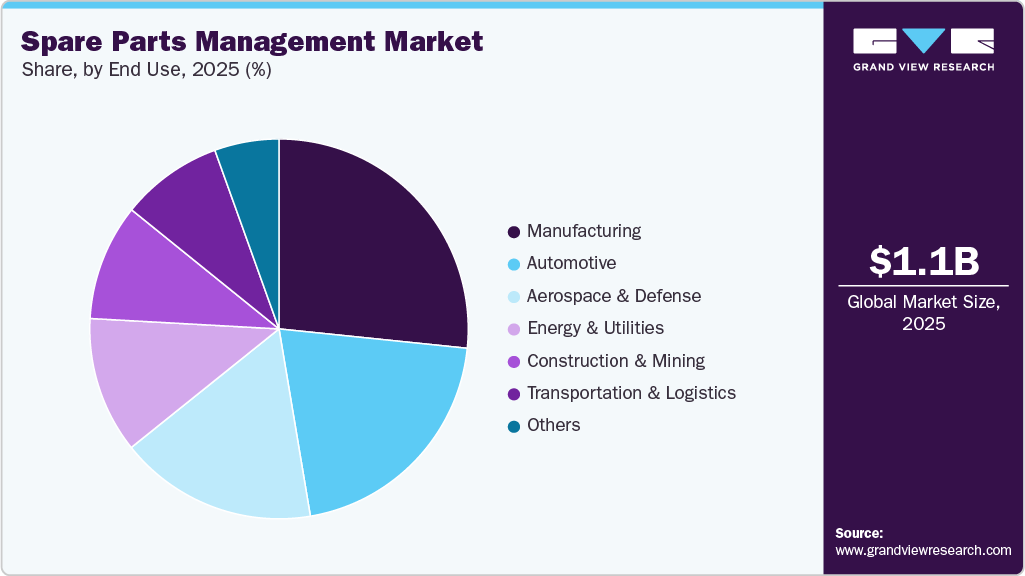
The manufacturing segment accounted for the largest market share in 2025. The increasing automation and adoption of advanced manufacturing technologies are driving the demand for spare parts management in the manufacturing segment. Modern production facilities rely heavily on automated machinery, robotics, and interconnected systems that require precise maintenance and timely component replacement. Any unexpected failure in such environments can halt entire production lines, leading to significant productivity losses. Spare parts management ensures that critical components are readily available, minimizing downtime and supporting continuous operations. Manufacturers are therefore investing in systems that can track equipment health and align spare parts availability with maintenance needs.
 To learn more about this report, Download Free Sample Report
 The energy & utilities segment is anticipated to register the fastest CAGR during the forecast period. The growing focus on preventive and predictive maintenance strategies is playing a crucial role in driving the adoption of spare parts management systems in the energy and utilities segment. Utilities are shifting from reactive maintenance approaches to more proactive models that aim to prevent equipment failures before they occur. Predictive maintenance relies on data analysis and condition monitoring to identify potential issues early. Spare parts management systems integrate with these maintenance strategies by ensuring that necessary components are available when maintenance activities are scheduled. This reduces unplanned downtime and extends the lifespan of critical assets. Efficient coordination between maintenance planning and inventory management is essential for maximizing operational efficiency. The shift toward proactive maintenance practices is, therefore, a significant market driver.
Regional Insights
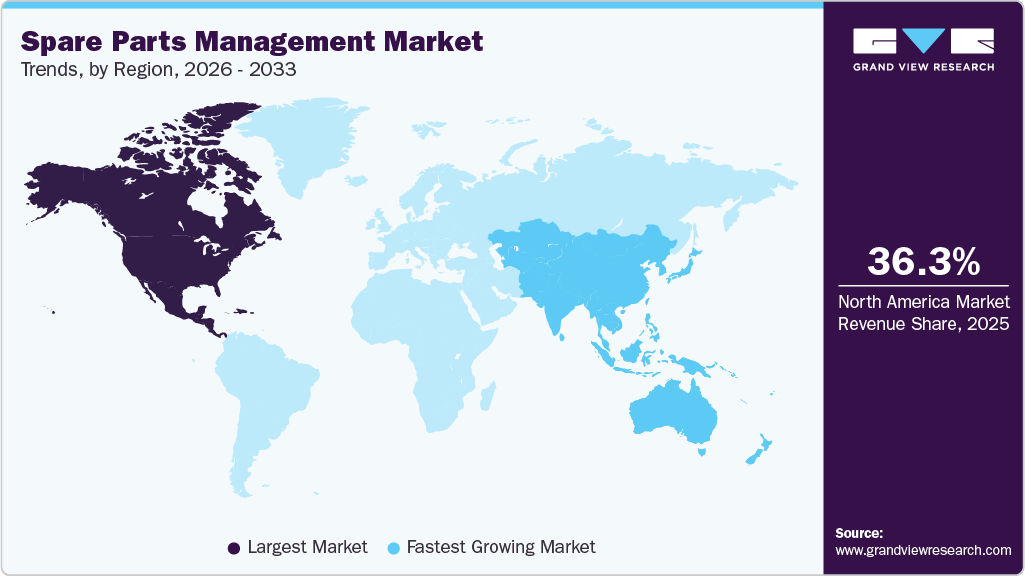
North America spare parts management industry led with a 36.3% revenue share in 2025. The increasing emphasis on after-sales services and customer satisfaction is driving the spare parts management market in North America. Companies are focusing on providing reliable maintenance and support services to differentiate themselves in competitive markets. Timely availability of spare parts is essential to ensure quick repairs and minimize customer downtime. Spare parts management systems help service teams maintain the necessary inventory and respond efficiently to service requests. This capability enhances customer experience and strengthens brand loyalty. Aftermarket services also represent a significant source of revenue for many organizations. The focus on service excellence is therefore contributing to the adoption of spare parts management solutions.
 To learn more about this report, Download Free Sample Report
 The spare parts management market in the U.S. is projected to grow significantly during the forecast period. The widespread adoption of advanced digital technologies is driving the spare parts management market in the U.S. Companies are leveraging technologies such as IoT, artificial intelligence, and data analytics to monitor equipment performance in real time. These technologies generate valuable insights that help optimize spare parts inventory and maintenance schedules. Spare parts management systems integrate with digital platforms to provide real-time visibility and predictive capabilities. This integration reduces inefficiencies and improves decision-making processes. Organizations benefit from enhanced operational transparency and better resource utilization. The strong digital ecosystem in the country is therefore contributing to the growth of the market.
Asia Pacific Spare Parts Management Market Trends
The SPM market in Asia Pacific is expected to grow at the fastest CAGR of 12.1% from 2026 to 2033. The expansion of infrastructure and energy projects is contributing to the demand for spare parts management solutions in the Asia Pacific. Governments and private sector players are investing heavily in transportation, power generation, and urban development projects. These projects involve extensive use of machinery and equipment that require regular maintenance and the availability of spare parts. Efficient spare parts management ensures that these assets operate smoothly without disruptions. It also supports the timely completion of large-scale projects by minimizing equipment downtime. Organizations involved in infrastructure development are prioritizing maintenance efficiency. The scale of infrastructure investments is therefore driving the need for advanced spare parts management systems.
China spare parts management industry is projected to grow significantly during the forecast period. The complexity of supply chains and logistics networks is driving the adoption of spare parts management solutions in China. Organizations operate across multiple regions with diverse supplier networks and distribution channels. Managing spare parts across such networks requires accurate tracking and efficient coordination. Spare parts management systems provide centralized visibility and improve inventory control across locations. This helps reduce delays and ensures the timely availability of components. It also supports better planning and optimization of logistics operations. The increasing complexity of supply chains is therefore contributing to the growth of the market.
Europe Spare Parts Management Market Trends
The spare parts management industry in Europe is anticipated to grow steadily from 2026 to 2033. The complexity of supply chains and cross-border operations in Europe is contributing to the demand for advanced spare parts management solutions. Organizations often operate across multiple countries with diverse supplier networks and logistics requirements. Managing spare parts across such networks requires accurate tracking and efficient coordination. Spare parts management systems provide centralized visibility and improve inventory control across locations. It also supports better planning and optimization of logistics operations. The interconnected nature of regional supply chains is therefore driving the adoption of structured management solutions.
The UK SPM industry is expected to grow significantly during the forecast period. The strong presence of advanced manufacturing and industrial engineering sectors in the UK is driving the demand for spare parts management solutions. Industries such as aerospace, automotive, and precision manufacturing rely on highly sophisticated machinery that requires consistent maintenance and timely component replacement. These sectors operate under strict quality and performance standards, where even minor disruptions can impact production efficiency. Spare parts management ensures that critical components are available when needed, minimizing downtime and supporting continuous operations. Organizations are focusing on structured inventory systems to manage complex equipment environments effectively. This approach improves operational reliability and reduces unexpected failures. The industrial strength of the country is therefore contributing to sustained demand for advanced spare parts management systems.
Key Spare Parts Management Companies Insights
Some prominent players in the spare parts management market include Deloitte and PTC, among others.
-
Deloitte is a professional services organizations specializng in consulting, audit, tax, and advisory services to enterprises, governments, and institutions across industries. Deloitte offers consulting and technology-enabled services that help organizations optimize the planning, sourcing, storage, and distribution of spare parts across complex supply chains. Its solutions are designed to address challenges such as demand variability, inventory imbalance, and high carrying costs, particularly in industries like manufacturing, aerospace, automotive, energy, and utilities. Deloitte supports clients in developing data-driven inventory strategies that ensure the right parts are available at the right time while minimizing excess stock and obsolescence.
-
PTC is a U.S.-based technology company specializing in industrial software solutions that support product lifecycle management, IoT, augmented reality, and digital transformation for manufacturing and engineering enterprises. PTC delivers advanced digital solutions that enable organizations to optimize service parts planning, inventory control, and aftersales operations. Its software capabilities are centered on service lifecycle management, in which spare parts are managed within a broader service ecosystem that includes maintenance planning, field service execution, and asset performance monitoring.
Key Spare Parts Management Companies:
The following key companies have been profiled for this study on the spare parts management market.
- Advanced Technology Services, Inc.
- Alterity, LLC
- Argon & Co
- Cognascents
- Deloitte
- DEX
- Kinaxis Inc.
- KSB
- Linde PLC
- NRX AssetHub
- PTC
- S.A. Talke
- Schneider Electric
- SDI, Inc.
- Verusen
Recent Developments
-
In March 2025, Verusen expanded its strategic partnership with Advanced Technology Services, Inc., further strengthening its collaborative capabilities. The partnership integrates Verusen’s AI-powered platform with ATS’s deep expertise in industrial maintenance and reliability, enabling the delivery of advanced, technology-driven solutions for manufacturers. This collaboration enhances their combined reach and strengthens their ability to help manufacturers optimize demand forecasting, inventory efficiency, and overall spare parts management in MRO supply chains, ensuring more streamlined, data-driven operations.
Spare Parts Management Market Report Scope
Report Attribute
Details
Market size in 2025
USD 1.1 billion
Estimated Market size in 2026
USD 1.3 million
Projected Market size by 2033
USD 236 million
Growth rate
CAGR of 10.5% from 2026 to 2033
Actual data
2021 - 2025
Forecast period
2026 - 2033
Quantitative units
Revenue in USD million/billion and CAGR from 2026 to 2033
Report coverage
Revenue forecast, company share, competitive landscape, growth factors, and trends
Segments covered
Component, deployment, solution, end use, region
Regional scope
North America; Europe; Asia Pacific; Latin America; MEA
Country scope
U.S.; Canada; Mexico UK; Germany; France; China; India; Japan; Australia; South Korea; Brazil; UAE; Saudi Arabia; South Africa
Key companies profiled
Advanced Technology Services, Inc.; Alterity, LLC; Argon & Co; Cognascents; Deloitte; DEX; Kinaxis Inc.; KSB; Linde PLC; NRX AssetHub; PTC; S.A. Talke; Schneider Electric; SDI, Inc.; Verusen
Customization scope
Free report customization (equivalent to 8 analysts working days) with purchase. Addition or alteration to country, regional & segment scope.
Pricing and purchase options
Avail customized purchase options to meet your exact research needs. Explore purchase options
Global Spare Parts Management Market Report Segmentation
This report forecasts revenue growth at global, regional, and country levels and provides an analysis of the latest industry trends in each of the sub-segments from 2021 to 2033. For this study, Grand View Research has segmented the global spare parts management market report based on component, deployment, solution, end use, and region.
-
Component Outlook (Revenue, USD Million, 2021 - 2033)
-
Software
-
Services
-
-
Deployment Outlook (Revenue, USD Million, 2021 - 2033)
-
Cloud
-
On-premise
-
-
Solution Outlook (Revenue, USD Million, 2021 - 2033)
-
Inventory Management
-
Procurement Management
-
Warehouse Management
-
Supplier Management
-
Lifecycle Management
-
Others
-
-
End Use Outlook (Revenue, USD Million, 2021 - 2033)
-
Automotive
-
Manufacturing
-
Aerospace & Defense
-
Energy & Utilities
-
Construction & Mining
-
Transportation & Logistics
-
Others
-
-
Regional Outlook (Revenue, USD Million, 2021 - 2033)
-
North America
-
U.S.
-
Canada
-
Mexico
-
-
Europe
-
Germany
-
UK
-
France
-
-
Asia Pacific
-
China
-
India
-
Japan
-
South Korea
-
Australia
-
-
Latin America
-
Brazil
-
-
Middle East & Africa
-
UAE
-
Saudi Arabia
-
South Africa
-
-
Frequently Asked Questions About This Report
The global spare parts management market size was valued at USD 1.1 billion in 2025 and is estimated at USD 1.3 billion for 2026.
The global spare parts management market is expected to grow at a CAGR of 10.5% from 2026 to 2033, reaching USD 2.6 billion by 2033.
The software segment accounted for the largest revenue share of 67.8% in 2025 in the spare parts management market, driven by the increasing demand for centralized and integrated digital platforms.
Key players include Advanced Technology Services, Inc.; Alterity, LLC; Argon & Co; Cognascents; Deloitte; DEX; Kinaxis Inc.; KSB; Linde PLC; NRX AssetHub; PTC; S.A. Talke; Schneider Electric; SDI, Inc.; Verusen.
Factors such as increasing focus on minimizing equipment downtime and improving operational efficiency, growing adoption of predictive maintenance and digital asset management solutions, rising complexity of industrial machinery requiring efficient spare parts tracking, and the expansion of manufacturing and logistics sectors play a key role in accelerating the spare parts management market.
North America dominated with a 36.3% revenue share in 2025.
Asia Pacific is the fastest-growing region over the forecast period.
The cloud segment dominated the market and accounted for the largest share in 2025.
The inventory management segment held the largest revenue share in 2025, while warehouse management is the fastest-growing solution.
Manufacturing segment held the largest share in 2025, while energy & utilities is the fastest-growing segment.
About the Author(s)
Communication Services Research Team
Technology · Communication ServicesThis report was authored by the communication services research team at Grand View Research - comprising two research analysts, one senior research analyst, and one industry expert - with specialized expertise in the communication services segment of the technology industry. All findings are based on proprietary technology databases, executive interviews, and regulatory analysis, subject to internal peer review prior to publication.
Last Updated:
Speak to Analyst

Customize this report to your needs - add regions, segments, or data points, with 20% free customization.
Or view our licence options:


ISO 9001:2015 & 27001:2022 Certified
We are GDPR and CCPA compliant! Your transaction & personal information is safe and secure. For more details, please read our privacy policy.


