
- Home
- »
- Automotive & Transportation
- »
-
Specialty Vehicle Market Size And Share Report, 2026-2033GVR Report cover

Specialty Vehicle Market (2026 - 2033)
Size, Share & Trends Analysis Report By Vehicle Type (Fire and Rescue Vehicles, Medical Response Vehicles), By Propulsion Type (Internal Combustion Engine (ICE)), By Application, By End User, By Region, And Segment Forecasts
Market Size, 2025
$101.4BMarket Estimate, 2026
$104.4BMarket Forecast, 2033
$144.4BCAGR, 2026–2033
4.7%Specialty Vehicle Market Summary
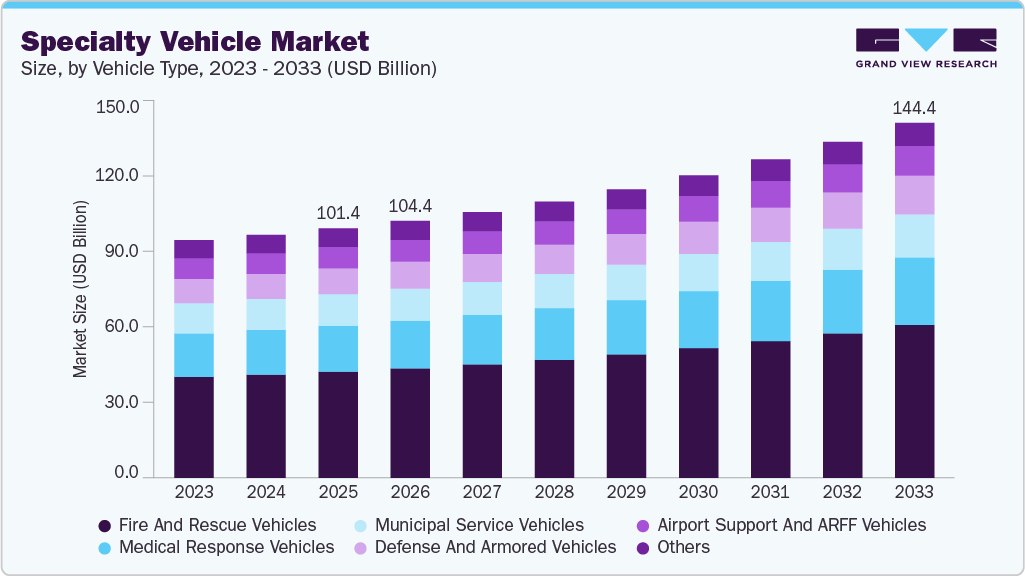
The global specialty vehicle market size was estimated at USD 101.4 billion in 2025 and is projected to grow from USD 104.4 billion in 2026 to USD 144.4 billion by 2033, at a CAGR of 4.7% from 2026 to 2033. North America held the largest revenue share of 34.0% of the global market in 2025. The market is gaining momentum, driven by rising demand for emergency response, public safety, and municipal service vehicles, along with growth in defense modernization programs and airport expansions driven by rising air traffic.
 Source: Grand View Research, IR Documents, Primary Interviews, Paid DatabasesTo learn more about this report,
 Download Free Sample Report
 Key Market Trends & Insights
- By vehicle type: Fire and rescue vehicles segment held the largest market share of 42.6% in 2025.
- By propulsion type: Internal combustion engine (ICE) segment held the largest market share in 2025.
- By application: Fire & rescue operations segment dominated the market in 2025.
- By end user: Municipal & public agencies segment dominated the market in 2025.
Regional Highlights
- Largest regional market: North America (34.0% market share, 2025)
Market Size & Forecast
- Market size in 2025: USD 101.4 Billion
- Estimated market size in 2026: USD 104.4 Billion
- Projected market size by 2033: USD 144.4 Billion
- CAGR (2026–2033): 4.7%
Three ways to get this report
Buy it, customize it, or ask a question.Ask an Analyst
Analyst response in 1 business day
- AccessReport author, directly
- Reply timeWithin 1 working day
- No sales callDirect answer only
- FormatEmail reply
- CostFree, no cost
Get the Full Report
What the study covers
- FormatsPDF · Excel · Dashboard
- Timeline2026–2033 annual, 2025 base
- Coverage20+ countries, 5 regions
- Companies10+ key players profiled
Customize the Report
20% free customization
- IncludeCountries, segments, points
- TailorTo your product definition
- ExtendDeeper competitor detail
- OrA fully bespoke study
- Turnaround5–10 working days
The need for rapid deployment of fire and rescue, medical, and law enforcement vehicles is further fueling the growth of the specialty vehicle industry. Also, the push toward sustainability and lower emissions is encouraging the adoption of electric and hybrid specialty vehicles, creating significant opportunities for manufacturers to innovate in modular platforms, telematics, and vehicle customization. However, high procurement and lifecycle costs, coupled with slow regulatory approvals and long replacement cycles, remain major challenges, limiting faster adoption and affecting the pace at which organizations can modernize their fleets.
 To learn more about this report, Download Free Sample Report
 Governments and municipal agencies are increasingly investing in the modernization of firefighting, law enforcement, and medical response fleets, creating steady demand for purpose-built vehicles such as fire trucks, ambulances, and armored personnel carriers. The expansion of urban centers and the need for rapid, reliable emergency response necessitate fleet upgrades and the replacement of aging vehicles. This trend encourages manufacturers to develop advanced, customized solutions tailored to specific operational requirements. For instance, in December 2024, India announced a plan to provide up to a 30% subsidy on the production of electric ambulances under the PM E-DRIVE scheme, supporting the adoption of sustainable vehicles, reducing procurement costs, and promoting the local manufacturing of zero-emission specialty vehicles.
Defense modernization programs are a key driver of the specialty vehicle market. Governments worldwide are investing in upgrading military and tactical fleets to enhance mobility, operational efficiency, and safety across diverse terrains and combat environments. Modernization initiatives often require purpose-built vehicles, including armored personnel carriers, multi-terrain transporters, and specialized off-road vehicles capable of supporting high-performance missions. These programs create recurring procurement opportunities for manufacturers and encourage innovation in vehicle design and technology integration. For example, in March 2024, Polaris Government and Defense launched the 2025 Military 650 TITAN 155 and 850 PRO RMK 155 snowmobiles for arctic military operations. Equipped with blackout mode, IR lighting, and enhanced electrical systems, these vehicles demonstrate the increasing demand for advanced, mission-ready specialty vehicles.
Airports require advanced, reliable, and high-performance emergency response and ground support vehicles to ensure passenger safety, rapid incident response, and operational efficiency. Growing international and domestic air travel, coupled with stricter safety regulations, necessitates fleet upgrades and the adoption of next-generation airport fire and rescue (ARFF) vehicles. For instance, in October 2022, ZIEGLER delivered the world’s first Z-Class HYBRIDdrive 6×6 ARFF vehicle to Cranfield Airport, UK. Capable of pure electric, hybrid, or conventional operation, the vehicle delivers up to 1,150 HP, enabling rapid deployment while supporting green airport initiatives. Such developments underscore how airport growth directly stimulates specialty vehicle procurement and innovation.
Urban centers and municipal agencies are increasingly prioritizing zero-emission fleets to meet environmental targets and support cleaner city operations, creating significant demand for electric specialty vehicles. For instance, in November 2025, Kia unveiled its PV5 Chassis Cab at SOLUTRANS 2025 in Lyon, France, as part of its modular Platform Beyond Vehicle (PBV) electric fleet. Designed for light commercial and municipal operations, the PV5 combines a high-tech, modern design with the ability to support cities’ zero-emission initiatives and encourage policymakers to implement stronger electric vehicle mandates. Companies in the market are also focusing on expanding modular electric platforms, improving battery performance, and integrating advanced telematics for optimized fleet management. For instance, in April 2024, Xos partnered with Winnebago to develop a custom electric chassis for Winnebago Specialty Vehicles. Built on Xos’ SV platform, the chassis supports 33- and 38-foot vehicle shells for mobile medical, commercial, and accessibility applications, enabling scalable production, streamlined maintenance, and integrated software improvements. Such developments highlight the expanding opportunities for electric and hybrid specialty vehicles, driving innovation and adoption across global markets.
Purpose-built vehicles, such as fire trucks, ambulances, armored personnel carriers, and airport rescue vehicles, require specialized components, advanced safety systems, and customized configurations, all of which drive up upfront investment. Also, ongoing maintenance, spare parts replacement, and operational expenses contribute to elevated lifecycle costs, impacting fleet budgeting and procurement cycles. These high costs often limit the ability of municipal agencies, healthcare providers, and defense organizations to expand or modernize their fleets rapidly. Thus, cost considerations remain a key constraint on market growth and adoption of new specialty vehicle technologies.
Market Dynamics
The specialty vehicle market is driven by the structural shift toward closed loop operational ecosystems where conventional on-road vehicles cannot efficiently perform mobility, transportation, maintenance, or material handling functions. Modern industrial, commercial, institutional, and infrastructure facilities are increasingly designed as highly optimized operational environments such as warehouses, airports, ports, mines, factories, campuses, defense bases, and large hospitality properties where movement efficiency directly impacts labor productivity, asset utilization, turnaround time, and operating cost. This has created sustained demand for specialized vehicles engineered specifically for low-speed, high-frequency, short-distance, and application-centric operations.
Another major underlying driver is the rising cost of operational downtime and labor inefficiency across industrial and logistics-intensive sectors. Organizations are increasingly deploying specialty vehicles to minimize manual handling, reduce worker transit time, improve intra-facility transportation, and streamline repetitive operational tasks. In sectors such as warehousing, airports, and manufacturing, even marginal improvements in internal mobility efficiency can generate significant gains in throughput and workforce productivity, making specialty vehicles operationally indispensable rather than optional equipment.
The specialty vehicle market is primarily restrained by the high capital cost associated with designing, manufacturing, and deploying application-specific vehicle platforms. Unlike mass market passenger or commercial vehicles, specialty vehicles are typically produced in comparatively lower volumes with significant customization requirements based on end use applications, operating environments, payload capacities, and regulatory standards. This limited production scalability reduces economies of scale, resulting in higher per-unit manufacturing costs, elevated procurement prices, and longer replacement cycles for end users.
Another major constraint for market expansion is the price sensitivity of small and mid-sized fleet operators, particularly in developing economies where purchasing decisions are heavily influenced by upfront investment costs rather than long term operational efficiency benefits. Many industries continue relying on refurbished vehicles, modified conventional utility vehicles, or manual operational methods due to the substantial capital expenditure required for specialized fleet modernization.
The specialty vehicle market is witnessing significant growth opportunities through the rapid transition toward electrified, autonomous, and digitally connected fleet ecosystems across industrial, commercial, municipal, and recreational environments. As organizations increasingly prioritize operational efficiency, sustainability targets, and automation-driven productivity improvements, specialty vehicles are emerging as ideal platforms for early adoption of electric propulsion and autonomous mobility technologies due to their predictable operating routes, controlled environments, and relatively lower speed requirements.
Another major opportunity lies in the electrification of intra-facility transportation and utility operations across warehouses, airports, ports, manufacturing plants, educational campuses, healthcare facilities, and hospitality infrastructure. Governments and private enterprises are accelerating decarbonization initiatives and carbon neutrality commitments, creating strong demand for electric specialty vehicles that offer lower operating costs, reduced maintenance requirements, and compliance with evolving emission regulations. The falling cost of lithium-ion batteries and advancements in charging infrastructure are further improving the commercial viability of electric specialty fleets.
Market Concentration & Characteristics
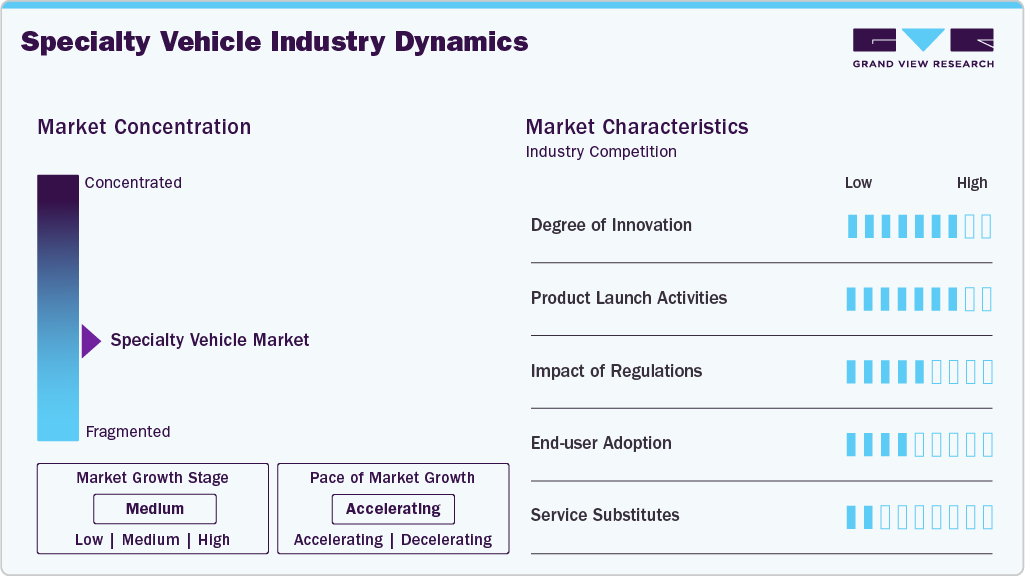
The specialty vehicle market is moderately fragmented, characterized by the presence of global OEMs, specialized vehicle manufacturers, utility vehicle producers, and regional fabricators serving diverse industrial, commercial, municipal, recreational, and defense applications. Major companies such as REV Group, Inc., Oshkosh Corporation, Sutphen Corporation, and Rosenbauer International AG dominate key segments through extensive product portfolios, established dealer networks, strong aftermarket support capabilities, and broad penetration across utility, industrial, agricultural, turf management, and recreational applications. At the same time, the market includes numerous regional and niche manufacturers that provide customized specialty vehicles designed for specific operational environments such as airports, warehouses, ports, mining sites, municipal services, and hospitality facilities.
 To learn more about this report, Download Free Sample Report
 Market fragmentation is further reinforced by the highly application specific nature of specialty vehicles, where customer requirements vary significantly based on payload capacity, terrain conditions, operational duty cycles, emission standards, and automation requirements. This diversity creates opportunities for smaller manufacturers and engineering focused companies to compete through product customization, localized manufacturing, and application oriented fleet solutions. Additionally, growing demand for electric utility vehicles, autonomous industrial transport systems, airport ground support vehicles, and smart municipal mobility platforms is enabling emerging players to differentiate themselves through advanced battery technologies, connected fleet management systems, and autonomous navigation capabilities.
Vehicle Type Insights
The fire and rescue vehicles segment led the specialty vehicle market, accounting for the largest share of 42.6% in 2025. Factors such as the rising number of urban emergencies, increased government investment in public safety infrastructure, and stricter regulatory standards for response times are driving demand for advanced fire and rescue vehicles. Companies in the market are focusing on innovation, customization, and electrification to meet these evolving requirements. For instance, in October 2025, Frontline Fire & Rescue launched its ‘Crafted for Courage’ brand platform through Chapter Brand Leadership, showcasing high-quality, custom-built fire trucks, rescue vehicles, ambulances, specialized trailers, and EV innovations designed to enhance life-saving operations for private and government clients.
The defense and armored vehicles segment is expected to register the fastest CAGR from 2026 to 2033, driven by rising defense modernization programs and increasing geopolitical tensions requiring advanced armored mobility solutions. Companies in the market are focusing on localized production and strategic partnerships to meet these demands. For instance, in September 2025, Tata Advanced Systems inaugurated an 8x8 armored vehicle production facility near Casablanca to support Morocco’s defense modernization. The plant, leveraging partial local sourcing, aims to serve domestic forces and regional export markets, reinforcing Morocco’s efforts to expand indigenous armored manufacturing while strengthening industrial collaboration with India.
Propulsion Type Insights
The internal combustion engine (ICE) segment accounted for the largest share of the specialty vehicle industry in 2025, driven by the widespread adoption of proven, high-performance drivetrains. Factors such as increasing demand for reliable, long-range operations in emergency response, defense, and municipal services, along with existing fueling infrastructure and lower upfront costs compared to electric alternatives, are further supporting the the segment’s growth.
The electric segment is expected to grow at a significant CAGR during the forecast period, driven by rising demand for zero-emission specialty vehicles and increasing government incentives supporting electrification of emergency, municipal, and commercial fleets. Companies in the market are focusing on developing scalable, high-performance electric platforms to meet operational and sustainability requirements. For instance, in March 2023, Phoenix Motorcars partnered with Matthews Specialty Vehicles to jointly develop and deploy Class 4 electric specialty vehicles in the U.S. The collaboration targets mobile healthcare, bloodmobiles, bookmobiles, classrooms, public safety, and shuttles, leveraging Phoenix’s Gen 4 and Gen 5 electric chassis technologies to deliver at least 50 vehicles within three years.
Application Insights
The fire & rescue operations segment accounted for the largest share in 2025, driven by increasing investment in rapid-response infrastructure, rising adoption of advanced firefighting technologies, and the need for customizable, high-capacity vehicles to serve diverse urban and rural environments. Major players are focusing on delivering flexible solutions that enhance operational efficiency and safety. For instance, in January 2021, KME Fire Apparatus, a subsidiary of REV Group, introduced the X-Series custom pumpers in the U.S. These vehicles feature multiple configurable models with 750-1,000-gallon water tanks, optimized pump systems, and ample equipment storage, enabling tailored solutions that reduce lead times and improve emergency response capabilities.
The tactical & security missions segment is expected to register a notable CAGR from 2026 to 2033. This segment includes specialty vehicles designed for military operations, law enforcement, and high-security transport of personnel or critical assets. Growth is driven by increased investments in border security and counter-terrorism infrastructure, as well as rising demand for armored and multi-purpose vehicles capable of operating in hostile environments, with enhanced mobility, protection, and surveillance.
End User Insights
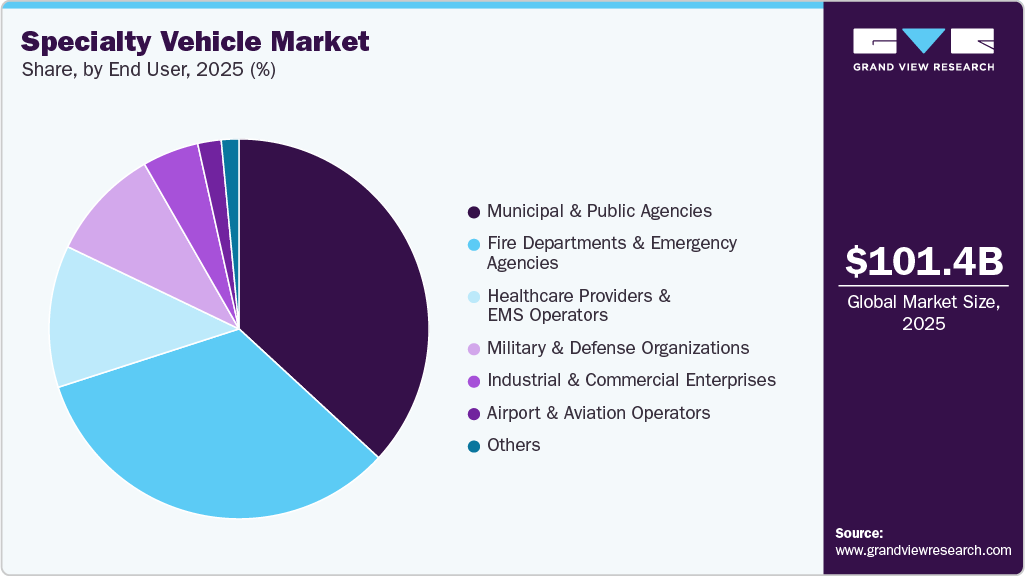
The municipal & public agencies segment accounted for the largest share of the specialty vehicle market in 2025, reflecting the critical role of specialty vehicles in supporting city operations, emergency response, and public safety initiatives. Growth is driven by increasing investments in urban infrastructure and fleet modernization programs, rising demand for multipurpose municipal vehicles such as garbage trucks, street sweepers, and snowplows, and expanding government initiatives to adopt environmentally friendly, electric-powered specialty vehicles for sustainable city management.
 To learn more about this report, Download Free Sample Report
 The military & defense organizations segment is expected to register a notable CAGR from 2026 to 2033, driven by rising defense modernization programs and increasing demand for tactical and logistical mobility solutions. Governments are investing heavily in upgrading armored, transport, and specialized vehicles to enhance operational readiness and support rapid deployment across diverse terrains. For instance, in March 2025, Ashok Leyland secured contracts worth approximately USD 81.9 million (INR 700 crore) to supply the Indian Army with Stallion 4×4 and 6×6 platforms, buses, and CIWS mobility systems, engineered for high reliability, strong off-road performance, and superior support for defense operations.
Regional Insights
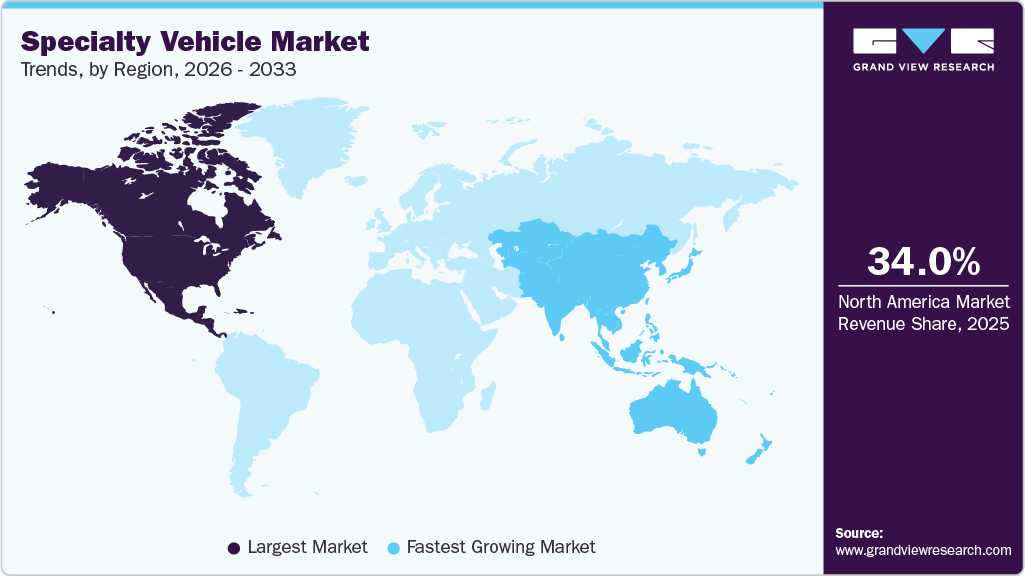
The North America specialty vehicle market accounted for 34.0% of the global share in 2025, driven by rising investments in emergency response infrastructure, growing demand for municipal service vehicles, and modernization of defense fleets. The increasing government and private-sector focus on rapid, reliable emergency response is boosting the procurement of purpose-built ambulances, fire trucks, and law enforcement vehicles. For instance, in August 2024, Road Rescue, a brand under REV Group, launched its RediMedic Type I and Type III ambulances in the U.S., featuring EMS-inspired interiors and CurveForce™ aluminum body corners to enhance safety, hygiene, and durability, supporting optimized pre-hospital care for first responders.
 To learn more about this report, Download Free Sample Report
 U.S. Specialty Vehicle Market Trends
The U.S. specialty vehicle industry held a dominant position in 2025. The market is witnessing rapid transformation, driven by the increasing adoption of sustainable and electric solutions for airport and municipal operations and by the growing demand for versatile, multi-purpose vehicles capable of year-round applications. For instance, in November 2025, Dallas Fort Worth International Airport introduced six Striker Volterra 6×6 Electric ARFF vehicles from Oshkosh, featuring zero-emission electric drives and advanced firefighting systems, making DFW the largest U.S. operator of electric ARFF vehicles.
Companies in the U.S. are increasingly expanding multi-purpose municipal vehicle portfolios to meet year-round operational needs. In February 2023, Federal Signal acquired Trackless Vehicles, a Canadian manufacturer of versatile municipal tractors. The Trackless MT7 series features attachments for snow removal, sweeping, and vegetation management, enabling all-season functionality. This acquisition strengthens Federal Signal’s specialty vehicle offerings, broadens U.S. distribution, and supports sustainable, multi-use operations for municipalities, highlighting the growing focus on efficiency and environmental responsibility in public service fleets.
The Canada specialty vehicle market is expanding, driven primarily by the need to modernize airport and aviation emergency response fleets. Increasing air traffic and stricter safety regulations are prompting investments in advanced firefighting and rescue vehicles. For instance, in January 2022, Yellowknife Airport received an Oshkosh Striker 6×6 ARFF vehicle through Commercial Emergency Equipment Co. The delivery included post-delivery inspection and training, significantly enhancing the airport’s frontline firefighting and emergency response capabilities.
Europe Specialty Vehicle Market Trends
The Europe specialty vehicle industry was identified as a lucrative region in 2025. The market is undergoing a significant transformation, driven by rising demand for defense modernization, increased investments in emergency medical services, and stringent safety regulations across the public and private sectors. These factors are prompting governments and agencies to procure advanced, purpose-built vehicles that offer enhanced operational efficiency, versatility, and compliance with evolving standards. For instance, in September 2025, Serbia unveiled the Alexander the Unifier 4×4 armored vehicle family during its national military parade. Built on a modular high-mobility chassis, the platform supports multiple mission configurations, enabling deployment across low to high-intensity operational environments.
Similarly, in January 2023, Hato Hone St John launched its Waka Manaaki ambulances across New Zealand. The fleet features high-visibility safety livery and culturally aligned Māori designs, commissioning around 50 vehicles nationwide to enhance patient and crew safety while reflecting community identity. Such developments underscore the market’s focus on innovation, safety, and cultural alignment, highlighting a broader trend toward modern, purpose-built solutions that address operational, environmental, and societal needs.
The German specialty vehicle market is being shaped by increasing investments in green mobility and zero-emission public service fleets. Stricter EU environmental regulations and national policies aimed at achieving carbon neutrality are prompting municipalities, airports, and emergency services to upgrade their fleets with electric and hybrid vehicles. For instance, German airports and urban centers are prioritizing electric ARFF vehicles and municipal utility trucks to reduce emissions while maintaining operational efficiency. Rising demand for advanced firefighting, emergency medical, and defense vehicles, coupled with government incentives for the adoption of clean technology, is expected to boost procurement and modernization, driving sustained growth.
The specialty vehicle market in the UK is witnessing strong growth, driven by increasing government investment in urgent and emergency care infrastructure. According to the GOV. UK, nearly USD 590 million (GBP 450 million) has been allocated to expand facilities and reduce waiting times in A&E, including the rollout of almost 500 new ambulances by March 2026, highlighting the country’s focus on modernizing pre-hospital emergency response. In parallel, rising demand for advanced firefighting and rescue capabilities is boosting procurement of custom fire and rescue vehicles, as authorities seek highly reliable, purpose-built solutions to enhance operational efficiency, improve public safety, and meet evolving emergency care requirements across communities.
Asia Pacific Specialty Vehicle Market Trends
The Asia Pacific specialty vehicle industry was identified as a lucrative region in 2025 and is expected to grow at the fastest CAGR during the forecasted period. The market growth is driven by rising investments in emergency response infrastructure, expanding urbanization with complex traffic patterns, and increasing government focus on modernizing public safety fleets. Rapidly growing cities and industrial hubs require highly maneuverable, reliable vehicles to ensure timely medical, firefighting, and municipal services. For instance, in October 2024, Isuzu Motors India launched the ISUZU D-MAX Ambulance, fully built to AIS-125 Type C specifications. With 14+ best-in-class features, a robust iGRIP platform, and SUV-like suspension, the vehicle ensures patient safety and comfort across urban and rural terrains, exemplifying the increasing demand for advanced specialty vehicles in the region.
The China specialty vehicle market held a substantial market share in 2025. The market is experiencing rapid growth, driven by the increasing urban municipalization, which requires versatile public service vehicles, and by government initiatives to modernize city infrastructure with sustainable solutions. Expanding industrial zones and growing population density are further fueling demand for reliable, purpose-built vehicles for waste management, street cleaning, and emergency services. For instance, in February 2025, CSCTRUCK established a dedicated Municipal Truck Branch in Wuhan, China, along with a specialized website, municipaltruck.com. The branch provides customized municipal vehicles, including garbage trucks, sweepers, vacuum trucks, snow plows, and sprinklers, enhancing operational efficiency and supporting environmentally friendly, durable solutions for urban public works.
The specialty vehicle market in Japan held a significant share in 2025. The market is influenced by the steady modernization of disaster response and emergency services, driven by frequent natural disasters such as earthquakes and typhoons. Growing adoption of low-emission and hybrid emergency vehicles supports sustainable operations, while investments in advanced fire and rescue technologies enhance rapid response capabilities. For instance, in November 2025, Samoa received its first fully electric fire trucks under the CAP-IT Project, a collaboration between the Government of Samoa, Japan, and the UNDP. This initiative underscores Japan’s role in advancing low-emission, climate-resilient specialty vehicles for emergency services, reflecting a broader regional focus on sustainable and technologically advanced fleets.
Key Specialty Vehicle Company Insights
Some of the key players operating in the market include REV Group, Inc., Oshkosh Corporation, Sutphen Corporation, Rosenbauer International AG, and Seagrave Fire Apparatus, LLC.
-
REV Group is a U.S. specialty vehicle manufacturer, offering a wide range of products for fire & emergency services, commercial, and municipal applications. Its portfolio includes more than 20 brands, such as E‑ONE, KME, Ferrara, Spartan, Road Rescue, and Smeal. The company provides customized solutions, including fire apparatus, ambulances, terminal trucks, and industrial sweepers, serving both public and private-sector clients. REV Group focuses on innovation, quality, and regulatory compliance, ensuring vehicles meet operational demands for safety, reliability, and performance.
-
Oshkosh Corporation is a global specialty vehicle and industrial manufacturer, serving fire & emergency, defense, and commercial markets. Its fire & emergency division produces custom fire trucks, airport rescue and firefighting (ARFF) vehicles, mobile command units, and other emergency apparatus. In defense, Oshkosh manufactures tactical and logistical vehicles, including MRAPs and highly mobile combat-support trucks. The company emphasizes advanced technology, safety, and operational efficiency, supporting government agencies, municipalities, and private operators worldwide.
Key Specialty Vehicle Companies:
The following key companies have been profiled for this study on the specialty vehicle market.
- REV Group, Inc.
- Oshkosh Corporation
- Sutphen Corporation
- Rosenbauer International AG
- Seagrave Fire Apparatus, LLC
- The Shyft Group, Inc. (Aebi Schmidt Group)
- Binz GmbH
- Mowag GmbH
- Magirus GmbH (Iveco Group)
- Morita Holdings Corporation
Competitive Benchmarking
Operating Strategies
Competitive Edge
Weaknesses
Mature Players: Oshkosh Corporation, REV Group, Inc., Rosenbauer International AG
- Mature players focus on delivering diversified specialty vehicle portfolios across industrial, agricultural, municipal, recreational, defense, airport, and utility applications.
- Companies are increasingly investing in autonomous mobility platforms, electric utility vehicles, and modular vehicle architectures to strengthen long-term competitiveness.
- Strong brand recognition, established dealer ecosystems, and broad aftermarket service capabilities support high customer retention and global market penetration.
- Extensive manufacturing scale and engineering expertise enable reliable performance across demanding operating environments.
- Large organizational structures can reduce operational agility and slow product customization for niche applications.
- Premium pricing structures may limit penetration in cost-sensitive emerging markets and small fleet operations.
- Dependence on mature industrial and recreational markets may constrain growth in highly saturated regions.
Emerging Players: Sutphen Corporation, Seagrave Fire Apparatus, LLC, The Shyft Group, Inc., Binz GmbH.
- Emerging players focus on niche specialty vehicle applications including electric utility vehicles, autonomous industrial transport platforms, smart municipal mobility, and low-speed commercial transportation solutions.
- Many emerging companies prioritize partnerships with logistics operators, industrial facilities, and smart infrastructure projects to accelerate commercialization.
- Higher operational flexibility and faster innovation cycles enable rapid adaptation to evolving customer requirements and electrification trends.
- Strong focus on electric propulsion and software-enabled mobility solutions enhances differentiation in high-growth segments.
- Limited global distribution capabilities and smaller manufacturing scale restrict participation in large multinational fleet contracts.
- Lower brand visibility and limited aftermarket support infrastructure may impact customer confidence and long-term fleet servicing capabilities.
- Higher dependence on external suppliers for batteries, electronic systems, and advanced vehicle components can increase operational risks and margin pressure.
Recent Developments
-
In November 2025, Indonesia’s PT SSE introduced the P2 Tiger 4x4 armored personnel carrier at Defense and Security 2025 in Bangkok after completing full road trials. Built on Texelis’ Celeris platform and developed to NATO standards, the vehicle targets both domestic requirements and broader Southeast Asian export demand with its modular, high-mobility design.
-
In September 2025, Torsus introduced the Terrastorm 4x4 Ambulance, designed for extreme off-road and flood-prone areas. Built on a VW Crafter/MAN TGE 4Motion chassis, it features life-support equipment, extreme wading capability, reinforced suspension, and customizable wheelbase and roof height, ensuring reliable patient transport in Europe’s most remote and challenging terrains.
-
In July 2025, Medix Specialty Vehicles in the U.S. introduced an extended cab option for its MSV-II 157 Type I ambulance. Built on a Ford F-450/550 SuperCab chassis, the design enhances crew comfort and operational efficiency, offering additional seating, storage, and workspace for EMS and fire departments across diverse care and transport settings.
-
In February 2025, Shell Oman introduced the country’s first 7.5KL mobile fuel tanker, integrating advanced safety and operational features such as electronic stability control, rollover prevention, and fatigue monitoring. The tanker enhances fuel transport efficiency and safety, setting a benchmark for utility and work vehicle operations in Oman’s energy sector
-
In January 2025, Force Motors Limited secured a contract to supply 2,429 ambulances to the Uttar Pradesh Government Health Department. The Force Traveller Ambulance, available in BLS, ALS, and Mobile Medical Unit variants, provides advanced safety, comfort, and reliability for emergency medical transport, reinforcing the company’s position as a leading specialty vehicle provider in India
-
In March 2024, Stellenbosch Municipal Law Enforcement in South Africa added an RG12 MK2 Multi-Purpose Armoured Personnel Carrier to its fleet for community protection. Equipped with FLIR thermal imaging, 360-degree recording, and real-time monitoring, the vehicle enhances officer safety, supports policing operations, and aids the South African Police Service during high-risk situations, including violent protests and criminal interventions.
Specialty Vehicle Market Report Scope
Report Attribute
Details
Market size value in 2025
USD 101.4 billion
Estimated Market size in 2026
USD 104.4 billion
Projected Market size by 2033
USD 144.4 billion
Growth rate
CAGR of 4.7% from 2026 to 2033
Base year for estimation
2025
Historical data
2021 - 2024
Forecast period
2026 - 2033
Quantitative units
Revenue in USD million/billion and CAGR from 2026 to 2033
Report coverage
Revenue forecast, company market share, competitive landscape, growth factors, and trends
Segments covered
Vehicle type, propulsion type, application, end user, and region
Regional scope
North America; Europe; Asia Pacific; Latin America; MEA
Country scope
U.S.; Canada; Mexico; UK; Germany; France; China; India; Japan; Australia; South Korea; Brazil; UAE; Kingdom of Saudi Arabia (KSA); South Africa
Key companies profiled
REV Group, Inc.; Oshkosh Corporation; Sutphen Corporation; Rosenbauer International AG; Seagrave Fire Apparatus, LLC; The Shyft Group, Inc. (Aebi Schmidt Group); Binz GmbH; Mowag GmbH; Magirus GmbH (Iveco Group); Morita Holdings Corporation
Customization scope
Free report customization (equivalent up to 8 analysts working days) with purchase. Addition or alteration to country, regional & segment scope.
Pricing and purchase options
Avail customized purchase options to meet your exact research needs. Explore purchase options
Global Specialty Vehicle Market Report Segmentation
This report forecasts revenue growth at the global, regional, and country levels and provides an analysis of the latest industry trends in each of the sub-segments from 2021 to 2033. For this study, Grand View Research has segmented the global specialty vehicle market report based on vehicle type, propulsion type, application, end user, and region:
-
Vehicle Type Outlook (Revenue, USD Million, 2021 - 2033)
-
Fire and Rescue Vehicles
-
Medical Response Vehicles
-
Municipal Service Vehicles
-
Defense and Armored Vehicles
-
Airport Support and ARFF Vehicles
-
Others
-
-
Propulsion Type Outlook (Revenue, USD Million, 2021 - 2033)
-
Internal Combustion Engine (ICE)
-
Electric
-
Others
-
-
Application Outlook (Revenue, USD Million, 2021 - 2033)
-
Fire & Rescue Operations
-
Medical Deployment & Mobile Healthcare
-
Utility & Infrastructure Services
-
Industrial & On-Site Support
-
Tactical & Security Missions
-
Airport Ground Handling
-
Others
-
-
End User Outlook (Revenue, USD Million, 2021 - 2033)
-
Municipal & Public Agencies
-
Fire Departments & Emergency Agencies
-
Healthcare Providers & EMS Operators
-
Military & Defense Organizations
-
Industrial & Commercial Enterprises
-
Airport & Aviation Operators
-
Others
-
-
Regional Outlook (Revenue, USD Million, 2021 - 2033)
-
North America
-
U.S.
-
Canada
-
Mexico
-
-
Europe
-
UK
-
Germany
-
France
-
-
Asia Pacific
-
China
-
India
-
Japan
-
Australia
-
South Korea
-
-
Latin America
-
Brazil
-
-
Middle East & Africa (MEA)
-
UAE
-
Kingdom of Saudi Arabia (KSA)
-
South Africa
-
-
Delivered Customizations
This report has been delivered with the following In-depth customizations
Client Request
Customization Delivered
Value Adds
Specialty Vehicle Market Analysis
- Segmentation of specialty vehicles across utility vehicles, industrial vehicles, recreational vehicles, municipal vehicles, airport ground support vehicles, and defense mobility platforms
- Application-wise assessment across industrial, commercial, municipal, agricultural, recreational, and defense sectors.
- Identified high-growth segments in electric utility vehicles, industrial mobility solutions, and smart municipal fleets
- Supported demand forecasting linked to industrial automation, infrastructure expansion, and sustainability initiatives
Industrial Mobility & Operational Efficiency Study
- Analysis of intra-facility transportation requirements across warehouses, airports, ports, manufacturing plants, campuses, and logistics hubs.
- Assessment of fleet optimization trends, labor productivity enhancement, and automation integration within controlled operational environments.
- Improved understanding of operational mobility challenges and fleet modernization requirements
- Enabled alignment of vehicle positioning with productivity optimization and automation-driven demand
Competitive Landscape Assessment
- Benchmarking of leading specialty vehicle manufacturers, utility vehicle OEMs, and application-specific mobility solution providers
- Product portfolio comparison across payload capacity, powertrain technology, operational range, durability, and connectivity features
- Supported competitive positioning and differentiation strategy
- Identified growth opportunities in electric specialty vehicles, autonomous fleet solutions, and connected mobility ecosystems
Frequently Asked Questions About This Report
Some key players operating in the specialty vehicle market include TREV Group, Inc., Oshkosh Corporation, Sutphen Corporation, Rosenbauer International AG, Seagrave Fire Apparatus, LLC, The Shyft Group, Inc. (Aebi Schmidt Group), Binz GmbH, Mowag GmbH, Magirus GmbH (Iveco Group), Morita Holdings Corporation
Key factors that are driving the market growth include rising demand for emergency response, public safety, and municipal service vehicles, along with growth in defense modernization programs and increasing airport expansions due to rising air traffic. The need for rapid deployment of fire and rescue, medical, and law enforcement vehicles is further fueling market growth
The North America specialty vehicle market accounted for 34.0% of the global share in 2025, driven by rising investments in emergency response infrastructure, growing demand for municipal service vehicles, and modernization of defense fleets. Increasing government and private sector focus on rapid and reliable emergency response is boosting procurement of purpose-built ambulances, fire trucks, and law enforcement vehicles.
Fire and rescue vehicles led with a 42.6% share in 2025, while defense and armored vehicles segment is expected to grow fastest.
Municipal & public agencies segment dominated the market in 2025, while military & defense organizations segment is expected to register a notable CAGR.
Fire & rescue operations segment held the largest share in 2025, while tactical & security missions segment is expected to register a notable CAGR.
Internal combustion engine (ICE) segment held the largest share in 2025, while electric segment is expected to grow at a significant CAGR.
The global specialty vehicle market size was estimated at USD 101.4 billion in 2025, and is projected to reach USD 104.4 billion by 2026.
The global specialty vehicle market is expected to grow at a compound annual growth rate of 4.7% from 2026 to 2033 to reach USD 144.4 billion by 2033
About the Author(s)
Automotive & Transportation Research Team
Technology · Automotive & TransportationThis report was authored by the automotive & transportation research team at Grand View Research - comprising two research analysts, one senior research analyst, and one industry expert - with specialized expertise in the automotive & transportation segment of the technology industry. All findings are based on proprietary technology databases, executive interviews, and regulatory analysis, subject to internal peer review prior to publication.
Last Updated:
Speak to Analyst

Customize this report to your needs - add regions, segments, or data points, with 20% free customization.
Or view our licence options:


ISO 9001:2015 & 27001:2022 Certified
We are GDPR and CCPA compliant! Your transaction & personal information is safe and secure. For more details, please read our privacy policy.


