
- Home
- »
- Alcohol & Tobacco
- »
-
Spirits Market Size, Share And Trends Report, 2026-2033GVR Report cover

Spirits Market (2026 - 2033)
Size, Share & Trends Analysis Report By Product (Vodka, Whiskey, Rum, Gin, Baijiu), By Price Point (Economy, Mid-Premium, Supper-Premium), By Distribution Channel, By Product - Price Point – Distribution Channel, By Region, And Segment Forecasts
Market Size, 2025
$442.7BMarket Estimate, 2026
$461.8BMarket Forecast, 2033
$641.8BCAGR, 2026–2033
4.8%Spirits Market Summary
The global spirits market size was valued at USD 442.7 billion in 2025 and is projected to grow from USD 461.8 billion in 2026 to USD 641.8 billion by 2033, at a CAGR of 4.8% from 2026 to 2033. Asia Pacific dominated the market, accounting for a revenue share of 54.4% in 2025. The demand for spirits is expected to grow steadily over the forecast period, driven by evolving consumer preferences, premiumization trends, and the rising popularity of craft and artisanal beverages.
 Source: Grand View Research, IR Documents, Primary Interviews, Paid DatabasesTo learn more about this report,
 Download Free Sample Report
Key Market Trends & Insights
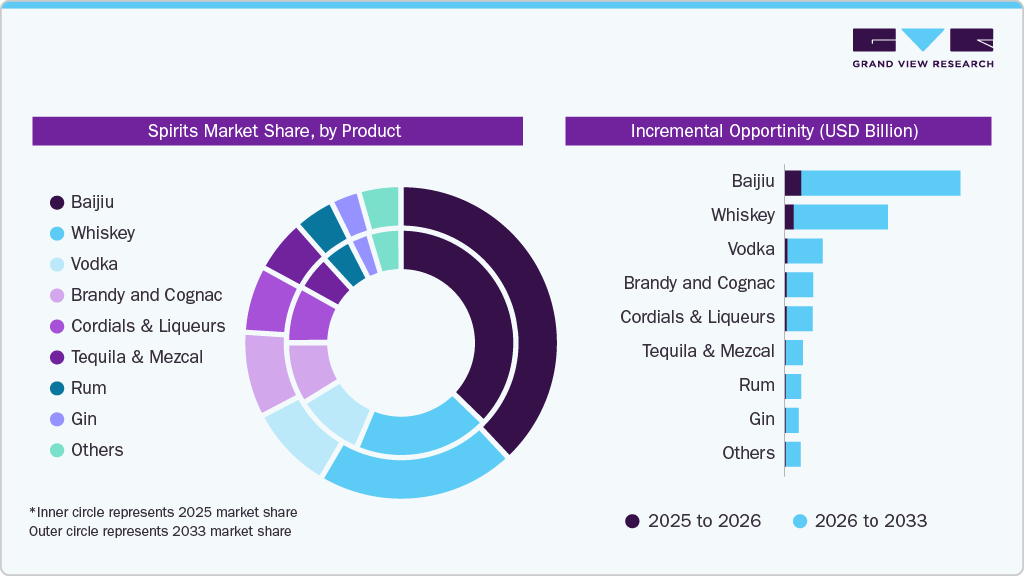
- By product: Baijiu led the spirits market and accounted for a share of 37.2% in 2025.
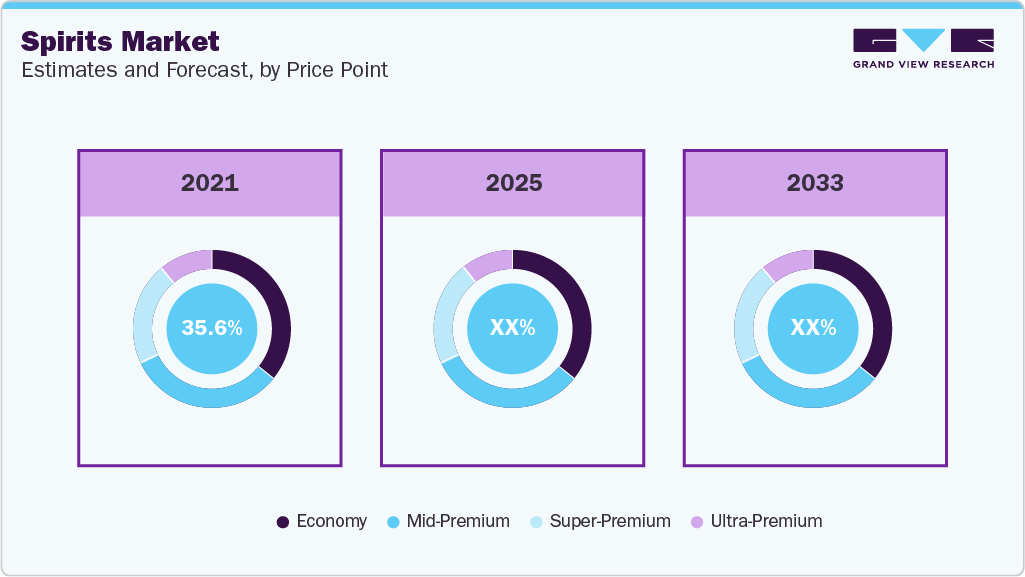
- By price point: Economic spirits led the market and accounted for a share of 34.9% in 2025.
- By distribution channel: Sales of spirits through the off-trade led the spirits market and accounted for a share of 60.0% in 2025.
Regional Highlights
- Largest regional market: Asia Pacific (54.4% revenue share, 2025)
- By country: China held the largest market share in 2025.
Market Size & Forecast
- Market size in 2025: USD 442.7 Billion
- Estimated market size in 2026: USD 461.8 Billion
- Projected market size by 2033: USD 641.8 Billion
- CAGR (2026-2033): 4.8%
Prism AI by Grand View Research Free to tryAsk a question about the spirits marketTry asking✓Every figure cited from GVR research Prefer the report? Download free sample →
Increasing disposable incomes, especially in emerging economies, and the expanding young adult population are boosting the consumption of premium and flavored spirits such as whiskey, vodka, rum, and gin. Additionally, innovations in product offerings, including low-calorie, organic, and ready-to-drink (RTD) options, are attracting health-conscious consumers. The growing influence of social media, celebrity endorsements, and experiential marketing has further enhanced brand visibility and consumer engagement. Moreover, the on-trade channel recovery post-pandemic, coupled with the expansion of e-commerce platforms for alcohol sales, is contributing to the market’s strong momentum. As consumers increasingly seek unique taste experiences and higher-quality products, global spirit manufacturers are focusing on innovation, sustainability, and diversification to capture the rising demand across both developed and emerging markets.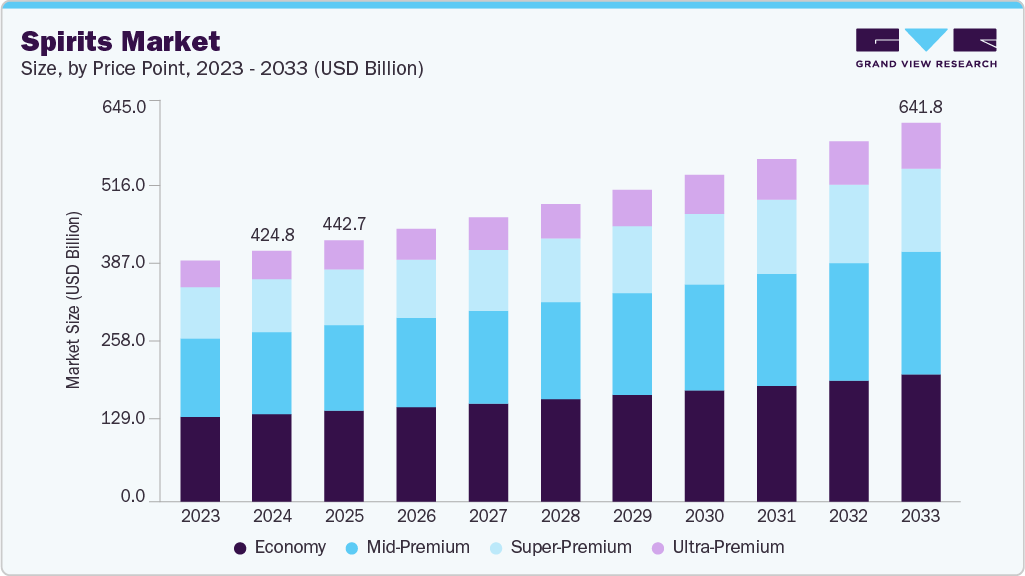 To learn more about this report, Download Free Sample Report
A growing trend in the market is the introduction of flavored and infused spirits, such as brandy, vodka, that are designed to attract younger and experimental drinkers. Some versions of brandy often feature fruit, spice, or honey infusions that make the spirit smoother and more approachable, especially for those new to brandy. This trend caters to evolving palates that prefer sweeter, mixable profiles ideal for cocktails or casual drinking. For instance, in June 2024, Tilaknagar Industries, a leading Indian-made foreign Liquor Manufacturer, introduced a new Green apple–flavored brandy under its premium Mansion House Flandy range, initially launched in Telangana, India. The variant blends the crisp essence of green apple with refined oaky undertones, offering a refreshing twist on traditional brandy. This launch aims to attract younger, flavor-seeking consumers and strengthen the company’s position in the premium brandy segment.
Another key trend driving the spirits industry is the growing focus on premiumization through exclusive, limited-edition, and luxury product launches. Leading distillers are increasingly catering to collectors and high-end consumers with rare blends, age-statement editions, and heritage-inspired packaging that highlight craftsmanship and brand legacy. These curated releases not only enhance brand prestige but also foster a sense of exclusivity and elevated value perception among consumers. In March 2026, Indri launched Rudhira, a limited-edition single malt matured in Pineau des Charentes casks, with only 252 individually numbered bottles. The release targets collectors and whisky enthusiasts, reinforcing premiumization through rarity, craftsmanship, and distinctive cask maturation.
Market Dynamics
The growing preference for premium and super-premium alcoholic beverages is a major factor driving the spirits market. Consumers are increasingly willing to spend more on products that offer superior quality, unique production methods, and differentiated taste experiences. The expansion of cocktail culture, hospitality establishments, and premium dining venues has further elevated demand for whiskey, gin, tequila, rum, and other high-value spirits. Younger adult consumers are showing strong interest in craft offerings, limited-edition releases, and locally produced products that emphasize authenticity and heritage. For instance, In June 2026, ABD Maestro launched “Bar Maestro,” a multi-city bartending platform across India designed to celebrate cocktail artistry and premium spirits. The initiative features RANGEELA Vodka, ZOYA Gin, and WOODBURNS Whisky, with bartenders using the portfolio to create distinctive cocktails, highlighting the growing role of craft, mixology, and experiential occasions in premium spirits consumption.
The spirits industry faces challenges from increasingly strict regulations governing alcohol production, marketing, distribution, and consumption. Many governments impose high excise duties, advertising restrictions, age-verification requirements, and sales limitations aimed at reducing alcohol-related harm. These measures can increase operational costs and restrict market expansion opportunities. At the same time, growing consumer awareness regarding wellness and lifestyle-related health concerns is influencing drinking habits. Some consumers are reducing alcohol intake, participating in moderation trends, or shifting toward low-alcohol and alcohol-free alternatives. Public health campaigns highlighting the risks associated with excessive alcohol consumption have further contributed to changing consumer behavior. Together, regulatory pressures and evolving health preferences may constrain growth in certain regions and create challenges for traditional spirits manufacturers.
Manufacturers can grow by developing locally tailored spirits portfolios that combine familiar categories with regional flavors, ingredients, and consumption occasions. Pernod Ricard India launched Seagram’s Xclamat!on in December 2025, covering whisky, vodka, gin, rum, and brandy under a single premium portfolio, with products incorporating Indian ingredients and production influences. The portfolio is planned for phased expansion across 14 markets, demonstrating how localized product development and multi-category portfolios can help manufacturers recruit new consumers and broaden market reach.
Consumer Insights:
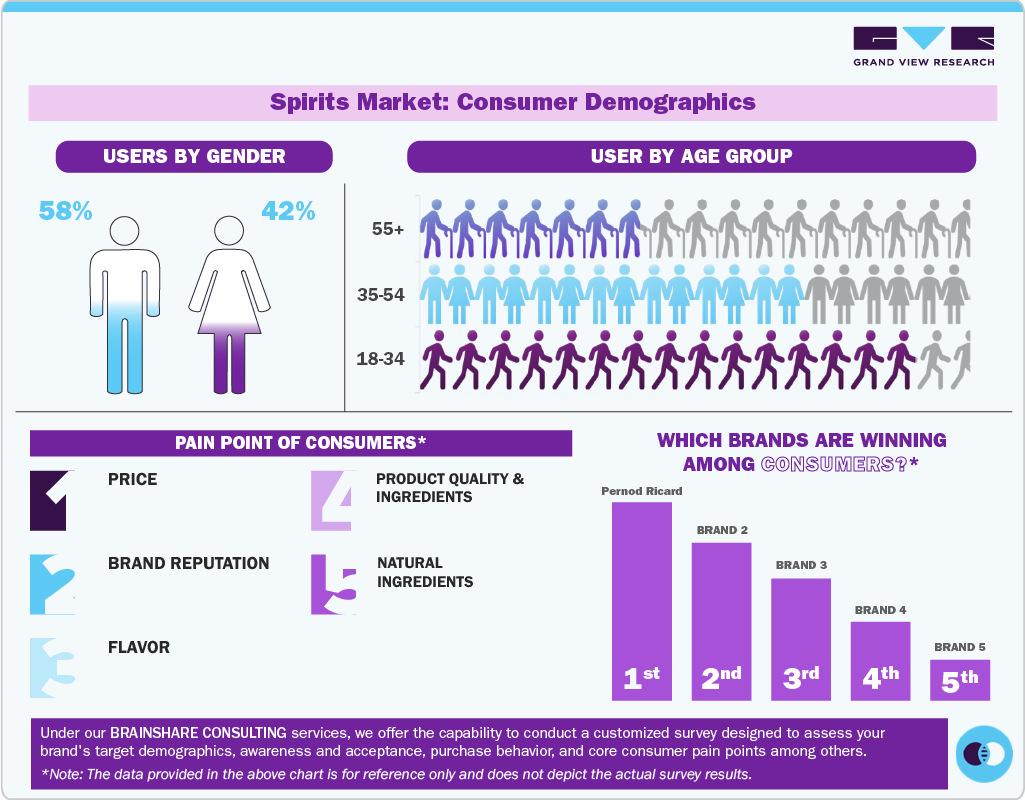
Consumer behavior in the spirits market is increasingly shifting toward quality-led and experience-driven consumption, with consumers showing greater willingness to spend on higher-quality spirits while moderating drinking frequency. NIQ’s 2026 REACH research found that 55% of consumers are still willing to pay more for better-quality drinks, while 63% would choose one or two high-quality drinks over four or five standard/value drinks. NIQ also reports that 67% of spirits drinkers are willing to pay more for higher-quality drinks, reinforcing the continued relevance of premiumization in the on-premise channel.
 To learn more about this report, Download Free Sample Report
Beyond premiumization, consumers are increasingly seeking distinctive flavor profiles, craft credentials, provenance, and personalized drinking experiences, encouraging brands to diversify beyond conventional spirit offerings. Interest in limited releases, aged expressions, innovative maturation techniques, and small-batch products is strengthening among consumers who associate rarity and craftsmanship with higher perceived value. At the same time, growing awareness of responsible consumption is encouraging moderation, lower-ABV choices, and alcohol-free alternatives, while digital retail and delivery platforms are making premium and niche spirits more accessible.
Product Insights
Based on product type, Baijiu accounts for the largest share of 37.2% in 2025, due to its deep cultural significance, widespread consumption in China, and growing global recognition as a premium spirit. Baijiu’s dominance is supported by its strong presence in social and ceremonial occasions, where it remains an integral part of Chinese tradition and hospitality. In addition, increasing international awareness, premium product launches, and efforts by Chinese distilleries to expand into global markets have further strengthened its position. The rising demand for authentic, heritage-rich beverages and the premiumization of traditional spirits have also contributed to Baijiu’s substantial market share.
 To learn more about this report, Download Free Sample Report
Tequila & Mezcal is anticipated to witness a CAGR of 5.9% from 2026 to 2033, driven by rising global demand for authentic, craft-distilled spirits and the growing appreciation for agave-based beverages. Consumers, particularly in North America and Europe, are increasingly drawn to premium and ultra-premium tequila and mezcal varieties that emphasize origin, artisanal production methods, and sustainability. The expansion of cocktail culture, along with innovative flavor infusions and celebrity-backed brands, is further propelling category growth. Moreover, the shift toward sipping spirits and the popularity of experiential drinking have elevated Tequila & Mezcal from party-centric beverages to sophisticated lifestyle choices, supporting their sustained market expansion over the forecast period.
Price Point Insights
By price point, economic spirits accounted for a share of 34.9% in 2025 due to their affordability, accessibility, and widespread consumption in emerging economies. These products cater to a broad consumer base that values quality and taste but remains highly price-sensitive, making them the preferred choice for everyday or social drinking occasions rather than luxury gifting or collecting. The segment also benefits from strong retail penetration across supermarkets, convenience stores, and local liquor shops, ensuring easy availability. In many developing markets, economic spirits serve as an entry point for new consumers transitioning from traditional or informal alcoholic beverages. In addition, growing urbanization, expanding middle-income populations, and aggressive marketing by local manufacturers continue to support the steady growth of affordable spirits globally.
 To learn more about this report, Download Free Sample Report
Ultra-premium spirits are anticipated to witness a CAGR of 5.9% from 2026 to 2033 as consumers increasingly associate these spirits with luxury, craftsmanship, and social status. Growing disposable incomes and lifestyle upgrades have fueled the trend of “drinking less but better,” with buyers seeking refined, high-quality experiences. Leading heritage brands such as Hennessy and Rémy Martin drive this growth through limited editions, aged blends, and artistic collaborations emphasizing exclusivity and authenticity. This shift is particularly strong in affluent markets such as the U.S., China, and Europe, where premium spirits symbolize sophistication and success.
Distribution Channel Insights
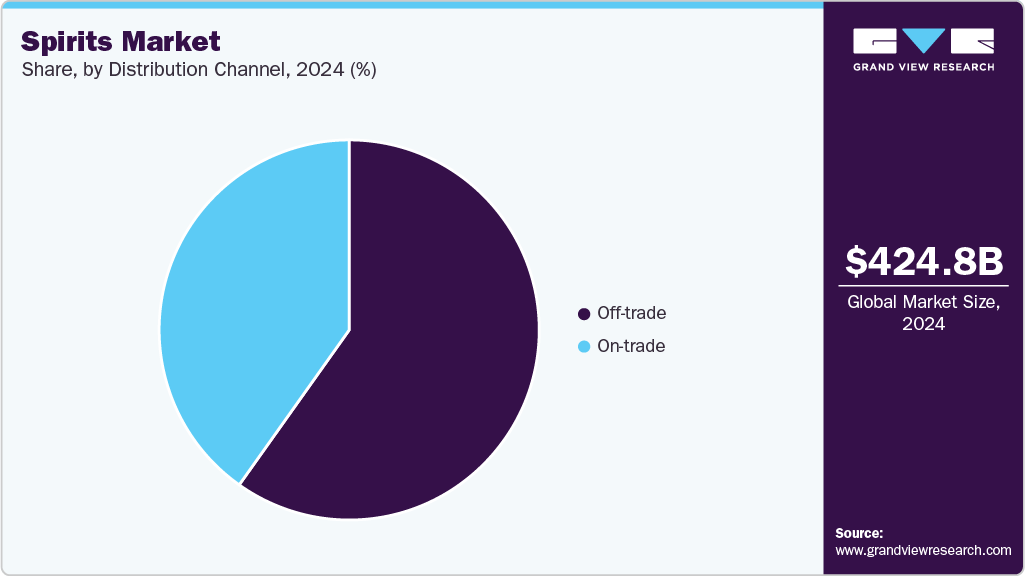
The sales of spirits through off-trade channels held the largest shares of around 60.0% in the global spirits market in 2025, due to their wider accessibility, convenience, and cost advantages. Most consumers purchase spirits for home consumption, gifting, or social gatherings, making retail and online outlets the most practical buying options. Off-trade channels also allow customers to explore a variety of brands and price ranges at competitive rates compared to on-trade venues like bars or restaurants. Additionally, the rapid growth of e-commerce and duty-free retail has strengthened this segment, as consumers increasingly prefer purchasing premium spirits online for ease, discounts, and exclusive editions.
 To learn more about this report, Download Free Sample Report
Spirits sales through on-trade channels are expected to grow at a CAGR of 4.5% from 2026 to 2033 due to the rising popularity of social drinking, premium experiences, and cocktail culture. Consumers, especially younger urban professionals, increasingly view spirits as sophisticated choices for socializing and celebration. The growing global trend of luxury dining, nightlife, and mixology has positioned these spirits as essential ingredients in premium cocktails, driving higher consumption through on-trade venues. Tourism growth and premium hospitality expansion have also boosted on-trade sales, as high-end establishments feature exclusive spirit selections and curated tasting experiences.
Regional Insights
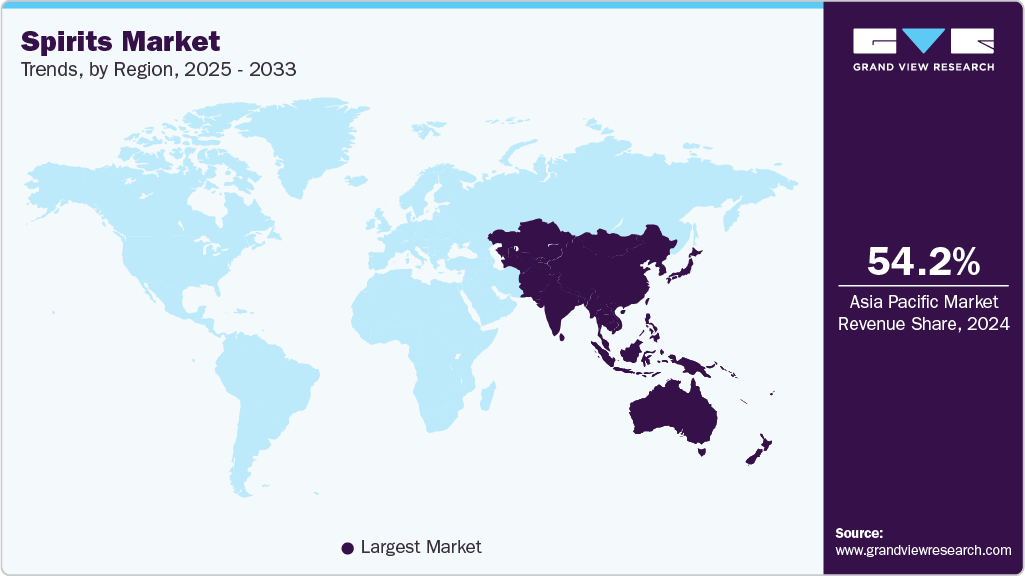
The Asia Pacific spirits market accounted for a revenue share of 54.4% of the global revenue in 2025, driven by rapid urbanization, and the expanding middle-class population across major economies such as China, India, and Southeast Asian nations. Consumers in the region are increasingly shifting toward premium and flavored spirits, while maintaining strong demand for traditional categories such as Baijiu, Shochu, and Soju. The growth of modern retail formats, e-commerce alcohol delivery platforms, and vibrant nightlife and on-trade channels further support market expansion. Additionally, global brands are strengthening their presence through localized flavors, smaller pack sizes, and targeted marketing to young adults. This combination of cultural diversity, premiumization, and widening access positions the Asia Pacific as one of the fastest-growing spirits markets worldwide.
 To learn more about this report, Download Free Sample Report
China Spirits Market Trends
China accounts for the largest share of the Asia Pacific spirits market, supported by its extensive baijiu industry, established domestic brands, and strong cultural association between spirits and social gatherings, family banquets, and gifting. According to the USDA Foreign Agricultural Service’s 2026 Spirits Market Update, baijiu accounts for more than 90% of China’s spirits market, while imported categories such as whisky, brandy, and vodka serve additional consumer preferences. The market is also undergoing a generational shift as younger consumers explore whisky, fruit-flavored spirits, lower-alcohol options, and cocktail-based experiences. These changing preferences are encouraging producers to diversify product formats and consumption occasions, while established baijiu brands continue adapting their portfolios and pricing to reflect more consumer-led purchasing patterns.
North America Spirits Market Trends
The North America spirits market is expected to grow at a CAGR of 4.8% from 2026 to 2033, fueled by the premiumization trend and consumers’ evolving taste for craft and authentic experiences. Consumers are gravitating toward premium, small-batch, and aged spirits that showcase craftsmanship, provenance, and superior quality. The surge in cocktail culture has further strengthened demand across categories such as whiskey, rum, gin, and tequila, as mixology becomes a mainstream lifestyle element. Younger consumers, in particular, are exploring innovative flavor profiles and premium mixers, driving experimentation with high-end spirits in bars and at home. Leading brands are capitalizing on this trend through collaborations with renowned mixologists, limited-edition releases, and storytelling that highlights heritage and artistry. For instance, brands like Patrón and Woodford Reserve are promoting premium expressions and signature cocktail experiences, positioning themselves at the intersection of luxury and creativity in the dynamic North American spirits landscape.
The spirits market in the U.S.accounted for 85.3% in the North America spirits market revenue in 2025. This leadership is driven by the country’s strong culture of premiumization, rising interest in craft distilling, and a well-developed on-trade and off-trade ecosystem. High consumer spending on premium, small-batch, and aged spirits, especially whiskey, tequila, and bourbon, continues to fuel category expansion. The U.S. also benefits from a vibrant cocktail culture, with bars, restaurants, and home mixologists driving demand for versatile, high-quality spirits. Additionally, continuous innovation, celebrity-backed brands, and a rapidly growing e-commerce channel have further strengthened market penetration. The country’s diverse consumer base, openness to experimentation, and preference for authentic, story-driven brands position the U.S. as the primary growth engine for the North American spirits industry.
Europe Spirits Market Trends
The spirits market in Europe accounted for 18.7% in 2025. The spirits market is being shaped by a growing emphasis on authenticity, sustainability, and craftsmanship. Consumers are increasingly drawn to spirits that celebrate regional identity, traditional production methods, and traceable ingredients, with designations such as Scotch Whisky and Cognac AOC symbolizing quality and heritage. Sustainability has become a key differentiator, as brands adopt eco-conscious practices like energy-efficient distillation, organic sourcing, and recyclable packaging to appeal to environmentally aware consumers. Meanwhile, innovation is reshaping the landscape through the introduction of flavored, lower-ABV, and cocktail-oriented variants that cater to younger, urban audiences seeking modern drinking experiences. Brands such as The Macallan and Grey Goose are expanding their portfolios with creative expressions and collaborations that bridge tradition with contemporary mixology, enhancing their relevance in both casual and premium consumption occasions across Europe.
Central & South America Spirits Market Trends
The Central & South America spirits market is expected to grow at a CAGR of 4.3% from 2026 to 2033, influenced by tourism-linked consumption, regional production heritage, and expanding premium travel flows, creating stronger demand for locally rooted spirits and destination-based drinking experiences. Growth in South American visitors to Caribbean destinations is supporting hospitality-led consumption, while manufacturers are increasingly leveraging local ingredients, cultural identity, and provenance to differentiate products. Diageo reported spirits growth in Brazil and Colombia in FY2026, with Colombia’s spirits volumes rising 23.3%, highlighting the region’s expanding contribution to category growth.
Middle East & Africa Spirits Market Trends
The Middle East & Africa spirits industry is expected to grow at a CAGR of 4.0% from 2026 to 2033. It is increasingly influenced by local sourcing and adaptation of international brands to regional tastes, as manufacturers use indigenous ingredients, locally relevant flavors, and domestic production to improve consumer resonance. Diageo, for example, sources 86% of its African ingredients locally and has developed spirits such as Orijin Marula, a gin made with African fruits. This localization strategy supports product differentiation while strengthening regional supply networks and consumer relevance.
Key Spirits Company Insights
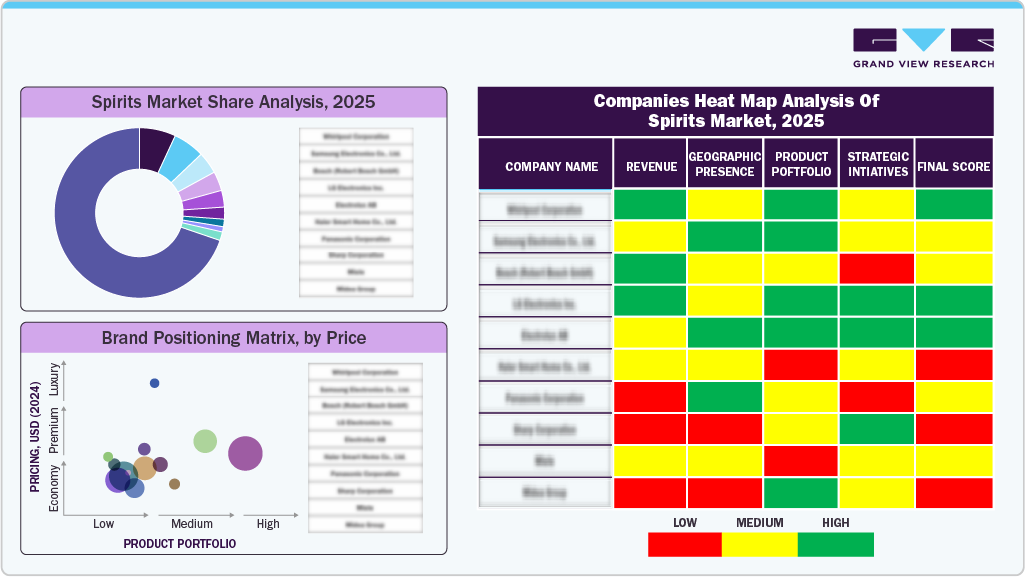
Leading players in the spirits industry include Asahi Group Holdings, Ltd., Diageo plc, Pernod Ricard S.A., Campari Group, and Constellation Brands, Inc. The global spirits market remains highly competitive, with leading manufacturers strategically expanding their distribution networks across online and offline platforms to improve product accessibility and visibility. Companies strongly emphasize innovation, advanced distillation processes, and diversified flavor profiles to attract younger consumers and broaden their international presence. Market growth is further fueled by the rising demand for premium and super-premium segments, the increasing influence of Western drinking culture and global mixology trends.
 To learn more about this report, Download Free Sample Report
Key Spirits Companies:
The following key companies have been profiled for this study on the spirits market:
-
Asahi Group Holdings, Ltd.
-
Diageo plc
-
Pernod Ricard S.A.
-
Campari Group
-
Constellation Brands, Inc.
-
Tilaknagar Industries Ltd.
-
Bacardi Limited
-
Suntory Holdings Limited
-
Louis Royer
-
Cognac Hardy
Competitive Benchmarking
Category
Operating Strategies
Competitive Edge
Weakness
Established Players (Diageo plc, Pernod Ricard S.A., Bacardi Limited, Campari Group, Suntory Holdings Limited)
Expand premium and super-premium spirits portfolios through acquisitions, product innovation, and global distribution partnerships.
Invest in brand building, experiential marketing, and emerging market expansion.
Strong brand equity, extensive global distribution networks, and diversified product portfolios across multiple spirit categories. Significant financial resources for marketing and product development.
High exposure to taxation and regulatory changes across markets.
Large organizational structures may limit responsiveness to rapidly changing consumer preferences.
Emerging Players (Tilaknagar Industries Ltd., Louis Royer, Cognac Hardy, regional craft distilleries)
Focus on premium niche offerings, craft production methods, and region-specific branding strategies. Leverage digital marketing, direct consumer engagement, and unique product positioning.
Greater flexibility in innovation, ability to target niche consumer segments, and strong authenticity-driven brand appeal. Faster adaptation to evolving consumption trends.
Limited production capacity and distribution reach compared to multinational competitors.
Lower marketing budgets and challenges in achieving large-scale brand recognition.
Recent Developments
-
In July 2026, Diageo introduced Bulleit ’87, its first new core expression since Bulleit 95 Rye in 2011. The American whiskey combines bourbon and rye, aged separately for at least four years and finished in toasted American and French oak, expanding Bulleit’s core whiskey portfolio.
-
In July 2026, Código 1530 launched its 15-Year Extra Añejo, a limited tequila aged in French white-oak ex-Cabernet barrels and finished for six months in cognac casks. Only 350 bottles were produced, with a retail price of US$4,100 per 70cl bottle.
-
In December 2025, Pernod Ricard India launched Seagram’s Xclamat!on, a portfolio spanning whisky, vodka, gin, rum, and brandy. The range combines Indian ingredients and production influences with global techniques and was planned for phased expansion across 14 markets.
-
In March 2025, Wray & Nephew launched Wray’s 43, a new UK-exclusive white Jamaican rum with an ABV of 43%, designed to cater to the growing demand for flavorful, easy-to-mix spirits. This limited edition rum is a blend of unaged Jamaican white rums, featuring notes of rich fruits, charred pineapple, and molasses.
Spirits Market Report Scope
Report Attribute
Details
Market size in 2025
USD 442.7 billion
Estimated market size in 2026
USD 461.8 billion
Revenue Forecast in 2033
USD 641.8 billion
Growth Rate
CAGR of 4.8% from 2025 to 2033
Actuals
2021 - 2024
Forecast period
2025 - 2033
Quantitative units
Revenue in USD million/billion, volume in million 9-Liter Cases and CAGR from 2026 to 2033
Report coverage
Revenue & Volume forecast, company ranking, competitive landscape, growth factors, and trends
Segments covered
Product, price point, distribution channel, and product - price point – distribution channel
Regional scope
North America; Europe; Asia Pacific; Central & South America; Middle East and Africa
Country scope
U.S.; Canada; Mexico; Germany; UK; France; Italy; Spain; China; Japan; India; Australia & New Zealand; South Korea; Brazil; Argentina; South Korea; UAE
Key companies profiled
Asahi Group Holdings, Ltd.; Diageo plc; Pernod Ricard S.A.; Campari Group; Constellation Brands, Inc.; Tilaknagar Industries Ltd.; Bacardi Limited; Suntory Holdings Limited; Louis Royer; Cognac Hardy
Customization scope
Free report customization (equivalent up to 8 analysts’ working days) with purchase. Addition or alteration to country, regional & segment scope.
Pricing and purchase options
Avail customized purchase options to meet your exact research needs. Explore purchase options
Global Spirits Market Report Segmentation
This report forecasts revenue growth at regional levels and provides an analysis of the latest trends and opportunities in each sub-segment from 2021 to 2033. For this study, Grand View Research has segmented the Spirits market by product, price point, distribution channel, product - price point – distribution channel and region.
-
Product Outlook (Volume, Million 9-Liter Cases; Revenue, USD Million, 2021 - 2033)
-
Vodka
-
Whiskey
-
Rum
-
Brandy and Cognac
-
Gin
-
Cordials & Liqueurs
-
Tequila & Mezcal
-
Baijiu
-
Others
-
-
Price Point Outlook (Volume, Million 9-Liter Cases; Revenue, USD Million, 2021 - 2033)
-
Economy
-
Mid-Premium
-
Super-Premium
-
Ultra-Premium
-
-
Distribution Channel Outlook (Volume, Million 9-Liter Cases; Revenue, USD Million, 2021 - 2033)
-
On-trade
-
Off-trade
-
-
Product - Price Point – Distribution Channel Outlook (Volume, Million 9-Liter Cases; Revenue, USD Million, 2021 - 2033)
-
Vodka
-
Unflavored/Regular
-
Economy
-
On-trade
-
Off-trade
-
-
Mid-Premium
-
On-trade
-
Off-trade
-
-
Super-Premium
-
On-trade
-
Off-trade
-
-
Ultra-Premium
-
On-trade
-
Off-trade
-
-
-
Flavored
-
Economy
-
On-trade
-
Off-trade
-
-
Mid-Premium
-
On-trade
-
Off-trade
-
-
Super-Premium
-
On-trade
-
Off-trade
-
-
Ultra-Premium
-
On-trade
-
Off-trade
-
-
-
Whiskey
-
Scotch Whiskey
-
Economy
-
On-trade
-
Off-trade
-
-
Mid-Premium
-
On-trade
-
Off-trade
-
-
Super-Premium
-
On-trade
-
Off-trade
-
-
Ultra-Premium
-
On-trade
-
Off-trade
-
-
-
Irish Whiskey
-
Economy
-
On-trade
-
Off-trade
-
-
Mid-Premium
-
On-trade
-
Off-trade
-
-
Super-Premium
-
On-trade
-
Off-trade
-
-
Ultra-Premium
-
On-trade
-
Off-trade
-
-
-
Global/American Whiskey
-
Economy
-
On-trade
-
Off-trade
-
-
Mid-Premium
-
On-trade
-
Off-trade
-
-
Super-Premium
-
On-trade
-
Off-trade
-
-
Ultra-Premium
-
On-trade
-
Off-trade
-
-
-
Japanese Whiskey
-
Economy
-
On-trade
-
Off-trade
-
-
Mid-Premium
-
On-trade
-
Off-trade
-
-
Super-Premium
-
On-trade
-
Off-trade
-
-
Ultra-Premium
-
On-trade
-
Off-trade
-
-
-
Canadian Whiskey
-
Economy
-
On-trade
-
Off-trade
-
-
Mid-Premium
-
On-trade
-
Off-trade
-
-
Super-Premium
-
On-trade
-
Off-trade
-
-
Ultra-Premium
-
On-trade
-
Off-trade
-
-
-
Other Whiskey
-
Economy
-
On-trade
-
Off-trade
-
-
Mid-Premium
-
On-trade
-
Off-trade
-
-
Super-Premium
-
On-trade
-
Off-trade
-
-
Ultra-Premium
-
On-trade
-
Off-trade
-
-
-
Rum
-
Dark & Golden Run
-
Economy
-
On-trade
-
Off-trade
-
-
Mid-Premium
-
On-trade
-
Off-trade
-
-
Super-Premium
-
On-trade
-
Off-trade
-
-
Ultra-Premium
-
On-trade
-
Off-trade
-
-
-
White Rum
-
Economy
-
On-trade
-
Off-trade
-
-
Mid-Premium
-
On-trade
-
Off-trade
-
-
Super-Premium
-
On-trade
-
Off-trade
-
-
Ultra-Premium
-
On-trade
-
Off-trade
-
-
-
Flavored & Spiced Rum
-
Economy
-
On-trade
-
Off-trade
-
-
Mid-Premium
-
On-trade
-
Off-trade
-
-
Super-Premium
-
On-trade
-
Off-trade
-
-
Ultra-Premium
-
On-trade
-
Off-trade
-
-
-
Others
-
Economy
-
On-trade
-
Off-trade
-
-
Mid-Premium
-
On-trade
-
Off-trade
-
-
Super-Premium
-
On-trade
-
Off-trade
-
-
Ultra-Premium
-
On-trade
-
Off-trade
-
-
-
Gin
-
Economy
-
On-trade
-
Off-trade
-
-
Mid-Premium
-
On-trade
-
Off-trade
-
-
Super-Premium
-
On-trade
-
Off-trade
-
-
Ultra-Premium
-
On-trade
-
Off-trade
-
-
-
Brandy & Cognac
-
Unflavored/Regular
-
Economy
-
On-trade
-
Off-trade
-
-
Mid-Premium
-
On-trade
-
Off-trade
-
-
Super-Premium
-
On-trade
-
Off-trade
-
-
Ultra-Premium
-
On-trade
-
Off-trade
-
-
-
Flavored
-
Economy
-
On-trade
-
Off-trade
-
-
Mid-Premium
-
On-trade
-
Off-trade
-
-
Super-Premium
-
On-trade
-
Off-trade
-
-
Ultra-Premium
-
On-trade
-
Off-trade
-
-
-
Tequila Mezcal
-
Economy
-
On-trade
-
Off-trade
-
-
Mid-Premium
-
On-trade
-
Off-trade
-
-
Super-Premium
-
On-trade
-
Off-trade
-
-
Ultra-Premium
-
On-trade
-
Off-trade
-
-
-
Baijiu
-
Economy
-
On-trade
-
Off-trade
-
-
Mid-Premium
-
On-trade
-
Off-trade
-
-
Super-Premium
-
On-trade
-
Off-trade
-
-
Ultra-Premium
-
On-trade
-
Off-trade
-
-
-
Other Spirits
-
Economy
-
On-trade
-
Off-trade
-
-
Mid-Premium
-
On-trade
-
Off-trade
-
-
Super-Premium
-
On-trade
-
Off-trade
-
-
Ultra-Premium
-
On-trade
-
Off-trade
-
-
-
-
Regional Outlook (Volume, Million 9-Liter Cases; Revenue, USD Million, 2021 - 2033)
-
North America
-
U.S.
-
Canada
-
Mexico
-
-
Europe
-
Germany
-
UK
-
France
-
Italy
-
Spain
-
-
Asia Pacific
-
China
-
Japan
-
India
-
Australia & New Zealand
-
South Korea
-
-
Central & South America
-
Brazil
-
Argentina
-
-
Middle East and Africa (MEA)
-
South Africa
-
UAE
-
-
Research Methodology
The spirits market figures in this report are based on a proven research process that combines executive interviews with secondary research from proprietary databases, company filings, and recognized regulatory and institutional sources. Market size is built through value-chain sizing—reconciling supply-side and demand-side estimates—and triangulated with bottom-up and top-down approaches. Every estimate passes multiple levels of expert validation before publication, with each spirits segment quantified using the revenue-capture definitions in the table below.
Segment Definition
Segment - Product
Revenue capture definition
Vodka
This segment includes the sales of vodka-based spirits consumed in cocktails and standalone servings. Its popularity stems from a clean flavor profile and adaptability across drinking occasions. Strong retail and hospitality presence supports continued market demand.
Whiskey
This segment includes the sales of whiskey products such as Scotch, bourbon, Irish whiskey, and other variants. Consumer interest is driven by heritage, aging characteristics, and premium product offerings. Demand remains strong across both mature and emerging markets.
Rum
This segment includes the sales of rum products consumed neat or as cocktail ingredients. Growth is supported by flavored varieties, premium expressions, and expanding cocktail culture. The category appeals to a broad range of consumer preferences.
Brandy and Cognac
This segment includes the sales of brandy and cognac across standard and luxury product ranges. Consumption is influenced by gifting traditions, celebrations, and premium drinking occasions. Brand reputation and aging quality play important roles in purchasing decisions.
Gin
This segment includes the sales of gin products featuring classic and botanical-infused formulations. Rising interest in craft beverages and innovative flavor profiles supports category expansion. Demand is particularly strong in cocktail-focused markets.
Cordials & Liqueurs
This segment includes the sales of flavored spirits and liqueurs used for sipping and cocktail preparation. Product innovation and diverse flavor offerings attract a wide consumer base. Seasonal consumption and mixology trends further support sales.
Tequila & Mezcal
This segment includes the sales of tequila and mezcal produced from agave plants. Growing appreciation for authentic production methods and premium variants drives market growth. International demand continues to expand beyond traditional consumption regions.
Baijiu
This segment includes the sales of baijiu, a traditional Chinese distilled spirit with strong cultural significance. Consumption is closely associated with social gatherings, celebrations, and business events. Domestic demand remains the primary contributor to market performance.
Others
This segment includes the sales of regional, specialty, and emerging spirit categories outside the major classifications. Demand is supported by local traditions and evolving consumer tastes. Product diversity creates opportunities across niche market segments.
Segment - Distribution Channel
Revenue capture definition
On-trade
This segment includes the sales of spirits through bars, restaurants, hotels, clubs, and similar venues. Purchasing is influenced by social experiences, tourism activity, and hospitality trends. Premium and cocktail-based consumption is particularly prominent in this channel.
Off-trade
This segment includes the sales of spirits through supermarkets, liquor stores, convenience outlets, and online platforms. Consumer preference for convenience and home consumption supports channel growth. Broad product availability encourages purchases across all price categories.
Segment – Price Point
Revenue capture definition
Economy
This segment includes the sales of affordable spirits targeted toward budget-conscious consumers. Demand is largely driven by accessibility, value pricing, and high-volume consumption. Distribution is widespread across retail and convenience channels.
Mid-Premium
This segment includes the sales of spirits positioned between economy and premium offerings. Consumers are attracted to improved quality while maintaining reasonable pricing. The category benefits from broad appeal across multiple demographics.
Super-Premium
This segment includes the sales of premium spirits known for superior ingredients, craftsmanship, and production standards. Demand is supported by consumers seeking elevated drinking experiences. Brand heritage and product differentiation contribute to category growth.
Ultra-Premium
This segment includes the sales of luxury spirits featuring exclusive production techniques, rare ingredients, or limited releases. Purchases are often associated with prestige, gifting, and special occasions. Rising interest in high-end alcoholic beverages supports market expansion.
Estimation Model
No.
Layer
Key Question
Description
01
Target Population Layer
Who is legally eligible to consume spirits?
Identify the legal drinking-age population across each country/market and apply demographic and regulatory filters. Consider age, gender, income, urbanization, and country-specific legal drinking-age requirements to establish the potential addressable consumer population.
02
Supplement Adoption Layer
Who consumes alcoholic beverages?
Apply country-specific alcohol consumption rates to the eligible population, considering consumption frequency, demographics, cultural preferences, and drinking occasions to estimate the active consumer base.
03
Men's Health Conversion Layer
Who actively consumes and purchases spirits?
Apply a spirits participation rate to alcohol consumers, considering product preferences, consumption frequency, price tiers, and on-/off-trade purchases.
04
Monetisation Layer
How much revenue is generated?
Multiply active spirits consumers by annual spending or consumption volume, considering product mix, pricing, purchase frequency, premiumization, and on-/off-trade channels to estimate market revenue.
Customization Table
Client Request
Customization Delivered
Value Adds
Premiumization & Consumer Preference Trends
Conducted a focused assessment of premium spirits demand across whisky, vodka, rum, gin, tequila, and craft alcoholic beverages, including flavor innovation and premium brand positioning trends.
Helps stakeholders identify high-growth product categories, evolving consumer preferences, and premium revenue opportunities.
Distribution Channel & On-Trade/Off-Trade Analysis
Evaluated sales performance across bars, restaurants, retail stores, duty-free outlets, and e-commerce channels, including purchasing behavior and regional consumption patterns.
Provides insights into channel optimization, market penetration strategies, and revenue expansion opportunities.
Production, Trade & Regulatory Landscape Assessment
Assessed raw material sourcing, distillation capacity, import-export trends, taxation policies, and alcohol regulations influencing market competitiveness.
Supports investment planning, geographic expansion, and risk mitigation through a deeper understanding of supply and regulatory dynamics.
Frequently Asked Questions About This Report
The global spirits market is expected to grow at a CAGR of 4.8% from 2026 to 2033, reaching USD 641.8 billion in 2033.
North America is a significantly growing region over the forecast period.
The global spirits market was valued at USD 442.7 billion in 2025 and is estimated to reach USD 461.8 billion in 2026.
Key players include Asahi Group Holdings, Ltd.; Diageo plc; Pernod Ricard S.A.; Campari Group; Constellation Brands, Inc.; Tilaknagar Industries Ltd.; Bacardi Limited; Suntory Holdings Limited; Louis Royer; Cognac Hardy
Key factors include rising consumer demand for premium alcoholic beverages, growing cocktail consumption, increasing disposable incomes, expanding on-trade and e-commerce sales channels, and continuous innovation in flavors, packaging, and product formats.
Asia Pacific dominated the market, accounting for a revenue share of 54.4% in 2025.
Sales of spirits through the off-trade led the spirits market and accounted for a share of 60.0% in 2025, while spirits sales through on-trade channels segment is the fastest-growing distribution channel.
The economic spirits accounted for a share of 34.9% in 2025, while ultra-premium spirits segment is the fastest-growing price point.
Baijiu segment led with a 37.2% revenue share in 2025, while tequila & mezcal is the fastest-growing segment.
About the Author(s)
Alcohol & Tobacco Research Team
Consumer Goods · Alcohol & TobaccoThis report was authored by the alcohol & tobacco research team at Grand View Research - comprising two research analysts, one senior research analyst, and one industry expert - with specialized expertise in the alcohol & tobacco segment of the consumer goods industry. All findings are based on proprietary consumer goods databases, executive interviews, and regulatory analysis, subject to internal peer review prior to publication.
Last Updated:
Speak to Analyst

Customize this report to your needs - add regions, segments, or data points, with 20% free customization.
Or view our licence options:


ISO 9001:2015 & 27001:2022 Certified
We are GDPR and CCPA compliant! Your transaction & personal information is safe and secure. For more details, please read our privacy policy.


