
- Home
- »
- Healthcare IT
- »
-
Spiritual Wellness Apps Market Size Share Report 2026-2033GVR Report cover

Spiritual Wellness Apps Market (2026 - 2033)
Size, Share & Trends Analysis Report By Platform (Android, iOS), By Device (Smartphones, Tablets), By Subscription (Paid (In App Purchase), Free), By Type, By Region, And Segment Forecasts
Market Size, 2025
$2.5BMarket Estimate, 2026
$2.8BMarket Forecast, 2033
$7.4BCAGR, 2026–2033
14.8%Spiritual Wellness Apps Market Summary
The global spiritual wellness apps market size was valued at USD 2.5 billion in 2025 and is projected to grow from USD 2.8 billion in 2026 to USD 7.4 billion by 2033, at a CAGR of 14.8% from 2026 to 2033. North America dominated the market, accounting for the largest revenue share of 44.1% in 2025. Factors such as increasing consumer adoption of digital wellness solutions, growing awareness of meditation and mindfulness, rising smartphone penetration, and continuous innovation in spiritual wellness applications are driving the spiritual wellness apps industry’s growth.
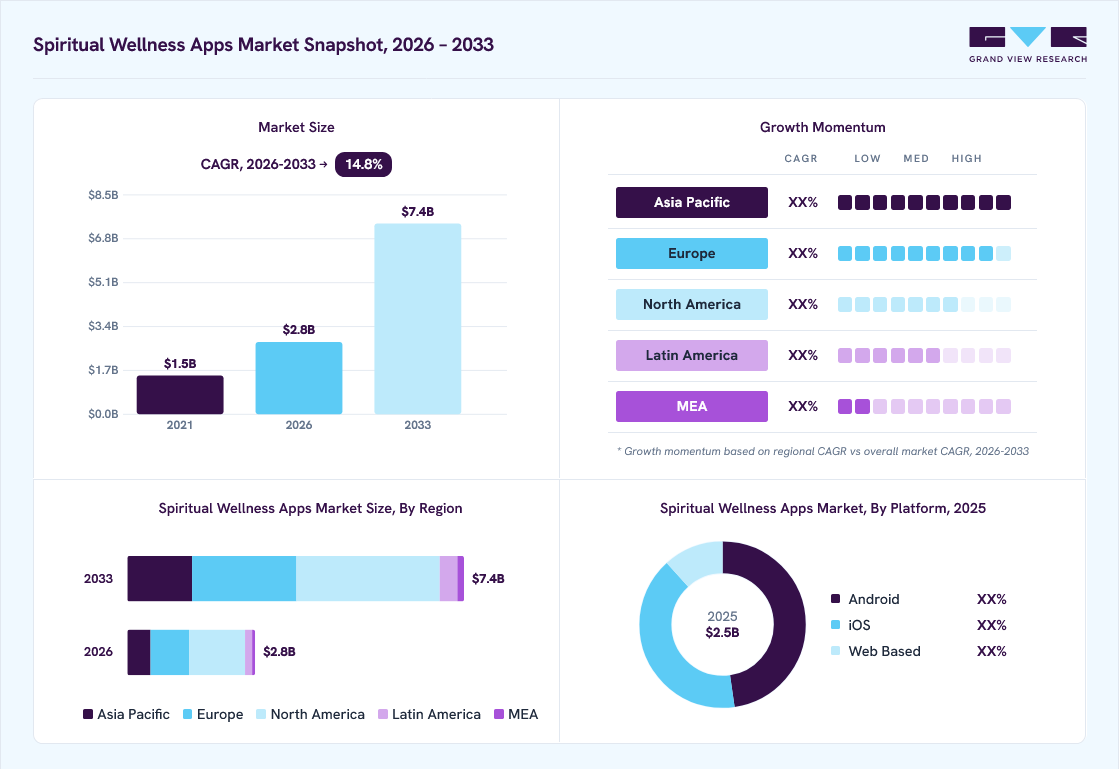 Source: Grand View Research, IR Documents, Primary Interviews, Paid DatabasesTo learn more about this report,
 Download Free Sample Report
Key Market Trends & Insights
- By platform: Android held the largest revenue share in 2025
- By device: Smartphones held the largest revenue share in 2025
- By subscription: Paid (in-app purchase) segment held the largest revenue share in 2025
- By type: Meditation and mindfulness apps held the largest revenue share in 2025
Regional Highlights
- Largest regional market: North America (44.1% revenue share, 2025)
- Fastest-growing regional market: Asia Pacific (fastest CAGR, 2026-2033)
- By country: Canada is expected to grow at the fastest CAGR from 2026 to 2033
Market Size & Forecast
- Market Size in 2025: USD 2.5 Billion
- Estimated Market Size in 2026: USD 2.8 Billion
- Projected Market Size by 2033: USD 7.4 Billion
- CAGR (2026-2033): 14.8%
Three ways to get this report
Buy it, customize it, or ask a question.Ask an Analyst
Analyst response in 1 business day
- AccessReport author, directly
- Reply timeWithin 1 working day
- No sales callDirect answer only
- FormatEmail reply
- CostFree, no cost
Get the Full Report
What the study covers
- FormatsPDF · Excel · Dashboard
- Timeline2026–2033 annual, 2025 base
- Coverage20+ countries, 5 regions
- Companies10+ key players profiled
Customize the Report
20% free customization
- IncludeCountries, segments, points
- TailorTo your product definition
- ExtendDeeper competitor detail
- OrA fully bespoke study
- Turnaround5–10 working days
Factors such as increasing consumer adoption of digital wellness solutions, growing awareness of meditation and mindfulness, rising smartphone penetration, and continuous innovation in spiritual wellness applications are driving the spiritual wellness apps industry’s growth. For instance, in June 2025, the Isha Foundation launched the Miracle of Mind meditation app, which surpassed one million downloads within just 15 hours of its release . To learn more about this report, Download Free Sample Report
The free app combines guided meditation with adaptive digital features to make meditation more accessible, reflecting the growing consumer demand for digital spiritual wellness solutions.
Market Dynamics
The spiritual wellness apps market is experiencing significant growth, driven by the rising prevalence of stress, anxiety, depression, and sleep disorders, alongside increasing awareness of mental and emotional well-being and broader adoption of digital health solutions. Market growth is further supported by advancements in artificial intelligence, personalized recommendations, mood tracking, journaling, and immersive audio experiences that enhance user engagement. In addition, collaborations with mental health professionals, wellness coaches, yoga instructors, and spiritual practitioners are expanding the quality and diversity of digital wellness content. While challenges such as intense competition, user retention, data privacy concerns, and limited clinical validation for certain approaches persist, the emergence of AI-powered spiritual companions and culturally relevant wellness experiences presents significant opportunities for sustained market growth and innovation.
Advancements in smartphone and wearable technologies are accelerating the growth of the spiritual wellness apps market by enabling seamless access to meditation, mindfulness, sleep improvement, and holistic wellness applications, while supporting real-time health monitoring and personalized wellness experiences. According to the GSMA Mobile Economy 2025 report, 58% of the global population (around 4.7 billion people) subscribed to mobile internet services in 2024, and this figure is expected to reach 5.5 billion by 2030, representing 64% of the global population. Furthermore, Ericsson's Mobility Report, published in June 2025, estimates that global 5G subscriptions will exceed 2.9 billion by the end of 2025 and reach 6.3 billion by 2030 , enabling faster connectivity and seamless access to digital wellness platforms.
In addition, wearable device adoption continues to accelerate, allowing users to monitor sleep quality, stress levels, heart rate, and other wellness metrics that integrate with spiritual wellness applications. According to the International Data Corporation (IDC), data published in July 2025, the global wearable device shipments totaled 145.7 million units in Q1 2026, reflecting continued growth in connected health technologies. The expanding ecosystem of smartphones, wearables, and high-speed 5G connectivity is expected to significantly drive the adoption of spiritual wellness apps during the forecast period.
The growing adoption of spiritual wellness apps for meditation, mindfulness, sleep improvement, and stress management has increased concerns regarding the privacy and security of users' health-related data. These applications collect sensitive information, including mood, emotional well-being, sleep patterns, and biometric data from connected wearable devices. As the integration of AI, cloud computing, and digital health technologies expands, protecting user data has become a critical challenge for app developers.
According to the HIPAA Breach Report, in April 2026, 47 healthcare data breaches affecting 500 or more individuals were reported to the HHS' Office for Civil Rights (OCR). In addition, 725 large healthcare data breaches were reported in 2024, affecting over 275 million records. The rising frequency of cyberattacks and stringent regulations such as HIPAA, GDPR, and other regional data protection laws require developers to invest heavily in cybersecurity and regulatory compliance. These factors can reduce consumer trust and limit the adoption of spiritual wellness applications, thereby restraining market growth.
AI-powered features such as personalized meditation plans, adaptive mindfulness recommendations, mood tracking, spiritual coaching, and guided wellness journeys are enhancing user engagement and improving long-term retention. As consumers increasingly seek customized, data-driven wellness experiences, developers have an opportunity to integrate spirituality with AI, wearable devices, and behavioral analytics to deliver highly personalized digital wellness solutions.
For instance, in July 2025, Rgyan launched Rgyan Bodhi, an AI-powered devotional assistant designed to deliver personalized spiritual guidance and content recommendations based on users' birth details, location, and individual preferences. The platform offers AI-driven Panchang updates, personalized horoscopes, mantra recommendations, guided meditations, ritual guidance, access to sacred texts, and recommendations for spiritual products and services. By integrating AI with devotional practices, the launch reflects the growing trend toward personalized digital spirituality and highlights the significant opportunity for AI-enabled innovation in the spiritual wellness app market.
"Rgyan Bodhi is more like a living, breathing spiritual companion designed to light up your path and walk with you every step of your digital devotional journey. In today's fast-paced world, people are truly seeking inner peace and deeper connections. We've used the power of AI to bring the richness of our spiritual/devotional traditions directly to individuals, customized to their unique spiritual needs. This isn't just about information; it's about nurturing genuine spiritual growth and holistic well-being."
-Umesh Khatri, Co-founder and CEO, Rgyan
Key Spiritual Wellness Apps
Apps
Features
Calm
Offers hundreds of guided meditations, daily 10-minute Daily
Calm sessions, customizable breathing exercises, celebrity
narrated Sleep Stories, and expert-led mindfulness
masterclasses covering stress, focus, sleep, and personal well
Features a dedicated Calm Kids section with age-appropriate
mindfulness content for children aged 3 and above, along with
customizable wellness programs tailored to users' individual
mental health and relaxation needs.
Headspace
Offers over 1,000 guided meditations, Sleepcasts, specialized
programs for meditation, sleep, focus, and movement, along
with AI-powered emotional support through Ebb and access to
professional mental health coaching.
Integrates AI-driven personalized recommendations,
mindfulness techniques inspired by Burmese and Tibetan
Buddhist traditions, and tailored wellness content to help users
improve emotional well-being, sleep quality, productivity, and
overall mental health.
Breethe
Offers 1,700+ audio tracks, including guided meditations,
relaxation music, sleep sounds, sleep stories, breathing
exercise videos, and hypnotherapy sessions designed to
improve sleep, reduce stress, and support emotional well
Features themed meditation series addressing real-life
challenges, AI-supported daily routines with morning
meditation alarms, and structured mindfulness programs to
help users build consistent wellness habits and improve overall
mental health.
Market Concentration & Characteristics
The spiritual wellness apps industry has been characterized by a high degree of innovation, driven by the integration of AI, personalized wellness solutions, and the ongoing launch of digitally enhanced spiritual platforms. Developers are increasingly leveraging AI-driven recommendations, guided meditation technologies, and interactive content to deliver more personalized spiritual experiences. For instance, in December 2025, Seek Peace Inc. launched the Peace App, a Christian meditation platform designed to provide guided meditations, scripture-based content, and multi-session spiritual wellness programs across 175 countries. The introduction of such faith-oriented, technology-enabled solutions highlights the industry's shift toward personalized, accessible digital spiritual experiences, supporting continued innovation in the spiritual wellness apps market.
 To learn more about this report, Download Free Sample Report
"In a world that constantly demands our attention, we wanted to create a space where Christians and faith-curious seekers could intentionally disconnect from the noise and reconnect with God. The Peace App is more than just a meditation app; it's a movement and tool for spiritual formation, helping users find the quiet strength that comes from dwelling in God's presence."
-Matthew McDonald, CEO and Founder, Peace App.
The spiritual wellness apps market is characterized by a moderate level of merger and acquisition (M&A) activity, as companies increasingly pursue strategic acquisitions to expand their digital spiritual offerings, strengthen community engagement, and reach a broader user base. For instance, in 2025, EWTN Global Catholic Network acquired a majority stake in Holy Habits, a Catholic spiritual formation application focused on helping users build virtues, enhance prayer practices, and develop daily faith-based habits. Through this acquisition, Holy Habits founder Drago Dimitrov joined EWTN’s leadership team to support the app’s future growth initiatives.
Regulatory frameworks significantly influence the industry due to the increasing collection of user data, including personal preferences, behavioral patterns, and wellness information. In the U.S., the Federal Trade Commission (FTC) Act requires companies to ensure transparency and prevent unfair data practices. Although no federal privacy law equivalent to GDPR exists, several state-level regulations have been introduced. For instance, in 2025, California expanded consumer data protection requirements through the CCPA and CPRA, while states such as Virginia, Colorado, and Connecticut implemented similar privacy laws, encouraging app providers to strengthen consent practices, data security, and privacy compliance.
Several market players are expanding their business by introducing new spiritual wellness solutions to strengthen their market position and broaden their product portfolios. For instance, in February 2025, Spirit Daughter launched Moment, an energy-alignment app designed to promote mindfulness and emotional well-being. The platform expanded the company's portfolio, offering personalized meditation and spiritual wellness sessions tailored to users' lifestyles, goals, and experience levels.
The industry is marked by considerable regional growth, as businesses focus on localizing their content and customizing solutions to meet the cultural and linguistic preferences of different regions. The Asia-Pacific and Latin America regions have seen notable growth, fueled by increased smartphone usage and a rising interest in mindfulness practices. Meanwhile, North America and Europe remain established markets with consistent adoption levels.
Analyst Perspective
The spiritual wellness apps market is projected to grow steadily, driven by rising consumer awareness of mental, emotional, and spiritual health, as well as the widespread use of smartphones and digital health technologies. Companies are prioritizing AI-powered personalization, guided meditation, faith-based content, and integration with wearable devices to boost user engagement and retention. Increased demand for holistic wellness, along with the growth of subscription-based models and strategic partnerships, is expected to create significant opportunities. However, strong competition, user retention challenges, and changing data privacy regulations will require ongoing innovation and unique content to shape the market’s long-term landscape.
Platform Insights
The Android segment dominated the spiritual wellness apps market in 2025 with a revenue share of 47.6%. Factors such as the rapidly increasing number of Android users and the growing adoption of smartphones globally are anticipated to fuel segment growth. Furthermore, there are growing downloads of meditation and yoga apps on Android phones to stay active and relieve stress and anxiety. For instance, according to data published by BankMyCell in January 2025, the number of active Android smartphone users worldwide was estimated to reach approximately 4.2 billion in 2025, highlighting the platform's extensive global reach and supporting the continued growth of Android-based spiritual wellness applications.
The iOS segment is expected to grow at the fastest CAGR over the forecast period, driven by the increasing adoption of Apple devices and rising consumer spending on premium digital wellness applications. iOS users typically show higher engagement with subscription-based services, which supports the growth of spiritual wellness apps on the platform. According to data published by BankMyCell in January 2025, there are approximately 1.56 billion iPhone users globally, reflecting the expanding Apple ecosystem and its growing potential for digital health and wellness applications.
Device Insights
The smartphones segment dominated the spiritual wellness apps industry in 2025, accounting for the largest revenue share of 57.0%. The segment's growth is driven by the widespread adoption of smartphones, increasing internet connectivity, and the availability of advanced mobile technologies that support meditation, mindfulness, yoga, and spiritual wellness applications. Smartphones have evolved into comprehensive wellness devices, enabling users to access personalized spiritual content conveniently anytime, anywhere. According to SQ Magazine data published in February 2025, the number of smartphone users in the U.S. reached approximately 310 million. This reflects the continued expansion of the smartphone ecosystem and the support for the adoption of spiritual wellness apps.
The wearable devices segment is anticipated to grow at the fastest CAGR over the forecast period. Technological advancements, growing investments, and the rise in the launch of new products fuel the market growth. For instance, in March 2025, Muse (InteraXon Inc.) launched Athena, a next-generation EEG-powered brain-training wearable that integrates with the Muse meditation app. The device delivers real-time neurofeedback, personalized brain-training exercises, and cognitive insights, enhancing users' meditation and mindfulness experiences and strengthening the company's digital spiritual wellness ecosystem.
Subscription Insights
The paid (In-App Purchase) segment dominated the market in 2025 with a revenue share of 62.8%, owing to the higher disposable incomes, awareness of mental and spiritual well-being, and increased demand for premium, personalized wellness experiences. More consumers are choosing paid subscriptions to access exclusive features, including guided meditation, AI-powered recommendations, sleep content, personalized spiritual journeys, and ad-free use. For instance, Calm’s premium subscription offers unlimited access to guided meditations, sleep stories, breathing exercises, relaxation music, and exclusive wellness programs, encouraging users to subscribe for a more personalized experience. These factors continue to support the expansion of the segment.
The free segment is anticipated to grow at the fastest CAGR over the forecast period. These applications attract a broad audience, particularly in developing regions, as they offer key features without upfront payment. The rising adoption of smartphones and the expansion of internet access enable individuals across various demographics to explore wellness applications for free, contributing to the segment's growth. For instance, Neuphony, a brain training app, is available free of charge. It is an app for free meditations and cognitive insights, such as calm, focus, and mood, with neurofeedback for brain training. In April 2025, LifeTime introduced its first-ever Mindful May program in Chanhassen, Minneso ta, offering free guided meditation, breath work, and purpose-driven practices through its app. Centered on spiritual wellness, the initiative encourages users to build daily mindfulness habits that support stress reduction, better sleep, and a stronger sense of balance.
Type Insights
The meditation and mindfulness apps dominated the market with a revenue share of 42.0% in 2025. The rising prevalence of mental health disorders such as depression and anxiety and growing healthcare expenditures, fuel the demand for meditation and mindfulness apps across the globe. For instance, according to the World Health Organization (WHO), approximately 332 million people globally were living with depression in 2025. In addition, Mental Health America (MHA) reported that 23.08% of adults in the U.S., equivalent to nearly 60 million people, experienced a mental illness in 2024, highlighting the increasing need for accessible digital mental wellness solutions.
 To learn more about this report, Download Free Sample Report
The yoga and movement-based spirituality apps segment is anticipated to grow at the fastest CAGR over the forecast period. Factors such as growing consumer awareness of health and wellness, the popularity of online yoga platforms, and the rise in adoption of various strategies by market players and public organizations fuel the market growth. Yoga offers diverse benefits beyond physical fitness, such as improved flexibility, stress reduction, emotional well-being, and mental clarity. In February 2025 Spirit Daughter launched Moment. A wellness app that provides bite-sized energy-raising sessions which include meditation, mindfulness, and gentle movement. The app includes guided visualizations, affirmations, and movement practices to help users release tension and boost energy.
Regional Insights
North America dominated the spiritual wellness apps market in 2025, accounting for the largest revenue share of 44.1%. This dominance is attributed to rising mobile utilization, growing 5G networks, increasing healthcare expenditures, and growing government initiatives and funding that drive regional market growth. Increasing awareness towards yoga and its benefits boosts market demand in this region.In February 2024, Mindvalley launched its first fully interactive meditation and personal development app on Apple’s Vision Pro. It is developed with Framestore, which offers VR-based guided meditations in natural environments, public speaking simulations, and access to its personal growth library.
 To learn more about this report, Download Free Sample Report
U.S. Spiritual Wellness Apps Market Trends
The U.S. spiritual wellness apps industry held the largest revenue share in 2025. The market growth is driven by the widespread adoption of smartphones, increasing consumer awareness of mindfulness and holistic well-being, rising demand for digital self-care solutions, and the strong presence of leading spiritual wellness app providers. The high penetration of mobile devices has made meditation, mindfulness, and faith-based applications more accessible, supporting sustained market growth. According to ConsumerAffairs' Cell Phone Statistics 2026 report, as of 2024, 98% of Americans (approximately 331 million people) owned a mobile phone, providing a strong foundation for the widespread adoption of spiritual wellness applications across the U.S.
Europe Spiritual Wellness Apps Market Trends
The Europe spiritual wellness apps industry is anticipated to register significant growth during the forecast period. Factors such as developments in coverage networks, rising smartphone adoption, and increasing internet and social media penetration fuel market growth in this region. In July 2025, See Yoga Retreats in Las Palmas, Gran Canaria, broadened its services to include new meditation retreats and Spanish language classes alongside adaptable yoga programs.
The spiritual wellness apps market in Germany is anticipated to register a significant CAGR during the forecast period.Technological advancements, such as the widespread adoption of smartphones and the availability of high-speed internet, have made spiritual apps more accessible. They enable users to engage with content anytime, anywhere, which boosts market growth. In January 2025, according to DataReportal, Germany’s population stood at 84.4 million with a median age of 45.5 years. Internet penetration reached 93.5%, translating to nearly 79 million users.
The UK spiritual wellness apps market is anticipated to register a considerable growth rate during the forecast period. Expanding internet access and growing consumer preference for convenient, on-demand meditation and spiritual guidance are driving market growth. In addition, the presence of innovative digital health companies and increasing investments in AI-powered and personalized wellness solutions are expected to accelerate the adoption of spiritual wellness applications across the UK.
Asia Pacific Spiritual Wellness Apps Market Trends
The Asia Pacific spiritual wellness apps industry is anticipated to register the fastest growth over the forecast period. Rising awareness of mental well-being and the increasing number of new product launches by market players are further accelerating market growth across the region. For instance, in March 2026, Insight Timer officially launched its platform in India, providing users with access to more than 300,000 guided meditations, music tracks, and talks from over 20,000 teachers globally. The launch expanded access to the digital mindfulness and spiritual wellness solutions in one of the region's fastest-growing mobile app markets.
The China spiritual wellness apps market is anticipated to grow at a significant CAGR during the forecast period. Market growth is driven by rising awareness of mental health and stress management, expanding adoption of digital health applications, and growing government support for digital healthcare initiatives. The widespread use of mobile payment systems and super-app ecosystems, along with increasing consumer demand for AI-powered and personalized wellness solutions, is further supporting the adoption of spiritual wellness applications across the country.
Latin America Spiritual Wellness Apps Market Trends
Latin America is witnessing considerable growth in the spiritual wellness apps industry. The rapid increase in smartphone penetration and internet connectivity across Latin America has made digital content more accessible. In October 2024, according to GSMA, mobile data use in Latin America is growing, particularly in video streaming and messaging related to mindfulness and meditation apps. In Bolivia, browsing and streaming make up almost 75% of traffic, while in Chile, streaming is at 35%, indicating rising demand for spiritual wellness content.
The Brazil spiritual wellness apps market is anticipated to register a considerable growth rate during the forecast period. The availability of numerous prayer and meditation apps in the country boosts demand. For instance, Aquarius is an app that provides series and documentaries about meditation, yoga, sustainability, and spirituality. In August 2024, an article in Frontiers in Psychology reported a pilot study on “Eu + Compassivo,” a self-compassion-based app for Brazilian college students.
Middle East & Africa Spiritual Wellness Apps Market Trends
Middle East and Africa is experiencing growth at a lucrative CAGR in the spiritual wellness apps industry, driven by expanding digital connectivity and rising awareness of mental health and emotional well-being. The growing adoption of mobile-based wellness solutions has encouraged users to access meditation, mindfulness, stress management, and spiritual guidance platforms conveniently through digital channels. In addition, increasing social and economic pressures, along with the acceptance of self-care practices, are supporting demand for personalized wellness applications across the region. According to the GSMA, mobile technologies and services contributed USD 350 billion to the economies of the Middle East and North Africa in 2024, equivalent to 5.7% of regional GDP. Furthermore, 308 million people in the region were connected to mobile internet, with 4G accounting for approximately 67% of mobile internet connections, underscoring the expanding digital ecosystem that supports the adoption of spiritual wellness and health-focused applications.
The Saudi Arabia's spiritual wellness apps market is anticipated to register significant growth during the forecast period. Government initiatives under Vision 2030 supporting digital health transformation are encouraging the adoption of wellness applications offering meditation, mindfulness, and spiritual guidance. In addition, industry players are focusing on localized content, partnerships, and platform expansion to strengthen their presence in the Saudi market.
Key Spiritual Wellness Apps Company Insights
Key participants in the spiritual wellness apps market are focusing on developing innovative business growth strategies in the form of mergers & acquisitions, partnerships & collaborations, product portfolio expansions, and business footprint expansions.
Key Spiritual Wellness Apps Companies
The following key companies have been profiled for this study of the spiritual wellness apps market.
-
Headspace Inc.
-
Sattva
-
Insight Network Inc.
-
Breethe
-
Sleep Reset (Ingenio)
-
Muse (InteraXon Inc.)
-
Mindbliss Inc.
-
Enso Meditation (Fascinative Labs).
-
Flowtime (Enter Technology Co., Ltd.)
-
Calm
Competitive Benchmarking
Category
Operating Strategies
Competitive Edge
Weakness
Established Players (e.g.,Headspace Inc.; Calm; Insight Network Inc.; Breethe; Muse (InteraXon Inc.))
Focus on expanding subscription-based platforms through continuous content development, AI-driven personalization, and strategic partnerships.
Invest in global expansion, corporate wellness programs, and integration with wearable devices to enhance user engagement.
Strong brand recognition, extensive user base, and comprehensive content libraries across multiple wellness categories.
Robust financial resources and advanced technology capabilities enable continuous product innovation and global market presence.
High dependence on premium subscription models may limit adoption in price-sensitive markets.
Intense competition and rising customer acquisition costs challenge long-term user retention.
Emerging Players (e.g., Sattva; Sleep Reset (Ingenio); Mindbliss Inc.; Enso Meditation (Fascinative Labs); Flowtime (Enter Technology Co., Ltd.))
Focus on niche offerings such as faith-based wellness, energy healing, sleep improvement, or culturally specific meditation practices.
Expand through product innovation, community building, and partnerships while leveraging freemium pricing models.
Ability to address specialized user needs through differentiated and highly personalized spiritual wellness experiences.
Greater flexibility to rapidly introduce innovative features and respond to evolving consumer preferences.
Limited brand awareness, smaller customer base, and restricted geographical presence compared to established competitors.
Lower financial resources and marketing capabilities may slow expansion and large-scale product development.
Recent Developments
-
In March 2026, Insight Timer officially launched in India, expanding its presence in one of the world's fastest-growing digital wellness markets. The launch provided Indian users with access to more than 300,000 guided meditations, music tracks, and talks created by over 20,000 teachers, aiming to support mindfulness, stress management, sleep improvement, and overall emotional well-being.
"India has long been at the heart of the world's meditation and mindfulness traditions. Launching Insight Timer here feels incredibly meaningful for us because these practices have deep cultural roots in the country. Our mission has always been to make wellbeing accessible to everyone. With one of the largest meditation libraries in the world and a vibrant global community of teachers, we hope to support millions of people in India in finding moments of clarity, focus and self awareness in their daily lives."- Christopher Plowman, CEO of Insight Timer. "
-
In October 2025, Neosophical Labs launched the beta version of Ahoum.ai, the world's first spiritual AI platform, globally. The application leverages a proprietary diagnostic engine, drawing on over 70,000 human data points, to deliver hyper-personalized spiritual journeys by integrating ancient wisdom with neuroscience and psychology, offering features such as meditation, journaling, guided conversations, and personalized spiritual growth.
-
In August 2025, Theraexpressions Meditation LLC marked its 10-year anniversary by rolling out an upgraded version of its wellness app, OM Your Mental Health, available on both Apple and Google Play in 176 countries.
-
In February 2025, Spirit Daughter, a wellness and astrology platform, launched a new mindfulness and meditation app designed to elevate users' energy and offer motivational guidance.
-
In May 2025, TikTok introduced an in-app meditation feature aimed at improving sleep and curbing late-night scrolling, with guided exercises triggered during “sleep hours” by default for users under 18, alongside broader safety updates and a USD 2.3M donation to global mental health organizations.
Spiritual Wellness Apps Market Report Scope
Report Attribute
Details
Market size value in 2025
USD 2.5 billion
Estimated market size in 2026
USD 2.8 billion
Projected market size by 2033
USD 7.4 billion
Growth rate
CAGR of 14.8% from 2026 to 2033
Actual data
2021 - 2025
Forecast data
2026 - 2033
Quantitative units
Revenue in USD million/billion and CAGR from 2026 to 2033
Report coverage
Revenue forecast, company ranking, competitive landscape, growth factors, and trends
Segments covered
Platform, device, subscription, type, region
Regional scope
North America; Europe; Asia Pacific; Latin America; MEA
Country scope
U.S.; Canada; Mexico; Germany; UK; Spain; Italy; France; Norway; Denmark; Sweden; Japan; China; India; Australia; Thailand; South Korea; Brazil; Argentina; South Africa; Saudi Arabia; UAE; Kuwait
Key companies profiled
Headspace Inc.; Sattva; Insight Network Inc.; Breethe; Sleep Reset (Ingenio); Muse (InteraXon Inc.); Mindbliss Inc.; Enso Meditation (Fascinative Labs).; Flowtime (Enter Technology Co., Ltd.); Calm
Customization scope
Free report customization (equivalent up to 8 analyst working days) with purchase. Addition or alteration to country, regional & segment scope.
Pricing and purchase options
Avail customized purchase options to meet your exact research needs. Explore purchase options
Global Spiritual Wellness Apps Market Segmentation
This report forecasts revenue growth at the global, regional, and country level and provides an analysis of industry trends in each of the sub segments from 2021 to 2033. For this study, Grand View Research, Inc. has segmented the spiritual wellness apps market report based on type, platform, device, subscription, and region:
-
Platform Outlook (Revenue, USD Million/Billion, 2021 - 2033)
-
Android
-
iOS
-
Web Based
-
-
Device Outlook (Revenue, USD Million/Billion, 2021 - 2033)
-
Smartphones
-
Tablets
-
Wearable Devices
-
-
Subscription Outlook (Revenue, USD Million/Billion, 2021 - 2033)
-
Paid (In App Purchase)
-
Free
-
-
Type Outlook (Revenue, USD Million/Billion, 2021 - 2033)
-
Meditation & Mindfulness Apps
-
Yoga & Movement-Based Spirituality Apps
-
Affirmation & Positivity Apps
-
Religious & Faith-Based Apps
-
Energy Healing & Chakra Apps
-
-
Regional Outlook (Revenue, USD Million/Billion, 2021 - 2033)
-
North America
-
U.S.
-
Canada
-
Mexico
-
-
Europe
-
Germany
-
UK
-
Spain
-
Italy
-
France
-
Denmark
-
Norway
-
Sweden
-
-
Asia Pacific
-
Japan
-
China
-
India
-
Australia
-
Thailand
-
South Korea
-
-
Latin America
-
Brazil
-
Argentina
-
-
MEA
-
South Africa
-
Saudi Arabia
-
UAE
-
Kuwait
-
-
Research Methodology
The spiritual wellness apps market figures in this report are based on a proven research process that combines executive interviews with secondary research from proprietary databases, company filings, and recognized regulatory and institutional sources. Market size is built through value-chain sizing—reconciling supply-side and demand-side estimates—and triangulated with bottom-up and top-down approaches. Every estimate passes multiple levels of expert validation before publication, with each spiritual wellness apps segment quantified using the revenue-capture definitions in the table below.
Segment Definition
Segment - Type
Revenue capture definition
Meditation and Mindfulness Apps
These apps offer guided meditation, breathing exercises, mindfulness practices, and stress management techniques to improve mental clarity, emotional well-being, and spiritual awareness.
Yoga and Movement-Based Spirituality Apps
These applications provide yoga sessions, guided movement practices, stretching routines, and breathwork designed to promote physical wellness alongside spiritual growth and inner balance.
Affirmation and Positivity Apps
These apps deliver daily affirmations, motivational content, gratitude exercises, and positive mindset practices to enhance self-confidence, emotional resilience, and personal development.
Religious and Faith-Based Apps
These platforms provide religious teachings, scriptures, prayers, devotionals, worship resources, and faith-based guidance tailored to specific religions or spiritual traditions.
Energy Healing and Chakra Apps
These applications focus on practices such as chakra balancing, energy healing, sound therapy, guided visualizations, and frequency-based meditation to support holistic well-being.
Segment - Platform
Revenue capture definition
Android
Android-based spiritual wellness apps are applications designed for Android smartphones and tablets, offering meditation, mindfulness, yoga, sleep, and spiritual guidance through the Google Play ecosystem.
iOS
iOS-based spiritual wellness apps are applications developed for Apple devices such as iPhones and iPads, providing personalized meditation, mindfulness, and holistic wellness experiences through the App Store.
Web Based
Web-based spiritual wellness platforms are browser-accessible applications that allow users to access meditation sessions, wellness programs, and spiritual content without requiring installation on a mobile device.
Segment - Device
Revenue capture definition
Smartphones
Smartphones are the primary devices used to access spiritual wellness apps, enabling users to engage in meditation, mindfulness, sleep therapy, and spiritual guidance through dedicated mobile applications.
Tablets
Tablets provide a larger display for accessing guided meditation sessions, yoga classes, wellness programs, and interactive spiritual content, enhancing the overall user experience.
Wearable devices
Wearable devices, such as smartwatches and fitness trackers, integrate with spiritual wellness apps to monitor health metrics, including heart rate, stress levels, sleep quality, and breathing patterns, supporting personalized wellness recommendations.
Segment - Subscription
Revenue capture definition
Paid (In App Purchase)
Paid (In-App Purchase) spiritual wellness apps offer premium features such as advanced meditation programs, personalized wellness plans, exclusive content, and ad-free experiences through one-time or recurring payments.
Free
Free spiritual wellness apps provide users with basic access to meditation sessions, mindfulness exercises, spiritual content, and wellness tools at no cost, often supported by advertisements or limited feature access.
Estimation Model
1. Research Methodology
Market estimates were developed through a combination of secondary research, primary interviews, company financial analysis, app store intelligence, industry publications, and validation with digital wellness experts, app developers, healthcare professionals, and wellness practitioners.
2. Market Sizing Approach
The market size was estimated using a triangulation approach comprising app downloads, monthly active users, paid subscriber penetration, average revenue per user (ARPU), subscription revenues, in-app purchases, advertising income, and company revenue benchmarking to validate the overall market value.
3. User Adoption Model
The addressable market was estimated by evaluating the population seeking mental, emotional, and spiritual well-being, and converting the eligible user base into spiritual wellness app users based on digital adoption, wellness awareness, and subscription conversion rates.
4. Revenue Estimation Model
Market revenue was calculated using subscription pricing, freemium conversions, in-app purchases, premium content, coaching services, advertising revenue, and average revenue per user (ARPU) across spiritual wellness applications.
5. Company Revenue Validation
The estimated market size was cross-validated against publicly available data on revenues, user bases, app rankings, strategic partnerships, product portfolios, and geographic presence of leading spiritual wellness app providers.
6. Forecast Development
Forecasts were developed based on increasing awareness of mental and emotional well-being, growing adoption of AI-enabled wellness solutions, personalized digital experiences, subscription growth, and continued investment in digital wellness platforms.
7. Segmentation Methodology
Market segmentation was established using a weighted index based on platform adoption, monetization model, user demographics, application type, regional digital maturity, and consumer spending on wellness applications.
8. Scope & Assumptions
The market is measured in USD and includes mobile applications offering spiritual wellness services, including meditation, mindfulness, breathwork, yoga, journaling, faith-based wellness, sleep support, and holistic well-being solutions across iOS, Android, and other digital platforms.
Delivered Customizations
This report has been delivered with the following In-depth customizations
CLIENT REQUEST
CUSTOMIZATION DELIVERED
VALUE ADDS
Competitive Benchmarking & Feature Evaluation
Developed a competitive benchmarking framework assessing leading spiritual wellness applications across key performance metrics, including MAUs, downloads, user ratings, retention, engagement, subscription conversion, customer sentiment, feature adoption, AI capabilities, personalization, content library, and platform availability.
Provides actionable insights into competitive positioning, product differentiation, feature effectiveness, user engagement, and market best practices, enabling stakeholders to prioritize product enhancements and strengthen competitive advantage.
Pricing & Monetization Benchmarking
Conducted a comprehensive benchmark of monetization strategies across leading spiritual wellness applications, including monthly and annual subscription plans, freemium models, premium membership benefits, in-app purchases, trial offerings, bundled services, and regional pricing variations across Android and iOS platforms.
Enables stakeholders to benchmark competitor pricing strategies, identify monetization gaps, optimize pricing models, and develop competitive subscription offerings that enhance customer acquisition, retention, and revenue growth.
Customer Engagement & Retention Strategy Assessment
Evaluated customer engagement and retention strategies adopted by major market participants, including personalized content recommendations, AI-driven experiences, gamification, streak rewards, push notifications, community features, loyalty programs, subscription renewal initiatives, and user lifecycle management practices.
Helps companies identify best practices for improving user engagement, increasing subscription renewal rates, reducing customer churn, maximizing customer lifetime value (CLV), and building long-term user loyalty.
Frequently Asked Questions About This Report
North America dominated spiritual wellness apps market with the largest revenue share of 44.1% in 2025
Asia Pacific is the fastest-growing region over the forecast period.
The smartphones segment led with a 57.0% revenue share in 2025, and wearable devices is the fastest-growing segment.
The paid (in app purchase) segment led with a 62.8% revenue share in 2025, and free is the fastest-growing segment.
The android segment led with a 47.6% revenue share in 2025, and iOS is the fastest-growing segment.
Some key players operating in the market include Headspace Inc., Sattva, Insight Network Inc., Breethe, Simple Habit, Muse, Mindbliss Inc., Enso Meditation., Flowtime, Calm
Factors such as the rising number of people suffering from depression, anxiety, and stress, rising awareness regarding mental health, increasing use of tablets and smartphones, and favorable government initiatives that promote meditation and yoga drive market growth.
The global spiritual wellness apps market size was valued at USD 2.5 billion in 2025 and is estimated at USD 2.8 billion for 2026.
The global spiritual wellness apps market is expected to grow at a CAGR of 14.8% from 2026 to 2033, reaching USD 7.4 billion by 2033.
About the Author(s)
Healthcare IT Research Team
Healthcare · Healthcare ITThis report was authored by the healthcare it research team at Grand View Research - comprising two research analysts, one senior research analyst, and one industry expert - with specialized expertise in the healthcare it segment of the healthcare industry. All findings are based on proprietary healthcare databases, executive interviews, and regulatory analysis, subject to internal peer review prior to publication.
Last Updated:
Speak to Analyst

Customize this report to your needs - add regions, segments, or data points, with 20% free customization.
Or view our licence options:


ISO 9001:2015 & 27001:2022 Certified
We are GDPR and CCPA compliant! Your transaction & personal information is safe and secure. For more details, please read our privacy policy.


