
- Home
- »
- Clothing, Footwear & Accessories
- »
-
Sports Sunglasses Market Size & Share Report, 2026-2033GVR Report cover

Sports Sunglasses Market (2026 - 2033)
Size, Share & Trends Analysis Report By Lens Type (Polarized, Non-Polarized), By Price Tier (Mass, Mid-range), By End User (Men, Women), By Distribution Channel, By Region, And Segment Forecasts
Market Size, 2025
$4.2BMarket Estimate, 2026
$4.5BMarket Forecast, 2033
$6.9BCAGR, 2026–2033
6.4%Sports Sunglasses Market Summary
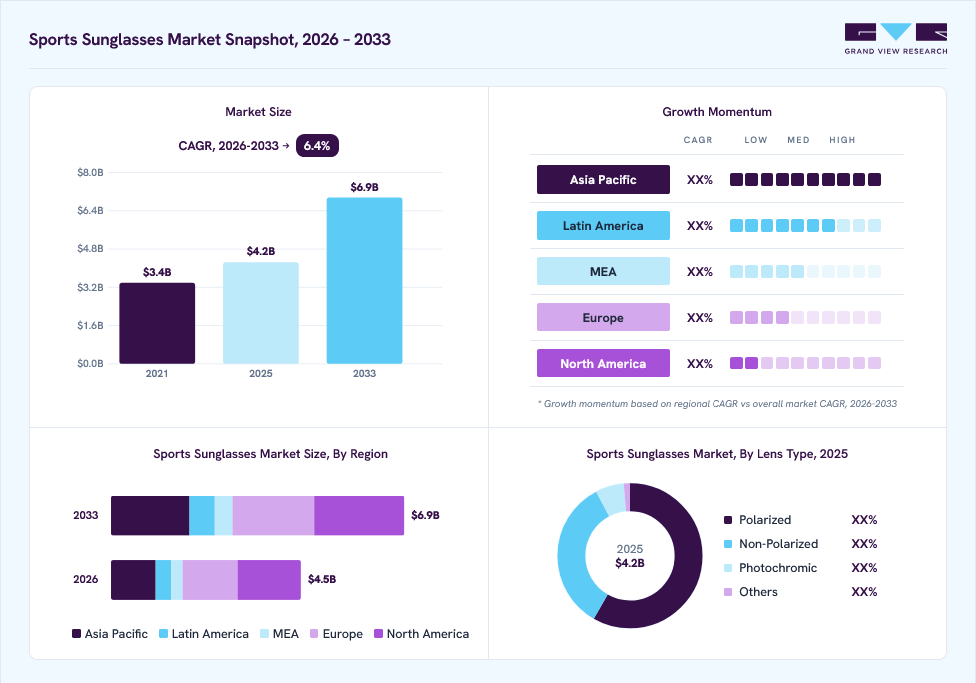
The global sports sunglasses market size was valued at USD 4.2 billion in 2025 and is projected to grow from USD 4.5 billion in 2026 to USD 6.9 billion by 2033, at a CAGR of 6.4% from 2026 to 2033. The market in North America dominated with a revenue share of 33.7% in 2025. Growing participation in outdoor sports and recreational activities is driving demand for sports sunglasses that provide UV protection, glare reduction, visual clarity, and comfort during prolonged outdoor use.
 Source: Grand View Research, IR Documents, Primary Interviews, Paid DatabasesTo learn more about this report,
 Download Free Sample Report
 Key Market Trends & Insights
- By lens type: Polarized lenses segment held the largest market share of 58.2% in 2025.
- By price tier: Mid-range segment held the largest market share of 43.3% in 2025.
- By end user: Men segment held the largest market share of 54.3% in 2025.
- By distribution channel: Sports specialty stores segment held the largest market share of 32.9% in 2025.
Regional Highlights
- Largest regional market: North America (33.7% revenue share, 2025)
- Fastest-growing regional market: Asia Pacific (highest CAGR, 2026-2033)
- By country: The U.S. held the largest market share in 2025
Market Size & Forecast
- Market size in 2025: USD 4.2 Billion
- Estimated market size in 2026: USD 4.5 Billion
- Projected market size by 2033: USD 6.9 Billion
- CAGR (2026-2033): 6.4%
Three ways to get this report
Buy it, customize it, or ask a question.Ask an Analyst
A direct answer, usually in 1 working day
- AccessReport author, directly
- Reply timeWithin 1 working day
- No sales callDirect answer only
- FormatEmail reply
- CostFree, no cost
Get the Full Report
What the study covers
- FormatsPDF · Excel · Dashboard
- Timeline2026–2033 annual, 2025 base
- Coverage20+ countries, 5 regions
- Companies10+ key players profiled
Customize the Report
20% free customization
- IncludeCountries, segments, points
- TailorTo your product definition
- ExtendDeeper competitor detail
- OrA fully bespoke study
- Turnaround5–10 working days
The sports sunglasses market is growing among consumers who require vision correction but still want performance-oriented eyewear. In March 2025, Zenni Optical introduced Zunnies Cycling, a prescription-ready sports sunglasses collection offering customization of lens type, tint, and prescription. The product demonstrates how manufacturers are addressing the needs of recreational athletes who want to combine corrective vision with lightweight construction, secure fit, and sport-specific design. Sports sunglasses are increasingly transitioning from performance-oriented products into mainstream fashion accessories. During the 2024 Paris Olympics, more than 2,000 athletes wore Oakley sunglasses, increasing the visibility of wraparound and shield-style designs among consumers. This trend was also reflected in retail demand, with Marks & Spencer reporting a 73% year-over-year increase in demand for sporty sunglasses, while Selfridges recorded a 140% increase in searches for Oakley sunglasses over three months. The growing adoption of performance-inspired designs by athletes, celebrities, and younger consumers is expanding the addressable market for sports sunglasses beyond professional and recreational sports users.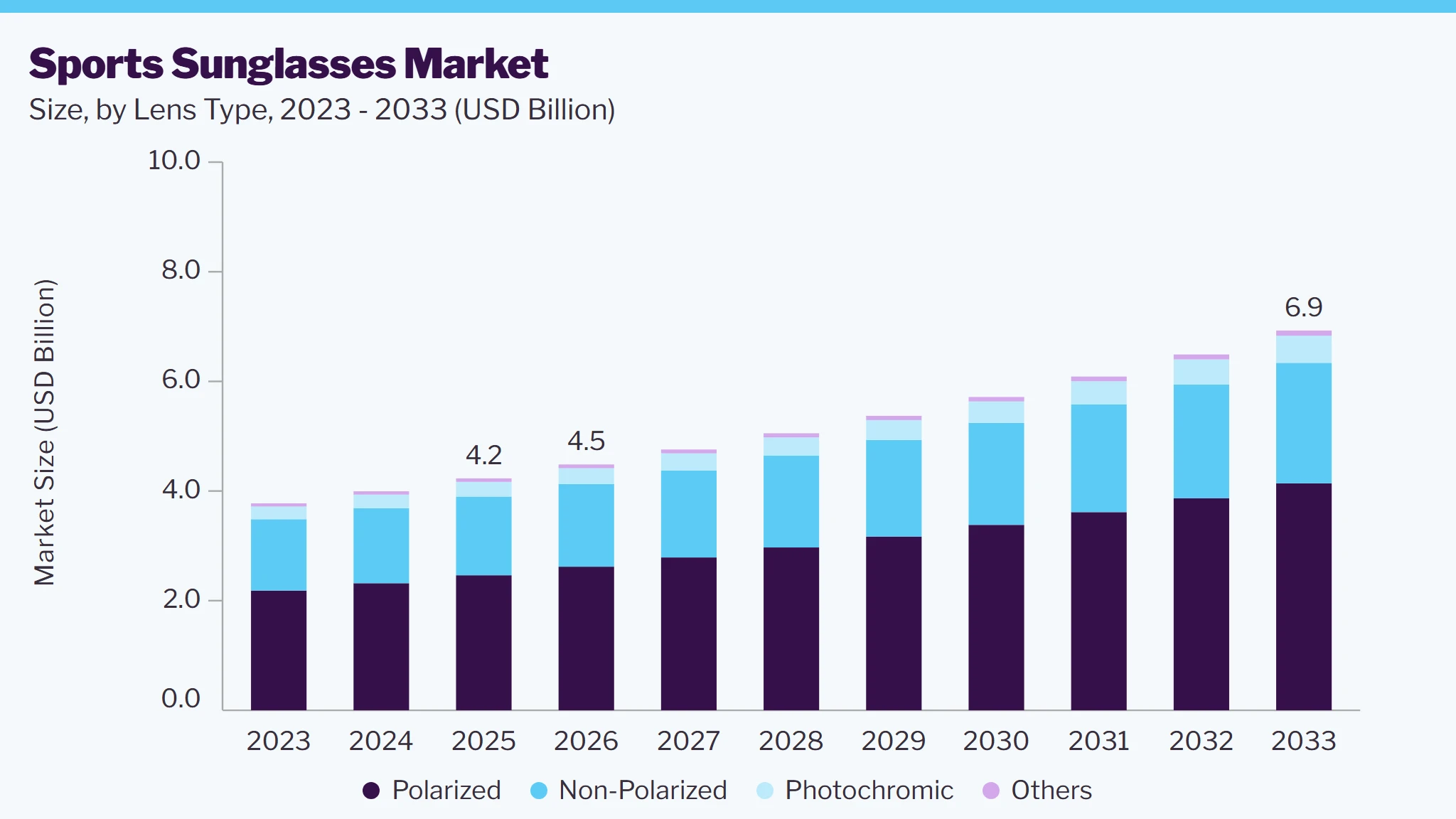 To learn more about this report, Download Free Sample Report
 The sports sunglasses market comprises performance-oriented eyewear designed to provide visual protection and enhanced vision during outdoor sports and recreational activities such as running, cycling, golf, hiking, fishing, skiing, water sports, and other high-intensity activities. Unlike conventional sunglasses, sports sunglasses emphasize UV protection, glare reduction, impact resistance, lightweight construction, secure fit, ventilation, and sport-specific optical performance. Demand is supported by growing participation in sports and outdoor recreation, increasing awareness of eye protection, premiumization of performance eyewear, and technological advancements in lens and frame materials. Leading brands are increasingly differentiating products through polarized, photochromic, contrast-enhancing, interchangeable, and prescription-compatible lenses, along with wraparound and aerodynamic designs.
Top 10 sunglasses brands in the world (2026)
Rank
Brand
Brand Positioning
1
Ray-Ban
Global lifestyle & heritage eyewear
2
Oakley
Sports & performance eyewear
3
Maui Jim
Premium outdoor & performance eyewear
4
Costa Del Mar
Outdoor, fishing & water sports eyewear
5
Persol
Luxury & heritage eyewear
6
Smith Optics
Outdoor & action sports eyewear
7
Tifosi Optics
Accessible sports eyewear
8
Tom Ford
Luxury fashion eyewear
9
Revo
Performance & technical eyewear
10
Serengeti
Optical performance & outdoor eyewear
Source: Global Brands Magazine
The expansion of the outdoor recreation participant base creates a larger addressable consumer pool for sports eyewear. According to the Outdoor Industry Association (OIA) 2026 Outdoor Participation Trends Report, 183.2 million Americans participated in outdoor recreation in 2025, equivalent to 59% of the U.S. population aged 6 and older. OIA also reports that the outdoor participant base has increased by nearly 30 million people since 2019. Activities such as hiking, running, cycling, fishing, and other outdoor pursuits create repeated exposure to sunlight and therefore support demand for protective and performance-oriented eyewear.
According to the World Health Organization (WHO), UV exposure is influenced by environmental conditions, with surfaces such as snow, water, and sand reflecting UV radiation and increasing the amount of UV reaching the eyes. This makes eye protection particularly important for consumers participating in outdoor activities such as skiing, snowboarding, surfing, sailing, fishing, beach sports, and other water-based activities. Fresh snow can reflect a substantial proportion of UV radiation, while water and sand can also increase exposure. Consequently, athletes and recreational users require sunglasses that provide effective UV protection while also reducing glare and maintaining clear vision in changing outdoor conditions. This is encouraging sports eyewear manufacturers to incorporate high-UV-protection lenses, polarized lenses, wraparound designs, enhanced side coverage, and specialized lens technologies into products designed for outdoor sports.
Market Dynamics
- Frequent sports engagement by age, U.S.,2025
Age Group
Women - Very often or often
Men - Very often or often
18-24 years
66%
83%
25-34 years
65%
87%
35-44 years
59%
88%
45-54 years
51%
79%
55+ years
51%
70%
Source: US Sports Engagement Index 2025
Rising global participation in sports, fitness, and outdoor recreation is a foundational driver for the sports sunglasses market, as more consumers engage in activities that expose the eyes to sun, glare, wind, and UV radiation, creating sustained demand for protective, performance-oriented eyewear. Both organized sports and informal outdoor recreation have seen consistent multi-year growth in the U.S., with industry bodies reporting record participation levels alongside strong momentum in specific high-exposure activities like cycling, hiking, running, and racquet sports, all core use cases for sports sunglasses. According to the Sports & Fitness Industry Association's (SFIA) 2026 Topline Participation Report, 250 million Americans took part in at least one sport, fitness, or leisure activity in 2025, marking the highest level of participation since SFIA began tracking the metric, up 1.2% year-over-year, highlighting the sustained growth in sports and fitness engagement across the population.
The availability of low-cost alternatives and counterfeit sports sunglasses can restrain market growth by providing consumers with inexpensive substitutes for branded and technologically advanced products. Counterfeit products often imitate established brands and designs while being sold at substantially lower prices, making them attractive to price-sensitive consumers. This can reduce consumers’ willingness to pay for genuine sports sunglasses equipped with advanced lenses, UV protection, impact resistance, and specialized performance features. Counterfeiting can also affect brand reputation and consumer trust, while legitimate manufacturers face increased costs related to brand protection and enforcement. For instance, in August 2025, the National Bureau of Investigation (NBI) conducted raids in Manila, Pasay, and Valenzuela and seized 19,546 counterfeit Oakley sunglasses and prescription glasses and 42,258 counterfeit Ray-Ban sunglasses and prescription glasses, totaling 61,804 counterfeit eyewear pieces. The seized products had an estimated value of approximately PHP 800 million. Counterfeit products can damage brand reputation, intensify price competition, and cause revenue losses for legitimate manufacturers, making them a key restraint on the sports sunglasses market.
The integration of AI, cameras, audio, fitness connectivity, and smart sensors is creating a new category of performance-oriented sports sunglasses that combine eye protection with digital functionality. Instead of serving only as protective eyewear, smart sports sunglasses can provide hands-free access to performance information, navigation, audio, activity tracking, photography, and AI-based assistance. This creates an opportunity for manufacturers to differentiate products, attract technology-oriented consumers, and increase the value proposition of premium sports eyewear. For instance, in June 2025, Oakley and Meta announced the Oakley Meta HSTN, of next-generation performance-oriented smart glasses designed for athletes and sports enthusiasts. The eyewear combines a 3K camera, open-ear speakers, a microphone, Meta AI, and enhanced battery life of up to eight hours, enabling users to capture videos, access information, and interact with AI hands-free during outdoor activities. The opportunity to combine advanced digital functionality with sports eyewear and create premium, technology-driven products for active consumers.
Regulatory and safety compliance is a key challenge for the sports sunglasses market because manufacturers selling internationally must comply with different requirements for UV protection, optical performance, impact resistance, lens transmittance, product labeling, driving suitability, and material safety. Requirements can vary by country, increasing the need for market-specific testing, certification, documentation, and labeling. This can raise compliance costs and extend product-launch timelines, particularly for brands expanding into multiple regions. For example, in the U.S., sunglasses are regulated by the U.S. Food and Drug Administration (FDA). Although these products are generally exempt from the 510(k) premarket notification requirement, manufacturers and importers must comply with other applicable requirements, including establishment registration and device listing, quality-system requirements, labeling provisions, and impact-resistance requirements under 21 CFR 801.410. Sunglasses must be fitted with impact-resistant lenses, with applicable testing and documentation requirements.
Analyst Perspective
The sports sunglasses market is positioned for steady growth as consumers increasingly prioritize eye protection, visual performance, and comfort during outdoor and fitness activities. Demand is shifting beyond basic UV protection toward polarized, photochromic, impact-resistant, and contrast-enhancing lenses tailored to specific sports. Growing participation in running, hiking, cycling, golf, swimming, and water sports is expanding the addressable consumer base. Premiumization also supports higher-value products, although price sensitivity and counterfeit alternatives remain constraints. Competitive differentiation is increasingly driven by lens innovation, lightweight materials, athlete partnerships, and smart eyewear integration. Overall, brands combining technical performance, accessible pricing, omnichannel distribution, and sport-specific design are likely to capture the strongest opportunities.
Consumer Insights
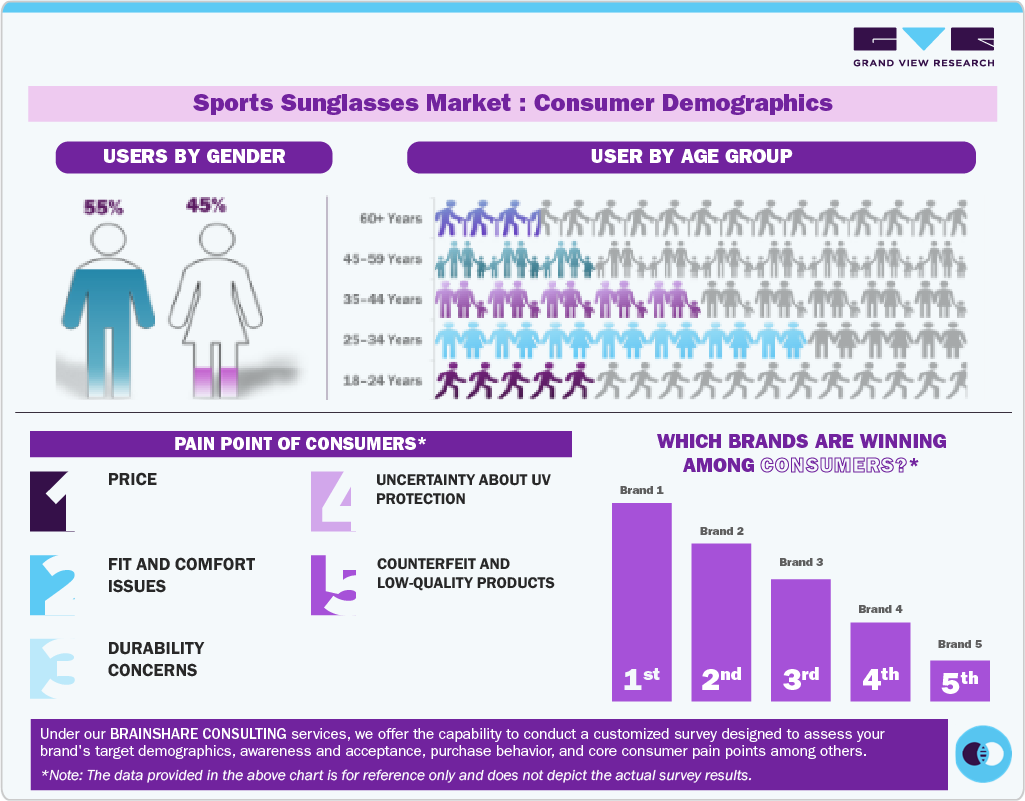
Consumers prioritize fitness, comfort, durability, performance, and affordability when selecting sports sunglasses. According to a 2024 Vision Council report, fit and comfort rank highest at 82%, followed by durability and performance/functionality at 74% each, while 73% consider price important. Ownership is also meaningful within the category: 29% of adults report owning sports sunglasses, with running (45%), fishing (40%), and biking (36%) being the leading usage occasions. These preferences indicate that consumers evaluate sports sunglasses primarily for their ability to deliver reliable performance, a secure fit, and durability in active outdoor environments rather than solely as fashion accessories.
 To learn more about this report, Download Free Sample Report
 Consumers also demonstrate distinct preferences around the visual design and versatility of sports sunglasses. According to a 2024 Vision Council report, among adults, 51% prefer square-shaped sunglasses, while 37% favor aviator styles, and 60% prefer black or grey lenses, highlighting continued demand for conventional, versatile aesthetics alongside technical functionality. Sports sunglasses ownership is particularly associated with activities such as running, fishing, and biking, suggesting that consumers increasingly select eyewear based on both sport-specific requirements and personal style preferences. This combination of functional performance and aesthetic appeal supports the broader positioning of sports sunglasses as products suitable for both active use and everyday outdoor wear.
Lens Type Insights
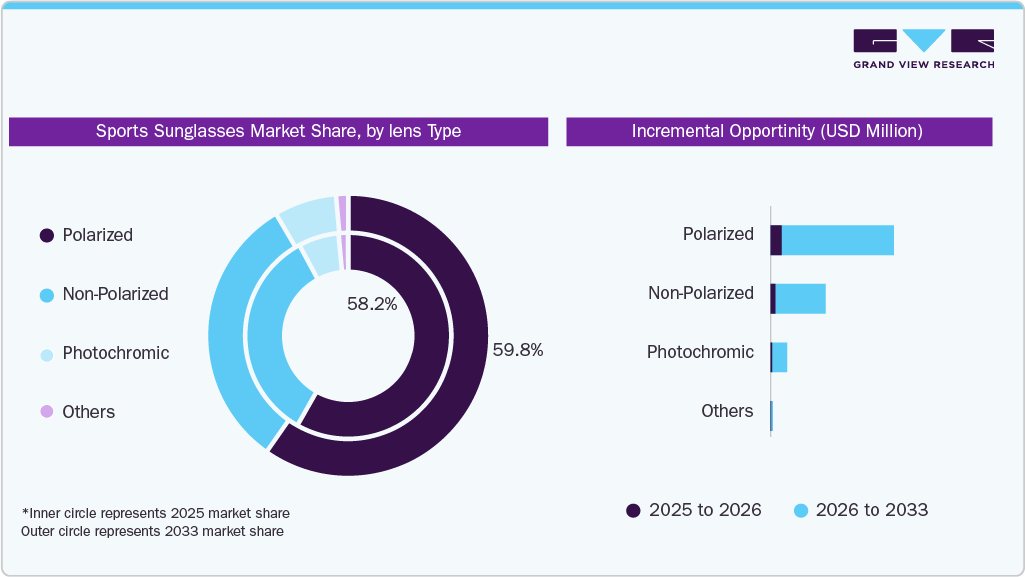
Polarized lenses based sports sunglasses market accounted for the largest market share of 58.2% in 2025, supported by increasing participation in outdoor sports, rising consumer awareness of eye protection, and demand for eyewear that combines glare reduction, visual comfort, lightweight construction, and sport-specific performance. Polarized lenses are particularly relevant for activities involving highly reflective surfaces, including fishing, boating, water sports, snow sports, cycling, and other outdoor recreational activities. Prescription-compatible sunglasses represent an important growth opportunity within the market. ZEISS cites data indicating that while approximately 91% of Americans requiring vision correction wear prescription eyeglasses, only around 33% own prescription sunglasses, while roughly 25% of adult prescription wearers use non-prescription sunglasses outdoors. This gap indicates potential for manufacturers and optical retailers to expand offerings that combine prescription correction with UV protection, polarization, and sport- or environment-specific lens technologies.
 To learn more about this report, Download Free Sample Report
 Photochromic lenses based sunglasses industry is anticipated to grow at a CAGR of 8.0% from 2026 to 2033, is gaining traction as athletes and outdoor consumers increasingly seek eyewear that can automatically adapt to changing light conditions. Unlike conventional fixed-tint sports sunglasses, photochromic lenses enable users to transition between shaded trails, open roads, cloudy conditions, and direct sunlight without changing lenses. Recent product developments indicate that manufacturers are focusing on wider light-transmission ranges, faster adaptation, lightweight construction, prescription compatibility, and multisport functionality. A key trend in the photochromic sports sunglasses market is the development of lenses capable of operating across a broad range of lighting conditions. Rudy Project's Cutline Photochromic model, designed for road cycling, running, triathlon, and beach volleyball, operates across Category 1 to Category 3 and provides a visible light transmission range of 9% to 74%. This enables a single lens to address conditions ranging from relatively low light to intense sunlight.
Price Tier Insights
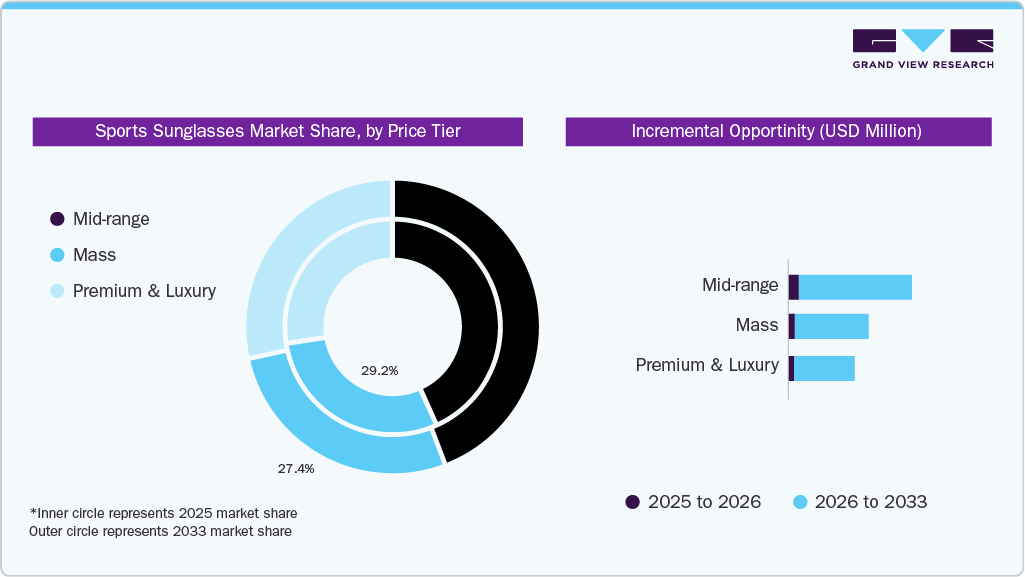
Mid-range sports sunglasses market accounted for the largest market share of 43.3% in 2025 and is increasingly defined by products that bring brand-specific optical technologies and sport-derived construction into a price band accessible to serious recreational users. Rather than competing primarily on affordability, manufacturers in this tier differentiate through proprietary lens systems, coverage, frame engineering, and versatility across active and everyday use. Oakley's Highland, priced at USD192, incorporates Prizm lens technology and is positioned within the brand's Players Collection. Oakley's broader U.S. portfolio also includes the Terraforma at USD150 and the Holbrook at USD174, illustrating the availability of branded performance and lifestyle eyewear within the mid-range price band. Another example is Smith's Cipher, which is available at approximately USD187 with ChromaPop lens technology, positioning it within the mid-range performance category for cycling and other outdoor activities.
 To learn more about this report, Download Free Sample Report
 The premium & luxury sports sunglasses market is anticipated to grow at a CAGR of 6.9% from 2026 to 2033, characterized by the increasing integration of advanced lens technologies, high-performance materials, precision engineering, and design-led product differentiation. Consumers in this segment place greater emphasis on specialized optical performance, lightweight, durable construction, technological innovation, and brand value, which supports higher product price points. Bollé has expanded its high-performance sports eyewear portfolio with models such as SKYRUN and TRAILCHASER, priced at USD 280 and USD 300, respectively. These products incorporate advanced Phantom photochromic lens technology, reflecting the increasing adoption of adaptive optics and sport-specific designs within the premium segment.
End User Insights
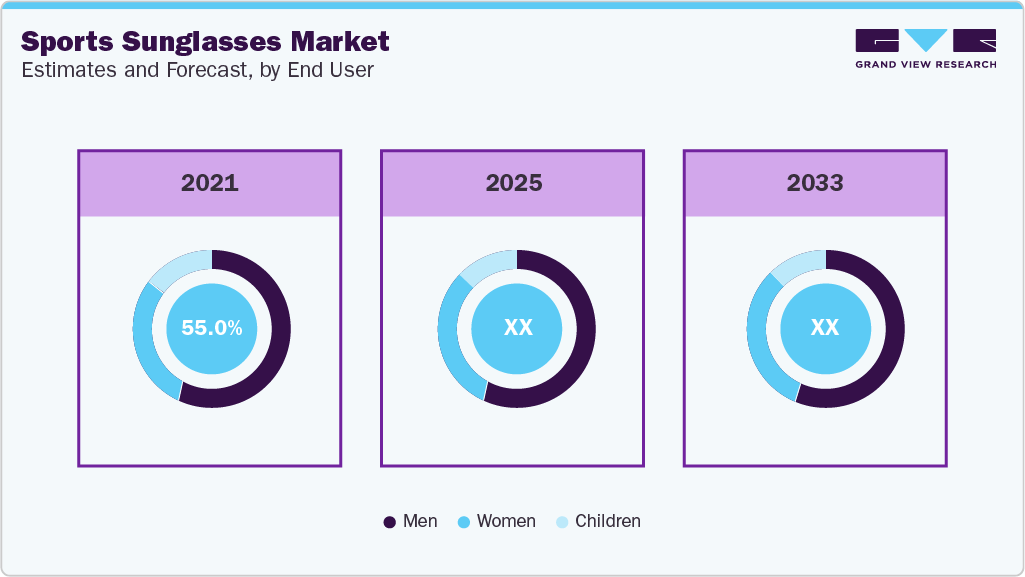
Men’s sports sunglasses market accounted for the largest market share of 54.3% in 2025. The men’s segment represents an important consumer group in the sports sunglasses market, supported by participation in cycling and other outdoor recreational activities where prolonged exposure to sunlight, glare, wind, dust, and changing light conditions increases the functional value of protective eyewear. The 2025 Evaluation of Ngā Haerenga Great Rides of New Zealand, covering the year ended June 2025, surveyed 7,475 trail users, of whom 46% were men. The relatively balanced gender composition demonstrates a substantial male user base within cycling-oriented outdoor recreation and provides a relevant indicator of the potential addressable audience for sports sunglasses.
 To learn more about this report, Download Free Sample Report
 Women’s sports sunglasses market is anticipated to grow at a CAGR of 7.1% from 2026 to 2033, supported by increasing participation in outdoor recreation and growing engagement with cycling and other active lifestyles. According to Winnebago Industries’ 2025 Spotlight Survey, 52% of women planned to increase their outdoor activity in 2025, representing a 6-percentage-point increase from the previous year, while 55% expected to spend six or more hours outdoors each week. In addition, 89% of women planned to maintain or increase their outdoor activity levels during 2025. These findings indicate a growing base of female consumers spending significant time outdoors, creating potential demand for eyewear that combines protection and performance with comfort and everyday usability.
Distribution Channel Insights
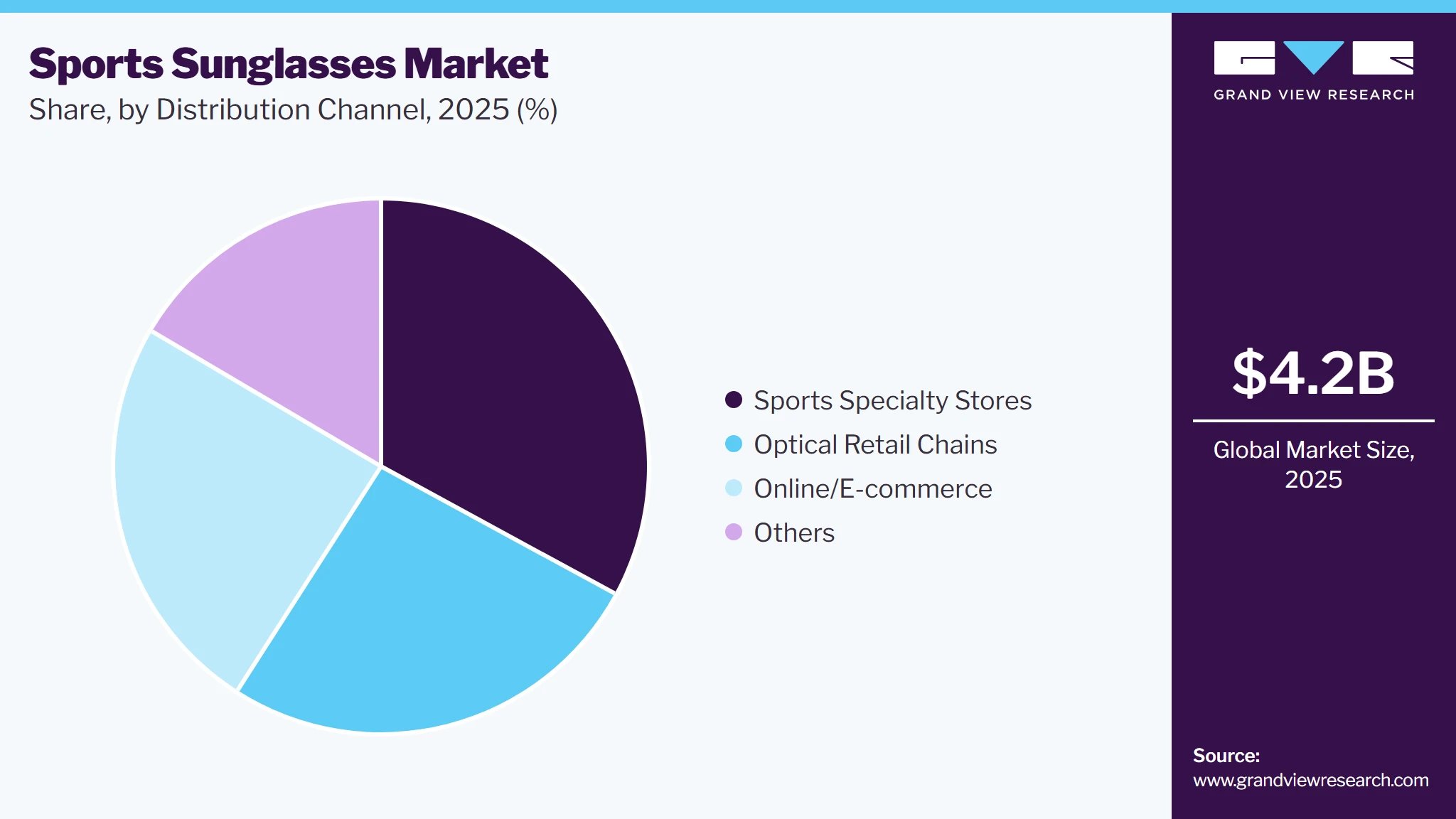
The sales of sports sunglasses through sports specialty stores accounted for the largest market share of 32.9% in 2025. Sports specialty stores represent a performance-led distribution channel for sports sunglasses, reaching consumers at the point of purchase for activities such as cycling, running, hiking, skiing, fishing, and multisport recreation. Unlike general eyewear retailers, these stores can merchandise sunglasses alongside sport-specific equipment and apparel, allowing consumers to select eyewear based on their activity, lens technology, fitness, and performance requirements. For instance, Academy Sports + Outdoors is expanding its physical retail footprint in 2026, strengthening the reach of sports specialty stores across the U.S. The retailer announced plans to open 11 new stores during the third quarter of 2026 across six states, including Texas, Georgia, Oklahoma, Tennessee, and Virginia. Two locations had already opened during the quarter in St. Clairsville, Ohio, and Kerrville, Texas, bringing the total to 11. Across the full year, Academy plans to open 20-25 new locations.
 To learn more about this report, Download Free Sample Report
 The sales of sports sunglasses through online/e-commerce channels are anticipated to grow at the fastest CAGR of 9.1% from 2026 to 2033 and are becoming increasingly important for sports sunglasses by providing consumers with broader product choice, detailed technical information, price comparison, customer reviews, and convenient home delivery. The channel is particularly suited to sports sunglasses because consumers can compare products according to sport, lens technology, polarization, fitness, protection, and price before purchasing. For example, in 2026 continued expansion of performance eyewear assortments on major online sporting goods platforms. DICK'S Sporting Goods currently lists 142 sports eyewear products online, covering styles designed for running, cycling, and other sports, with features including UV protection, impact-resistant lenses, lightweight frames, and anti-fog technology. Its online assortment includes performance models from brands such as Oakley, Nike, and 100%.
Regional Insights
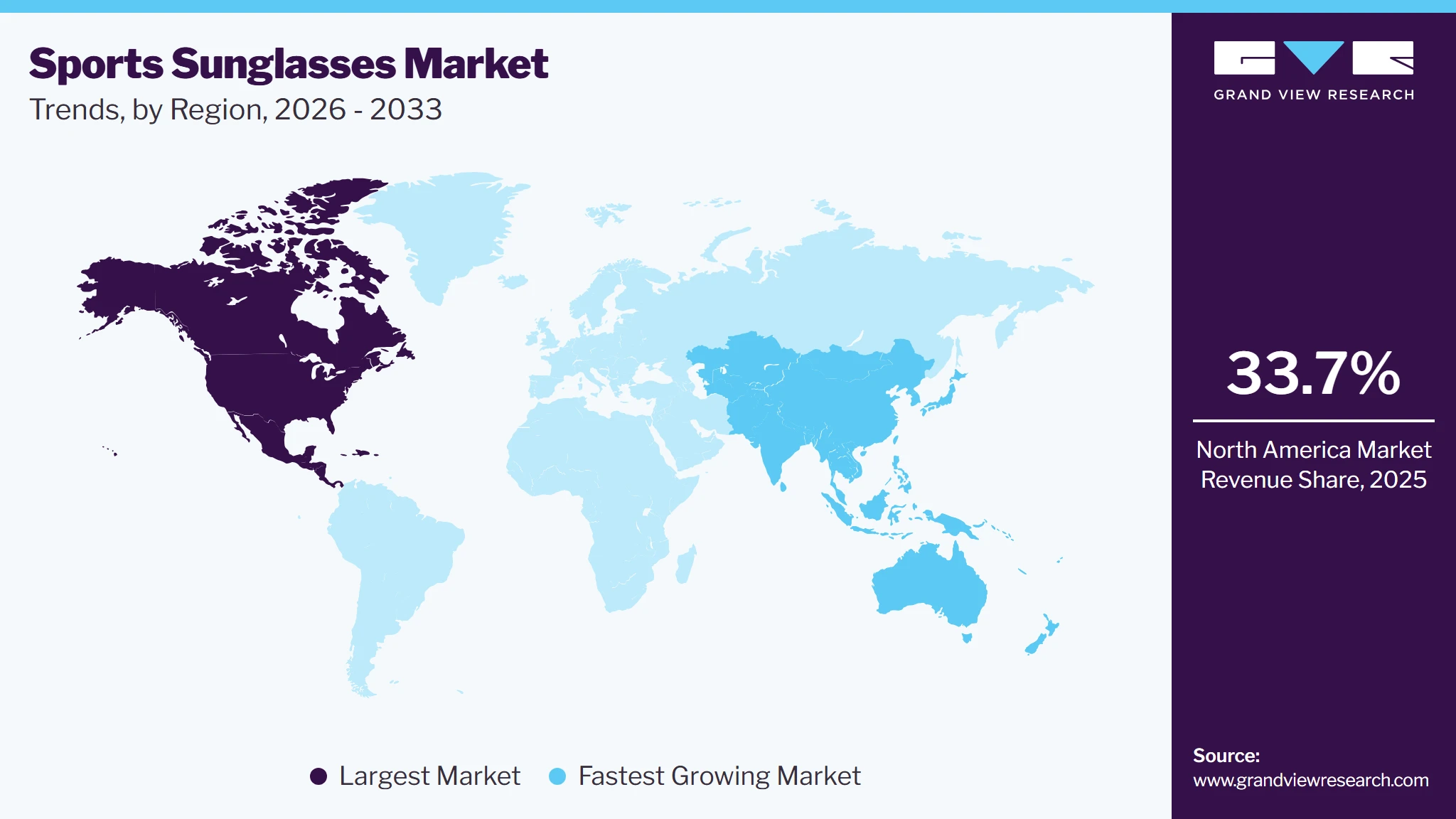
The North America sports sunglasses industry accounted for the largest share of 33.7% in 2025, supported by the region's strong participation in outdoor, fitness, and endurance activities, alongside increasing consumer demand for eyewear that combines UV protection, glare reduction, visual enhancement, lightweight construction, and sport-specific performance. The U.S. remains the primary demand center, supported by a large base of cycling, running, outdoor recreation, and fitness participants. Consumer behavior in North America indicates a combination of performance orientation and increasing price consciousness. The Vision Council's Q4 2025 survey of 12,129 U.S. adults found that more than half of consumers spent less than USD 50 on non-prescription sunglasses. The survey also showed that 52% of consumers who had previously purchased eyewear online switched to an in-person purchase for their most recent transaction, highlighting the continued importance of physical retail, where consumers can evaluate fit, comfort, lens characteristics, and frame design before purchasing.
 To learn more about this report, Download Free Sample Report
 U.S. Sports Sunglasses Market Trends
The sports sunglasses industry in the U.S. accounted for the largest share of 81.8% in 2025, supported by consumers increasingly viewing sports sunglasses as protective equipment that can improve visibility while reducing exposure to sunlight, glare, wind, dust, and other environmental conditions. Cycling-specific eyewear continues to drive innovation. In 2026, Oakley introduced its Tour de France collection, including the Velo Kato with a close-to-face lens design enabled by PhysioMorphic Geometry and PRIZM Road Black lenses. The U.S. product listing was priced at USD 369, illustrating continued innovation and demand for specialized, higher-value performance eyewear. The company also introduced a 2026 Tour de France HSTN model priced at USD 217, demonstrating how brands are using major sporting events and cycling culture to create specialized sports and lifestyle eyewear collections.
The sports sunglasses indistry in Cananda is expected to grow at a CAGR of 5.3% from 2026 to 2033, supported by widespread sunglasses usage and an active outdoor population. The Vision Council's 2025 Consumer Insights Canada survey found that 55% of recent plano-sunglasses purchasers spent less than USD 50, while Ray-Ban, Oakley, and Foster Grant were the most-cited sunglasses brands. In addition, 87% of eyewear purchases were made in person, highlighting the continued importance of physical retail. Meanwhile, Statistics Canada's Canadian Health Measures Survey indicates that approximately 46% of Canadian adults met recommended physical-activity levels, supporting demand for performance eyewear across running, cycling, skiing, hiking, and other outdoor activities.
Asia Pacific Sports Sunglasses Market Trends
The Asia Pacific sports sunglasses market is expected to grow at the highest CAGR of 8.4% from 2026 to 2033, benefiting from rising sports participation, expanding sports infrastructure, growing sports consumption, and increasing adoption of technologically advanced eyewear. Consumer demand for sports sunglasses in Japan is supported by strong adoption among active sports participants and a clear emphasis on functional performance. A 2025 Oakley Japan survey of 608 adults aged 20-40 who participate in sports at least once a week found that 54.3% use sports sunglasses during sports activities. Among users, UV protection (58.8%), fit (58.2%), and visual clarity (57.9%) were the leading purchase considerations, while 94.9% perceived at least some positive impact on sports performance. Meanwhile, a separate survey of 330 non-users found that 77.8% experienced eye-related problems while participating in sports, with sunlight glare (64.2%) being the most common issue. These findings indicate strong potential for sports sunglasses offering UV protection, glare reduction, secure fit, visual clarity, and enhanced comfort in the Japanese market.
The India sports sunglasses industry is expected to grow at a CAGR of 9.9% from 2026 to 2033. is benefiting from increasing participation in recreational sports and outdoor activities. In November 2025, Lenskart launched the Spanish sunglasses brand Meller in India across its platform and planned to roll out the brand to approximately 500 Lenskart stores selected using GeoIQ intelligence. Meller reported ₹2.72 billion in FY25 revenue, with an EBITDA of ₹443 million. Although Meller is primarily a fashion-sunglasses brand rather than a specialist sports sunglasses brand, the launch demonstrates the expansion of international eyewear brands and consumer choice in India's sunglasses market.
China sports sunglasses market accounted for a revenue share of around 36.7% of the Asia Pacific market in 2025. China provides a significant demand base for sports sunglasses. China's 2025 National Fitness Activity Survey, conducted across 31 provinces and involving 141,145 valid respondents, found that 38.52% of the population regularly participated in physical exercise. In addition, 96.8% of respondents had participated in at least one sports activity, with walking, running, cycling, badminton, and basketball among the most popular activities. Among adults aged 19-59, average annual sports consumption reached RMB 2,428, demonstrating increasing consumer spending on sports-related activities and products. The survey also showed that 39.4% of adults aged 19 years and above participated in sports or fitness organizations, while 45.1% participated in mass sporting events. The increasing participation in organized and recreational sports provides a broader consumer pool for performance products such as sports sunglasses.
Europe Sports Sunglasses Market Trends
The Europe sports sunglasses industry accounted for a revenue share of 29.1% of the global market in 2025. The European sports sunglasses market continues to emphasize product characteristics such as secure fit, lightweight construction, impact resistance, lens clarity, and protection from UV exposure. Cycling has contributed to the evolution of sports eyewear from a functional product into an important component of sporting identity and brand differentiation. Cycling Weekly reported in 2025 that cycling sunglasses increasingly represent performance, personal style, and brand identity, with established and specialist brands competing through lens and frame technologies.
The Germany sports sunglasses industry is expected to grow at a CAGR of 7.4% from 2026 to 2033. Germany represents a significant market for sports sunglasses, supported by high sunglasses penetration and a large active-sports consumer base. According to the 2025 Allensbach Eyewear Study, 86% of Germans regularly wear sunglasses, while the proportion rises to 92% among consumers aged 16-29. Among younger consumers, 57% primarily consider sunglasses a fashion accessory, and 52% own multiple pairs, highlighting the growing overlap between eyewear functionality and fashion. UV protection is also a key purchasing consideration, cited by 71% of consumers. The country's large sports participation base provides additional support for the demand for sports sunglasses. According to the German Olympic Sports Confederation (DOSB), organized sports membership reached a record 29.3 million memberships across approximately 86,000 sports clubs as of January 1, 2025, representing an increase of 625,704 memberships, or 2.18%, from the previous year. The expanding participation base creates opportunities for performance eyewear across cycling, running, athletics, outdoor recreation, and other sports.
The UK sports sunglasses industry accounted for a revenue share of around 21.1% of the Europe market in 2025. The UK market is supported by a large active consumer base and the growing convergence of performance eyewear with lifestyle fashion and wearable technology. Sport England's Active Lives Adult Survey 2025 found that 64.6% of adults in England, equivalent to 30.9 million people, met recommended physical-activity levels, supporting demand for outdoor and performance-oriented products. The market is also benefiting from the increasing mainstream adoption of wraparound and shield-style eyewear, particularly among younger consumers, as sports-derived designs transition into everyday fashion.
Central & South America Sports Sunglasses Market Trends
The Central & South America sports sunglasses industry is expected to grow at a CAGR of 7.2% from 2026 to 2033. The Central & South America sports sunglasses are evolving as consumers increasingly prioritize functional eyewear, advanced lens technologies, and versatile designs that support comfort and visual performance across diverse sporting and outdoor environments. The Brazilian launch also highlights the increasing importance of advanced optical technologies. Oakley Meta Vanguard incorporates PRIZM lenses designed to improve contrast and visual detail, while the wraparound construction provides coverage against sun, wind, and dust. The product is also compatible with interchangeable lens options, including PRIZM Road, PRIZM 24K, PRIZM Black, and PRIZM Sapphire, allowing users to adapt eyewear to different lighting and sporting conditions.
The Brazil sports sunglasses industry is expected to grow at a CAGR of 7.2% from 2026 to 2033, and is witnessing continued innovation in lightweight construction, adaptive lenses, optical performance, and sport-lifestyle design. Running has gained significant traction in Brazil. A 2026 study by Olympics and Box1824, covering activity patterns in 2025, found that Brazil had approximately 15 million weekly runners, representing an increase of 2 million participants in one year. Running's participation rate increased to 14% in 2025 from 12% in 2024, making it the country's fourth most-practiced physical activity. Cycling accounted for 10%, while walking led at 39%. This expansion of running and cycling provides a growing consumer base for sports sunglasses, particularly products designed for UV protection, glare management, lightweight construction, and stable fit during high-movement activities.
Middle East & Africa Sports Sunglasses Market Trends
The Middle East & Africa sports sunglasses industry is expected to grow at a CAGR of 6.5% from 2026 to 2033. The Middle East eyewear ecosystem remains largely dependent on international manufacturers, while organized retailers are expanding their role; according to Lenskart’s FY2025 industry analysis, organized retailers accounted for 58-60% of the Middle East eyewear market by value, with this share projected to reach 69-71% by FY2030. The same analysis highlights localized eyewear requirements such as enhanced UV and dust protection and lightweight frames suited to high temperatures. The market is also supported by an increasingly import- and distribution-driven eyewear ecosystem, with regional retailers and distributors expanding access to international and specialized eyewear products across the Middle East. According to Eyewear Beyond, limited local manufacturing capacity has increased reliance on sourcing from major production hubs such as China, Italy, South Korea, and Turkey, creating opportunities for international brands and private-label suppliers to introduce specialized sports sunglasses across the region.
The Saudi Arabia sports sunglasses industry accounted for a revenue share of around 31.9% of the Middle East and Africa market in 2025. In Saudi Arabia, recent product developments reflect the growing relevance of lightweight and high-contrast performance eyewear for cycling, running, and other outdoor activities. In 2025, Julbo launched Intensity, a lightweight sports sunglasses model developed for high-intensity activities such as cycling and trail running. The model incorporates front ventilation and Spectron HD 3 lenses, designed to enhance contrast and visual comfort. This development aligns with the broader regional shift toward advanced lens technologies, lightweight construction, and activity-specific eyewear as outdoor and endurance sports continue to gain prominence.
Key Sports Sunglasses Company Insights
The global sports sunglasses market is moderately fragmented, with competition centered on lens technology, sport-specific performance, lightweight construction, durability, brand reputation, and omnichannel availability. EssilorLuxottica (Oakley) maintains a strong competitive position through advanced PRIZM lens technology, impact-resistant materials, sport-specific designs, and a broad global distribution network. Safilo Group (Smith Optics) competes through performance-oriented eyewear for cycling, skiing, and outdoor sports, supported by technologies such as ChromaPop. Nike, Inc. and Adidas AG leverage established sports brands, athlete partnerships, and sport-specific product development to strengthen their eyewear presence.
Rudy Project S.p.A. differentiates through high-performance cycling and multisport eyewear, incorporating lightweight frames, interchangeable lenses, and advanced lens technologies. Bollé Brands competes across cycling, skiing, and outdoor activities, emphasizing optical performance, protection, and ergonomic designs, while Julbo S.A.S. focuses strongly on mountain, trail, cycling, and outdoor sports through photochromic and high-altitude lens technologies. Tifosi Optics, Inc. targets performance-oriented consumers with comparatively accessible pricing, interchangeable lenses, and lightweight designs. Competition is increasingly shifting from conventional UV protection toward specialized optical performance, contrast enhancement, photochromic and polarized lenses, impact protection, lightweight materials, sport-specific ergonomics, athlete collaborations, and direct-to-consumer distribution. Brands that combine technical innovation with strong sports positioning and accessible omnichannel distribution are well-positioned to capture consumer demand across running, cycling, golf, skiing, water sports, and other outdoor activities.
Key Sports Sunglasses Companies
The following key companies have been profiled for this study on the sports sunglasses market.
-
EssilorLuxottica (Oakley)
-
Safilo Group (Smith Optics)
-
Nike, Inc.
-
Adidas AG
-
Rudy Project S.p.A.
-
Bollé Brands
-
Julbo S.A.S.
-
Tifosi Optics, Inc.
-
Under Armour, Inc.
-
POC Sports AB
Competitive Benchmarking
Category
Operating Strategies
Competitive Edge
Weakness
Mature Players: EssilorLuxottica (Oakley) Safilo Group (Smith Optics) Nike, Inc. Adidas AG Rudy Project S.p.A. Bollé Brands Julbo S.A.S.
- Focus on continuous lens, frame, and performance innovation, including polarized, photochromic, contrast-enhancing, and impact-resistant technologies. Expand from conventional sunglasses into smart, connected, and prescription-enabled sports eyewear. Use professional athletes, sports teams, and events to test products, build credibility, and influence product development.
- Strong brand recognition and athlete credibility across cycling, running, skiing, outdoor, and other sports. Advanced R&D and manufacturing capabilities support the rapid development of lightweight frames, specialized lenses, and sport-specific designs. Ability to combine performance, technology, and lifestyle positioning, allowing brands to address both professional athletes and recreational users. Large athlete networks provide access to real-world performance feedback.
- Large organizational structures and broad product portfolios can increase development complexity, operating costs and decision-making time. Premium technical features and advanced materials can result in higher retail prices, limiting penetration among price-sensitive consumers. Strong positioning in established sports categories can make it more difficult to rapidly adapt to emerging niche sports and changing consumer preferences. Dependence on global manufacturing and specialized optical components can expose companies to supply-chain, material-cost and production risks.
Emerging Players: Tifosi Optics, Inc. Under Armour, Inc. POC Sports AB- Focus on niche sports segments and performance-oriented consumers, particularly cycling, running, trail running, and endurance sports. Differentiate through lightweight construction, specialized fit systems, photochromic lenses, prescription options, and sport-specific designs. Introduce frequent product updates, limited editions, and athlete/team collaborations to increase visibility. Target specific consumer requirements rather than competing across the entire eyewear market.
- Greater product specialization and flexibility allow these companies to respond quickly to sport-specific requirements. Strong technical expertise in selected categories such as cycling, trail running, and endurance sports creates differentiation from broad-based eyewear companies. Ability to build authentic relationships with professional athletes, specialist communities, and sports events. More focused portfolios can support faster product experimentation and niche innovation.
- Smaller geographic footprints and lower brand awareness can restrict international market penetration. Comparatively limited financial resources may constrain large-scale R&D, athlete sponsorships, and global marketing. Competition from established brands with stronger distribution, marketing budgets, and recognized technologies can make customer acquisition and retention challenging.
Recent Developments
-
In January 2026, Rudy Project launched Performance 40, a limited-edition recreation of its iconic Super Performance sports sunglasses. The model features a 3D-printed hollow titanium frame, weighs approximately 36 grams, and is limited to 100 individually numbered units. The launch combines Rudy Project's heritage in performance eyewear with advanced manufacturing and premium materials, supporting the company's strategy of premiumization and limited-edition positioning within the sports sunglasses market.
-
In April 2026, Bollé launched Trailchaser, a new sports sunglasses model developed specifically for trail running. The cylindrical half-rim shield features a Phantom photochromic lens, lightweight 31-gram construction, ventilation details, FIT-TEC temples, and an adjustable Thermogrip nose piece for stability during intense activity. The launch marks Bollé's expansion into the trail-running category and strengthens its performance sports sunglasses portfolio through sport-specific design and adaptive lens technology.
-
In May 2025, POC launched its 2025 EF Pro Cycling limited-edition collection, introducing the Elicit Toric EF Pro Cycling Edition sports sunglasses alongside the Cytal cycling helmet. The Elicit Toric features a frameless design, toric lens, enhanced peripheral vision, Clarity Road lens technology, and lightweight bio-grilamid temples, targeting the performance requirements of road cyclists. The launch strengthens POC's focus on cycling-specific eyewear innovation and performance-oriented product development, while leveraging its EF Pro Cycling team partnership to enhance product visibility among cycling enthusiasts.
Sports Sunglasses Market Report Scope
Report Attribute
Details
Market size in 2025
USD 4.2 billion
Estimated market size in 2026
USD 4.5 billion
Projected market size by 2033
USD 6.9 billion
Growth rate
CAGR of 6.4% from 2026 to 2033
Base year for estimation
2025
Historical data
2021 - 2024
Forecast period
2026 - 2033
Quantitative units
Revenue in USD million/billion and CAGR from 2026 to 2033
Report coverage
Revenue forecast, company ranking, competitive landscape, growth factors, and trends
Segments covered
Lens Type, Price Tier, End User, Distribution Channel, and Region
Regional scope
North America; Europe; Asia Pacific; Central & South America; and Middle East & Africa
Country scope
U.S.; Canada; Mexico; UK; Germany; France; Italy; Spain; China; India; Japan; South Korea; Australia & New Zealand; Brazil; Argentina; Saudi Arabia and South Africa
Key companies profiled
EssilorLuxottica (Oakley); Safilo Group (Smith Optics); Nike, Inc.; Adidas AG; Rudy Project S.p.A.; Bollé Brands; Julbo S.A.S.; Tifosi Optics, Inc.; Under Armour, Inc.; POC Sports AB
Customization scope
Free report customization (equivalent up to 8 analysts working days) with purchase. Addition or alteration to country, regional & segment scope.
Pricing and purchase options
Avail customized purchase options to meet your exact research needs. Explore purchase options
Global Sports Sunglasses Market Report Segmentation
This report forecasts revenue growth at the global, regional & country levels and analyzes the latest trends and opportunities in each sub-segment from 2021 to 2033. For this study, Grand View Research has segmented the global sports sunglasses market based on lens type, price tier, end user, distribution channel, and region:
-
Lens Type Outlook (Revenue, USD Million; Volume, Thousand Units) 2021 - 2033)
-
Polarized
-
Non-Polarized
-
Photochromic
-
Others
-
-
Price Tier Outlook (Revenue, USD Million; Volume, Thousand Units) 2021 - 2033)
-
Mass
-
Mid-range
-
Premium & Luxury
-
-
End User Outlook (Revenue, USD Million; Volume, Thousand Units) 2021 - 2033)
-
Men
-
Women
-
Children
-
-
Distribution Channel Outlook (Revenue, USD Million; Volume, Thousand Units) 2021 - 2033)
-
Optical Retail Chains
-
Sports Specialty Stores
-
Online/E-commerce
-
Others
-
-
Regional Outlook (Revenue, USD Million; Volume, Thousand Units) 2021 - 2033)
-
North America
-
U.S.
-
Canada
-
Mexico
-
-
Europe
-
UK
-
Germany
-
France
-
Italy
-
Spain
-
-
Asia Pacific
-
China
-
India
-
Japan
-
South Korea
-
Australia & New Zealand
-
-
Central & South America
-
Brazil
-
Argentina
-
-
Middle East & Africa
-
South Africa
-
Saudi Arabia
-
-
Research Methodology
The sports sunglasses market figures in this report are based on a proven research process that combines executive interviews with secondary research from proprietary databases, company filings, and recognized regulatory and institutional sources. Market size is built through value-chain sizing - reconciling supply-side and demand-side estimates - and triangulated with bottom-up and top-down approaches. Every estimate passes multiple levels of expert validation before publication, with each sports sunglasses segment quantified using the revenue-capture definitions in the table below.
Segment Definition
Lens Type
Revenue capture definition
Polarized
Includes sports sunglasses featuring polarized lenses that reduce reflected glare and improve visual clarity during outdoor sporting activities. Covers products using different lens materials, coatings, frame formats, and performance configurations designed for cycling, running, fishing, skiing, water sports, golf, hiking, and other active applications.
Non- Polarized
Includes sports sunglasses using conventional non-polarized lenses that provide UV protection and optical clarity without polarization technology. Covers products across different lens materials, tints, coatings, frame designs, sporting applications, and price tiers, including performance eyewear intended for recreational and competitive outdoor activities.
Photochromic
Includes sports sunglasses equipped with light-responsive lenses that automatically adjust their tint according to changes in surrounding light conditions. Covers UV-activated and sunlight-responsive technologies across different lens materials, frame designs, and sports applications, including cycling, running, hiking, skiing, and multisport activities.
Others
Includes sports sunglasses incorporating lens technologies other than polarized, non-polarized, and photochromic formats. Covers specialized offerings such as contrast-enhancing, color-enhancing, low-light, prescription, interchangeable-lens systems, and other proprietary performance lens technologies used across various sporting applications.
Estimation Model
Layer No.
Layer Name
Key Question
Description
01
Relevant Consumer & Sports Participation Layer
Which consumers participate in activities where sports sunglasses are relevant?
Begin with the relevant population or the applicable consumer population. Filter based on participation in outdoor and sports activities such as running, cycling, hiking, golf, tennis, fishing, skiing, water sports, and other activities requiring outdoor eye protection. Consider frequency of participation, outdoor exposure, sport type, and consumer need for UV protection, glare reduction, impact resistance, and visual performance.
02
Product Accessibility & Distribution Layer
Which potential consumers can access sports sunglasses through available channels?
Filter the relevant consumer base based on access to sports sunglasses through sporting goods stores, optical retailers, specialty sports stores, department stores, brand stores, e-commerce platforms, marketplaces, and DTC websites. Consider regional distribution coverage, online penetration, brand availability, and accessibility of different price tiers.
03
Purchase & Usage Conversion Layer
Which accessible consumers actually purchase sports sunglasses?
Apply sports sunglasses purchase/adoption rates to the accessible consumer base. Consider purchase intent, sport participation frequency, existing ownership, replacement cycle, lens preferences, prescription requirements, income, age, and sport-specific usage. Segment consumers by product type, such as polarized, photochromic, and standard performance sunglasses.
04
Monetisation Layer
How much revenue is generated?
Multiply the number of sports sunglasses purchasers by annual purchase frequency and average selling price (ASP). Calculate separately by product category, price tier, and distribution channel. Incorporate differences between entry-level and premium products. Add replacement and repeat purchases to estimate total annual market revenue.
Delivered Customizations
This report has been delivered with the following In-depth customizations
Client Request
Customization Delivered
Value Adds
Sports Sunglasses Market & Product Trend Analysis
Conducted a detailed assessment of the sports sunglasses landscape, covering running, cycling, golf, hiking, skiing, water sports, tennis, and other outdoor activities. The analysis evaluates polarized, photochromic, contrast-enhancing, prescription, interchangeable-lens, and impact-resistant sunglasses, along with developments in lightweight materials, lens technologies, ventilation, ergonomic designs, smart eyewear, and sustainable materials
Helps stakeholders identify high-potential product categories, understand evolving consumer preferences, assess lens and frame innovations, and develop differentiated sports eyewear portfolios around optical performance, UV protection, comfort, durability, sport-specific functionality, and technology.
Consumer & Regional Demand Analysis
Evaluated demand across North America, Europe, Asia Pacific, Central & South America, and Middle East & Africa by assessing sports participation, outdoor recreation, consumer preferences, purchase behavior, price sensitivity, lens preferences, and usage frequency. Regional analysis was further developed for key countries based on participation in running, cycling, hiking, golf, skiing, water sports, and other relevant activities.
Provides insights into regional and country-level demand opportunities, supports market-entry strategies, and enables companies to tailor product portfolios, pricing, distribution, sport-specific designs, and marketing strategies to local consumer requirements and participation patterns.
Technology, Distribution & Competitive Landscape Assessment
Assessed emerging developments in advanced lens technologies, photochromic and polarized lenses, contrast enhancement, lightweight and impact-resistant frames, prescription sports eyewear, interchangeable lenses, smart eyewear, and sustainable materials. The analysis also evaluated sporting-goods stores, optical retailers, specialty sports stores, department stores, e-commerce marketplaces, DTC channels, and brand websites, alongside major companies, product launches, athlete partnerships, collaborations, and geographic expansion strategies.
Supports long-term product-development and investment decisions by identifying technology opportunities, high-potential distribution channels, competitive positioning, partnership opportunities, and emerging revenue pools across the sports sunglasses market.
About the Author(s)
Clothing, Footwear & Accessories Research Team
Consumer Goods · Clothing, Footwear & AccessoriesThis report was authored by the clothing, footwear & accessories research team at Grand View Research - comprising two research analysts, one senior research analyst, and one industry expert - with specialized expertise in the clothing, footwear & accessories segment of the consumer goods industry. All findings are based on proprietary consumer goods databases, executive interviews, and regulatory analysis, subject to internal peer review prior to publication.
Last Updated:
Speak to Analyst

Customize this report to your needs - add regions, segments, or data points, with 20% free customization.
Or view our licence options:


ISO 9001:2015 & 27001:2022 Certified
We are GDPR and CCPA compliant! Your transaction & personal information is safe and secure. For more details, please read our privacy policy.


