
- Home
- »
- Next Generation Technologies
- »
-
Sprinkler Irrigation Market Size & Share Report, 2026-2033GVR Report cover

Sprinkler Irrigation Market (2026 - 2033)
Size, Share & Trends Analysis Report By Type (Center Pivot Systems, Lateral Move Systems, Solid Set Sprinkler Systems), By Level of Automation, By Application, By Component, By Mobility, By Region, And Segment Forecasts
Market Size, 2025
$3.0BMarket Estimate, 2026
$3.2BMarket Forecast, 2033
$5.0BCAGR, 2026–2033
6.5%Sprinkler Irrigation Market Summary
The global sprinkler irrigation market size was valued at USD 3.0 billion in 2025 and is projected to grow from USD 3.2 billion in 2026 to USD 5.0 billion by 2033, at a CAGR of 6.5% from 2026 to 2033. North America dominated the market with the largest revenue share of 30.9% in the global market in 2025. The market is expanding steadily due to the increasing global demand for efficient water management solutions in agriculture and landscaping activities.
 Source: Grand View Research, IR Documents, Primary Interviews, Paid DatabasesTo learn more about this report,
 Download Free Sample Report
 Key Market Trends & Insights
- By component: Spray or sprinkler heads segment held the largest market share in 2025.
- By type: Center pivot systems segment held the largest market share of over 46.0% in 2025.
- By level of automation: Manual systems segment held the largest market share in 2025.
- By mobility: Stationary segment held the largest market share in 2025.
- By application: Agriculture segment held the largest market share in 2025.
Regional Highlights
- Largest regional market: North America (30.9% revenue share, 2025).
- Fastest-growing regional market: Asia Pacific (highest CAGR, 2026-2033).
- By country: The U.S. held the largest market share in 2025.
Market Size & Forecast
- Market size in 2025: USD 3.0 Billion
- Estimated market size in 2026: USD 3.2 Billion
- Projected market size by 2033: USD 5.0 Billion
- CAGR (2026-2033): 6.5%
Three ways to get this report
Buy it, customize it, or ask a question.Ask an Analyst
A direct answer, usually in 1 working day
- AccessReport author, directly
- Reply timeWithin 1 working day
- No sales callDirect answer only
- FormatEmail reply
- CostFree, no cost
Get the Full Report
What the study covers
- FormatsPDF · Excel · Dashboard
- Timeline2026–2033 annual, 2025 base
- Coverage20+ countries, 5 regions
- Companies10+ key players profiled
Customize the Report
20% free customization
- IncludeCountries, segments, points
- TailorTo your product definition
- ExtendDeeper competitor detail
- OrA fully bespoke study
- Turnaround5–10 working days
One of the primary drivers of the sprinkler irrigation market is the rising concern over water scarcity across several agricultural regions. Changing climate patterns, irregular rainfall distribution, and declining groundwater levels have increased the need for efficient irrigation systems that deliver controlled and uniform water distribution. Sprinkler irrigation systems reduce water loss caused by evaporation and runoff, making them a preferred choice for farmers seeking sustainable and resource-efficient irrigation solutions. Governments and agricultural agencies are also promoting water conservation practices, further supporting market growth.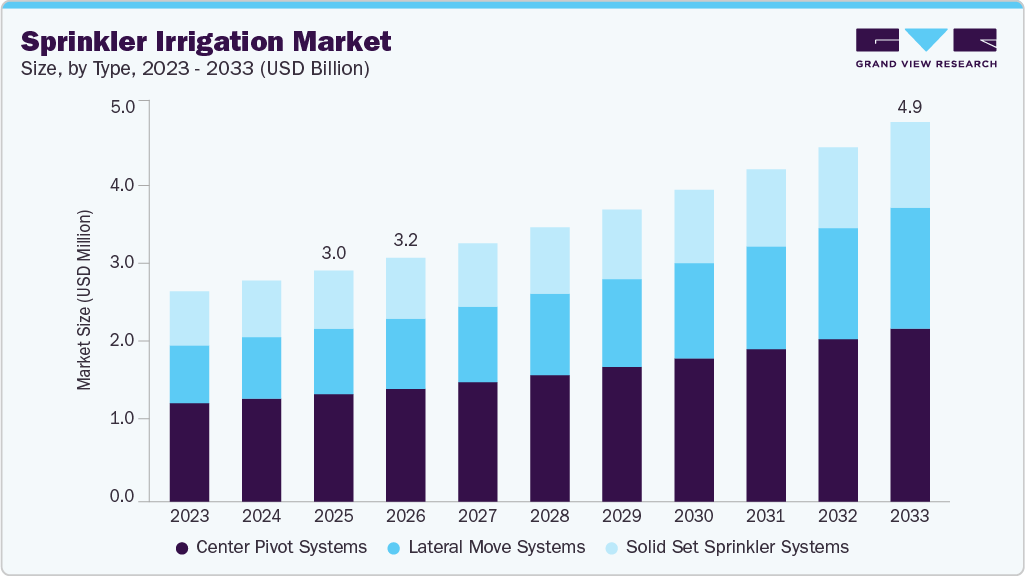 To learn more about this report, Download Free Sample Report
 One of the primary drivers of the sprinkler irrigation market is increasing government support for water-efficient irrigation technologies. In December 2025, the Government of India’s Ministry of Jal Shakti announced the Cabinet’s approval of the Modernization of Command Area Development and Water Management (M-CADWM) sub-scheme under Pradhan Mantri Krishi Sinchayee Yojana (PMKSY). This initiative explicitly aims to encourage farmers to adopt drip and sprinkler systems by developing pressurized irrigation networks and improving on-farm water use efficiency, supporting sprinkler irrigation adoption at scale across 23 States/UTs. This exemplifies how national policies are creating an enabling environment for market expansion.
Expanding commercial landscaping and turf management activities are also contributing significantly to market growth. Urbanization and infrastructure development have increased the demand for irrigation systems in golf courses, sports fields, public parks, and residential landscapes. Sprinkler irrigation systems offer uniform coverage and ease of installation across large landscaped areas, making them highly suitable for maintaining aesthetic and functional outdoor spaces. In addition, the increasing focus on green infrastructure development is further supporting the demand for efficient irrigation solutions.
The growing cultivation of high-value crops and greenhouse farming is further accelerating the adoption of sprinkler irrigation systems. Farmers cultivating fruits, vegetables, and ornamental plants are increasingly utilizing advanced irrigation techniques to ensure consistent crop growth and improved yield quality. Greenhouse and nursery operators particularly benefit from sprinkler systems due to their ability to maintain controlled moisture levels across cultivation environments. Continuous technological advancements, including energy-efficient designs and improved system durability, are expected to create further growth opportunities for the sprinkler irrigation market during the forecast period.
Component Insights
The spray or sprinkler heads segment led the market with the largest revenue share in 2025. The segment holds a prominent position as these components serve as the primary water distribution interface in sprinkler irrigation systems, directly influencing irrigation efficiency and coverage uniformity. The widespread demand for various spray patterns, flow rates, and pressure compatibility across diverse agricultural and landscaping applications has contributed significantly to the strong adoption of advanced sprinkler head designs. Farmers and commercial irrigation operators are increasingly selecting specialized sprinkler heads designed for specific crop types, soil conditions, and field layouts to enhance irrigation precision. In addition, rising investments in modern irrigation infrastructure, growing replacement demand for worn-out components, and the increasing adoption of high-efficiency irrigation equipment are further driving the demand for spray and sprinkler heads across both agricultural and non-agricultural applications.
The controllers segment is anticipated to grow at a significant CAGR during the forecast period. Controllers act as the central management unit of sprinkler irrigation systems, enabling automated operation based on programmed settings, environmental inputs, and crop-specific requirements. The rising adoption of digital irrigation platforms is encouraging farmers and landscape managers to deploy advanced controllers to improve system reliability and irrigation accuracy. The growing demand for data-driven farm management and remote irrigation monitoring is a key driver supporting segment expansion. Modern controllers equipped with wireless connectivity and cloud-based control capabilities allow users to manage irrigation systems through mobile and web applications, enhancing operational convenience and resource efficiency.
Type Insights
The center pivot systems segment led the market with the largest revenue share in 2025. The dominance of this segment is primarily driven by its ability to irrigate large agricultural fields efficiently while reducing labor requirements and water wastage. Center pivot systems provide uniform water distribution through automated rotating sprinkler mechanisms, making them highly suitable for large-scale farming operations such as cereals, grains, and oilseed cultivation. Their cost-effectiveness over large land areas and ability to operate with minimal manual intervention have made them a preferred choice among commercial farmers and agribusiness operators. Center pivot systems can be integrated with advanced technologies such as soil moisture sensors, GPS tracking, and automated control systems, allowing farmers to optimize irrigation scheduling and resource utilization.
The lateral move systems segment is anticipated to grow at the fastest CAGR during the forecast period, due to the increasing demand for efficient irrigation solutions for rectangular and irregularly shaped fields where center pivot systems are less effective. Lateral move systems provide uniform water distribution by moving across fields in a straight path, allowing farmers to maximize irrigation coverage and improve crop productivity. The rising focus on precision farming and water resource optimization is a major driver supporting segment growth. Lateral move systems can be integrated with advanced automation technologies, including remote monitoring, soil moisture sensors, and GPS-based guidance, enabling precise irrigation management and reducing operational inefficiencies. In addition, increasing investments in modern agricultural infrastructure and the growing need to improve crop yield quality while minimizing water consumption are encouraging farmers to adopt lateral move irrigation systems, further accelerating segment expansion.
Level of Automation Insights
The manual systems segment led the market with the largest revenue share in 2025. The segment’s dominance is largely attributed to its affordability and ease of deployment, particularly among small and medium-scale farmers operating in cost-sensitive regions. Manual sprinkler systems require minimal initial investment and technical expertise, making them widely accessible in developing agricultural economies. Additionally, these systems offer flexibility in operation and maintenance, allowing farmers to control irrigation timing and coverage based on crop requirements and water availability. Furthermore, insufficient electricity supply, lack of technical awareness, and financial constraints in several agricultural regions encourage farmers to rely on manual sprinkler irrigation systems, sustaining their strong market presence.
The fully automatic irrigation systems segment is anticipated to register the fastest CAGR during the forecast period. Fully automatic irrigation systems utilize advanced sensors, controllers, and programmable scheduling to deliver water based on real-time soil moisture levels, weather patterns, and crop requirements. These systems significantly reduce human intervention while ensuring consistent and efficient irrigation, making them highly attractive for large-scale commercial farming and high-value crop cultivation. The growing focus on labor cost reduction and farm operational efficiency is a major driver supporting segment expansion. Fully automatic systems enable remote monitoring and control through digital platforms, allowing farmers to manage irrigation activities more effectively and reduce water wastage.
Mobility Insights
The stationary segment accounted for the largest share of market revenue in 2025. The segment’s dominance is largely supported by its strong adoption across permanent agricultural fields, orchards, vineyards, and landscaped areas where fixed irrigation infrastructure is preferred. Stationary sprinkler systems provide consistent water application and long-term operational reliability, making them suitable for farms and facilities that require stable and continuous irrigation coverage. Their lower operational complexity and reduced need for frequent repositioning further contribute to their widespread usage in established cultivation zones.
The movable segment is expected to grow at the fastest CAGR during the forecast period. The growth of this segment is primarily driven by its flexibility and adaptability across diverse farming environments. The increasing need for cost-efficient and versatile irrigation solutions is a major driver supporting segment expansion. Movable systems enable farmers efficiently manage water resources across varying crop types and field conditions while reducing capital investment compared to fixed installations. In addition, the rising adoption of contract farming, expanding cultivation in remote agricultural areas, and growing demand for irrigation systems that support flexible farm management practices are encouraging farmers to adopt movable sprinkler irrigation systems, further accelerating market growth.
Application Insights
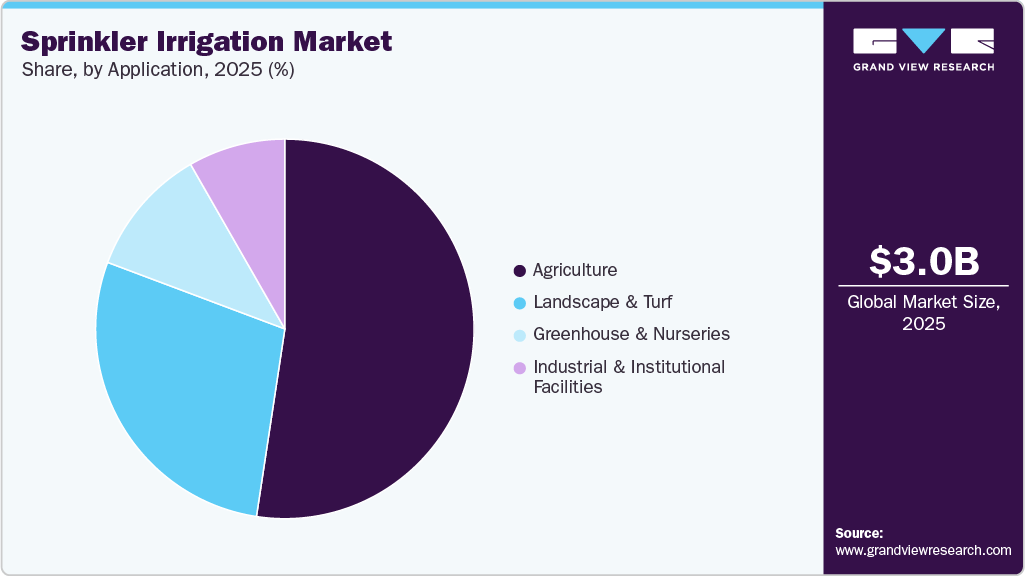
The agriculture segment led the market with the largest revenue share in 2025. Rising global food demand and the need to enhance land productivity are major drivers fueling segment growth. Increasing cultivation of water-sensitive crops and the expansion of irrigated farmland in water-scarce regions are encouraging farmers to adopt efficient irrigation technologies. In addition, supportive agricultural subsidy programs, growing awareness regarding crop quality improvement, and the increasing shift toward climate-resilient farming practices are further promoting the adoption of sprinkler irrigation systems within the agriculture sector.
 To learn more about this report, Download Free Sample Report
 The greenhouse & nurseries segment is anticipated to register a significant CAGR during the forecast period. The growth of this segment is driven by the increasing adoption of controlled environment agriculture for cultivating high-value crops, ornamental plants, and seedlings. The growing demand for premium horticultural crops and ornamental plants is a key factor accelerating segment expansion. Greenhouse and nursery operators are increasingly investing in advanced irrigation systems to improve plant quality, reduce water consumption, and enhance operational efficiency. In addition, the expansion of urban gardening initiatives, increasing commercial plant propagation activities, and growing awareness regarding resource-efficient cultivation practices are encouraging the adoption of sprinkler irrigation systems across greenhouse and nursery applications.
Regional Insights
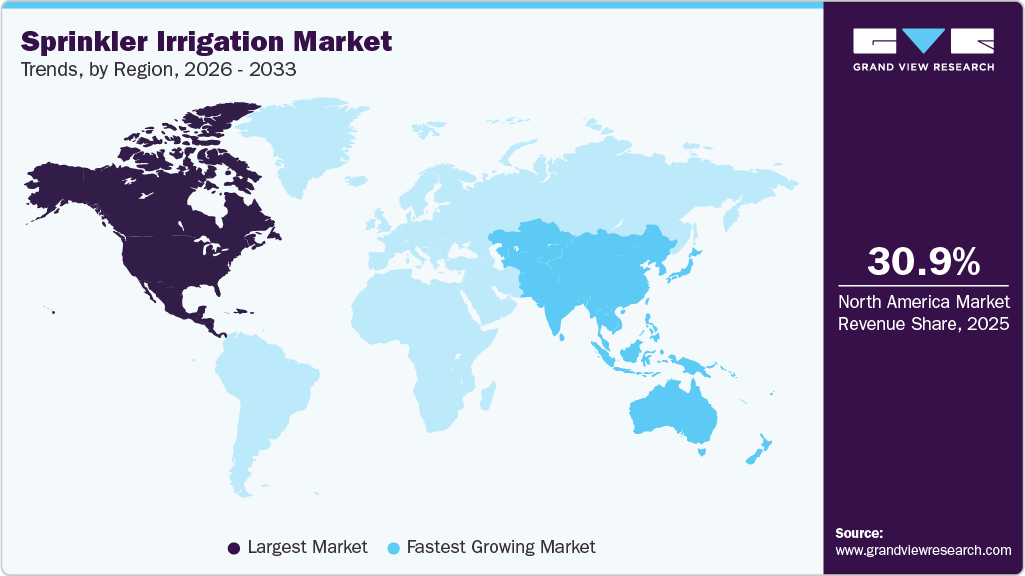
North America held 30.9% revenue share of the sprinkler irrigation market in 2025 and is expected to register a significant CAGR from 2026 to 2033. Growth in this region is supported by rising investment in modern agricultural infrastructure and the adoption of water-efficient irrigation technologies to address ongoing concerns over water scarcity and sustainable farming. Large-scale farming operations in Canada and Mexico, as well as strong mechanization trends in the U.S., have driven demand for efficient sprinkler systems that reduce labor use and optimize water application. In addition, government programs encouraging precision agriculture, enhanced irrigation practices, and environmental conservation are further supporting market expansion across North America.
 To learn more about this report, Download Free Sample Report
 U.S. Sprinkler Irrigation Market Trends
The sprinkler irrigation industry in the U.S. is anticipated to witness a significant CAGR from 2026 to 2033. In the U.S., increasing focus on precision farming and digital agriculture is motivating growers to adopt smart irrigation solutions that include automated control systems, sensors, and remote monitoring technologies. Regional drivers such as the need to improve crop yields while conserving water amid periodic droughts, as well as federal and state-level support for sustainable water management practices, are supporting sprinkler irrigation uptake.
Asia Pacific Sprinkler Irrigation Market Trends
The Asia Pacific sprinkler irrigation industry is expected to register the fastest CAGR over the forecast period. The region’s growth is driven by its large agricultural base and urgent need for efficient water management due to population growth and water scarcity. Countries such as India and China are investing heavily in irrigation modernization and smart irrigation technology adoption, supporting large-scale installation of sprinkler and precision irrigation systems. Government policies promoting irrigation infrastructure, subsidies for water-saving technologies, and increasing mechanization in farming are encouraging farmers to shift from traditional methods to advanced sprinkler solutions. Large irrigated farmland areas and a rising focus on food security further strengthen demand for modern irrigation systems in the Asia Pacific.
The sprinkler irrigation industry in China is projected to grow at a notable CAGR from 2026 to 2033. National strategies to improve irrigation efficiency and address water scarcity are increasing demand for sprinkler systems and automation platforms. Large events such as the Beijing International Irrigation Technology Expo highlight the country’s focus on innovation and smart agriculture solutions. Moreover, extreme weather patterns such as droughts have prompted increased focus on irrigation resilience and government support, further supporting market growth in China.
Europe Sprinkler Irrigation Market Trends
The sprinkler irrigation industry in Europe is anticipated to grow at a significant CAGR from 2026 to 2033, supported by increasing focus on water conservation, sustainability, and precision farming practices. Strict environmental regulations across the European Union and national policies under frameworks such as the Common Agricultural Policy are encouraging farmers to adopt efficient irrigation technologies to reduce water use and improve crop yields. Southern European countries with water-scarce conditions are increasingly implementing low-pressure and automated sprinkler systems to address seasonal drought stress, while smart irrigation solutions with IoT integration are gaining traction to optimize resource use and meet sustainability goals.
The UK sprinkler irrigation market is anticipated to grow at a significant CAGR from 2026 to 2033. In the UK, a strong focus on environmental sustainability and improving agricultural productivity is driving adoption of advanced irrigation solutions. Government initiatives and funding aimed at water-efficient agriculture and smart irrigation technologies are supporting market growth, while climate variability has underscored the need for irrigation systems that conserve water and enhance farm resilience.
Key Sprinkler Irrigation Company Insights
Some of the key companies operating in the sprinkler irrigation market, include Nelson Irrigation, Jain Irrigation Systems Ltd. and Rain Bird Corporation among others are some of the leading participants in the sprinkler irrigation market.
-
Nelson Irrigation is a U.S.-based company headquartered in Walla Walla, Washington, that manufactures irrigation equipment for agriculture and water management applications. The company offers products such as pivot sprinklers, rotator sprinklers, big gun sprinklers, pressure regulators, control valves, and irrigation automation systems. Its products are widely used in agricultural irrigation and are distributed globally through dealer and partner networks, strengthening its presence in the sprinkler irrigation market.
-
Jain Irrigation Systems Ltd. is an India-based multinational company headquartered in Jalgaon, Maharashtra. The company focuses on providing irrigation and agricultural solutions and operates in more than 120 countries. It supports farmers by offering technologies that improve water use efficiency and crop productivity. The company provides a wide range of products including sprinkler irrigation systems, drip irrigation systems, pipes, fittings, filters, and irrigation accessories. It also offers farm advisory, irrigation system design, and project implementation services, strengthening its presence in the global sprinkler irrigation market.
Key Sprinkler Irrigation Companies:
The following key companies have been profiled for this study on the sprinkler irrigation market.
- Amiad Water Systems Ltd.
- Dramm Corporation
- Hunter Industries Inc.
- Jain Irrigation Systems Ltd.
- Komet Austria GmbH
- Lindsay Corporation
- Nelson Irrigation
- NETAFIM
- Rain Bird Corporation
- Rain-Flo Irrigation
- REINKE MANUFACTURING CO., INC.
- Röhren- und Pumpenwerk BAUER GmbH
- Rubicon Water
- The Toro Company
- Valmont Industries, Inc.
Recent Developments
-
In February 2026, R M Drip & Sprinklers Systems announced its expansion into IoT-enabled smart irrigation and digital farming solutions. The company plans to introduce connected technologies, mobile-based monitoring, and data analysis tools to improve irrigation control. This move is intended to enable farmers manage water use more efficiently, simplify irrigation operations, and support better crop growth through technology-driven farming practices.
-
In December 2025, Lindsay Corporation signed an agreement to supply Zimmatic irrigation systems and FieldNET remote irrigation management technology in the Middle East and North Africa region. The project, worth about USD 80 million, aims to improve local food production by helping farmers use water more efficiently and increase crop yield in regions facing water shortages.
-
In October 2025, Rain Bird Corporation acquired Rachio, Inc. to strengthen its connected irrigation and smart controller capabilities. The acquisition aims to accelerate innovation, expand Rain Bird’s sustainable irrigation portfolio, and enhance customer engagement through advanced digital watering technologies, supporting the company’s commitment to intelligent water management and environmentally responsible irrigation solutions.
Sprinkler Irrigation Market Report Scope
Report Attribute
Details
Market size in 2025
USD 3.0 billion
Estimated market size in 2026
USD 3.2 billion
Projected market size by 2033
USD 5.0 billion
Growth rate
CAGR of 6.5% from 2026 to 2033
Actual data
2021 - 2025
Forecast period
2026 - 2033
Quantitative units
Revenue in USD million/billion and CAGR from 2026 to 2033
Report coverage
Revenue forecast, company share, competitive landscape, growth factors, and trends
Segments covered
Type, level of automation, application, component, mobility, region
Regional scope
North America; Europe; Asia Pacific; Latin America; MEA
Country scope
U.S.; Canada; Mexico; UK; Germany; France; China; India; Japan; Australia; South Korea; Brazil; UAE; Saudi Arabia; South Africa
Key companies profiled
Amiad Water Systems Ltd.; Dramm Corporation; Hunter Industries Inc.; Jain Irrigation Systems Ltd.; Komet Austria GmbH; Lindsay Corporation; Nelson Irrigation; NETAFIM; Rain Bird Corporation; Rain-Flo Irrigation; REINKE MANUFACTURING CO., INC.; Röhren- und Pumpenwerk BAUER GmbH; Rubicon Water; The Toro Company; Valmont Industries, Inc.
Customization scope
Free report customization (equivalent to 8 analysts working days) with purchase. Addition or alteration to country, regional & segment scope.
Pricing and purchase options
Avail customized purchase options to meet your exact research needs. Explore purchase options
Global Sprinkler Irrigation Market Report Segmentation
This report forecasts revenue growth at global, regional, and country levels and provides an analysis of the latest industry trends in each of the sub-segments from 2021 to 2033. For this study, Grand View Research has segmented the global sprinkler irrigation market report based on type, level of automation, application, component, mobility, and region:
-
Type Outlook (Revenue, USD Billion, 2021 - 2033)
-
Center Pivot Systems
-
Lateral Move Systems
-
Solid Set Sprinkler Systems
-
-
Level of Automation Outlook (Revenue, USD Billion, 2021 - 2033)
-
Manual Systems
-
Semi-Automatic Systems
-
Fully Automatic Irrigation Systems
-
-
Component Outlook (Revenue, USD Billion, 2021 - 2033)
-
Tubing
-
Couplers
-
Spray or Sprinkler Heads
-
Sensors
-
Controllers
-
Injectors
-
Flow Meters
-
Others
-
-
Mobility Outlook (Revenue, USD Billion, 2021 - 2033)
-
Stationary
-
Movable
-
-
Application Outlook (Revenue, USD Billion, 2021 - 2033)
-
Agriculture
-
Landscape & Turf
-
Greenhouse & Nurseries
-
Industrial & Institutional Facilities
-
-
Regional Outlook (Revenue, USD Billion, 2021 - 2033)
-
North America
-
U.S.
-
Canada
-
Mexico
-
-
Europe
-
Germany
-
UK
-
France
-
-
Asia Pacific
-
China
-
India
-
Japan
-
South Korea
-
Australia
-
-
Latin America
-
Brazil
-
-
Middle East & Africa
-
UAE
-
Saudi Arabia
-
South Africa
-
-
Frequently Asked Questions About This Report
The global sprinkler irrigation market size was valued at USD 3.0 billion in 2025 and is projected to reach USD 3.2 billion in 2026.
The global sprinkler irrigation market is expected to grow at a CAGR of 6.5% from 2026 to 2033, reaching USD 5.0 billion by 2033.
The agriculture segment held the market with the largest revenue share in 2025.
Some key players operating in the driving simulator sprinkler irrigation market include Amiad Water Systems Ltd.; Dramm Corporation; Hunter Industries Inc.; Jain Irrigation Systems Ltd.; Komet Austria GmbH; Lindsay Corporation; Nelson Irrigation; NETAFIM; Rain Bird Corporation; Rain-Flo Irrigation; REINKE MANUFACTURING CO., INC.; Röhren- und Pumpenwerk BAUER GmbH; Rubicon Water; The Toro Company; Valmont Industries, Inc.
Key factors that are driving the market growth include the increasing global demand for efficient water management solutions in agriculture and landscaping activities. Growing pressure on freshwater resources, coupled with the need to improve agricultural productivity, is encouraging farmers and commercial landowners to adopt advanced irrigation technologies that minimize water wastage while maximizing crop yield and quality.
The stationary segment held the market with the largest revenue share in 2025, while movable is the fastest-growing segment.
The spray or sprinkler heads segment held the market with the largest revenue share in 2025.
North America dominated with a revenue share of 30.9% in 2025.
Asia Pacific is the fastest-growing region over the forecast period.
The center pivot systems segment held the market with the largest revenue share of over 46.0% in 2025, while lateral move systems is the fastest-growing segment.
About the Author(s)
Next Generation Technologies Research Team
Technology · Next Generation TechnologiesThis report was authored by the next generation technologies research team at Grand View Research - comprising two research analysts, one senior research analyst, and one industry expert - with specialized expertise in the next generation technologies segment of the technology industry. All findings are based on proprietary technology databases, executive interviews, and regulatory analysis, subject to internal peer review prior to publication.
Last Updated:
Speak to Analyst

Customize this report to your needs - add regions, segments, or data points, with 20% free customization.
Or view our licence options:


ISO 9001:2015 & 27001:2022 Certified
We are GDPR and CCPA compliant! Your transaction & personal information is safe and secure. For more details, please read our privacy policy.


