
- Home
- »
- Advanced Interior Materials
- »
-
Structural Wood Screws Market Size Report, 2025-2033GVR Report cover
![Structural Wood Screws Market Size, Share & Trends Report]()
Structural Wood Screws Market (2025 - 2033) Size, Share & Trends Analysis Report By Application (Construction, Furniture and Crafts, Others), By Type (Carbon Steel, Stainless Steel), By Region, And Segment Forecasts
Market Size, 2024
$4.6BMarket Estimate, 2026
$5.1BMarket Forecast, 2033
$7.4BCAGR, 2025–2033
5.5%Structural Wood Screws Market Summary
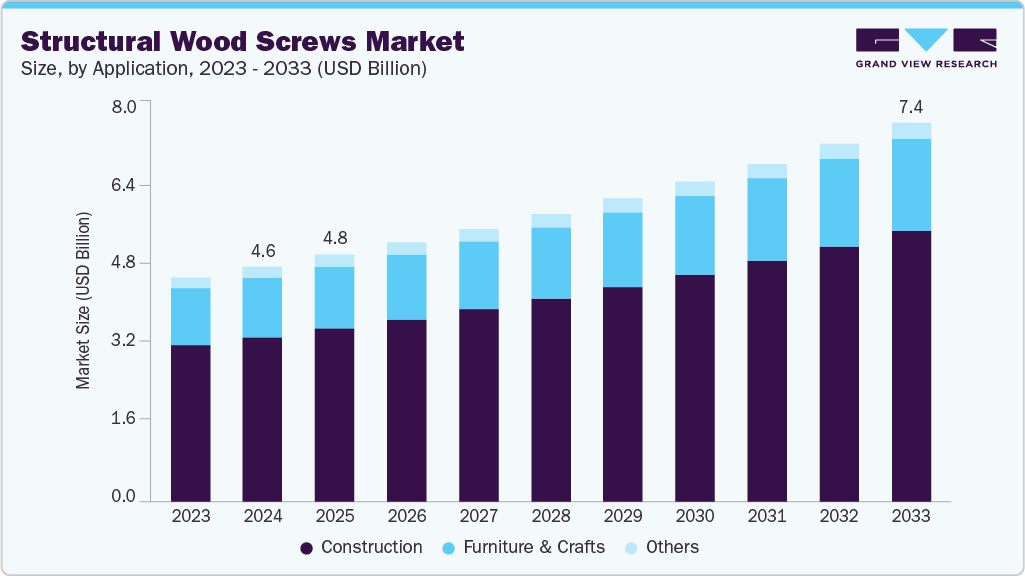
The global structural wood screws market size was valued at USD 4.6 billion in 2024 and is projected to grow from USD 5.1 billion in 2026 to USD 7.4 billion by 2033, at a CAGR of 5.5% from 2025 to 2033. Europe dominated the market, accounting for a revenue share of 42.0% in 2024. The growth is driven by the expanding construction and infrastructure development across residential, commercial, and industrial sectors. Rapid urbanization and government-led housing initiatives in emerging economies are fueling demand for durable fastening solutions.

Key Market Trends & Insights
- By type, carbon steel segment is expected to grow at fastest CAGR of 6.0% over the forecast period.
- By application, construction segment is expected to grow at fastest CAGR of 5.7% over the forecast period.
Market Size & Forecast
- 2024 Market Size: USD 4.6 Billion
- 2033 Projected Market Size: USD 7.4 Billion
- CAGR (2025-2033): 5.5%
- Europe: Largest market in 2024
- Asia Pacific: Fastest growing market
Structural wood screws offer enhanced load-bearing capacity and long-term stability compared to traditional nails and fasteners, making them a crucial component in modern wood-frame construction. In addition, growing adoption in renovation and remodeling projects further contributes to market growth, as builders increasingly prioritize efficiency and structural integrity.Increasing awareness of safety standards and building codes is another significant driver for the structural wood screws industry. Governments and regulatory bodies are enforcing stringent guidelines to ensure structural safety and longevity, particularly in earthquake-prone and high-wind regions. Structural wood screws, with superior mechanical performance and resistance to loosening, are preferred to meet these compliance requirements. The emphasis on quality and reliability in construction materials is encouraging builders and contractors to adopt advanced screw solutions over conventional fastening methods.
Technological advancements in material composition and screw design are also propelling market growth. Innovations such as corrosion-resistant coatings, self-drilling tips, and enhanced thread geometry improve performance across diverse wood types and varying environmental conditions. These features reduce installation time, improve load distribution, and extend the service life of wooden structures. Manufacturers are increasingly focusing on research and development to introduce screws that combine durability, ease of use, and cost-effectiveness, thereby attracting a broader customer base across various construction segments.
Market Concentration & Characteristics
The structural wood screws industry exhibits a moderately fragmented concentration, with a mix of multinational fastener manufacturers and regional suppliers competing alongside specialized niche players. The degree of innovation in the market is significant, driven by advancements in materials, coatings, and screw geometry to enhance performance, corrosion resistance, and ease of installation. The sector has witnessed a moderate level of mergers and acquisitions, as companies seek to expand geographic presence, consolidate production capabilities, and strengthen distribution networks. Regulatory frameworks and building codes play a critical role, particularly in regions with stringent construction safety standards, driving the adoption of high-quality screws over alternative fasteners.
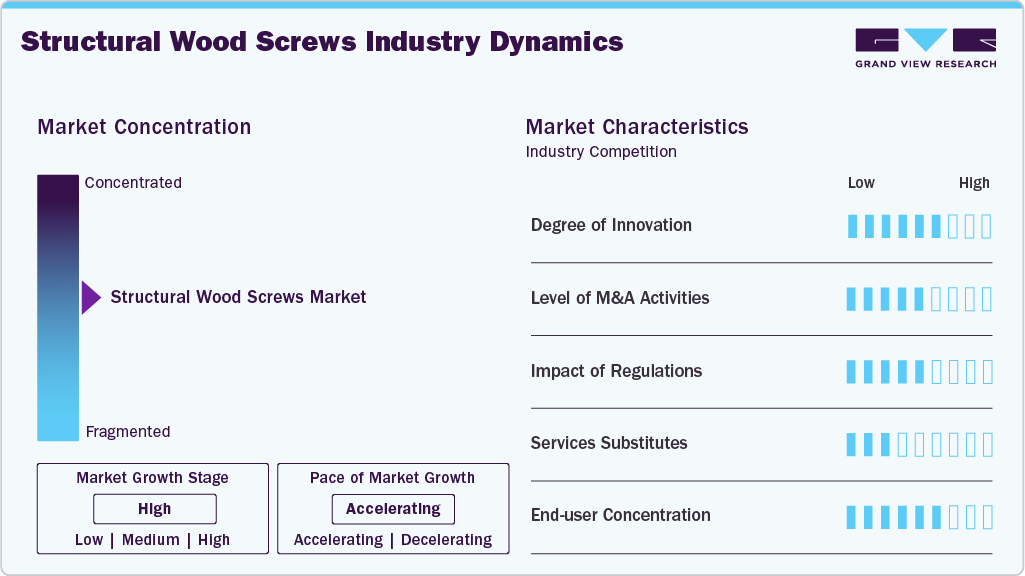
Market characteristics are shaped by the availability of service substitutes and the distribution of end-user demand. While nails and other mechanical fasteners act as substitutes in certain applications, structural wood screws are increasingly preferred for their superior load-bearing capacity, durability, and long-term reliability. End-user concentration is moderately high, with the construction, furniture manufacturing, and DIY sectors accounting for the bulk of consumption. The market’s performance is therefore closely linked to construction activity and renovation trends, with manufacturers focusing on product differentiation, standardization, and quality assurance to capture a larger share of both professional and consumer segments.
Application Insights
The construction segment led the market with the largest revenue share of 70.1% in 2024, driven by the global surge in residential, commercial, and infrastructure development projects. Growing urbanization and population expansion have increased the demand for durable fastening solutions that can support larger loads and withstand long-term structural stresses. Modern construction practices-such as timber framing, mass timber, CLT (cross-laminated timber), and modular building-also require high-strength wood screws designed for precision and reliability. In addition, stricter building codes and a greater emphasis on safety and sustainability encourage the adoption of engineered fasteners over traditional nails or low-grade screws, further strengthening demand in this segment.
The furniture & crafts segment is expected to grow at the fastest CAGR of 5.1% over the forecast period, the rising popularity of DIY culture, customization trends, and the demand for high-quality furniture with longer life spans. Structural wood screws are preferred for their superior holding power, clean aesthetics, and ease of installation, which appeal to both hobbyists and professional craftspeople. The expansion of e-commerce platforms has also boosted the distribution of woodworking tools and materials, increasing accessibility for small businesses and home workshops
Type Insights
The stainless steel segment led the market with the largest revenue share of 78.8% in 2024, driven by applications that require superior corrosion resistance and durability. Industries such as outdoor construction, marine environments, decking, and exterior furniture rely on stainless steel screws to prevent rust and structural degradation caused by moisture, salt, and temperature fluctuations. As environmental exposure standards become more stringent, end users increasingly choose stainless steel fasteners for their long service life and minimal maintenance requirements.
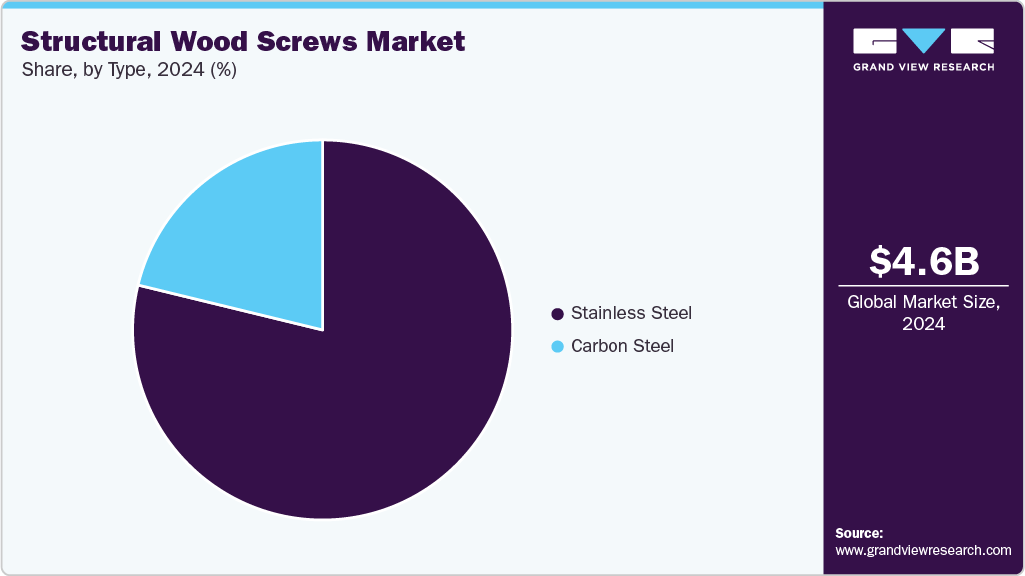
The carbon steel segment is expected to grow at the fastest CAGR of 6.0% over the forecast period, driven by its cost-effectiveness, high tensile strength, and versatility across a wide range of construction and manufacturing applications. This segment benefits heavily from large-scale construction projects where cost efficiency and mechanical performance are key priorities. Advances in surface coatings-such as zinc plating, black oxide, and polymer layers-have improved corrosion resistance, making carbon steel screws suitable for both indoor and certain protected outdoor uses.
Regional Insights
The structural wood screws market in North America is driven by robust construction activity, particularly in residential housing and light commercial buildings. The growing preference for wood-frame construction is enhancing demand for high-strength fastening solutions. Stringent building codes, which emphasize structural safety and compliance, further promote the use of engineered screws. Renovation and remodeling projects, which remain consistently strong across the region, also contribute to market growth. In addition, increased adoption of advanced coatings and corrosion-resistant materials supports use in diverse climates. Together, these factors sustain steady regional demand.
U.S. Structural Wood Screws Market Trends
The structural wood screws market in the U.S. held a significant share in North America in 2024. In the U.S., market growth is propelled by significant investment in housing development, infrastructure upgrades, and disaster-resilient construction. The rise of prefabricated and modular building systems has increased reliance on precision fastening solutions, such as structural wood screws. Federal and local regulations aimed at improving energy efficiency and structural integrity support wider adoption. The expanding DIY culture and home-improvement spending also stimulate retail demand. Furthermore, the strong presence of key manufacturers drives continuous product innovation. These elements combine to reinforce the U.S. as a dominant market.
Europe Structural Wood Screws Market Trends
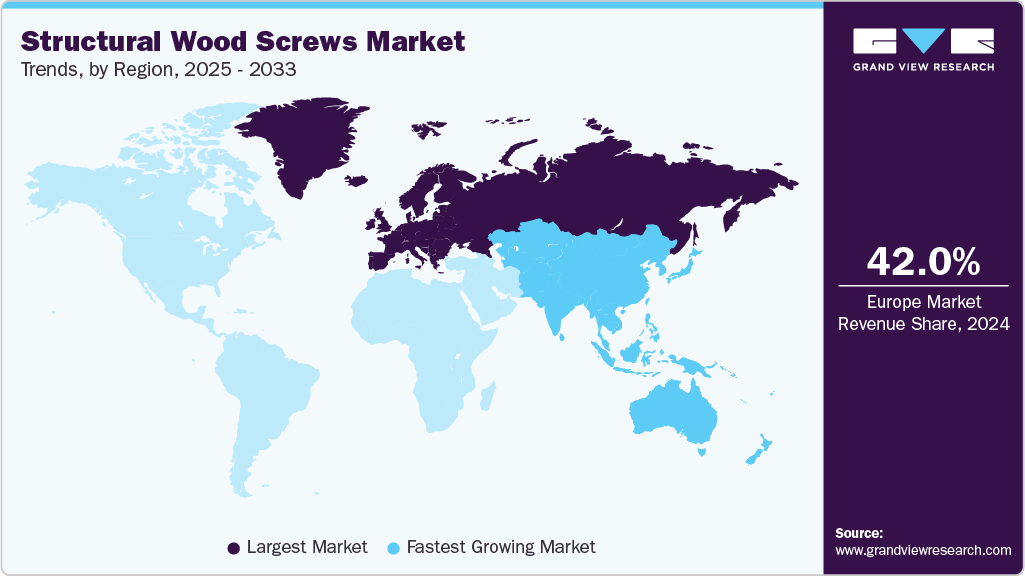
Europe dominated the global structural wood screws market with the largest revenue market share of 42.0% in 2024, driven by a strong emphasis on sustainable construction and widespread use of engineered timber. Stringent EU standards governing structural integrity and environmental performance drive the adoption of certified fastening products. Renovation and energy-efficiency upgrades across aging building stock further fuel demand. European manufacturers lead in innovation, offering advanced screw designs with superior corrosion resistance. The region’s commitment to carbon-neutral construction practices encourages the use of long-lasting fastening solutions. These dynamics support steady and technologically advanced market growth.
The structural wood screws market in Germany is driven by the country's leadership in timber construction engineering and its adherence to rigorous building regulations. The high demand for precision fastening solutions stems from the country’s robust prefabricated housing industry. Emphasis on quality, durability, and structural reliability promotes the use of premium wood screws. Ongoing renovation programs targeting energy efficiency also elevate consumption. The country’s advanced manufacturing base fosters continuous innovation in products. Collectively, these factors make Germany one of Europe’s most mature and technically sophisticated markets.
Asia Pacific Structural Wood Screws Market Trends
The structural wood screws market in the Asia Pacific is driven by rapid urbanization, large-scale infrastructure expansion, and rising investments in residential construction. Growing adoption of Western-style wood-frame structures in certain regions is increasing demand for high-performance screws. Government-backed housing programs in developing economies further boost consumption. Advancements in manufacturing capabilities allow regional producers to offer competitively priced, high-quality products. The growing DIY and furniture manufacturing sectors add to demand. As industrialization accelerates, the region remains a high-growth market.
TheChina structural wood screws market is supported by expanding construction projects and government initiatives promoting sustainable building materials. The growing use of engineered wood products, such as cross-laminated timber, drives the need for reliable fastening systems. Increasing environmental regulations are encouraging the use of durable, long-lasting structural components like advanced wood screws. Rapid industrial automation enables large-scale production with improved quality. Rising consumer interest in home improvement also contributes to retail demand. These factors position China as a key contributor to regional market growth.
Latin America Structural Wood Screws Market Trends
The structural wood screws market in Latin America is anticipated to grow at a significant CAGR during the forecast period. In Latin America, market growth is driven by expanding residential construction and increasing adoption of cost-effective wood-frame building practices. Government-led housing initiatives in countries such as Brazil and Mexico bolster demand for durable fastening solutions. The region’s tropical climate encourages the use of corrosion-resistant screws to ensure long-term performance. Growth in the furniture and woodworking sectors adds a layer of demand. The rising availability of advanced screw designs is improving market accessibility. These factors support gradual but consistent market expansion.
Middle East & Africa Structural Wood Screws Market Trends
The structural wood screws market in the Middle East & Africa is anticipated to grow at the fastest CAGR during the forecast period, driven by increasing interest in alternative building materials and rising residential development. Wood-based construction is gaining traction in certain regions, driving the need for reliable fastening systems. Climate-resistant structural screws are increasingly favored due to harsh environmental conditions. Government diversification efforts and infrastructure investments further stimulate construction activity. Expanding retail channels make modern fastening products more accessible to consumers and professionals. Together, these elements promote the growth of emerging markets.
Key Structural Wood Screws Company Insights
Some of the key players operating in market includeTrex Company, Inc., Fiberon
-
Trex is a leading manufacturer of wood-alternative composite decking, railing, cladding and related outdoor building materials made largely from recycled inputs. Its composite decking products are made from up to 95% recycled materials, diverting large volumes of plastic and scrap wood from landfills annually.
-
Fiberon produces wood-plastic composite decking, railing, and cladding made from recycled wood fibers and high-density polyethylene (HDPE). Their composite products consistently contain around 94% recycled content, combining sawdust and waste plastic to create durable, low-maintenance alternatives to traditional lumber.
UPM, SGL Carbon are some of the emerging market participants in global structural wood screws industry.
-
The European firm UPM (through its UPM Biocomposites division) offers recycled and bio-based composites under product lines such as UPM ProFi (for decking and outdoor use) and UPM Formi (granulates for injection moulding and extrusion).
-
SGL Carbon is a key player in the recycled carbon fiber composites segment, specializing in recycled carbon- and graphite-based composites for industrial, automotive, and aerospace applications. The company invests in recycling technology to recover high-performance carbon fibers suitable for structural and high-specification uses.
Key Structural Wood Screws Companies:
The following are the leading companies in the structural wood screws market. These companies collectively hold the largest market share and dictate industry trends.
- SPAX International GmbH & Co. KG
- SFS Group
- Grip-Rite
- Fischer
- Simpson Strong-Tie
- Rothoblaas
- Eurotec
- GRK Fasteners
- Kyocera Senco
- Fastenmaster
- MITEK INC.
- Hillman
- TR Fastenings
- Forch
- Dresselhaus
- Friulsider SPA
- Kreg
- FastCap
- Wurth
- Big Timber
- Camo Fasteners
Recent Developments
-
In September 2024, Simpson Strong-Tie introduced its Strong-Drive SWD Double-Threaded screw, expanding its structural fastener range. The screw’s double-thread engineering allows it to replace various interior and exterior connectors. This innovation helps speed up installation while lowering labour demands and costs.
Structural Wood Screws Market Report Scope
Report Attribute
Details
Market size in 2024
USD 4.6 billion
Estimated market size in 2026
USD 5.1 billion
Projected market size by 2033
USD 7.4 billion
Growth rate
CAGR of 5.5% from 2025 to 2033
Base year for estimation
2024
Historical data
2021 - 2023
Forecast period
2025 - 2033
Quantitative units
Volume in Tons, Revenue in USD million/billion, and CAGR from 2025 to 2033
Report coverage
Revenue forecast, company ranking, competitive landscape, growth factors, and trends
Segments covered
Type, application, region
Regional scope
North America; Europe; Asia Pacific; Central & South America; Middle East & Africa
Country scope
U.S.; Canada; Mexico; U.K.; Germany; France; Italy; Sweden; China; India; Japan; South Korea; Singapore; Brazil; Argentina; Colombia
Key companies profiled
SPAX International GmbH & Co. KG; SFS Group; Grip-Rite; Fischer; Simpson Strong-Tie; Rothoblaas; Eurotec; GRK Fasteners; Kyocera Senco; FastenMaster; MITEK Inc.; Hillman; TR Fastenings; Forch; Dresselhaus; Friulsider SPA; Kreg; FastCap; Würth; Big Timber; Camo Fasteners.
Customization scope
Free report customization (equivalent up to 8 analysts’ working days) with purchase. Addition or alteration to country, regional & segment scope.
Pricing and purchase options
Avail customized purchase options to meet your exact research needs. Explore purchase options
Global Structural Wood Screws Market Report Segmentation
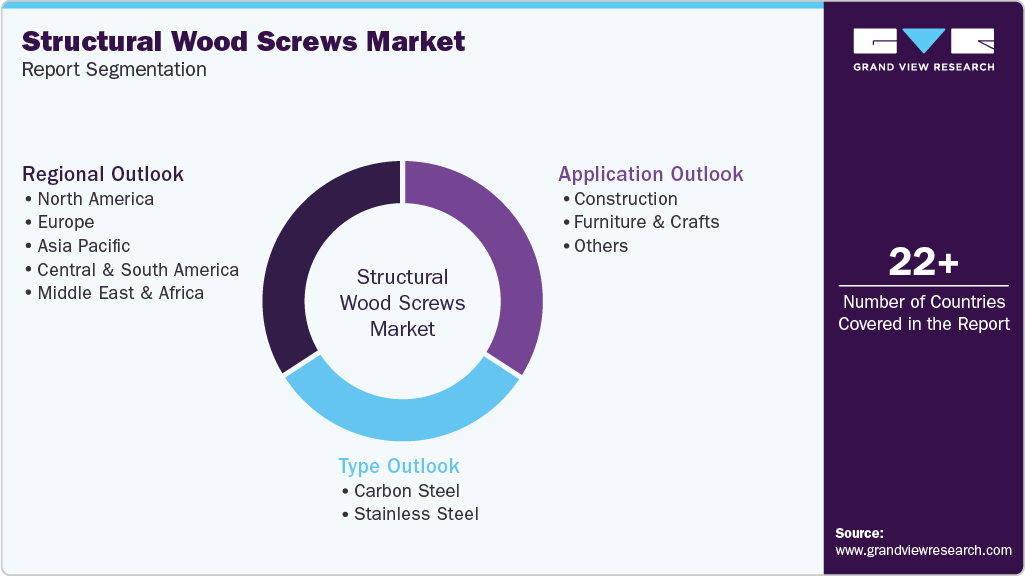
This report forecasts revenue growth at global, regional, and country levels and provides an analysis of the latest industry trends in each of the sub-segments from 2021 to 2033. For this study, Grand View Research has segmented the global structural wood screws market report based on application, type and region.
-
Application Outlook (Volume, Tons; Revenue, USD Million, 2021 - 2033)
-
Construction
-
Furniture and Crafts
-
Others
-
-
Type Outlook (Volume, Tons; Revenue, USD Million, 2021 - 2033)
-
Carbon Steel
-
Stainless Steel
-
-
Regional Outlook (Volume, Tons; Revenue, USD Million, 2021 - 2033)
-
North America
-
U.S.
-
Canada
-
Mexico
-
-
Europe
-
Germany
-
UK
-
France
-
Italy
-
Sweden
-
-
Asia Pacific
-
China
-
Japan
-
India
-
South Korea
-
Singapore
-
-
Central & South America
-
Brazil
-
Argentina
-
Colombia
-
-
Middle East & Africa
-
Frequently Asked Questions About This Report
The global structural wood screws market size was valued at USD 4.6 billion in 2024 and is estimated at USD 5.1 billion for 2026.
The global structural wood screws market is expected to grow at a CAGR of 5.5% from 2025 to 2033, reaching USD 7.4 billion by 2033.
Residential construction segment dominated the market and accounted for the largest revenue share of 60.6% in 2024, driven by heightened consumer preference for environmentally responsible materials that lower household carbon footprints.
Some of key players in the structural wood screws market are Corbion N.V., BASF SE, Evonik Industries AG, Algix LLC, Prometheus Materials, Flora Materials, Ocean Grows Limited, Algenesis Materials, AlgaEnergy S.A.
The key factors driving the structural wood screws market include rising demand for low-carbon construction solutions, advancements in algae cultivation and bio-processing technologies, increasing regulatory support for sustainable materials, growing emphasis on circular and renewable resources, and expanding adoption of bio-based alternatives across residential and commercial projects.
About the Author(s)
Advanced Interior Materials Research Team
Advanced Materials · Advanced Interior MaterialsThis report was authored by the advanced interior materials research team at Grand View Research - comprising two research analysts, one senior research analyst, and one industry expert - with specialized expertise in the advanced interior materials segment of the advanced materials industry. All findings are based on proprietary advanced materials databases, executive interviews, and regulatory analysis, subject to internal peer review prior to publication.
Last Updated:
Speak to Analyst


Need a Tailored Report?
Customize this report to your needs — add regions, segments, or data points, with 20% free customization.
Or view our licence options:


ISO 9001:2015 & 27001:2022 Certified
We are GDPR and CCPA compliant! Your transaction & personal information is safe and secure. For more details, please read our privacy policy.












