
- Home
- »
- Power Generation & Storage
- »
-
Substation Battery Market Size & Share Report, 2026-2033GVR Report cover

Substation Battery Market (2026 - 2033)
Size, Share & Trends Analysis Report By Battery Chemistry (Lead-acid, Nickel-cadmium, Lithium-ion), By Application (Transmission substations, Distribution substations), By Region, And Segment Forecasts
Market Size, 2025
$5.5BMarket Estimate, 2026
$5.9BMarket Forecast, 2033
$8.9BCAGR, 2026–2033
6.2%Substation Battery Market Summary
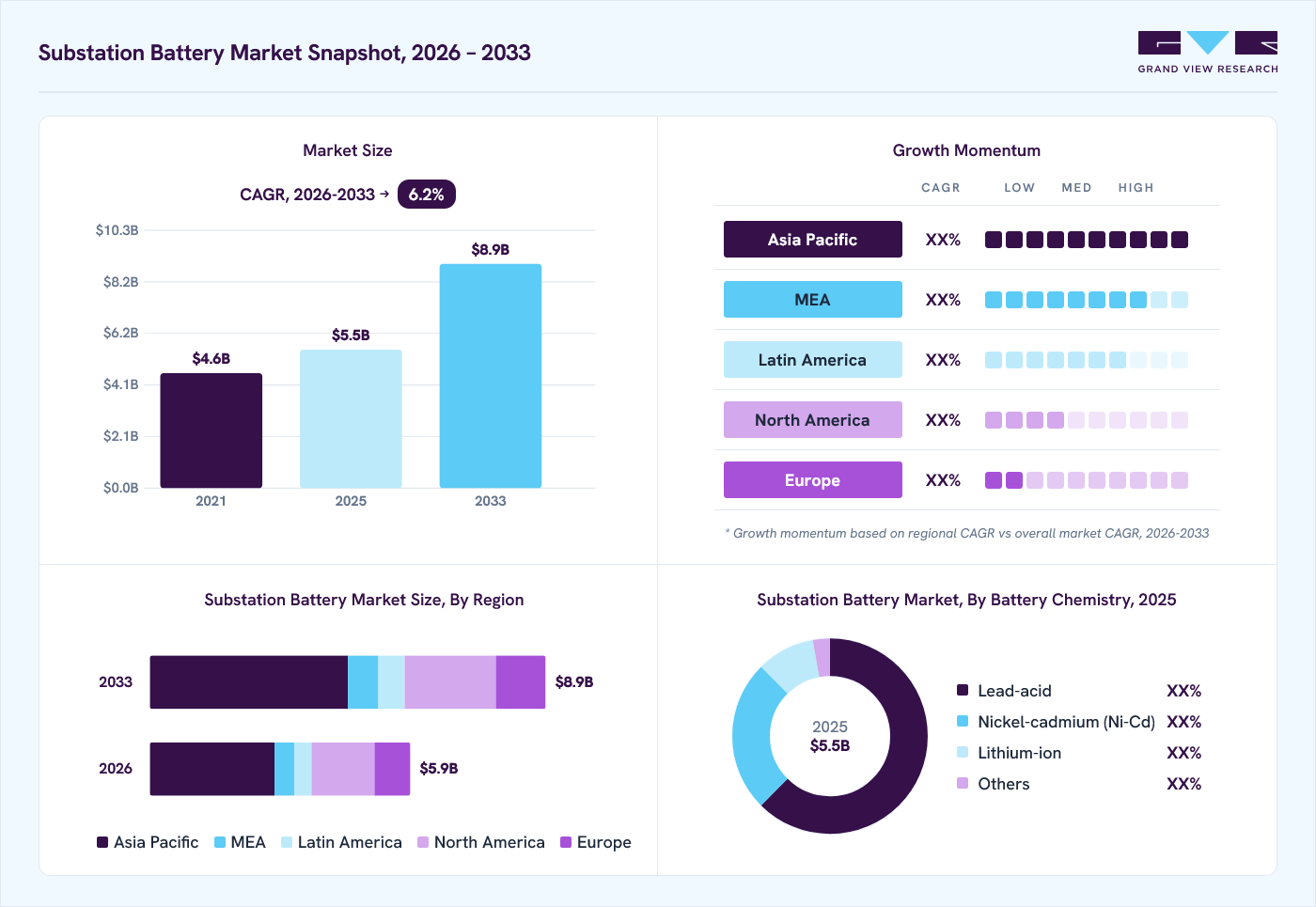
The substation battery market size was estimated at USD 5.5 billion in 2025 and is projected to grow from USD 5.9 billion in 2026 to USD 8.9 billion by 2033, growing at a CAGR of 6.2% from 2026 to 2033. The market is driven by grid modernization initiatives, rising electricity demand, increasing integration of renewable energy sources, and the need for reliable backup power to ensure uninterrupted substation operations.
 Source: Grand View Research, IR Documents, Primary Interviews, Paid DatabasesTo learn more about this report,
 Download Free Sample Report
Key Market Trends & Insights
- Asia Pacific substation battery market held the largest share of 47.6% of the global market in 2025.
- The substation battery market in India is expected to grow at a CAGR of 7.2% over the forecast period.
- Lead-acid segment held the largest revenue share of 62.4% in 2025.
- Transmission substations segment held the largest revenue share of 58.9% in 2025.
Market Size & Forecast
- 2025 Market Size: USD 5.5 Billion
- Estimated market size in 2026: USD 5.9 Billion
- 2033 Projected Market Size: USD 8.9 Billion
- CAGR (2026-2033): 6.2%
GVR research-powered AIAsk Prism AI about the substation battery marketGet cited answers from GVR research on market growth, segments, regulations and forecasts.Start with✓ Source-linked answers ✓ Market-specific context ✓ Traceable figuresExplore Prism AI ↗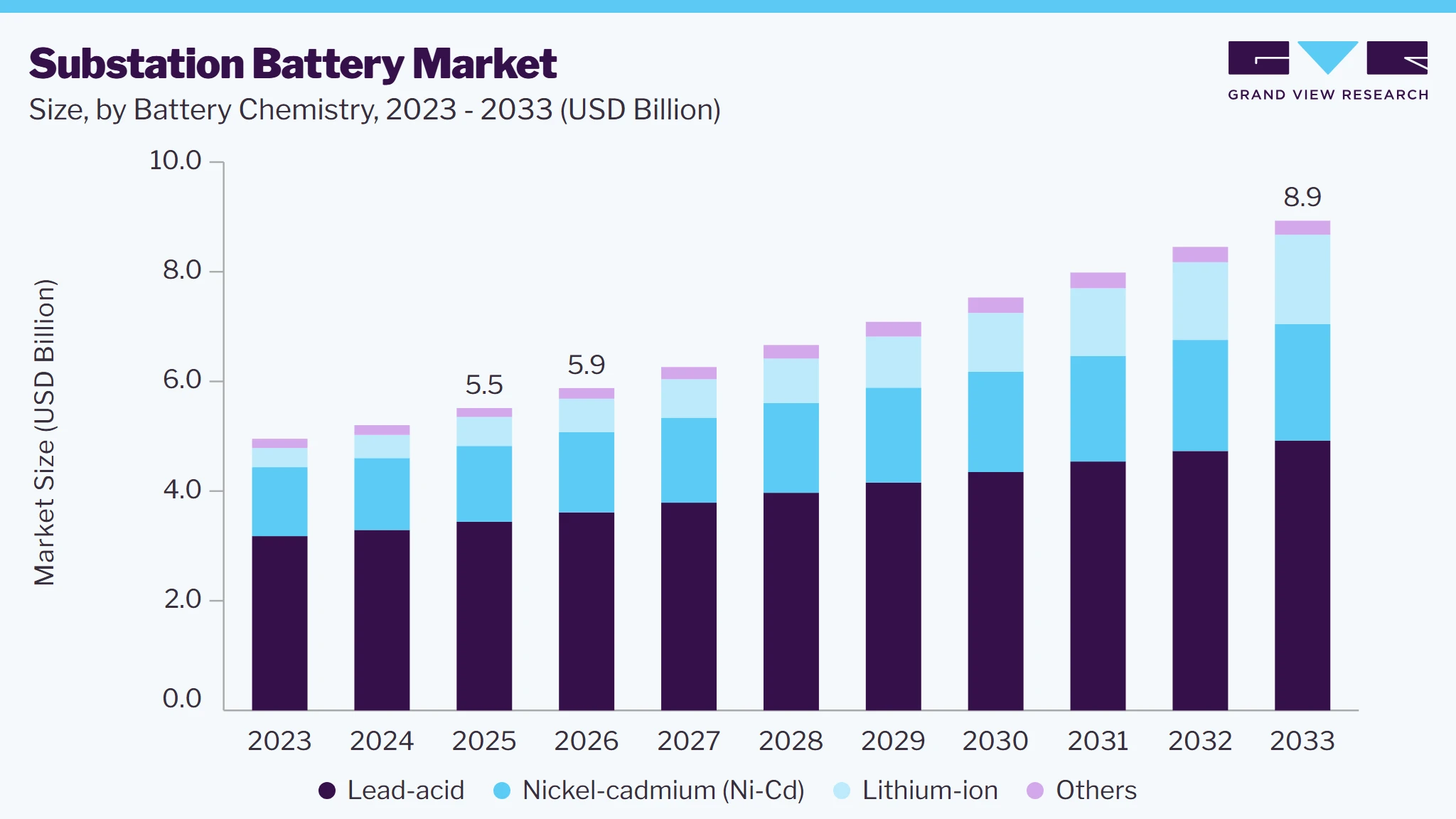 To learn more about this report, Download Free Sample Report
The growing deployment of digital substations, expansion of transmission and distribution infrastructure, and replacement of aging battery systems are further supporting market growth.
Market Dynamics
The substation battery market is driven by increasing investments in power grid modernization, rising electricity demand, renewable energy integration, and the need for reliable backup power to support uninterrupted substation operations. The expansion of transmission and distribution networks, replacement of aging battery systems, and growing adoption of digital substations are further supporting market growth. However, high initial investment costs, battery maintenance requirements, limited service life, and concerns regarding battery disposal and recycling may constrain adoption. Technological advancements in lithium-ion batteries, improved battery monitoring systems, and the development of high-performance, low-maintenance battery solutions are creating new growth opportunities for market participants.
Aging power infrastructure in developed regions and the development of new substations in emerging economies are driving demand for substation batteries. These batteries provide reliable DC backup power for protection relays, circuit breakers, control panels, and communication systems, ensuring critical substation operations continue during power interruptions. Investments in transmission network expansion, digital substations, and grid reliability are further supporting market growth.
According to India’s Ministry of Power Annual Report 2025-26, POWERGRID added approximately 2,300 circuit kilometres of extra-high-voltage transmission lines, seven new substations, and 47,555 MVA of transformation capacity during 2025. This expansion highlights the growing requirement for supporting substation infrastructure, including battery backup systems for protection, control, and operational continuity.
The high upfront cost of substation battery systems, particularly advanced lithium-ion solutions, can constrain adoption among utilities and grid operators with limited capital budgets. In addition to battery procurement, expenses associated with chargers, battery monitoring systems, installation, and integration with existing substation infrastructure increase overall project costs. These financial barriers can encourage cost-sensitive buyers, particularly in developing economies, to continue using conventional lead-acid batteries or defer battery replacement, thereby limiting the adoption of advanced battery technologies.
The shift toward data-driven power infrastructure is creating opportunities for specialized service providers to offer battery lifecycle management solutions for substations. Businesses can differentiate themselves through cloud-based analytics, automated diagnostic tools, battery performance benchmarking, and lifecycle cost optimization services. These solutions help utilities determine optimal replacement schedules, identify underperforming battery units, and reduce total ownership costs across geographically dispersed substations. Developing vendor-neutral platforms that support multiple battery chemistries and legacy monitoring infrastructure can further expand market reach, particularly among utilities managing large, aging asset portfolios.
Analyst Perspective
The substation battery market is expected to benefit from sustained investments in grid reliability, transmission infrastructure, and digital substation deployment. While lead-acid batteries are likely to remain relevant in cost-sensitive applications due to their established supply chains and lower upfront costs, lithium-ion batteries are positioned to gain traction where space constraints, reduced maintenance, and higher energy density are priorities. Market participants that combine battery manufacturing with monitoring software, lifecycle services, and application-specific solutions are likely to strengthen their competitive positioning. Over the long term, battery selection will depend on total cost of ownership, operational requirements, safety standards, and utility procurement priorities rather than battery chemistry alone.
Battery Chemistry Insights
The lead-acid segment held the largest revenue share of 62.4% in 2025. Its leading position reflects the technology’s established use in substations due to its cost-effectiveness, reliable backup power capabilities, and proven performance in critical power applications. Lead-acid batteries are widely used to supply emergency power to protection relays, circuit breakers, control systems, and communication equipment during power outages. Their well-established manufacturing base, broad availability, and relatively simple maintenance requirements further support adoption across utility substations.
The lithium-ion segment is anticipated to grow at the fastest CAGR of 15.0% from 2026 to 2033. This growth is driven by the increasing demand for compact, high-performance energy storage solutions in substations. Lithium-ion batteries offer higher energy density, longer service life, faster charging capabilities, and lower maintenance requirements compared with conventional lead-acid batteries. Their lightweight design and reduced space requirements make them suitable for modern substations with limited installation space. Additionally, ongoing grid modernization and the growing need for reliable backup power are expected to support the adoption of lithium-ion batteries.
Application Insights
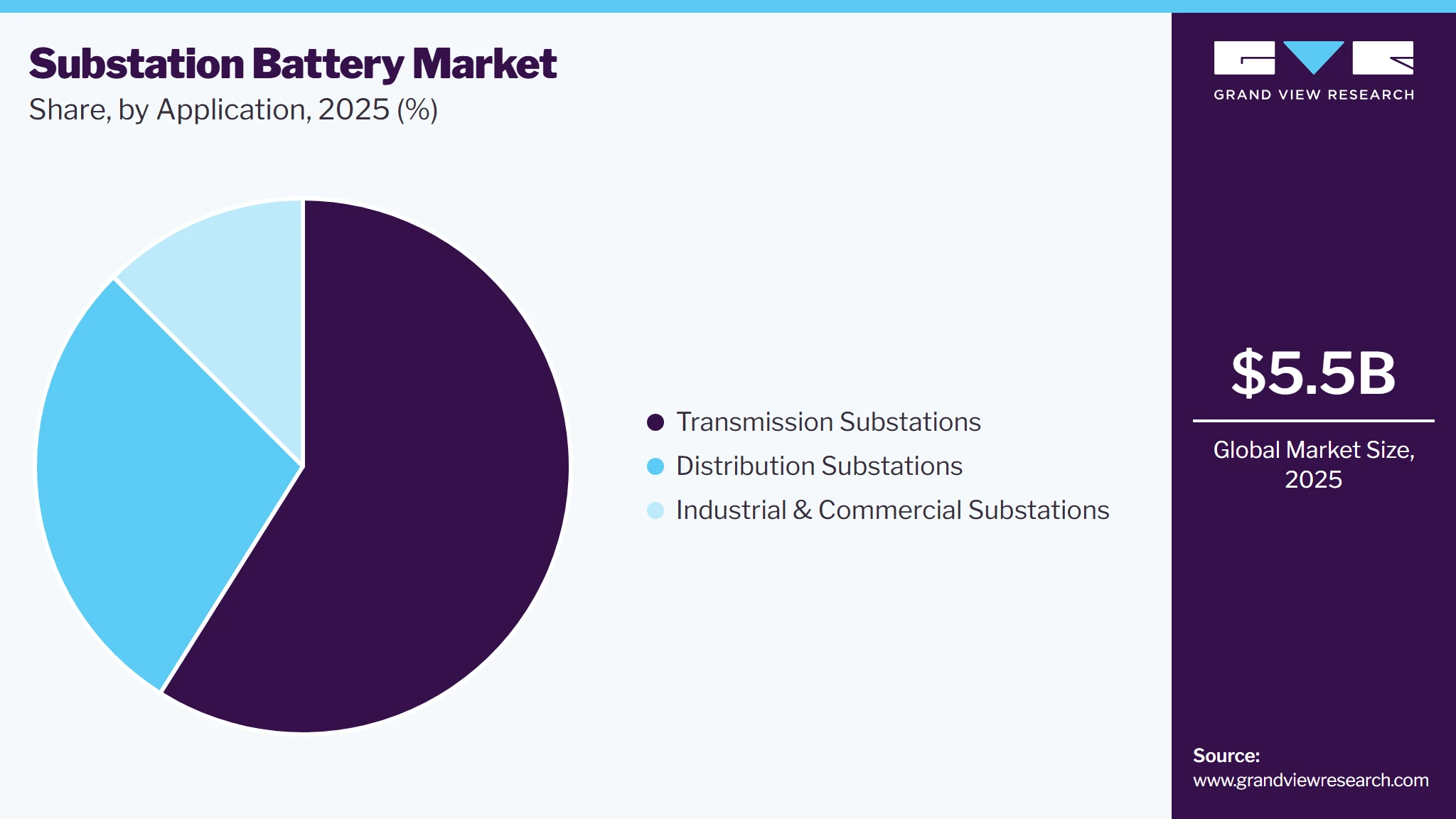
Transmission substations dominated the global market with a revenue share of 58.9% in 2025. This is due to their critical role in transmitting electricity over long distances and maintaining grid stability across interconnected power networks. These substations require reliable battery systems to provide backup power for protection relays, circuit breakers, monitoring equipment, and control systems during outages. Increasing investments in high-voltage transmission infrastructure, grid expansion, and renewable energy integration further drive demand for substation batteries.
 To learn more about this report, Download Free Sample Report
Industrial and commercial substations are expected to grow at the fastest CAGR of 7.1% during the forecast period. This growth is supported by increasing electricity demand from manufacturing facilities, commercial buildings, data centers, and other energy-intensive operations. The expansion of industrial infrastructure and growing investments in electrification are increasing the need for reliable power distribution and backup systems. Substation batteries provide essential backup power for protection, monitoring, and control equipment, ensuring operational continuity during power interruptions.
Regional Insights
Asia Pacific Substation Battery Market
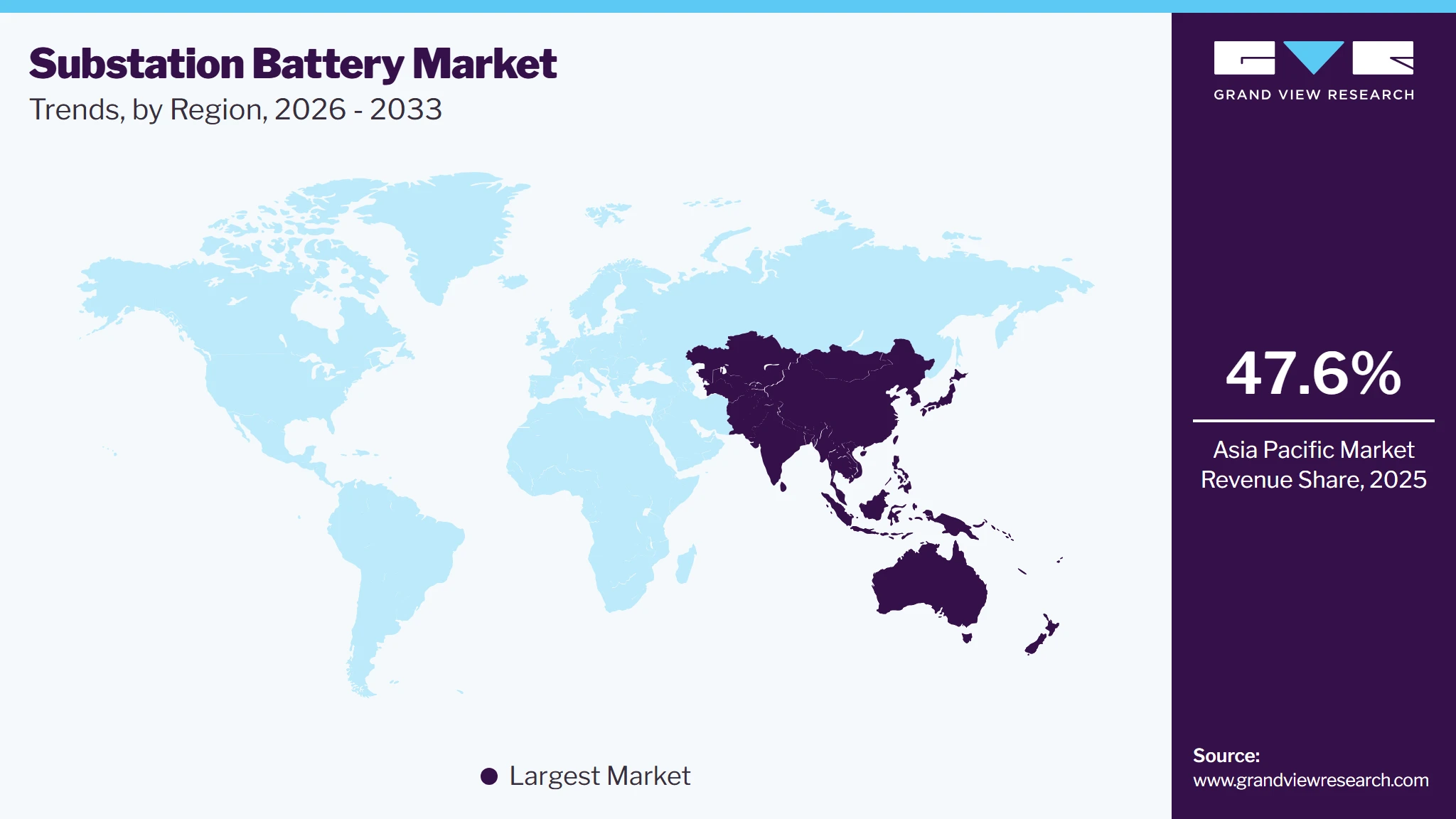
The Asia Pacific substation battery market dominated the global market with a revenue share of 47.6% in 2025. This is supported by rapid urbanization, industrialization, rising electricity demand, renewable energy integration, and large-scale investments in transmission and distribution infrastructure. China, India, Japan, South Korea, and Southeast Asian economies are creating opportunities for battery suppliers through grid expansion, substation digitalization, and modernization of existing power networks. In May 2026, the Asian Development Bank announced plans to mobilize USD 50 billion by 2035 through its Pan-Asia Power Grid Initiative to strengthen cross-border electricity connectivity. These investments are expected to increase demand for reliable substation backup power systems and associated battery management technologies.
 To learn more about this report, Download Free Sample Report
China Substation Battery Market
China represents a significant substation battery market, supported by extensive investments in power transmission infrastructure, grid modernization, and renewable energy integration. The country’s expanding ultra-high-voltage transmission networks and growing solar and wind power capacity are increasing the need for reliable backup power systems across substations. Lead-acid batteries remain widely used due to their established deployment, while lithium-ion technology is gaining attention for its higher energy density and longer service life. Ongoing efforts to strengthen grid reliability and accommodate rising electricity demand are expected to support market growth.
Middle East & Africa Substation Battery Market
The Middle East and Africa substation battery market is expected to grow at the second-fastest CAGR of 6.4% from 2026 to 2033. This is driven by electricity network expansion, growing power demand, renewable energy projects, and the need to improve supply reliability in developing power systems. Investments in solar and wind infrastructure are increasing the importance of dependable backup power for substation protection, control, and communication equipment. In June 2026, Egypt and the European Union announced a financing package of up to approximately USD 800 million to modernize and expand Egypt's electricity network, including infrastructure to integrate renewable energy and improve grid reliability. This investment is expected to create opportunities for substation battery manufacturers, system integrators, and maintenance service providers across the region.
North America Substation Battery Market
The North America substation battery market is driven by aging transmission infrastructure, rising electricity consumption, data center expansion, and investments in grid resilience. Utilities require reliable battery backup systems to maintain the operation of circuit breakers, protection relays, and substation control equipment during power interruptions. Growing electricity demand from data centers, manufacturing facilities, and other energy-intensive industries is increasing the need for transmission capacity and dependable power infrastructure. These developments are expected to support procurement of substation batteries, chargers, and monitoring systems across the U.S., Mexico, and Canada.
U.S. Substation Battery Market
The U.S. substation battery market is supported by ongoing investments in grid modernization, aging transmission infrastructure upgrades, and the integration of renewable energy sources. The growing deployment of solar and wind power, alongside rising electricity demand from data centers and industrial facilities, is increasing the need for reliable backup power systems. Lead-acid batteries maintain a strong presence in conventional substation applications, while lithium-ion batteries are gaining traction due to their longer service life, compact design, and reduced maintenance requirements. Federal grid resilience initiatives and investments in transmission infrastructure are expected to further support market growth.
Europe Substation Battery Market
The Europe substation battery market is supported by grid modernization initiatives, renewable energy integration, stringent reliability requirements, and the replacement of aging electrical infrastructure. The growing deployment of digital substations is creating demand for reliable battery systems that provide backup DC power for protection and control equipment. In June 2025, the European Commission estimated that Europe would require approximately USD 554 billion for electricity transmission grid development and USD 847 billion for distribution networks by 2040, based on approximate euro-to-dollar conversion. These planned investments are expected to support demand for substation batteries, battery monitoring systems, and associated power equipment.
Latin America Substation Battery Market
The Latin America substation battery market is driven by electricity transmission expansion, renewable energy development, and the need to improve grid reliability amid weather-related disruptions. Investments in new substations and network upgrades are creating demand for dependable backup power solutions, particularly in Brazil. Renewable energy projects and modernization of aging transmission infrastructure are expected to support demand for substation batteries used in protection, control, and communication systems. These developments are creating opportunities for battery manufacturers, system integrators, and maintenance service providers across the region.
Key Companies & Market Share Insights
Some of the key players operating in the global substation battery market include EnerSys and TotalEnergies, among others.
-
EnerSys participates in the substation battery market through the manufacture and supply of industrial battery systems designed for stationary power backup and critical infrastructure applications. Its portfolio includes valve-regulated lead-acid (VRLA), flooded lead-acid, and nickel-based battery technologies used to provide reliable DC power for substation protection, control, and communication systems. The company also offers battery chargers, power conversion equipment, and related energy storage solutions for utility and industrial customers. Its established manufacturing capabilities and broad industrial battery portfolio position EnerSys across battery supply, system integration, and lifecycle support for substation applications.
-
TotalEnergies, through its subsidiary Saft, participates in the substation battery market by supplying advanced battery systems for electricity transmission and distribution infrastructure. Saft's portfolio includes nickel-based and lithium-ion battery technologies designed for applications requiring reliable backup power, operational resilience, and long service life. Its solutions support substation protection and control systems, telecommunications, and other critical electrical infrastructure. The company's battery engineering expertise, global manufacturing presence, and capabilities in designing solutions for demanding operating environments position it to serve utility operators seeking reliable battery systems for grid modernization and infrastructure expansion.
Key Substation Battery Companies
The following key companies have been profiled for this study on the substation battery market.
-
Amara Raja Energy & Mobility Limited
-
Stryten Energy (C&D Technologies, Inc.)
-
East Penn Manufacturing Company
-
EnerSys
-
GS Yuasa International Ltd.
-
HOPPECKE Batterien GmbH & Co. KG
-
Leoch International Technology Limited
-
Narada
-
Panasonic Energy Co., Ltd.
-
TotalEnergies
Competitive Benchmarking
Category
Operating Strategies
Competitive Edge
Weakness
Established Players (Stryten Energy (C&D Technologies, Inc.), East Penn Manufacturing Company, EnerSys, GS Yuasa International Ltd., HOPPECKE Batterien GmbH & Co. KG, TotalEnergies)
- Leverage established manufacturing facilities, global distribution networks, and long-term relationships with utilities and substation equipment suppliers.
- Offer diversified battery chemistries, customized backup power solutions, and complementary charging and monitoring systems.
- Focus on product reliability, lifecycle services, and replacement demand from existing installations.
- - Strong brand recognition, proven performance records, and established relationships with utility customers.
- Extensive technical expertise, manufacturing capabilities, and compliance with stringent industry standards.
- Ability to provide integrated solutions, warranties, and after-sales support across multiple regions.
- Higher manufacturing and operational costs may limit price competitiveness against lower-cost suppliers.
- Legacy product portfolios and established production processes can make technology transitions more complex.
- Dependence on mature battery technologies in certain applications may expose them to competition from newer battery chemistries.
Emerging Players (Amara Raja Energy & Mobility Limited, Leoch International Technology Limited, Narada, Panasonic Energy Co., Ltd.)
- Compete through cost-effective battery solutions and expansion into high-growth regional markets.
- Invest in manufacturing capacity, lithium-ion technology, and application-specific products for utility backup systems.
- Build partnerships with local utilities, EPC contractors, and substation equipment integrators to expand market access.
- Competitive pricing and localized manufacturing can improve accessibility in price-sensitive markets.
- Flexibility in product development and the ability to adapt solutions to regional requirements.
- Opportunities to expand through growing electricity infrastructure investments and demand for advanced battery technologies.
- Comparatively limited brand recognition and established utility relationships in some international markets.
- Smaller global service networks may constrain after-sales support and maintenance coverage.
- Potential challenges in meeting local certification requirements, securing large utility contracts, and competing with established suppliers on proven long-term reliability.
Recent Developments
- In October 2026, Stryten Energy completed its acquisition of C&D Technologies and Trojan Battery Company, expanding its battery manufacturing scale and global reach across the United States, Mexico, and China. The combined company operates 18 battery manufacturing and component facilities and retains the C&D Technologies and Trojan Battery brands. The acquisition strengthens Stryten Energy’s portfolio of lead-acid, lithium, and vanadium redox flow battery technologies, including stationary batteries used in utility and critical infrastructure applications. This development is expected to enhance its manufacturing capabilities and position it to serve growing demand for reliable backup power systems.
Substation Battery Report Scope
Report Attribute
Details
Market Definition
The global substation battery market includes revenue from stationary battery cells and battery banks installed and operating at electrical substations to provide DC power for protection, switching, control, monitoring, and communication systems, excluding grid-scale battery energy storage systems (BESS).
Market size value in 2025
USD 5.5 billion
Market size value in 2026
USD 5.9 billion
Revenue forecast in 2033
USD 8.9 billion
Growth Rate
CAGR of 6.2% from 2026 to 2033
Base year for estimation
2025
Historical data
2021 - 2024
Forecast period
2026 - 2033
Quantitative Units
Revenue in USD Million and CAGR from 2026 to 2033
Report coverage
Revenue forecast, competitive landscape, growth factors, and trends
Segments covered
Battery chemistry, application, and region
Regional scope
North America, Europe, Asia Pacific, Latin America, Middle East & Africa
Country scope
U.S., Canada, Mexico, Germany, UK, France, Italy, China, India, Japan, Australia, Brazil, Saudi Arabia, UAE, South Africa
Key companies profiled
Amara Raja Energy & Mobility Limited, Stryten Energy (C&D Technologies, Inc.), East Penn Manufacturing Company, EnerSys, GS Yuasa International Ltd., HOPPECKE Batterien GmbH & Co. KG, Leoch International Technology Limited, Narada, Panasonic Energy Co., Ltd., TotalEnergies
Customization scope
Free report customization (equivalent up to 8 analysts working days) with purchase. Addition or alteration to country, regional & segment scope.
Pricing and purchase options
Avail customized purchase options to meet your exact research needs. Explore purchase options
Global Substation Battery Market Report Segmentation
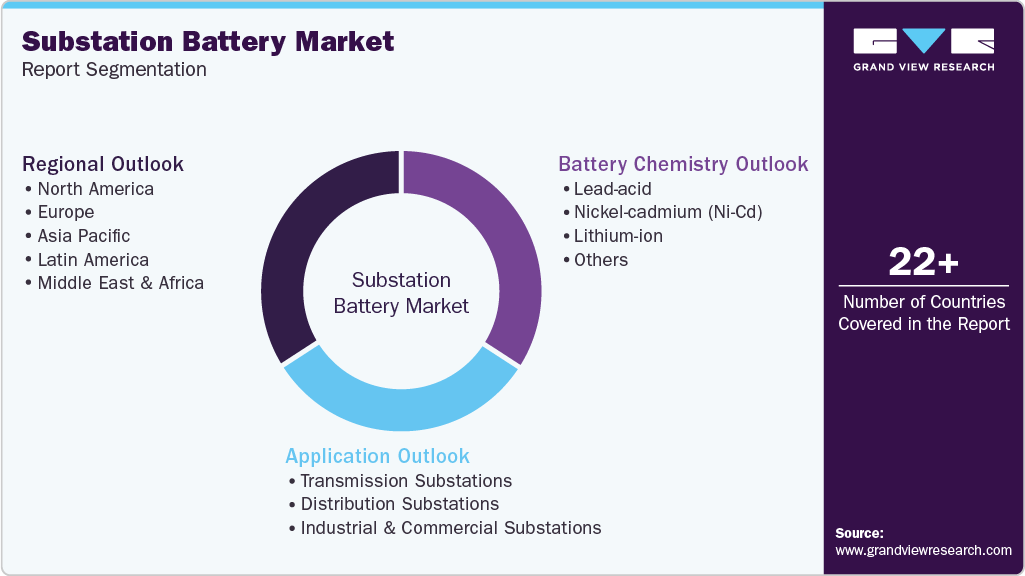
This report forecasts revenue growth at global, regional, and country levels and provides an analysis of the latest industry trends in each of the sub-segments from 2021 to 2033. For the purpose of this study, Grand View Research has segmented the global substation battery market report on the basis of battery chemistry, application, and region.
 To learn more about this report, Download Free Sample Report
-
Battery Chemistry Outlook (Revenue, USD Million; 2021 - 2033)
-
Lead-acid
-
Nickel-cadmium (Ni-Cd)
-
Lithium-ion
-
Others
-
-
Application Outlook (Revenue, USD Million; 2021 - 2033)
-
Transmission substations
-
Distribution substations
-
Industrial & commercial substations
-
-
Regional Outlook (Revenue, USD Million; 2021 - 2033)
-
North America
-
U.S.
-
Canada
-
Mexico
-
-
Europe
-
UK
-
Italy
-
France
-
Germany
-
-
Asia Pacific
-
China
-
India
-
Japan
-
Australia
-
-
Latin America
-
Brazil
-
-
Middle East & Africa
-
Saudi Arabia
-
UAE
-
South Africa
-
-
Research Methodology
The substation battery market figures in this report are based on a proven research process that combines executive interviews with secondary research from proprietary databases, company filings, and recognized regulatory and institutional sources. Market size is built through value-chain sizing - reconciling supply-side and demand-side estimates - and triangulated with bottom-up and top-down approaches. Every estimate passes multiple levels of expert validation before publication, with each substation battery segment quantified using the revenue-capture definitions in the table below.
Segment Definition
Segment - Battery Chemistry
Revenue capture definition
Lead-acid
Revenue generated from the sale of lead-acid batteries used in substations to provide backup DC power for protection relays, circuit breakers, control systems, and communication equipment.
Nickel-cadmium (Ni-Cd)
Revenue generated from the sale of nickel-cadmium batteries for substation backup power applications, including installations requiring high reliability, long service life, and operation under demanding environmental conditions.
Lithium-ion
Revenue generated from the sale of lithium-ion batteries for substation backup power, including applications requiring high energy density, compact installation, and reduced maintenance requirements.
Others
Revenue generated from the sale of other battery chemistries used in substations, including nickel-metal hydride and other applicable technologies, excluding lead-acid, nickel-cadmium, and lithium-ion batteries.
Segment - Application
Revenue capture definition
Transmission substations
Revenue generated from the sale of batteries used in high-voltage transmission substations to provide backup DC power for protection, switching, control, and monitoring systems.
Distribution substations
Revenue generated from the sale of batteries used in distribution substations to support protection relays, circuit breakers, automation systems, and other critical control equipment.
Industrial & commercial substations
Revenue generated from the sale of batteries used in industrial and commercial substations to provide backup power for electrical protection, control, communication, and operational systems.
Estimation Model
Layer Name
Key Question
Description
Demand Layer
Which factors generate demand for substation batteries?
Assess demand arising from grid expansion and modernization, increasing electricity consumption, renewable energy integration, replacement of aging battery systems, digital substation deployment, and the need for reliable backup DC power for protection, control, and communication equipment.
Technology Layer
Which battery chemistries generate market revenue?
Evaluate revenue across lead-acid, nickel-cadmium (Ni-Cd), lithium-ion, and other battery chemistries based on performance, service life, energy density, maintenance requirements, operating conditions, safety considerations, and total cost of ownership.
Application Layer
Which substation applications generate market revenue?
Quantify revenue across transmission substations, distribution substations, and industrial and commercial substations based on battery deployment requirements, voltage infrastructure, backup power needs, substation configuration, and the scale of electrical infrastructure investments.
Revenue Layer
How is substation battery market revenue generated?
Market revenue is quantified through the sale of batteries specifically designed or deployed for substation backup power applications. Revenue varies by battery chemistry, capacity, application, system configuration, and geographic market, with the analysis focused on battery equipment sales rather than electricity generation, utility-scale energy storage revenues, or unrelated substation equipment.
Delivered Customizations
We have successfully delivered the following deep-dive customizations:
Client Request
Customization Delivered
Value Adds
Technology Opportunity Assessment
Market analysis was conducted across lead-acid, nickel-cadmium (Ni-Cd), and lithium-ion battery technologies by evaluating cost, energy density, service life, maintenance requirements, reliability, safety, and suitability for substation backup power applications.
Identified high-potential battery technologies based on performance, lifecycle costs, scalability, maintenance requirements, and adoption trends across substation applications.
Application Opportunity Assessment
Market analysis was performed across transmission substations, distribution substations, and industrial & commercial substations by assessing backup power requirements, grid reliability needs, infrastructure investments, electricity demand, and battery deployment potential.
Identified high-growth substation applications based on grid modernization, transmission network expansion, industrial electrification, renewable energy integration, and demand for reliable backup power systems.
Regional Opportunity Assessment
Country-level analysis was conducted to assess substation battery adoption based on grid modernization initiatives, transmission infrastructure investments, renewable energy deployment, electricity demand, government policies, and battery technology adoption across key markets.
Identified countries with strong market growth potential based on power grid expansion, renewable energy integration, infrastructure upgrades, and increasing demand for reliable and resilient electricity networks.
About the Author(s)
Power Generation & Storage Research Team
Energy & Power · Power Generation & StorageThis report was authored by the power generation & storage research team at Grand View Research - comprising two research analysts, one senior research analyst, and one industry expert - with specialized expertise in the power generation & storage segment of the energy & power industry. All findings are based on proprietary energy & power databases, executive interviews, and regulatory analysis, subject to internal peer review prior to publication.
Last Updated:
Speak to Analyst

Customize this report to your needs - add regions, segments, or data points, with 20% free customization.
Or view our licence options:


ISO 9001:2015 & 27001:2022 Certified
We are GDPR and CCPA compliant! Your transaction & personal information is safe and secure. For more details, please read our privacy policy.


