
- Home
- »
- Distribution & Utilities
- »
-
Superconducting Power Cables Market Size Report, 2033GVR Report cover
![Superconducting Power Cables Market (2026 - 2033)Report]()
Superconducting Power Cables Market (2026 - 2033)
Size, Share & Trends Analysis Report By Type (LTS, HTS, MTS), By End-user (Energy, Healthcare, Transportation, Research), By Region (North America, Europe, Asia Pacific), And Segment Forecasts
Market Size, 2025
$2.9BMarket Estimate, 2026
$3.0BMarket Forecast, 2033
$5.5BCAGR, 2026–2033
8.8%Superconducting Power Cables Market Summary
The global superconducting power cables market size was valued at USD 2.9 billion in 2025 and is projected to grow from USD 3.0 billion in 2026 to USD 5.5 billion by 2033, at a CAGR of 8.8% from 2026 to 2033. Asia Pacific dominated the market, accounting for the largest market share of 40.2% in 2025. The market is driven by rising electricity demand, increasing renewable energy integration, grid modernization, and the need for high capacity, low loss power transmission.

Key Market Trends & Insights
- By type: The HTS (High-temperature superconductors) segment held the largest revenue share of 75.1% in 2025.
- By end-user: The energy segment held the largest revenue share of 45.9% in 2025.
Regional Highlights
- Largest regional market: Asia Pacific (40.2% revenue share, 2025)
- Fastest-growing regional market: Latin America (highest CAGR, 2026-2033)
- By country: China held the largest market share in 2025.
Market Size & Forecast
- Market size in 2025: USD 2.9 Billion
- Estimated market size in 2026: USD 3.0 Billion
- Projected market size by 2033: USD 5.5 Billion
- CAGR (2026-2033): 8.8%

Growing grid congestion and limited transmission corridors are further increasing demand for superconducting cables, which can transmit higher power through constrained spaces while reducing transmission losses.Market Dynamics
The superconducting power cables market is being driven by rising electricity demand, renewable energy integration, grid congestion, and the need to transmit higher power through limited transmission corridors. Increasing investments in grid modernization and urban power infrastructure are supporting the adoption of superconducting cables due to their high power density, low transmission losses, and compact footprint. High manufacturing and installation costs, complex cryogenic cooling requirements, and limited deployment experience remain key restraints. However, growing investments in offshore renewable projects, underground transmission networks, and advanced grid infrastructure are creating opportunities for superconducting cables as utilities seek efficient, reliable, and space-saving solutions for high-capacity power transmission.
Rising electricity demand in densely populated cities is increasing the need for high-capacity transmission without requiring additional underground corridors. HTS cables can transmit three to five times more power than conventional cables at the same cross-section, enabling utilities to increase capacity within existing infrastructure. This is particularly valuable where expanding rights-of-way or constructing new tunnels is costly or impractical.
For instance, in 2025, Sumitomo Electric highlighted HTS cables as a compact transmission solution, noting that its 66 kV/5 kA-class HTS cable system was designed for installation in existing 150-mm-diameter underground conduits. Testing showed AC losses below one-third of those of a conventional cable after accounting for cooling-system efficiency, demonstrating the potential to increase transmission capacity while reducing losses and utilizing existing underground infrastructure.
High upfront costs remain a major restraint for the superconducting power cables market, as HTS conductors are still considerably more expensive than conventional copper cables. The need for specialized cryogenic cooling systems further increases capital and operating costs, making project economics challenging for utilities. The IEA HTS TCP reported that HTS cables can remain 5-10 times more expensive than conventional DC cables, limiting adoption primarily to applications where their high power density provides a clear economic advantage.
The expansion of offshore wind farms is creating an emerging opportunity for superconducting power cables, particularly for long-distance transmission to coastal grids. HTS cables can provide high power transfer capacity with a compact footprint and near-zero resistive losses, while potentially reducing the need for large offshore converter stations. This is expected to improve the economics of renewable power transmission from remote offshore generation sites. For instance, in November 2025, the SupraMarine consortium secured USD 7.9 million grant to develop an HVAC superconducting power transmission demonstrator for connecting offshore wind farms to the coast. Testing is planned for 2028, highlighting the growing potential of HTS cables for efficient offshore renewable energy transmission.
Analyst Perspective
The superconducting power cables market is transitioning from a niche, demonstration-driven technology toward targeted commercial deployment, with the strongest near-term potential in space constrained urban grids, high-load transmission corridors, and offshore renewable integration. Although high capital costs and cryogenic system complexity continue to limit broad adoption, the technology’s ability to deliver 3-10 times higher power capacity within the same corridor can justify its economics in locations where conventional grid expansion is difficult or costly. As utilities increasingly prioritize grid capacity expansion and renewable power evacuation, declining technology risks and growing project experience are expected to improve the commercial viability of HTS systems, shifting competition toward system level cost optimization, cooling efficiency, and reliable long distance operation.
Type Insights
The HTS (High-temperature superconductors) segment held the largest revenue share of 75.1% in 2025, driven by their high current-carrying capacity, low transmission losses, and compact size compared with conventional copper and aluminum cables. HTS cables transmit significantly more power within the same footprint, making them suitable for high-demand urban grids, renewable energy integration, and capacity expansion where space for new transmission infrastructure is limited. Their ability to operate using liquid nitrogen also makes cooling more practical than for low-temperature superconductors. Growing investments in efficient and reliable power transmission infrastructure are further supporting the adoption of HTS technology.
The MTS (Medium-temperature superconductors) segment is expected to register the second fastest CAGR of 8.6% during the forecast period, driven by the growing adoption of magnesium diboride (MgB₂) in superconducting power cables. MTS materials offer lower operating and manufacturing costs than many HTS alternatives while providing high current-carrying capacity at moderate cryogenic temperatures. Their suitability for compact, high-power transmission systems, along with simpler wire manufacturing and reduced cooling requirements, is supporting their use in power transmission applications.
End-user Insights
The energy segment held the largest revenue share of 45.9% in 2025, supported by the growing need for high-capacity, and low-loss power transmission amid renewable energy integration, grid modernization, and rising electricity demand. Superconducting power cables can transmit large amounts of electricity through compact infrastructure with significantly lower transmission losses, making them suitable for urban grids and renewable power evacuation. Increasing investments in transmission networks and the need to connect remote renewable generation sites with major demand centers are further supporting the adoption of superconducting cables in the energy sector.
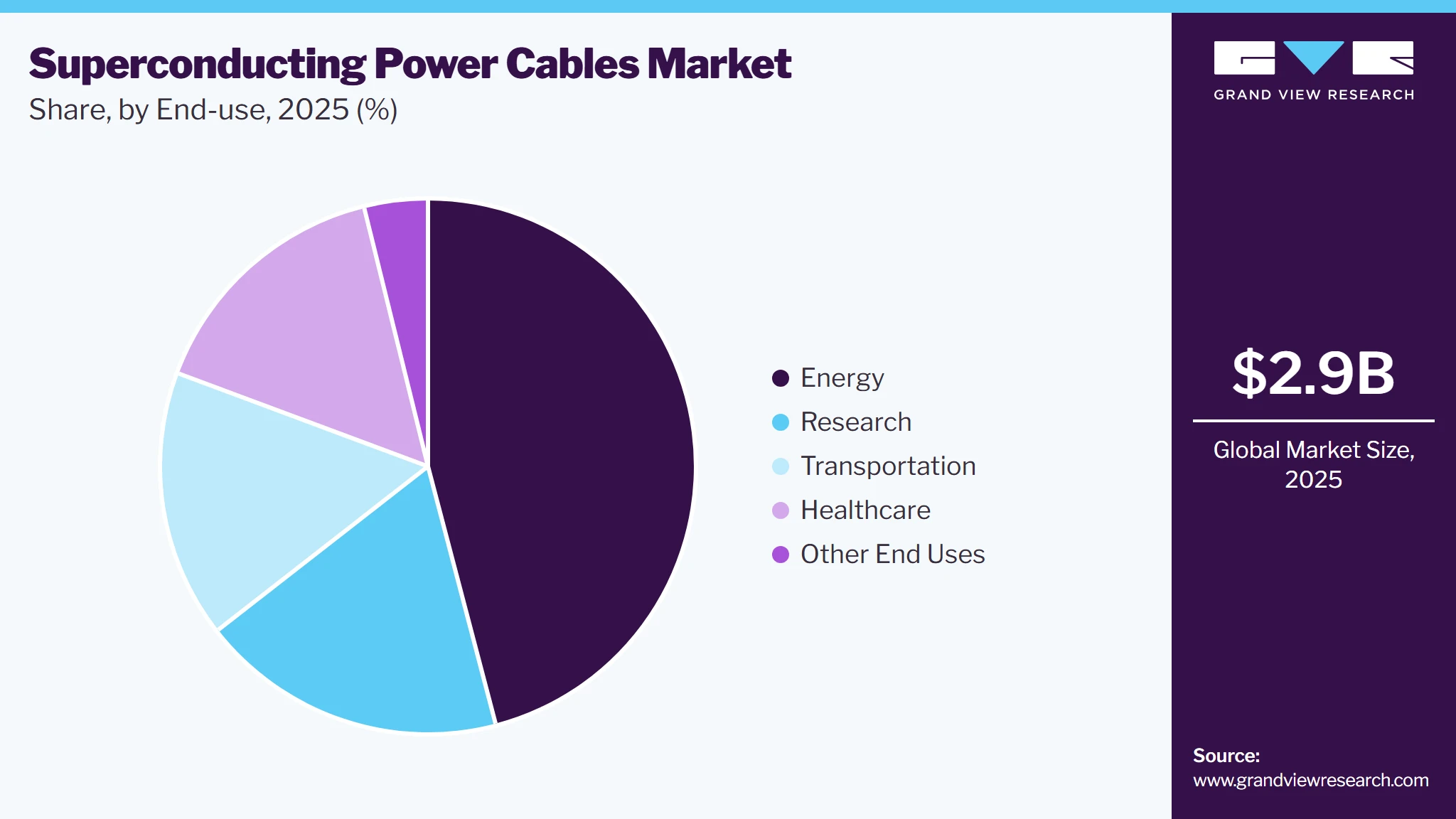
The research segment is anticipated to register the fastest CAGR of 9.3% over the forecast period, driven by increasing R&D activities focused on improving superconducting materials, cable designs, cooling systems, and transmission efficiency. Growing efforts to develop longer and more reliable superconducting cables are supporting research investments, particularly as grid expansion and renewable energy integration increase the need for high-capacity transmission solutions. Ongoing prototype development, field testing, and advances in HTS tapes are also helping improve the commercial readiness of superconducting power cable technology.
Regional Insights
Asia Pacific superconducting power cables market dominated the global market with a revenue share of 40.2% in 2025, supported by rapid urbanization, increasing electricity consumption, grid modernization, and investments in advanced power infrastructure. China, Japan, and South Korea have developed capabilities across superconducting wire and cable technologies, creating a strong regional ecosystem for commercialization. The region's dense urban networks are particularly suitable for superconducting cables because they can provide high transmission capacity while requiring limited underground space.

China Superconducting Power Cables Market Trends
China is at the forefront of superconducting cable deployment, supported by rapid urban electricity demand, grid modernization, and investments by major power utilities. The Shanghai Xuhui HTS cable project demonstrates the country's growing deployment capability, with the system supplying electricity to approximately 49,000 users and transmitting around 180 million kWh of electricity annually. Continued investment in large scale HTS projects is expected to strengthen China's position in the global superconducting power cables market.
Europe Superconducting Power Cables Market Trends
Superconducting power cables market in Europe is emerging as a key market for superconducting power cables, supported by renewable energy integration, grid modernization, and the need to transmit large amounts of electricity through space constrained corridors. The region is also advancing superconducting solutions for offshore wind, with projects such as SupraMarine focusing on HTS cable systems for efficient transmission from offshore wind farms to shore. Growing investments in renewable power infrastructure and efforts to strengthen transmission networks are expected to create opportunities for the deployment of superconducting cables.
North America Superconducting Power Cables Market Trends
North America is expected to witness increasing adoption of superconducting power cables as utilities address grid congestion, rising electricity demand, and constraints on new transmission corridors. The technology is particularly relevant for densely populated areas where expanding underground infrastructure is difficult and expensive. Increasing electricity consumption from data centers, industrial facilities, and electrification is also creating demand for high capacity transmission solutions, supporting the long term growth potential of superconducting cables.
The U.S. represents a significant opportunity for superconducting power cables due to aging grid infrastructure, rising electricity demand, and limited transmission rights of way in major urban and industrial centers. HTS cables can provide higher power capacity within existing underground corridors, allowing utilities to expand transmission capacity without extensive new construction. Growing electricity requirements from data centers, manufacturing facilities, renewable generation, and electrification are expected to further support demand for advanced transmission technologies.
Latin America Superconducting Power Cables Market Trends
Latin America is anticipated to register the fastest CAGR of 10.4% from 2026 to 2033. The region remains an emerging market for superconducting power cables, with adoption expected to initially focus on high value applications rather than conventional transmission projects. Rising electricity demand, renewable energy development, and the need to connect remote generation resources with major population centers could create opportunities for compact, high capacity superconducting systems. However, high upfront costs, limited local manufacturing capabilities, and relatively low deployment experience are likely to restrict near term adoption.
Middle East & Africa Superconducting Power Cables Market Trends
The Middle East and Africa market offers emerging opportunities as countries invest in grid expansion, renewable power, and large urban infrastructure projects. Rapid development of solar power and increasing electricity demand could create applications for superconducting cables where transmission capacity and energy efficiency are important. However, high capital requirements, limited local expertise, and relatively low technology adoption are expected to keep deployment selective, particularly in major renewable energy and high density urban projects.
Key Superconducting Power Cables Company Insights
Some of the key players operating in the global superconducting power cables market include GE Vernova and Siemens, among others.
-
GE Vernova is a major technology provider in the superconducting power cables market, offering superconducting power cables, substation automation, protection and control, SCADA, and advanced grid management solutions that enable utilities to monitor, control, and optimize power networks in real time. Through its Superconducting Power Cables portfolio and GridOS platform, the company supports automated fault detection, grid stability, renewable energy integration, and distributed energy resource management. Its capabilities across grid digitalization, automation, and power system management, combined with a broad global presence, position GE Vernova as a key participant in the superconducting power cables market.
-
Siemens is a prominent technology provider in the superconducting power cables market, offering substation automation, protection and control, SCADA, energy management, and digital grid solutions for transmission and distribution networks. Its portfolio enables utilities to improve real-time monitoring, automate grid operations, detect and manage faults, and integrate renewable energy and distributed energy resources. Siemens’ strong expertise in electrification, automation, and digitalization, supported by its global customer base and comprehensive grid technology portfolio, positions the company as a leading participant in the superconducting power cables market.
Key Superconducting Power Cables Companies:
The following key companies have been profiled for this study on the superconducting power cables market.
-
American Superconductor Corporation
-
Furukawa Electric Co., Ltd.
-
LS Cable & System Ltd.
-
Nexans
-
NKT A/S
-
Shanghai Superconductor Technology Co., Ltd.
-
Southwire Company, LLC.
-
Sumitomo Electric Industries, Ltd.
-
SuperNode
-
THEVA Dünnschichttechnik GmbH
Competitive Benchmarking
Category
Operating Strategies
Competitive Edge
Weakness
Established Players (American Superconductor Corporation, Furukawa Electric Co., Ltd., LS Cable & System Ltd., Nexans, NKT A/S)
- Leverage established global operations, utility relationships, and extensive power transmission portfolios to deliver integrated superconducting cable solutions.
- Invest in HTS materials, cryogenic systems, cable design, and testing capabilities to improve transmission capacity and system efficiency.
- Pursue strategic partnerships, demonstration projects, and large utility contracts to accelerate commercialization and expand project pipelines.
- Strong brand recognition and long standing relationships with utilities and transmission operators.
- Extensive experience in high voltage cable manufacturing, grid engineering, testing, and project execution.
- Greater financial resources to support demonstration projects, R&D, and large scale infrastructure investments.
- High organizational and operating costs can make early stage superconducting projects expensive to commercialize.
- Existing manufacturing infrastructure is largely optimized for conventional cables and may require additional investment for superconducting systems.
- Large corporate structures can result in slower decision making and longer commercialization cycles.
Emerging Players (Shanghai Superconductor Technology Co., Ltd., SuperNode, THEVA Dünnschichttechnik GmbH)
- Focus on specialized HTS conductors, superconducting cable architectures, cryogenic systems, and other high value technology niches.
- Develop demonstration projects with utilities, research institutions, and technology partners to validate performance and build commercial references.
- Target applications where the high power density of superconducting cables provides a clear advantage, including congested urban grids and offshore renewable transmission.
- Greater technological specialization and ability to focus resources on superconducting technologies.
- More agile organizational structures enable faster product development and adaptation to emerging grid requirements.
- Ability to develop differentiated HTS materials, cable designs, and cooling technologies that can improve system efficiency.
- Limited commercial deployment history and fewer large scale utility references compared with established cable manufacturers.
- Smaller financial resources can constrain large demonstration projects, manufacturing expansion, and international market development.
- Dependence on strategic partners for cable integration, grid deployment, manufacturing, or access to utility customers.
Recent Developments
-
In July 2025, LS Cable & System Ltd., LS Electric, and Korea Electric Power Corporation (KEPCO) signed a memorandum of understanding to develop the world’s first superconducting power grid for data centers. Under the agreement, LS Cable & System will design and manufacture superconducting cables, LS Electric will provide superconducting current limiters and power equipment, and KEPCO will conduct technology verification and system development. The superconducting system is designed to enable 154 kV-class large capacity power transmission at 23 kV, allowing utilities to expand power supply without constructing new substations while improving energy efficiency and reducing installation space requirements for rapidly growing AI and data center applications.
Superconducting Power Cables Market Report Scope
Report Attribute
Details
Market Definition
The market revenue represents sales generated from superconducting power cables used for electricity transmission applications.
Market size value in 2025
USD 2.9 billion
Market size value in 2026
USD 3.0 billion
Revenue forecast in 2033
USD 5.5 billion
Growth rate
CAGR of 8.8% from 2026 to 2033
Base year for estimation
2025
Historical data
2021 - 2024
Forecast period
2026 - 2033
Quantitative units
Revenue in USD billion and CAGR from 2026 to 2033
Report coverage
Revenue forecast, competitive landscape, growth factors, and trends
Segments covered
Type, end-user, region
Regional scope
North America; Europe; Asia Pacific; Latin America; Middle East & Africa
Country scope
U.S.; Canada; Mexico; Germany; UK; France; Italy; Spain; China; India; Japan; South Korea; Australia; Brazil; Argentina; UAE; Saudi Arabia; South Africa
Key companies profiled
American Superconductor Corporation; Furukawa Electric Co., Ltd.; LS Cable & System Ltd.; Nexans; NKT A/S; Shanghai Superconductor Technology Co., Ltd.; Southwire Company, LLC.; Sumitomo Electric Industries Ltd.; SuperNode; THEVA Dünnschichttechnik GmbH
Customization scope
Free report customization (equivalent up to 8 analysts working days) with purchase. Addition or alteration to country, regional & segment scope.
Pricing and purchase options
Avail customized purchase options to meet your exact research needs. Explore purchase options
Global Superconducting Power Cables Market Report Segmentation
This report forecasts revenue growth at global, regional, and country levels and provides an analysis of the latest industry trends in each of the sub-segments from 2021 to 2033. For this study, Grand View Research has segmented the global superconducting power cables market report based on type, end-user, and region:

-
Type Outlook (Revenue, USD Billion, 2021 - 2033)
-
LTS (Low-temperature superconductors)
-
HTS (High-temperature superconductors)
-
MTS (Medium-temperature superconductors)
-
-
End-user Outlook (Revenue, USD Billion, 2021 - 2033)
-
Energy
-
Healthcare
-
Transportation
-
Research
-
Other End-user
-
-
Regional Outlook (Revenue, USD Billion, 2021 - 2033)
-
North America
-
U.S.
-
Canada
-
Mexico
-
-
Europe
-
Germany
-
UK
-
France
-
Italy
-
Spain
-
-
Asia Pacific
-
China
-
India
-
Japan
-
South Korea
-
Australia
-
-
Latin America
-
Brazil
-
Argentina
-
-
Middle East & Africa
-
Saudi Arabia
-
UAE
-
South Africa
-
-
Research Methodology
The superconducting power cables market figures in this report are based on a proven research process that combines executive interviews with secondary research from proprietary databases, company filings, and recognized regulatory and institutional sources. Market size is built through value-chain sizing-reconciling supply-side and demand-side estimates-and triangulated with bottom-up and top-down approaches. Every estimate passes multiple levels of expert validation before publication, with each superconducting power cables segment quantified using the revenue-capture definitions in the table below.
Segment Definition
Segment - Type
Revenue capture definition
LTS (Low-temperature superconductors)
Revenue from sales of power cables using low temperature superconducting materials.
HTS (High-temperature superconductors)
Revenue from sales of power cables using high temperature superconducting materials.
MTS (Medium-temperature superconductors)
Revenue from sales of power cables using medium temperature superconducting materials.
Segment - End-use
Revenue capture definition
Energy
Revenue from superconducting power cables sold for power generation, transmission, distribution, and grid applications.
Healthcare
Revenue from superconducting power cables sold for power supply and electrical infrastructure in healthcare facilities.
Transportation
Revenue from superconducting power cables sold for railway, electric mobility, marine, and other transportation infrastructure.
Research
Revenue from superconducting power cables sold to research institutions and experimental facilities.
Other End Uses
Revenue from superconducting power cables sold for industrial, commercial, data center, and other applications not classified above.
Estimation Model
Layer Name
Key Question
Description
Demand Layer
Which factors generate demand for superconducting power cables?
Assess demand arising from rising electricity consumption, grid congestion, renewable energy integration, urbanization, and the need for high capacity transmission within space constrained corridors. Evaluate how increasing power loads and grid modernization requirements influence the adoption of superconducting cable systems.
Type Layer
Which superconducting technologies generate market revenue?
Evaluate revenue across LTS, HTS, and MTS cables based on operating temperature, performance characteristics, cooling requirements, and suitability for different applications.
End User Layer
Which end users generate market revenue?
Assess revenue across energy, healthcare, transportation, research, and other end uses based on their requirements for high capacity, efficient, and reliable power transmission.
Revenue Layer
How is market revenue generated?
Market revenue is quantified through the sale of superconducting power cables and associated cable systems, including related installation, testing, maintenance, and technical services. Revenue varies by cable type, application, capacity, project size, and end user.
Delivered Customizations
We have successfully delivered the following deep-dive customizations:
Client Request
Customization Delivered
Value Adds
Superconducting Technology Level Opportunity Assessment
Market analysis was performed across LTS, HTS, and MTS technologies by evaluating operating temperatures, cooling requirements, power transmission capacity, technology maturity, and suitability across different applications.
Enabled identification of high potential superconducting technologies based on commercial maturity, performance advantages, deployment potential, and future technology adoption.
End User Opportunity Assessment
Market analysis was conducted across Energy, Healthcare, Transportation, Research, and Other End Uses by assessing power requirements, infrastructure investments, technology adoption, and demand for high capacity and reliable power transmission.
Identified high potential end user segments based on demand growth, application suitability, infrastructure requirements, and future revenue opportunities.
Regional Opportunity Assessment
Country level analysis was conducted to assess superconducting power cable adoption based on electricity demand, grid modernization, renewable energy deployment, urbanization, transmission constraints, and infrastructure investments across key regions.
Identified high growth countries and regions with strong infrastructure requirements, increasing electricity demand, superconducting cable projects, and favorable commercialization opportunities.
Frequently Asked Questions About This Report
The superconducting power cables market size was valued at USD 2.9 billion in 2025 and is estimated at USD 3.0 billion in 2026.
The superconducting power cables market is expected to grow at a CAGR of 8.8% from 2026 to 2033, reaching USD 5.5 billion by 2033.
Asia Pacific dominated the market, accounting for the largest market share of 40.2% in 2025.
The key players operating in the superconducting power cables market are American Superconductor Corporation, Furukawa Electric Co., Ltd., LS Cable & System Ltd., Nexans, NKT A/S, Shanghai Superconductor Technology Co., Ltd., Southwire Company, LLC., Sumitomo Electric Industries, Ltd., SuperNode, THEVA Dünnschichttechnik GmbH, and others.
The HTS (High-temperature superconductors) segment held the largest revenue share of 75.1% in 2025, while MTS (Medium-temperature superconductors) segment is the fastest growing type.
The superconducting power cables market is driven by rising electricity demand, increasing grid congestion, renewable energy integration, and the need for high capacity power transmission within space constrained corridors.
Latin America is anticipated to register the fastest CAGR of 10.4% over the forecast period.
The energy segment held the largest revenue share of 45.9% in 2025, while research segment is the fastest growing end-user.
About the Author(s)
Distribution & Utilities Research Team
Energy & Power · Distribution & UtilitiesThis report was authored by the distribution & utilities research team at Grand View Research - comprising two research analysts, one senior research analyst, and one industry expert - with specialized expertise in the distribution & utilities segment of the energy & power industry. All findings are based on proprietary energy & power databases, executive interviews, and regulatory analysis, subject to internal peer review prior to publication.
Last Updated:
Speak to Analyst


Customize this report to your needs — add regions, segments, or data points, with 20% free customization.
Or view our licence options:


ISO 9001:2015 & 27001:2022 Certified
We are GDPR and CCPA compliant! Your transaction & personal information is safe and secure. For more details, please read our privacy policy.


