
- Home
- »
- Consumer F&B
- »
-
Surimi Market Size, Share, Growth, Trends Report 2026-2033GVR Report cover
![Surimi Market (2026 - 2033)Report]()
Surimi Market (2026 - 2033)
Size, Share & Trends Analysis Report By Source (Tropical, Cold Water), By Form (Frozen, Fresh), By Distribution Channel (B2B, B2C), By Region, And Segment Forecasts
Market Size, 2025
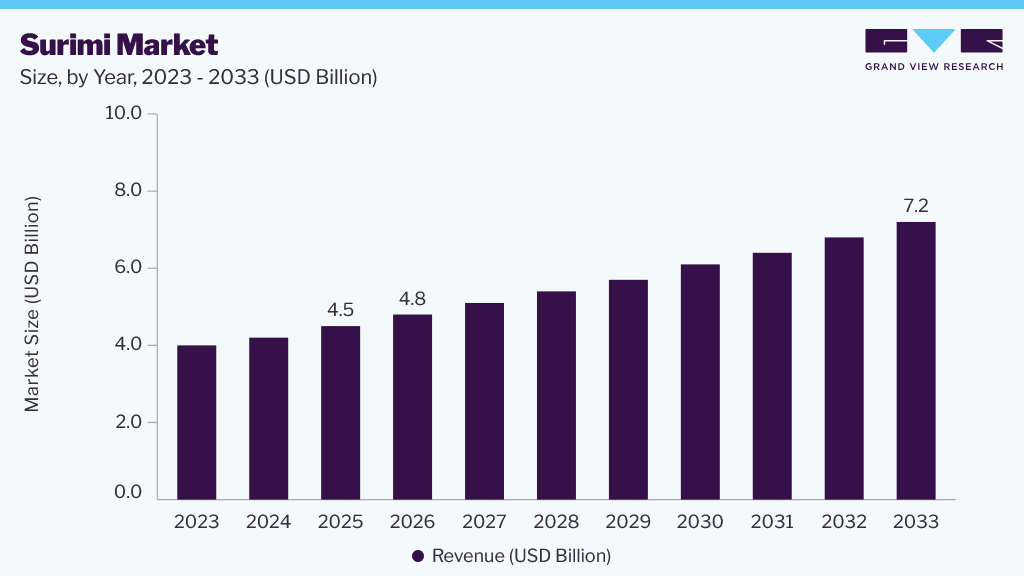
$4.5BMarket Estimate, 2026
$4.8BMarket Forecast, 2033
$7.2BCAGR, 2026–2033
6.1%Surimi Market Summary
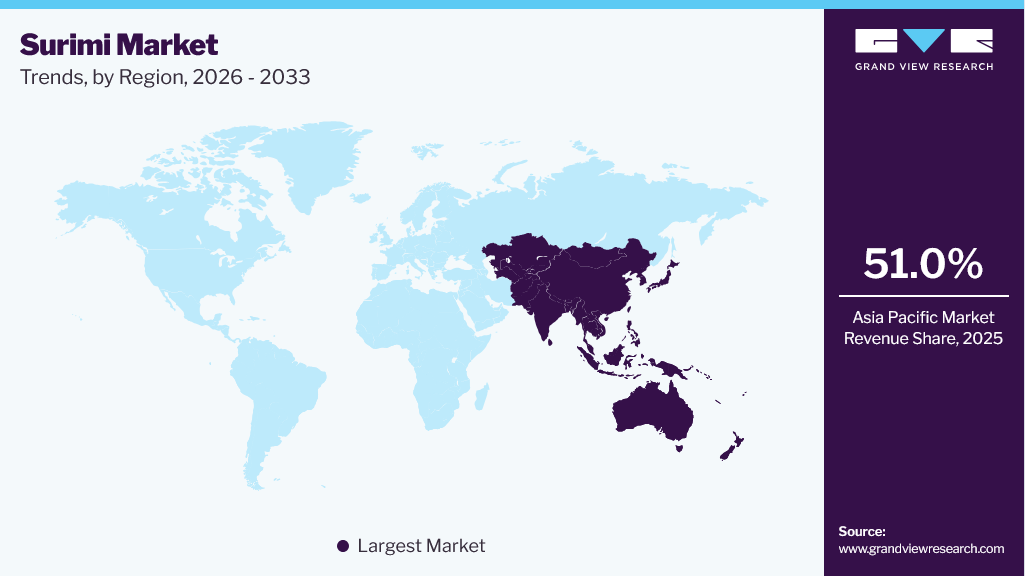
The global surimi market size was valued at USD 4.5 billion in 2025 and is projected to grow from USD 4.8 billion in 2026 to USD 7.2 billion by 2033, at a CAGR of 6.1% from 2026 to 2033. Asia Pacific dominated the market, accounting for a revenue share of 51.0% in 2025. The growing popularity of surimi as a cost-effective alternative to seafood across various regions is a key driver of market growth.
Key Market Trends & Insights
- By source: The tropical segment led the market with the largest revenue share of over 70.5% in 2025.
- By form: The frozen segment accounted for the highest market share of over 72.0% in 2025.
- By distribution channel: The B2B segment accounted for the highest market share of around 49.5% in 2025.
Regional Highlights
- Largest regional market: Asia Pacific (51.0% revenue share, 2025)
- Fastest-growing regional market: Europe (highest CAGR, 2026-2033)
Market Size & Forecast
- Market size in 2025: USD 4.5 Billion
- Estimated market size in 2026: USD 4.8 Billion
- Projected market size by 2033: USD 7.2 Billion
- CAGR (2026-2033): 6.1%
Three ways to get this report
Buy it, customize it, or ask a question.Ask an Analyst
A direct answer, usually in 1 working day
- AccessReport author, directly
- Reply timeWithin 1 working day
- No sales callDirect answer only
- FormatEmail reply
- CostFree, no cost
Get the Full Report
What the study covers
- FormatsPDF · Excel · Dashboard
- Timeline2026–2033 annual, 2025 base
- Coverage20+ countries, 5 regions
- Companies10+ key players profiled
Customize the Report
20% free customization
- IncludeCountries, segments, points
- TailorTo your product definition
- ExtendDeeper competitor detail
- OrA fully bespoke study
- Turnaround5–10 working days
The demand for seafood-based products is rapidly increasing, boosting demand for surimi, a key ingredient in several dishes, particularly in Asian cuisine. In addition, factors such as high nutritional value, the long shelf life of frozen surimi, and its affordability are increasing its popularity among consumers, further supporting market growth.
Consumers across the globe are actively seeking easy-to-prepare and convenient food options. Processed foods, including surimi-based products, are gaining popularity because they require less preparation time and are easy to store and consume. These attributes continue to support consumer adoption of surimi-based products as an affordable seafood alternative. Thus, the increasing demand for convenient food options is fueling market growth. In addition, growing awareness of the nutritional benefits associated with surimi consumption is further supporting market expansion.
Surimi-based products are rich in protein and can provide beneficial nutrients, including omega-3 fatty acids, depending on the raw materials used. These products are increasingly preferred by health-conscious consumers seeking nutritious and convenient food choices. In addition, surimi is often considered suitable for consumers seeking lower-calorie, lower-fat protein options compared with certain conventional meat products. Thus, rising awareness of the nutritional benefits associated with surimi and surimi-based products is expected to support market growth.
One of the significant factors contributing to market growth is the expansion of the aquaculture industry. Aquaculture remains one of the fastest-growing food production sectors worldwide. The rapidly increasing demand for seafood is driving investments in fish farming and aquatic production. According to the OECD-FAO Agricultural Outlook 2025–2034, released in July 2025, global fisheries and aquaculture production reached about 193 million tonnes in 2024, with aquaculture continuing to be the key driver of growth. The report projects that aquaculture will account for more than 85% of the additional growth in global aquatic production by 2034, as seafood demand continues to increase worldwide.
Moreover, the rising popularity of Asian cuisine is contributing to increased consumption of surimi-based products across global markets. Surimi is widely used in a variety of Asian dishes, including dumplings and spring rolls, and serves as a key ingredient in seafood products such as fish cakes, fish balls, and crab sticks. The extensive use of surimi in these products, coupled with growing consumer interest in seafood-based protein alternatives to red meat, is expected to support market growth over the forecast period.
Analyst Perspective
Surimi is gradually transitioning from a traditional seafood ingredient to a versatile protein component used across multiple food categories. Manufacturers are increasingly focusing on product diversification, incorporating surimi into snacks, ready-to-eat meals, and value-added seafood products to attract a broader consumer base. The market is also benefiting from surimi's ability to deliver seafood-like texture and taste at a lower cost than many conventional seafood products. As seafood affordability and supply stability remain key industry concerns, surimi is positioned as a practical solution for food processors and retailers seeking scalable, cost-efficient, and adaptable protein offerings across domestic and international markets.
Source Insights
By source, the tropical segment held the largest market share, over 70.5%, in 2025 and is expected to grow during the forecast period. The tropical segment includes bigeye snapper, lizardfish, threadfin bream, goatfish, and others. Tropical surimi is a more affordable alternative to other seafood, making it an attractive option for consumers looking for a cost-effective way to enjoy seafood. In addition, tropical surimi is a more sustainable option than traditional seafood because it uses underutilized fish from abundant tropical fisheries. This reduces the pressure on over-fished sources and supports the conservation of marine biodiversity.
The cold-water segment is expected to grow at a notable pace during the forecast period. The cold-water segment is further sub-segmented into Alaska Pollock, Pacific Whiting, and others. The rapid growth of the segment can be attributed to advancements in technology and fishing practices that have made it easier to access and catch these fish sources. Improved fishing gear and methods, such as longline fishing and bottom trawling, have enabled targeting of these fish in deeper waters. Moreover, the growing interest in sustainable seafood production has led to a focus on cold-water fisheries, as they are often more resilient to overfishing than tropical fisheries. This has resulted in increased investment in developing sustainable aquaculture practices for a cold-water source.
Form Insights
By form, the frozen segment dominated the market with the highest revenue share of over 72.0% in 2025 and is expected to grow at the fastest CAGR during the forecast period. The growth of the segment can be attributed to frozen surimi offering a longer shelf life than fresh seafood, creating it a convenient option for consumers who lack access to fresh seafood or prefer to stock up on frozen products for future use. In addition, frozen surimi is more widely available than fresh seafood in many regions, making it a more accessible option for consumers. Moreover, advances in freezing and packaging technology have helped maintain the quality and taste of frozen surimi products, thereby contributing to growth in the segment in the coming years.
The fresh segment is expected to grow significantly during the forecast period. The segment's growth is attributed to high-quality products compared to frozen surimi, which has a shorter shelf life and requires less processing. This has led to increased demand among consumers who prioritize freshness and quality in their food choices. Moreover, the increasing interest in healthy and sustainable diets has led to a growing demand for fresh surimi, a low-fat, low-calorie protein source that can be used in a variety of dishes. Furthermore, advancements in transportation and logistics have made it easier to transport fresh surimi over longer distances, expanding its availability in more regions.
Distribution Channel Insights
By distribution channel, the B2B segment held the largest revenue share of around 49.5% in 2025 and is expected to grow at a considerable CAGR during the forecast period. The segment is driven by the extensive use of surimi across food processing, foodservice, and aquaculture industries. Surimi is widely utilized in restaurants, catering services, and seafood processing applications due to its versatility, consistent quality, and cost-effectiveness compared to several traditional seafood products. It is commonly incorporated into sushi, seafood salads, soups, fish cakes, and other value-added seafood products. In addition, fish processing byproducts generated during surimi production are used in animal feed and aquaculture applications, further supporting demand through industrial channels.
The B2C segment is expected to grow at a significant CAGR during the forecast period. The growth of the B2C segment is primarily driven by rising consumer demand for convenient, ready-to-cook, and frozen seafood products. The segment includes hypermarkets & supermarkets, convenience stores, online channels, and other retail outlets. Increasing adoption of online grocery platforms and changing consumer purchasing behavior are improving product accessibility across various regions. Frozen surimi products are particularly well-suited for retail distribution due to their extended shelf life and ease of storage. Furthermore, expanding product availability across modern retail formats and e-commerce platforms is expected to support the continued growth of the B2C segment.
Regional Insights
The surimi market in the Asia Pacific accounted for approximately 51.0% in 2025 and is expected to grow at the fastest CAGR during the forecast period. Surimi is widely consumed across the region due to its affordability, versatility, seafood-like texture, and convenience. In many Asian countries, seafood forms an integral part of daily diets, creating strong demand for surimi-based products. In addition, established seafood processing industries and extensive marketing efforts by manufacturers have contributed to the widespread adoption of surimi across the region. Products such as fish balls, crab sticks, kamaboko, and other processed seafood items are commonly consumed as snacks or incorporated into traditional dishes.
Europe Surimi Market Trends
Europe held a significant share of the market and is anticipated to grow with a significant CAGR over the forecast period. The growing demand for healthy, sustainable protein sources has been observed in the region, and surimi is seen as a low-fat alternative to meat and seafood. Moreover, the seafood industry in Europe has also been promoting surimi-based products as a convenient and affordable alternative to fresh seafood. Furthermore, the popularity of Asian cuisine in Europe has increased awareness and appreciation of surimi-based products, such as crab sticks and fish balls, thereby driving market growth. According to the EU Seafood Supply Synopsis 2025, total seafood consumption in the European Union reached 10.7 million tonnes in 2024, a 5% increase from 2023, reflecting continued growth in consumer demand for seafood-based products across the region.
Key Surimi Company Insights
Key players in the market are regional and international seafood processors, focusing on product innovation, capacity expansion, and strengthening their distribution networks. Companies are increasingly introducing value added surimi products and expanding their presence across retail, foodservice, and processed seafood applications to address evolving consumer preferences.
Key Surimi Companies
The following key companies have been profiled for this study on the surimi market:
-
HAI THANH CO., LTD
-
APITOON GROUP
-
Starfish Co., Ltd.
-
Java Seafood
-
PT. INDO SEAFOOD
-
Southern Marine
-
SEAPRIMEXCO
-
Zhejiang Longsheng Aquatic Products Co., Ltd.
-
PT. Indonesia Bahari Lestari
-
Gadre Marine Export Pvt. Ltd.
Recent Developments
-
In September 2025, Kibun Foods launched "The SURIMI," a modern reinterpretation of traditional surimi products made from Alaska pollock. The product was developed to highlight surimi as a convenient, nutritious, and versatile protein option for everyday consumption. Through this launch, the company aimed to increase consumer awareness of surimi beyond traditional seafood applications. The development reflects ongoing product innovation in the surimi industry and growing efforts by manufacturers to appeal to younger and health-conscious consumers.
Surimi Market Report Scope
Report Attribute
Details
Market size in 2025
USD 4.5 billion
Estimated Market size in 2026
USD 4.8 billion
Projected Market size by 2033
USD 7.2 billion
Growth rate
CAGR of 6.1% from 2026 to 2033
Base year for estimation
2025
Actual data
2021 – 2025
Forecast period
2026 – 2033
Quantitative units
Revenue in USD Billion, and CAGR from 2026 to 2033
Report coverage
Revenue forecast, company ranking, competitive landscape, growth factors, and trends
Segments covered
Source, form, distribution channel, region
Regional scope
North America, Europe, Asia Pacific, Latin America, Middle East & Africa
Country scope
U.S.; Canada; Mexico; UK; Germany; France; Italy; Spain; China; India; Japan; Australia & New Zealand, South Korea; Brazil; Argentina, South Africa, UAE
Key companies profiled
HAI THANH CO., LTD; APITOON GROUP; Starfish Co., Ltd.; Java Seafood; PT. INDO SEAFOOD; Southern Marine; SEAPRIMEXCO; Zhejiang Longsheng Aquatic Products Co., Ltd.; PT. Indonesia Bahari Lestari; Gadre Marine Export Pvt. Ltd.
Customization scope
Free report customization (equivalent up to 8 analysts working days) with purchase. Addition or alteration to country, regional & segment scope.
Pricing and purchase options
Avail of customized purchase options to meet your exact research needs. Explore purchase options
Global Surimi Market Report Segmentation
This report forecasts revenue growth at the regional and country levels and provides an analysis of the latest industry trends and opportunities in each sub segment from 2021 to 2033. For this study, Grand View Research has segmented global surimi market report on the basis of source, form, distribution channel, and region.
-
Source Outlook (Revenue, USD Billion, 2021 - 2033)
-
Tropical
-
Cold Water
-
Alaska Pollock
-
Pacific Whiting
-
Others
-
-
-
Form Outlook (Revenue, USD Billion, 2021 - 2033)
-
Frozen
-
Fresh
-
-
Distribution Channel Outlook (Revenue, USD Billion, 2021 - 2033)
-
B2B
-
B2C
-
Hypermarkets & Supermarkets
-
Convenience Stores
-
Online
-
Others
-
-
-
Regional Outlook (Revenue, USD Billion, 2021 - 2033)
-
North America
-
U.S.
-
Canada
-
Mexico
-
-
Europe
-
UK
-
Germany
-
France
-
-
Asia Pacific
-
China
-
Japan
-
Thailand
-
South Korea
-
-
Central & South America
-
Brazil
-
-
Middle East & Africa
-
UAE
-
Saudi Arabia
-
-
Frequently Asked Questions About This Report
The global surimi market size was valued at USD 4.5 billion in 2025 and is estimated at USD 4.8 billion for 2026.
The global surimi market is expected to grow at a CAGR of 6.1% from 2026 to 2033, reaching USD 7.2 billion by 2033.
Asia Pacific dominated with a 51.0% revenue share in 2025.
Tropical dominated the XYZ market with a share of 70.5% in 2025.
Key players include HAI THANH CO., LTD; APITOON GROUP; Starfish Co., Ltd.; Java Seafood; PT. INDO SEAFOOD; Southern Marine; SEAPRIMEXCO; Zhejiang Longsheng Aquatic Products Co., Ltd.; PT. Indonesia Bahari Lestari; Gadre Marine Export Pvt. Ltd.
About the Author(s)
Consumer F&B Research Team
Consumer Goods · Consumer F&BThis report was authored by the consumer f&b research team at Grand View Research - comprising two research analysts, one senior research analyst, and one industry expert - with specialized expertise in the consumer f&b segment of the consumer goods industry. All findings are based on proprietary consumer goods databases, executive interviews, and regulatory analysis, subject to internal peer review prior to publication.
Last Updated:
Speak to Analyst


Customize this report to your needs - add regions, segments, or data points, with 20% free customization.
Or view our licence options:


ISO 9001:2015 & 27001:2022 Certified
We are GDPR and CCPA compliant! Your transaction & personal information is safe and secure. For more details, please read our privacy policy.


