
- Home
- »
- Medical Devices
- »
-
Surrogacy Market Size, Share & Growth Report, 2026-2033GVR Report cover

Surrogacy Market (2026 - 2033)
Size, Share & Trends Analysis Report By Compensation Model (Commercial / Compensated Surrogacy), By Intended Parent (Heterosexual Couples, Same-Sex Couples, Single Intended Parents), By Service, By Country, And Segment Forecasts
Market Size, 2025
$7.8BMarket Estimate, 2026
$8.6BMarket Forecast, 2033
$17.9BCAGR, 2026–2033
11.0%Surrogacy Market Summary
The surrogacy market size was valued at USD 7.8 billion in 2025 and is projected to grow from USD 8.6 billion in 2026 to USD 17.9 billion by 2033, at a CAGR of 11.0% from 2026 to 2033. This growth is attributed to the rising prevalence of infertility, delayed parenthood, and advancements in assisted reproductive technologies (ART) such as IVF and ICSI.
Key Market Trends & Insights
- By compensation model: Commercial/compensated surrogacy segment held the largest revenue share in 2025.
- By intended parent: Heterosexual couples segment accounted for the largest market revenue share of 63.8% in 2025.
- By service: Medical & fertility services segment held the largest revenue share of 33.4% in 2025.
Country Highlights
- Largest market: U.S. (52.0% revenue share, 2025)
- Fastest-growing market: UAE (highest CAGR, 2026-2033)
Market Size & Forecast
- 2025 Market Size: USD 7.8 Billion
- Estimated Market Size in 2026: USD 8.6 billion
- Projected market size by 2033: USD 17.9 Billion
- CAGR (2026-2033): 11.0%
Prism AI by Grand View Research Free to tryAsk a question about the surrogacy marketTry asking✓Every figure cited from GVR research Prefer the report? Download free sample →
Increasing infertility associated with age, lifestyle factors, medical conditions, and recurrent pregnancy loss is encouraging more individuals and couples to consider surrogacy when conventional fertility treatments are unsuccessful. At the same time, improvements in IVF, embryo culture, genetic testing, and embryo-transfer techniques are improving treatment outcomes and making gestational surrogacy more viable.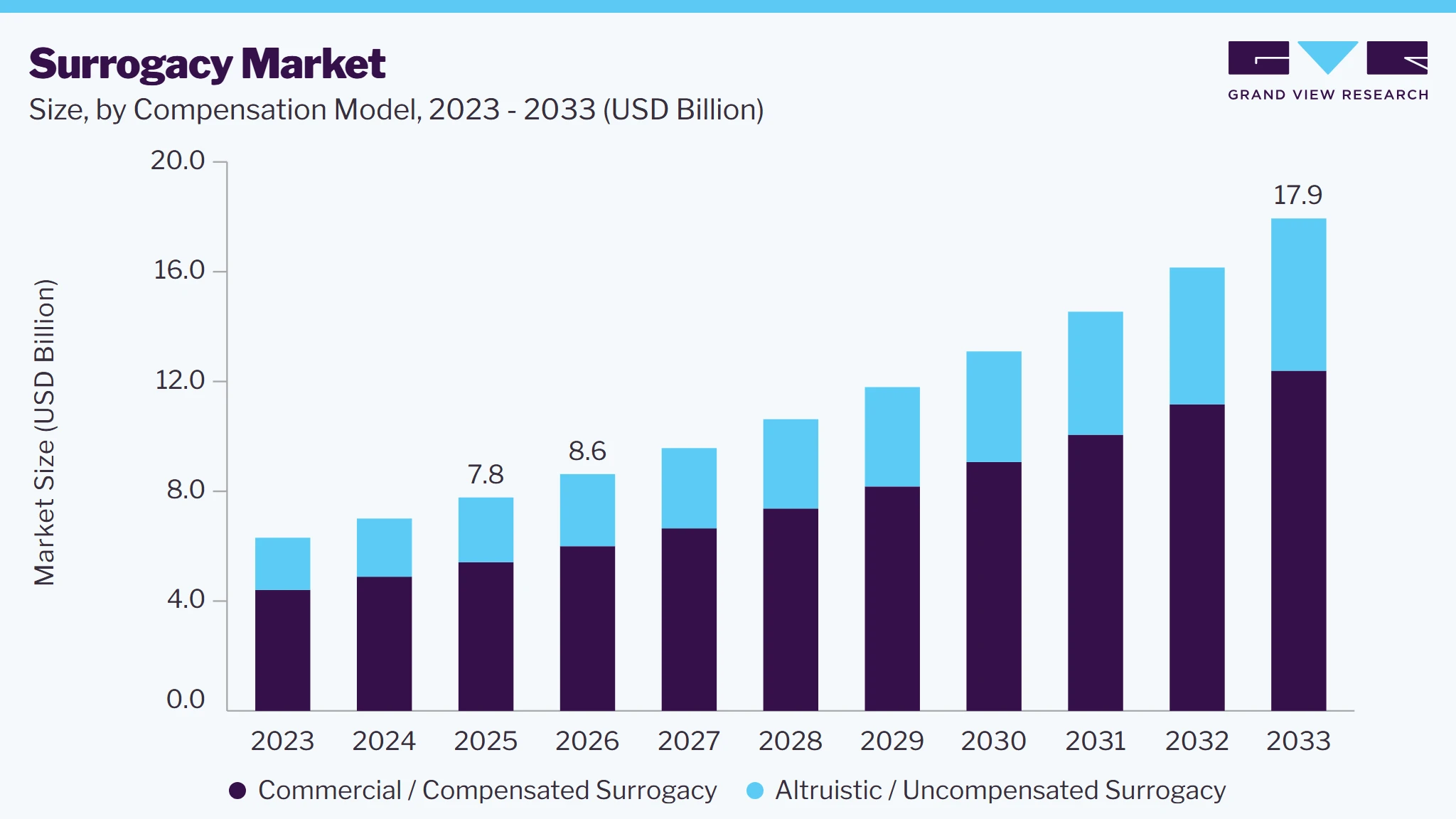 Source: Grand View Research, IR Documents, Primary Interviews, Paid DatabasesTo learn more about this report,
 Download Free Sample Report
In addition, growing acceptance of single-parent and LGBTQ+ families, greater awareness of alternative family-building options, and increasing social acceptance of assisted reproduction are further expanding the potential user base.
Market Dynamics
The section below outlines the key factors driving the growth of the surrogacy market, highlighting the rising prevalence of infertility and increasing demand for assisted reproductive services among individuals and couples unable to achieve successful pregnancies naturally. It also examines the growing adoption of gestational surrogacy, advancements in In-vitro Fertilization (IVF) and embryo-transfer technologies, increasing acceptance of single-parent and LGBTQ+ family-building options, rising awareness and social acceptance of surrogacy, and improving access to fertility clinics and reproductive healthcare services.
Infertility, delayed childbearing, and medical conditions that make pregnancy difficult or unsafe are increasing the need for alternative family-building options. As individuals postpone parenthood to later reproductive ages, the likelihood of fertility challenges can increase, while conditions such as uterine abnormalities, recurrent pregnancy loss, previous unsuccessful IVF attempts, or health conditions that make pregnancy medically unsafe may prevent individuals from carrying a pregnancy themselves. In such cases, gestational surrogacy provides an alternative pathway to parenthood, particularly when an embryo can be created through IVF and transferred to a gestational carrier. The growing use of IVF and greater awareness of this option are therefore expanding the pool of intended parents seeking surrogacy services, supporting overall market growth.
According to SurrogateFirst’s research published in January 2025, intended parents continue to seek surrogacy despite increasing legal, financial, and medical complexities. The report found that 30% of intended parents experienced more barriers to family building, while 20% delayed their surrogacy plans because of changing circumstances. In addition, the continued demand for IVF and surrogacy highlights the importance of these services for individuals who cannot conceive or safely carry a pregnancy themselves. The report also notes that 18% of intended parents had postponed IVF treatments, demonstrating how fertility treatment and surrogacy are closely connected in the family-building pathway.
Annual Incidence Rates of Female Infertility Diagnoses by Age Group, Active Component Service Women, U.S. Armed Forces, 2019-2023
Age Group
2019
2020
2021
2022
2023
<20
18.3
18
11.1
7.5
6.4
20-24
51.7
42.1
42
35.3
32.6
25-29
99.5
92.2
89.2
75.7
67.3
30-34
166.5
132
149.2
137.6
131.9
35-39
176.1
158.5
166.9
150.8
145.7
40-44
101
84.4
99.7
93.8
97
45-49
10.4
5.6
7.4
5.8
4.4
Rising Infertility Among Women Aged 35+ Is Expanding Demand for Alternative Family-Building: A July 2026 Euronews report, citing a study published in The Lancet, highlights a significant demographic trend: infertility among women aged 35-49 is projected to approach 80 million cases by 2036, compared with approximately 53.6 million in 2023 representing an almost 1.5-fold increase. The sharpest increase is expected among women aged 35-39, with researchers attributing much of the growth to delayed motherhood and age-related declines in ovarian reserve and fertility.
The projected increase is expected to expand the population seeking assisted reproductive technologies, including IVF. For women who can produce embryos through IVF but are unable or advised not to carry a pregnancy because of reproductive or medical complications, gestational surrogacy can provide an alternative pathway to parenthood. Consequently, the growing prevalence of infertility among women in older reproductive age groups can broaden the potential pool of intended parents and support demand for surrogacy services.
Regulatory and legal uncertainty is a significant restraint for the surrogacy market, as surrogacy is governed by highly diverse and frequently changing laws concerning eligibility, compensation, parental rights, citizenship, embryo transfer, and the enforceability of surrogacy agreements. Regulations vary considerably across countries and even within jurisdictions, creating uncertainty for intended parents, surrogacy agencies, fertility clinics, and legal service providers. For example, India’s Surrogacy (Regulation) Act, 2021 permits only altruistic surrogacy and places strict eligibility requirements on intended parents and surrogates, substantially narrowing the addressable market. Similarly, Australia permits only altruistic surrogacy, while its rules can vary across individual states. Such differences increase legal costs, extend the time required to complete arrangements, and create risks around parentage and cross-border surrogacy, discouraging some prospective parents from pursuing the procedure.
- Germany - 2026: Surrogacy remains prohibited in Germany, although German law does not make it illegal to raise a child born through surrogacy abroad. A July 2026 controversy involving senior CDU/CSU politician Jens Spahn, whose child was born through a U.S. surrogate, highlighted the continuing conflict between domestic restrictions and international surrogacy arrangements.
- Italy - cross-border restrictions: Italy has taken a particularly restrictive position, with legislation making it illegal for Italian citizens to pursue surrogacy abroad. This creates additional legal uncertainty for individuals considering international surrogacy.
- France and Spain: Both countries maintain restrictions/bans on surrogacy, illustrating the fragmented regulatory environment across Europe. Consequently, intended parents may need to navigate different rules when arranging treatment and establishing legal parentage across borders.
- India: The introduction of the Surrogacy (Regulation) Act, 2021, significantly changed the country's surrogacy framework by prohibiting commercial surrogacy and limiting eligibility. These restrictions demonstrate how regulatory changes can directly reduce the pool of potential surrogates and intended parents.
A major opportunity for the surrogacy market lies in the growing use of gestational surrogacy by LGBTQ+ couples, single parents, and individuals who cannot safely carry a pregnancy. While surrogacy was historically associated mainly with heterosexual couples facing infertility or pregnancy-related medical complications, it is increasingly being used as a broader family-building option. The American Society for Reproductive Medicine (ASRM) notes that gestational carriers are increasingly utilized by unpartnered individuals and LGBTQIA+ people, while its 2026 guidance specifically addresses fertility and family-building needs among LGBTQ+ populations.
This creates opportunities for surrogacy agencies, fertility clinics, IVF providers, legal service providers, and reproductive-health platforms to develop more inclusive services, including LGBTQ+-friendly counseling, donor-gamete coordination, legal support, psychological services, and end-to-end surrogacy management. ASRM also identifies gestational carriers as an important family-building pathway for single men and male same-sex couples, further expanding the potential customer base.
Case Study: Rising Political and Regulatory Attention to Surrogacy in the U.S.
Background
The U.S. surrogacy market is attracting increasing political and regulatory attention as debates surrounding IVF, embryo protection, commercial surrogacy, international intended parents, and birthright citizenship become more prominent. Although surrogacy remains legally permissible in many U.S. states, the absence of a uniform federal framework creates differences in eligibility, contracts, parental rights, and regulatory requirements across states.Recent Development
In June 2026, the Texas Republican Party adopted platform language opposing public funding for IVF and calling for greater regulation of assisted reproduction, including commercial surrogacy. The platform also supported restrictions on surrogacy contracts involving foreign nationals and third-party egg and sperm donation. Similar embryo-related positions have been incorporated into Republican party platforms in states including Idaho, Missouri, North Carolina, and Oklahoma. At the federal level, Senator Rick Scott introduced the SAFE KIDS Act in November 2025, which seeks to restrict nationals from designated adversarial countries from entering into surrogacy arrangements with U.S. citizens.Market Implications
The growing political focus is increasing the importance of legal, screening, matching, documentation, and coordination services within the surrogacy ecosystem. Agencies may need to conduct more extensive background and eligibility screening of intended parents, particularly in international cases, while attorneys and coordinators may face greater demand for contract reviews, parental-rights documentation, citizenship-related guidance, and compliance monitoring. Restrictions on international intended parents could also affect cross-border demand for U.S. surrogacy services and encourage agencies to diversify their client base toward domestic intended parents.Why It Matters to the Market
This development demonstrates that political and regulatory changes can directly influence the accessibility, cost, and structure of surrogacy services. While stricter regulation may act as a restraint on certain international and commercial arrangements, it can simultaneously drive demand for professional agencies, legal advisors, insurance providers, escrow services, and specialized coordination support. Therefore, increasing political scrutiny represents a key market-shaping trend, particularly for the U.S. agency, matching & coordination segments.Market Concentration & Characteristics
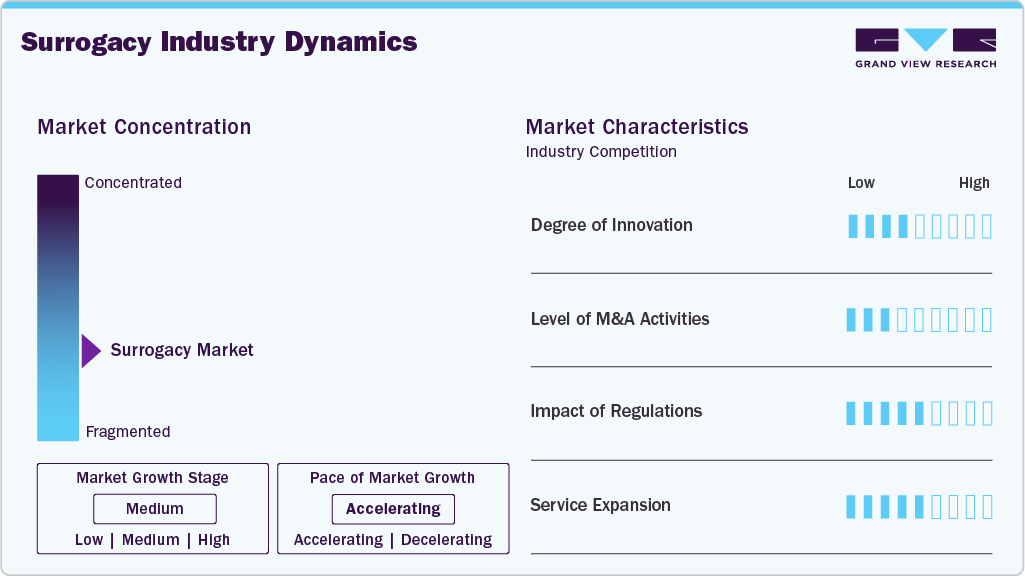
The surrogacy market is moderately fragmented, comprising fertility and IVF clinics, specialized surrogacy agencies, reproductive healthcare providers, and independent facilitators. Market dynamics vary across countries due to differences in regulations, reimbursement policies, eligibility criteria, and legal frameworks. Established providers benefit from strong clinical expertise, surrogate and intended-parent networks, integrated fertility services, and regulatory compliance capabilities.
The market is witnessing a high degree of innovation. Patriot Conceptions’ technology-driven approach represents an important innovation in the surrogacy market by digitizing and streamlining the traditionally fragmented surrogacy journey. The company developed a custom web application and Patriot Conceptions Fertility Support Platform (PCFSP) that integrates CRM, customer support, analytics, secure communication, and progress tracking. This innovation can reduce administrative delays, improve matching efficiency, enhance data security, expand access to surrogacy services, and provide a more personalized experience for intended parents and surrogates. Patriot Conceptions reported that its shift to virtual consultations reduced operational costs by 25% and expanded its client base by 30%, demonstrating the potential of digital technologies to improve both operational efficiency and market reach.
 To learn more about this report, Download Free Sample Report
The level of merger and acquisition activities in the market can be characterized as moderate, with companies pursuing acquisitions to expand geographic reach, strengthen fertility and family-building capabilities, and integrate surrogacy into broader reproductive healthcare platforms. A notable example is Progyny’s acquisition of Apryl in June 2024. Apryl, a Berlin-based fertility benefits platform, was acquired to expand Progyny’s total fertility and family-building services across more than 100 countries. The enhanced offering includes support for fertility treatments, adoption, and surrogacy, along with access to vetted fertility clinics and country-specific benefit integration.
“Employers recognize the importance of providing fertility and family building benefits and want to be able to streamline these efforts to ensure their employees have equitable benefits and consistent high-touch experiences, regardless of where they live,”
-said Pete Anevski, CEO of Progyny. “We’re excited to broaden our support on a total scale.”
Regulations have a high impact on the market as differences in laws governing eligibility, surrogate compensation, parental rights, medical procedures, and cross-border arrangements directly influence market accessibility and provider operations. Countries such as India have established dedicated legislation, including the Surrogacy (Regulation) Act, 2021, which created national and state-level regulatory authorities and formal requirements for surrogacy arrangements. At the total level, regulations remain highly inconsistent, with some countries permitting commercial surrogacy, others allowing only altruistic arrangements, and some prohibiting surrogacy altogether.
Service expansion is an emerging strategy in the market, as providers increasingly broaden their offerings beyond basic surrogate matching to include surrogate recruitment, education, personalized support, matching, pregnancy management, compensation guidance, and postpartum care. For instance, in March 2026, ConceiveAbilities launched its “Surrogacy Spark Series,” featuring more than 20 women sharing their motivations for becoming surrogates. The initiative expands the agency’s surrogate-engagement efforts by using education and real-life experiences to attract and inform potential surrogates. ConceiveAbilities also provides individualized support throughout the journey, from matching through postpartum recovery.
"Purpose-driven women don't just dream of making a difference, they act on it," "Every surrogate we meet embodies strength, compassion, and a calling to change lives in the most extraordinary way-as featured in the new Surrogacy Spark Series."
- Michelle DeMonte, Vice President of Surrogate Engagement.
Analyst Perspective
The surrogacy market is witnessing steady growth, driven by the increasing prevalence of infertility, delayed parenthood, pregnancy-related medical conditions, and the growing acceptance of alternative family-building options. Expanding adoption of in vitro fertilization (IVF), embryo freezing, embryo transfer, genetic testing, and other assisted reproductive technologies (ART) is improving the feasibility and success of surrogacy arrangements across countries. In addition, growing acceptance of same-sex couples, single intended parents, and diverse family structures is expanding the potential user base. Continuous advancements in fertility technologies, personalized matching, digital coordination platforms, legal and financial support services, and integrated counseling are enhancing the efficiency, transparency, and accessibility of surrogacy journeys, supporting the expansion of modern surrogacy services across developed and emerging markets.
Compensation Model Insights
The commercial / compensated surrogacy segment accounted for the largest market revenue share in 2025. The growing acceptance and legalization of commercial or compensated surrogacy is supporting the expansion of the surrogacy market by creating more structured pathways for intended parents and increasing the willingness of women to become gestational carriers. In compensated arrangements, surrogates receive financial compensation in addition to reimbursement for pregnancy-related medical and ancillary expenses, which can make participation more attractive given the physical demands, time commitment, medical risks, and potential lost income associated with pregnancy.
The altruistic / uncompensated surrogacy segment is expected to register the fastest CAGR over the forecast period. This is supported by the willingness of women to help individuals or couples who are unable to carry a pregnancy, particularly when the surrogate has a close emotional relationship with the intended parents. Family members, sisters, relatives, and close friends may choose to become surrogates because they view the arrangement as an opportunity to help someone achieve parenthood, instead as a source of financial income. This motivation is supported by an October 2024 U.S. study published by NCBI, which highlights that 231 surrogates found that prosocial and altruistic motivations were primary reasons for participating in surrogacy, with participants generally having relatively stable socioeconomic circumstances. In addition, Canada provides a strong example of a regulatory environment supporting altruistic surrogacy: its Assisted Human Reproduction Act prohibits paying a surrogate a fee but permits reimbursement of eligible out-of-pocket expenses, thereby establishing a predominantly altruistic model.
Intended Parent Insights
The heterosexual couples segment accounted for the largest market revenue share of 63.8% in 2025. Heterosexual couples represent an important intended-parent segment in the surrogacy market, particularly when the female partner is unable to safely conceive or carry a pregnancy because of infertility, uterine abnormalities, recurrent pregnancy loss, or medical conditions that make pregnancy potentially life-threatening. The American Society for Reproductive Medicine (ASRM) current guidance provides a clear clinical example of a heterosexual woman who has a medical condition that makes pregnancy unsafe or impossible; in such cases, a gestational carrier can carry an IVF-created embryo on behalf of the couple. Conditions cited by ASRM include absence of the uterus, severe uterine abnormalities such as Asherman syndrome, recurrent pregnancy loss, and serious cardiovascular, renal, autoimmune, pulmonary, or other medical conditions that could make pregnancy dangerous. In addition, U.S. gestational-carrier activity has expanded considerably: SART-reported gestational-carrier cycles increased from 1,539 in 2004 to 11,515 in 2023, indicating broader utilization of this family-building pathway, although it remains a specialized segment of the overall market.
The same-sex couples segment is expected to register the fastest CAGR over the forecast period. The increasing number of same-sex couples seeking to become parents is driving demand for gestational surrogacy, egg donation, IVF, and related fertility services, particularly among male same-sex couples for whom pregnancy is biologically impossible without a gestational carrier. Greater social acceptance of LGBTQ+ families, broader recognition of same-sex parenthood, and increasing access to inclusive fertility care are encouraging more couples to pursue biological family-building options instead of adoption alone. The American Society for Reproductive Medicine (ASRM) explicitly recognizes gestational carriers as a family-building option for familial structures in which pregnancy is biologically infeasible, including single men and male same-sex couples.
Service Insights
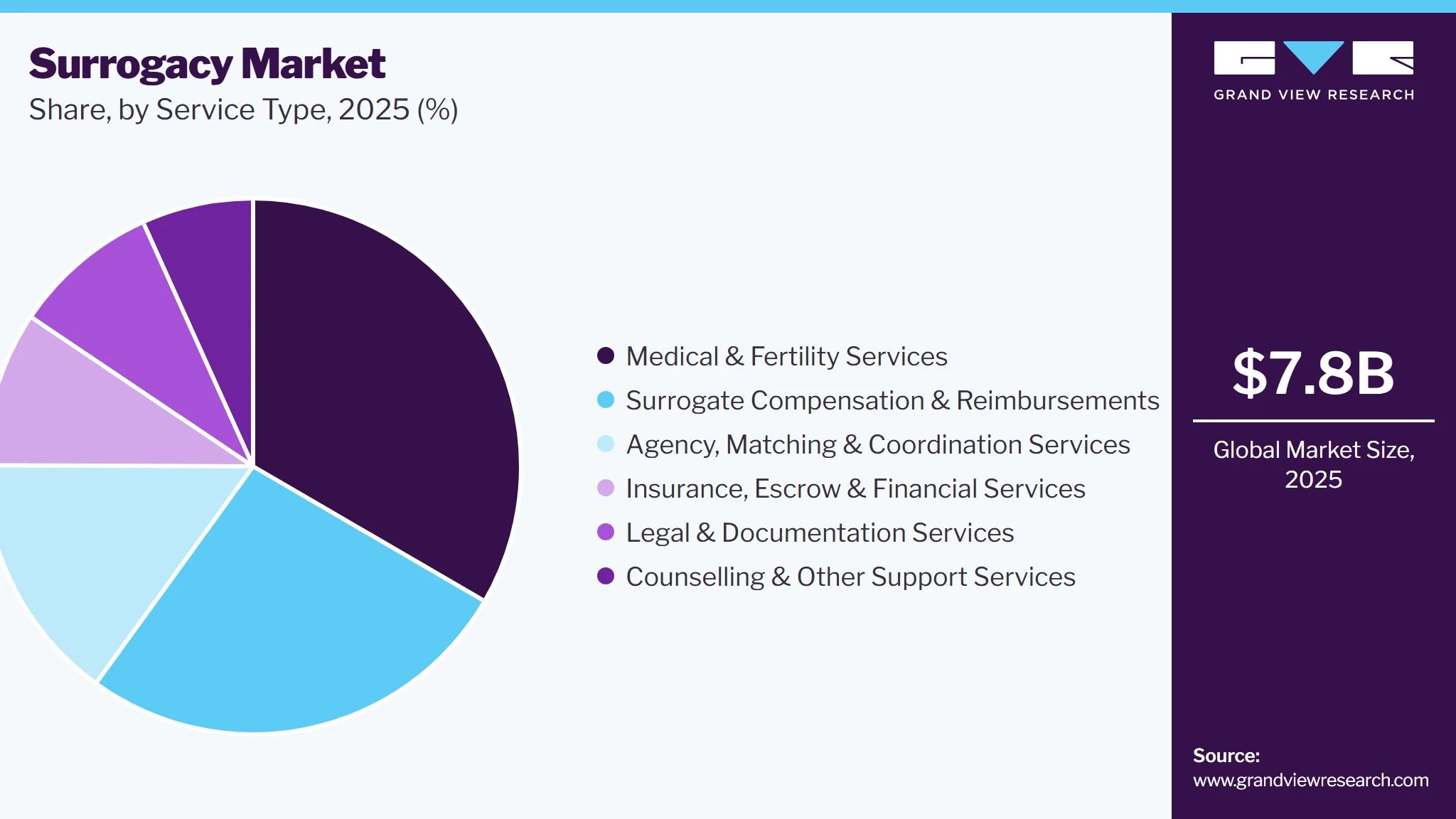
The medical & fertility services segment dominated with the largest market share of 33.4% in 2025, due to increasing integration of medical and fertility services with surrogacy programs. Modern gestational surrogacy is closely dependent on assisted reproductive technologies (ART), particularly in-vitro fertilization (IVF), embryo creation and freezing, genetic testing, fertility medications, embryo transfer, hormonal preparation, and specialized prenatal monitoring. As fertility clinics and surrogacy providers increasingly offer these services as an integrated pathway, intended parents can access a more coordinated treatment journey from fertility assessment through embryo transfer and pregnancy management. The growth in gestational-carrier treatment is reflected in U.S. clinical activity. According to ASRM report published in May 2026, SART-reported gestational-carrier cycles increased from 1,539 in 2004 to 11,515 in 2023, demonstrating the increasing use of fertility-clinic-based medical services for surrogacy.
 To learn more about this report, Download Free Sample Report
The agency, matching & coordination services segment accounted for a significant market share in the market. This is driven by the increasing complexity of surrogacy journeys and the growing preference of intended parents and surrogates for professionally managed, end-to-end support. Surrogacy involves multiple stakeholders including fertility clinics, attorneys, insurance providers, mental-health professionals, financial administrators, surrogates, and intended parents making professional coordination increasingly valuable. At the same time, agencies are placing greater emphasis on personalized and compatibility-based matching, considering factors such as personality, communication preferences, reproductive decisions, location, medical requirements, and legal considerations instead of relying solely on availability or waiting lists. For instance, ConceiveAbilities’ Matching Matters program reports a 97% success rate at the first introduction by evaluating relationship compatibility, medical criteria, legal considerations, and the preferences of both parties.
Country Insights
U.S. Surrogacy Market Trends
The U.S. surrogacy market accounted for the largest share of 52.0% in 2025, driven by the increasing infertility and medical conditions that prevent women from safely carrying a pregnancy. The CDC report published in May 2024 highlights that 19% of married U.S. women aged 15-49 with no prior births are unable to become pregnant after one year of trying, while 26% experience difficulty becoming pregnant or carrying a pregnancy to term. Moreover, the expansion of IVF is directly supporting surrogacy because modern gestational surrogacy generally relies on IVF to create an embryo that is subsequently transferred to the gestational carrier. CDC data show that 435,426 ART cycles were performed at 457 U.S. clinics in 2022, resulting in 94,039 live-birth deliveries and 98,289 live-born infants, equivalent to approximately 2.6% of all U.S. infants born that year.
Canada Surrogacy Market Trends
The Canada surrogacy market is expected to witness steady growth during the forecast period, driven by demand from individuals and couples facing infertility, same-sex couples, and intended parents seeking a regulated alternative to commercial surrogacy. Canada permits altruistic surrogacy but prohibits paying a surrogate or paying a third party to arrange surrogate services under the Assisted Human Reproduction Act. Surrogates can, however, receive reimbursement for eligible expenses such as travel, legal services, counselling, maternity clothing, healthcare-related expenses, and other specified costs. This regulatory model supports a formal surrogacy ecosystem while limiting commercialization. Market implication: demand remains supported by Canada's established fertility infrastructure and acceptance of family-building alternatives, but restrictions on compensation can constrain surrogate recruitment, thereby limiting market expansion relative to commercial surrogacy destinations.
UK Surrogacy Market Trends
The UK surrogacy market is projected to register notable growth driven by rising infertility, increasing demand from same-sex couples, and greater social acceptance of non-traditional family-building. However, the market operates under an altruistic model, with commercial surrogacy prohibited and the surrogate remaining the legal mother at birth until parenthood is transferred through a court process. Demand has nevertheless increased substantially: reporting in July 2026 indicated that almost 1,000 children were born through surrogacy in 2025, approximately twice the level recorded in 2015. The UK's Law Commissions proposed a new framework in 2023 that would provide greater clarity and allow intended parents to become legal parents from birth under specified conditions, but implementation has remained slow. Driver: rising demand combined with potential legal reform could expand the domestic market, although the existing system continues to encourage some intended parents to seek commercial arrangements overseas.
India Surrogacy Market Trends
The India surrogacy market has shifted from being a major commercial-surrogacy destination to a highly regulated altruistic-surrogacy market. The Surrogacy (Regulation) Act, 2021, prohibits commercial surrogacy and limits access to specified intended parents meeting medical and eligibility requirements. This significantly reduced the addressable market for commercial agencies and foreign intended parents. At the same time, demand remains supported by infertility, medical conditions preventing pregnancy, and India's relatively strong IVF infrastructure. In August 2026, the Himachal Pradesh High Court supported maternity leave for a woman who became a mother through surrogacy, reinforcing recognition of the rights of mothers using surrogacy.
Key Surrogacy Company Insights
The surrogacy market players are focusing on devising innovative business growth strategies in the form of service portfolio expansions, partnerships & collaborations, mergers & acquisitions, and business footprint expansions.
Key Surrogacy Companies
-
CCRM Fertility
-
Circle Surrogacy
-
HRC Fertility Management
-
TRIO Fertility
-
Canadian Fertility Consulting
-
ADVANCED FERTILITY CENTER CANCUN
-
Surrogacy Mexico
-
CReATe Fertility Centre
-
Nordic Surrogacy
-
INDIRA IVF
Competitive Benchmarking
Category
Operating Strategies
Competitive Edge
Weakness
Established Players (e.g., Circle Surrogacy, ConceiveAbilities, Growing Generations, Extraordinary Conceptions, CSP Surrogacy)
- Invest in comprehensive end-to-end surrogacy programs covering surrogate recruitment and screening, intended-parent matching, medical coordination, legal support, escrow and financial administration, and emotional counseling. Expand geographic reach through fertility-clinic partnerships, legal networks, referral relationships, digital platforms, and dedicated international programs.
- Strong brand reputation, large surrogate and intended-parent networks, established matching processes, experienced case-management teams, extensive relationships with fertility clinics and attorneys, and comprehensive support throughout the surrogacy journey. Established providers also benefit from experience managing complex domestic and international arrangements.
- Higher service fees can make programs less accessible to cost-sensitive, intended parents. Large agencies may face higher administrative complexity, longer coordination processes, and exposure to changing state-level regulations. Dependence on maintaining an adequate pool of qualified surrogates can also create matching delays.
Emerging Players (e.g., regional surrogacy agencies, boutique matching agencies, specialized fertility and surrogacy coordinators)
- Focus on personalized matching, specialized support for specific intended-parent groups, digital onboarding and communication, faster case coordination, and customized surrogacy programs. Strengthen market presence through partnerships with fertility clinics, reproductive-law firms, counselors, and international referral networks.
- Greater flexibility in matching and case management, personalized communication, faster decision-making, specialized services for niche client groups, and ability to adapt offerings to specific state or country requirements. Lower organizational complexity can allow emerging providers to develop differentiated client experiences.
- Limited brand recognition, smaller surrogate and intended-parent databases, and fewer established relationships with clinics and legal providers compared with major agencies. Smaller financial and operational resources can also limit geographic expansion, technology investment, international operations, and the ability to manage large numbers of concurrent surrogacy journeys.
Recent Developments
-
In May 2026, Pure Infusion was launched following the merger of AleraCare and Pure Healthcare, combining two established ambulatory infusion networks under a unified brand. The merger expanded outpatient infusion capabilities and strengthened the company’s ability to deliver coordinated specialty infusion care nationwide.
-
In January 2026, BioMatrix Specialty Pharmacy acquired First Choice Wellness Centers to expand its ambulatory infusion services across the Southeastern U.S. The acquisition strengthened BioMatrix’s community-based infusion network and enhanced access to specialty infusion therapies through expanded outpatient care capabilities.
Surrogacy Market Report Scope
Report Attribute
Details
Market size in 2025
USD 7.8 billion
Estimated market size in 2026
USD 8.6 billion
Projected market size by 2033
USD 17.9 billion
Growth Rate
CAGR of 11.0% from 2026 to 2033
Actual Data
2021 - 2025
Forecast Data
2026 - 2033
Quantitative units
Revenue in USD billion and CAGR from 2026 to 2033
Report coverage
Revenue forecast, company ranking, competitive landscape, growth factors, and trends
Segments covered
Compensation model, intended parent, service, country
Country scope
U.S.; Canada; Mexico; UK; India; Australia; Thailand; Brazil; South Africa; UAE
Key companies profiled
CCRM Fertility; Circle Surrogacy; HRC Fertility Management; TRIO Fertility; Canadian Fertility Consulting; ADVANCED FERTILITY CENTER CANCUN; Surrogacy Mexico; CReATe Fertility Centre; Nordic Surrogacy; INDIRA IVF
Customization scope
Free report customization (equivalent up to 8 analysts working days) with purchase. Addition or alteration to country, regional & segment scope.
Pricing and purchase options
Avail customized purchase options to meet your exact research needs. Explore purchase options
Surrogacy Market Report Segmentation
This report forecasts revenue growth at country levels and provides an analysis on industry trends in each of the segments from 2021 to 2033. For this study, Grand View Research, Inc. has segmented the surrogacy market report on the basis of compensation model, intended parent, service, and country:
-
Compensation Model Outlook (Revenue, USD Billion, 2021 - 2033)
-
Commercial / Compensated Surrogacy
-
Altruistic / Uncompensated Surrogacy
-
-
Intended Parent Outlook (Revenue, USD Billion, 2021 - 2033)
-
Heterosexual Couples
-
Same-Sex Couples
-
Single Intended Parents
-
Others
-
-
Service Outlook (Revenue, USD Billion, 2021 - 2033)
-
Medical & Fertility Services
-
Agency, Matching & Coordination Services
-
Surrogate Compensation & Reimbursements
-
Legal & Documentation Services
-
Insurance, Escrow & Financial Services
-
Counselling & Other Support Services
-
-
Country Outlook (Revenue, USD Billion, 2021 - 2033)
-
U.S.
-
Canada
-
Mexico
-
UK
-
India
-
Australia
-
Thailand
-
Brazil
-
South Africa
-
UAE
-
Research Methodology
The surrogacy market figures in this report are based on a proven research process that combines executive interviews with secondary research from proprietary databases, company filings, and recognized regulatory and institutional sources. Market size is built through value-chain sizing-reconciling supply-side and demand-side estimates-and triangulated with bottom-up and top-down approaches. Every estimate passes multiple levels of expert validation before publication, with each surrogacy segment quantified using the revenue-capture definitions in the table below.
Segment Definition
Segment - By Compensation Model
Revenue capture definition
Commercial / Compensated Surrogacy
Surrogacy in which the surrogate receives financial compensation beyond reimbursement of pregnancy-related expenses for carrying and delivering a child for intended parents.
Altruistic / Uncompensated Surrogacy
Surrogacy in which the surrogate does not receive a service fee or profit and is generally reimbursed only for reasonable pregnancy, medical, and related expenses.
Segment - Ownership Model
Revenue capture definition
Independent Centers
Operate as privately owned ambulatory infusion facilities that function separately from hospitals, physician practices, and specialty pharmacies while providing outpatient infusion services.
Hospital-Owned Centers
Function as outpatient infusion units managed by hospitals or healthcare systems, offering specialty infusion therapies as an extension of hospital-based care.
Physician-Owned Centers
Represent infusion facilities established and operated by physician practices, allowing specialists to administer therapies within their own clinical environments.
Specialty Pharmacy-Owned Centers
Consist of infusion facilities operated by specialty pharmacy organizations that integrate medication management, pharmacy support, and outpatient infusion services.
Segment - Intended Parent
Revenue capture definition
Heterosexual Couples
Male-female couples who use surrogacy when pregnancy is medically difficult, unsafe, or otherwise not feasible for the female partner.
Same-Sex Couples
Couples of the same sex who use surrogacy to build a family, particularly male couples who require a gestational surrogate to carry an embryo.
Single Intended Parents
Individuals who pursue parenthood independently through surrogacy, using donor eggs or sperm as required depending on their reproductive circumstances.
Others
Other intended-parent groups, including unmarried couples, intended parents with specific reproductive circumstances, and other family-building arrangements not covered above.
Segment - Service
Revenue capture definition
Medical & Fertility Services
Fertility-related medical services supporting surrogacy, including IVF, embryo creation and transfer, fertility testing, pregnancy monitoring, and obstetric care.
Agency, Matching & Coordination Services
Services that recruit and screen surrogates, match surrogates with intended parents, and coordinate medical, legal, administrative, and communication activities throughout the surrogacy journey.
Surrogate Compensation & Reimbursements
Payments and expense reimbursements provided to surrogates for agreed compensation, medical expenses, travel, maternity-related costs, and other eligible expenses.
Legal & Documentation Services
Legal services covering surrogacy agreements, parental rights, court orders, birth certificates, contracts, and other required legal and documentation procedures.
Insurance, Escrow & Financial Services
Services managing insurance coverage, escrow accounts, compensation disbursements, medical expenses, and other financial transactions associated with a surrogacy arrangement.
Counselling & Other Support Services
Psychological counseling, emotional support, social-work services, education, case support, and other assistance provided to surrogates and intended parents during the surrogacy process.
Estimation Model
Section
Key Summary
1.1 Research Approach
Hybrid research approach combining secondary and primary research methodologies. Market assessment is based on the number of surrogacy arrangements, intended parent volumes, surrogate registrations, IVF and embryo-transfer utilization, agency and coordination revenues, surrogate compensation, legal and documentation fees, insurance and escrow services, and counseling and support service revenues. Insights from fertility clinics, surrogacy agencies, legal firms, insurance providers, escrow companies, intended parents, surrogates, and industry experts are used to validate market estimates.
1.2 Market Estimation Framework
Market size is estimated using three approaches: (1) surrogacy arrangement and service expenditure model, (2) service utilization and average cost model, and (3) provider revenue validation model. These approaches are triangulated to determine the overall market size and forecast projections.
1.2.1 Demand Model
Estimates market demand based on the number of intended parents seeking surrogacy, infertility prevalence, medical conditions preventing pregnancy, delayed parenthood, demand from same-sex couples and single intended parents, availability of surrogates, IVF utilization, and the number of countries and jurisdictions permitting surrogacy. International intended-parent demand and cross-border surrogacy activity are also considered where applicable.
1.2.2 Revenue Model
Market value is calculated based on the average expenditure per surrogacy journey, including agency and matching fees, medical and fertility services, surrogate compensation and reimbursements, legal and documentation expenses, insurance, escrow and financial services, and counseling and support services. Variations in costs by compensation model, intended-parent type, service, country, and regulatory framework are incorporated into the estimation.
1.2.3 Vendor Model
Market estimates are validated using revenues and service volumes of key surrogacy agencies, fertility clinics, legal service providers, insurance and escrow companies, and counseling organizations. The analysis considers the number of surrogacy journeys facilitated, surrogate and intended-parent matching volumes, IVF cycles and embryo transfers associated with surrogacy, geographic presence, service expansion, partnerships, acquisitions, and publicly disclosed financial information.
1.3 Forecast Development
Forecast projections are developed by analyzing rising infertility and delayed parenthood, increasing acceptance of assisted reproductive technologies, advancements in IVF and embryo-transfer procedures, growing acceptance of diverse family structures, increasing demand from same-sex couples and single intended parents, expansion of surrogacy agencies and fertility clinics, international surrogacy demand, changes in reimbursement and insurance coverage, and evolving legal and regulatory frameworks.
1.4 Segmentation Method
Market segmentation is determined using weighted analysis of compensation models, intended-parent demographics, service utilization, surrogacy arrangement volumes, medical and fertility treatment adoption, agency and matching activity, surrogate availability, regulatory environment, and regional differences in surrogacy costs and accessibility. Segments are further assessed based on commercial versus altruistic arrangements and the availability of supporting services in each market.
1.5 Scope & Assumptions
Market is measured in USD based on revenues and expenditures associated with surrogacy services. The scope includes medical & fertility services; agency, matching & coordination services; surrogate compensation & reimbursements; legal & documentation services; insurance, escrow & financial services; and counseling & other support services. Estimates incorporate the number of surrogacy journeys, average expenditure per journey, service utilization, surrogate compensation, IVF and embryo-transfer costs, agency fees, legal expenses, insurance and escrow charges, and country-level variations in regulations, service availability, and pricing.
Delivered Customizations
This report has been delivered with the following In-depth customizations
Client Request
Customization Delivered
Value Adds
Surrogacy Journey Cost & Profitability Analysis
Comparison of total surrogacy journey costs, including agency fees, IVF and fertility treatment, surrogate compensation, legal services, insurance, escrow, and counseling across countries or states.
Enables clients to identify high-value service areas, optimize pricing strategies, and evaluate profitability across different markets.
Surrogate Supply & Availability Analysis
Assessment of the number and availability of potential surrogates based on eligibility requirements, geographic concentration, compensation levels, medical criteria, and matching timelines.
Helps agencies identify surrogate-supply gaps, improve recruitment strategies, and reduce matching and waiting periods.
International Surrogacy Flow Analysis
Analysis of cross-border intended-parent demand, destination countries, source countries, legal restrictions, travel requirements, and international surrogacy volumes.
Helps clients identify international patient opportunities and understand how regulatory changes may affect cross-border demand.
Frequently Asked Questions About This Report
The total surrogacy market size was estimated at USD 7.8 billion in 2025 and is projected to grow from USD 8.6 billion in 2026
The total surrogacy market is projected to reach at USD 17.9 billion by 2033, growing at a CAGR of 11.0% from 2026 to 2033.
The commercial / compensated surrogacy segment accounted for the largest market revenue share in 2025. The growing acceptance and legalization of commercial or compensated surrogacy is supporting the expansion of the surrogacy market by creating more structured pathways for intended parents and increasing the willingness of women to become gestational carriers
The heterosexual couples segment accounted for the largest market revenue share of 63.8% in 2025.
The medical & fertility services segment dominated the end use segment with the largest market share of 33.4% in 2025 due to increasing integration of medical and fertility services with surrogacy programs.
Key players in the market include CCRM Fertility; Circle Surrogacy; HRC Fertility Management; TRIO Fertility; Canadian Fertility Consulting; ADVANCED FERTILITY CENTER CANCUN; Surrogacy Mexico; CReATe Fertility Centre; Nordic Surrogacy; INDIRA IVF
The Canada surrogacy market is expected to witness steady growth during the forecast period, driven by demand from individuals and couples facing infertility, same-sex couples, and intended parents seeking a regulated alternative to commercial surrogacy.
The market drivers include the rising prevalence of infertility, delayed parenthood, and advancements in assisted reproductive technologies (ART) such as IVF and ICSI. Increasing infertility associated with age, lifestyle factors, medical conditions, and recurrent pregnancy loss is encouraging more individuals and couples to consider surrogacy when conventional fertility treatments are unsuccessful.
About the Author(s)
Medical Devices Research Team
Healthcare · Medical DevicesThis report was authored by the medical devices research team at Grand View Research - comprising two research analysts, one senior research analyst, and one industry expert - with specialized expertise in the medical devices segment of the healthcare industry. All findings are based on proprietary healthcare databases, executive interviews, and regulatory analysis, subject to internal peer review prior to publication.
Last Updated:
Speak to Analyst

Customize this report to your needs - add regions, segments, or data points, with 20% free customization.
Or view our licence options:


ISO 9001:2015 & 27001:2022 Certified
We are GDPR and CCPA compliant! Your transaction & personal information is safe and secure. For more details, please read our privacy policy.


