
- Home
- »
- Advanced Interior Materials
- »
-
Tandem Piston Compressor Market Size Report, 2026-2033GVR Report cover

Tandem Piston Compressor Market (2026 - 2033)
Size, Share & Trends Analysis Report By Type (Stationary, Portable), By Stage (Single Stage, Two Stage), By Application (Oil Refineries, Natural Gas Processing and Distribution, Chemicals and Petrochemicals), By Region, And Segment Forecasts
Market Size, 2025
$6.3BMarket Estimate, 2026
$6.5BMarket Forecast, 2033
$9.3BCAGR, 2026–2033
5.2%Tandem Piston Compressor Market Summary
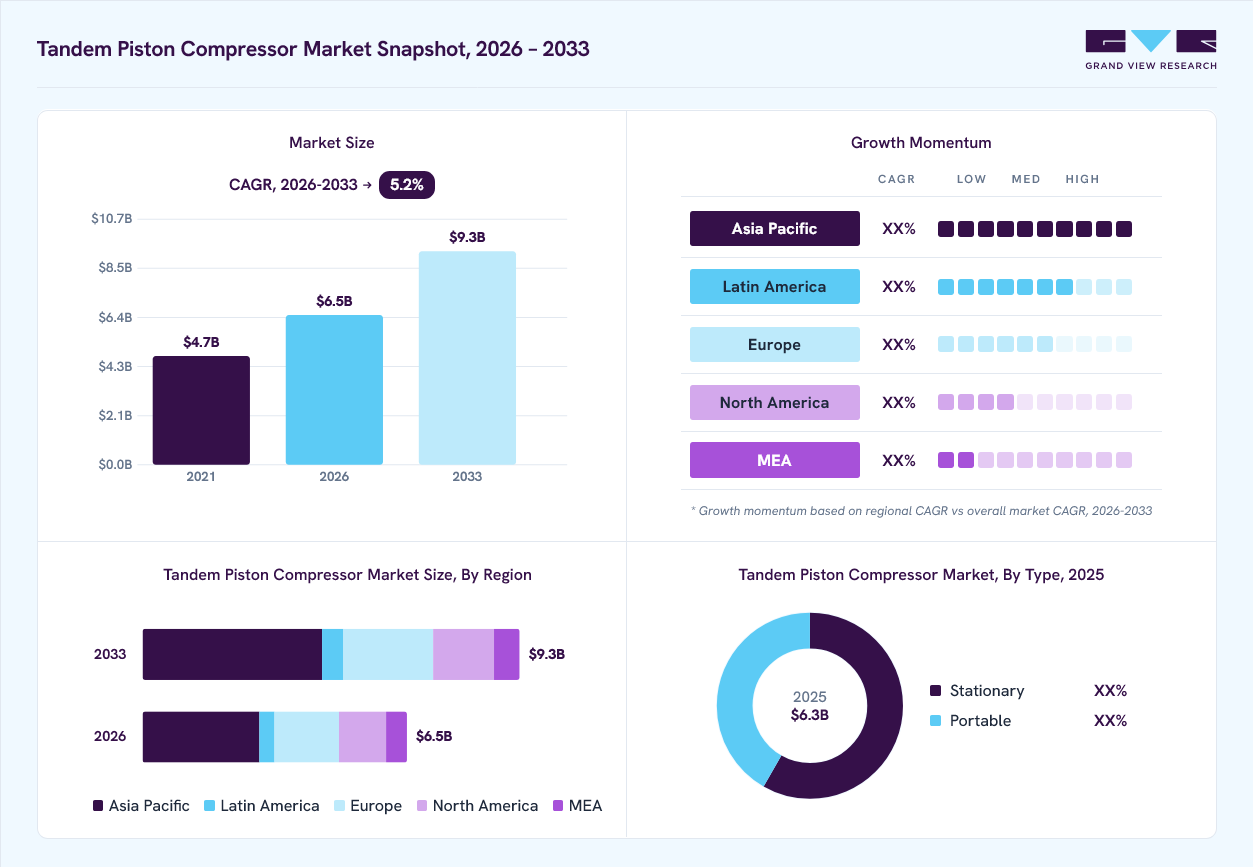
The global tandem piston compressor market size was valued at USD 6.3 billion in 2025 and is projected to grow from USD 6.5 billion in 2026 to USD 9.3 billion by 2033, growing at a CAGR of 5.2% from 2026 to 2033. Asia Pacific dominated the market, accounting for the largest global share of 44.2% in 2025. Increasing industrialization and the rising demand for compressed air across various sectors, such as Oil Refineries and construction, are significant contributors.
 Source: Grand View Research, IR Documents, Primary Interviews, Paid DatabasesTo learn more about this report,
 Download Free Sample Report
 Key Market Trends & Insights
- By type: Stationary segment held the largest revenue share of 58.2% in 2025.
- By application: Natural gas processing & distribution segment held the largest share of 34.7% in 2025.
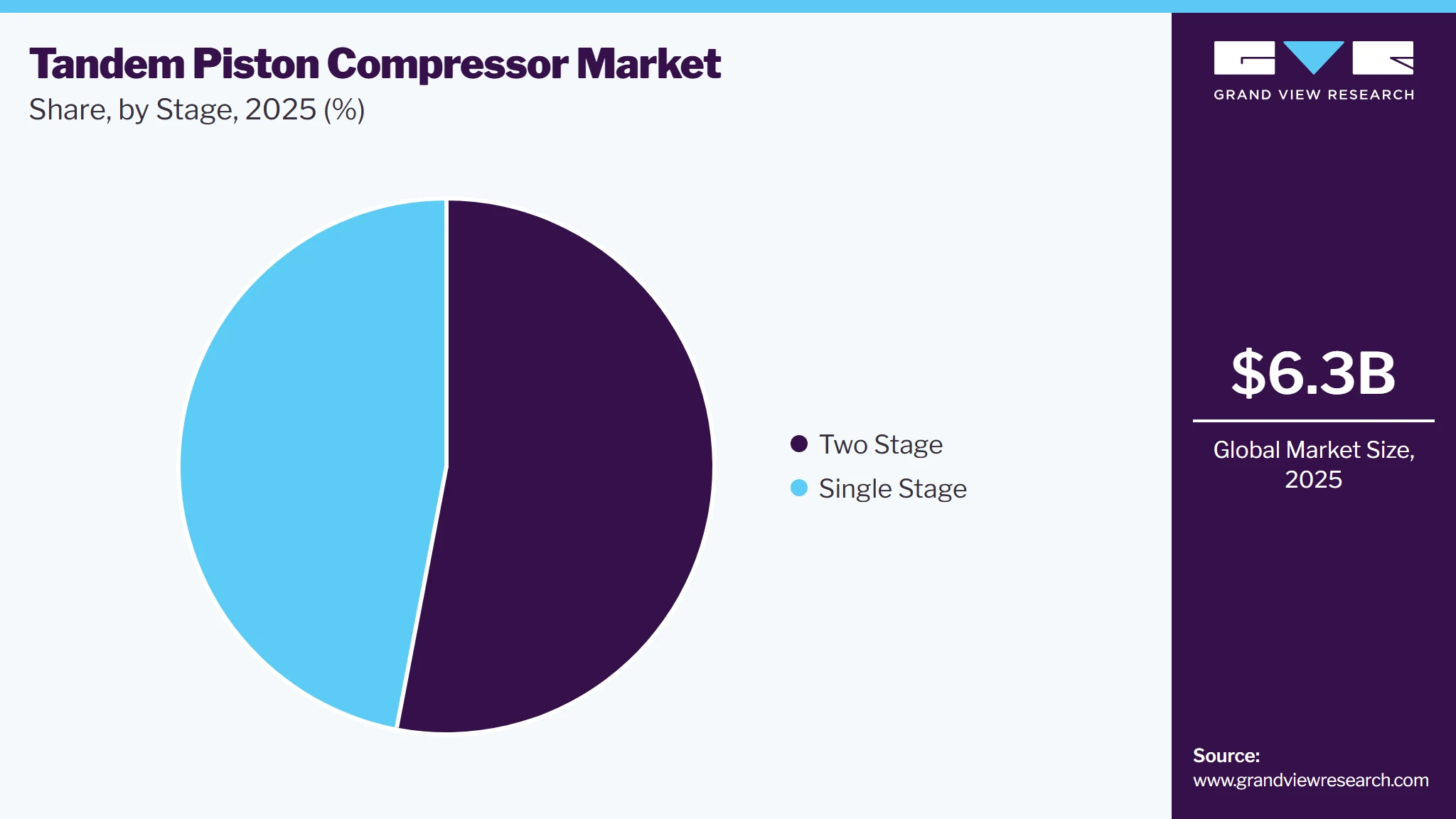
- By stage: Two stage segment held the largest revenue share of 53.0% in 2025.
Regional Highlights
- Largest regional market: Asia Pacific (44.2% revenue share, 2025)
- By country: China held the largest share of Asia Pacific in 2025.
Market Size & Forecast
- Market size in 2025: USD 6.3 Billion
- Estimated market size in 2026: USD 6.5 Billion
- Projected market size by 2033: USD 9.3 Billion
- CAGR (2026-2033): 5.2%
Three ways to get this report
Buy it, customize it, or ask a question.Ask an Analyst
A direct answer, usually in 1 working day
- AccessReport author, directly
- Reply timeWithin 1 working day
- No sales callDirect answer only
- FormatEmail reply
- CostFree, no cost
Get the Full Report
What the study covers
- FormatsPDF · Excel · Dashboard
- Timeline2026–2033 annual, 2025 base
- Coverage20+ countries, 5 regions
- Companies10+ key players profiled
Customize the Report
20% free customization
- IncludeCountries, segments, points
- TailorTo your product definition
- ExtendDeeper competitor detail
- OrA fully bespoke study
- Turnaround5–10 working days
As industries strive for energy efficiency, tandem piston compressors are favored for their ability to deliver high efficiency and reliability, making them ideal for heavy-duty applications. Moreover, technological advancements are enhancing the performance and functionality of tandem piston compressors, enabling them to meet stringent regulatory standards and customer requirements. The shift towards automation and the increasing use of pneumatic tools in industrial settings further drive demand, as these compressors are essential for operating such equipment effectively.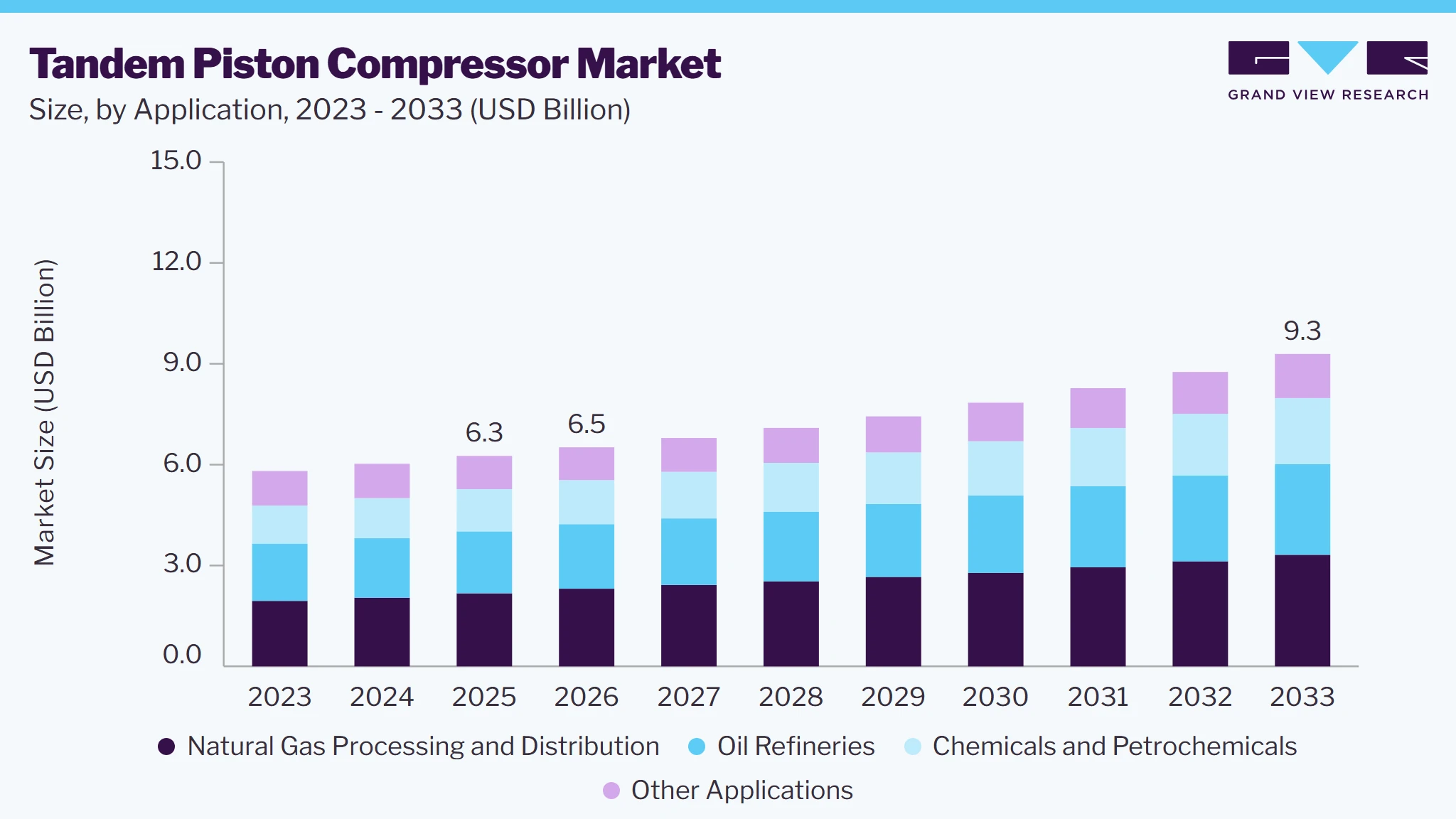 To learn more about this report, Download Free Sample Report
 Market Dynamics
The tandem piston compressor market is driven by the increasing demand for reliable, high-pressure compressed air systems across manufacturing, oil & gas, power generation, mining, chemical processing, and refrigeration industries. The expansion of industrial automation and process industries is encouraging the adoption of tandem piston compressors, as they offer high-pressure performance, operational reliability, and durability for demanding applications. Growing emphasis on energy efficiency is prompting manufacturers to introduce compressors with improved cooling systems, reduced power consumption, and digital monitoring capabilities for predictive maintenance. However, competition from rotary screw compressors in continuous-duty applications, along with higher maintenance requirements and initial installation costs, may restrain market growth in certain end-use sectors. At the same time, investments in industrial infrastructure, natural gas processing, hydrogen applications, and the modernization of compressed air systems are creating new opportunities for market expansion.
The increasing use of high-pressure compressed air in manufacturing, oil & gas, mining, power generation, chemical processing, and refrigeration industries is driving demand for tandem piston compressors. These compressors are preferred for applications requiring consistent pressure, durability, and reliable performance under demanding operating conditions. Industrial expansion, coupled with the modernization of production facilities, is encouraging end users to invest in advanced compressor systems that offer improved efficiency and operational reliability. The ability of tandem piston compressors to handle intermittent and high-pressure workloads makes them well suited for a wide range of industrial processes.
Tandem piston compressors face strong competition from rotary screw compressors, particularly in applications requiring continuous operation and lower noise levels. Rotary screw compressors generally offer reduced maintenance frequency, smoother airflow, and lower operating costs for continuous-duty environments, making them an attractive alternative for many industrial users. Furthermore, tandem piston compressors involve more moving components that require periodic maintenance and replacement, increasing lifecycle costs and downtime. These factors can limit adoption, particularly among cost-sensitive end users.
The growing focus on energy efficiency and digitalization is creating opportunities for manufacturers to develop next-generation tandem piston compressors equipped with variable speed drives, intelligent control systems, IoT-enabled monitoring, and predictive maintenance capabilities. Industries are increasingly seeking compressor solutions that reduce energy consumption, improve equipment reliability, and minimize unplanned downtime. At the same time, expanding investments in hydrogen production, compressed natural gas (CNG) infrastructure, industrial gas handling, and emerging manufacturing facilities are opening new application areas for high-pressure tandem piston compressors, supporting long-term market growth.
Analyst Perspective
The tandem piston compressor market is experiencing steady growth, driven by increasing demand for reliable, high-pressure gas compression across industries such as oil & gas, chemicals, manufacturing, refrigeration, and power generation. Rising focus on energy efficiency, operational reliability, and lower maintenance costs is accelerating the adoption of advanced compressors with automated controls and digital monitoring capabilities. Growing demand for oil-free compressors in food & beverage, pharmaceuticals, and electronics manufacturing is further supporting market expansion, creating long-term opportunities for manufacturers offering efficient and application-specific solutions.
Type Insights
“The portable segment is expected to grow at a significant CAGR of 5.9% from 2026 to 2033 in terms of revenue.”
They benefit from the growing trend toward mobility in construction and maintenance applications. Their lightweight and compact design allows for easy transportation, making them ideal for on-site work where space and accessibility are limited. The rise in construction activities, infrastructure projects, and outdoor events drives the demand for portable compressors, as these units provide flexibility and immediate access to compressed air wherever needed.
Based on type, the stationary segment led the market with the largest revenue share of 58.2% in 2025. Stationary compressors are experiencing increased demand due to their robustness and suitability for fixed installations in industrial settings. As industries such as Oil Refineries and construction expand, stationary compressors are favored for their efficiency and ability to deliver consistent performance over long periods. Furthermore, technological advancements, including enhanced energy efficiency and reduced emissions, make stationary systems more attractive to companies seeking to optimize their operations while adhering to regulatory standards.
Application Insights
“The oil refineries segment is expected to grow at a significant CAGR of 5.0% from 2026 to 2033 in terms of revenue.”
In the oil refineries sector, the need for reliable and high-performance equipment drives the demand for tandem piston compressors. These compressors are essential for various processes, including gas compression and vapor recovery, where consistent operation and efficiency are critical. The ongoing investments in refinery expansions and modernization projects further fuel the demand for robust compressor solutions that can meet the stringent operational requirements of this industry.
Based on application, the natural gas processing and distribution segment led the market with the largest revenue share of 34.7% in 2025. In natural gas processing and distribution, tandem piston compressors play a vital role in ensuring gas safe and efficient transportation. The increasing global focus on natural gas as a cleaner energy source and the expansion of pipeline infrastructure drive the demand for reliable compression systems. As new processing plants are developed and existing facilities upgraded, the need for high-performance compressors becomes increasingly important to handle the growing volumes of natural gas while maintaining safety and regulatory compliance.
Stage Insights
"The two stage segment is expected to grow at a rapid CAGR of 5.3% from 2026 to 2033 in terms of revenue.”
Based on stage, the two stage segment led the market with the largest revenue share of 53.0% in 2025. Two stage compressors are favored in applications that require higher pressure and greater efficiency. Their design allows for better heat dissipation and improved performance, making them suitable for demanding industrial applications, including heavy-duty Oil Refineries. As industries increasingly focus on energy efficiency and productivity, the superior performance of two stage compressors positions them as a preferred option, particularly in sectors where high pressure is crucial.
 To learn more about this report, Download Free Sample Report
 The single stage segment accounted for 44.3% of the market share in 2025. Single stage compressors are popular for their simplicity and cost-effectiveness in applications requiring moderate pressure. They are particularly advantageous in smaller operations where the air demand is not overly high, making them an economical choice. The growing number of small to medium-sized enterprises across various industries bolstered the demand for single stage compressors, as they offer a straightforward solution without the complexity of multi-stage systems.
Regional Insights
“India to witness fastest market growth at 6.9% CAGR”
Asia Pacific dominated the tandem piston compressor market with the largest revenue share of 44.2% in 2025. The tandem piston compressor market in China held the largest share in the Asia Pacific region in 2025. In Asia Pacific, rapid industrialization and urbanization are significant factors propelling market growth. Countries like China and India are expanding their oil refineries capabilities, increasing demand for reliable and efficient air compression solutions. Furthermore, government initiatives to boost infrastructure development and energy efficiency encourage investments in tandem piston compressors across various sectors.
 To learn more about this report, Download Free Sample Report
 The tandem piston compressor market in India is estimated to grow by 6.9% over the forecast period. In India, the market growth is driven by several key factors. The industrial sector remains a significant contributor, with Oil Refineries, oil and gas, and construction leading the demand for efficient air compression solutions. As companies prioritize energy efficiency to reduce operational costs and meet sustainability goals, there is a shift toward advanced compressor technologies that offer lower emissions and enhanced performance. Top of Form
North America Tandem Piston Compressor Market Trends
The tandem piston compressor market in North America is growing due to the robust industrial sector, particularly in Oil Refineries, oil and gas, and construction. The emphasis on energy efficiency and sustainability prompts industries to adopt advanced compressor technologies. Furthermore, ongoing investments in infrastructure and the trend towards automation in oil refinery processes further stimulate demand.
Europe Tandem Piston Compressor Market Trends
The tandem piston compressor market in Europe is largely driven by stringent environmental regulations and a strong focus on sustainability. Industries are increasingly seeking energy-efficient solutions to comply with these regulations. Moreover, the transition to renewable energy sources creates demand for compressors in various applications, such as natural gas processing and distribution. The presence of established manufacturers and ongoing technological innovations also contribute to market expansion in this region.
Key Tandem Piston Compressors Company Insights
Some key players operating in the market include Atlas Copco AB and WSP.
-
Atlas Copco AB is a manufacturer and provider of compressors, pumps, generators, power tools, and assembly systems through multiple brands such as ABAC, AGRE, AIRnet, ALUP, Balma, and American Pneumatic Tools (APT), among others. The company has a direct presence in over 70 countries and sales in more than 180.
-
Danfoss Group’s product portfolio includes compressors, district heating solutions, district cooling solutions, AC drives, valves, energy recovery devices, energy metering, pumps, sem-safe fire safety, steering, software, filter driers, sight glasses, and more. Danfoss serves customers across various sectors, including Natural Gas Processing and Distribution, energy, marine, building, industrial, mobility, and others, in regions such as Europe, North America, Asia Pacific, Latin America, Africa, and the Middle East.
Key Tandem Piston Compressors Companies:
The following key companies have been profiled for this study on the tandem piston compressors market.
-
Atlas Copco AB
-
BOGE
-
Shanghai Xinran Compressor Company (Asia-pacific Universal Machinery Company)
-
Dorin S.p.A.
-
BAC Compressors.
-
NU AIR
-
Danfoss AS
-
FIMA s.r.l.
-
Nardi Compressor SRL
-
Castair
-
REMEZA
-
ELGi
-
MGF Compressors Srl
-
KOBE STEEL, LTD.
-
Bristol Compressors
Competitive Benchmarking
Category
Operating Strategies
Competitive Edge
Weakness
Established Players (e.g., Atlas Copco AB, ELGi Equipments Ltd., Dorin S.p.A., BAC Compressors, REMEZA)
- Emphasize product innovation through the development of energy-efficient, high-pressure tandem piston compressors with enhanced operational reliability.
- Expand global manufacturing capabilities, distribution networks, and aftermarket service offerings to strengthen customer engagement and market penetration.
- Extensive product portfolios supported by strong engineering expertise and established global distribution channels.
- Well-established brand recognition, comprehensive service infrastructure, and long-standing relationships with industrial customers.
- Premium pricing may limit adoption in price-sensitive markets.
- Competitive pressure from alternative compressor technologies and established global manufacturers.
Emerging & Regional Players (e.g., Asia-Pacific Universal Machinery Company), NU AIR, Nardi Compressor SRL, Castair, MGF Compressors Srl)
- Focus on delivering application-specific and cost-competitive tandem piston compressor solutions tailored to regional industrial requirements.
- Strengthen regional distribution partnerships and manufacturing capabilities to expand market presence and customer reach.
- Competitive pricing combined with the ability to provide customized solutions for diverse industrial applications.
- Strong understanding of regional market requirements and operational flexibility in serving niche customer segments.
- Limited international market penetration and comparatively smaller global distribution networks.
- Lower investment capacity for advanced product development and technological innovation compared to established market participants.
Recent Developments
-
In April 2022,ELGi Compressors Europe, part of ELGi Equipments Limited, revealed plans to launch the 'LD Series' of lubricated direct drive reciprocating air compressors in Europe. This innovative piston air compressor technology is designed to cater to various industries needing compact, high-performance compressors that operate quietly and require minimal maintenance. The ELGi LD Series offers capacities from 2.2 to 11 kW, representing a significant piston air compressor technology advancement.
-
Atlas Copco AB acquired Kingsdown Compressed Air Systems Limited, a distributor of compressed air and related equipment. Known for its robust sales and service, Kingsdown has a strong market presence. This acquisition aligns with Atlas Copco AB’s strategy to expand its geographical reach and improve our service to current and future customers.
Tandem Piston Compressor Market Report Scope
Report Attribute
Details
Market size value in 2025
USD 6.3 billion
Market size value in 2026
USD 6.5 billion
Revenue forecast in 2033
USD 9.3 billion
Growth rate
CAGR of 5.2% from 2026 to 2033
Base year for estimation
2025
Historical data
2021 - 2024
Forecast period
2026 - 2033
Quantitative units
Revenue in USD billion, and CAGR from 2026 to 2033
Report coverage
Revenue forecast, company ranking, competitive landscape, growth factors, and trends
Segments covered
Type, stage, application, region
Regional scope
North America; Europe; Asia Pacific; Latin America; Middle East & Africa
Country scope
U.S.; Canada; Mexico; UK; Germany; France; Italy; Spain; China; India; Japan; South Korea; Australia; Brazil; Argentina; South Africa; Saudi Arabia; UAE
Key companies profiled
Broadcom Inc.; Murata Manufacturing Co., Ltd.; Qorvo, Inc.; Skyworks Solutions, Inc.; TDK Corporation; Kyocera AVX Components Corporation; Taiyo Yuden Co., Ltd.; Tai-Saw Technology Co., Ltd.; Akoustis Technologies Inc.; Mitsubishi Electric Corporation
Customization scope
Free report customization (equivalent up to 8 analysts' working days) with purchase. Addition or alteration to country, regional & segment scope.
Pricing and purchase options
Avail customized purchase options to meet your exact research needs. Explore purchase options
Global Tandem Piston Compressor Market Report Segmentation
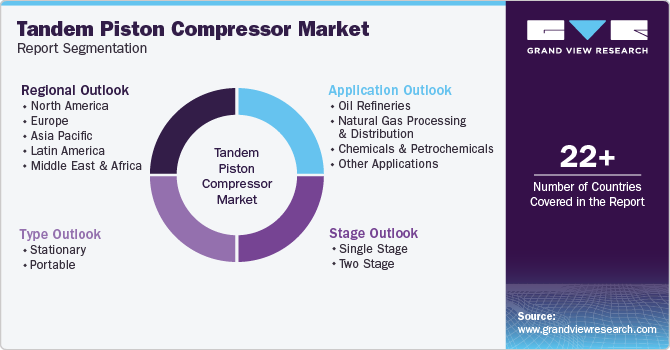
This report forecasts revenue growth at global, regional & country levels and provides an analysis of the industry trends in each of the sub-segments from 2021 to 2033. For this study, Grand View Research has segmented the global tandem piston compressor market report based on the type, stage, application, and region:
 To learn more about this report, Download Free Sample Report
 -
Type Outlook (Revenue, USD Million, 2021 - 2033)
-
Stationary
-
Portable
-
-
Stage Outlook (Revenue, USD Million, 2021 - 2033)
-
Single Stage
-
Two Stage
-
-
Application (Revenue, USD Million, 2021 - 2033)
-
Oil Refineries
-
Natural Gas Processing and Distribution
-
Chemicals and Petrochemicals
-
Other Applications
-
-
Regional Outlook (Revenue, USD Million, 2021 - 2033)
-
North America
-
U.S.
-
Canada
-
Mexico
-
-
Europe
-
UK
-
Germany
-
France
-
Italy
-
Spain
-
-
Asia Pacific
-
China
-
India
-
Japan
-
South Korea
-
Australia
-
-
Latin America
-
Brazil
-
Argentina
-
-
Middle East & Africa
-
South Africa
-
Saudi Arabia
-
UAE
-
-
Research Methodology
The tandem piston compressor market figures in this report are based on a proven research process that combines executive interviews with secondary research from proprietary databases, company filings, and recognized regulatory and institutional sources. Market size is built through value-chain sizing - reconciling supply-side and demand-side estimates - and triangulated with bottom-up and top-down approaches. Every estimate passes multiple levels of expert validation before publication, with each tandem piston compressor segment quantified using the revenue-capture definitions in the table below.
Segment Definition
Segment - Type
Revenue Capture Definition
Stationary
The segment refers to tandem piston compressors designed for fixed installation in industrial and commercial facilities where continuous or high-capacity compressed air or gas is required. The segment captures revenue generated from the sale of stationary tandem piston compressors across all end-use industries.
Portable
The segment refers to tandem piston compressors designed for mobility and temporary operations, typically mounted on wheeled frames, trailers, or skids for field use. The segment captures revenue generated from the sale of portable tandem piston compressors across all end-use industries.
Segment - Stage
Revenue Capture Definition
Single Stage
The segment refers to tandem piston compressors that compress air or gas to the required pressure in a single compression stage for moderate-pressure applications. The segment captures revenue generated from the sale of single-stage tandem piston compressors across all end-use industries.
Two Stage
The segment refers to tandem piston compressors that utilize two successive compression stages to achieve higher discharge pressures with improved operational efficiency. The segment captures revenue generated from the sale of two-stage tandem piston compressors across all end-use industries.
Segment - Application
Revenue Capture Definition
Oil Refineries
The segment captures revenue generated from sales of tandem piston compressors supplied for oil refinery applications, including process gas compression, instrument air systems, pressure boosting, and maintenance operations.
Natural Gas Processing and Distribution
The segment captures revenue generated from sale of tandem piston compressors supplied for natural gas processing, gas gathering, pressure boosting, storage, and pipeline distribution applications.
Chemicals and Petrochemicals
The segment captures revenue generated from sale of tandem piston compressors supplied for chemical and petrochemical applications, including process gas handling, feedstock compression, utility services, and production processes.
Other Applications
The segment captures revenue generated from sale of tandem piston compressors supplied for all other applications, including mining, power generation, manufacturing, food & beverage, pharmaceuticals, marine, and other industrial sectors not covered under the above segments.
Estimation Model
Layer Name
Key Question
Description
Industrial Gas Compression Demand Layer
Where are tandem piston compressors required?
Analyze demand across oil & gas, chemical processing, power generation, manufacturing, refrigeration, food & beverage, pharmaceuticals, and other industrial sectors. Assess compressed gas requirements, operating pressures, production capacities, and process-specific applications to establish the addressable demand for tandem piston compressors.
Industrial Investment & Capacity Expansion Layer
Where is new equipment demand being created?
Evaluate investments in manufacturing facilities, industrial processing plants, energy infrastructure, refrigeration systems, and gas handling facilities. Assess greenfield projects, plant expansions, equipment replacement cycles, and industrial modernization initiatives that drive procurement of new tandem piston compressors.
Product Adoption Layer
Which tandem piston compressor technologies are being deployed?
Segment demand by compressor type, stage, pressure range, application, and end-use industry. Apply adoption rates based on discharge pressure, flow capacity, energy efficiency, reliability, maintenance requirements, and operating conditions. Assess the increasing adoption of oil-free, energy-efficient, and digitally monitored tandem piston compressors for critical industrial applications requiring high operational reliability.
Revenue Generation Layer
How much market revenue is generated?
Estimate annual shipments of tandem piston compressors by product type, application, end-use industry, and region. Quantify revenues generated exclusively from the sale of new tandem piston compressors supplied to industrial facilities, OEMs, EPC contractors, and equipment distributors.
Delivered Customizations
This report has been delivered with the following In-depth customizations
Client Request
Customization Delivered
Value Adds
Competitive Benchmarking
A competitive benchmarking analysis was conducted by evaluating established market participants based on product portfolio, technological capabilities, manufacturing footprint, strategic initiatives, financial strength, innovation focus, and competitive positioning within the tandem piston compressor market.
This benchmarking enabled stakeholders to assess competitive strengths, identify product and technology differentiation opportunities, understand evolving competitive strategies, and develop informed market positioning and growth strategies.
Regional Segmentation
A comprehensive regional analysis was provided across key markets, highlighting regional demand trends, industrialization levels, manufacturing ecosystems, regulatory standards, and end-use industry developments influencing the tandem piston compressor market. The assessment also evaluated the contribution of major countries to regional market performance.
The regional insights helped stakeholders identify high-growth markets, optimize expansion strategies, allocate resources effectively, and align product offerings with region-specific industrial requirements and regulatory standards.
Opportunity Assessment
A detailed opportunity assessment was conducted by evaluating emerging industrial applications, advancements in energy-efficient compressor technologies, digital monitoring solutions, and investment trends across the tandem piston compressor market. The analysis identified high-growth opportunities across industrial manufacturing, oil & gas, natural gas processing, chemical processing, refrigeration, and other high-pressure applications.
This assessment enabled stakeholders to prioritize high-potential investment areas, align product development with evolving customer requirements, and capitalize on growth opportunities driven by industrial automation, energy efficiency initiatives, and expanding high-pressure compression applications.
Frequently Asked Questions About This Report
The global tandem piston compressor market size was estimated at USD 6.3 billion in 2025 and is expected to reach USD 6.5 billion in 2026.
The global tandem piston compressor market's revenue is expected to grow at a compound annual growth rate of 5.2% from 2026 to 2033, reaching USD 9.3 billion by 2033.
Asia Pacific dominated the tandem piston compressor market with the largest revenue share of 44.2% in 2025.
The global tandem piston compressors market is driven by increasing industrialization and the demand for energy-efficient, reliable compressed air solutions in sectors like manufacturing and construction. Technological advancements and the shift towards automation further boost demand, while environmental concerns promote the adoption of greener alternatives. Additionally, urbanization and diverse product offerings support market expansion, creating a favorable growth environment.
Asia Pacific is anticipated to be one of the fastest-growing regional markets over the forecast period, driven by rapid industrialization, expanding manufacturing capacity, increasing energy demand, and growing investments in petrochemical and infrastructure projects.
The stationary segment led the market with the largest revenue share of 58.2% in 2025.
The two-stage segment accounted for the largest revenue share of 53.0% in 2025.
The natural gas processing and distribution segment led the market with the largest revenue share of 34.7% in 2025.
Some of the key players operating in the Tandem Piston Compressor Market are Atlas Copco AB, BOGE, Shanghai Xinran Compressor Company (Asia-pacific Universal Machinery Company), Dorin S.p.A., BAC Compressors., NU AIR, Danfoss AS, FIMA s.r.l., Nardi Compressor SRL, Castair, REMEZA, ELGi, MGF Compressors Srl, KOBE STEEL, LTD., and Bristol Compressors.
About the Author(s)
Advanced Interior Materials Research Team
Advanced Materials · Advanced Interior MaterialsThis report was authored by the advanced interior materials research team at Grand View Research - comprising two research analysts, one senior research analyst, and one industry expert - with specialized expertise in the advanced interior materials segment of the advanced materials industry. All findings are based on proprietary advanced materials databases, executive interviews, and regulatory analysis, subject to internal peer review prior to publication.
Last Updated:
Speak to Analyst

Customize this report to your needs - add regions, segments, or data points, with 20% free customization.
Or view our licence options:


ISO 9001:2015 & 27001:2022 Certified
We are GDPR and CCPA compliant! Your transaction & personal information is safe and secure. For more details, please read our privacy policy.


