
- Home
- »
- Digital Media
- »
-
Technology CAD Software Market Size Report, 2026-2033GVR Report cover

Technology CAD Software Market (2026 - 2033)
Size, Share & Trends Analysis Report By Application (CMOS, Image Sensors, Solar Cells, Analog/RF Devices), By Region (North America, Europe, Asia Pacific, Latin America, MEA), And Segment Forecasts
Market Size, 2025
$12.1BMarket Estimate, 2026
$13.1BMarket Forecast, 2033
$22.9BCAGR, 2026–2033
8.3%Technology CAD Software Market Summary
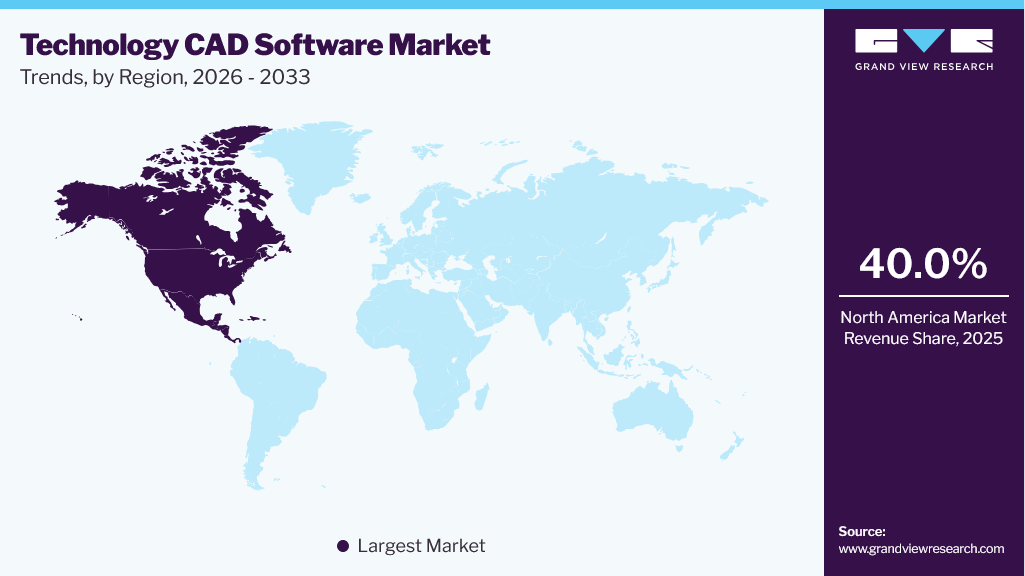
The global technology CAD software market size was valued at USD 12.1 billion in 2025 and is projected to grow from USD 13.1 billion in 2026 to USD 22.9 billion in 2033, at a CAGR of 8.3% from 2026 to 2033. North America dominated the market, accounting for a revenue share of 40.0% in 2025, driven by the strong presence of semiconductor manufacturers, advanced R&D capabilities, and increasing investments in next-generation chip design technologies.
Key Market Trends & Insights
- By application: Solar cells held the largest revenue share of over 31.0% in 2025.
Regional Highlights
- Largest regional market: North America (40.0% revenue share, 2025)
- Fastest-growing regional market: Asia Pacific (highest CAGR, 2026-2033)
Market Size & Forecast
- Market size in 2025: USD 12.1 Billion
- Estimated market size in 2026: USD 13.1 Billion
- Projected market size by 2033: USD 22.9 Billion
- CAGR (2026-2033): 8.3%
Three ways to get this report
Buy it, customize it, or ask a question.Ask an Analyst
Analyst response in 1 business day
- AccessReport author, directly
- Reply timeWithin 1 working day
- No sales callDirect answer only
- FormatEmail reply
- CostFree, no cost
Get the Full Report
What the study covers
- FormatsPDF · Excel · Dashboard
- Timeline2026–2033 annual, 2025 base
- Coverage20+ countries, 5 regions
- Companies10+ key players profiled
Customize the Report
20% free customization
- IncludeCountries, segments, points
- TailorTo your product definition
- ExtendDeeper competitor detail
- OrA fully bespoke study
- Turnaround5–10 working days
Market growth is primarily driven by the increasing complexity of semiconductor device architectures and the need to shorten development cycles and reduce manufacturing costs. TCAD software enables semiconductor manufacturers to simulate fabrication processes and device performance, helping optimize designs, improve wafer yields, and minimize reliance on costly experimental testing. Technology plays a critical role in the development of advanced semiconductor devices, including FinFETs, multi-gate transistors, and other nanoscale architectures.
 Source: Grand View Research, IR Documents, Primary Interviews, Paid DatabasesTo learn more about this report,
 Download Free Sample Report
 The rapid expansion of consumer electronics, wireless communication devices, and high-performance computing applications is further supporting market growth. Rising demand for compact, energy-efficient, and high-performance chips has increased the adoption of advanced simulation tools across semiconductor design and manufacturing workflows. In addition, the growing integration of electronics in healthcare applications, including wearable and implantable medical devices, is creating opportunities for TCAD software providers to support the design of sophisticated integrated circuits and electronic components.
The adoption of emerging technologies such as artificial intelligence (AI), machine learning (ML), Internet of Things (IoT), augmented reality (AR), virtual reality (VR), autonomous vehicles, and aerospace electronics is accelerating demand for advanced semiconductor solutions, thereby driving the need for TCAD software. Furthermore, ongoing innovations in semiconductor manufacturing processes, including advanced lithography techniques and next-generation transistor designs, are increasing the importance of simulation-based design approaches.
Market participants are focusing on product innovation, strategic partnerships, mergers and acquisitions, and geographic expansion to strengthen their competitive positions. The continued growth of electronics manufacturing across the Asia Pacific and the increasing trend toward device miniaturization are expected to create significant opportunities for TCAD software vendors over the forecast period.
Analyst Perspective
The global technology CAD software market is witnessing significant growth as semiconductor manufacturers increasingly rely on advanced simulation-driven design and process optimization to address the growing complexity of next-generation devices. The market is evolving toward AI-enabled and highly integrated simulation platforms that enable faster product development, improved device performance, and reduced manufacturing costs.
Growth is being driven by the expanding adoption of semiconductors across consumer electronics, automotive, healthcare, renewable energy, artificial intelligence (AI), Internet of Things (IoT), and autonomous systems. As device architecture becomes more sophisticated, including FinFETs, Gate-All-Around (GAA) transistors, silicon carbide (SiC) power devices, and advanced image sensors, the demand for accurate process and device simulation tools continues to grow. TCAD software plays a critical role in reducing reliance on costly experimental wafer runs, improving yield optimization, and accelerating time-to-market for new semiconductor technologies.
Despite strong growth prospects, challenges such as high implementation costs, substantial computational requirements, and the need for specialized technical expertise may limit adoption among certain end users. However, continuous advancements in AI-driven modeling capabilities, cloud-based simulation environments, strategic industry collaborations, and increasing investments in global semiconductor manufacturing capacity are expected to enhance market penetration. The expansion of semiconductor fabrication facilities across North America and the Asia Pacific, coupled with the industry's focus on innovation and process efficiency, is anticipated to create substantial growth opportunities for the TCAD software market throughout the forecast period.
Application Insights
The solar cells segment accounted for the largest revenue share in 2025, at over 31.0%. Segment growth is primarily driven by the increasing deployment of solar cells in renewable energy generation, electric vehicles, and emerging solar-powered transportation applications. The growing global emphasis on clean energy adoption and carbon emissions reduction has further accelerated demand for advanced solar cell technologies. For instance, in December 2025, Waaree Energies announced that its solar PV cell manufacturing facility in Gujarat received Approved List of Models and Manufacturers (ALMM) List-II approval with an annual production capacity of 5.25 GW, including advanced N-type TOPCon cells. Such investments in high-efficiency solar cell manufacturing highlight the growing importance of semiconductor process optimization and device simulation capabilities, supporting demand for TCAD software across solar cell development and production environments.
The image sensors segment is expected to register the fastest CAGR of approximately 9.0% from 2026 to 2033. Image sensors are increasingly utilized across smartphones, digital cameras, autonomous vehicles, medical imaging systems, industrial automation equipment, and surveillance applications. As demand for higher-performance and more sophisticated sensor technologies continues to grow, manufacturers are increasingly relying on advanced simulation tools to optimize device architectures and fabrication processes. In May 2026, Sony Semiconductor Solutions and TSMC entered into a strategic partnership through a memorandum of understanding (MoU) to jointly develop and manufacture next-generation image sensors. The collaboration is expected to accelerate innovation in advanced sensor technologies, thereby increasing the need for TCAD software solutions to support device modeling, performance simulation, and process optimization throughout the image sensor development lifecycle.
Regional Insights
North America dominated the Technology Computer-Aided Design (TCAD) software market, accounting for over 40.0% of revenue in 2025. The region's leadership is primarily attributed to the strong presence of leading TCAD software providers, semiconductor manufacturers, and advanced research institutions. In addition, the increasing deployment of connected, autonomous, and software-defined vehicles, coupled with growing investments in artificial intelligence (AI), high-performance computing, and advanced semiconductor technologies, is driving demand for sophisticated semiconductor design and simulation tools.
 To learn more about this report, Download Free Sample Report
 The region is also witnessing significant investments in AI-enabled chip design, advanced packaging technologies, and next-generation semiconductor manufacturing processes, which are increasing the complexity of device development. As a result, semiconductor companies are increasingly adopting TCAD software to perform process simulations, optimize device architecture, improve manufacturing yields, and accelerate time-to-market for advanced semiconductor products. For instance, in September 2025, Synopsys expanded the generative AI capabilities of its Synopsys.ai Copilot platform from its California headquarters, enhancing engineering productivity and accelerating complex chip design workflows. Such developments reflect the growing adoption of AI-driven semiconductor design and simulation technologies, supporting demand for advanced TCAD software solutions across the North American semiconductor ecosystem.
Asia Pacific Technology CAD Software Market Trends
Asia Pacific is projected to witness the fastest growth over the forecast period. The adoption of Technology Computer-Aided Design (TCAD) software in the region is expected to increase due to the expanding semiconductor manufacturing ecosystem and the growing presence of electronics manufacturing companies, particularly in China, Japan, South Korea, and Taiwan. Furthermore, governments and semiconductor companies across the region are investing heavily in advanced semiconductor manufacturing and AI-driven chip development capabilities. These investments are increasing the need for sophisticated device and process simulations, thereby supporting the adoption of TCAD software for developing advanced process nodes and high-performance semiconductor devices. For instance, in June 2025, Rapidus Corporation announced a collaboration with Siemens Digital Industries Software to support semiconductor design and manufacturing processes for the 2 nm technology generation. The collaboration includes the joint development of process design kits (PDKs) and enhancements in manufacturing optimization and reliability assessment capabilities, which are expected to increase the adoption of TCAD software for device modeling, process simulation, and design-manufacturing co-optimization across the Asia Pacific semiconductor ecosystem.
Key Technology CAD Software Market Companies
The market for technology computer-aided design software is consolidated and characterized by intense competitive rivalry. In addition, the market has witnessed various inorganic growth strategies, such as acquisitions and mergers, partnerships, and collaborations, adopted by companies in recent years.
Key Technology CAD Software Companies
The following key companies have been profiled for this study on the technology CAD software market:
-
Cogenda
-
Crosslight Software Inc.
-
NTT DATA Mathematical Systems Inc.
-
Global TCAD Solutions (GTS) GmbH
-
Silvaco, Inc.
-
Synopsys, Inc.
Recent Developments
- In April 2026, Silvaco announced a partnership with Taiwan's Industrial Technology Research Institute (ITRI) to support next-generation microcontroller unit (MCU) development and startup innovation. The collaboration expanded the deployment of Silvaco's semiconductor simulation technologies and reinforced the use of TCAD solutions in advanced chip design workflows.
- In March 2026, Silvaco announced a strategic partnership with APEC to advance the development of silicon carbide (SiC) power devices. As part of the collaboration, APEC has expanded its deployment of Silvaco's Victory TCAD and EDA software suites. This expanded adoption is designed to accelerate innovation in next-generation power semiconductors while further solidifying Silvaco's leadership in AI-driven semiconductor process and device simulation.
- In June 2025, Synopsys launched the Sentaurus X 2025.06 release, introducing enhanced semiconductor process and device simulation capabilities, improved physical models, and greater simulation efficiency. The update strengthened the company's TCAD portfolio, supporting advanced-node semiconductor development and device optimization.
Technology CAD Software Market Report Scope
Report Attribute
Details
Market size in 2025
USD 12.1 billion
Estimated market size in 2026
USD 13.1 billion
Projected market size by 2033
USD 22.9 billion
Growth rate
CAGR of 8.3% from 2026 to 2033
Base year for estimation
2025
Actual data
2021 – 2024
Forecast period
2026 – 2033
Quantitative units
Revenue in USD billion, and CAGR from 2026 to 2033
Report coverage
Revenue forecast, company ranking, competitive landscape, growth factors, and trends
Segments covered
Application, region
Regional scope
North America; Europe; Asia Pacific; Latin America; Middle East & Africa
Country scope
U.S.; Canada; UK; Germany; France; China; India; Japan; Australia; South Korea; Brazil; Mexico; Saudi Arabia; South Africa; UAE
Key companies profiled
Cogenda; Crosslight Software Inc.; NTT DATA Mathematical Systems Inc.; Global TCAD Solutions (GTS) GmbH; Silvaco, Inc.; Synopsys, Inc.
Customization scope
Free report customization (equivalent to 8 analyst working days) with purchase. Addition or alteration to country, regional & segment scope.
Pricing and purchase options
Avail of customized purchase options to meet your exact research needs. Explore purchase options
Global Technology CAD Software Market Report Segmentation
This report forecasts revenue growth at the global, regional, and country levels and provides an analysis of the latest industry trends and opportunities across each sub-segment from 2021 to 2033. For this study, Grand View Research has segmented the global technology CAD software market report based on application and region:
- Application Outlook (Revenue, USD Billion, 2021 - 2033)
- CMOS
- Image Sensors
- Solar Cells
- Analog/RF Devices
- Regional Outlook (Revenue, USD Billion, 2021 - 2033)
- North America
- U.S.
- Canada
- Europe
- UK
- Germany
- France
- Asia Pacific
- China
- Japan
- India
- Australia
- South Korea
- Latin America
- Brazil
- Mexico
- Middle East and Africa
- Saudi Arabia
- South Africa
- UAE
- North America
Frequently Asked Questions About This Report
The global technology CAD software market size was valued at USD 12.1 billion in 2025 and is estimated at USD 13.1 billion for 2026.
Solar cells dominated the technology CAD software market with a share of 31.0% in 2025, while image sensors is the fastest-growing segment.
Some key players operating in the technology CAD software market include Cogenda, Crosslight Software Inc., NTT DATA Mathematical Systems Inc., Global TCAD Solutions (GTS) GmbH, Silvaco, Inc., and Synopsys, Inc., among others.
North America dominated with a 40.0% revenue share in 2025.
The global technology CAD software market is expected to grow at a CAGR of 8.3% from 2026 to 2033, reaching USD 22.9 billion by 2033.
About the Author(s)
Digital Media Research Team
Technology · Digital MediaThis report was authored by the digital media research team at Grand View Research - comprising two research analysts, one senior research analyst, and one industry expert - with specialized expertise in the digital media segment of the technology industry. All findings are based on proprietary technology databases, executive interviews, and regulatory analysis, subject to internal peer review prior to publication.
Last Updated:
Speak to Analyst

Customize this report to your needs - add regions, segments, or data points, with 20% free customization.
Or view our licence options:


ISO 9001:2015 & 27001:2022 Certified
We are GDPR and CCPA compliant! Your transaction & personal information is safe and secure. For more details, please read our privacy policy.


