
- Home
- »
- Communications Infrastructure
- »
-
Telecom Tower Market Size And Share Report, 2026-2033GVR Report cover

Telecom Tower Market (2026 - 2033)
Size, Share & Trend Analysis Report By Tower Type (Lattice Towers, Monopole Towers, Guyed Towers), By Seat Type, By Ownership, By Power Source, By Region, And Segment Forecasts
Market Size, 2025
$30.9BMarket Estimate, 2026
$31.6BMarket Forecast, 2033
$42.1BCAGR, 2026–2033
4.2%Telecom Tower Market Summary
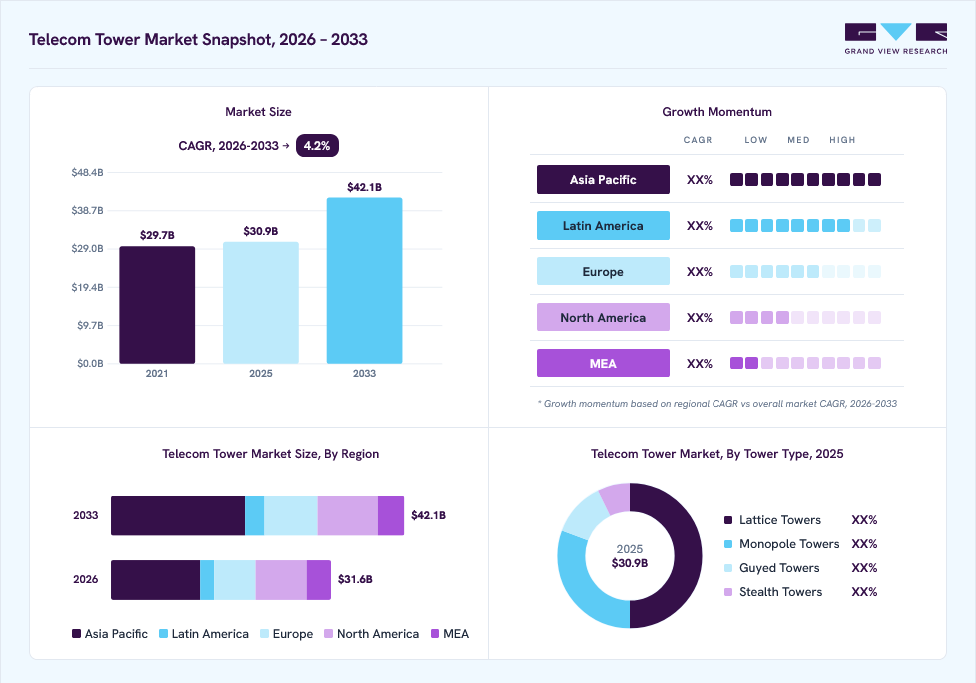
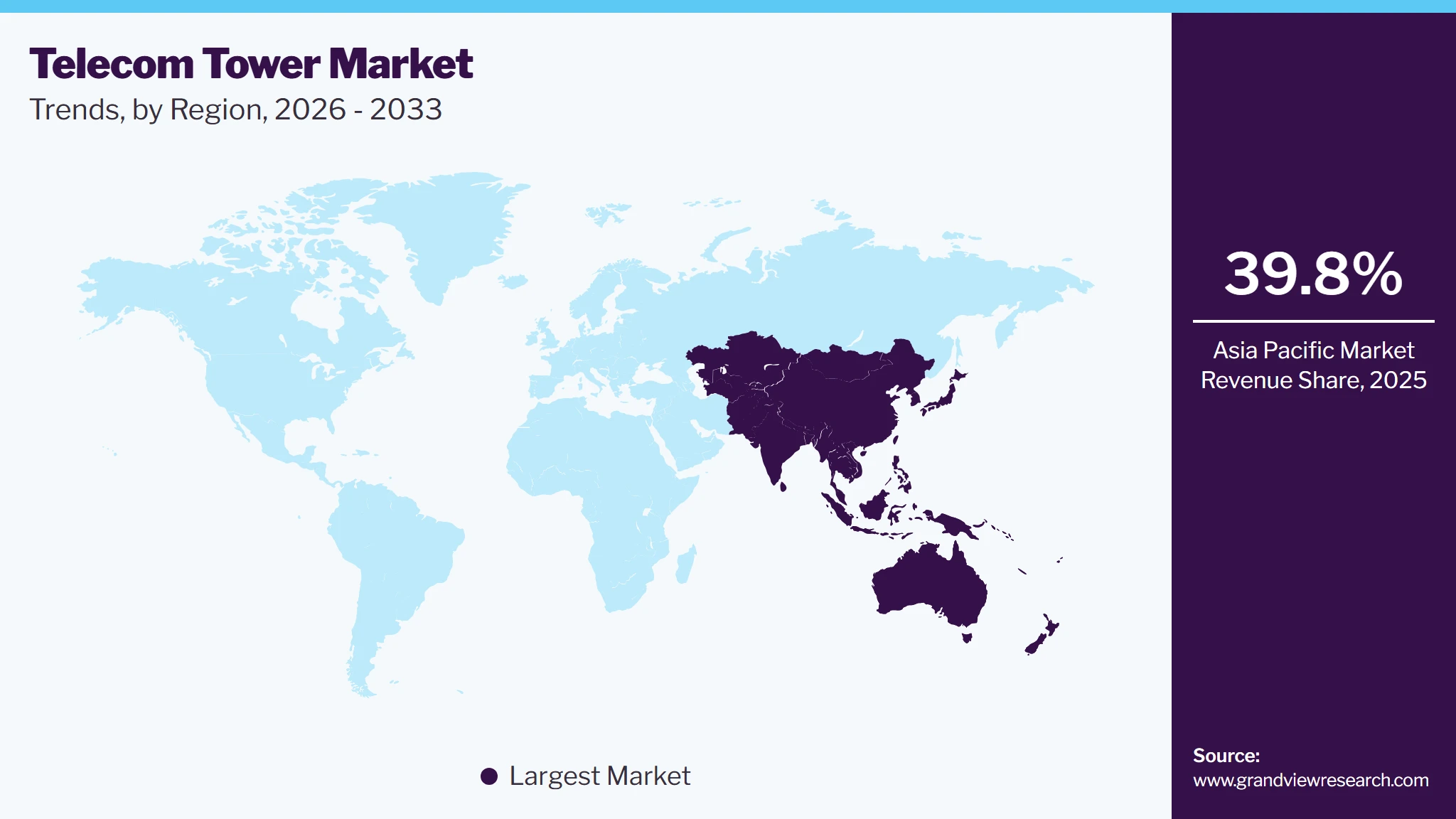
The global telecom tower market size was valued at USD 30.9 billion in 2025 and is projected to grow from USD 31.6 billion in 2026 to USD 42.1 billion by 2033, at a CAGR of 4.2% from 2026 to 2033. Asia Pacific dominated the market, accounting for the largest revenue share of 39.8% in 2025. The increasing demand for 5G network infrastructure is driving the growth of the telecom tower market.
 Source: Grand View Research, IR Documents, Primary Interviews, Paid DatabasesTo learn more about this report,
 Download Free Sample Report
Key Market Trends & Insights
- By tower type: Lattice tower segment accounted for the highest revenue share of 49.9% of the global revenue in 2025.
- By installation type: Ground-based towers (GBT) segment led the market and accounted for 80.7% of the global revenue in 2025.
- By ownership: Independent tower companies (tower companies) segment accounted for the largest share of 59.0% in 2025.
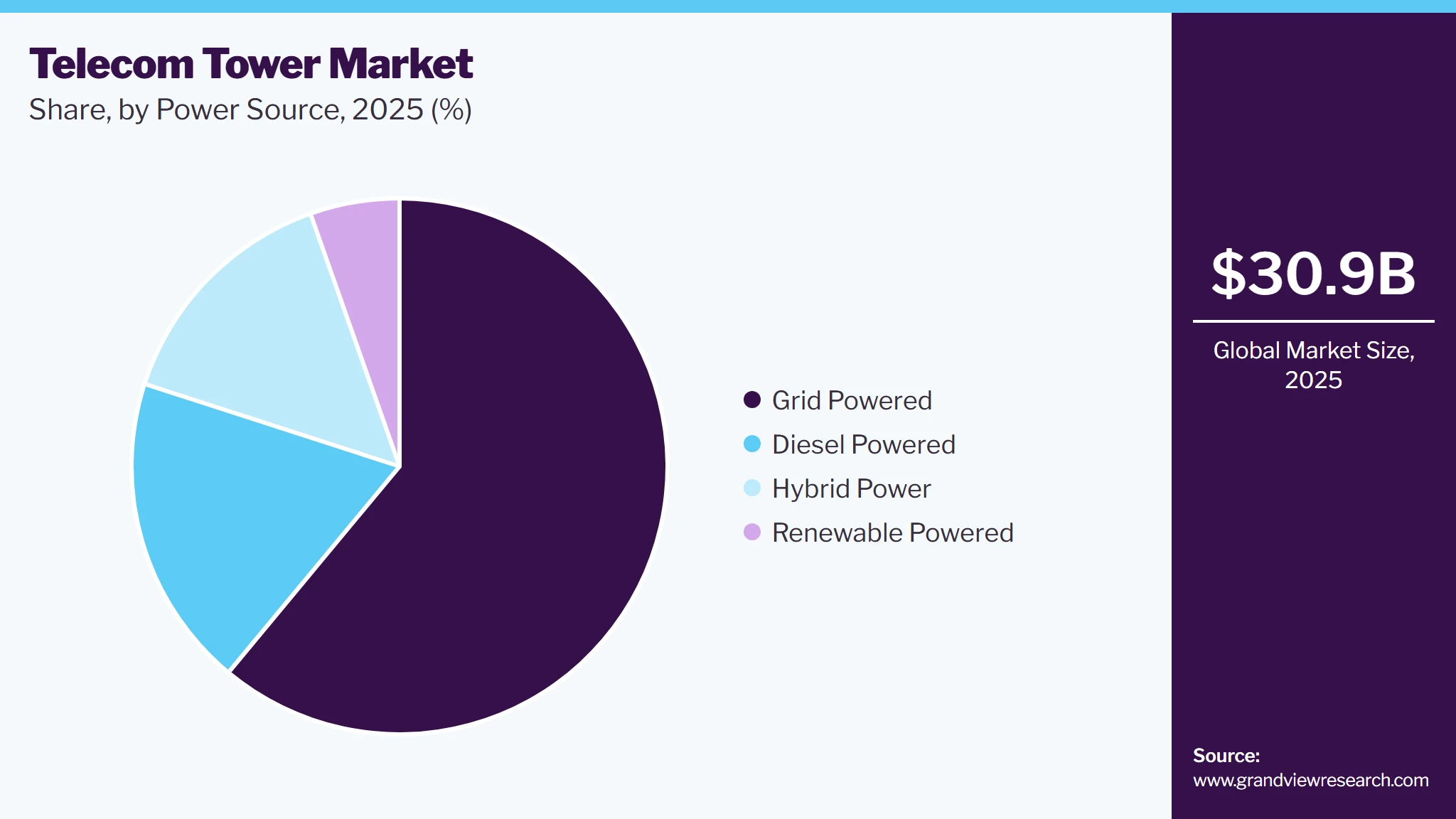
- By power sources: Grid powered segment accounted for the largest market revenue share of 61.0% in 2025.
Regional Highlights
- Largest regional market: Asia Pacific (39.8% revenue share, 2025)
- By country: China held the largest market share in 2025.
Market Size & Forecast
- Market size in 2025: USD 30.9 Billion
- Estimated market size in 2026: USD 31.6 Billion
- Projected market size by 2033: USD 42.1 Billion
- CAGR (2026-2033): 4.2%
Prism AI by Grand View Research Free to tryAsk a question about the telecom tower marketTry asking✓Every figure cited from GVR research Prefer the report? Download free sample →
The evolution of 5G-Advanced is increasing the demand for high-capacity wireless network infrastructure in the market. It requires robust fiber backhaul to transport large volumes of data with low latency. This is driving investments in advanced wireless infrastructure to meet growing network demands. As a result, telecom tower operators are expanding and upgrading tower sites to improve network capacity and reliability. These infrastructure enhancements are driving the growth of the telecom tower market.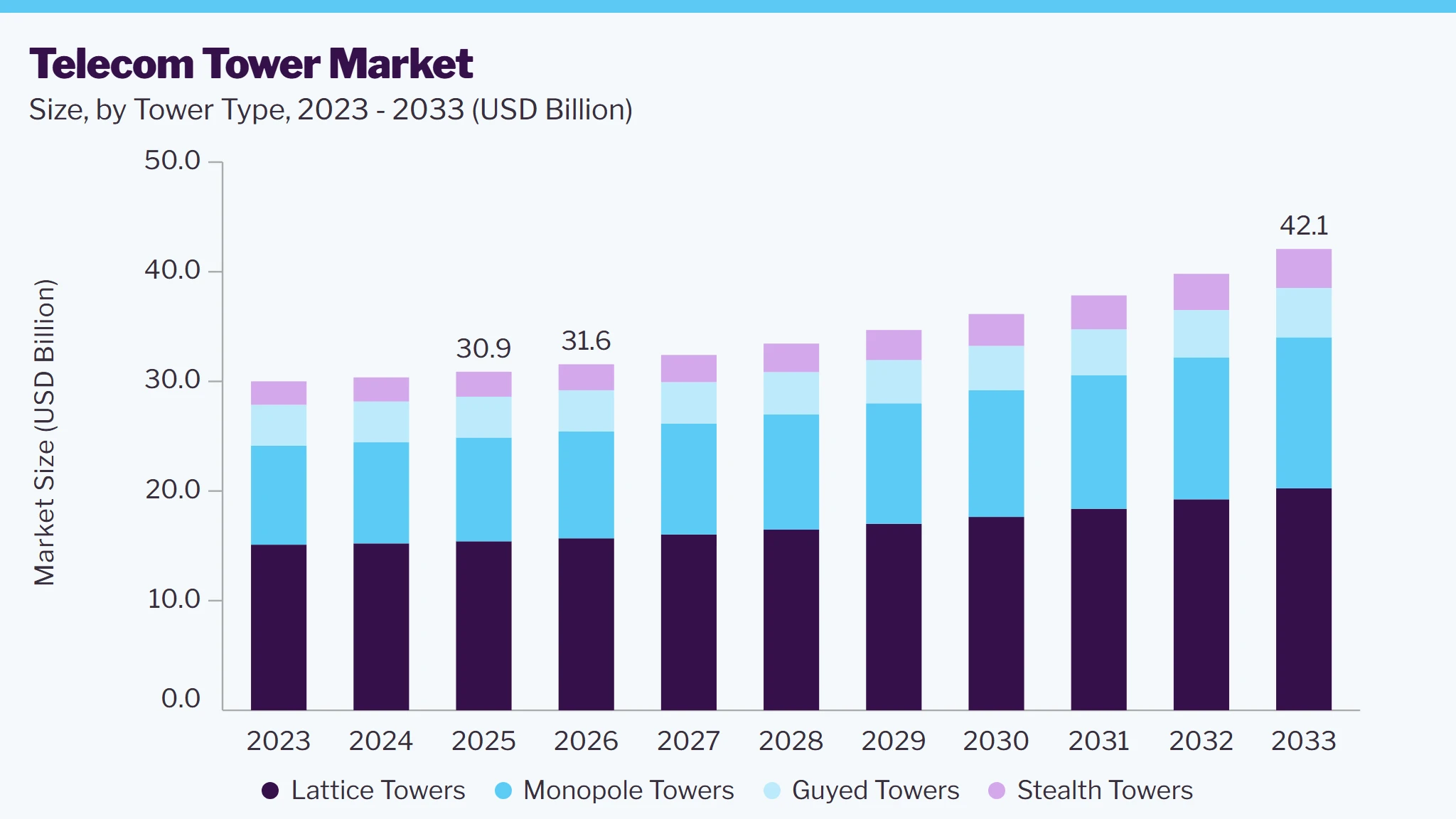 To learn more about this report, Download Free Sample Report
The integration of Edge AI and Wi-Fi 8 technologies is an emerging advancement in wireless communication infrastructure. It enables lower latency, higher reliability, and intelligent traffic management for AI-driven applications and connected devices. As enterprise data traffic and real-time workloads continue to increase, telecom operators are adopting these technologies to improve network efficiency and user experience. Furthermore, telecom tower infrastructure is being enhanced to support these next-generation wireless technologies. These infrastructure enhancements improve network coverage, capacity, and performance, thereby supporting the growth of the telecom tower market.
The rapid expansion of wireless communication networks is increasing the need for stringent regulations and safety compliance in telecom tower deployment. Telecom tower projects must comply with aviation, radio-frequency (RF), environmental, zoning, and land-use regulations to ensure safe and reliable network deployment. As these requirements become more stringent, tower operators are adopting standardized engineering and structural safety practices. Telecom tower solutions meet these requirements by providing durable, structurally resilient infrastructure that complies with regulatory standards. This enables reliable network expansion and supports the growth of the telecom tower market.
Increasing network congestion in high-density wireless environments is a key restraint for the telecom tower market. Rising mobile data traffic and the growing number of connected devices require additional tower deployments and continuous network densification. This increases infrastructure investment, site acquisition, and operating costs for telecom operators. As a result, higher deployment expenses can restrain the growth of the telecom tower market.
Market Dynamics
The telecom tower market is experiencing sustained growth, driven by rapid mobile network expansion, rising data consumption, and the global transition to advanced wireless technologies such as 5G and future 6G networks. Growing demand for enhanced network coverage, low-latency connectivity, and dense small-cell deployments is encouraging telecom operators and infrastructure providers to expand tower networks. The increasing adoption of tower-sharing models, energy-efficient tower solutions, and digital monitoring technologies is reshaping the competitive landscape. Additionally, investments in rural connectivity programs, smart city infrastructure, and network densification are expected to support long-term market expansion.
The rapid deployment of 5G networks globally is creating significant demand for telecom tower infrastructure capable of supporting higher frequency bands, increased network density, and improved coverage requirements. Unlike previous generations, 5G networks require more network sites due to shorter signal propagation ranges, particularly in high-frequency spectrum bands such as millimeter waves. Telecom operators are facing challenges in expanding coverage, increasing capacity in urban areas, and ensuring reliable connectivity for applications such as autonomous vehicles, industrial automation, and IoT ecosystems. As a result, the need for additional tower installations and upgrades of existing infrastructure has become a major growth driver for the telecom tower market.
Telecom tower solutions enable operators to rapidly expand network coverage by providing scalable infrastructure for antenna installation, radio equipment deployment, and network densification. Tower companies support operators through shared infrastructure models, allowing multiple telecom providers to utilize the same tower assets and reduce capital expenditure requirements. Modern tower solutions integrated with advanced power systems, remote monitoring capabilities, and modular designs improve operational efficiency and accelerate 5G rollout. The increasing deployment of new towers and upgrades of existing sites is expected to drive revenue growth across tower types, ownership models, and installation categories.
Telecom tower deployment requires substantial capital investment for land acquisition, tower construction, equipment installation, regulatory approvals, and ongoing maintenance. The complexity of obtaining site permissions, managing environmental regulations, and securing suitable locations can significantly delay infrastructure deployment. In developing regions, limited access to financing and challenging geographical conditions further increases deployment costs. These factors create barriers for smaller operators and infrastructure providers, limiting the speed of tower network expansion.
High deployment costs disproportionately affect rural and remote regions, where lower population density reduces the economic feasibility of new tower installations. Emerging markets in regions such as parts of Africa, Latin America, and Southeast Asia experience slower infrastructure development due to longer investment recovery periods. The restraint also encourages telecom operators to adopt tower-sharing arrangements and lease-based models rather than directly owning infrastructure. Although this supports tower company’s growth, it can slow overall new tower construction in cost-sensitive markets.
The increasing focus on sustainable telecommunications infrastructure is creating opportunities for renewable-powered telecom towers, particularly in regions with unreliable grid connectivity. Telecom operators and tower companies are seeking alternatives to traditional diesel-powered backup systems due to rising fuel costs, carbon reduction targets, and regulatory pressure to minimize emissions. Advances in solar energy systems, battery storage technologies, and hybrid power solutions are enabling the deployment of energy-efficient tower infrastructure in both developed and emerging markets.
Renewable-powered telecom towers provide significant growth opportunities for tower infrastructure providers, energy solution suppliers, and technology integrators. Companies offering integrated solar, battery storage, remote energy monitoring, and hybrid power management solutions are positioned to capture increasing demand from operators seeking lower operational costs and sustainable network expansion. Rural connectivity initiatives and off-grid network deployments are expected to accelerate the adoption of renewable-powered towers, particularly across emerging economies. This trend will create new revenue opportunities across the level of autonomy segment.
Market Concentration & Characteristics
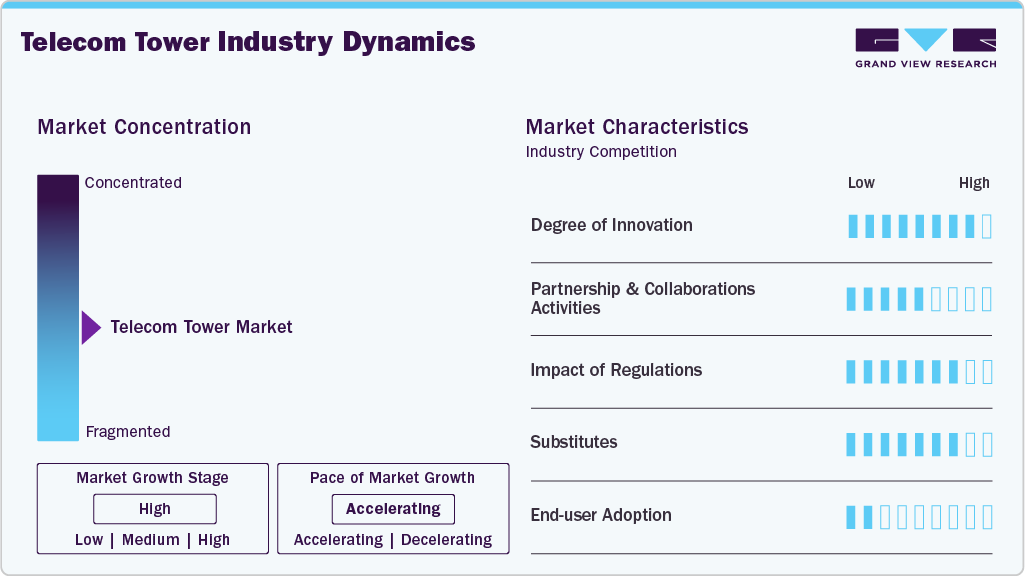
The telecom tower market is moderately consolidated due to the presence of several global and regional infrastructure providers offering macro towers, rooftop towers, small cell infrastructure, and customized tower solutions for telecom operators, wireless service providers, and government connectivity initiatives. Companies are focusing on expanding tower portfolios, increasing colocation capabilities, deploying 5G-ready infrastructure, and investing in smart tower management systems, renewable energy solutions, and energy-efficient power technologies. As mobile data consumption, 5G network deployment, and rural connectivity programs accelerate globally, market participants continue to compete for market share through tower footprint expansion, strategic partnerships, infrastructure sharing models, operational efficiency, and sustainable tower solutions rather than for complete market dominance.
 To learn more about this report, Download Free Sample Report
Moderate market concentration is further supported by the strong presence of established companies such as ATC TRS V LLC., China Tower Corporation Limited, Crown Castle, and Cellnex, which continue to strengthen their market positions through large-scale tower portfolios, acquisitions, long-term leasing agreements, and partnerships with telecom operators. At the same time, companies including Vantage Towers, EDOTCO Group, Phoenix Tower International, and PT TOWER BERSAMA INFRASTRUCTURE TBK. Infrastructure, are expanding their presence through regional growth strategies, tower-sharing initiatives, and investments in emerging connectivity markets. Market participants primarily compete on tower availability, geographic coverage, multi-tenant leasing capabilities, network deployment speed, energy efficiency, infrastructure quality, regulatory compliance, and long-term relationships with telecom operators, thereby maintaining the moderately consolidated nature of the telecom tower market.
Analyst Perspective
The telecom tower market is positioned for sustained growth as global connectivity requirements, 5G deployment, and increasing mobile data consumption continue to drive infrastructure investments. Tower sharing models, smart tower technologies, and renewable-powered solutions are transforming traditional telecom infrastructure operations. The market is expected to witness increased investments toward energy-efficient towers, network densification, and digital infrastructure management. Competitive dynamics are shifting toward tower companies and infrastructure providers capable of offering scalable, multi-operator, and sustainable tower solutions.
Tower Type Insights
The lattice towers segment accounted for 49.9% of the largest share of global revenue in 2025. The growing demand for wider network coverage and higher data capacity is increasing the deployment of lattice towers segment. Lattice towers support multiple antennas and communication equipment on a single structure to meet these requirements. The robust structural design enables telecom operators to accommodate future network upgrades without significant infrastructure modifications. This improves network efficiency, optimizes infrastructure utilization, and supports the growth of the telecom tower market.
The stealth towers segment is projected to grow at the fastest CAGR over the forecast period. The increasing deployment of telecom infrastructure in urban and residential areas is driving the demand for stealth towers. Local zoning regulations and aesthetic requirements are encouraging telecom operators to install towers that blend with the surrounding environment. Stealth tower solutions integrate wireless communication equipment into structures designed to minimize visual impact while maintaining network performance. This creates new opportunities in locations where conventional towers are restricted.
Seat Ownership Insights
The ground-based towers segment accounted for 80.7% of the largest share of global revenue in 2025. The increasing expansion of mobile network coverage in suburban and rural areas is driving the adoption of ground-based towers. Growing demand for reliable connectivity is encouraging telecom operators to deploy towers that provide wide-area coverage and support multiple mobile network operators. Ground-based tower solutions offer high structural strength, long-range coverage, and heavy-equipment load capacity for large-scale network deployments. Their scalable design also enables future network upgrades, making them well-suited for long-term telecom infrastructure expansion.
The rooftop towers (RTT) type segment is projected to grow at the fastest CAGR over the forecast period, driven by increasing demand for enhanced network capacity in densely populated urban areas. Limited land availability and the need for cost-effective network expansion are encouraging telecom operators to utilize existing building infrastructure. Rooftop tower solutions support multiple mobile network operators and multiple antenna configurations to improve network capacity and coverage. Structural compliance and safety assessments ensure reliable deployment, creating an efficient approach for expanding urban wireless networks.
Ownership Insights
The independent tower companies (TowerCos) segment accounted for the largest share of global revenue in 2025 and is projected to grow at the fastest CAGR over the forecast period. The increasing adoption of infrastructure sharing models is driving the growth of independent tower companies (tower companies). Telecom operators are shifting toward leased tower infrastructure to reduce capital expenditure and improve operational flexibility. tower companies provide shared multi-operator solutions that enhance asset utilization and enable faster network expansion. This model is accelerating investments in telecom infrastructure and strengthening the role of tower companies in the market.
The joint venture towers segment is poised for significant growth from 2026 to 2033. The increasing adoption of joint venture tower ownership is driven by the growing need for collaborative telecom infrastructure development and network expansion. Telecom operators and infrastructure providers are forming partnerships to combine resources, share expertise, and accelerate deployment across new and existing markets. These collaborations enable joint management of tower infrastructure, improve utilization, and support wider network coverage. This approach strengthens telecom infrastructure development and enables faster deployment of advanced wireless networks.
Power Source Insights
The grid powered segment accounted for the largest market revenue share in 2025. The increasing demand for a reliable power supply to support expanding telecom networks is driving adoption in the grid-powered segment. As 5G deployments expand and data consumption continues to rise, telecom operators require a reliable electricity supply to maintain network performance and uninterrupted connectivity. Grid-connected power solutions provide stable energy access, reduce operational challenges, and improve tower reliability, making them a preferred choice in areas with established power infrastructure.
 To learn more about this report, Download Free Sample Report
The renewable powered segment is projected to grow at the fastest CAGR over the forecast period, the growing focus on sustainable telecom infrastructure is creating new opportunities for renewable-powered telecom towers. Telecom operators are increasingly integrating solar energy, battery storage, and hybrid power systems to reduce energy costs and minimize environmental impact. These renewable solutions support efficient tower operations in remote locations with limited grid access while helping operators achieve their sustainability goals.
Regional Insights
The Asia Pacific telecom tower market led the global market and accounted for 39.8% of the global revenue in 2025 and is projected to grow at the fastest CAGR over the forecast period. Growing digital transformation and rising demand for mobile connectivity are creating opportunities for telecom tower expansion in the Asia Pacific. Rapid growth in smartphone usage, cloud services, and enterprise connectivity is driving the need for additional tower infrastructure. This trend supports investments in ground-based towers, shared networks, and efficient power systems.
 To learn more about this report, Download Free Sample Report
The China telecom tower market held a dominant share in the Asia Pacific market. Increasing investment in large-scale 5G network expansion is driving demand for telecom towers in China. The rapid deployment of advanced communication networks requires extensive tower infrastructure to support increasing data traffic and connected devices. This is accelerating the development of high-capacity tower networks and efficient power management solutions.
Japan telecom tower market is expected to grow at a significant CAGR over the forecast period. The growing adoption of advanced, space-efficient tower solutions is influencing the trend in Japan. Limited urban space and increasing connectivity requirements are encouraging the use of rooftop towers, monopole towers, and stealth infrastructure designs. These solutions help operators enhance coverage while maintaining urban aesthetics and efficient land utilization.
Europe Telecom Tower Market Trends
The Europe telecom tower market is poised significant growth from 2026 to 2033. Rising focus on sustainable telecom infrastructure is creating opportunities for renewable-powered tower deployments in Europe. Tower operators are increasingly integrating solar energy, hybrid power systems, and energy-efficient solutions to reduce operational costs and carbon emissions. The transition toward greener networks is supporting the adoption of advanced power technologies across telecom sites.
The UK telecom tower market is driven by the increasing demand for improved mobile connectivity is driving telecom tower expansion in the UK The growth of 5G services and rising consumer data usage are encouraging operators to strengthen network coverage through new tower installations and upgrades. This demand is supporting the deployment of rooftop towers and compact infrastructure solutions in urban areas.
The Germany telecom tower market held a substantial share in the Europe market. Growing emphasis on network coverage obligations is influencing telecom tower development in Germany. Regulatory requirements to improve mobile connectivity in underserved areas are encouraging operators to expand their tower infrastructure beyond major urban locations. These initiatives are supporting the wider deployment of ground-based and shared tower solutions to enhance nationwide network availability.
North America Telecom Tower Market Trends
North America telecom tower market held a significant share of the market in 2025. Increasing deployment of advanced wireless networks is driving demand for telecom towers across North America. The expansion of 5G infrastructure and growing requirements for high-speed connectivity are encouraging operators to upgrade tower networks and improve coverage capacity. This is accelerating the deployment of advanced tower infrastructure to support broader coverage and enhance network performance.
The U.S. telecom tower market is held the largest market share in 2025. The growing deployment of small cell infrastructure is shaping the trend in the U.S. The increasing demand for faster data speeds and improved network capacity is encouraging operators to deploy compact tower solutions in high-density urban areas. This shift is accelerating the adoption of monopole towers, rooftop installations, and advanced network densification strategies across the U.S.
Key Telecom Tower Company Insights
Key players operating in the telecom tower market include ATC TRS V LLC., Cellnex, Crown Castle, AT&T Intellectual Property, Vertical Bridge, REIT, LLC., Phoenix Tower International, Vantage Towers, PT TOWER BERSAMA INFRASTRUCTURE TBK., EDOTCO Group Sdn Bhd and China Tower Corporation Limited. Key players in the telecom tower market are expanding their telecom infrastructure portfolios with advanced tower solutions while strengthening partnerships with telecom operators and infrastructure providers. Companies are focusing on improving network coverage, enhancing energy efficiency, supporting 5G deployment, and meeting the growing demand for grid-powered, renewable-powered, and shared telecom tower infrastructure.
-
Cellnex is a wireless telecommunications infrastructure operator in Europe, providing tower and connectivity solutions for mobile networks, broadcasting, and digital infrastructure. The company follows a shared infrastructure model that helps operators expand networks efficiently while supporting reliable voice, data, and audiovisual services. Cellnex focuses on developing infrastructure ecosystems to enable advanced connectivity and the adoption of new technologies across Europe markets.
-
Crown Castle is a provider of shared communications infrastructure. The company operates a large portfolio of wireless towers that support mobile networks and advanced connectivity services. The company helps wireless operators expand coverage and capacity through its tower infrastructure, enabling reliable connections for businesses and communities. Crown Castle focuses on building and managing scalable communication infrastructure to support the growing demand for wireless connectivity.
Key Telecom Tower Companies
The following key companies have been profiled for this study on the telecom tower market.
-
ATC TRS V LLC.
-
Cellnex
-
Crown Castle
-
AT&T Intellectual Property
-
Vertical Bridge, REIT, LLC.
-
Phoenix Tower International
-
Vantage Towers
-
PT TOWER BERSAMA INFRASTRUCTURE TBK.
-
EDOTCO Group Sdn Bhd
-
China Tower Corporation Limited.
Company Categorization
Operating Strategies
Competitive Edge
Weaknesses
Mature Players: China Tower Corporation Limited., Crown Castle, Cellnex, ATC TRS V LLC.
Mature players in the telecom tower market are focus on large-scale tower ownership, multi-tenant leasing models, geographic expansion, and long-term partnerships with telecom operators.
Mature players gain a competitive advantage through global presence, extensive tower portfolios, diversified customer base, and strong financial capabilities enable these companies to support large-scale network expansion projects.
These companies often face challenges in managing extensive telecom tower portfolios, requiring significant capital for site operations, maintenance, and network upgrades. Their large-scale operations and regulatory obligations can reduce operational flexibility and slow infrastructure expansion in emerging markets.
Emerging Players: Vantage Towers, EDOTCO Group Sdn Bhd, Phoenix Tower International
Emerging players in the telecom tower market are focus on regional expansion, strategic acquisitions, infrastructure sharing, and partnerships with telecom operators to strengthen their tower portfolios. It emphasizes sustainable towers, renewable energy adoption, and efficient infrastructure management.
Emerging players gain market traction through emerging market expansion, flexible business models, and focus on green telecom infrastructure solutions.
Emerging players operate in fewer countries and manage smaller tower portfolios, limiting economies of scale and revenue diversification. Their greater reliance on regional telecom investments and regulatory conditions makes them more vulnerable to local market fluctuations and slower growth.
Recent Developments
-
In July 2025, Phoenix Tower International entered exclusive negotiations to acquire Infracos, a joint venture that manages approximately 3,700 wireless sites in France. The potential acquisition would expand PTI’s French portfolio to nearly 10,000 sites, strengthening its telecom infrastructure presence and supporting 5G network expansion across the country.
-
In March 2025, EDOTCO Group Sdn Bhd partnered with DNB, U Mobile Sdn Bhd, CelcomDigi Berhad, and Avealto to accelerate the expansion of 5G infrastructure and enhance digital connectivity. The collaborations focus on sustainable tower solutions, in-building coverage, and innovative telecom technologies to support next-generation networks.
Telecom Tower Market Report Scope
Report Attribute
Details
Market size in 2025
USD 30.9 billion
Estimated market size in 2026
USD 31.6 billion
Projected market size by 2033
USD 42.1 billion
Growth rate
CAGR of 4.2% from 2026 to 2033
Base year for estimation
2025
Historical data
2021 – 2024
Forecast period
2026 – 2033
Quantitative units
Revenue in USD billion and CAGR from 2026 to 2033
Report coverage
Revenue forecast, company ranking, competitive landscape, growth factors, and trends
Segments covered
Tower type, installation type, ownership, power source, and region
Regional scope
North America; Europe; Asia Pacific; Latin America; MEA
Country scope
U.S.; Canada; Mexico; Germany; UK; France; China; Japan; India; South Korea; Australia; Brazil; KSA; UAE; South Africa
Key companies profiled
ATC TRS V LLC.; Cellnex; Crown Castle; AT&T Intellectual Property; Vertical Bridge, REIT, LLC.; Phoenix Tower International; Vantage Towers; PT TOWER BERSAMA INFRASTRUCTURE TBK.; EDOTCO Group Sdn Bhd; China Tower Corporation Limited.
Customization scope
Free report customization (equivalent up to 8 analysts working days) with purchase. Addition or alteration to country, regional & segment scope.
Pricing and purchase options
Avail customized purchase options to meet your exact research needs. Explore purchase options
Global Telecom Tower Market Report Segmentation
The report forecasts revenue growth at global, regional, and country levels and provides an analysis of the latest industry trends in each of the sub-segments from 2021 to 2033. For the purpose of this study, Grand View Research has segmented the global telecom tower market based on tower type, installation type, ownership, power source, and region.
-
Tower Type Outlook (Revenue, USD Billion, 2021 - 2033)
-
Lattice Towers
-
Monopole Towers
-
Guyed Towers
-
Stealth Towers
-
-
Installation Type Outlook (Revenue, USD Billion, 2021 - 2033)
-
Ground-Based Towers (GBT)
-
Rooftop Towers (RTT)
-
-
Ownership Outlook (Revenue, USD Billion, 2021 - 2033)
-
Independent Tower Companies
-
Operator-Owned Towers
-
Joint Venture Towers
-
-
Power Source Outlook (Revenue, USD Billion, 2021 - 2033)
-
Grid Powered
-
Diesel Powered
-
Hybrid Power
-
Renewable Powered
-
-
Regional Outlook (Revenue, USD Billion, 2021 - 2033)
-
North America
-
U.S.
-
Canada
-
Mexico
-
-
Europe
-
Germany
-
UK
-
France
-
-
Asia Pacific
-
China
-
India
-
Japan
-
South Korea
-
Australia
-
-
Latin America
-
Brazil
-
-
Middle East & Africa (MEA)
-
UAE
-
Kingdom of Saudi Arabia (KSA)
-
South Africa
-
-
Research Methodology
The telecom tower market figures in this report are based on a proven research process that combines executive interviews with secondary research from proprietary databases, company filings, and recognized regulatory and institutional sources. Market size is built through value-chain sizing—reconciling supply-side and demand-side estimates—and triangulated with bottom-up and top-down approaches. Every estimate passes multiple levels of expert validation before publication, with each telecom tower segment quantified using the revenue-capture definitions in the table below.
Segment Definition
Segment – Tower Type
Revenue capture definition
Lattice Towers
The segment revenue is generated from the construction, installation, leasing, and maintenance of self-supporting steel lattice tower structures used for telecom antenna mounting, primarily supporting high-capacity wireless networks and wide-area coverage applications.
Monopole Towers
The segment revenue is generated from single-pole tower installations, including manufacturing, deployment, leasing, and maintenance services for compact telecom infrastructure used in urban, suburban, and space-constrained locations.
Guyed Towers
The segment revenue is generated from lightweight tower structures supported by guy wires, including tower fabrication, installation, maintenance, and leasing activities, mainly used for cost-effective coverage expansion in rural and remote areas.
Stealth Towers
The segment revenue is generated from disguised telecom tower solutions, including architectural integration, customized tower design, installation, and maintenance services for locations requiring aesthetic compatibility and regulatory approval.
Segment – Installation Type
Revenue capture definition
Ground-Based Towers (GBT)
The segment revenue is generated from the development, installation, leasing, and maintenance of telecom towers installed directly on land-based foundations, including macro tower deployments supporting large coverage areas and multiple operators.
Rooftop Towers (RTT)
The segment revenue is generated from rooftop-mounted telecom infrastructure services, including installation, rental agreements, structural modifications, and maintenance activities for network expansion in dense urban environments.
Segment – Ownership
Revenue capture definition
Independent Tower Companies
The segment revenue is generated from tower leasing, colocation services, infrastructure management, and maintenance activities provided by independent tower operators that lease tower capacity to multiple telecom service providers.
Operator-Owned Towers
The segment revenue is generated from telecom operators owning, constructing, maintaining, and operating their own tower infrastructure to support their wireless network requirements.
Joint Venture Towers
The segment revenue is generated from shared ownership models between telecom operators and infrastructure providers involving tower development, leasing, management, and operational revenue-sharing activities.
Segment – Power Source
Revenue capture definition
Grid Powered
The segment revenue is generated from grid powered, including installation, power management systems, operation, and maintenance services supporting continuous network operation.
Diesel Powered
The segment revenue is generated from diesel powered, including generator installation, fuel management, maintenance, and backup power services.
Hybrid Power
The segment revenue is generated from hybrid power such as grid, diesel, batteries, and renewable energy systems, including installation and energy management solutions.
Renewable Powered
The segment revenue is generated from renewable powered such as solar and wind power, including renewable equipment deployment, energy storage integration, and maintenance services.
Estimation Model
Layer No.
Layer Name
Key Question
Description
01
Infrastructure Demand Assessment
What drives telecom tower requirements?
This layer evaluates telecom network expansion requirements based on mobile subscriber growth, data consumption, 5G deployment, and connectivity initiatives. It analyzes demand for new tower installations, network densification, and coverage expansion across different regions. The assessment considers operator investments and infrastructure-sharing strategies influencing tower demand.
02
Tower Deployment Analysis
How many towers are being deployed?
This layer estimates market volume through analysis of new tower construction, replacement activities, upgrades, and modernization projects. It considers tower types, installation methods, and deployment locations including urban, rural, and remote environments. The analysis evaluates infrastructure requirements for macro towers and advanced wireless networks.
03
Revenue and Pricing Evaluation
How is market revenue generated?
This layer evaluates revenue generation through tower leasing, colocation agreements, installation services, maintenance contracts, and infrastructure management solutions. It analyzes pricing trends based on tower ownership models, tenant capacity, and geographic variations. The layer also considers revenue contributions from independent tower companies and operator-owned infrastructure.
04
Competitive and Technology Assessment
What factors influence future market growth?
This layer evaluates competitive positioning, technology adoption, and strategic developments among telecom tower providers. It considers advancements in smart towers, renewable energy integration, automation, and digital monitoring solutions. The assessment identifies emerging opportunities and competitive shifts shaping the telecom tower industry.
Delivered Customizations
This report has been delivered with the following In-depth customizations
Client Request
Customization Delivered
Value Adds
Regional Telecom Tower Market Opportunity Assessment
- Country/region-wise market sizing and forecasts
- Analysis of demand, adoption trends, and regulatory landscape
- Identification of high-growth regions and investment hotspots
- Identified region-specific growth opportunities
- Supported expansion and go-to-market strategy
- Enabled informed regional investment decisions
Cross-Segmentation Analysis for the Telecom Tower Market
- Criss-cross market analysis by tower type, installation type, ownership, power source
- Demand and adoption assessment across key segments
- Segment attractiveness and growth potential benchmarking
- Identified high-potential market segments
- Supported targeted tower type positioning and marketing strategy
- Improved customer and segment prioritization
Competitive Benchmarking and Strategic Positioning in the Telecom Tower Market
- Benchmarking of key competitors across tower types, pricing, partnerships, and innovation
- Comparative assessment of market share, capabilities, and strategies
- Analysis of competitive strengths, gaps, and differentiation areas
- Identified competitive white spaces and growth gaps
- Supported strategic positioning and differentiation
- Enabled data-driven competitive strategy development
Frequently Asked Questions About This Report
The global telecom tower market size was estimated at USD 30.9 billion in 2025 and is expected to reach USD 31.6 billion in 2026.
The global telecom tower market is expected to grow at a compound annual growth rate of 4.2% from 2026 to 2033, reaching USD 42.1 billion by 2033.
Lattice towers type segment accounted for 49.9% of the largest share of global revenue in 2025. The growing demand for wider network coverage and higher data capacity is increasing the deployment of lattice towers segment
The Asia Pacific telecom tower market led the global market and accounted for 39.8% of the global revenue in 2025 and is projected to grow at the fastest CAGR over the forecast period. Growing digital transformation and rising demand for mobile connectivity are creating opportunities for telecom tower expansion in the Asia Pacific
The increasing demand for 5G network infrastructure is driving the growth of the telecom tower market.
Some key players operating in the telecom tower market include ATC TRS V LLC., Cellnex, Crown Castle, AT&T Intellectual Property, Vertical Bridge, REIT, LLC., Phoenix Tower International, Vantage Towers, PT TOWER BERSAMA INFRASTRUCTURE TBK., EDOTCO Group Sdn Bhd, and China Tower Corporation Limited.
Ground-based towers segment accounted for 80.7% of the largest share of global revenue in 2025, while rooftop towers (RTT) type segment is projected to grow at the fastest CAGR over the forecast period
Independent tower companies (TowerCos) segment accounted for the largest share of 59.0% in 2025 and is projected to grow at the fastest CAGR over the forecast period.
Grid powered segment accounted for the largest market revenue share of 61.0% in 2025, while renewable powered segment is projected to grow at the fastest CAGR over the forecast period.
About the Author(s)
Communications Infrastructure Research Team
Technology · Communications InfrastructureThis report was authored by the communications infrastructure research team at Grand View Research - comprising two research analysts, one senior research analyst, and one industry expert - with specialized expertise in the communications infrastructure segment of the technology industry. All findings are based on proprietary technology databases, executive interviews, and regulatory analysis, subject to internal peer review prior to publication.
Last Updated:
Speak to Analyst

Customize this report to your needs - add regions, segments, or data points, with 20% free customization.
Or view our licence options:


ISO 9001:2015 & 27001:2022 Certified
We are GDPR and CCPA compliant! Your transaction & personal information is safe and secure. For more details, please read our privacy policy.


