
- Home
- »
- Automotive & Transportation
- »
-
Telehandler Market Size, Share & Growth Report, 2026-2033GVR Report cover
![Telehandler Market (2026 - 2033)Report]()
Telehandler Market (2026 - 2033)
Size, Share & Trends Analysis Report By Product (Large, Compact), By Propulsion Type (ICE, Electric), By Lift Capacity (Less than 3 Ton, 3 - 10 Ton), By End Use (Construction, Agriculture), By Region, And Segment Forecasts
Market Size, 2025
$5.1BMarket Estimate, 2026
$5.4BMarket Forecast, 2033
$8.0BCAGR, 2026–2033
5.8%Telehandler Market Summary
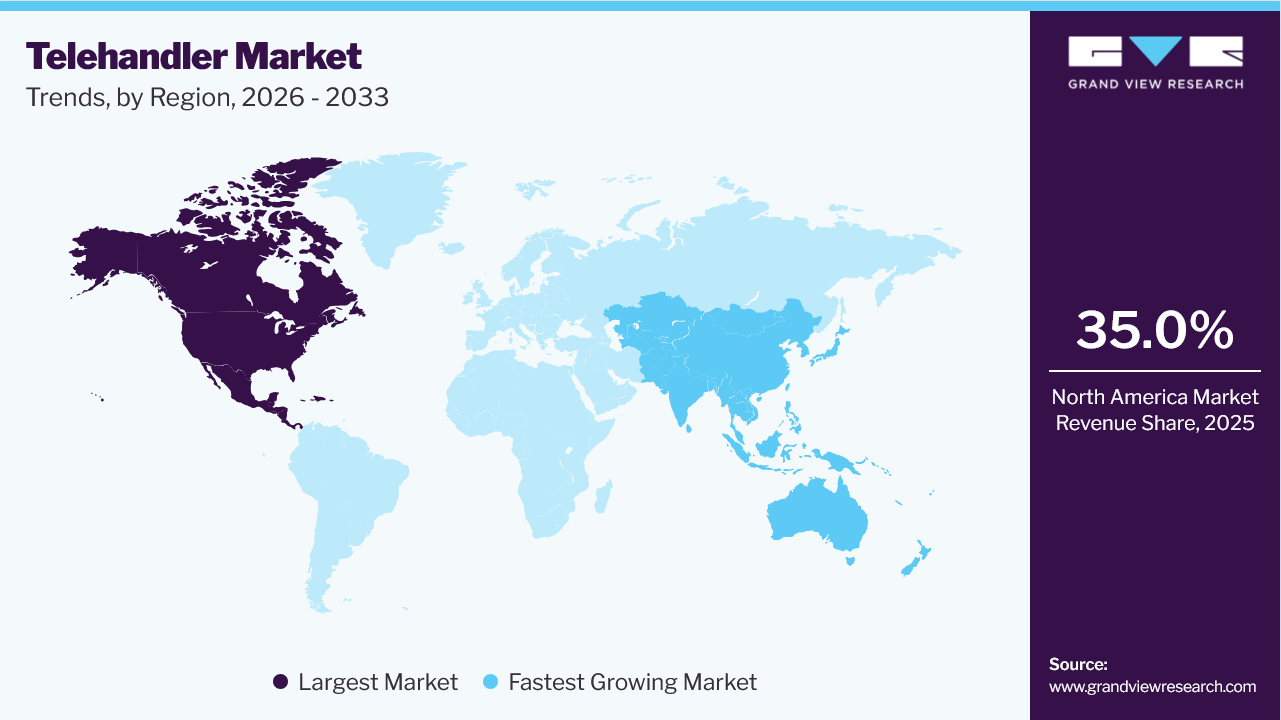
The global telehandler market size was valued at USD 5.1 billion in 2025 and is projected to grow from USD 5.4 billion in 2026 to USD 8.0 billion in 2033, at a CAGR of 5.8% from 2026 to 2033. North America dominated the global market, accounting for the largest revenue share of 35.0% in 2025. The market has experienced remarkable growth, driven primarily by the booming construction industry, particularly in emerging economies.
Key Market Trends & Insights
- By propulsion type: The internal combustion engine (ICE) segment held the largest market share of over 55.0% in 2025.
- By lift capacity: The 3-10-ton segment held the largest market share of over 53.0% in 2025.
- By end use: The construction segment held the largest market share of over 39.0% in 2025.
- By product: The large segment held the largest market share in 2025 of over 58.0%.
Regional Highlights
- Largest regional market: North America (35.0% revenue share, 2025)
- Fastest-growing regional market: Asia Pacific (highest CAGR, 2026-2033)
Market Size & Forecast
- Market size in 2025: USD 5.1 Billion
- Estimated market size in 2026: USD 5.4 Billion
- Projected market size by 2033: USD 8.0 Billion
- CAGR (2026-2033): 5.8%
Three ways to get this report
Buy it, customize it, or ask a question.Ask an Analyst
A direct answer, usually in 1 working day
- AccessReport author, directly
- Reply timeWithin 1 working day
- No sales callDirect answer only
- FormatEmail reply
- CostFree, no cost
Get the Full Report
What the study covers
- FormatsPDF · Excel · Dashboard
- Timeline2026–2033 annual, 2025 base
- Coverage20+ countries, 5 regions
- Companies10+ key players profiled
Customize the Report
20% free customization
- IncludeCountries, segments, points
- TailorTo your product definition
- ExtendDeeper competitor detail
- OrA fully bespoke study
- Turnaround5–10 working days
The phenomenon of urbanization has led to a surge in construction projects, including residential complexes, commercial buildings, and infrastructure development. As cities expand and populations grow, demand for modernized, well-equipped structures increases. Furthermore, infrastructure development projects, such as the construction of highways, bridges, airports, and rail networks, require versatile equipment capable of efficiently handling a range of tasks.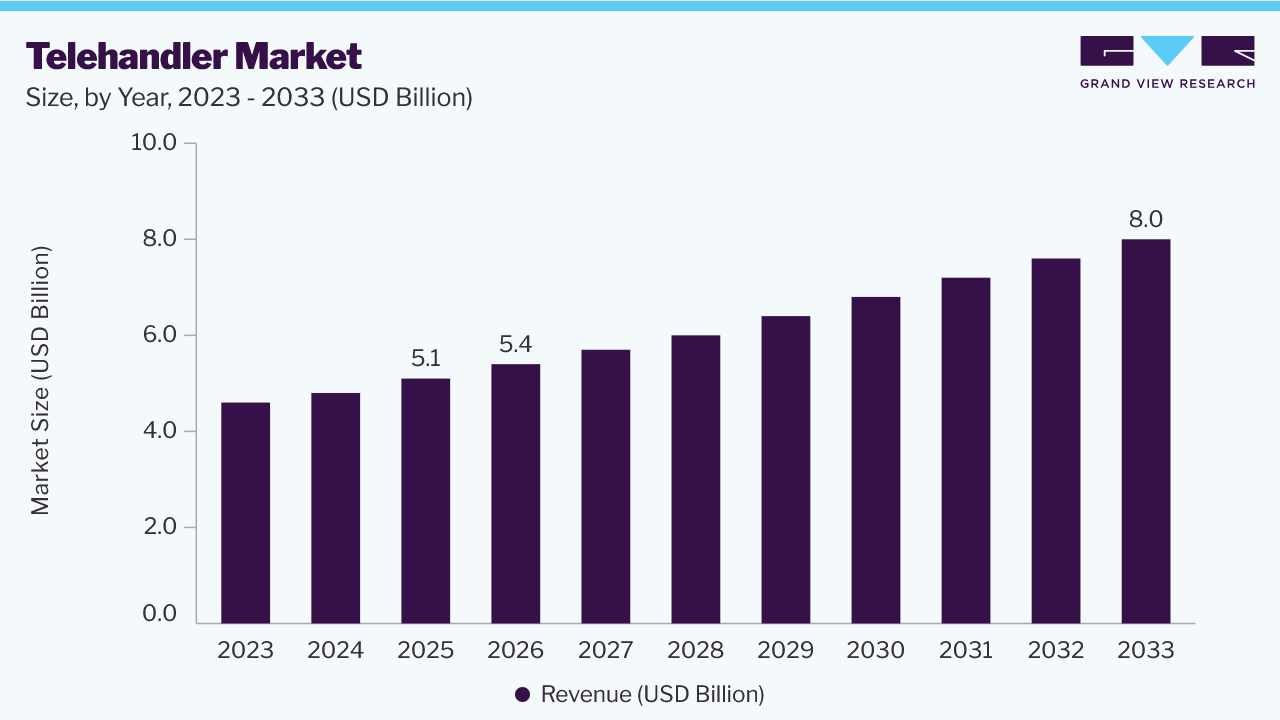
The growing demand for advanced telehandlers has prompted key manufacturers in various regions to develop new products. For instance, in March [1] 2025, JLG Industries announced the launch of a specialized telehandler product line designed for the specific requirements of commercial agricultural operations. Such developments signal the market's growth potential.
Moreover, these machines offer adaptability in challenging terrain, enabling construction projects to proceed smoothly in uneven or restricted areas. The need for telehandlers arises from the construction sector's demand for effective, safe material handling; improved productivity; and flexibility across various job site conditions, ultimately contributing to streamlined construction processes and successful project outcomes.
Market Dynamics
The agricultural sector is currently undergoing a profound transformation driven by rapid technological advancements and the growing demand for greater productivity, leading to the adoption of innovative practices and precision farming techniques. Farmers worldwide are actively adopting mechanization solutions to optimize operations and maximize output. Telehandlers enable farmers to accomplish tasks that were previously time-consuming, such as loading & unloading, material handling, stacking & storage, and labor-intensive tasks, with relative ease and speed. The ability to lift and transport heavy hay bales or move bulky materials swiftly not only saves valuable time but also minimizes manual labor requirements. Moreover, telehandlers offer considerable cost savings for farmers by streamlining and automating various agricultural processes, such as crop management, palletizing & storage. These machines reduce the need for additional labor, thereby lowering labor costs. Farmers can allocate resources more efficiently and effectively, optimizing budgets while increasing productivity.
The market is highly fragmented, with numerous manufacturers operating globally. This landscape fosters intense competition, leading to frequent price wars and mounting pressure on profit margins. Established players in the market constantly face challenges from emerging regional competitors offering cost-effective solutions, further intensifying the competitive environment. As a result, this cutthroat competition often leads to diminished profit margins and limited opportunities to expand market share.
Partnerships, collaborations, and geographical expansions to underserved markets present significant opportunities for this industry. For instance, in February 2026, a port machinery business unit of SANY Group, SANY Marine, announced its latest strategic partnership with CFC Group’s Construction Equipment Australia (CEA), which brought SANY's telehandler range to the Australian market. Such developments highlight significant opportunities for manufacturers and material handling companies in this market. In addition, the rental business is expected to provide lucrative opportunities for telehandler manufacturers in various regional markets.
Market Characteristics & Concentration
The telehandler industry is experiencing a remarkable surge in technological advancements, bolstering its capabilities and enhancing operational efficiency. Manufacturers have recognized the potential of automation, telematics, and remote monitoring systems and are actively integrating these cutting-edge technologies into telehandlers. This integration gives operators superior control over the machines while facilitating comprehensive data collection and predictive maintenance.
By incorporating automation features, telehandlers can perform various tasks with minimal human intervention. This includes automated lifting, lowering, and positioning of loads, along with precise movement control. These automated functions increase operational efficiency and reduce the risks of human error.
Analyst Perspective
The market is characterized by focused investments in innovation, the transition from traditional ICEs to hybrid and fully electric machines, the development of application-specific offerings, and portfolio expansions that include advanced technology features. In addition, multiple companies have been expanding their presence in underserved regional and country markets to improve operational capabilities and market presence. The development of compact machines for limited-space applications in construction and other specific industrial settings also influences further market growth. Innovation in energy solutions and raw materials used in manufacturing is expected to highly influence the future course of this industry in the coming years.
Product Insights
The large segment held the largest market share in 2025 of over 58.0%. The construction industry's rapid growth and increasing infrastructure projects require versatile and powerful machinery capable of lifting heavy loads and reaching high elevations. Large telehandlers provide the necessary lifting capacity and height, making them indispensable for tasks such as material handling, placing construction materials, and operating in confined spaces.
The compact segment is anticipated to register the fastest CAGR over the forecast period. Compact telehandlers offer a compelling solution, combining the lifting capabilities of traditional telehandlers with the compact size and maneuverability needed for urban environments. With their ability to navigate narrow access points, reach high elevations, and handle various materials, compact telehandlers are becoming indispensable for construction, agriculture, warehousing, and maintenance tasks.
Propulsion Type Insights
The internal combustion engine (ICE) segment held the largest market share of over 55.0% in 2025. The ICE segment’s growth is driven by its superior power and torque, which enable it to handle heavy loads and operate in challenging terrain. The ICEs offer a longer range and faster refueling times than their electric counterparts, making them suitable for long work shifts and remote locations where EV charging infrastructure is limited. ICEs often cost less initially than electric models, making them a more affordable choice for businesses.
The electric segment is anticipated to register the fastest CAGR over the forecast period. The increasing focus on environmental sustainability has led to a notable shift toward electric power. Electric telehandlers have emerged as a significant solution, with their zero-emission operation effectively curbing carbon footprints and improving air quality. Furthermore, rapid advancements in battery technology have improved performance and extended operating time, making electric telehandlers a viable option for various applications. The growing demand for electric telehandlers has stimulated new product launches across various regional markets. For instance, in November 2025, New Holland unveiled a hybrid full-size telehandler prototype that features both electric drive and compressed natural gas capabilities. In November 2025, another global manufacturer of construction and mining equipment, SANY Group, announced the launch of STH625e electric telehandlers. Such advancements in zero-emission portfolio offerings by global companies highlight the segment's growth potential.
The lower operating costs associated with electric telehandlers, including reduced fuel consumption and maintenance requirements, make them economically viable for businesses. The increasing demand for quieter, more efficient machinery in urban construction and industrial settings further drives the transition to electric telehandlers, which offer lower noise levels and greater operational efficiency. Hence, these factors are propelling the global adoption of electric telehandlers.
Lift Capacity Insights
The 3-10 ton segment held the largest market share of over 53.0% in 2025, and it is anticipated to register the fastest CAGR over the forecast period. The construction industry relies heavily on these versatile machines to lift and move heavy materials with precision, enhancing job-site efficiency and productivity.
The logistics & warehousing sectors benefit from the 3-10 ton type's ability to maneuver in confined spaces, enabling efficient loading and unloading of goods. The 3-10 ton telehandler's adaptability extends to the mining and extraction industries, where it assists in transporting equipment and materials across rugged terrain. The increasing emphasis on safety and ergonomics has driven the demand for telehandlers, as their advanced features and comfortable operator cabins enhance operator well-being and reduce the risk of accidents.
The more than 10-ton segment is expected to grow at a significant CAGR over the forecast period. These heavy-duty telehandlers offer enhanced lifting capacities, allowing them to handle substantial loads in various construction, mining, and logistics industries. Their ability to lift and maneuver heavy materials and equipment efficiently contributes to increased productivity and cost-effectiveness on job sites. The growing need for larger telehandlers is propelled by the expansion of infrastructure projects worldwide, including the construction of buildings, roads, bridges, and airports. These projects often require moving heavy materials, making high-capacity telehandlers indispensable.
End Use Insights
The construction segment held the largest market share of over 39.0% in 2025, and it is anticipated to experience the fastest CAGR over the forecast period. The growing emphasis on infrastructure development, particularly in emerging economies, has heightened the need for versatile, efficient machinery capable of lifting heavy loads and maneuvering in tight spaces. The increasing focus on safety and productivity in construction sites has led to the adoption of telehandlers, which offer enhanced operator visibility, stability, and lifting capacities. Technological advancements in telehandler design, such as improved fuel efficiency, advanced control systems, and telematics integration, offer enhanced performance and operational benefits, driving their widespread adoption across construction projects worldwide.
Multiple companies engaged in the manufacturing of Mobile Elevating Work Platforms (MEWPs) and heavy construction machinery have launched new products for construction applications. For instance, in March 2026, LGMG North America, Inc., announced a high-capacity H1256 telehandler, specifically designed for construction applications. Equipped with a 12,000 lb lifting capacity, max lift height of 56’1”, and 42’ outreach, this new offering has strengthened LGMG’s portfolio.
The agricultural industry is expected to grow at a significant CAGR over the forecast period. The growing trend of mechanization in agriculture, aimed at improving efficiency and reducing labor costs, has significantly increased demand for telehandlers, which offer a cost-effective solution for multiple tasks that would otherwise require multiple machines or manual labor. In addition, technological advancements, such as precision farming, automation, and data analytics, are transforming the agriculture sector. These technologies help optimize crop yields, reduce costs, and improve overall productivity. As a result, such factors provide lucrative opportunities for the segment's growth.
Regional Insights
North America dominated the market, accounting for more than 35.0% in 2025. The region's growing demand for construction and infrastructure projects has increased the need for adaptable, efficient material-handling equipment. In addition, the growing trend towards mechanization and automation across industries, including agriculture, manufacturing, and logistics, is driving the adoption of telehandlers due to their ability to handle diverse tasks. Furthermore, technological advancements, such as improved fuel efficiency, advanced control systems, and telematics integration, enhance telehandlers' overall performance and productivity, attracting customers seeking modern, innovative solutions.
Asia Pacific Telehandler Market Trends
The telehandler market in the Asia Pacific is anticipated to register the fastest CAGR over the forecast period. The Asia Pacific region has been experiencing rapid urbanization and infrastructure development, creating a high demand for telehandlers. Growing investments in construction projects, including residential and commercial buildings, highways, bridges, and airports, drive demand for telehandler operators. The growing agricultural sector in countries such as China and India is driving demand for telehandlers across various applications, including loading and unloading crops and farm equipment. The expansion of the industrial sector, particularly manufacturing and logistics, is driving the adoption of telehandlers for more efficient material handling. Moreover, the rising trend of urbanization and the need for efficient materials handling in urban construction projects further contribute to market growth.
Key Telehandler Company Insights
The market is highly fragmented, with many regional and global players. The major participants are entering into strategic collaborations, mergers & acquisitions, and partnerships to expand their organization’s footprint and survive the competitive environment. Manufacturers are incorporating advanced control systems, telematics, enhanced safety features, and improved fuel efficiency to meet customer demands.
Key Telehandler Companies
The following key companies have been profiled for this study on the telehandler market.
-
AB Volvo
-
Caterpillar.
-
CNH Industrial N.V.
-
Doosan Corporation.
-
Haulotte Group
-
J C Bamford Excavators Ltd.
-
Komatsu Ltd.
-
L&T Technology Services Limited.
-
Manitou.com
-
Oshkosh Corporation
-
Terex Corporation.
-
Wacker Neuson SE
Recent Developments
-
In April 2025, Bobcat, a compact heavy machinery manufacturer, announced three additions to its agricultural telehandler portfolio. This includes TL34.65HF V-Drive, TL43.80HF V-Drive, and TL38.70HF V-Drive, equipped with a continuous transmission system.
-
In January 2025, Caterpillar, a manufacturer of heavy construction and industrial equipment, announced the latest addition to its material handling equipment lineup: the launch of its Cat Telehandler fleet, specifically targeting retail purchasers and commercial rental markets. This strategic rollout introduces the advanced TH0642, TH1055, TH0842, and TH1255 models to the global marketplace. These newly engineered machines directly replace the company's legacy TL943, TL642, TL1255, and TL1055 models.
Telehandler Market Report Scope
Report Attribute
Details
Market size in 2025
USD 5.1 billion
Estimated market size in 2026
USD 5.4 billion
Projected market size by 2033
USD 8.0 billion
Growth rate
CAGR of 5.8% from 2026 to 2033
Historical data
2021 - 2025
Forecast period
2026 - 2033
Quantitative units
Revenue in USD billion, and CAGR from 2026 to 2033
Report coverage
Revenue forecast, company ranking, competitive landscape, growth factors, and trends
Segments covered
Product, propulsion type, lift capacity, end use, region
Regional scope
North America; Europe; Asia Pacific; Latin America; MEA
Country scope
U.S.; Canada; UK; Germany; France; Italy; Spain; China; India; Japan; Australia; South Korea; Brazil; Mexico; Argentina; UAE; Saudi Arabia; South Africa
Key companies profiled
AB Volvo; Caterpillar; CNH Industrial N.V.; Doosan Corporation; Haulotte Group; J C Bamford Excavators Ltd.; Komatsu Ltd.; L&T Technology Services Limited; Manitou.com; Oshkosh Corporation; Terex Corporation; Wacker Neuson SE
Customization scope
Free report customization (equivalent up to 8 analysts working days) with purchase. Addition or alteration to country, regional & segment scope.
Pricing and purchase options
Avail of customized purchase options to meet your exact research needs. Explore purchase options
Global Telehandler Market Report Segmentation
This report forecasts revenue growth at the regional and country levels and provides an analysis of the latest industry trends and opportunities in each of the sub-segments from 2021 to 2033. For this study, Grand View Research has segmented the global telehandler market report based on product, propulsion type, lift capacity, end use, and region:
-
Product Outlook (Revenue, USD Million, 2021 - 2033)
-
Large
-
Compact
-
-
Propulsion Type Outlook (Revenue, USD Million, 2021 - 2033)
-
ICE
-
Electric
-
-
Lift Capacity Outlook (Revenue, USD Million, 2021 - 2033)
-
Less than 3 Ton
-
3 - 10 Ton
-
More than 10 Ton
-
-
End-use Outlook (Revenue, USD Million, 2021 - 2033)
-
Construction
-
Agriculture
-
Manufacturing
-
Others
-
-
Regional Outlook (Revenue, USD Million, 2021 - 2033)
-
North America
-
U.S.
-
Canada
-
-
Europe
-
UK
-
Germany
-
France
-
Italy
-
Spain
-
-
Asia Pacific
-
China
-
India
-
Japan
-
Australia
-
South Korea
-
-
Latin America
-
Brazil
-
Mexico
-
Argentina
-
-
Middle East & Africa (MEA)
-
UAE
-
Saudi Arabia
-
South Africa
-
-
Frequently Asked Questions About This Report
Some key players operating in the telehandler market include AB Volvo, Caterpillar., CNH Industrial N.V., Doosan Corporation., HAULOTTE GROUP, J C Bamford Excavators Ltd., Komatsu Ltd., L&T Technology Services Limited, and Manitou.com.
North America dominated with a 35.0% revenue share in 2025.
The global telehandler market size was valued at USD 5.1 billion in 2025 and is estimated at USD 5.4 billion in 2026.
The global telehandler market is expected to grow at a CAGR of 5.8% from 2026 to 2033, reaching USD 8.0 billion by 2033.
The internal combustion engine (ICE) segment held the largest market share of over 55.0% in 2025.
About the Author(s)
Automotive & Transportation Research Team
Technology · Automotive & TransportationThis report was authored by the automotive & transportation research team at Grand View Research - comprising two research analysts, one senior research analyst, and one industry expert - with specialized expertise in the automotive & transportation segment of the technology industry. All findings are based on proprietary technology databases, executive interviews, and regulatory analysis, subject to internal peer review prior to publication.
Last Updated:
Speak to Analyst


Customize this report to your needs - add regions, segments, or data points, with 20% free customization.
Or view our licence options:


ISO 9001:2015 & 27001:2022 Certified
We are GDPR and CCPA compliant! Your transaction & personal information is safe and secure. For more details, please read our privacy policy.


