
- Home
- »
- Plastics, Polymers & Resins
- »
-
Temperature-Sensitive Packaging Market Report, 2033GVR Report cover

Temperature-Sensitive Packaging Market (2026 - 2033)
Size, Share & Trends Analysis Report By Product (Insulated Shippers, Insulated Containers, Refrigerants / Thermal Packs, Active Temperature-Controlled Containers), By End Use, By Usability, By Region, And Segment Forecasts
Market Size, 2025
$47.9BMarket Estimate, 2026
$49.8BMarket Forecast, 2033
$91.4BCAGR, 2026–2033
9.0%Temperature-Sensitive Packaging Market Summary
The global temperature-sensitive packaging market size was valued at USD 47.9 billion in 2025 and is projected to grow from USD 49.8 billion in 2026 to USD 91.4 billion by 2033, at a CAGR of 9.0% from 2026 to 2033. North America dominated the market, accounting for the revenue share of 35.9% in 2025. The industry is primarily driven by the increasing demand for temperature-controlled transportation and storage across pharmaceuticals, biologics, vaccines, food & beverages, and other temperature-sensitive products, supported by the expansion of cold chain infrastructure, growing pharmaceutical distribution, and the need to maintain product quality and safety throughout the supply chain.
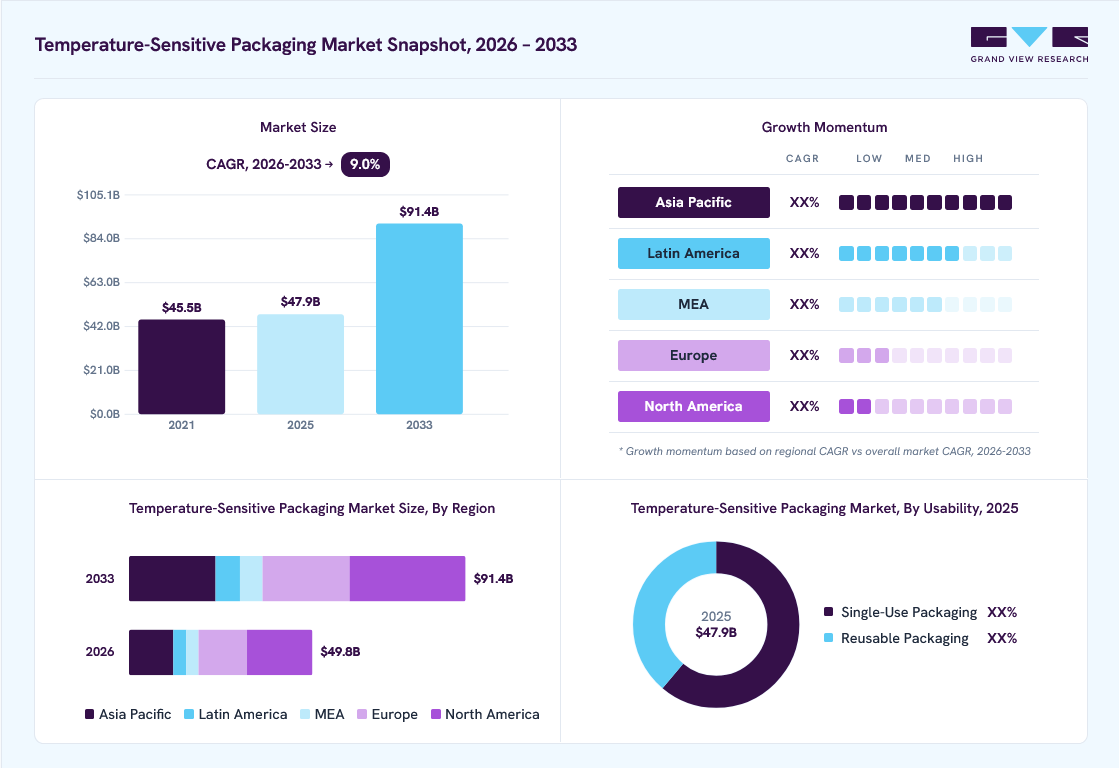 Source: Grand View Research, IR Documents, Primary Interviews, Paid DatabasesTo learn more about this report,
 Download Free Sample Report
 Key Market Trends & Insights
- Based on product: Insulated shippers segment dominated with the largest revenue share of 43.7% in 2025.
- Based on end use: Healthcare Providers & Diagnostics segment is forecast to grow at a CAGR of 9.7% from 2026 to 2033.
- Based on temperature range: Ultra-Low / Cryogenic (Below −20°C) segment is projected to register the fastest CAGR of 10.3% from 2026 to 2033.
Regional Highlights
- Largest regional market: North America (35.9% revenue share, 2025)
- Fastest-growing regional market: Asia-Pacific (highest CAGR, 2026-2033)
Market Size & Forecast
- Market Size in 2025: USD 47.9 Billion
- Estimated market size in 2026: USD 49.8 Billion
- Projected Market Size by 2033: USD 91.4 Billion
- CAGR (2026-2033): 9.0%
Three ways to get this report
Buy it, customize it, or ask a question.Ask an Analyst
A direct answer, usually in 1 working day
- AccessReport author, directly
- Reply timeWithin 1 working day
- No sales callDirect answer only
- FormatEmail reply
- CostFree, no cost
Get the Full Report
What the study covers
- FormatsPDF · Excel · Dashboard
- Timeline2026–2033 annual, 2025 base
- Coverage20+ countries, 5 regions
- Companies10+ key players profiled
Customize the Report
20% free customization
- IncludeCountries, segments, points
- TailorTo your product definition
- ExtendDeeper competitor detail
- OrA fully bespoke study
- Turnaround5–10 working days
The temperature-sensitive packaging market is driven by the increasing transportation of temperature-sensitive pharmaceuticals, biologics, vaccines, food products, and other products that require controlled environmental conditions throughout the supply chain. As pharmaceutical and biotechnology companies expand global distribution networks, there is growing demand for reliable packaging formats that can maintain specified temperature ranges during storage and transit.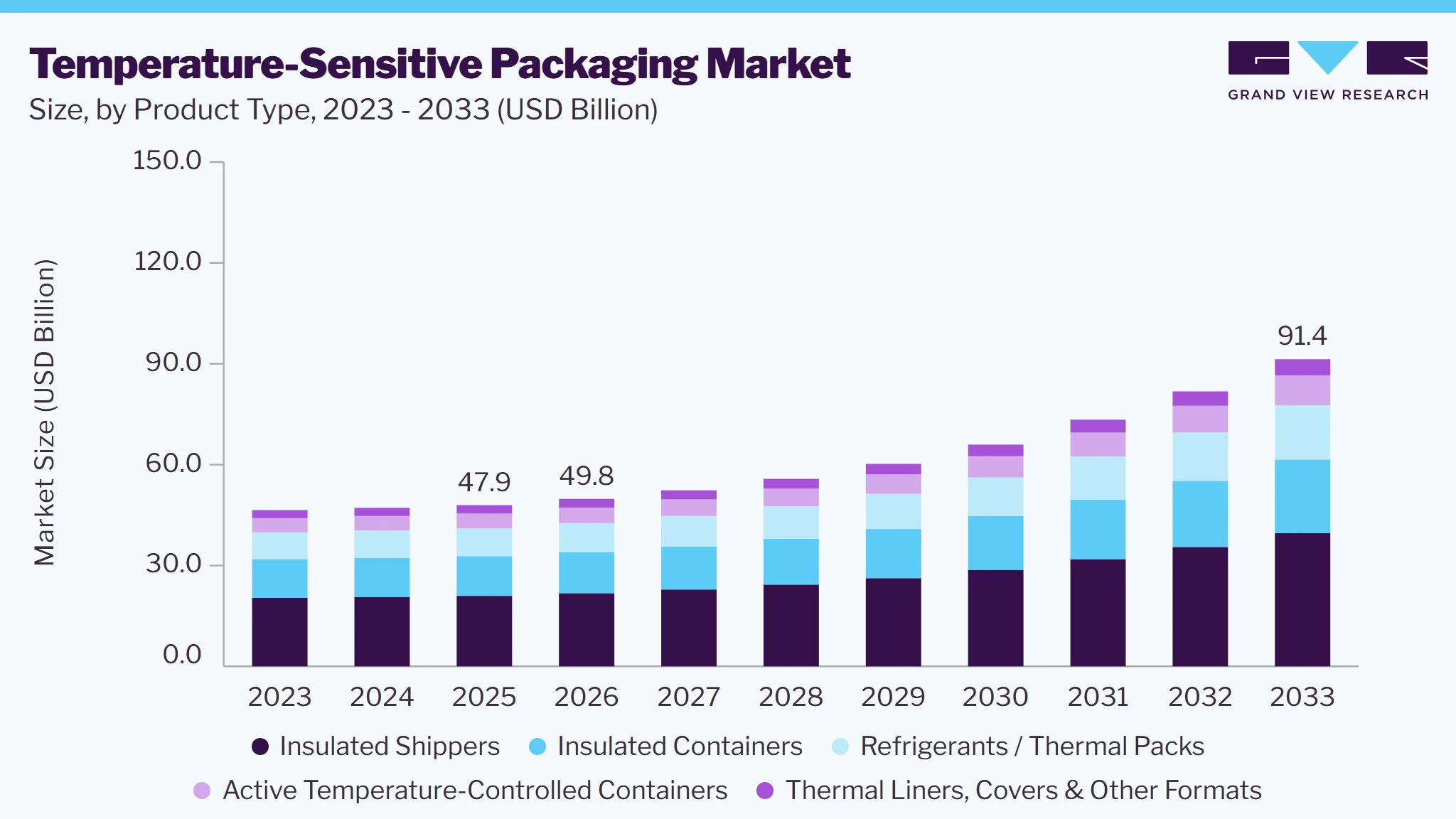 To learn more about this report, Download Free Sample Report
 An increasing focus on product safety, quality preservation, and regulatory compliance across temperature-sensitive supply chains is expected to boost market growth in the coming years. Industries such as pharmaceuticals, biotechnology, food & beverage, healthcare, and diagnostics increasingly rely on temperature-controlled packaging to prevent product degradation and maintain required storage conditions.
The transition toward advanced temperature-control technologies and more efficient packaging systems is also significantly contributing to market growth. A defining trend in the temperature-sensitive packaging industry is the increasing adoption of active temperature-controlled containers. These systems provide enhanced temperature stability and greater control during longer-distance transportation, making them increasingly suitable for high-value pharmaceuticals, biologics, clinical trial materials, and other sensitive products. At the same time, refrigerants and thermal packs are supported by their broad application in passive cold-chain packaging. The increasing emphasis on reliable cold-chain performance, reusable solutions, and packaging technologies capable of supporting stringent temperature requirements is expected to encourage continued innovation and investment across the market.
Market Dynamics
The temperature-sensitive packaging market is experiencing strong growth due to the expansion of global cold chain networks, growth in specialty pharmaceuticals, increasing biologics shipments, and stricter requirements for maintaining product integrity, which are encouraging manufacturers to develop more reliable thermal protection solutions. At the same time, advances in insulation materials, temperature monitoring, reusable systems, and active temperature-control technologies are improving packaging performance. However, high packaging costs, complex qualification requirements, and the need for specialized handling infrastructure remain important challenges for market participants.
The growing distribution of temperature-sensitive pharmaceuticals and biologics is a major driver of the market. The increasing use of vaccines, biologic drugs, cell and gene therapies, specialty medicines, and temperature-sensitive clinical trial materials requires controlled conditions during transportation from manufacturers to healthcare providers and patients. Pharmaceutical and biotechnology companies are therefore increasingly adopting insulated shippers, thermal packs, insulated containers, and active temperature-controlled systems to minimize exposure to temperature excursions and preserve product quality.
The expansion of international pharmaceutical trade and decentralized healthcare distribution is further increasing the need for dependable cold chain packaging. Products frequently move through multiple transportation and storage stages, including manufacturing facilities, distribution centers, airports, hospitals, pharmacies, and direct-to-patient delivery networks. This is encouraging companies to invest in packaging systems with longer thermal performance, improved insulation, temperature monitoring, and greater resistance to variable transportation conditions. The growing importance of maintaining product stability throughout these complex logistics networks is expected to sustain demand for temperature-sensitive packaging solutions.
A significant restraint is the high cost and operational complexity associated with advanced temperature-control solutions. Active temperature-controlled containers, specialized reusable systems, thermal monitoring devices, and validated packaging configurations require higher investments in equipment, qualification, maintenance, and handling. In addition, temperature-sensitive shipments require careful packaging selection and monitoring based on product characteristics, temperature range, transit duration, and environmental conditions. Transportation delays, improper handling, and temperature excursions can further increase product loss and replacement costs, limiting adoption in cost-sensitive applications and regions with less-developed cold chain infrastructure.
A major opportunity for the temperature-sensitive packaging companies lies in the growing adoption of reusable and technology-enabled packaging solutions. Pharmaceutical and biotechnology companies are increasingly seeking reusable insulated containers, advanced thermal systems, and durable packaging formats that can provide consistent temperature protection across multiple shipment cycles while reducing packaging waste. At the same time, integration of temperature sensors, data loggers, real-time tracking, and digital monitoring capabilities is improving shipment visibility and enabling faster identification of temperature excursions. Continued innovation in insulation materials, phase-change materials, and active cooling technologies is expected to expand opportunities for high-performance temperature-sensitive packaging across pharmaceutical, healthcare, food, and life sciences applications.
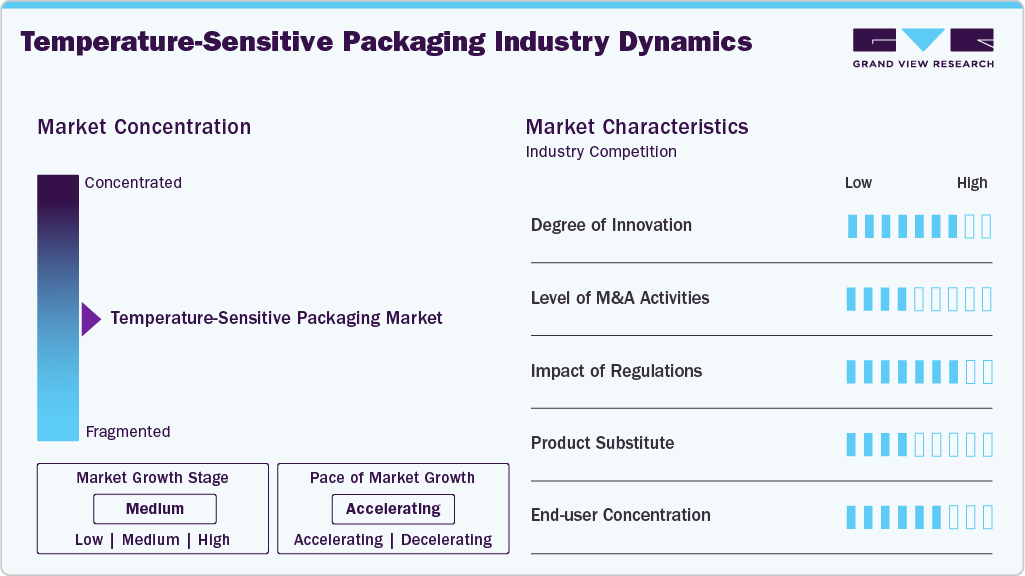
Market Concentration & Characteristics
The temperature-sensitive packaging market is characterized by its strong focus on maintaining product integrity and specified temperature conditions during storage and transportation. Demand is driven primarily by pharmaceutical, biotechnology, healthcare, food, and life sciences applications, where products such as biologics, vaccines, specialty medicines, diagnostics, and perishable foods require controlled thermal environments. Manufacturers focus on thermal efficiency, packaging validation, durability, and cost optimization across insulated shippers, insulated containers, refrigerants, thermal packs, and active temperature-controlled systems.
 To learn more about this report, Download Free Sample Report
 A defining feature of the industry is its reliance on specialized insulation materials, phase-change materials, refrigerants, and active cooling technologies. Growing cold chain requirements are encouraging the development of reusable packaging, recyclable materials, and lightweight thermal solutions to improve sustainability. In addition, temperature sensors, data loggers, and real-time tracking technologies are increasingly integrated into packaging systems to monitor shipments and minimize temperature excursions. Regulatory and quality requirements, particularly in pharmaceutical logistics, continue to influence packaging design, validation, and adoption.
Analyst Perspective
The global temperature-sensitive packaging market has evolved from conventional insulated boxes and refrigerant-based solutions toward advanced, validated packaging systems designed to maintain precise temperature conditions across complex cold chain networks. Historically driven by pharmaceuticals, vaccines, food, and other perishables, the industry is increasingly supported by biologics, specialty medicines, diagnostics, and advanced therapies requiring reliable thermal protection. Current developments emphasize insulated shippers, active temperature-controlled containers, phase-change materials (PCM), reusable packaging, and temperature monitoring. Growth is expected to remain strong as pharmaceutical distribution expands, cold chain infrastructure improves, and demand rises for sustainable, smart, and high-performance temperature-controlled packaging solutions.
Product Insights
The insulated shippers segment led the temperature-sensitive packaging market, accounting for the largest revenue share of 43.7% in 2025. Insulated shippers are widely used for the transportation of pharmaceuticals, biologics, vaccines, diagnostics, and other temperature-sensitive products requiring protection during transit. Their combination of thermal insulation, portability, and compatibility with refrigerants or thermal packs makes them suitable for parcel-based and cold chain shipments. Demand is supported by the expansion of pharmaceutical distribution and the growing need to maintain temperature stability across varying transportation conditions.
The active temperature-controlled containers segment is expected to grow at the fastest CAGR of 9.8% during the forecast period. These systems provide precise temperature control through integrated cooling or heating technologies, making them suitable for high-value pharmaceuticals, biologics, clinical trial materials, and other products with stringent temperature requirements. Growth is driven by the increasing distribution of temperature-sensitive therapies, longer and more complex supply chains, and the need for reliable temperature management during extended transportation.
Usability Insights
The single-use packaging segment dominated the industry, accounting for the largest revenue share of 61.1% in 2025. Single-use solutions are widely adopted for pharmaceutical, biotechnology, healthcare, and food shipments due to their convenience, hygiene, and suitability for one-way distribution. Their use is particularly common in insulated shippers and thermal packaging systems where simplified handling and reduced reverse-logistics requirements are important.
The reusable packaging segment is expected to grow at the fastest CAGR of 9.5% during the forecast period. Reusable temperature-sensitive packaging offers durability and consistent thermal performance across multiple shipment cycles, making it increasingly attractive for pharmaceutical and healthcare supply chains. Its growth is supported by efforts to reduce packaging waste, improve logistics efficiency, and lower packaging costs over repeated shipments.
Temperature Range Insights
The refrigerated/chilled (2°C-8°C) segment led the market, accounting for the largest revenue share of 48.7% in 2025. This range is widely used for pharmaceuticals, biologics, vaccines, diagnostics, and perishable food products that require controlled refrigeration during storage and transportation. Its dominance is supported by the broad use of cold chain logistics and the increasing distribution of temperature-sensitive healthcare products.
The ultra-low/cryogenic (below −20°C) segment is expected to grow at the fastest CAGR of 10.3% during the forecast period. Demand for ultra-low-temperature packaging is increasing with the expansion of advanced biologics, cell and gene therapies, research materials, and other products requiring deep-frozen or cryogenic storage. The need for reliable thermal protection during longer and more complex shipments further supports the adoption of specialized insulation, dry ice-based systems, and advanced temperature-controlled packaging.
End Use Insights
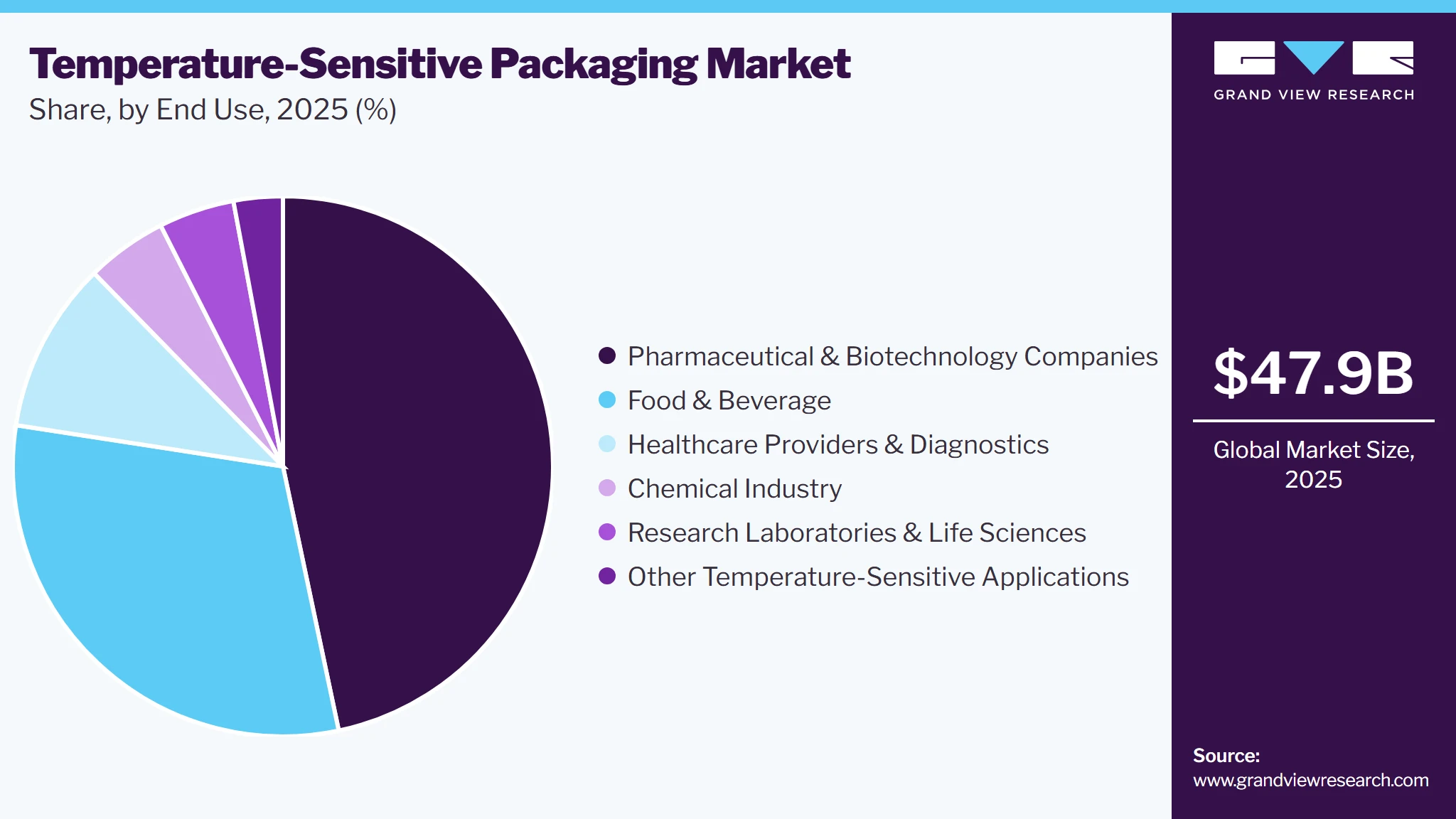
The pharmaceutical & biotechnology companies segment dominated the industry with the largest revenue share of 46.7% in 2025. Temperature-sensitive packaging is extensively used for transporting vaccines, biologics, specialty medicines, clinical trial materials, and other pharmaceutical products that require controlled conditions. Growing biopharmaceutical production and the expansion of global pharmaceutical cold chain networks are supporting demand for reliable thermal packaging solutions.
 To learn more about this report, Download Free Sample Report
 The healthcare providers & diagnostics segment is expected to grow at the fastest CAGR of 9.7% during the forecast period. Increasing transportation of diagnostic samples, laboratory specimens, blood products, and temperature-sensitive medical materials is driving demand for specialized packaging solutions. Growth is further supported by expanding diagnostic services, decentralized healthcare delivery, and the need to maintain sample integrity throughout transportation.
Regional Insights
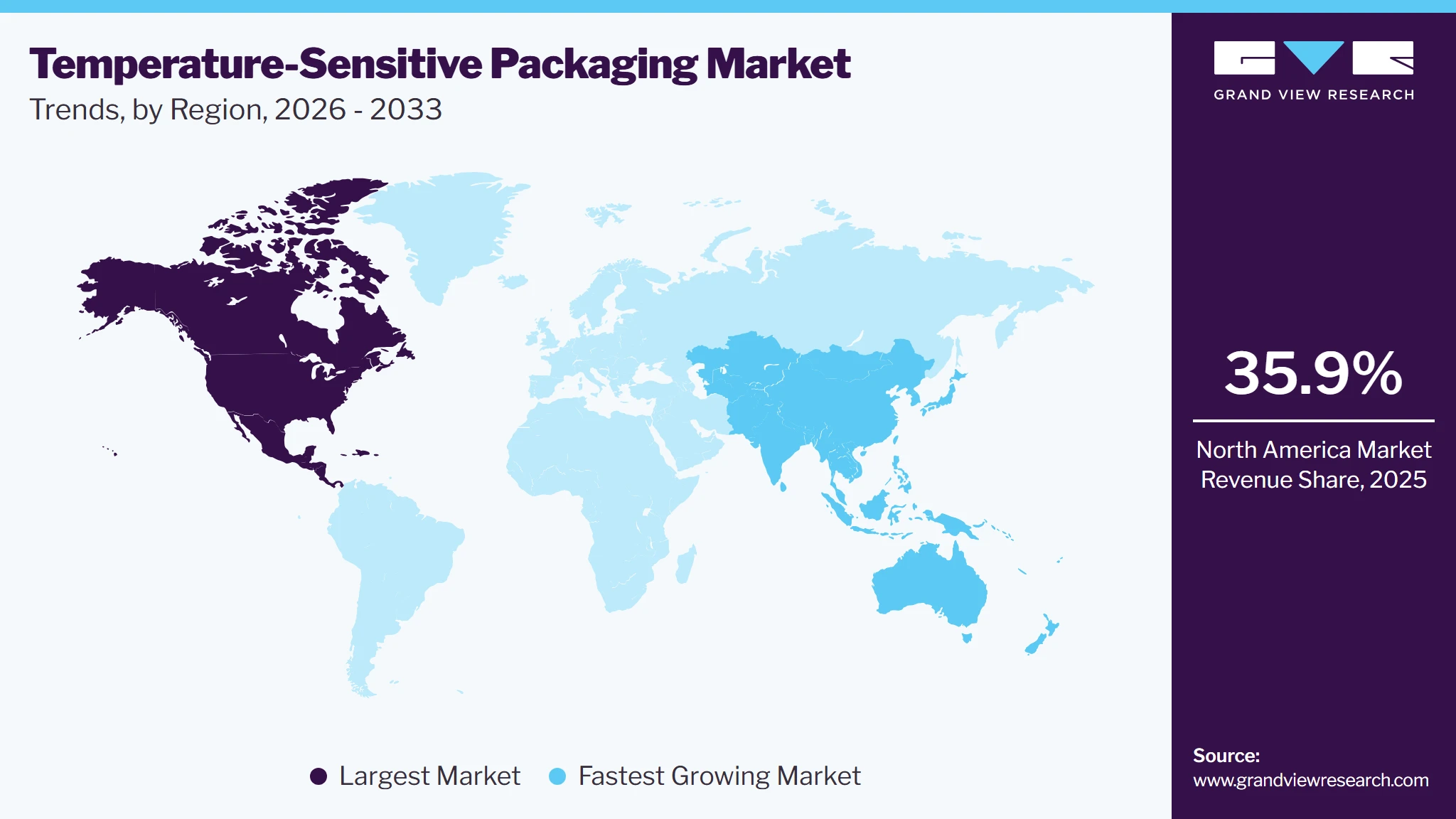
North America dominated the temperature-sensitive packaging market, accounting for the largest revenue share of 35.9% in 2025. The region benefits from established pharmaceutical and biotechnology industries, extensive cold chain infrastructure, and strong demand for temperature-controlled transportation of biologics, vaccines, diagnostics, and specialty medicines. The presence of advanced logistics networks and increasing adoption of validated packaging and monitoring technologies further support regional market development.
 To learn more about this report, Download Free Sample Report
 U.S. Temperature-Sensitive Packaging Market Trends
The temperature-sensitive packaging market in the U.S. is supported by its large pharmaceutical and biotechnology sector and well-developed healthcare distribution network. Rising shipments of biologics, vaccines, clinical trial materials, and other temperature-sensitive products are increasing demand for insulated shippers, thermal packs, and active temperature-controlled containers. Growing emphasis on product integrity and cold chain compliance is also encouraging the adoption of advanced packaging and monitoring solutions.
Europe Temperature-Sensitive Packaging Market Trends
The temperature-sensitive packaging market in Europe is expected to expand steadily during the forecast period, underpinned by the region's pharmaceutical manufacturing base and established healthcare logistics infrastructure. Demand for reliable temperature-controlled packaging is increasing as the distribution of biologics, vaccines, diagnostics, and specialty medicines grows. Sustainability initiatives are also encouraging greater use of reusable packaging and resource-efficient thermal solutions.
The Germany temperature-sensitive packaging market accounts for a significant share of the European market due to its strong pharmaceutical, biotechnology, and healthcare industries. The country's well-developed logistics infrastructure supports the transportation of temperature-sensitive medicines and biological materials across domestic and international supply chains. Increasing demand for validated cold chain solutions and reusable packaging systems is expected to support market growth.
The temperature-sensitive packaging market in the UK is supported by demand from pharmaceutical distribution, healthcare, diagnostics, and life sciences applications. The expansion of biologics and specialty medicines is creating a need for dependable temperature-controlled transportation solutions. Growing attention to supply chain efficiency and sustainable packaging is also supporting the adoption of reusable and technology-enabled systems.
Asia Pacific Temperature-Sensitive Packaging Market Trends
Thetemperature-sensitive packaging market in the Asia Pacific is projected to register the fastest CAGR of 10.0% during the forecast period (2026-2033). Growth is driven by expanding pharmaceutical and biotechnology manufacturing, increasing healthcare spending, improving cold chain infrastructure, and rising distribution of vaccines and biologics. Growing investments in advanced logistics capabilities across emerging economies are creating additional demand for insulated, reusable, and active temperature-controlled packaging.
The China temperature-sensitive packaging market is expected to be spurred by its expanding pharmaceutical manufacturing industry, growing healthcare sector, and increasing investment in cold chain logistics. Rising production and distribution of vaccines, biologics, diagnostics, and other temperature-sensitive products are strengthening demand for thermal packaging solutions. Improvements in logistics infrastructure are further facilitating the adoption of temperature-controlled packaging.
Thetemperature-sensitive packaging market in India is expected to witness strong growth during the forecast period, supported by expanding pharmaceutical and biotechnology production and increasing healthcare distribution requirements. Growth in vaccine manufacturing, biologics, diagnostics, and temperature-sensitive medicines is creating demand for insulated shippers, thermal packs, and specialized cold chain solutions. Investments in healthcare infrastructure and temperature-controlled logistics are expected to further strengthen market adoption.
Latin America Temperature-Sensitive Packaging Market Trends
The temperature-sensitive packaging market in Latin America is projected to grow steadily, supported by increasing pharmaceutical distribution, healthcare activity, and demand for temperature-controlled food and beverage logistics. Improvements in cold chain infrastructure and growing awareness of product integrity during transportation are encouraging the use of insulated packaging and thermal management solutions across the region.
The Brazil temperature-sensitive packaging market has gained ground due to its large healthcare and pharmaceutical sectors and growing demand for temperature-controlled logistics. The distribution of vaccines, medicines, biological products, and perishable goods is creating opportunities for insulated and reusable packaging solutions. Continued development of cold chain infrastructure is expected to support market expansion.
Thetemperature-sensitive packaging market in Argentina is expected to develop steadily, driven by pharmaceutical distribution, healthcare applications, and the transportation of temperature-sensitive food products. Increasing requirements for maintaining product quality during transportation are supporting demand for insulated shippers, thermal packs, and other controlled-temperature packaging formats.
Middle East & Africa Temperature-Sensitive Packaging Market Trends
The temperature-sensitive packaging market in the Middle East & Africa is expected to register steady growth during the forecast period. Increasing healthcare investments, pharmaceutical distribution, and development of cold chain infrastructure are creating demand for reliable temperature-controlled packaging. The region's climatic conditions also increase the importance of thermal protection during transportation, particularly for pharmaceuticals, vaccines, and other temperature-sensitive products.
Key Temperature-Sensitive Packaging Company Insights
Some key companies in the temperature-sensitive packaging market include Peli BioThermal LLC, CSafe, Envirotainer, and va-Q-tec Thermal Solutions GmbH. The industry is characterized by advanced thermal insulation, temperature-control technologies, reusable and single-use packaging systems, and integrated monitoring solutions. Key participants are focusing on improving thermal performance, extending temperature-hold durations, reducing packaging waste, and developing solutions tailored to pharmaceutical, biotechnology, healthcare, diagnostics, and other temperature-sensitive applications.
-
Peli BioThermal LLC develops a broad portfolio of temperature-controlled packaging solutions, including reusable and single-use parcel and bulk systems. Its solutions incorporate advanced insulation and phase-change materials and are designed for the transportation of pharmaceuticals, vaccines, diagnostics, blood supplies, and other sensitive healthcare products.
-
CSafe provides end-to-end temperature-controlled shipping solutions covering active and passive bulk air cargo, parcel shipping, cell and gene therapy, and specialty applications. The company also integrates real-time shipment visibility and data-logging capabilities through its digital solutions, supporting temperature monitoring and supply chain management for pharmaceutical products.
Key Temperature-Sensitive Packaging Companies
The following key companies have been profiled for this study on the temperature-sensitive packaging market.
-
Peli BioThermal LLC
-
CSafe
-
Envirotainer
-
va-Q-tec Thermal Solutions GmbH
-
ThermoSafe
-
Cryopak
-
Intelsius
-
TOWER Cold Chain Solutions
-
SkyCell AG
-
SOFTBOX SYSTEMS (I) PVT. LIMITED
-
TempSeal
-
BSmart Solutions
Competitive Benchmarking
Category
Operating Strategies
Competitive Edge
Weakness
Established Players (Peli BioThermal LLC; CSafe; Envirotainer; va-Q-tec Thermal Solutions GmbH; ThermoSafe; Cryopak)
- Expand temperature-controlled packaging, insulated shippers, active/passive systems, PCM, and reusable solutions for pharmaceutical and cold chain applications.
- Strong global presence, thermal insulation expertise, validated packaging, broad portfolios, and cold chain networks.
- High validation, manufacturing, and logistics costs, along with dependence on specialized thermal materials and cold chain infrastructure.
Specialized & Emerging Players (Intelsius; TOWER Cold Chain Solutions; SkyCell AG; SOFTBOX SYSTEMS (I) PVT. LIMITED; TempSeal; BSmart Solutions)
- Develop passive temperature-controlled packaging, reusable containers, thermal packs, insulated boxes, and monitoring solutions for pharma, healthcare, and diagnostics.
- Strong application specialization, customized thermal solutions, reusable packaging, and temperature-control expertise.
- Limited production scale, geographic reach, and distribution networks compared with major global players.
Recent Developments
-
In March 2026, Peli BioThermal announced a strategic partnership with Polar Group to expand the availability of its reusable and single-use temperature-controlled packaging solutions across Brazil. The partnership is aimed at supporting pharmaceutical, biotechnology, and healthcare customers with regional access to cold chain packaging as demand for biologics and advanced therapies increases.
-
In June 2025, Cryopak introduced its NexBlu Cube10 universal shipper, a flexible temperature-controlled packaging system designed for pharmaceutical, biotechnology, and other cold chain applications. The solution offers EPS and more sustainable graphite expanded polystyrene configurations and is tested against ISTA 7D and 7E temperature profiles for long-duration and cross-border shipments.
Temperature-Sensitive Packaging Market Report Scope
Report Attribute
Details
Market size in 2025
USD 47.9 billion
Estimated market size in 2026
USD 49.8 billion
Projected market size by 2033
USD 91.4 billion
Growth rate
CAGR of 9.0% from 2026 to 2033
Base year for estimation
2025
Historical data
2021 - 2024
Forecast period
2026 - 2033
Quantitative units
Revenue in USD billion and CAGR from 2026 to 2033
Report coverage
Revenue forecast, company ranking, competitive landscape, growth factors, and trends
Segments covered
Product, end use, usability, temperature range, region
Regional Scope
North America, Europe, Asia Pacific, Latin America, Middle East & Africa
Country Scope
U.S.; Canada; Mexico; Germany; France; UK; Italy; Spain; China; India; Japan; South Korea; Australia; Brazil; Argentina; Saudi Arabia; UAE; South Africa
Key companies profiled
Peli BioThermal LLC; CSafe; Envirotainer; va-Q-tec Thermal Solutions GmbH; ThermoSafe; Cryopak; Intelsius; TOWER Cold Chain Solutions; SkyCell AG; SOFTBOX SYSTEMS (I) PVT. LIMITED; TempSeal; BSmart Solutions
Customization scope
Free report customization (equivalent up to 8 analysts working days) with purchase. Addition or alteration to country, regional & segment scope.
Pricing and purchase options
Avail of customized purchase options to meet your exact research needs. Explore purchase options
Global Temperature-Sensitive Packaging Market Report Segmentation
This report forecasts revenue growth at the global, regional, and country levels and provides an analysis on the latest industry trends and opportunities in each of the sub-segments from 2021 to 2033. For this study, Grand View Research has segmented the global temperature-sensitive packaging market report on the basis of product, end use, usability, temperature range, and region:
-
Product Outlook (Revenue, USD Billion, 2021 - 2033)
-
Insulated Shippers
-
Insulated Containers
-
Refrigerants / Thermal Packs
-
Active Temperature-Controlled Containers
-
Thermal Liners, Covers & Other Formats
-
-
End Use Outlook (Revenue, USD Billion, 2021 - 2033)
-
Pharmaceutical & Biotechnology Companies
-
Food & Beverage
-
Healthcare Providers & Diagnostics
-
Chemical Industry
-
Research Laboratories & Life Sciences
-
Other Temperature-Sensitive Applications
-
-
Usability Outlook (Revenue, USD Billion, 2021 - 2033)
-
Single-Use Packaging
-
Reusable Packaging
-
-
Temperature Range Outlook (Revenue, USD Billion, 2021 - 2033)
-
Refrigerated / Chilled (2°C-8°C)
-
Ambient / Controlled Room Temperature (15°C-25°C)
-
Frozen (Below 0°C to −20°C)
-
Ultra-Low / Cryogenic (Below −20°C)
-
-
Regional Outlook (Revenue, USD Billion, 2021 - 2033)
-
North America
-
U.S.
-
Canada
-
Mexico
-
-
Europe
-
Germany
-
France
-
UK
-
Italy
-
Spain
-
-
Asia Pacific
-
China
-
India
-
Japan
-
South Korea
-
Australia
-
-
Latin America
-
Brazil
-
Argentina
-
-
Middle East & Africa
-
Saudi Arabia
-
UAE
-
South Africa
-
-
Research Methodology
The temperature-sensitive packaging market figures in this report are based on a proven research process that combines executive interviews with secondary research from proprietary databases, company filings, and recognized regulatory and institutional sources. Market size is built through value-chain sizing - reconciling supply-side and demand-side estimates - and triangulated with bottom-up and top-down approaches. Every estimate passes multiple levels of expert validation before publication, with each temperature-sensitive packaging segment quantified using the revenue-capture definitions in the table below.
Segment Definition
Segment - Product Type
Revenue capture definition
Insulated Shippers
Revenue generated from the sale of insulated shipping boxes and parcel packaging designed to maintain specified temperature conditions during transportation of pharmaceuticals, biologics, vaccines, diagnostics, food, and other temperature-sensitive products. Includes insulated shippers using EPS, VIP, polyurethane, and other thermal insulation materials.
Insulated Containers
Revenue generated from the sale of insulated containers designed for temperature-controlled storage and transportation of temperature-sensitive products. Includes reusable and single-use containers incorporating thermal insulation, protective outer structures, and compatible cooling or heating components for pharmaceutical, healthcare, food, and life sciences applications.
Refrigerants / Thermal Packs
Revenue generated from the sale of refrigerants and thermal packs used to maintain required temperatures inside temperature-sensitive packaging during transportation. Includes gel packs, phase-change materials (PCMs), dry ice-based solutions, water-based refrigerants, and other cooling or heating packs used across refrigerated, frozen, and controlled-temperature applications.
Active Temperature-Controlled Containers
Revenue generated from the sale of active temperature-controlled containers incorporating powered heating, cooling, or temperature-regulation systems to maintain precise temperature conditions during transportation. Includes active air cargo containers and other electrically or mechanically controlled systems used primarily for pharmaceuticals, biologics, vaccines, cell and gene therapies, and other high-value temperature-sensitive products.
Thermal Liners, Covers & Other Formats
Revenue generated from the sale of thermal liners, insulated covers, blankets, thermal bags, pallet covers, and other specialized temperature-protection formats used to minimize temperature fluctuations during storage and transportation. Includes solutions for pharmaceutical, food and beverage, healthcare, and other cold chain applications.
Segment - End Use
Revenue capture definition
Pharmaceutical & Biotechnology Companies
Revenue generated from temperature-sensitive packaging supplied to pharmaceutical and biotechnology companies for transporting vaccines, biologics, specialty medicines, clinical trial materials, cell and gene therapies, and other temperature-sensitive pharmaceutical products.
Food & Beverage
Revenue generated from temperature-sensitive packaging used for transporting and storing perishable food and beverage products, including fresh foods, dairy products, frozen foods, seafood, meat, beverages, and other products requiring refrigerated or frozen conditions.
Healthcare Providers & Diagnostics
Revenue generated from temperature-controlled packaging used by hospitals, clinics, diagnostic centers, blood banks, and healthcare providers for transporting diagnostic samples, laboratory specimens, blood products, medical materials, and other temperature-sensitive healthcare products.
Chemical Industry
Revenue generated from temperature-sensitive packaging used to transport and store chemicals, reagents, specialty formulations, and other temperature-sensitive chemical products requiring controlled thermal conditions to maintain stability and product integrity.
Research Laboratories & Life Sciences
Revenue generated from temperature-controlled packaging used by research laboratories, academic institutions, life sciences organizations, and clinical research facilities for transporting biological samples, research materials, reagents, enzymes, and other temperature-sensitive substances.
Other Temperature-Sensitive Applications
Revenue generated from temperature-sensitive packaging used across other applications requiring thermal protection, including specialty products, agricultural and biological materials, cosmetics, industrial products, and other temperature-sensitive goods.
Segment - Usability
Revenue capture definition
Single-Use Packaging
Revenue generated from the sale of single-use temperature-sensitive packaging designed for one-way transportation of pharmaceuticals, biologics, vaccines, food products, diagnostics, and other temperature-sensitive goods. Includes disposable insulated shippers, thermal packs, liners, and other packaging formats used across cold chain logistics.
Reusable Packaging
Revenue generated from the sale or rental of reusable temperature-sensitive packaging designed for multiple shipment cycles. Includes reusable insulated containers, temperature-controlled systems, thermal covers, and other durable packaging solutions used primarily in pharmaceutical, healthcare, food, and life sciences cold chains.
Segment - Temperature Range
Revenue capture definition
Refrigerated / Chilled (2°C-8°C)
Revenue generated from temperature-sensitive packaging designed to maintain products within 2°C-8°C during storage and transportation. Includes insulated shippers, thermal packs, PCM solutions, and temperature-controlled containers used for vaccines, biologics, pharmaceuticals, diagnostics, and perishable products.
Ambient / Controlled Room Temperature (15°C-25°C)
Revenue generated from packaging solutions designed to maintain controlled room-temperature conditions of 15°C-25°C during transportation. Includes insulated shippers, thermal liners, covers, and passive temperature-control systems used for pharmaceuticals, clinical trial materials, diagnostics, and other temperature-sensitive products.
Frozen (Below 0°C to −20°C)
Revenue generated from packaging designed to maintain frozen temperature conditions below 0°C to −20°C during transportation and storage. Includes insulated containers, frozen thermal packs, dry ice-compatible packaging, and other cooling solutions used for frozen pharmaceuticals, food products, biological materials, and specialty products.
Ultra-Low / Cryogenic (Below −20°C)
Revenue generated from specialized packaging and temperature-control systems designed to maintain temperatures below −20°C for highly temperature-sensitive products. Includes advanced insulated containers, dry ice-based systems, cryogenic solutions, and specialized thermal packaging used for cell and gene therapies, biological samples, research materials, and other ultra-low-temperature applications.
Estimation Model
Layer No.
Layer Name
Key Question
Description
01
End-use Industry Layer
What drives demand?
Estimate demand from key industries including pharmaceuticals & biotechnology, food & beverage, healthcare, diagnostics, chemicals, and life sciences that require temperature-controlled packaging.
02
Temperature Requirement Layer
What temperature conditions need to be maintained?
Assess packaging demand across refrigerated/chilled, controlled room temperature, frozen, and ultra-low/cryogenic conditions based on product sensitivity and cold chain requirements.
03
Packaging Adoption Layer
Which packaging solutions are used?
Evaluate adoption of insulated shippers, insulated containers, refrigerants/thermal packs, active temperature-controlled containers, and thermal liners across temperature-sensitive applications.
04
Usability & Revenue Layer
How is revenue generated?
Estimate revenue generated through single-use and reusable temperature-sensitive packaging solutions supplied for the transportation and storage of pharmaceuticals, biologics, vaccines, food products, diagnostics, and other temperature-sensitive goods.
Delivered Customizations
This report has been delivered with the following In-depth customizations
Client Request
Customization Delivered
Value Adds
Competitive Benchmarking
Comparative benchmarking of leading temperature-sensitive packaging companies based on product portfolio, thermal insulation technologies, active and passive temperature-control solutions, reusable packaging, PCM capabilities, temperature ranges, geographic presence, and strategic developments.
Helps clients assess competitive positioning, technology capabilities, product gaps, differentiation opportunities, and market expansion strategies across key cold chain applications.
Opportunity Assessment
Detailed assessment of growth opportunities across product, usability, end use, temperature range, and regional markets, covering insulated shippers, insulated containers, thermal packs, active temperature-controlled containers, reusable packaging, and ultra-low-temperature solutions.
Enables identification of high-growth segments, emerging application areas, unmet cold chain requirements, and attractive regional opportunities to support investment and expansion decisions.
Trade Assessment
Analysis of international trade patterns for temperature-sensitive packaging and related thermal packaging components, covering major importing and exporting regions, trade flows, supply sources, regional manufacturing capabilities, and factors influencing cross-border cold chain supply.
Helps clients understand trade dynamics, supply-chain dependencies, sourcing opportunities, regional supply gaps, and potential markets for international expansion.
Frequently Asked Questions About This Report
The global temperature-sensitive packaging market size was valued at USD 47.9 billion in 2025 and is estimated at USD 49.8 billion in 2026.
The temperature-sensitive packaging market is primarily driven by increasing demand for pharmaceutical and biotechnology products, biologics, vaccines, diagnostics, perishable food products, cold chain logistics, advanced temperature-controlled transportation, and sustainable reusable packaging solutions.
The Active Temperature-Controlled Containers segment is the fastest-growing product type in the Temperature-Sensitive Packaging market, with a CAGR of 9.8% over the forecast period.
The Insulated Shippers segment led the temperature-sensitive packaging market with a 43.7% revenue share in 2025.
The Pharmaceutical & Biotechnology Companies segment led the Temperature-Sensitive Packaging market with a 46.7% revenue share in 2025.
The global temperature-sensitive packaging market is expected to grow at a CAGR of 9.0% from 2026 to 2033, reaching USD 91.4 billion by 2033.
North America dominated the temperature-sensitive packaging market with a 35.9% revenue share in 2025.
Asia Pacific is the fastest-growing region in the Temperature-Sensitive Packaging market, with a CAGR of 10.0% over the forecast period.
Key players in the temperature-sensitive packaging market include Peli BioThermal LLC, CSafe, Envirotainer, va-Q-tec Thermal Solutions GmbH, ThermoSafe, Cryopak, Intelsius, TOWER Cold Chain Solutions, SkyCell AG, SOFTBOX SYSTEMS (I) PVT. LIMITED, TempSeal, and BSmart Solutions.
About the Author(s)
Plastics, Polymers & Resins Research Team
Bulk Chemicals · Plastics, Polymers & ResinsThis report was authored by the plastics, polymers & resins research team at Grand View Research - comprising two research analysts, one senior research analyst, and one industry expert - with specialized expertise in the plastics, polymers & resins segment of the bulk chemicals industry. All findings are based on proprietary bulk chemicals databases, executive interviews, and regulatory analysis, subject to internal peer review prior to publication.
Last Updated:
Speak to Analyst

Customize this report to your needs - add regions, segments, or data points, with 20% free customization.
Or view our licence options:


ISO 9001:2015 & 27001:2022 Certified
We are GDPR and CCPA compliant! Your transaction & personal information is safe and secure. For more details, please read our privacy policy.


